




Abstract
A clustering method that combined density-based spatial clustering of applications with noise with mathematical morphology clustering is proposed to adapt to the features of driver’s fixation such as points’ dispersion and fixation regions’ irregularity and solve the problems of conventional density-based spatial clustering of applications with noise method’s large influence by parameters and mathematical morphology clustering’s needs of much manual intervention. Drivers’ fixation data were collected by Smart Eye Pro 5.7 eye tracking system, and the data were processed and clustered using conventional clustering methods and density-based spatial clustering of applications with noise–mathematical morphology clustering method. The results show that the method proposed in this article takes into account the advantages of density-based spatial clustering of applications with noise and mathematical morphology clustering to cluster irregular regions and makes up for defects of conventional clustering methods. It is verified that density-based spatial clustering of applications with noise–mathematical morphology clustering method is better than the conventional hierarchical clustering method and density-based spatial clustering of applications with noise method in driver’s fixation points clustering and can improve the quality of driver’s fixation region division.
Keywords
Introduction
The driver’s fixation region division is the basis of researching on driver’s visual movement. Dividing driver’s fixation region reasonably and effectively will contribute to finding driver’s visual rules and improve the accuracy of monitoring driver’s state and prediction of driving behavior.
Some experts and scholars studied about driver’s fixation region division. Underwood et al. 1 simply divided fixation region into nine equal rectangular areas. Falkmer and Gregersen 2 divided fixation region into the focus of expansion, the middle of the driving lane, and the right-hand roadside of the driving lane. Brackstone and Waterson 3 divided fixation region into up, down, ahead, left, and right areas. But the above methods have excessive subjectivity and need much manual intervention.
Defects of conventional fixation region division such as excessive subjectivity and a lot of manual intervention can be overcome by clustering methods. Many domestic experts and scholars carried out extensive attention and in-depth studies about clustering methods in driver’s fixation division; thus, fruitful research results were achieved: Guo 4 and Yuan 5 divided driver’s fixation region reasonably using distance-based clustering methods by changing cluster numbers. However, there are features of fixation regions’ irregularity and points’ dispersion in driver’s fixation, and conventional distance-based clustering methods can only reasonably divide round or ellipse data, and the region boundaries are crude when the discrete data are divided by distance-based clustering methods. Seeking reasonable and effective clustering methods thus becomes the key issue to improve accuracy and intelligent level of fixation region division.
In the field of clustering, density-based and morphology-based clustering methods can cluster data with irregular shapes. Many domestic experts and scholars had studied conventional density clustering and morphology clustering and achieved fruitful research results: Ester et al. 6 proposed the density-based spatial clustering of applications with noise (DBSCAN), and this is the earliest density-based clustering method which could divide data into arbitrary shapes; Ankerst et al. 7 proposed the OPTICS, and this method improved the clustering accuracy by manually defining features of clusters through reachability plots; Kryszkiewicz and Lasek, 8 Viswanath and Babu, 9 and Mimaroglu and Aksehirli 10 attempted to reduce the time complexity using the means of the triangle inequality, rough sets, and the pruning technique on bit vectors; Parker et al., 11 Smiti and Elouedi, 12 Xu et al., 13 Borah and Bhattacharyya, 14 and Dharni and Bnasal 15 had made significant progress in DBSCAN’s parameter selection through different methods; Guan et al. 16 proposed a neighborhood-based clustering algorithm to attempt to optimize the density-based clustering method; Postaire et al. proposed the earliest morphology-based clustering method; 17 and Starovoitov, 18 Silva and Velhinho, 19 Prangnell et al., 20 Di Kaichang et al., 21 Hernandez et al., 22 and Picard and Bar-Hen 23 optimized the morphology-based clustering methods, and these methods were used in many fields such as image processing. However, there are also problems that the DBSCAN’s parameter Eps seriously affects clustering results, and the low intelligent mathematical morphology clustering (MMC) needs lots of manual intervention.
A DBSCAN-MMC method is composed of improved MMC and DBSCAN. This method proposed in this article is to solve the problems of the DBSCAN and the MMC and improve the quality of driver’s fixation region division. The efficiency of the DBSCAN-MMC is verified by comparing with the hierarchical method clustering results and the DBSCAN clustering results of fixation data collected by the eye tracking system.
Experimental procedure and data process
The tests were conducted in normal period and good road condition. The test vehicle model is the Great Wall Motor Cowry. The participants are 10 male drivers (mean age = 36 years, standard deviation (SD) = 8) and 10 female drivers (mean age = 40 years, SD = 12) who have more than 8 years of driving experience. Participants were asked to drive straight, turn left, and turn right at the speed of 20 km/h. Every test group contains one driving straight procedure, one turning left procedure, and one turning right procedure. Participants’ gaze directions were collected by Smart Eye Pro 5.7 eye tracking system at the sampling frequency of 60 Hz, and every procedure’s data collection period was 10 s, and 20 groups of data were collected. The valid data are reported in Table 1.
Number of valid data in trials.

A vertical coordinate system is established, the origin is 1 m away from the driver’s eye in front of the driver. The intersection points of gaze lines and vertical plane are the fixation point data to be clustered. The fixation points are

Gaze direction vectors and fixation points.
DBSCAN and MMC
DBSCAN clustering method
Ester et al. 6 proposed the DBSCAN, and this is the classical density-based clustering method. The key definitions are as follows:
Definition 1 (
Definition 2 (directly density reachable): A point p is directly density reachable from a point
Definition 3 (density reachable): A point
Definition 4 (density connected): A point
Definition 5 (cluster): Let
Definition 6 (noise): Let
DBSCAN starts with an arbitrary point
MMC method
The MMC is a clustering method that combined the image processing method. In the MMC, the vector space is transferred to grids, the closing operations are repeatedly used to connect adjacent objects, and the objects in the same connected region are clustered to one class after the closing operations.
As shown in Figure 2, every point is closing operated (see the white areas), if points’ white areas are connected, we call the points are in the same connected region. In Figure 2, blue points are in a connected region, and the green points are also in a connected region.

Connected regions.
The steps of MMC based on circular structuring elements are as follows: 17
The circular radius
The circular structuring element
The number of connected regions
The radius of the circular structuring element is changed to
The effect of MMC is similar to the effect of image processing, that is, the clearances of data points which are transferred to grids can be eliminated, and the connected regions can be generated by proximate points. The location information can be taken full advantage in the MMC, and arbitrary-shaped clusters can be generated.
Driver fixation region division–oriented DBSCAN-MMC method
Problems existing in conventional clustering methods
In the process of dividing driver’s fixation regions by conventional clustering methods, the problems are as follows:
The driver’s fixation points are discrete and are irregularly distributed. However, conventional density-based clustering methods are sensitive to anomalous points, and when the methods are used to divide driver’s fixation points, the boundaries will be angular, and the division goals will not be achieved.
Results of DBSCAN are largely influenced by
The final number of clusters in the MMC should be manually defined; thus the adaptive ability and usability are poor.
DBSCAN-MMC method
A DBSCAN-MMC method that combined DBSCAN with MMC is proposed to solve the above-mentioned problems. In the DBSCAN-MMC method, the
1. It is considered that the fixation points are uniformly distributed in the fixation region, and every fixation point’s influence scope is a circle, and the diameter of the circle is the

where
2. The DBSCAN is used to cluster the fixation point data
3. The core object set
4. The nth to be clustered dataset is the
5. Deciding whether there is fixation points clustered into connected regions in the nth operation. If
6.
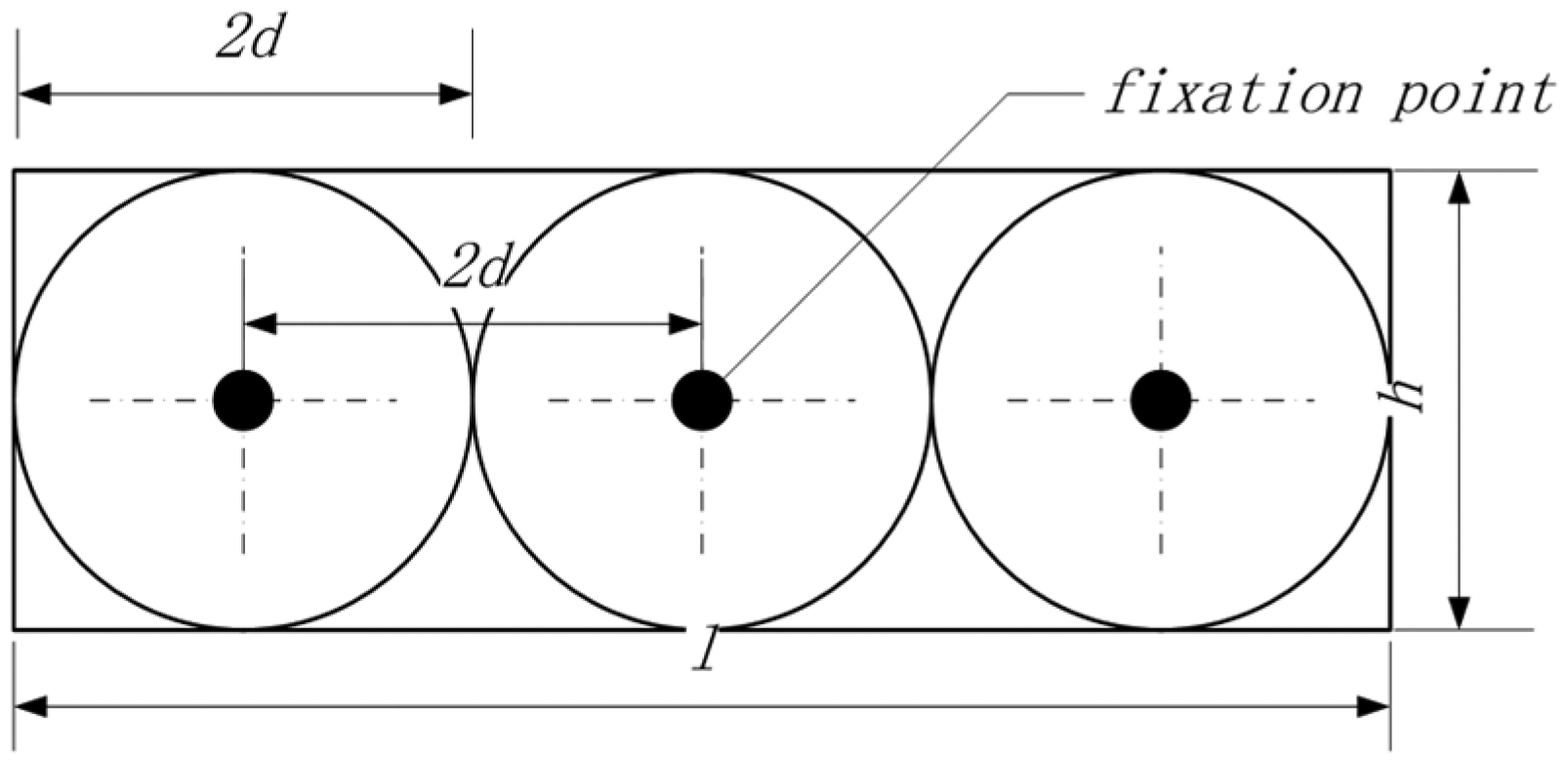
Schematic diagram of the
The flow of the method is shown in Figure 4. In the DBSCAN, if the

DBSCAN-MMC method flowchart.
Results and discussion
Fixation region dividing on the basis of the DBSCAN-MMC
Parameter setting. As described above,
Fixation concentrated regions’ calculation. The
Initial MMC. The initial dataset is morphologically dilated by the radius of the structure element
Morphological operation. The nth to be clustered dataset is the
Iteration. Deciding whether there is fixation points clustered into connected regions in the nth operation. If
Output:

Fixation points’ locations in the driver’s visual field.

Calculated fixation concentrated regions.

Effect of the first morphological dilation.

Clustering result of the DBSCAN-MMC.
It can be seen from Figure 8 that 10 fixation regions and 1 discrete region are generated by the DBSCAN-MMC method. The divided regions’ practical significances referring to Figure 5 are as follows: region 1 is the fixation region when the driver is gazing left through the left window; region 2 is the fixation region when the driver is gazing up through the left window; region 3 is the fixation region when the driver is gazing at the left rearview mirror; regions 4, 5, and 8 are the fixation regions when the driver is gazing at the different forward road and vehicles; region 6 is the fixation region when the driver is gazing up through the windshield; region 7 is the fixation region when the driver is gazing at the rearview mirror; region 9 is the fixation region when the driver is gazing up through the right window; region 10 is the fixation region when the driver is gazing at the left window; and region 11 is the fixation region when the driver is gazing at the dashboard and other things.
Fixation region dividing on the basis of conventional clustering methods
There is large subjectivity in defining MMC’s cluster number, radius of the structure element, and termination conditions; thus, it is not tested for the MMC in this article. The drivers’ fixation regions are divided by hierarchical clustering method 24 and DBSCAN clustering method to analyze the effect of the DBSCAN-MMC method.
The hierarchical clustering dendrogram is shown in Figure 9. The dendrogram consists of many U-shaped lines connecting objects in a hierarchical tree. The height of each U represents the distance between the two subnodes (clustered classes) being connected. The results of hierarchical clustering method (the single-linkage method and Euclidean distance are used to generate classes) are shown in Figure 10 when the cluster numbers are 6, 11, and 15.

Hierarchical clustering dendrogram.

Results of the hierarchical clustering method: (a) cluster number is 6, (b) cluster number is 11, and (c) cluster number is 15.
In the DBSCAN, the
Results of the DBSCAN when the

Results of the DBSCAN: (a)
It can be seen from Figures 9 and 10 that hierarchical clustering method can provide a dendrogram, but the cluster number should be manually selected. And the performance of the method largely depends on agglomerative hierarchical clustering generation method and the distance calculation method. It can be seen from Figure 11 that in the DBSCAN, smaller
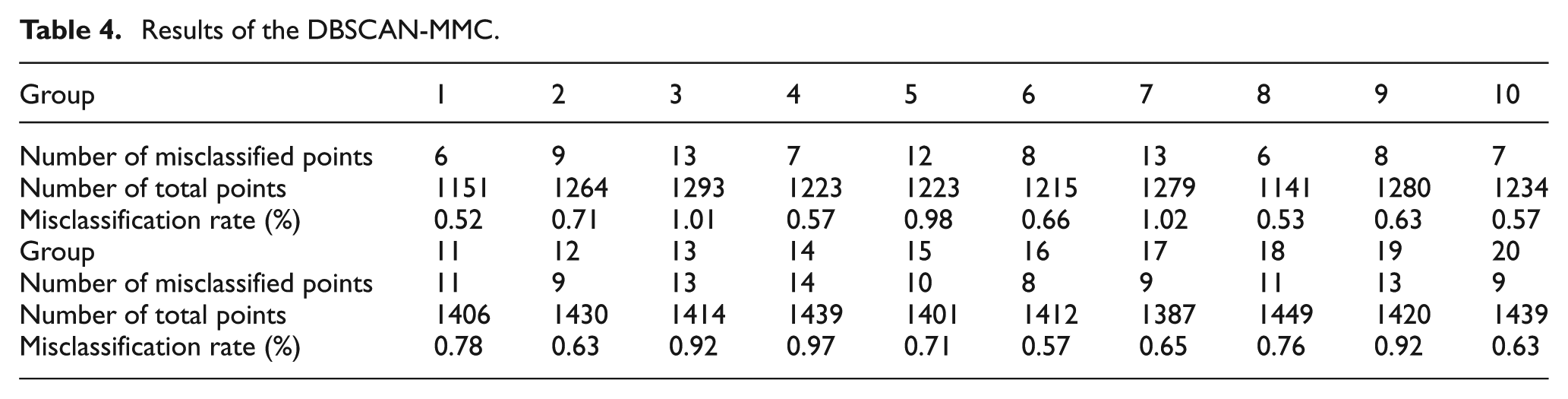
Other 19 groups of fixation point data are clustered. Results of the hierarchical clustering method (the single-linkage method and Euclidean distance are used to generate classes) are reported in Table 2, results of the DBSCAN are reported in Table 3, and results of the DBSCAN-MMC are reported in Table 4. The summary results of the three methods are reported in Table 5.
Results of the hierarchical clustering method.

Results of the DBSCAN.

Results of the DBSCAN-MMC.
Summary results of the hierarchical clustering method, the DBSCAN, and the DBSCAN-MMC.

Discussion
Comparative analysis of the DBSCAN-MMC and hierarchical clustering method
It can be seen from Figures 7 and 8 that the fixation regions’ boundaries using the DBSCAN-MMC were smooth, and the shapes of the regions vary with the changes of the concentrative degree; region 7 in the DBSCAN-MMC’s result is divided into three, five, and eight regions by the hierarchical clustering method when the cluster numbers are 6, 11, and 15, respectively. In Figure 8, the highly concentrated left window’s fixation region (region 2) and the highly concentrated left rearview mirror’s fixation region (region 7) were merged to one region by the hierarchical clustering method, and the right window’s fixation region (region 8) and the right rearview mirror’s fixation region (region 9) were merged to one region by the hierarchical clustering method. It is verified that even if the cluster number is right, the hierarchical clustering method clustered regions’ boundaries may be crude, and the regions may be improperly divided if the agglomerative hierarchical clustering generation method and the distance calculation method are improperly selected.
The clustering effects of the DBSCAN-MMC are better than the hierarchical clustering method. The reasons are as follows: in the DBSCAN, after the concentrated fixation regions are generated by the DBSCAN, the regions can be arbitrarily expanded by the MMC using the structure elements. Once the cluster centers are generated, the proximate fixation points will be divided into different clusters by the distance between the point and the cluster center; thus, the distance-based clustering methods, such as the hierarchical clustering method, may crudely divide boundary if the region is not round or ellipse.
Comparative analysis of the DBSCAN-MMC and DBSCAN
It can be seen from Figures 8 and 11 that the more points closing to boundaries were divided into the off-group region (marked by blue “*”) when the parameter values of the DBSCAN and the DBSCAN-MMC were the same (see Figure 11(a), 11 clusters were generated), more points were divided into the off-group region (see Figure 11(b), 24 clusters were generated) when the
The clustering effects of the DBSCAN-MMC are better than the conventional DBSCAN. The reasons are as follows. When the conventional DBSCAN is used, the dividing of the points closing to boundaries may be largely impacted by the
Comparative analysis of the DBSCAN-MMC, DBSCAN, and hierarchical clustering method
It can be seen from Tables 2–5 that the misclassification rates of the DBSCAN-MMC’s results are significantly lower than the rates of the DBSCAN and the hierarchical clustering method. The summary results show that the method proposed in this article takes into account the advantage of the DBSCAN and the MMC and overcomes the defects of the DBSCAN and the MMC, and the DBSCAN-MMC can improve the quality of driver’s fixation region division.
Conclusion
The importance of seeking reasonable and effective clustering methods was discussed, and the present situation of driver’s fixation region division was introduced. The features of the driver’s fixation regions and the corresponding difficulties in clustering were discussed. The classical density-based clustering method, DBSCAN, and the morphology-based clustering method, MMC, were introduced, and the defects of density-based clustering methods and morphology-based clustering method in dividing driver’s fixation regions were discussed in this article.
The experimental procedure was designed and carried out. In the tests, participants were asked to drive straight, turn left, and turn right at the speed of 20 km/h, and their eye movement data were collected by the eye tracking system and were processed to the fixation point data to be divided by the clustering methods.
The driver fixation region division–oriented DBSCAN-MMC method is proposed in this article. The core idea and the concrete steps of the DBSCAN-MMC were presented. The fixation point data were clustered by the DBSCAN-MMC, DBSCAN, and hierarchical clustering method. The practical significance of the divided regions in the DBSCAN-MMC was discussed. There are many advantages in the DBSCAN-MMC, such as the boundaries of the divided regions are smooth, clustering results will not be largely affected by the values of the parameters, and the method has high robustness. The advantages of the DBSCAN-MMC were discussed and verified by analyzing the results of the DBSCAN-MMC, DBSCAN, and hierarchical clustering method.
The DBSCAN-MMC is proposed to solve the problems of driver’s fixation regions division, improve the reasonability and accuracy of the clustering, and provide theoretical and technical supports for the division of driver’s fixation region and the research of driver’s fixation features. The experimental data in this article were collected from skilled drivers, and the test vehicle is the single model car. Although the representative fixation regions were generated, the vehicle type, the drivers’ characteristics, and the driving proficiency were not deeply analyzed. The items above will be analyzed, and the features and the laws of the driver’s fixation will be deeply and systematically studied in the further researches.
Footnotes
Academic Editor: Moran Wang
Declaration of conflicting interests
The author(s) declared no potential conflicts of interest with respect to the research, authorship, and/or publication of this article.
Funding
This paper was sponsored by the National Natural Science Foundation of China (51308250), the National Natural Science Foundation of China (51308251), China Postdoctoral Science Foundation-funded projects in particular (2014T70292), the China Postdoctoral Science oundation (2013M541306), the Young Technological Innovation Leading Talent and Team Project in Jilin Province (20130521004JH), the Key Laboratory Fund of Xihua University (s2jj2012-038), and the Key Scientific and Technological Project in Jilin Province (20140204021SF).