




Abstract
We presented the model of resistance, inductance, capacitance circuit using a novel derivative with fractional order that was recently proposed by Caputo and Fabrizio. The derivative possesses more important characteristics that are very useful in modelling. In this article, we proposed a novel translation from ordinary equation to fractional differential equation. Using this novel translation, we modified the resistance, inductance, capacitance electricity model. We solved analytically the modified equation using the Laplace transform method. We presented numerical results for different values of the fractional order. We observed that this solution depends on the fractional order.
Introduction
Replication of real-world problems via the use of derivative with fractional order proves to be more accurate and efficient, in particular when dealing with a model where memory or hereditary property characteristics play a fundamental role. One of the most important virtues of derivative with fractional order is perhaps it mathematical design, which involves the convolution.1–6 In the real sense, the convolution is a mathematical formula of two functions producing a third one, which is typically seen as the modified version of one of the original functions; the product is therefore the overlap between the two functions as a function of the amount that one of the original functions is translated. This concept extends its applications in many areas of sciences and engineering including probability, statistics, computer vision, image and signal processing, electrical engineering and many other fields. No wonder, then, that the concept of derivative with fractional order is applicable in almost all the branches of sciences and engineering.11–15
There are few definitions of derivative with fractional order, the old version having a kernel with singularity; this situation does not give a full memory of the description of the physical problem. In order to further enhance the concept of derivative with fractional order, Caputo and Fabrizio 7 have recently proposed a new fractional derivative also designed with the concept of convolution; however, this time the convolute filter is the exponential function, which helps to reduce the risk of singularity. 8 In their paper, they demonstrated that the derivative possesses very interesting properties, for instance, the possibility to portray physical occurrence with different scales.7,8 With the old version of fractional calculus, studies towards modelling of electrical circuits, for instance, domino ladders, tree structures, and element coils, have been done; see the work by Losada and Nieto, 8 Razminia and Baleanu, 9 Petrás 10 and Gómez et al. 11 In the same line of idea, it has been suggested that a fractional differential equation puts together with the simple harmonic oscillations of an LC circuit with the discharging of an RC circuit. With physical observations, it was proven that the wire obtains an inducting behaviour as the current is initiated in it and progressively restores its resisting behaviour.
The main aim of this work is to investigate the possibility of applying the new derivative with fractional order to the resistance, inductance, capacitance (RLC) circuit. The main reason for this application is to include into the mathematical equation the parameter that can be used to describe the low or high flow of electricity. For instance, in many non-developed countries, there is a time during which there is low flow, and one is not able to use all electrical items at the same time. We shall first present some background of the Caputo–Fabrizio fractional derivative and its connection with some integral transforms.
Background of Caputo–Fabrizio derivative with fractional order
The new proposed derivative with fractional order is designed using the convolution of the first derivative of a given function and the exponential function. The mathematical formula is given as follows.
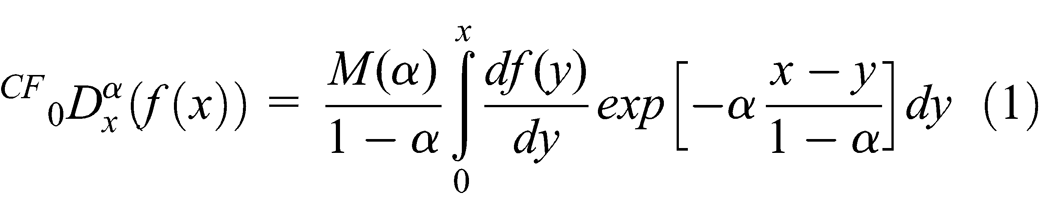
However, when alpha tends to 1 we obtain the first derivative of the function. When alpha tends to zero, we obtain the function

In the paper of Nieto and Losada, we proposed a particular way to find the normalized function. The method uses the fact that the above fractional integral is the average of the function and its anti-derivative for

The connection between the Laplace transform and the Caputo–Fabrizio derivative with fractional order is given as 7

Also, the relationship between the Fourier transform operator and the Caputo–Fabrizio derivative with fractional order is given in the work by Caputo and Fabrizio. 7 Recently, Atangana 12 proposed a relationship between the Caputo–Fabrizio fractional derivative and the Sumudu transform operator, and the relation is given as

In general, Atangana proved that

Modification of the RLC circuit model using the Caputo–Fabrizio derivative
With the old edition of the definition of fractional derivative, many researchers have modified many standard equations to fractional equations without any justification; however, in the work of Gómez et al. 11 a translation of the ordinary derivative operator to the fractional operator was recently proposed as follows

where the additional parameter

In our proposed translation, the auxiliary parameter has the dimension of seconds too. In addition, it represents the time fractional component in the system; that component shows an intermediate behaviour between a conservative and dissipative system. The derivative with fractional order is of course the one of Caputo–Fabrizio type. It is worth noting that the proposition in equation (7) was due to the design of the definition, in particular the function used to convolute with the derivative. It is worth noting that when the order of the derivative is one, we recover the first derivative.
An oscillating circuit in series, in a more broad sense, is an electrical circuit that normally consists of three different components, including a resistor with resistance R measured in ohms, an inductor with an inductance L with unit henries and finally a capacitor with capacitance C with unit farads. The rate of change with respect to the time of the electric charge

In the above model, the last term

One can use either numerical method or analytical method to solve the above equation. In this article, we will solve the above equation using the analytical method. In our work, we consider the second fractional derivative to be sequential meaning

In this case, we will use the Laplace transform method. Therefore, applying the Laplace transform on both sides of equation (10) we have the following

We shall first work out

For simplicity, we consider

Then


and

Then, equation (13) becomes

Replacing equation (15) into equation (12), we obtain the following
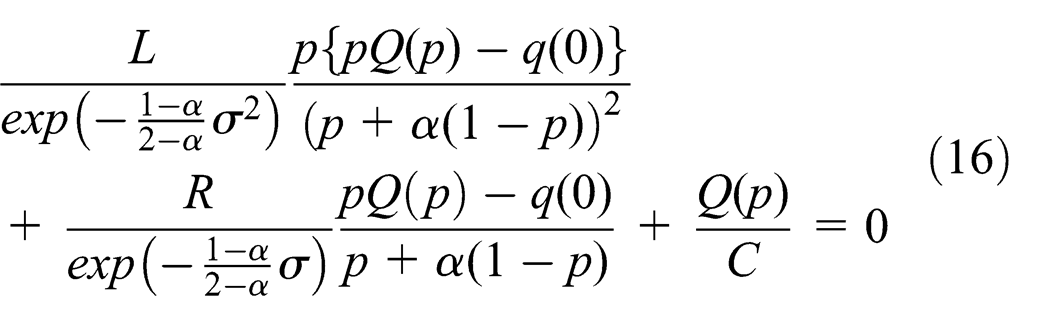
For simplicity, let us put

After arrangement, we obtain

Thus

We present the solution of equation (10) in Laplace space as a function of

Contour-plot of the flow of electricity in Laplace space and as a function of alpha.
However, the exact solution of the modified equation is obtained by applying the inverse Laplace on both sides of equation (18) to obtain

Due to the robustness of the exact solution, we will give the exact solution for particular parameters. Here, we consider L = 10, R = 100, and C = 50; at the beginning we have q = 200 and the time scale is first considered to be 1. We present the exact solution for different values of alpha. Thus, when alpha is 0.95 we have the following exact solution
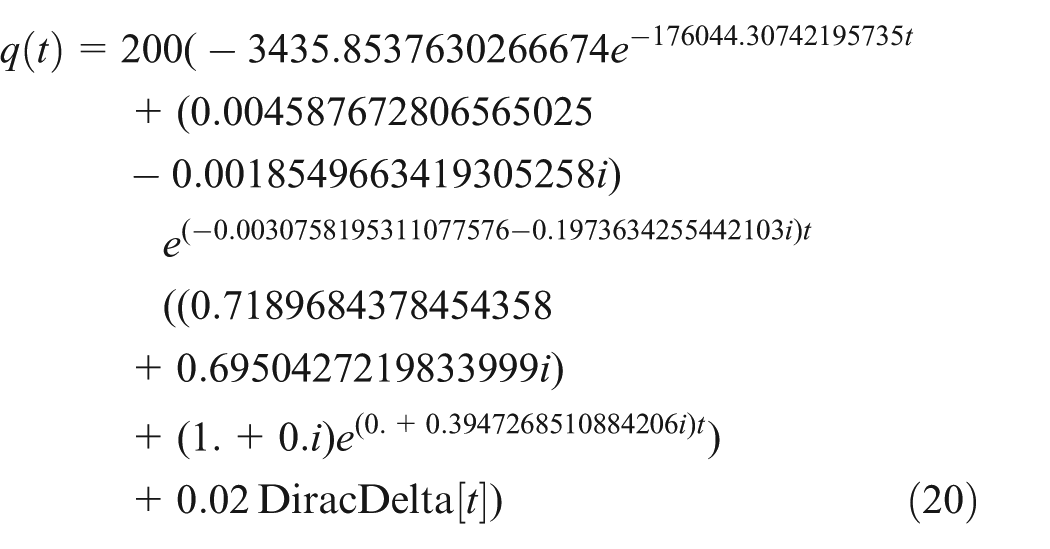
The numerical simulation of the above solution is depicted in Figure 2.

Numerical solution for alpha = 0.95.
The exact solution when alpha is 0.85 is given as

The numerical solution is depicted in Figure 3.

Numerical solution for alpha = 0.85.
For alpha = 0.65, we have the following exact solution

The numerical simulation is shown in Figure 4 (similarly in Figure 5 for alpha = 0.45).

Numerical solution for alpha = 0.65.

Numerical solution for alpha = 0.45.
In Figure 6, we show all the solutions as a function of alpha.

Comparison for different values of alpha.
From the figures, one can see that this solution depends heavily on the order of the derivative alpha. We observe more oscillations as alpha approaches 1, and we have less oscillation as alpha approaches zero. It is clear from the figures that the fractional-order derivative plays an important role in the numerical simulations. For some alpha, one will be able to describe the situation of low voltage, for other one can describe the over-voltage.
Conclusion
Recently, a novel derivative with fractional order able to portray physical behaviour in different scales was proposed by Caputo–Fabrizio. The new derivative is actually a convolution of the first derivative with an exponential function; the formula is therefore a derivative with no singular kernel. In order to further investigate the possible application of this new operator, we first proposed a novel transition from an ordinary differential equation to fractional differential equation and used it to model the flow of electricity in an RLC circuit. An exact solution was obtained using the Laplace transform method, and their numerical simulations were presented.
Footnotes
Academic Editor: Xiao-Jun Yang
Declaration of conflicting interests
The authors declare that there is no conflict of interest.
Funding
This research received no specific grant from any funding agency in the public, commercial or not-for-profit sectors.