




Abstract
Nanofluid is an innovative heat transfer fluid with the potential to significantly enhance the heat transfer performance of traditional fluids. By adding various types of nanoparticles to ordinary base fluids, several attempts have been made to boost the rate of heat transfer and thermal conductivity. The unsteady electrically conducting flow of Brinkman-type nanofluid over an infinite vertical plate with ramping wall temperature and concentration is investigated in this article. Water is taken as the base fluid, and multi-walled carbon nanotubes are distributed equally throughout it. The Caputo-Fabrizio fractional derivative, which has a non-singular kernel, is used to generalize the classical model. The Laplace transform technique has been utilized to achieve exact solutions. Furthermore, various graphs for fractional and physical parameters are used to represent the solutions. All figures are drawn for both conditions, that is, ramped and isothermal wall temperature and concentration. The velocity field increases for greater values of thermal and mass Grashof numbers while the reverse effect is observed for Hartman number, Brinkman parameter and volume fraction. Moreover, the obtained results are also reduced to the already published results in order to show the validation of the present results. The results are used to calculate the skin friction, Nusselt number, and Sherwood number. The heat transfer of pure water is increased by 17.03% when 4% of nanoparticles are added to it which will of course increase the efficiency of solar collectors and solar pools. Moreover, the mass transfer decreases by 3.18% when 4% of nanoparticles which are dispersed in it.
Keywords
Introduction
Nanotechnology has grown rapidly in recent decades in a variety of disciplines of engineering and science, including electronics and power generation, where heat transmission is a common occurrence. The additional technological progress need specialized heat transfer management. Many researchers have attempted to study an effective heat transfer medium for this purpose. Many techniques have been explored but failed owing to scientific limitations, such as the micro channel and extending the surface area. For the enhancement of the heat transfer rates, many experiments characterized and examined different nanofluids. Nanofluids are a combination of nanoparticles and traditional base fluids. Water, motor oil, ethylene, and crude oil are examples of base fluids. Molybdenum disulfide, aluminum, graphite, silver, copper, and other nanoparticles dispersed in the basic fluids. Scientists have been attempting to solve this problem since the beginning to improve the characteristics of various kinds of fluids. They are trying to improve the deficiencies of these regular fluids. The nanoparticles dispersion in the base fluid had been discovered for the first time by Choi and Eastman. 1 Various Nanofluids in heat transfer applications have been described, produced, and evaluated by several researchers.2,3 For the combination of nanoparticles with base fluids, several theoretical and experimental research are conducted. In base fluids including oil, water, and concrete, nanoparticles such as metallic oxides, carbide ceramics, nitride ceramics, and carbon in different forms are widely employed. However, because to their high thermal conductivity, some recent research suggest that carbon nanotubes (CNTs) are better suitable for heat transfer rates.4,34 The heat conductivity of CNTs nanoparticles is high, while their density is low.
A thermal energy transfer from a greater concentration to a lower concentration is referred to as “transfer of heat.” Mass transfer is the net movement of mass from one location to another. Conduction, convection, and radiation are all ways for transferring heat. The combined effect of bouncy thermal diffusion causes the mass and heat transfer are also being studied at the same time. Cooling processes, solar collectors, food processing, and many other lubricants such as engine oil are all examples of this phenomenon in modern technology and industries. An isothermal process is a thermodynamic process that occurs at a constant temperature. Heat transfer can be seen in this step since the temperature remains constant. An isothermal process is one in which the amount of work done is due to the system’s net heat content. We can say that an isothermal process is a constant temperature process. Isothermal processes include changes in the state or phase of various fluids due to melting and evaporation. Thermal equilibrium is maintained because heat is transferred in and out of the system at a slow rate. The heat produced by a device is referred to as “thermal.” The word “isothermal” refers to the concept of “equal heat,” which is defined as thermal equilibrium. Isothermal means “equal heat,” as “iso” means “equal.” Different researchers investigated the heat transfer in fluids by considering the isothermal process. Akram and Nadeem 5 examined the effects of a magnetic field and heat transfer on two-dimensional Jaffrey fluid peristaltic motion in an asymmetric channel. The effect of heat radiation along with ramped wall boundary conditions on the fluid flow was studied by Anwar et al. 6 Khan et al. 7 investigated free convection Maxwell fluid flow with ramping wall temperature and concentration. Through an infinite isothermal vertical plate, Soundergekar 8 calculated the exact solution to the viscous flow problem.
When it comes to the flow through a porous material, classical Navier Stokes’ equation fails. Several important physical processes in porous media have been explored for transport of mass and heat in the literature. Other variables included the effect of local thermal equilibrium between the solid phases and the fluid, thermal dispersion, porosity variance, and anisotropic porous media. Many scientific investigations have been done through permeable medium utilizing generalized model during the last few decades. The Darcy model is defined in detail by Brinkman-Forch-Homier. Brinkman introduced one of his unique models for flow of fluid among a permeable media.9,10 As Brinkman explained, when a flow moves through a highly permeable medium, it is referred to as a Brinkman-type fluid flow. Using a magnetic field, Varma and Babu 11 studied the steady flow of an incompressible fluid across a channel with varying permeability medium. Using the Brinkman model, Hsu and Cheng 12 studied fluid flow through a semi-infinite vertical plate immersed in porous material. Rajagopal 13 looked on fluid flow through a porous medium and included the influence of the porous media in the governing equations. Vafai and Tien14,15 proposed a generalized transport model. In addition, a lot of research is reported on the effects of inertial forces and solid walls through a porous media. Vafai 16 and Hadim and Vafai 17 wrote a book chapter on the importance aspects of porous media transport phenomena. Vafai and Hadim 18 and Sözen and Vafai 19 done extensive research in porous media on multiphase transport, and models were developed. These investigations initiated and explored a systematic report of several various phase models with the phase change process. Alazmi and Vafai 20 show the differences between porous media’s heat transfer and flow transport models. Vafai et al. 21 examined the literature for a number of turbulent models in permeable medium. Porous media theory is also frequently applied in biological applications. Khanafer and Vafai 22 looked into turbulent flows in porous medium with drug delivery and magnetic particles movement. Khaled and Vafai 23 studied the diffusion process in brain tissues, blood movement in cancers, and bioheat transport in tissues using the porous media.
Many physical problems are outside the reach of simple classical models to explain. Fractional calculus was developed to investigate these problems. The generalized form of classical calculus is fractional calculus. After Leibniz introduced the definition of the nth order derivative, fractional calculus was developed. Del Hospital asked Leibniz what would happen if fractional-order is considered. 24 Following that, several scientists started to think about it, proposing alternative meanings of fractional derivatives. Fractional calculus has practical applications in modern technology electrochemistry, electromagnetism, electric circuits, voltage dividers, neuron models, 3-D chaotic structures, and chaotic circuits, heat and mass transfer phenomenon, mathematical epidemiology.25–30 It was stated by Leibnitz in a 1695 letter to L. Hospital. 31 During the first part of the nineteenth century, systematic investigations on fractional calculus were conducted. 32 Fractional derivatives are defined in many ways in the literature and applied to various sciences, technology, and engineering sectors to explore real-world applications. 33 From open literature, it is cleared that derivatives of integer orders are local in nature while derivatives in the fractional form are non-local, which retain memory property.34,35
To the best of the author’s knowledge, the literature upon the nanofluid flow problems with the effect of the ramped and isothermal wall boundary conditions is very rare. Therefore, based on the above literature, the present study is carried out for the MHD flow of Brinkman type nanofluid with the joint effect ramped and isothermal wall boundary conditions on temperature and concentration. Water is considered as a base fluid while MWCNTs are equally dispersed in the base fluid in order to enhance its performance regarding it’s applications. Furthermore, to generalize the classical model, Caputo-Fabrizio (CF) time fractional time has been used to convert the classical Brinkman model with energy and concentration equations into a fractional form. With the governing momentum equation, the generalized energy and concentration equations are coupled in the momentum equation. For the exact solutions of coupled system of PDEs, the Laplace transform technique has been used. Additionally, the present results are also validated and reduced to the already published work. The embedded parameters have been illustrated using a variety of graphs with physical explanation.
Mathematical formulation
The current problem considers the unsteady, laminar, and MHD flow of Brinkman-type nanofluid through an infinite plate. The fluid is thought to be electrically conductive. The impact of the magnetic field is chosen along the y-axis, which is perpendicular to the flow direction, while the fluid flow is examined along the x-axis as shown in Figure 1. Both the plate and the fluid are initially at rest for




Geometry of the problem.
Here,
The following are the fields for velocity, temperature, and concentration which can be seen in Figure 1 given above:

Using equation (4), equations (1)–(3) in components form for Brinkman type nanofluid flow becomes:
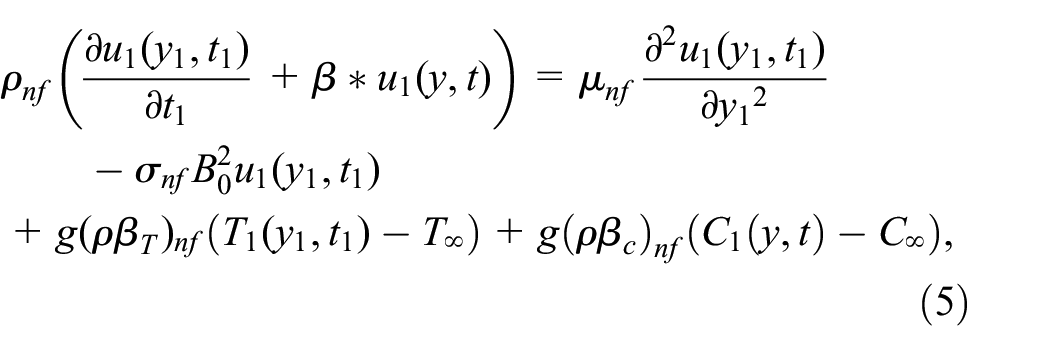


where
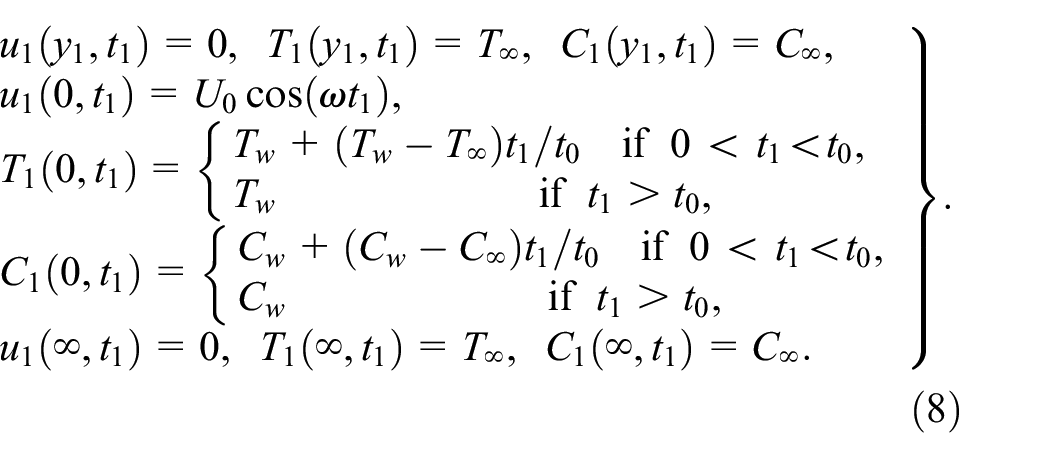
Where mathematical expressions for
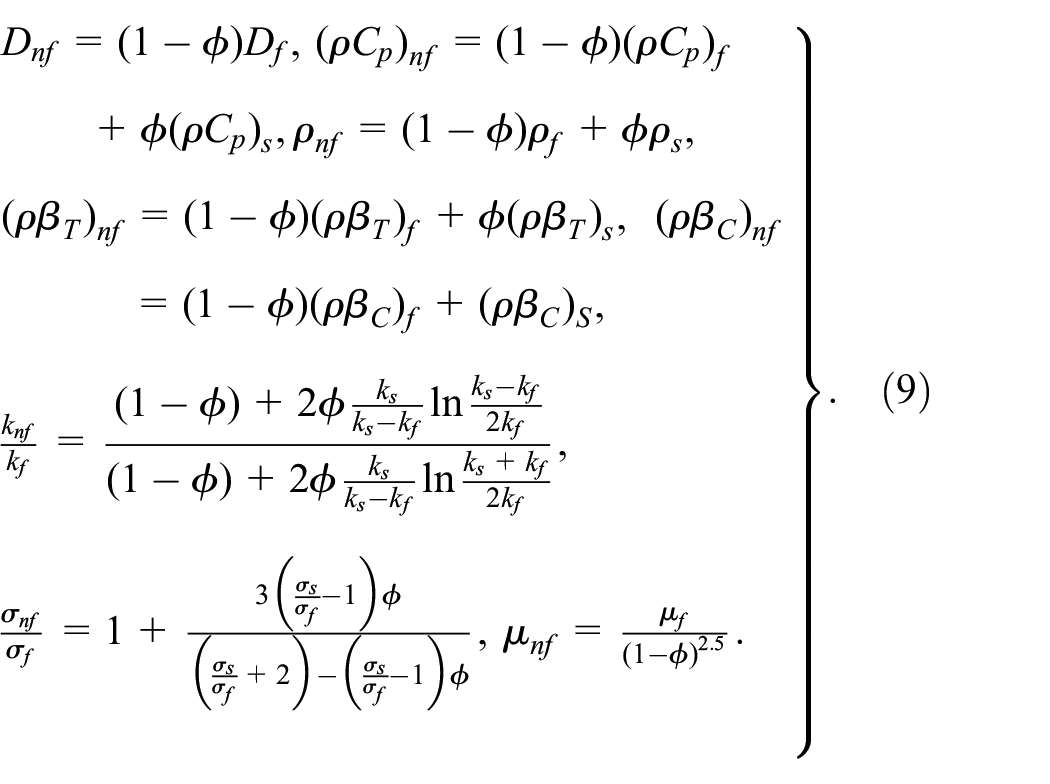
Nanofluid, base fluid, and solid CNTs nanoparticles are denoted by the subscripts the subscripts
Thermo-physical properties of H2O and MWCNTs. 34

Introducing the following dimensionless variables for nondimensionalization:

By using the dimensionless variables given in equation (10) and dropping * notation, with initial and boundary conditions, the dimensionless form of the governing equations becomes:


with

where

Here,
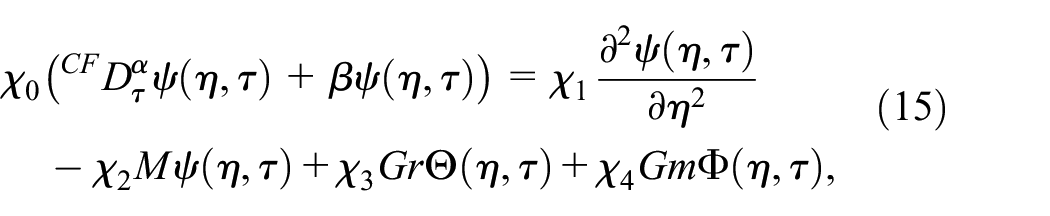


Where

Where
Solution of the problem
This section provides the exact solutions of the considered fractional model by using the Laplace technique:
Solutions for temperature field
We get the following results by applying the Laplace transform to equation (16) and utilizing equation (14).

while the transformed boundary becomes:

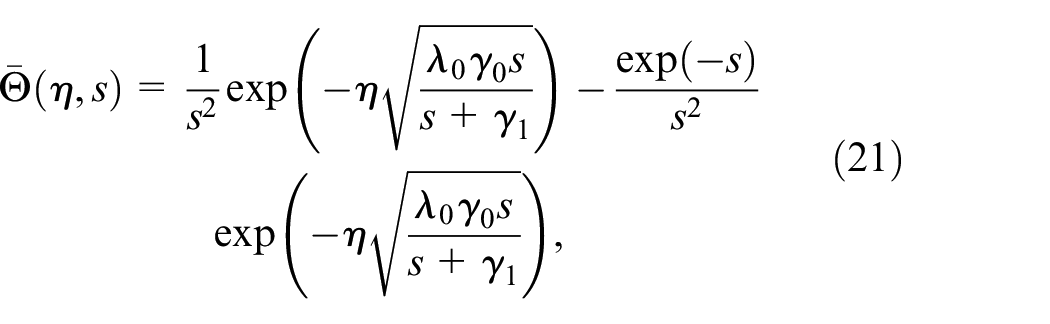
The boundary conditions provided in equation (20) are used to find the solutions of equation (13) in the Laplace transform domain as:
where
It’s crucial to note that equation (21) is the Laplace transform domain solution of the energy equation with ramped wall temperature. Equation (21) can be further reduced as follows:

where:
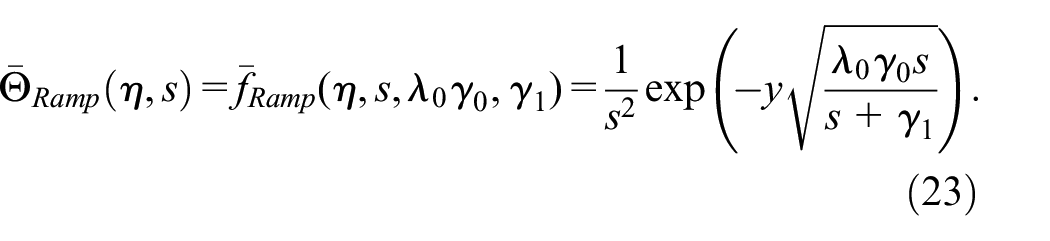
The inverse Laplace transform is used to convert equation (23) back to its original form, yielding:

where

Where

When

such that

The inverse Laplace transform is used to equation (28) to obtain the time domain solutions for isothermal temperature, yielding:

The exact solutions of equation (16) for ramped and isothermal temperatures are represented by equations (24) and (29), respectively.
Solution of concentration
By applying the Laplace transform technique in the same way applied in the temperature field, the solution of concentration equation given in equation (17) after applying the Laplace domain becomes:

where
The solutions for Ramped wall concentration take the following form:

Where

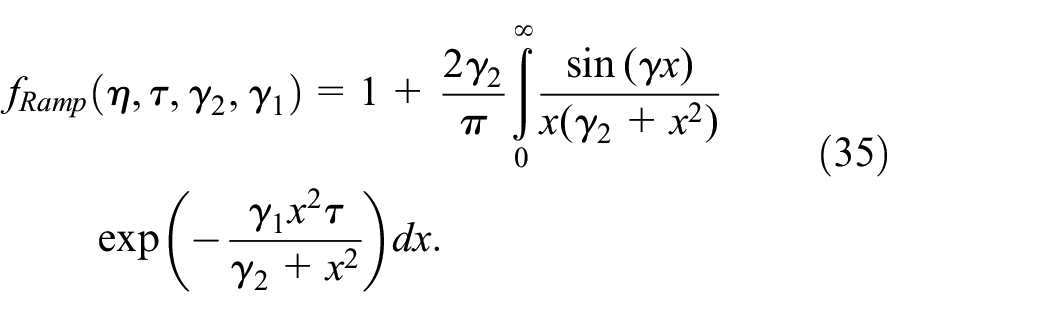
By inverting the Laplace transform, we get:

The term

where
When

such that

By taking the inverse Laplace transform, we get:

Equations (33) and (35) represent the exact solutions of equation (16) for ramped and isothermal concentrations, respectively.
Solution for the velocity field
By applying the Laplace transformation to equation (15) and utilizing equation (14), yields:
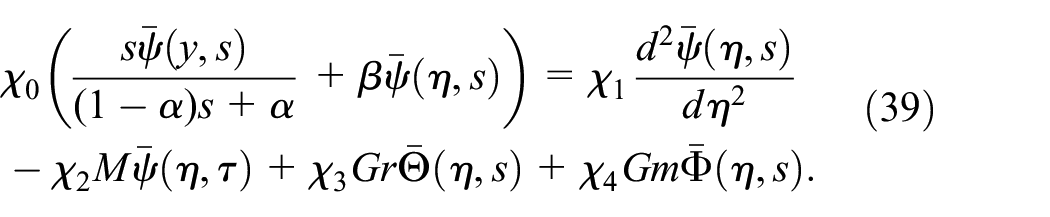
After further simplification and incorporating equations (21) and (30), we obtain:

The transformed boundary conditions are:

where
The solution of equation (40) in the Laplace domain can be written as:
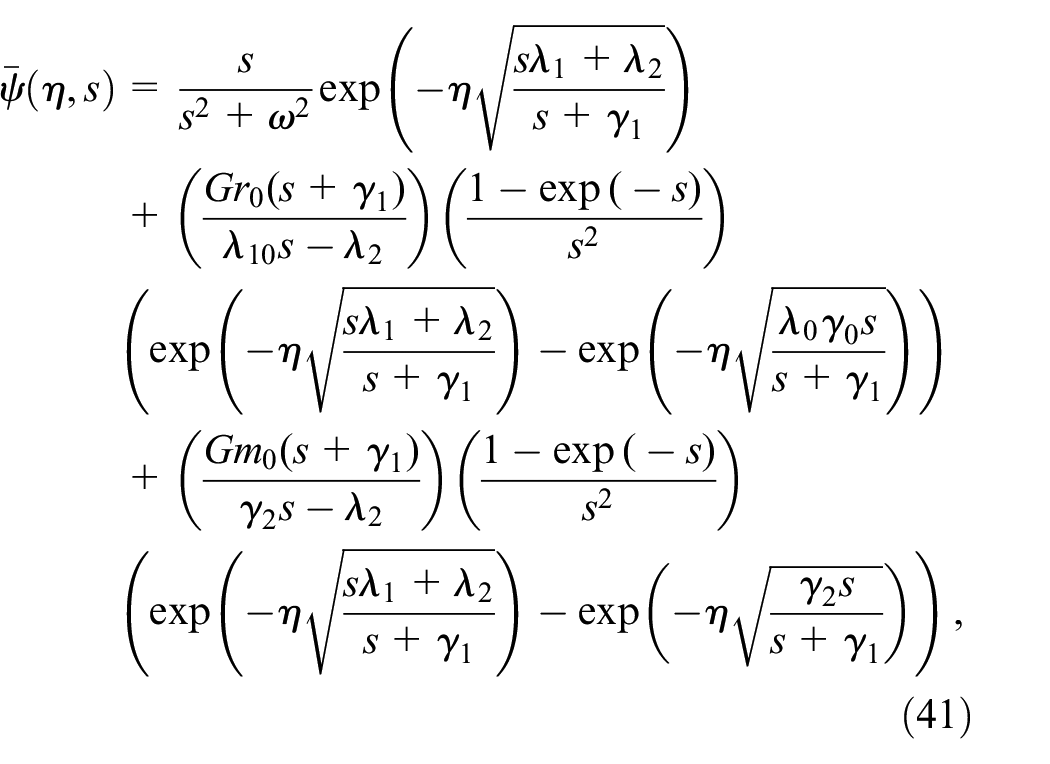
where
Equation (41) can be rewritten in a more appropriate way as:

where




Upon inversion of the Laplace transform, equation (42) becomes:

where
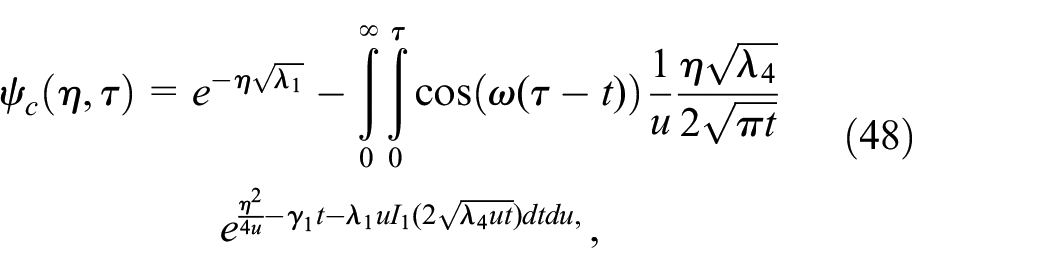



here

where * represents the convolution product. It’s worth noting that equation (47) describes velocity field solutions with ramping wall boundary conditions. For isothermal boundary conditions, equation (15) is now re-solved as:

To write equation (52) more simplified and convenient form as

The terms

The inverse Laplace transform of equation (46), which has the following form, yields the solution for isothermal temperature:

where

and
Limiting case
The obtained results given in equations (47) and (55) can be reduced to the results published by Saqib et al.
34
by ignoring mass Grashoff number that is,

and

The results given in equations (57) and (58) are identical to the final solutions obtained by Saqib et al. 34 which validates the correctness of the obtained solutions.
Nusselt number, Sherwood number, and skin friction
Nusselt number
The Nusselt number has the following mathematical expression:

Sherwood number
The Sherwood number has the following mathematical expression:

Skin friction
The Skin friction has the mathematical expression as:

Results and discussion
The goal of this study is to see how a Brinkman-type nanofluid flows through a vertical plate with the influence of applied magnetic field. The influence of ramped and isothermal boundary conditions on concentration and temperature is also examined. To generalize the classical model, Caputo-Fabrizio fractional derivative is applied. Additionally, water is considered as a base fluid while MWCNTs are dispersed to enhance the thermal properties of regular water. The Laplace transform technique is used to analyze exact solutions. Temperature, concentration, and velocity field closed form solutions are computed. The physical representation of the present problem can be seen in Figure 1. The temperature, velocity, and concentration distributions are graphically represented in Figures 2 to 12. The velocity distributions are shown in Figures 2 to 7, where Figures 8 to 10 show the temperature distribution. Figures 11 and 12 show the effect of concentration distributions. It’s worth noting that we use

Velocity distribution for different values of

Velocity distribution for different values of

Velocity distribution for different values of

Velocity distribution for different values of M.
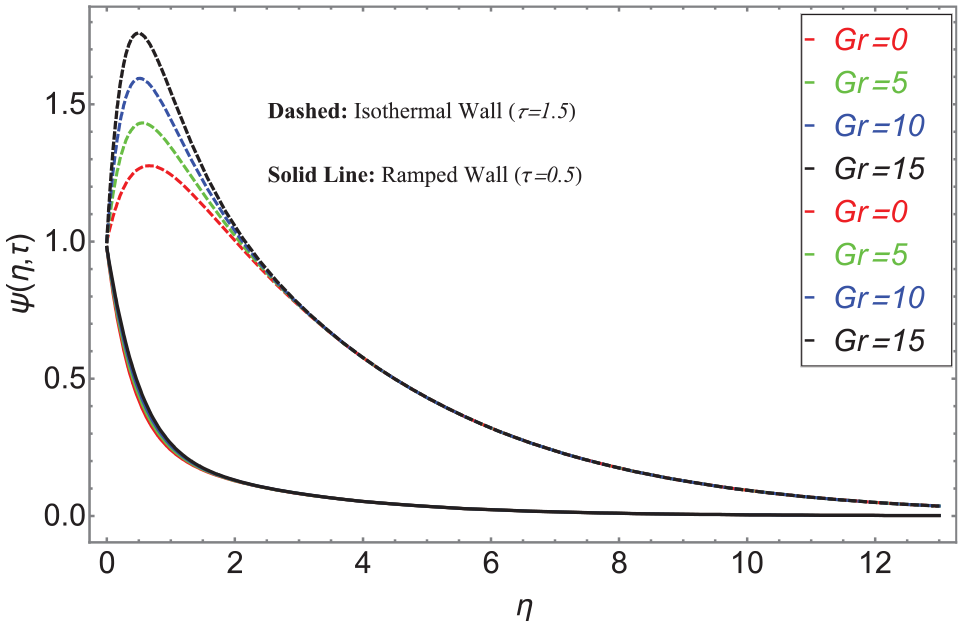
Velocity distribution for different values of Gr.

Velocity distribution for different values of Gm.

Temperature distribution for different values of

Temperature distribution for different values of

Temperature distribution for different values of t.

Concentration distribution for different values of
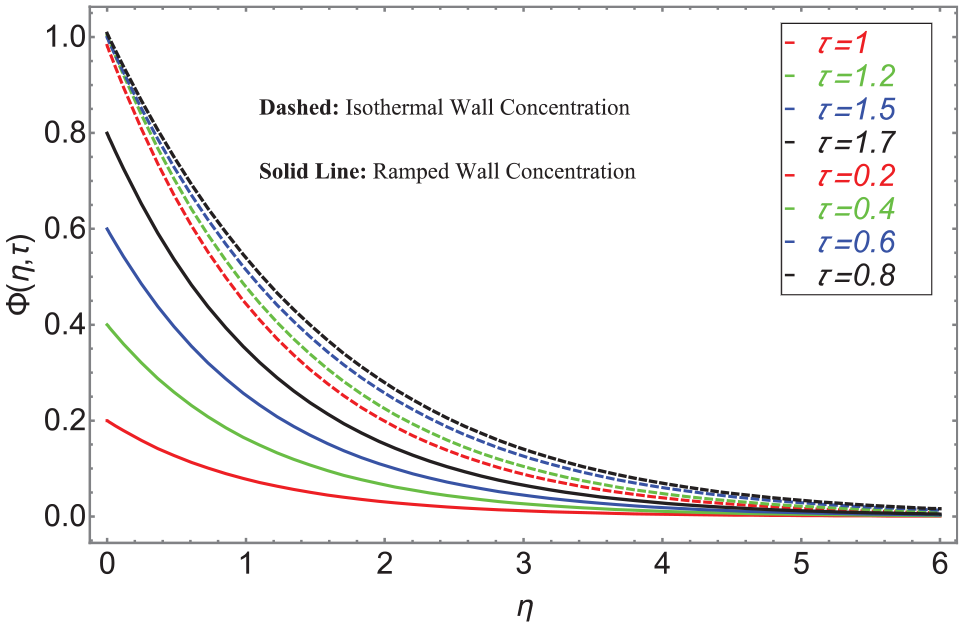
Concentration distribution for different values of t.
Figure 2 shows the effect of
Figure 8 shows the effect of
The effect of
For the validation of the present results, we also reduced the present solutions to the solutions of Saqib et al.
34
by taking

Comparison of the present results with the published results of Saqib et al. 34
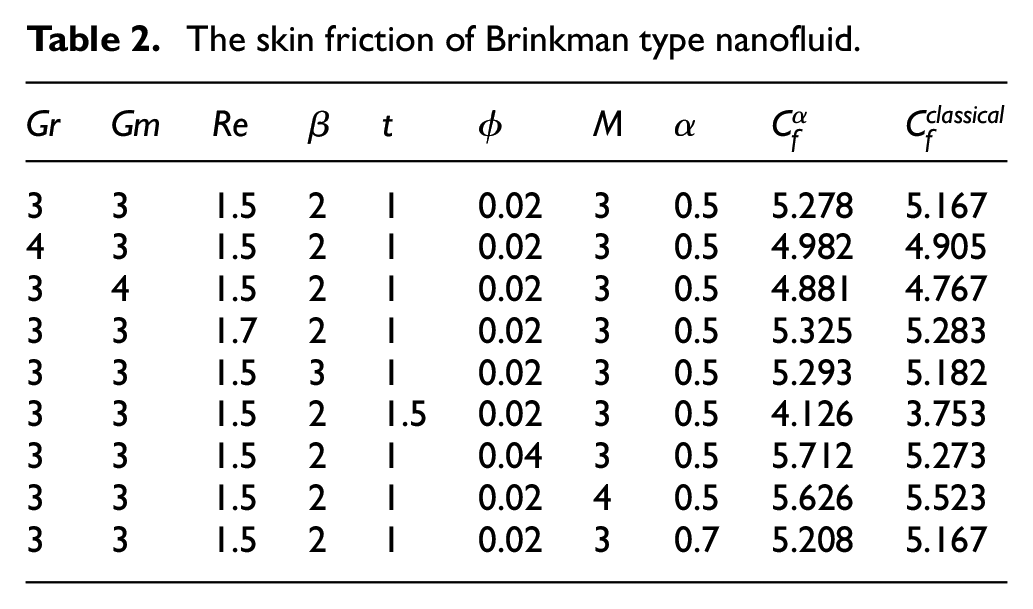
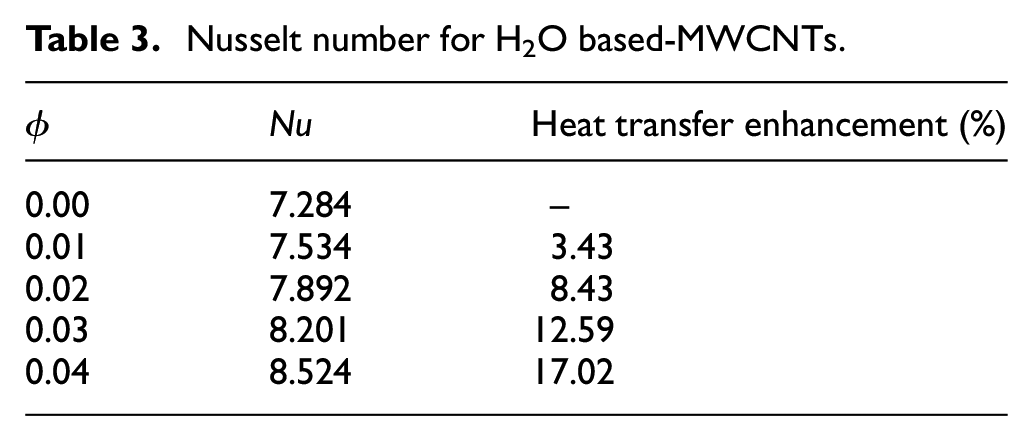
The thermophysical properties of the base fluid as well as nanoparticles is given in Table 1. The variation in skin friction against different parameters is tabulated in Table 2. Skin friction is calculated for both the cases, that is, classical as well as the fractional case. Similarly, variation in Nusselt number against
The skin friction of Brinkman type nanofluid.
Nusselt number for H2O based-MWCNTs.
Sherwood number for H2O based-MWCNTs.

Conclusion
This research is conducted to determine the closed form solutions for Brinkman-type nanofluid flow over a vertical plate. The effects of ramping and isothermal wall boundary conditions on the fluid’s temperature and concentration are examined in the presence of an applied magnetic field. The nanoparticles utilized are MWCNTs, and the base fluid is water. The classical model is then generalized by using the Caputo-Fabrizio fractional derivative, which has recently become the most often used fractional derivative. The solutions of the coupled system is obtained via the Laplace transform technique. The obtained results are also validated by reducing and comparing it with the already published results by making some parameters absent. The graphs also illustrate the results that have been obtained. The following are the main points of the study:
A decrease in the nanofluid velocity can be observed for large values of
The present results are reducable to the classical Brinkman type nanofluid model by taking
The obtained results are also reducable to the already published results of Saqib et al.
34
by taking
The velocity profile decreases for larger values of M and
By raising Gr and Gm, the velocity profile can be enhanced.
Increasing
By raising
Increasing the value of
Increasing the value of
Footnotes
Acknowledgements
The authors are highly thankful and grateful to ORIC-CUSIT for generous support and facilities of this research work.
Handling Editor: Chenhui Liang
Declaration of conflicting interests
The author(s) declared no potential conflicts of interest with respect to the research, authorship, and/or publication of this article.
Funding
The author(s) received no financial support for the research, authorship, and/or publication of this article.
