In this research, we applied the variational homotopic perturbation method and q-homotopic analysis method to find a solution of the advection partial differential equation featuring time-fractional Caputo derivative and time-fractional Caputo–Fabrizio derivative. A detailed comparison of the obtained results was reported. All computations were done using Mathematica.
In this research work, we have suggested the q-homotopic analysis method and the variational homotopic perturbation method to find a solution for the advection partial differential equations with time-fractional derivatives. We applied the methods based on Caputo–Fabrizio and Caputo derivatives1,2 in order to compare the reported results. This work at first has been conducted in order to use the homotopic analysis method by Liao3 and further to use it in order to solve PDEs featuring time-fractional derivative. El-Tawil and Huseen4 proposed a method called which is considered a more general method of HAM. There exists a supportive parameter n and h in such that on concession that , the standard HAM can be obtained. Otherwise, we consider the VHPIM.5 It should be noted that there are no accurate analytical solutions for most of the fractional differential equations. Consequently, for such equations we have to employ some direct and iterative methods. Researchers have used variant methods to solve fractional differential equations (FDEs) and fractional partial differential equations (FPDEs) in recent years. These methods include Abdomina’s decomposition method,6,7 variational iteration method ,8,9 HPM,10–12 and HAM.13–17
There are some books and papers related to applications of fractional calculus fitting real data for interested readers.18–22
This work is arranged as follows: in section “Preliminaries,” the preliminaries are introduced. In section “Fundamental notion of the q.HAM,” the description of the is offered. The VHPIM in section “Fundamental of VHPIM” is explained. In section “Application and consequences,” the application of and VHPIM to the advection differential equation featuring time-fractional derivative is illustrated and makes a comparison of and VHPIM featuring Caputo–Fabrizio and Caputo derivative, respectively. Finally, in section “Conclusion,” some conclusions regarding the proposed method are drawn.
Preliminaries
In this section, we introduced briefly Caputo’s fractional derivative1 and Caputo–Fabrizio fractional derivative.23–26
Definition 2.1
A function belongs to , , is assumed to be in , on the occasion that be , that , which , which is considered to be in iff , .
Definition 2.2
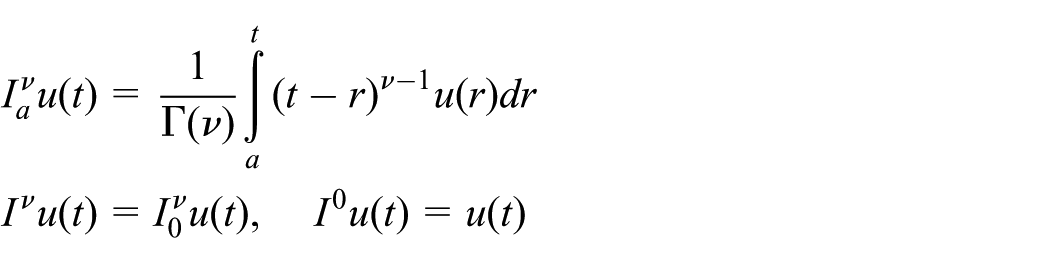
The fractional integral of , , stated below is named Niemann-Knoxville fractional integral operator featuring , of a , , will be stated in the form below
Definition 2.3
The fractional derivative of stated below is named Caputo’s fractional derivative
The fractional derivative of stated below is named Caputo–Fabrizio’s fractional derivative23
in which , , and is called the normalization function and it satisfies .
Definition 2.6
The fractional integral of stated below is named Caputo–Fabrizio fractional integral
Remark 2.7
When , the property below convinces
Fundamental notion of the q.HAM
To explain the essential notions of the for time-fractional PDEs, we consider
in which is an unfamiliar function, is an operator nonlinear and linear, t and x denote the independent variables, and denotes that Caputo fractional derivative or Caputo–Fabrizio fractional derivative featuring . First, we construct the zero-order modified equation as
here , is the embedded parameter, is a supportive parameter, is a supportive function, is a supportive linear operator, and is primary speculation. Clearly, since and , equation (6) turns out to be
in the state order. Therefore, q goes up from to , the answer changes to the primary speculation to . If , , h, and are selected suitably, answer of equation (7) exists for .
Here, we consider the Taylor series expression of with respect to q in
where
It is supposed that the supportive linear operator, the primary speculation, the supportive parameter h, and the supportive function are opted so, equation (8) is convergent when . Following that the rough answer (8) can be represented as
Then, we can express the vector
After mth-order derivation of equation (6) by attention to q, next with , the mth-order modified equation is given as
with primary concessions
where
and
Operating the Niemann-Knoxville integral operator on both sides of equation (12)
With regard to the fact that is controlled by equation (12) featuring linear boundary concessions that are resultant from the initial problem.
As a result of the existence of the factor , there will be more chance for the occurrence of convergence or even we can achieve faster convergence in comparison with the standard HAM.
Fundamental of VHPIM
In this part, we assume VHPIM in two stages for equation (5), featuring
in which and in which derivatives concerning t and x, is an operator in t, and x. Now, VHPIM is introduced in the following two stages.
Stage 1
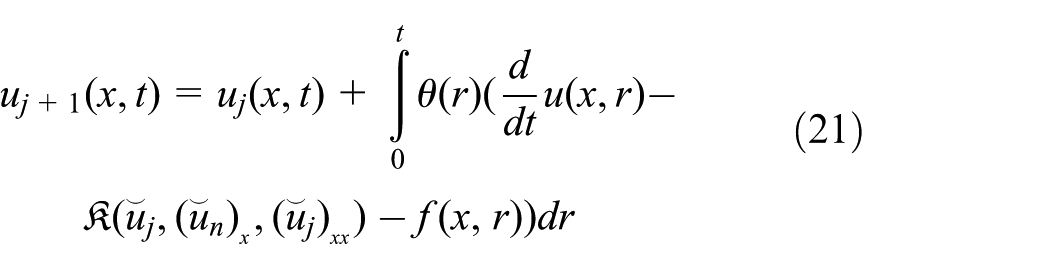
Conforming to VIM, we construct the rectification functional for formula (5)
Here, implies the Niemann-Knoxville fractional integral, and is a Lagrange coefficient, that can be recognized as optimal by variational approach. The function is supposed as a limited variation. In other words, .
Stage 2
By utilizing the HPM and VIM, we obtain the below formula
In equation (19), is a secured parameter and is a primary estimate of formula (5).
Balancing the sentences featuring the same powers of p in two sides of the formula (18), we may obtain .
Eventually, conforming to HPM, when p tends to be , we can gain the answer with approximation
Differently, conforming to VIM, the rectification functional (19) that may be uttered by approximation is stated as
where is a rectification functional; however, is assumed as a surrounded variation, that is, .
Afterward, by creating functional stationary
the Lagrange multiplier will be equal to . Thus, the following repetition rule to be earned
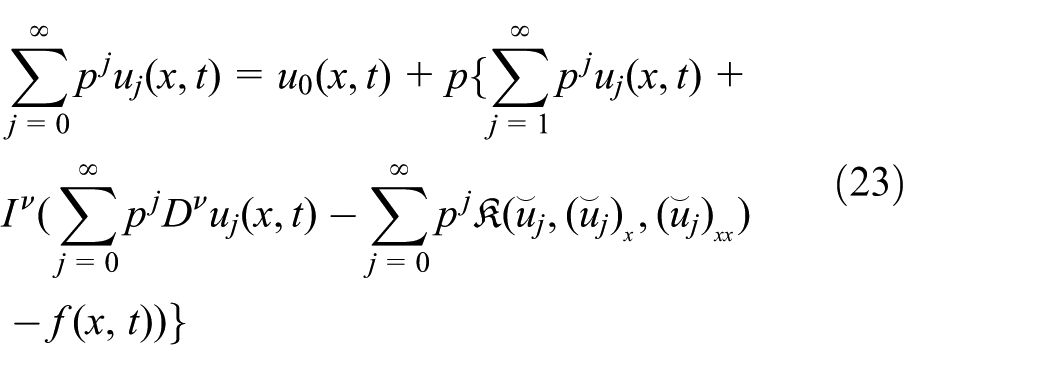
Applying equation (19), we can create the repetition rule as follows
Balanced with the coefficient of some power of p in two hands of equation (23), we can get . As a consequence HPM, we can gain an answer of equation (5)
Application and consequences
In this portion, we utilize and VHPIM to solve time-fractional advection PDE
where , , and is chosen featuring the primary status
With the replacement of the primary status in the recurrent formula (16), the consequence with featuring Caputo derivative is stated as
Then, we consider the first three sentences with as estimates of answer for formula (24)
Now, when the incipient value is substituted into the recursive equation (16), with featuring Caputo–Fabrizio derivative, we can obtain
The first three statements for approximate answer for equation (24) will be stated as
Substituting the incipient value within the recurrent formula (16), the consequence with VHPIM featuring Caputo derivative will be
Then, consider the first three sentences with as estimates of answer for formula (24) are
Now, when the initial amount is substituted into the iteration (16), with VHPIM featuring Caputo–Fabrizio derivative
Following that, the third sequence term approximate answer for formula (24) is stated as
In Tables 1 and 2, we may observe the rough answers for , that is taken for several values of x and t using and VHPIM with two fractional derivatives, involving singular differential operator which is named Caputo and involving nonsingular differential operator which is named Caputo–Fabrizio.
Estimate values with when , , and for equation (24).
Approximate answer
t
x
Caputo
Caputo–Fabrizio
0.3
0.50
0.15
0.150334
0.150334
0.75
0.225
0.225500
0.225500
1.00
0.30
0.299673
0.299673
0.5
0.50
0.25
0.248333
0.248333
0.75
0.375
0.372499
0.372499
1.00
0.50
0.496666
0.496666
0.7
0.50
0.35
0.348534
0.348534
0.75
0.525
0.507832
0.507832
1.00
0.70
0.677110
0.677110
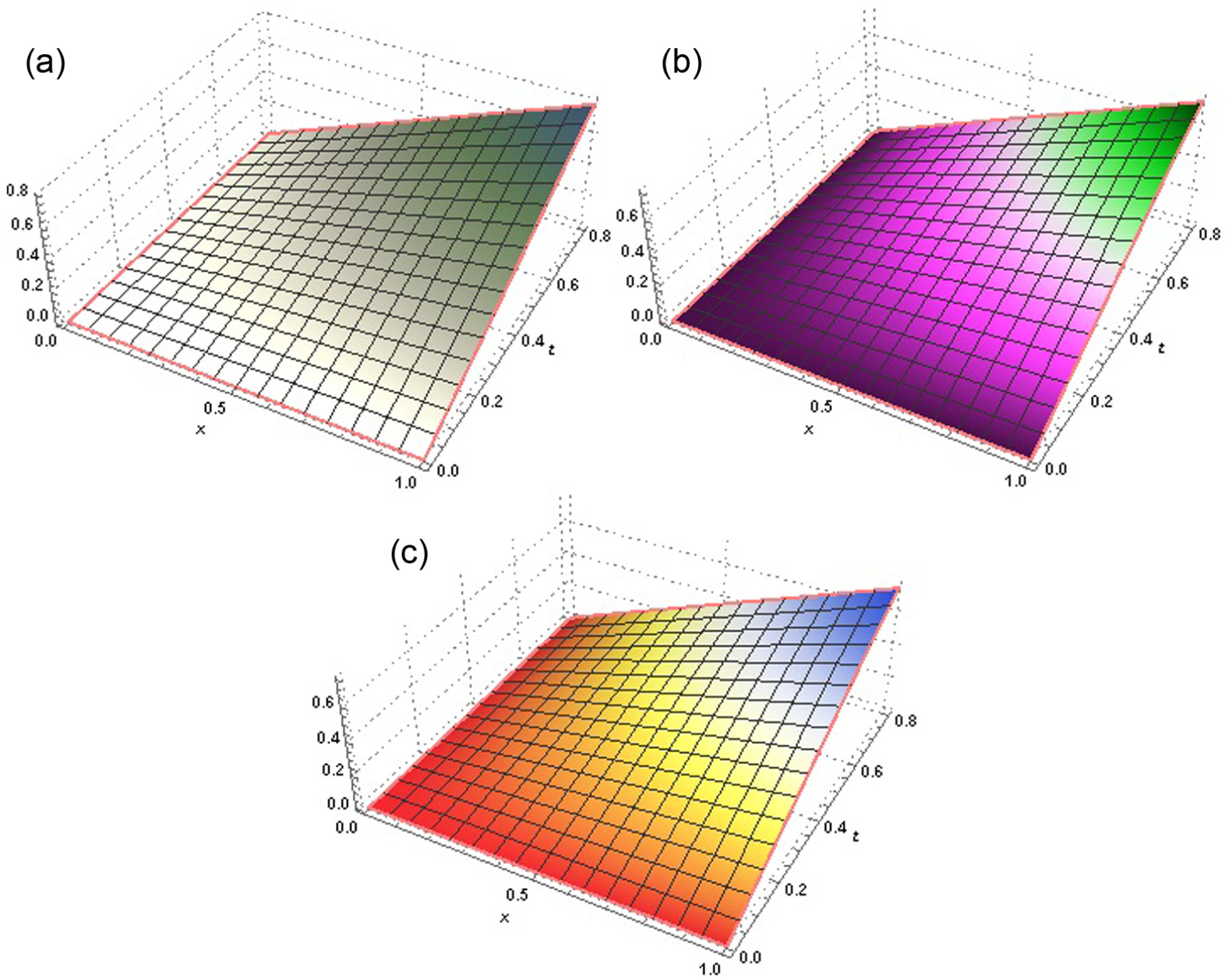
We can see the accrue and estimate answers with toward , in Figure 1 with VHPIM.
(a) The estimate answer, (b) approximate answer featuring Caputo-Fabrizio derivative with VHPIM, and (c) approximate answer featuring Caputo derivative with VHPIM.
In Figure 2, we can see the accrue and estimate answers toward , , and with .
(a) The estimate answer, (b) approximate answer featuring Caputo-Fabrizio derivative with q.HAM, and (c) approximate answer featuring Caputo derivative with q.HAM.
In Table 3, the list of the times in seconds for every iteration in two methods used by CPU has been shown.
List of the times in seconds used.
VHPIM
Caputo
Caputo–Fabrizio
Caputo
Caputo–Fabrizio
0
0
0
0
2.359375
0.015625
2.359375
0.015625
16.312500
3.968750
18.625000
4.328125
Conclusion
In this work, we have prosperously applied and VHPIM to compare between Caputo and Caputo–Fabrizio derivatives for the time-fractional advection partial differential equation. The results indicate that rough answers for both derivatives for both methods are similar. And the Caputo–Fabrizio derivative is faster than the Caputo derivative in terms of CPU speed in calculation in Mathematica.
Footnotes
Acknowledgements
The authors extend their appreciation to the International Scientific Partnership Program ISPP at King Saud University for funding this research work through ISPP# 63.
Academic Editor: Praveen Agarwal
Declaration of conflicting interests
The author(s) declared no potential conflicts of interest with respect to the research, authorship, and/or publication of this article.
Funding
The author(s) received no financial support for the research, authorship, and/or publication of this article.
References
1.
KilbasAASrivastavaHMTrujilloJJ.Theory and applications of fractional differential equations. Amsterdam: Elsevier B.V., 2006.
2.
MillerKSRossB.An introduction to the fractional calculus and fractional differential equations. New York: John Wiley & Sons, 1993.
3.
LiaoSJ.The proposed homotopy analysis technique for the solution of nonlinear problems. Doctoral Dissertation, PhD Thesis, Shanghai Jiao Tong University, Shanghai, China, 1992.
4.
El-TawilMAHuseenSN.The q-homotopy analysis method (q.HAM). Int J Appl Math Mech2012; 8: 51–75.
5.
NeamatyAAgheliBDarziR.Numerical solution of high-order fractional Volterra integro-differential equations by variational homotopy perturbation iteration method. J Comput Nonlin Dyn2015; 10: 061023.
6.
MomaniSShawagfehNT.Decomposition method for solving fractional Riccati differential equations. Appl Math Comput2006; 182: 1083–1092.
7.
WangQ.Numerical solutions for fractional KdV–Burgers equation by Adomian decomposition method. Appl Math Comput2006; 182: 1048–1055.
8.
Mustafa Inc. The approximate and exact solutions of the space- and time-fractional Burgers equations with initial conditions by variational iteration method. J Math Anal Appl2008; 345: 476–484.
9.
YangXJBaleanuDKhanY. Local fractional variational iteration method for diffusion and wave equations on Cantor sets. Rom J Phys2014; 59: 36–48.
10.
MomaniSOdibatZ.Homotopy perturbation method for nonlinear partial differential equations of fractional order. Phys Lett A2007; 365: 345–350.
11.
OdibatZMomaniS.Modified homotopy perturbation method: application to quadratic Riccati differential equation of fractional order. Chaos Soliton Fract2008; 36: 167–174.
12.
HosseinniaSRanjbarAMomaniS.Using an enhanced homotopy perturbation method in fractional differential equations via deforming the linear part. Comput Math Appl2008; 56: 3138–3149.
ZurigatMMomaniSAlawnehA.Analytical approximate solutions of systems of fractional algebraic–differential equations by homotopy analysis method. Comput Math Appl2010; 59: 1227–1235.
15.
KumarPAgrawalOP.An approximate method for numerical solution of fractional differential equations. Signal Process2006; 86: 2602–2610.
16.
YangXJBaleanuDZhongWP.Approximation solution for diffusion equation on Cantor time-space. Proc Rom Acad Ser A2013; 14: 127–133.
17.
YusteSB.Weighted average finite difference methods for fractional diffusion equations. J Comput Phys2006; 216: 264–274.
18.
AtanganaA.Application of fractional calculus to epidemiology. In: CattaniCSrivastavaHMYangX-J (eds) Fractional dynamics. Warsaw: Walter de Gruyter GmbH & Co KG, 2015, pp.174–187.
19.
DingYYeH.A fractional-order differential equation model of HIV infection of CD4+ T-cells. Math Comput Model2009; 50: 386–392.
20.
SierociukDDzieliskiASarwasG. Modelling heat transfer in heterogeneous media using fractional calculus. Philos T Roy Soc A2013; 371: 20120146.
21.
BaleanuDGvenZBMachadoJT (eds). New trends in nanotechnology and fractional calculus applications. New York: Springer, 2010, pp.xii+-531.
22.
RaySSSahooS.Comparison of two reliable analytical methods based on the solutions of fractional coupled Klein–Gordon–Zakharov equations in plasma physics. Comp Math Math Phys+2016; 56: 1319–1335.
23.
CaputoMFabrizioM.A new definition of fractional derivative without singular kernel. Prog Fract Differ Appl2015; 1: 73–85.
24.
LosadaJNietoJJ.Properties of a new fractional derivative without singular kernel. Prog Fract Differ Appl2015; 1: 87–92.
25.
AtanganaABaleanuD.Caputo-Fabrizio derivative applied to groundwater flow within confined aquifer. J Eng Mech: ASCE2016; 2016: D4016005.
26.
AlsaediABaleanuDEtemadS. On coupled systems of time-fractional differential problems by using a new fractional derivative. J Funct Space2016; 2016: 4626940.