



Abstract
With the development of metallurgical industry and the improvement of continuous casting technology, the processing properties of casting technology equipment are being paid more attention. Ladle is one of the most representatives of the furnace equipment; higher requirements of ladle are put forward in response to the call for national energy-saving and emission reduction. According to the requirements of actual operator and working condition, a lining structure of a new type of ladle with nanometer adiabatic material is put forward. Based on heat transfer theory and finite element technology, the three-dimensional finite element model of a new type of ladle is established. Temperature field and stress field of the new type of ladle with the nanometer adiabatic material in lining structure after baking are analyzed. The results indicate that the distributions of temperature and thermal stress level of working layer, permanent layer, and nanometer heat insulating layer are similar, and they are in the permissible stress and temperature range of each material for the new type of ladle. Especially heat preservation effect of nanometer adiabatic material is excellent. Furthermore, the maximum temperature of shell for the new type of ladle drops to 114°C than the traditional ladle, and the maximum stress of shell for the new type of ladle is lower than the traditional ladle, that is, 114 MPa. It can provide reliable theory for energy-saving and emission reduction of metallurgy industry, which also points out the right direction for the future development of the iron and steel industry.
Introduction
The ladle is an important equipment of refining furnace in metallurgical industry. The function of the ladle is to hold molten steel from furnace, refine molten steel in the ladle, remove impurities from liquid steel, and keep the temperature of liquid steel uniform. Ladle baking is a very important working process before filling molten steel. After ladle baking, the temperature of ladle lining will directly affect the quality of liquid steel and ladle’s service life. The reason is that when molten steel with temperature 1650°C is poured into the ladle, and the working layer of ladle lining is heat insulation material, if working layer did not reach the required temperature of 1000°C during ladle baking, molten steel liquid is directly injected into ladle that will cause great thermal shock to the working layer and bottom of ladle, which causes the damage of working layer and refractory material of ladle, thus reducing the service life of the ladle. Meanwhile, molten steel will lose a lot of heat in the ladle, and then molten steel temperature will drop dramatically. And molten steel temperature of continuous casting is controlled strictly to ensure the molten steel temperature within a narrow temperature range that can make sure the smooth progress of continuous casting. So the temperature and stress of ladle lining after ladle baking are important for continuous casting production and ladle’s service life. It is necessary to analyze the temperature field and stress field of the ladle.
Numerical simulation analysis of temperature field of the ladle was carried out, and temperature of the ladle was tested under practical conditions to verify the accuracy of the results of simulation. 1 Three scheme models of ladle bottom were put forward using the finite element method. An optimization scheme was put forward according to stress field of the three ladle models. The experiment results indicate the rationality and practicability of the scheme. Ladle’s lifetime can be increased by the method. 2 Two-dimensional finite element model of the ladle was established, and then the influence of thermal conductivity, thermal expansion coefficient, elasticity coefficient, and thickness of work lining on ladle stress field was discussed. 3 Expansion joint finite element model of ladle bottom lining was built, and the contact stress of expansion joint in every layer was studied. The results show that setting 2 mm expansion seam can reduce the contact stress which takes up 1/6 to 1/5 of lining resistance pressure intensity. 4 The influence of working lining material thermal conductivity, thermal expansion coefficient, Young’s modulus, and its thickness on ladle temperature and stress field was studied. The calculation result indicated the equivalent stress in the ladle enlarged as the thermal conductivity, thermal expansion coefficient, and Young’s modulus of working lining material increased and the thickness decreased. Research played a referring role in comprehending the distribution of temperature field and stress field of the ladle and selecting appropriately physical parameters of lining. The actual operation result indicates that the research increases the ladle’s lifetime effectively and shows its wide popularization value. 5 Despite temperature test of the ladle under practical conditions, verifying the accuracy of simulation results and numerical simulation analysis results of temperature field and stress field is very fruitful. But the surface temperature of the ladle shell of the traditional ladle is still very high, and heat preservation function of the ladle is not improved. Chen et al. 6 analyzed the insulation properties of the existing ladle. A new type of ladle lining was presented. The heating time of the new type of ladle was shorter under the same condition, which saves time and energy. The insulation properties of the new type of ladle were testified for two aspects: the temperature of the ladle shell and the temperature drop speed of molten steel. When the average characteristic temperature of the ladle shell was reduced by 45°C or so, the temperature drop speed of molten steel in the ladle was reduced by 0.27°C/min.
The new type of ladle with nanometer heat insulating layer had also been researched in the domestic study. The test process of taking new nanometer materials as ladle’s insulating layer in making-rolling plant was introduced. 7 The production practice showed that the material plays a great role in stabling production, reducing the production cost, optimizing the process of molten steel temperature control, and improving the quality of casting billet due to the material with low thermal conductivity and good heat preservation performance so that it greatly reduces the ladle heat dissipation. New ladle cooling was slow, so the increase in refining heating rate could reduce the range of refining power consumption of different steel grade refining at 2.01–8.41 kW/t, and lower power consumption costs about 3 million yuan. The new ladle had good performance to keep the temperature constant, so the temperature dropped by 5.16°C on average in the process of continuous casting, and the temperature of intermediate clad steel water reduced from 12°C to 6°C, which had created conditions for the stability of the continuous casting production. The temperature difference between the heat and cold surface of refractory was reduced and the outer wall temperature was reduced by an average of 147°C, which would reduce the cladding thermal stress, improve cladding strength and creep resistance, and reduce the temperature of the working environment. 8
Thermal insulation properties and stress distribution of ladle had attracted many foreign scholars. Through the ladle expansion joints of thermo-mechanical stress, the influence of expansion joint on high alumina, magnesia carbon refractory lining heat was researched. 9 The results showed that the reserved expansion joint of 0.6 mm can reduce the stress 23 MPa on the bottom of the ladle in the high aluminum refractory, which effectively reduces the thermal stress produced by ladle lining material. At the same time, it was also pointed out that expansion joint filler clay combined with static compressive stress data should be taken into account and the true value depended on the creep properties of materials. Thermal conductivities of four different ladle slags at 1773, 1823, 1873, and 19a23 K (1500°C, 1550°C, 1600°C, and 1650°C) were measured using the transient hot wire method. 10 A very good reproducibility was obtained. The thermal conductivity did not vary substantially with the variation in slag composition at 1873 and 1923 K (1600°C and 1650°C), at which the slags were all entirely liquid. The thermal conductivities were low. It was found that the precipitation of solid phase resulted in considerable increase in thermal conductivity. Kabakov and Pakholkova 11 proposed that heat losses from steel in pouring ladles reduced by decreasing the diameter of the top part of the ladle based on a theoretical estimate of the projected loss reduction. It was determined that a 10% decrease in the diameter of the top of a 350-ton-capacity ladle would lower heat losses from steel in the ladle by 12%. The proposed ladle redesign would also reduce expenditures on electric power for preheating steel on ladle furnaces prior to its casting. Russell et al. 12 studied stress and temperature distribution of different materials of ladle lining and analyzed the temperature distribution and heat loss of different materials of the ladle. The results showed that it was a significant effect for temperature of ladle when the high thermal conductivity material was used whether the bag cover was added or refined in pouring time. Using as an example the lining of a steel-teeming ladle, mathematical modeling of the thermal fields in preliminary heating of the ladle and during smelting is performed. An approach to the construction of thermal fields, assuming the presence of defects in the lining and in the case of intersecting thermal fields, is proposed. 13 To predict the temperature distribution in the ladle wall during the preheating process, a two-dimensional model was developed. The model calculated the heat transfer and the velocity field in the gas phase inside the ladle as well as the heat transfer in the solid walls during the preheating process. Measurements of the temperature in an industrial ladle were carried out using an infrared (IR) radiation camera. The measurements were made inside and outside the ladle. The model predictions were found to be in reasonably good agreement with the measured temperatures. 14
To sum up, researches of ladle are focused on the control of ladle shell temperature and different lining materials for temperature control and stress distribution of the ladle. In recent years, test of ladle with nanometer materials indicates low temperature of ladle shell and low energy consumption and also limited performance and temperature range of nanometer materials. There are various methods, such as using ladle stamped, adding covering agent, and adding insulation blanket in ladle lining and arranging multi-contact surfaces, that are used to reduce heat loss of the ladle and improve thermal insulation performance. The practical applications are not ideal, so temperature distribution and stress distribution of ladle lining need to be further studied. According to the above analysis, a new type of ladle structure is put forward; protection layer and nanometer heat insulating layer are added to the new type of ladle in addition to the permanent layer and ladle shell. Protection layer is to protect the nanometer heat insulating layer from damage when installing and removing it. This kind of lining structure of ladle is called new type of ladle.
The rest of the article is organized as follows. Section “Structure of new type of ladle” gives the structure of the new type of ladle. Section “A new finite element model of ladle” describes the finite element model of the new type of ladle. Section “Temperature field and stress field analysis of new type of ladle” analyzes the temperature field and stress field of the new type of ladle. Finally, section “Conclusion” concludes the article.
Structure of new type of ladle
Lining structure of the traditional ladle includes working layer of aluminum (magnesia carbon), permanent layer (high alumina), and shell (low-carbon steel). But the effect of thermal insulation is not ideal. The temperature of the ladle shell is basically 300°C, 15 and it also causes waste of energy. With the continuous study and update of refractory material, the heat preservation effect is in unceasing enhancement. Lining structure of the traditional ladle has only three layers and is shown in Figure 1. In Figure 1, 1 stands for working layer, 2 stands for permanent layer, and 3 stands for ladle shell. The thermal insulation effect of the traditional ladle cannot meet the production requirements currently. In recent years, more and more nanometer adiabatic material is used in industrial smelting equipment. As a result, adaptive changes have been made for the lining structure of ladle, especially ladle lining structure model from the inside to the outside includes working layer of aluminum (magnesium carbon), permanent layer (high alumina), protection layer (low-carbon steel), nanometer heat insulating layer, and shell (low-carbon steel). Meanwhile, lining structure of the new type of ladle comprises five layers; the difference between the traditional ladle and the new type of ladle is that the protection layer and nanometer heat insulating layer are added in the new type of ladle along with the permanent layer and ladle shell. The nanometer heat insulating material is expensive and the installation and disassembly are more complex. In order to reduce replacement frequency as far as possible, a layer with 5 mm steel plate, namely, protection layer, is used for protecting the nanometer heat insulating layer. Lining structure of the new type of ladle is shown in Figure 2. No. 1 in Figure 2 represents working layer, 2 represents permanent layer, 3 represents protection layer, 4 represents nanometer heat insulating layer, and 5 represents ladle shell. The corresponding materials of the five layers from the inside to the outside are 170 mm magnesium carbon layer, 105 mm high aluminum brick as the permanent layer, 5 mm Q345B as the protection layer, 20 mm nanometer heat insulating layer, and 32 mm Q345 as shell. Protection layer is welded by Q345B steel plate. Nanometer heat insulating layer uses nanometer heat insulating material of gas phase oxidation of silicon and technical preparation of calcium silicate. It has excellent thermal insulation performance, good mechanical properties, and flame-blocking performance. It can realize the resistance at 1000°C. The biggest difference between the traditional ladle and the new type of ladle is that the new type of ladle has been added two additional layers, namely, protection layer and nanometer heat insulating layer in ladle lining, and the effect of thermal insulation will be greatly improved.
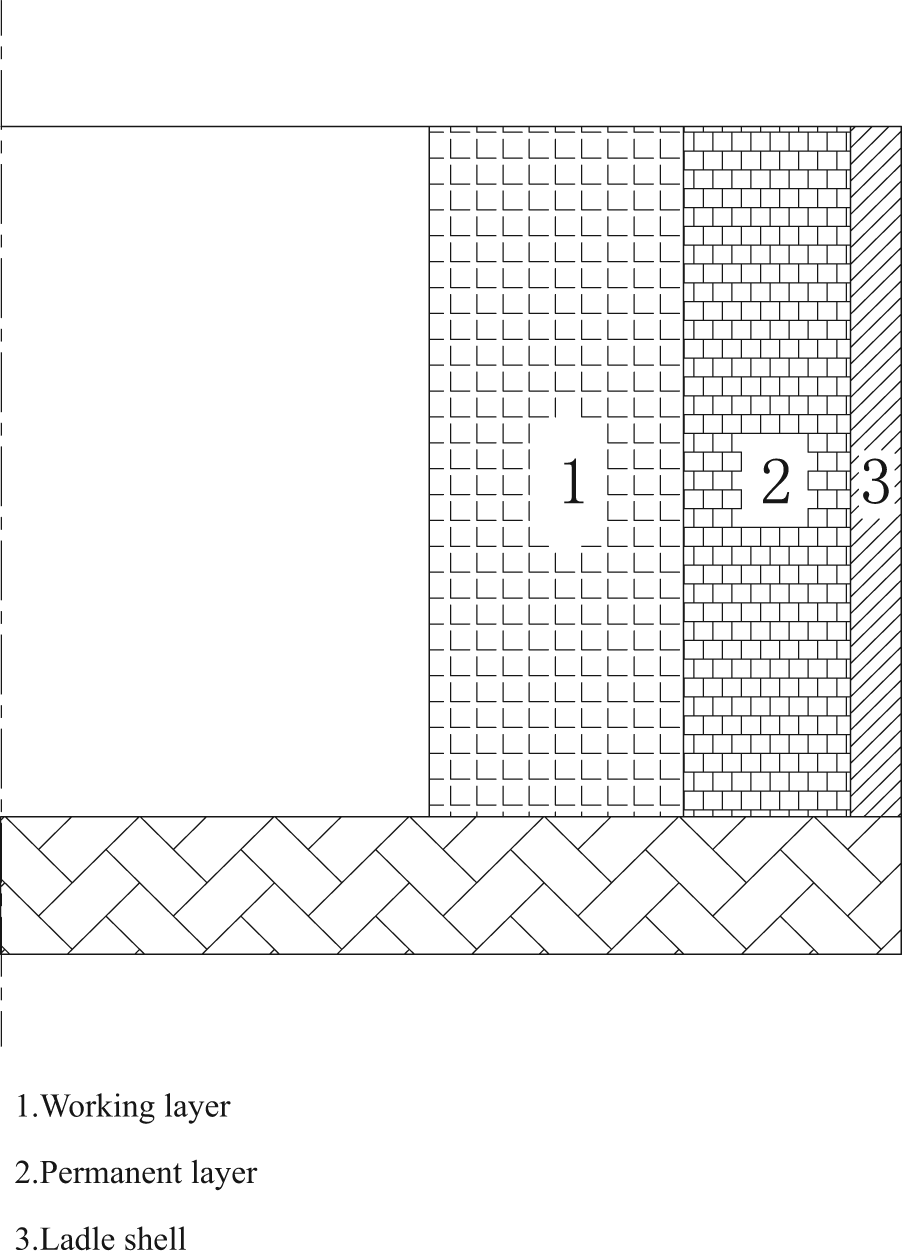
Lining structure of traditional ladle.

Lining structure of new type of ladle.
A new finite element model of ladle
Heat transfer mathematical model of new ladle
The ladle is a cylindrical structure, and in Cartesian coordinate system the temperature field of the ladle should be

where
Ladle thermal stress calculation includes the following three steps:17,18 first, according to the temperature distribution and thermal expansive coefficient of each part of ladle lining, the deformation is calculated in the special constraints (deformation displacement of each point in the ladle), and then the strain of each point of the ladle is calculated using deformation of ladle displacement with the geometric equation. Finally, stress in the ladle of each point is calculated through the strain according to the physical equation of ladle material (relationship of stress and strain).
Thermal stress field geometry equation, namely, the relationship of strain and displacement
It can be expressed by the form of matrix as
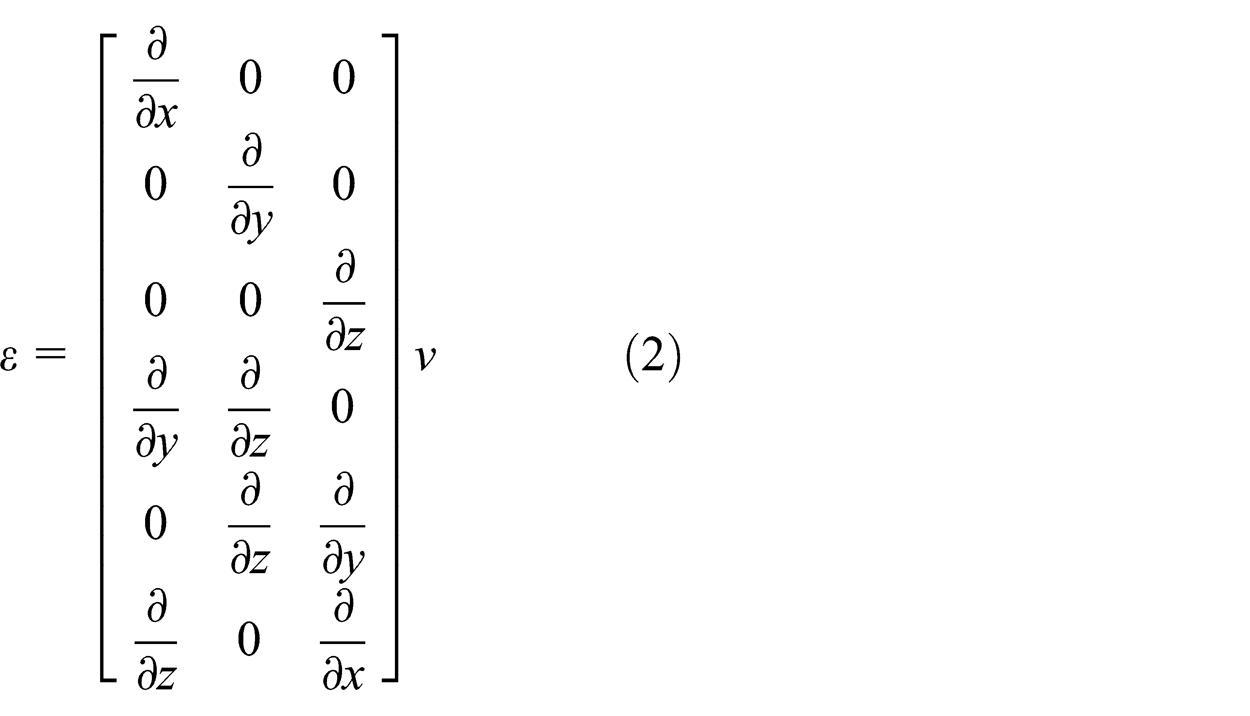
where
Physics equation of ladle stress field, namely, the relationship of stress and strain
It can be expressed by the Hooke representation theorem as
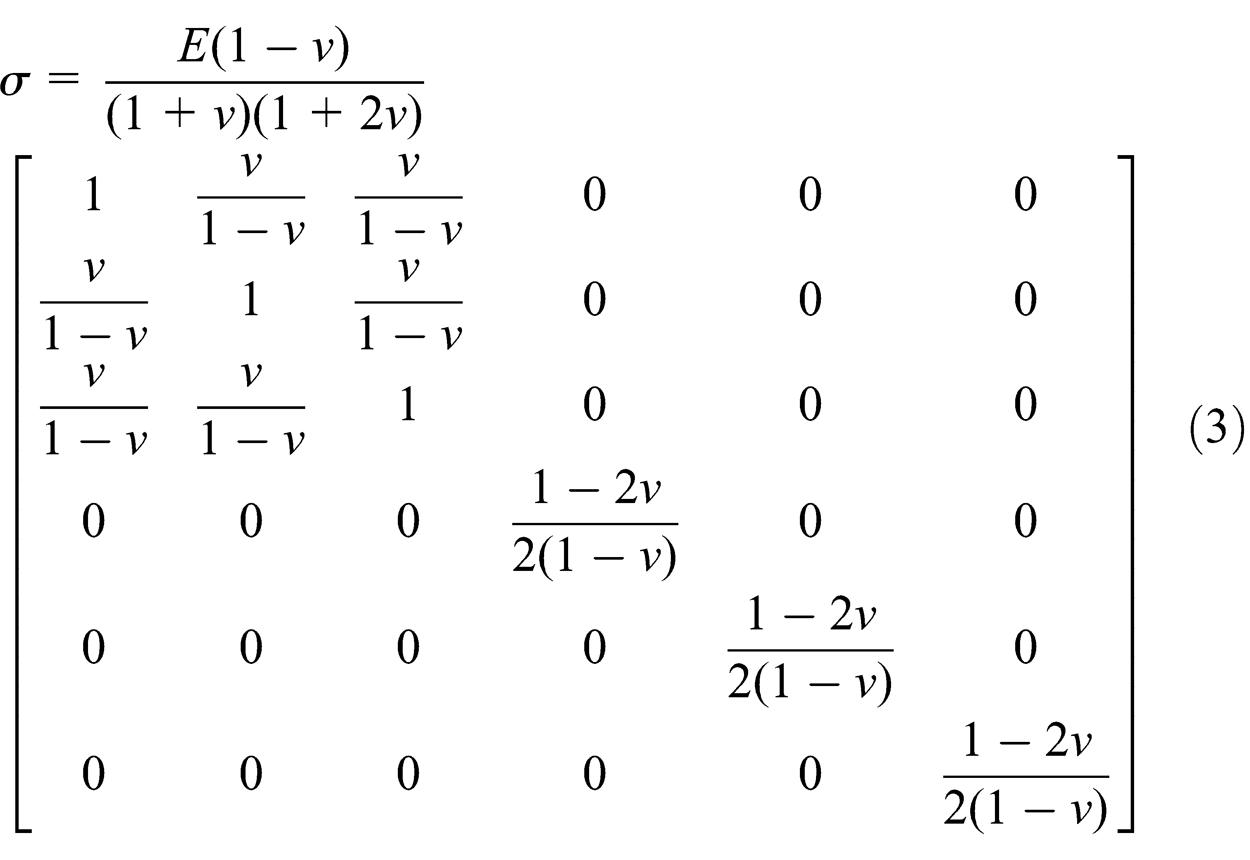
where
Balance equation of ladle
For the three-dimensional (3D) situation, the balance equation in any point coordinates for the ladle in
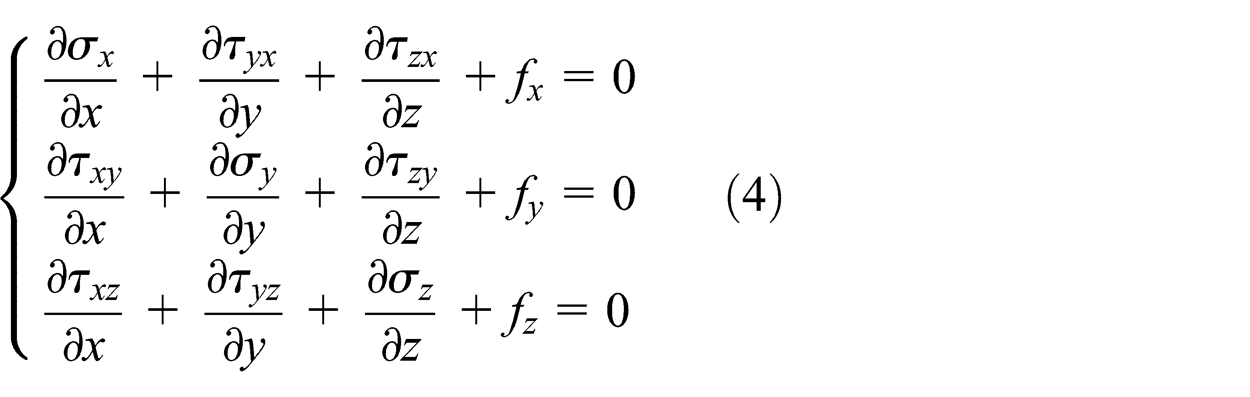
where
Establishment of new ladle 3D model
The size of ladle structure studied in this article is 4.285 m for the inner cavity height, and the outer diameter and the inner diameter are 3.958 and 3.294 m, respectively. In order to accurately calculate the temperature distribution of ladle under heating, the following hypothesizes in modeling are made: (1) a half of ladle model is analyzed; (2) permeable brick of ladle bottom, slide gate including its driving device and ladle tilting mechanism, and so on make little sense for ladle lining temperature field in finite element, so these parts can be omitted in modeling; and (3) ladle wall’s thickness is irrelative to its height. So the ladle model is simplified as the cylinder, regardless of the angle. The 3D model is established in proportion of 1:1. The 3D model of the new type of ladle is shown in Figure 3 and the finite element model is shown in Figure 4. The ladle can be made into unit size 0.1 by free division, and therefore, 112,663 grids and 23,913 nodes are obtained. The ladle model is partitioned into tetrahedral mesh using free meshing. The method can ensure the calculation precision as far as possible to reduce the calculation time. The accuracy of finite element mesh is shown in Table 1. 19

The 3D model of new type of ladle.

Finite element model of new type of ladle.
Statistics of mesh quality.

Determination of ladle’s material parameters and boundary conditions
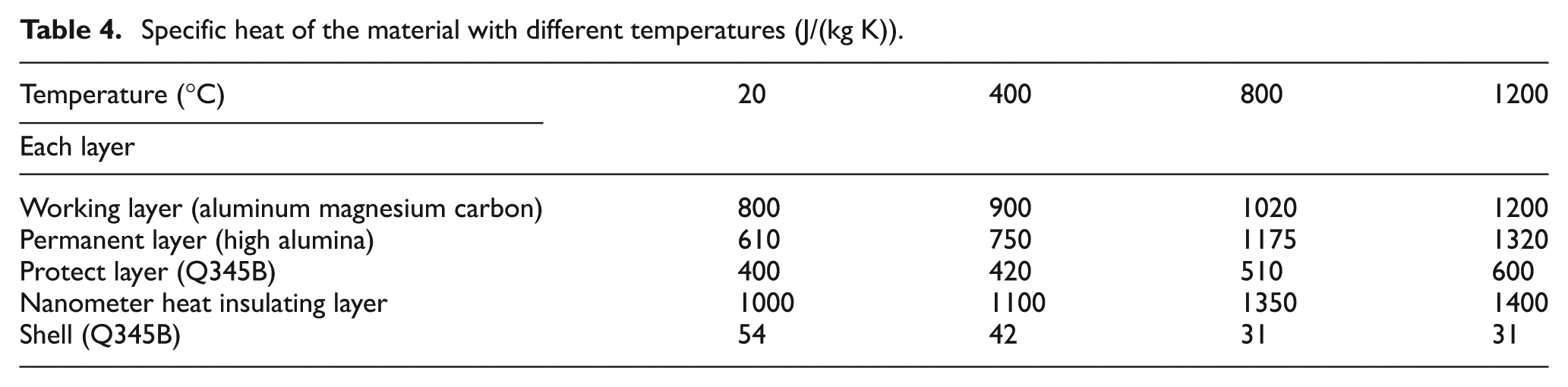
The physical property of ladle material selection is very important, which directly affects the calculation accuracy of ladle temperature field and stress field. Based on the literature review in this study, the physical properties of various materials were used with the change in temperature and specific heat. The boundary conditions such as physical parameters of liner, modulus of elasticity, Poisson’s ratio, coefficient of thermal expansion, density, thermal conductivity, and specific heat are required for calculation by finite element software. The parameters of various materials used in this study are shown in Tables 2–4. 20
Physical parameters of material in each layer.

Coefficient of thermal conductivity of the material with different temperatures (W/(m K)).

Specific heat of the material with different temperatures (J/(kg K)).
There are two ways for cooling the surface of the ladle: one is the natural convection between the ladle shell and the surrounding environment, and the other is the ladle shell radiates heat to the surroundings by radiation. There is convective heat transfer and radiation heat transfer between the ladle shell and air at the same time in every working station of the ladle. Because the radiation heat transfer coefficient is nonlinear, in general the equivalent convective heat transfer coefficient is used to replace radiation heat transfer coefficient for engineering calculation. From the view of heat transfer, using Newton cooling represents heat transfer formula

And, heat transfer

Therefore, the equivalent coefficient

where A is the heat transfer area,
Heat transfer of natural convection is expressed as

The total heat could be conveniently expressed as

where
The total convective heat transfer coefficient of the integrated heat transfer is

The average temperature of the ladle’s shell is taken as 275°C (is 548 K), room temperature as 30°C (is 303 K), and the blackness of the surface of the ladle’s shell as

Because the thickness of the boundary layer is related to factors such the temperature difference and fluid properties, it is difficult to determine. Generally, the point 3.0, the ratio of the cylinder's diameter and its height, is the boundary of infinite or limited space natural convection heat transfer. When the point is greater than 0.3, it is considered to be infinite space natural convection heat transfer, and vice versa, it is a limited natural convection heat transfer. As shown in Figure 4, the ratio of the ladle’s diameter and its height is 3.294/4.285 = 0.7687 > 0.3 in this article, so the ladle can be viewed as infinite space natural convection heat transfer. If

where
According to equation (10), the total convective heat transfer coefficient of the ladle’s integrated heat transfer can be calculated as follows

Temperature field and stress field analysis of new type of ladle
Analysis of temperature field
In the analysis, SOILD70 cell is selected and physical parameters of each material are added. Meanwhile, 1000°C is loaded to the inner wall of the ladle as the temperature load, comprehensive convective heat transfer coefficient of 16.234 W/(m2 K) is loaded to the ladle shell and bottom of the ladle, and the ambient temperature is set to 30°C. The boundary conditions of the model loading are shown in Figure 5. Then, the distribution of steady-state temperature field of ladle is calculated, and the steady-state is considered as the initial condition of the next working conditions. Figures 6–11 are the overall temperature distribution and the temperature distribution of each layer in the new type of ladle after the steady-state analysis of baking. In the same boundary conditions and unit type, the temperature field of the traditional ladle after baking is analyzed; Figures 12–14 are the temperature distribution of each layer of the traditional ladle.
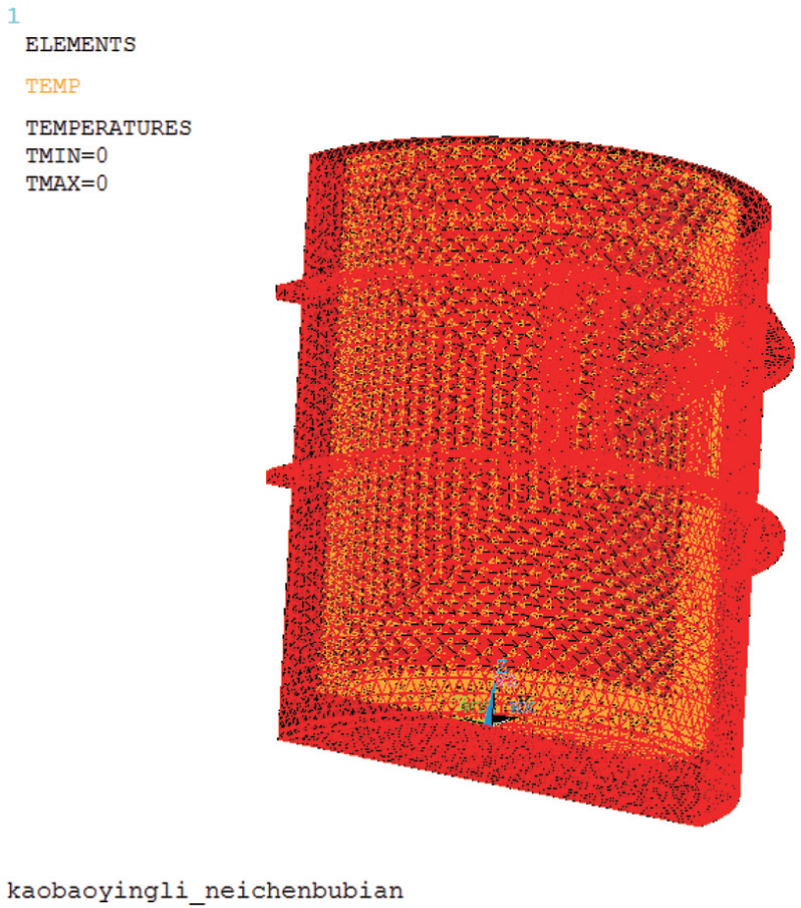
Boundary conditions.
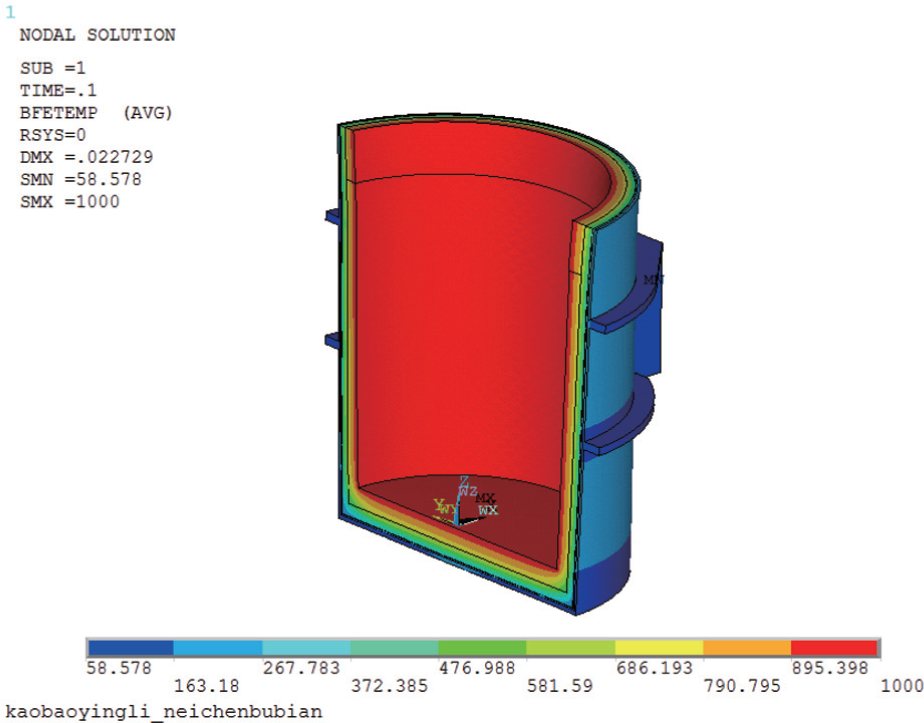
Overall temperature distribution of new type of ladle after baking.

Working layer temperature distribution of new type of ladle after baking.

Permanent layer temperature distribution of new type of ladle after baking.

Protect layer temperature distribution of new type of ladle after baking.
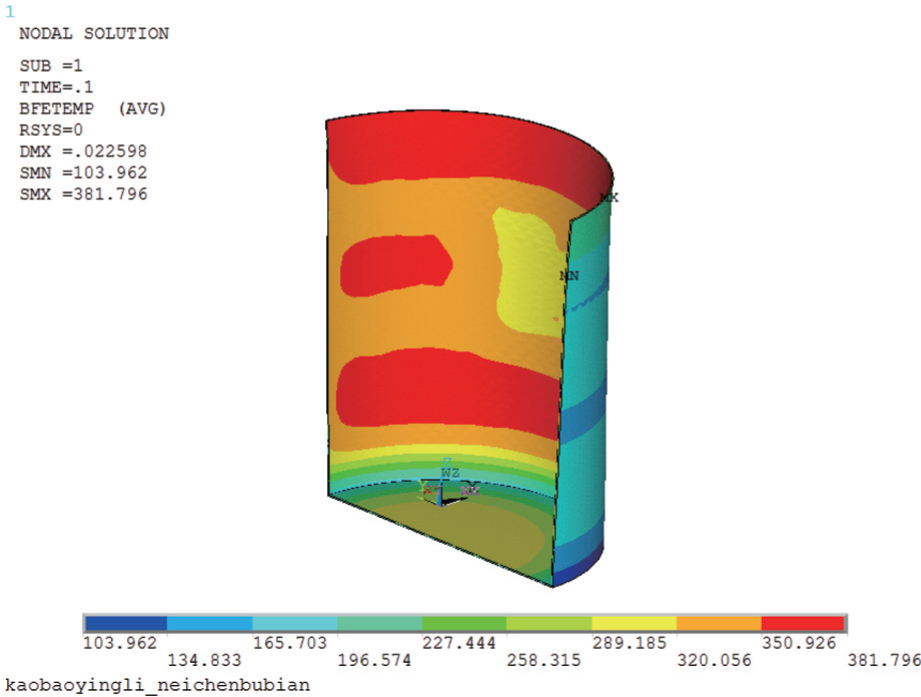
Nanometer heat insulating layer temperature distribution of new type of ladle after baking.
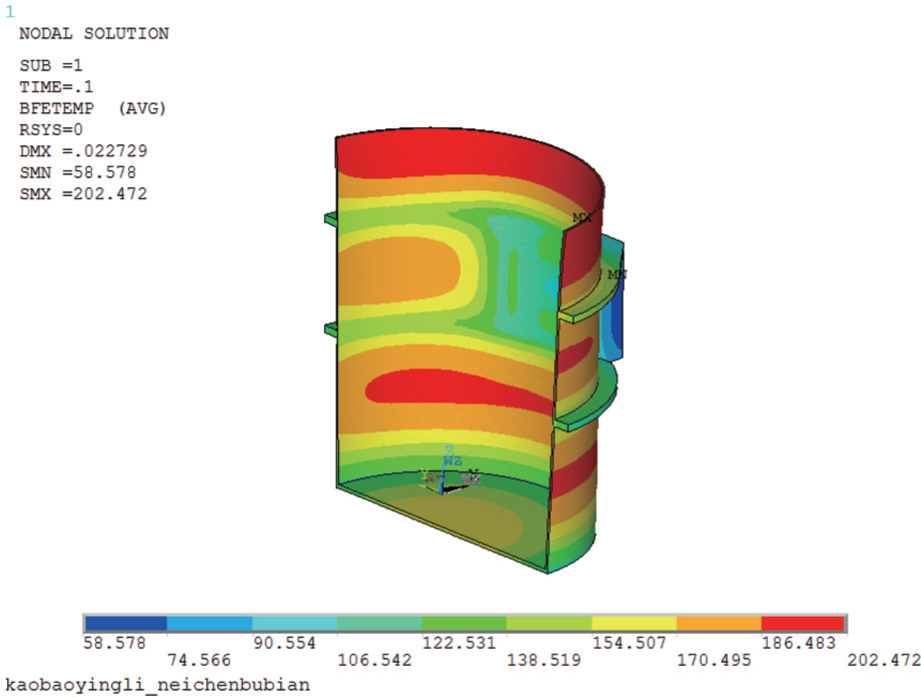
Shell temperature distribution of new type of ladle after baking.

Working layer temperature distribution of traditional ladle after baking.

Permanent temperature distribution of traditional ladle after baking.
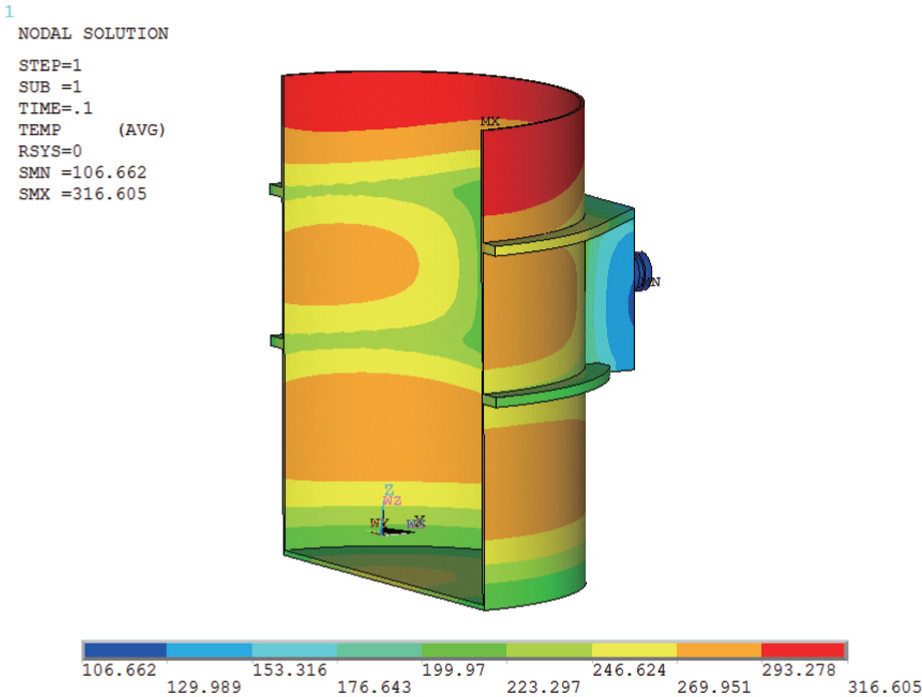
Shell temperature distribution of traditional ladle after baking.
It can be seen from Figure 6 that the whole temperature of the new type of ladle is distributed uniformly and the temperature in the trunnion, upper and lower hoop plate, ribbed plate, and bottom edge is low. Temperature distribution of working layer and permanent layer is similar in Figures 7 and 8. The temperature difference between the inside and the outside of the working layer is 323°C, and working layer reaches 436°C. The temperature decreases quickly when the heat loss is reduced through the two layers. It can be seen from Figure 9 that temperature distribution of the protection layer is similar to the shell because they have the same material, Q345B. But it can be seen that there is a small temperature difference between the inner and outer surfaces of the protection layer, which means the cylinder wall temperature of lining is at a high temperature level of 382°C. It can be seen from Figure 10 that there is a large temperature difference between the inner and outer surfaces of nanometer heating insulating layer. The highest temperature of the inner surface is 381°C, and the outer surface is only 103°C in the trunnion and ribbed plate, which fully demonstrates excellent insulation performance of nanometer heating insulating layer. Due to the special materials of nanometer heat insulating layer, its thermal conductivity is only 0.023 W/(m K). So, lots of heat from the liner wall is intercepted when it goes through the manometer heating insulating layer, which plays an excellent thermal insulation effect. The highest temperature of the ladle shell is 202°C in Figure 11; the high temperature is concentrated on the upper part of the shell. And the temperature in the middle position is only 154°C because there is a long distance from the upper and lower hoop plates, ribbed plate, and trunnion to heat source. Furthermore, the air heat exchanger is strong, so the temperature of trunnion and ribbed plate is much lower; it is only 60°C. The highest temperature of the traditional ladle shell is 316°C in Figure 14; it also appears in the upper part of the shell. And the distribution rule is similar to the new type of ladle. But the temperature region of the traditional ladle shell is 246°C–269°C, and the maximum temperature of the new type of ladle drops to 114°C than the traditional ladle. The effect of thermal insulation for the new type of ladle is particularly prominent, and it has important significance to energy-saving and emission reduction. Temperature distributions of working layer and permanent layer of the traditional ladle are shown in Figures 12 and 13; the distribution rules of the traditional ladle are similar to those of the new type of ladle. By analyzing the temperature field of each layer between the new type of ladle and the traditional ladle, it can be seen that the heat preservation of the new type of ladle is promoted because of the nanometer heat insulating material.
Analysis of stress field
Thermal stress field of the ladle is analyzed using the sequential coupling method. The basic steps are as follows. First, the temperature field results in the working condition of ladle baking as the initial condition is loaded to the finite model; then, the element type is switched to the structure element SOLID185 and the model and mesh are kept unchanged, and all constraints of displacement are imposed on the bottom of the ladle shell and symmetry plane. The analysis results of stress field of the new type of ladle are shown in Figures 15–19. In the same boundary conditions and unit type, stress field of each layer in the traditional ladle after baking are analyzed in Figures 20–22.
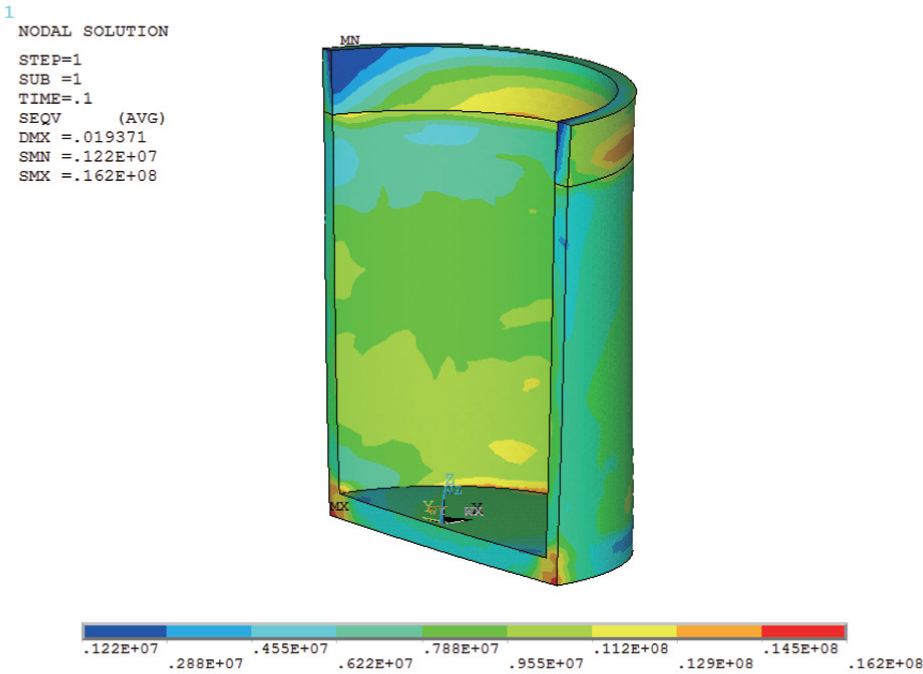
Stress distribution of working layer in new type of ladle after baking.

Stress distribution of permanent layer in new type of ladle after baking.
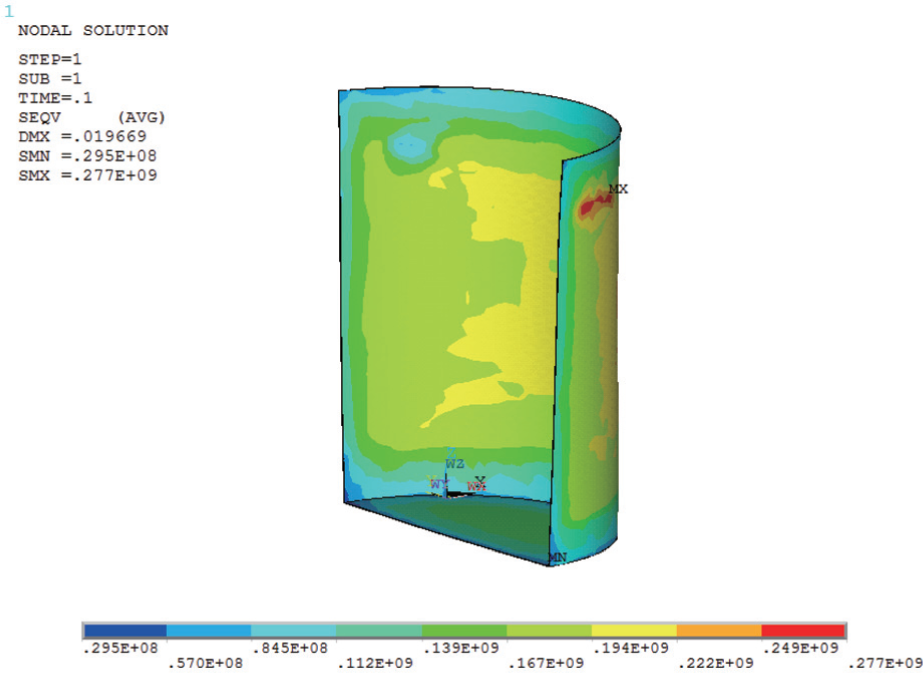
Stress distribution of protection layer in new type of ladle after baking.

Stress distribution of nanometer heat insulating layer of new type of ladle after baking.

Stress distribution of shell in new type of ladle after baking.

Stress distribution of working layer in traditional ladle after baking.
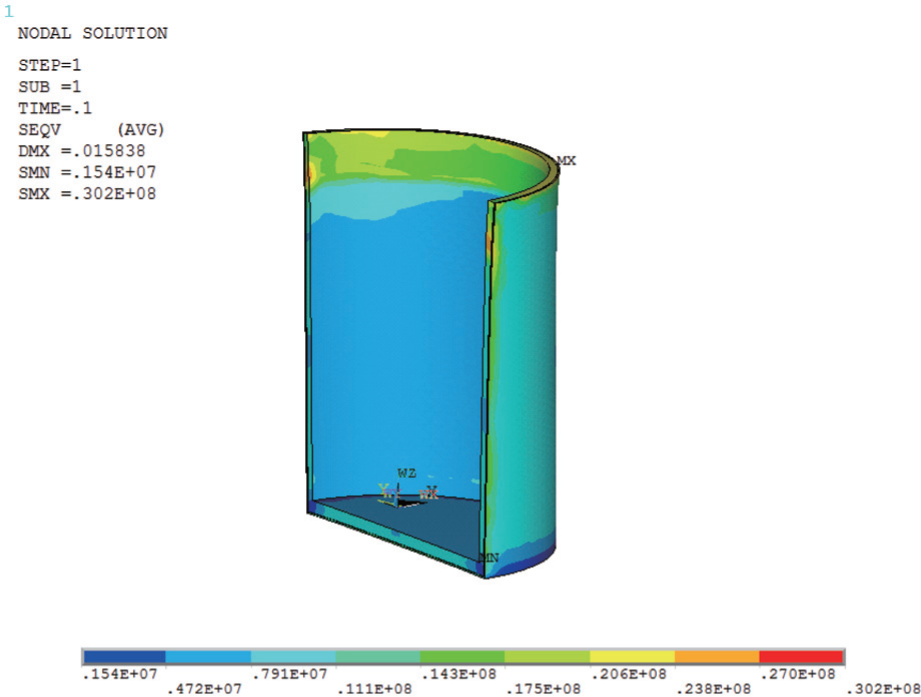
Stress distribution of permanent layer in traditional ladle after baking
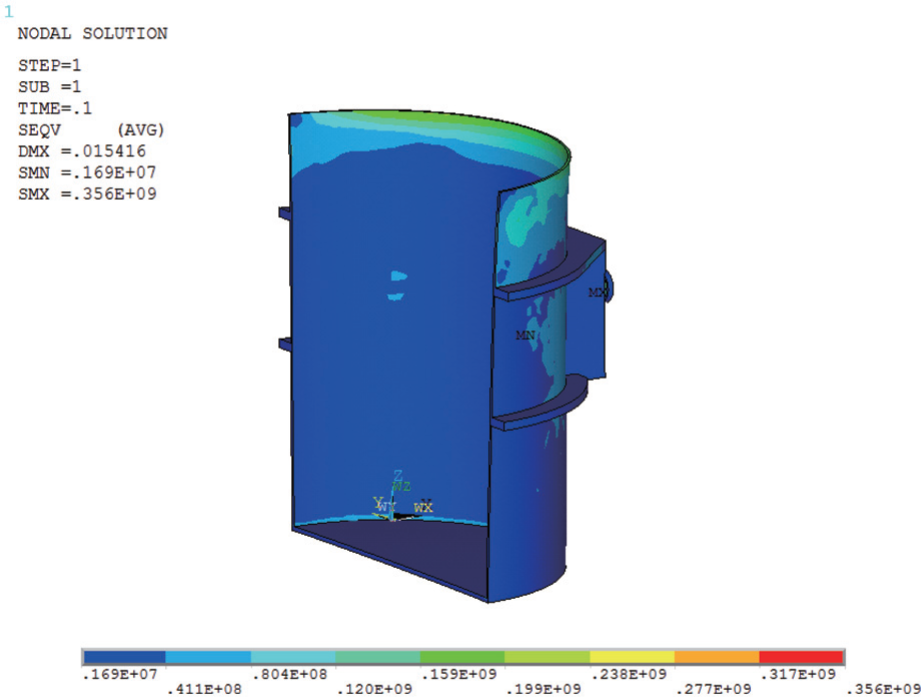
Stress distribution of shell in traditional ladle after baking.
It can be seen that stress level of working layer and permanent layer is low in Figures 15 and 16. The largest stress of working layer is only 16 MPa and that of permanent layer is just 14 MPa. It can be seen from Figure 17 that the stress level of protection layer is 167–249 MPa, and the maximum stress reaches 277 MPa. They are in permissible stress range of Q345B, so it is safe. The maximum stress of nanometer heat insulating layer for the new type of ladle is 16.6 MPa in Figure 18. Meanwhile, the maximum stress of working layer and permanent layer of the traditional ladle are 26 and 30 MPa, respectively, in Figures 20 and 21. The stress level of the new type of the ladle shell is 108–215 MPa in Figure 19; the maximum stress reaches 242 MPa; they are completely in permissible stress range of Q345B; and the new type of ladle is safe and reliable. Furthermore, stress level of the traditional ladle shell is 159–277 MPa in Figure 22, and the maximum stress reaches 356 MPa. Shell stress of the new type of ladle is smaller than that of the traditional ladle—it is 114 MPa. That means in the same working condition, the life of the new type of ladle will be longer. For the new type of ladle, stress mainly is concentrated in the shell and protection layer. Because the two layers are metallic material, its thermal conductivity and coefficient of thermal expansion are much larger than the thermal insulation materials, which means in the same heat flow density the amount of corresponding deformation is larger than the thermal insulation refractory material. But protection layer is between permanent layer and nanometer heat insulating layer. Because thermal expansion coefficient is small, the thermal expansion deformation is also small. For protection layer, it means bigger constraint, and the upper edge has stronger constraint than other positions; larger deformation is concentrated on this position, so the stress in upper part of the protection layer and shell is larger than other position. By the theory of thermal stress, the heated degree of each part of the metal is different, so the metal mutual restrict and diversionary and generation of stress are affected by the temperature difference. The upper part of the protection layer and shell is the stress concentration region, and stress level is the largest in the whole of ladle lining. The analysis results are consistent with the theory of thermal stress, which indicate the finite element model is accurate and the loading boundary conditions are reasonable.
Conclusions
The ladle takes charge of transferring molten steel from a converter to procedure of continuous casting or ingot casting, so it is a key equipment in metallurgical industry. Ladle’s lifetime influences production efficiency, product quality and flexibility, energy consumption, and work condition of workers. The distribution of ladle’s temperature field and stress field is of greatest importance to the lifetime. In order to meet the requirements of high efficiency and long time, a new type of ladle structure with nanometer heat insulating material is proposed. A finite element model of the new type of ladle is established in order to analyze the properties of the new type of ladle. Then, the temperature field and stress field of the new type of ladle and traditional ladle are analyzed. The simulation results indicate that temperature distribution and stress distribution of the protection layer are similar to those of the shell for the new type of ladle, but stress level and temperature level are higher than other layers. Temperature and thermal stress level of working layer, permanent layer, and nanometer heat insulating layer are similar, especially heat preservation effect of nanometer heat insulating material was excellent. The stress distribution of whole ladle is in an affordable range. The maximum temperature of the shell for the new type of ladle drops to 114°C than the traditional ladle. The maximum stress of the shell of the new type of ladle is lower (114 MPa) than the traditional ladle. The new type of ladle has more excellent thermal insulation performance and security than the traditional ladle, so it plays a referring role in comprehending distribution of temperature field and stress field of the ladle. The actual operation result indicates that the research increases the ladle’s lifetime effectively and shows its wide popularization value.
Footnotes
Academic Editor: Luís Godinho
Declaration of conflicting interests
The authors declare that there is no conflict of interests regarding the publication of this article.
Funding
This research was supported by National Natural Science Foundation of China (71271160) and China Scholarship Council (CSC), Science Foundation of Hubei Province of China (2010CDA023), and The State Key Laboratory of Refractories and Metallurgy (G201007). This support is greatly acknowledged.