




Abstract
Computer numerical control machine tool is a typical complex product related with multidisciplinary fields, complex structure, and high-performance requirements. It is difficult to identify the overall optimal solution of the machine tool structure for their multiple objectives. A new integrated multidisciplinary design optimization method is then proposed by using a Latin hypercube sampling, a Kriging approximate model, and a multi-objective genetic algorithm. Design space and parametric model are built by choosing appropriate design variables and their value ranges. Samples in design space are generated by optimal Latin hypercube method, and design variable contributions for design performance are discussed for aiding the designer’s judgments. The Kriging model is built by using polynomial approximation according to the response outputs of these samples. The multidisciplinary design model is established based on three optimization objectives, that is, setting mass, optimum deformation, and first-order natural frequency, and two constraints, that is, second-order natural frequency and third-order natural frequency. The optimal solution is identified by using a multi-objective genetic algorithm. The proposed method is applied in a multidisciplinary optimization case study for a typical computer numerical control machine tool. In the optimal solution, the mass decreases by 3.35% and the first-order natural frequency increases by 4.34% in contrast to the original solution.
Keywords
Introduction
Computer numerical control (CNC) machine tool plays an important role in different industries, which is key equipment for manufacture of mechanical products. 1 The machine tool has high speed, high precision, and lightweight. Its structure design is a typical complex multidisciplinary optimization problem, which must consider the static and dynamic stiffness, mass, and so on. The traditional subjective decision-making methods or single-objective optimization methods are difficult to deal with the issue for multi-objective coupling. Multidisciplinary design optimization (MDO) method can take full advantages of the synergistic effects among multiple disciplines and obtain the optimal solution by collaborating optimization for multiple objectives. Currently, MDO method has been applied in a lot of industry fields of aviation, aerospace, shipbuilding, automotive, and so on.2–4
Cutting performance such as feed rate, speed, and depth in machining operation should be optimized for improving productivity, quality, and cost per component. Furthermore, there are many economic and quality needs to operate these machine tools as efficiently as possible.5,6 A lot of research work is focused on cutting parameter optimization, which used Taguchi method, response surface methodology, neural network, genetic algorithm (GA), and so on.6–13 Cutting performance is closely related with the static and dynamic characteristics of CNC machine tool. The levels of requirements for these characteristics are higher along with the increment of cutting performance. For this purpose, Rafique et al. 14 developed a MDO method for a satellite launcher by using a heuristic search algorithm. Jaeger et al. 15 proposed an effective aircraft MDO method with uncertain design model and design variables, which provides an effective method for dealing with this kind of problem under uncertainty conditions. Chen et al. 16 proposed a multidisciplinary collaborative optimization method for a flight missile system development by using artificial neural network. Zhao et al. 17 established a meta-model multidisciplinary optimization model of tool head system for a heavy-duty CNC machine tool development. Response surface method is applied in the CNC machine tool development for construing design space. Yu et al. 18 achieved a multi-target optimization of the column static stiffness and natural frequencies in CNC machine tool by using an adaptive response surface model. Although the MDO method has been more widely used in some related areas, it still needs to develop new design methods to further improve and enhance design performance of the CNC machine tool considering high precision, high reliability, and lightweight. Thus, a new integrated multidisciplinary optimization method for CNC machine tool is proposed by using parametric model, Latin hypercube sampling, Kriging approximate model, and multi-objective GA.
This article is organized as follows. Problem description is summarized in the next section. Section “The integrated MDO method” describes the integrated multidisciplinary optimization method. In section “Case study,” a real-world case of a CNC machine tool is used to illustrate the proposed method. Conclusions are then presented in the final section.
Problem description
CNC machine tool is a complex system, which generally includes base, table, column, headstock, and other components. Lightweight is a trend in CNC machine tool development to reduce machine weight without decreasing its machining performance. Furthermore, it is important for improving machining accuracy by increasing the static stiffness. However, it is insufficient to only consider weight reduction and static stiffness for the CNC machine tool. Dynamic characteristics must also be considered to maximize its natural frequency in order to avoid resonance. Thus, the optimization design of CNC machine tool is a typical multidisciplinary problem under synthesis considering mass, static stiffness, and dynamic characteristics.
Static stiffness can be measured by using maximum deformation under certain load where maximum stiffness means minimum deformation. The dynamic characteristics are mostly influenced by the first-order, second-order, and third-order natural frequencies through infinite element analysis. A new integrated MDO method is then proposed for mechanical structure development of the CNC machine tool. Design variables are chosen effectively for establishing design space. The parametric model is then established and the samples with their responses can be obtained by using Latin hypercube sampling and parametric model simulation. The multidisciplinary approximate model is established by using the Kriging method. The optimized design results can be identified through solving the multidisciplinary optimization problem by using the multi-objective GA.
The integrated MDO method
Optimization process
Modeling and numerical optimization of complex mechanical structure requires a lot of time and cost. The satisfying results are hardly obtained for mutual influences among multiple objectives and too many design variables. Parametric model in computer aided engineering (CAE) can improve the efficiency of computer simulation analysis and reduce optimization cost. Furthermore, approximate model can effectively reduce computing time and noise impacts, which are based on constructing the relationships between input variables and output responses from the simulation by using high-dimension nonlinear function. Therefore, an effective optimization method is developed by integrating parametric modeling and simulation analysis, design of experiments, approximate model, and multi-objective GA for solving the high-dimension and nonlinear optimization problem of the machine tool. The specific optimization process is given in Figure 1. The key steps during the process are given as follows: (1) Identify related crucial design variables with their value ranges and establish optimization objectives and constraints. (2) Construct parametric model based on these variables and the samples extracted from design space. (3) Obtain the response results from simulating parametric model and then build approximate model. (4) Judge whether the model satisfies the requirements. If not, return to Step (2) and re-extract samples to form design space. (5) Optimize the MDO model using multi-objective GA. (6) Judge whether the model satisfies the requirements. If not, return to Step (2) and re-extract samples form design space. If yes, output the optimal solution.

MDO process.
Parametric model and experimental design
Parametric technology can help the designers establish models easily and identify quick responses during the optimization process. A parametric finite element model is used in the study for identifying the responses when the values of design variables are changed. The model can estimate parametric changes correspondingly, which ensures that the model is accurate without human intervention. A large number of sample calculations are required for facilitating the identification of rapid response values of all the sample points, which can reduce the complexity of the optimization problem and improve the optimization efficiency.
The optimization process needs to reasonably determine design variables and their value ranges for establishing the design space. Appropriate design variables can effectively reduce complicated degree of optimization problems and improve optimizing efficiency. An appropriate experimental design method should be chosen to sample from the entire design space a priori to construct the approximate model. The accuracy of the approximate model largely depends on the experimental design method and its sample capacity. During the experimental design, too small sample size will lead to low precision, while too large sample size will lead to too high optimizing cost. Therefore, it is necessary to identify appropriate sample size for balancing the model accuracy and optimization cost. Optimal Latin hypercube is a random choice of site characteristics with experimental design approach to consider both orthogonality and uniformity to make input combinations relatively evenly fill the entire design space. 19 The Latin square matrix can be optimized by defining dynamic weighting factor for achieving the trade-offs between orthogonality and uniformity. This test method is a high-efficiency and good-performance balanced experimental design method through fewer sample points for reflecting the characteristics of the entire design space. Furthermore, sensitivity analysis should be implemented for identifying the contributions of these design variables on structure performance, which can assist the designers to give the optimal judgments.
Kriging approximate model
Kriging approximate model has higher fitting precision, which can consider both global and local optimization in the design space. The model gradually replaces the response surface model using polynomial approximation.20,21 The model is formulated as follows

where


For the stochastic process,

where
MDO model with multi-objective GA
The MDO model is given as follows


where F(x) is the objective function, hi(x) and gj(x) are the equality constraints and inequality constraints, and m and n are the corresponding numbers, respectively. X = [x1, x2, x3, …, xk]T, where
The optimization model is generally solved by using the multi-objective optimization algorithms. The solving results form an optimal solution set that can meet the constraints but unable to be compared simply, which is also called Pareto optimal solution set. After obtaining the Pareto solution set, the final optimized result needs to be identified according to the designer’s experience and the requirements of practical projects. Nondominated sorting genetic algorithm–II (NSGA-II), a typical multi-objective GA, has high computational efficiency in solving the multi-objective optimization problems. It is superior to other solving methods and has been widely applied in seeking multi-objective optimization problem solutions.22,23 Therefore, the multi-objective GA–NSGA-II is used to solve the problem of the optimization. The main pseudo-code of the GA is shown in Figure 2.

NSGA-II process.
Case study
The proposed method is applied in a mechanical enterprise for a CNC milling machine development. The CNC milling machine is a typical product of CNC machine tools. Column is a key component of the milling machine, which has important effect on accuracy performance and dynamic characteristics. Thus, the column is selected as a representative for illustrating the applied process. The multidisciplinary optimization problem of the column focuses on the following three objectives: static stiffness, dynamic characteristics, and lightweight.
Parametric model
It needs to identify design variables and their ranges to construct a reasonable design space. Column structure of the CNC milling machine is shown in Figure 3. As given in Table 1, 11 parameters are selected as design variables through column structural analysis of the CNC milling machine. Furthermore, the changing of these design variables does not affect assembly relationships between the column with the other components. Thus, other constraints are not considered in the optimization process of the design variables. It can effectively determine the range of these parameters based on adequately considering the requirements of manufacturing and casting processes. The specifications of the original solution are also given in Table 1 with the 11 design variables (x1, x2, …, x11).

Column structure of a CNC milling machine: (a) column model and (b) column profile.
Design variables with their values.

Parametric modeling is needed to rapidly obtain response values for all sample points through column static and dynamic analysis. The column is a casting structure whose material is HT200, density is 7200 kg/m3, elastic modulus is 148 GPa, and Poisson’s ratio is 0.31. In the milling procedure, the cutting forces on the CNC milling tool can be calculated by the following empirical formula 24


where

Simulation results of the original solution: (a) first-order model of vibration (f = 116.77 Hz), (b) second-order model of vibration (f = 131.96 Hz), (c) third-order model of vibration (f = 131.96 Hz), and (d) deformation nephogram under certain load (m).
Experimental design and sensitivity analysis
Optimal Latin hypercube method enables sample points to be distributed as even as possible throughout the design space, which can ensure approximate model accuracy under a low-cost simulation. A total of 60 samples are extracted from the design space by using the optimal Latin hypercube method. The experimental solutions are given in Table 2.
Experimental solutions generated by using the optimal Latin hypercube method.

Sensitivity analysis can express the influence degree between design variables on the output variables, which plays a guiding role for optimizing design. 25 The sensitivity analysis is mainly expressed by using the contribution percentages of different design variables. Through variance analysis based on counting experimental data, the influence degrees are given in Figure 5, where the design variables with low influence degree are not shown in the figure. For example, the first-order natural frequency increases when design variables x1, x8, x11, and x7 increase and the influence degree reduces with the sequence in Figure 5(a). The first-order natural frequency decreases when design variable x2 increases. In this case, design variable x1 is the most important element for the structure characteristics of the column.
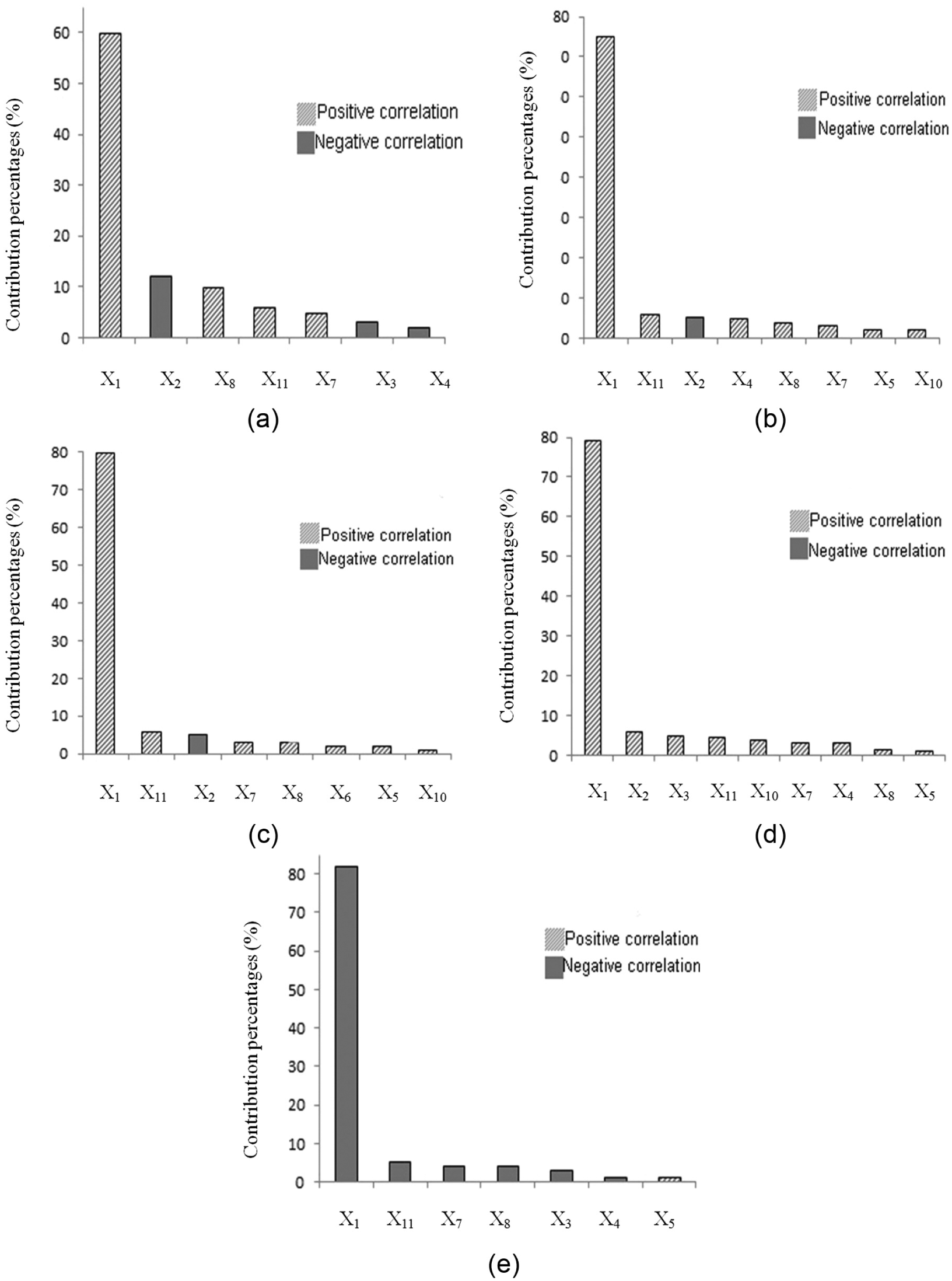
Influence degrees of design variables to the outputs: (a) first-order natural frequency, (b) second-order natural frequency, (c) third-order natural frequency, (d) mass, and (e) maximum deformation.
Approximate model
The optimization process is needed to establish approximation model for establishing the relationships between input variables and output responses in order to obtain a satisfying solution. The approximate model is built by using the Kriging model for the column optimization. The multidisciplinary approximate model considers product mass, the three first-order natural frequencies, and maximum deformation for optimizing the original solution and improving the overall performance. Figure 6 shows the approximation models of the three natural frequencies, column mass, and maximum deformation.
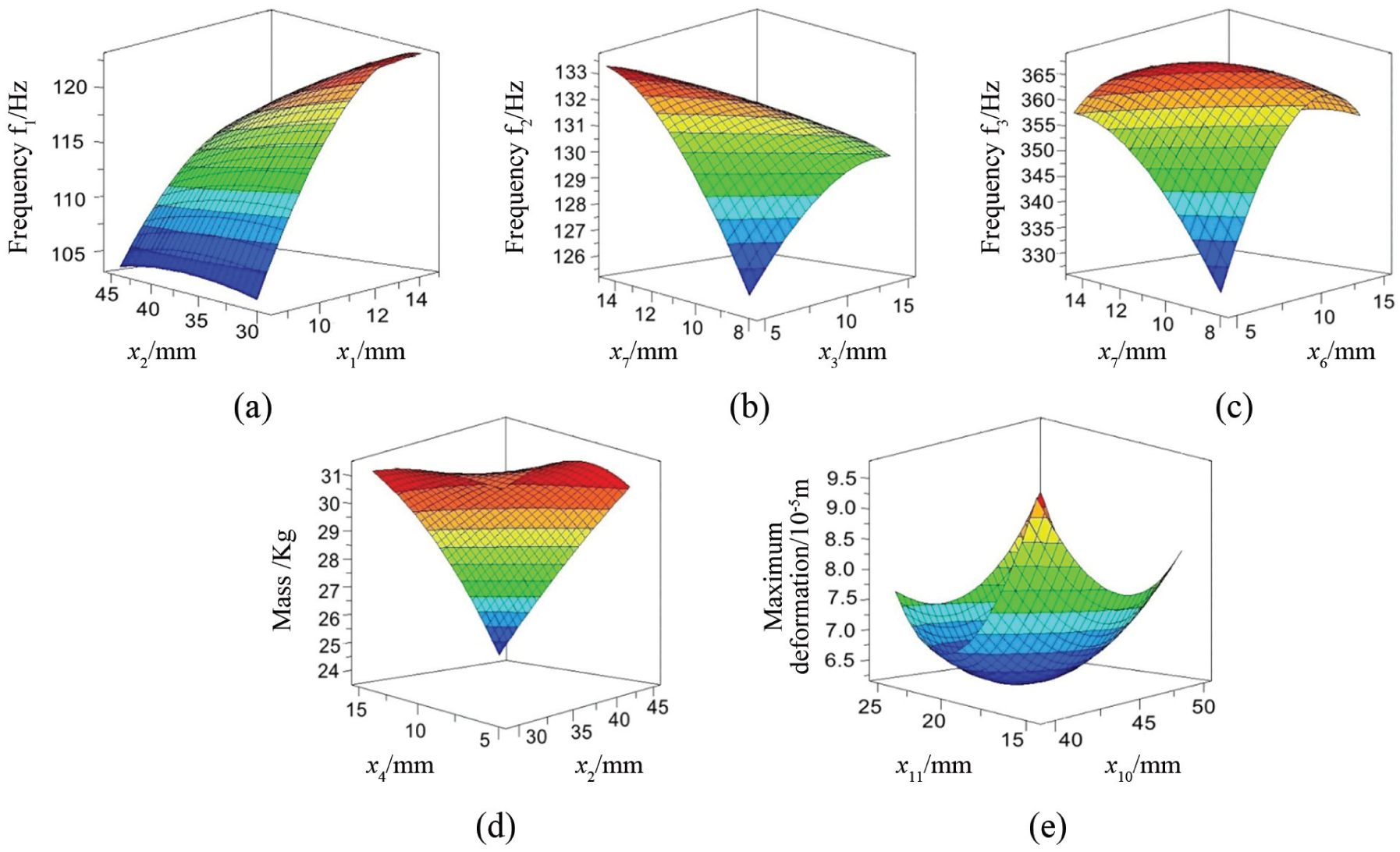
Approximate models of the three natural frequencies, mass, and maximum deformation: (a) frequency f1, (b) frequency f2, (c) frequency f3, (d) mass, and (e) maximum deformation.
Optimization results
The proposed MDO method is used to optimize machine tool column structure, which can modify the original design to improve the comprehensive performance. On the basis of the existing approximate model, the study selects column mass, first-order natural frequency, and maximum deformation as the objective function, and second-order and third-order natural frequencies as the constraints (i.e. the frequencies of the optimization results cannot be lower than the original values). These 11 design variables are set as optimization variables for the multi-objective optimization model. Pareto optimal solution set can be identified in Figure 7 by using the multi-objective GA.
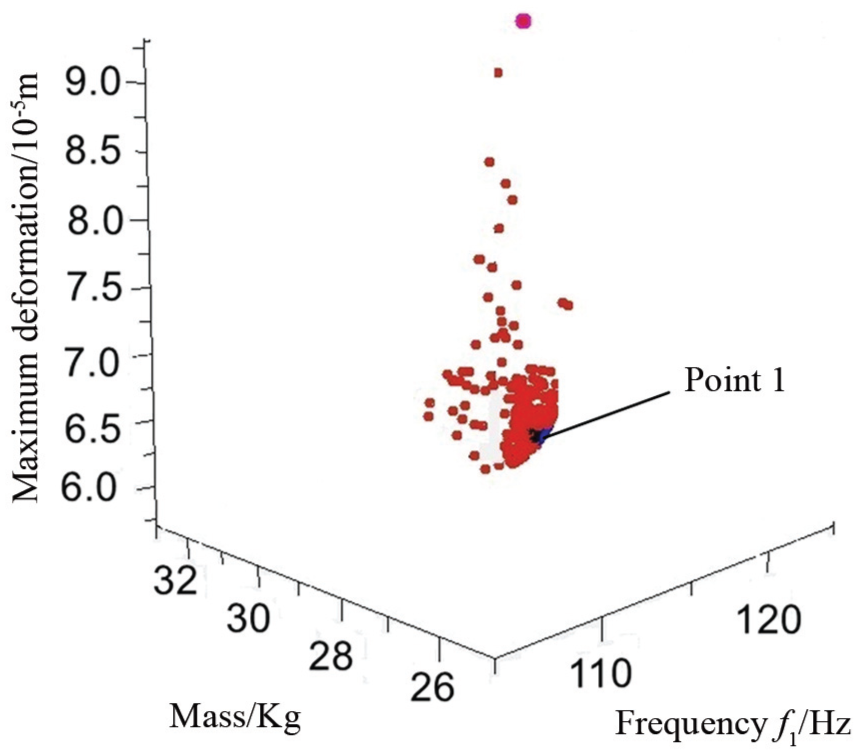
Pareto solution set.
The optimal solution is identified based on the final Pareto solution set from the practical engineering perspective and is analyzed by using finite element analysis (in Figure 8). The contrast results of the original solution and the optimization solution of the CNC milling machine column are given in Table 3. The results can indicate that the optimization solution can reduce 3.35% of column mass, improve 4.34% of the natural frequency, and slightly increase the other two natural frequencies and stiffness.

Simulation results of the optimizing solution: (a) first-order model of vibration (f = 121.86 Hz), (b) second-order model of vibration (f = 132.04 Hz), (c) third-order model of vibration (f = 368.16 Hz), and (d) deformation nephogram under certain load (m).
Original and optimum result comparison.

Conclusion
A new integration of MDO method is presented for the optimization of CNC machine structure. A Latin hypercube sampling method and a Kriging approximate model are used to establish the approximate model according to the response outputs of the samples, respectively. Optimal solution is identified by using a multi-objective GA algorithm. The proposed method is applied in a real-world multidisciplinary optimization case of a typical CNC machine tool. Improved optimization results are obtained in lightweight, static stiffness, and dynamic characteristics, and overall performance is better than the original design. This method has higher optimization efficiency, which can achieve more comprehensive optimization goals. A feasible way is developed for MDO of other complex mechanical products.
Further work would consider the effects of different optimization methods for CNC machine tool. The overall optimal solution for the machine tool would be identified. Additional models are required in order to better understand the relationship between design variables and design performance.
Footnotes
Acknowledgements
The authors express sincere appreciation to the anonymous referees for their helpful comments to improve the quality of the article.
Declaration of conflicting interests
The authors declare that there is no conflict of interests regarding the publication of this article.
Funding
The project was supported by National Natural Science Foundation of China (Nos 51205242, 71101084), Shanghai Science and Technology Innovation Action Plan (No. 13111102900), Funding Project for Training Young Teachers in Colleges and Universities of Shanghai (B.37-0109-12-007).