




Abstract
The purpose of this research is to investigate the enhanced thermal transport in hybrid (C2H6O2/H2O) by utilizing SWCNTs and joint contribution of internal and external physical constraints like solar radiations, heating source, Forchheimer effects and unsteady flow phenomena. The flow of SWCNTs/(C2H6O2/H2O) is taken over a sphere which rotates about its axis. Further, formulation is accomplished by operating the similarity transformative functions and then achieved the results using bvp4c scheme. It is examined that the unsteady and Forchheimer effects enhance the fluid flow while the NPs concentration controls it due to increasing density and viscosity factor. The unsteady number diminishes the velocity
Introduction
The composite structure of CNTs make them more efficient for thermal applications. Irfan et al. 1 determined the functionality of SWCNTs for Ellis model executed fine contribution regarding the heat transfer. Ibrahim et al. 2 explained the CNT functionalization and also discussed its features and their insights into the nanofluids, 3 thermal conductivity. Samat et al. 4 examined magnetic effect and heat transport features in traditional fluid saturated by CNTs. The study reveals the contribution of Also investigated the effect of other parameters such as CNTs volume fractions on the shear drag and Nu features. Zhang et al. 5 conducted indepth review about the characteristics and contribution of CNTs in nanofluids dynamics. They described some methods to design the safer nanomaterials to reduce the harmful effects of currently used CNTs.
Bartwal et al. 6 discussed the characteristics of tangent hyperbolic using machine learning algorithm. The study shown that the Bejan number diminishes by increasing the thickness parameter. The studies conducted by Upreti et al.,7,8 focused on the applications of CNTs nanomaterials for thermal behaviour of nanofluids. They also considered Forchheimer effects, Xue, and nanoparticles structure based models and provided that the outputs may be helpful in multiple engineering applications specifically in geothermal and nuclear waste. Further, Uddin et al., 9 provided deep analysis of various hybrid nanofluids for wide applications in biomedical, energy and electronics cooling etc.
Chen et al. 10 comprehensively described the techniques for CNTs development and prepared the nanomaterial using three techniques. Suhaimi et al. 11 prepared the MWCNTs by employing two-step technique. They also described that the presence of MWCNTS declines the dissipation effects which ultimately affects the output. Xie et al. 12 restrained the thermal conductivities of MWCNTs solution through hot wire. It is noticed that these nanotubes have higher thermal conductivity then based fluid. Munyalo et al. 13 reviewed the aspects of NPs structures and their varying characteristics due to surface areas. The output reveals that the thermal conductivity increase and surface tensions decreases for varying NPs size.
Kalsi et al. 14 discussed the features which affect the thermal properties of nanofluid and also described the novel approaches to achieve extremely high TC of nanofluid. Dey et al. 15 given the comprehensive review on the preparation and stability of nanofluid. Different methods for the preparation of nanofluids were also explained. Yang et al. 16 demonstrated the fluctuating characteristics of fluid by focusing on the NPs size. The study shows that enhancing the NPs agglomeration has concrete effects on the thermal conductivity. Michaelides 17 provided experimental investigation mass transport of nanofluids alters due to inclusion of NPs. Peterson and Li 18 discussed the thermo solutal transport in nanofluids and also explained the TC trends from experimental and theoretical ways. The researchers also performed experiments to analyze the nanofluids contribution for multiple applications. Aliabadi et al., 19 assessed the nanofluid performance through experimental approach for multiple straight tubes. The Cu/H2O taken in the experiment and prepared through two-phase method. Another empirical study conducted in reference 20 provides indepth contribution of Cu/water nanofluid for the performance of tubular heat exchangers along with vertex generator insert. 20 The conclusion reveals that use of nanofluid augments the performance, and simple fabrication of VG inserts is beneficial at high Reynolds number.
Khanafer and Vafai
21
used different models of nanofluid viscosity which expressed as function of
Lai et al. 25 reported the convection experiments with nano fluid. They used a single millimeter size stainless steel tube subjected to a constant heat flux. Warrier et al. 26 proposed correlation for the TC at multiple NPs dilution levels and noted that the nanofluid features vary with varying concentration. Yu et al. 27 summarized in the development in the nanofluid technology for heat transfer application in the industrial processes. The main focus of their study was the primarily transportation applications. Kleinstreuer and Feng 28 investigated the nanofluid based on hybrid traditional fluid using spherical type of NPs. Volder et al. 29 explained the uses of carbon nanotubes in different fields. They also explained its uses in super capacitors actuators and lightweight electromagnetic shields.
The study of Darcy/Forchheimer (DF) effects on heat transfer of radiated nanofluids with SWCNTs fills a very important gap in current research. Though past studies have focused on the efficiency of nanofluid’s heat transport or Forchheimer effects on the flow individually, the combination of SWCNTs with remarkable thermal conductivity and radiated DF flow, especially through a rotating sphere, has not been examined. The originality of this work is in its overall analysis of how Forchheimer, solar radiations, and SWCNTs addition affect thermal performance, with implications for industrial cooling systems. In addition, the work presents new model to enhance heat transfer effectiveness, filling the opening between theoretical expectations and real-world implementation for thermal applications. The research therefore benefits the field by offering a comprehensive framework for improving thermal transport.
This following important questions will be addressed in this research.
How the concentration of SWCNTs and Forchheimer phenomena affects the flow and temperature of (C2H6O2/H2O)?
How the heating source and thermal radiations contribute in thermal enhancement of nanofluid?
How the unsteady phenomena influenced the characteristics of SWCNTs/(C2H6O2/H2O)?
How the model parameters alter the shear drag and thermal gradient?
Model configuration
The streamline flow of SWCNTs/(C2H6O2/H2O) over a sphere which revolves about its axis is taken. The functional fluid is composition of SWCNTs and (C2H6O2/H2O) where the fluid is 50%–50% ratio of two newtonian fluids. The sphere revolves with velocity


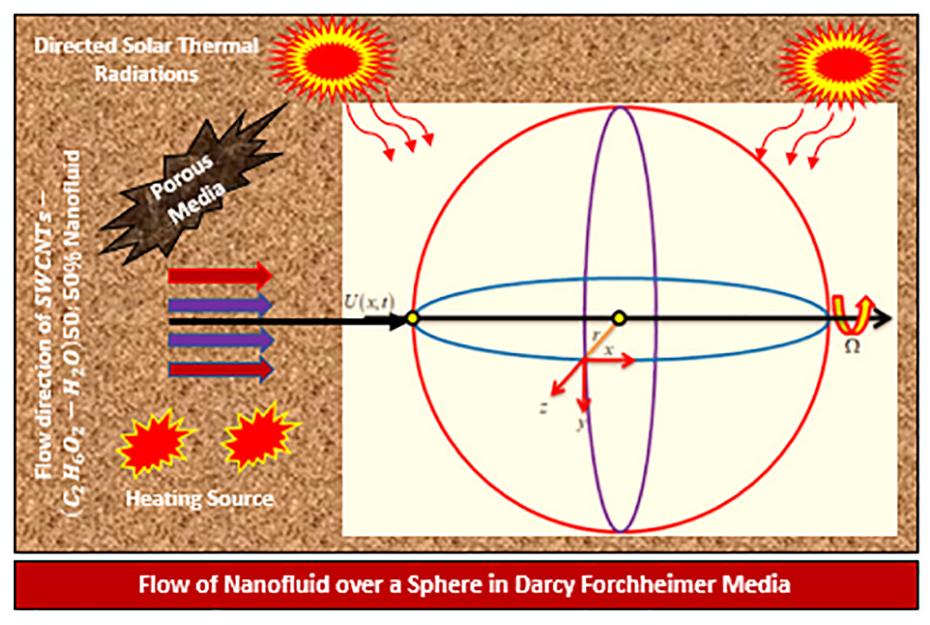
Flow scenario of nanofluid through revolving sphere.
In the physical laws defined above,




Here,
The following transformative functions are used to convert the flow problem into respective dimensionless form. 31

Further, the below improved characteristics are used to enhance the applicability of the problem for thermal applications.35,36


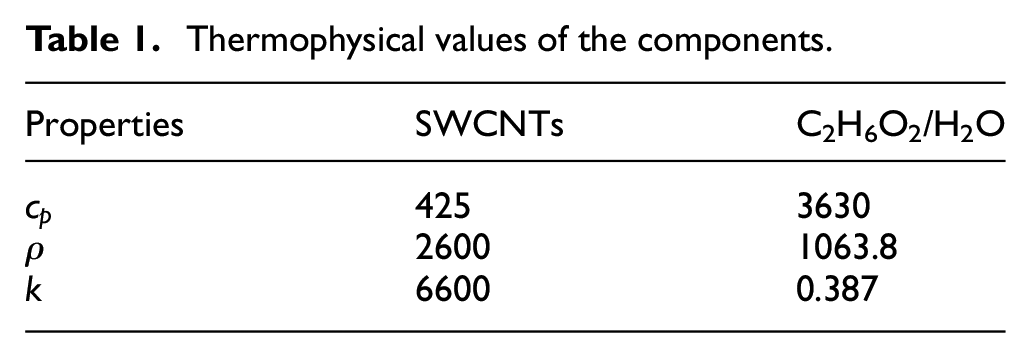
The specific values for the nanofluid components are added in Table 1 (see Refs).37,38
Thermophysical values of the components.
The problem development is carried using the above information and obtained the third and second order problem for the nanofluid flow.


The BCs which imposed on the flow of the fluid are enlisted in equations (16) and (17).


In the preceding equation,
Mathematical analysis
The flow SWCNTs/(C2H6O2/H2O) possesses a third order nonlinear problem with non-homogenous boundary conditions. The mathematical analysis is essential to spotlight the physical outcomes under the parameters involved in the study. Hence, the shooting scheme along with RK 39 method is exercised. For this, the problem is reformulated in the form of IVP 40 using appropriate transformations and then solved. The following procedure is adopted for the problem reduction.
The appropriate functions are defined as below.


For successful implementation of equations (19) and (20), the problem arranged in the below form.


Use of equations (19)–(21), in equations (22)–(24), yields the following form.


The corresponding conditions reduced in the following form. After this arranged problem, the scheme implemented successfully.


The scheme accuracy is obvious from the behaviour of the plotted results which fulfill the BCs and asymptotic nature of the results. The numerical output for the problem is performed in Table 2. The default values of the constraints are
Results for the velocity and temperature for parametric values.

Table 3 presenting the results validation from the current model with the data of Ramesh et al.
41
by excluding the influence of Darcy Forchheimer parameters. The model is aligned and computed the data for
Validation of the results with previous data.

Results and discussion
Figure 2(a)–(e) furnishing the velocity fluctuations for multiple model constraints. The rising trends of the velocity with increased

Behaviour of the nanofluid velocity under varying pertinent parameters.
The trends of the velocity

Behavior of nanofluid velocity
Figures 4 and 5 elucidating the temperature variations over the sphere in response of the parameters. The rising trajectory of nanofluid temperature across a sphere with greater

Behavior of nanofluid temperature under parameters

Behavior of nanofluid temperature under varying parameter (
Impacts of unsteady number
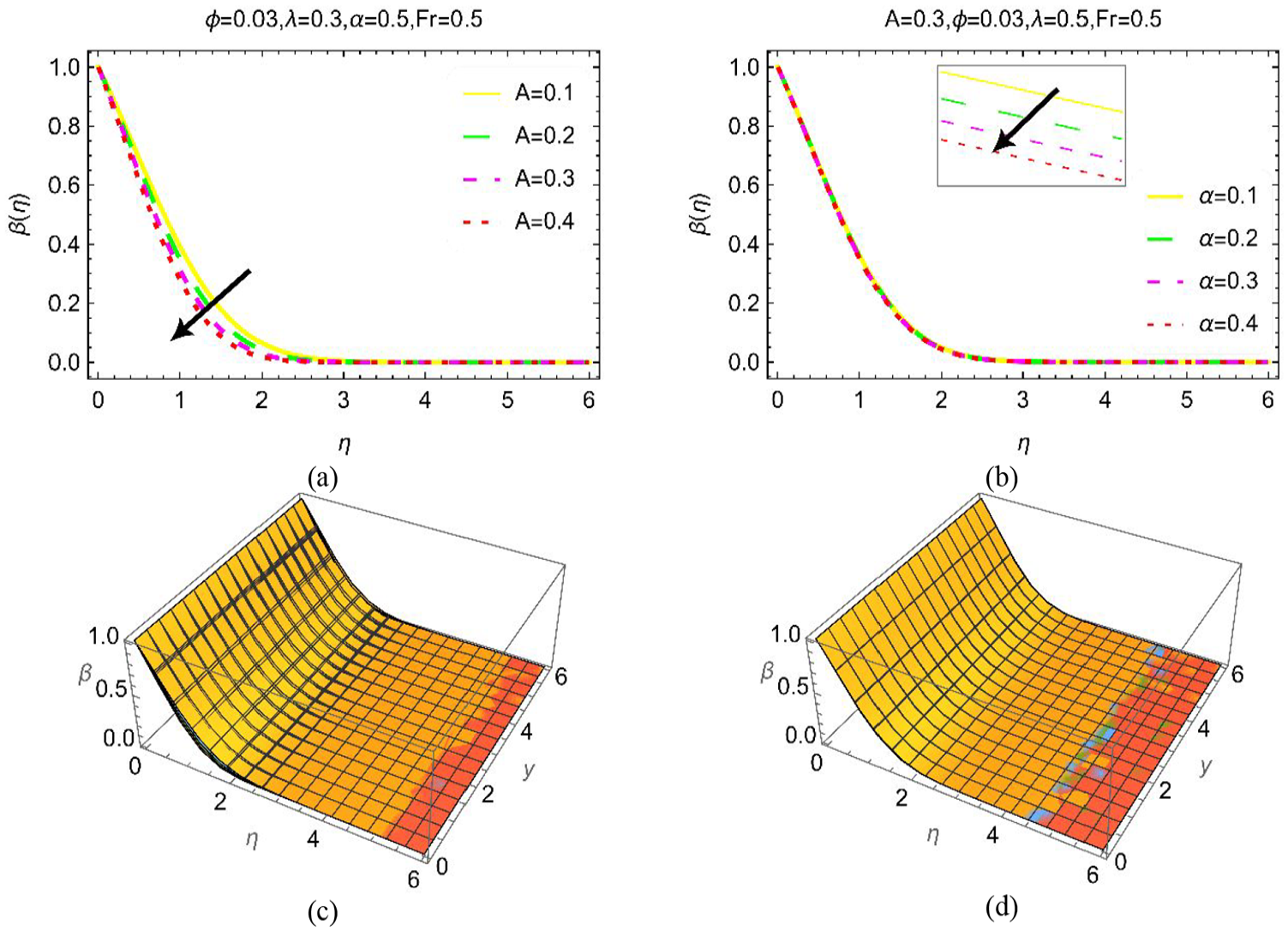
Behavior of nanofluid temperature under varying parameter
Figures 7 and 8 demonstrating the heat transport rate in nanofluid affected by multiple parameters of the model. The Nu that defines the rate of heat transfer in nanofluids follows augmentation with greater unsteady, rotational, and Forchheimer parameter values because of increased flow dynamics and energy transfer. The unsteady parameter also incorporates time-dependent fluctuations that cause disruption of thermal boundary layers to ensure improved mixing and increased convective heat transfer. Likewise, higher rotation enhances centrifugal forces, enhancing nanofluid rotation and thermal diffusion, whereas the Forchheimer effect enhances heat transfer through the enhancement of nonlinear flow interactions. In contrast, increased concentrations of nanoparticles decrease the Nusselt number, since the associated enhancement in effective viscosity suppresses fluid motion and lowers the efficiency of convective heat transfer. These contradictory effects highlight the interaction of flow dynamics and heat behavior in nanofluids through a sphere.

Variation of Nu for varying parameter

Variation of Nu for varying parameters
The following tabular results (Table 4) shows the
Computation for skin friction against the parametric values.

Conclusions
Indepth investigation of the model reveals that:
The component of velocity
The
The thermal profile is enhance by increasing the thermal radiation number and heat transfer rate and also for nanoparticle concentration but temperature is decreases if the values of parameters such as rotation, unsteadiness and Darcy number are increased.
The heat transfer is enhance for considering the effects of unsteadiness, rotation parameter, Darcy number and inertial effects but it reduces if the effect of nanoparticle concentration is taken into account.
The values of skin friction for both component is decreases for nanoparticles concentration. The components of skin friction
Subsequent research into SWCNTs/(C2H6O2-H2O) nanofluids across a sphere would consider the impact of nanoparticles with different shapes and functionalization for maximizing thermal and flow characteristics. Examination of the stability and agglomeration tendency of SWCNTs as a function of temperature and shear conditions would increase the feasibility of practical applications. The effect of combined nanoparticles (such as SWCNTs and metal oxides) on friction factors and heat transfer should also be addressed to achieve a balance between performance and energy efficiency.
Footnotes
Handling Editor: Sharmili Pandian

Funding
The author(s) disclosed receipt of the following financial support for the research, authorship, and/or publication of this article: The authors extend their appreciation to the Deanship of Scientific Research at Northern Border University, Arar, KSA for funding this research work through the project number (NBU-FFR-2025-2461-14).
Declaration of conflicting interests
The author(s) declared no potential conflicts of interest with respect to the research, authorship, and/or publication of this article.