



Abstract
This article explores heat transfer characteristics of magnetohydrodynamics water-base silver (Ag) and iron oxide (Fe3O4) hybrid nanomaterials flow in a Darcy-Forchheimer porous medium induced by a stretching/shrinking surface with impacts of heat sink/source. Moreover, thermal radiation effects and the slip boundary conditions are also incorporated in the given problem. Governing partial differential equations (PDEs) are first altered into the ordinary differential equations (ODEs) using suitable similarity transformations. These achieved ODEs are solved by the well-known shooting technique in Maple software to get the required numerical solutions for the variation in different physical parameters. Here, the numerical findings show duality in solutions in case of stretching/shrinking parameter over different ranges of the comprised distinguished parameters. In this regard, the stability analysis is done and the first solution is found stable and physically acceptable, while the second one unstable and physically infeasible. Besides, the skin friction increases for the case of shrinking but it decreases for case of stretching parameter due to the greater impacts of the mass transfer parameter while the heat transfer phenomenon upsurges for the case of shrinking parameter. Moreover, the skin friction, and the heat transfer rise with variation of the suction parameters when the quantity of solid nanoparticles volume fraction is increased.
Introduction
Over the last few decades, the nanoparticles (NPs) have garnered a lot of attention owing to their superparamagnetic properties, biocompatibility, and lack of toxicity. Recent developments in the biological generation of iron oxide NPs using environmentally friendly techniques have greatly enhanced both their quality and biological applications. On the other hand, the recent changes in nano-technology are also motivating the technical communities toward new innovative directions in all sectors of engineering and modern industries. Similarly, heat removal from the surfaces plays an important role of the several processes in industries such as heat transfer management in the pharmaceutical industries, cooling of different devices in the electromechanical sectors and treating the temperature in power plants. The thermal conductivity of the matter is one of the compelling factor for achieving anticipated heat removals rate. Traditional fluids, such as oils, glycine, water and common polymeric fluids possess poor thermal conductivity compared to solid particles. However, a homogeneous mixture of nanoparticles contains two liquids known as nanofluids. Nanoparticles operating in nanofluids are composed of carbon nanotubes, oxides, metals, and carbides. The base fluid is made up of liquid oil, ethylene glycol, and water. The nanofluid was first proposed by Choi and Eastman. 1 Nanofluids have applications in microelectronics, microfluidics, transportation, biomedical, X-rays, material processing, and scientific measurement. Buongiorno proposed an analytical model for convective transport in nanofluids, which incorporate the effects of Brownian diffusion and thermophoresis. These nanoparticles also hold a lot of significance in the areas of biological and medical applications. Some nanoparticles can bind many drugs, proteins, and target cancer cells. Since many nanoparticles have high atomic numbers that can produce heat, they lead to the treatment of tumor-selective photo thermal therapy. Most of the nanoparticles can cure and help in targeting the deadly cancer cells. Flow through porous medium with nanoparticles has significant applications in biomedical science (such as drug delivery and cancer treatment to treat radiotherapy) and chemical engineering. 2 Many researchers have worked on nanofluids from different points of views on different surfaces.3–5
Hybrid Nanofluids (HNF) are the most updated version of the nanofluids, where more than one types of nano-sized particles are dispersed into the pure working base fluid. Sulochana and Aparna 6 have explored how unsteady flow of hybrid liquids on an enlarging surface is affected by Brownian motion and thermophoresis. They concluded that the heat transfer rate decreases due to the influence of Brownian motion and thermophoresis. Devi and Devi 7 examined the Cu-Al2O3/H2O HNF flow over a permeable stretching surface. That investigation indicates that the volumetric fractions of nano-sized particles are essential to achieve the desired capability in the heat exchange rates. The thermo-physical features of EO-TC4/Ni mixtures along with the radiative effects have been analyzed. 8 Magnetohydrodynamics is an important field of the fluid mechanics, which deals with the magnetic features of electrical conduction in fluids. Aladdin et al. 9 scrutinize the magnetic field and suction influence on a stretching surface along with the aluminum-copper nanoparticles. In this study, duality in solution is observed owing to the presence of suction parameter, and better enhancement of transfer of heat is observed.
The magnetohydrodynamics (MHD) is concerned with physical and mathematical scaffold, which shows magnetic dynamics in the electrical conducting fluid. The applications of magnetohydrodynamics are especially useful in the modern industrial and engineering areas, such as the drawing of the plastic wires and films, polymer extrusion in the melt spinning process, crystal growth, paper production, glass fiber manufacturing, fluid film condensation processes, food production, electronic chips, electrochemical processes, flow through the filtering devices, and thermal energy storage. The incorporation of nanoparticles in MHD fluids has a wide range of applications in medical sciences, 10 materials processing, 11 and various other industries. The magnetic and electrical fields are very essential for controlling fluid flow, which is the most important need in nanofluids flow problems. Anandakumar and Umamaheswari 12 conducted a study on laminar forced flow of Fe3O4 with magnetic effects, demonstrating that the magnetic field enhances heat transfer rates in fluids. Krishna et al., 13 investigated radiative MHD flow of Casson hybrid nanofluid over an infinite exponentially accelerated vertical porous surface. Many other researchers have also explored MHD flow in this context. Moreover, the influence of the magnetic parameter on nanofluid flows has been a subject of observation by many researchers.13–17
The Darcy law, which establishes a proportional relationship between pressure gradients and velocity, may not be suitable for problems involving fluids with high-velocity flow. However, when dealing with models featuring higher velocities, several advanced fluid flow issues emerge. Consequently, Forchheimer’s nonlinear terms can be introduced to investigate fluid flow, particularly in permeable media along with higher Reynolds numbers. A study conducted by Ghadikolaei et al. 18 explored the flow of HNF over a curved, stretched surface, taking into account radiation and the influence of a constant temperature source. The findings revealed that the blade-shaped nanoparticles show greater enhancement in temperature as compared to brick-shaped nanoparticles. Another investigation, carried out by Shaiq et al., 19 delved into three-dimensional flow over a vertically stretching surface using a 50-50 mixture of ethylene glycol and water. Their results indicated that the shape factor and radiation enhance the heat transfer rate, with a more pronounced improvement observed in the case of hybrid nanofluids. Ghadikolaei and Gholinia 20 considered the temperature base viscosity model to examine the heat enactment of SiO2 and MoS2 nanoparticle along the base fluid ethylene glycol. In the realm of non-Darcy flow, Chamkha, 21 investigated hydromagnetic free convection from a cone and a wedge in porous media, while Chamkha, 22 delved into non-Darcy fully developed mixed convection in a porous medium channel with heat generation/absorption and hydromagnetic effects.
Motivated by the above literature, the current examination explores model development and magnetohydrodynamics radiative flow in the case of Darcy-Forchheimer porous medium in the presence of hybrid nanofluid past a stretching/shrinking surface with thermal radiation. In addition, heat absorption/generation and the slip conditions at the boundary are also incorporated into the study. Iron oxide (Fe3O4) and silver (Ag) nanoparticles combine with the base (water) fluid to form the proposed hybrid nanofluid. Dual (first and second) branch outcomes are also calculated against the specific range of suction as well as the stretching/shrinking parameters. The stability analysis is also conducted to forecast stable solutions as time evolves. According to the authors’ knowledge, no one has yet investigated the aforementioned problem.
Mathematical formulation
A two-dimensional (2D) incompressible steady boundary layer flow and heat transfer characteristic of

The flow model and coordinate system: (a) stretching surface (λ > 0) and (b) shrinking surface (λ < 0).
Moreover, the porous space of Darcy-Forchheimer is assumed. Thermal radiation, thermal slip and velocity slip, heat sink/source parameters are also considered in energy equation. A uniform magnetic field with



The boundary conditions are

Where,

Here,
To convert the equations (2)–(4) following similarity transformations 21 are considered here.

By utilizing equation (5) in equations (2)–(4), it is obtained:


The boundary condition are:
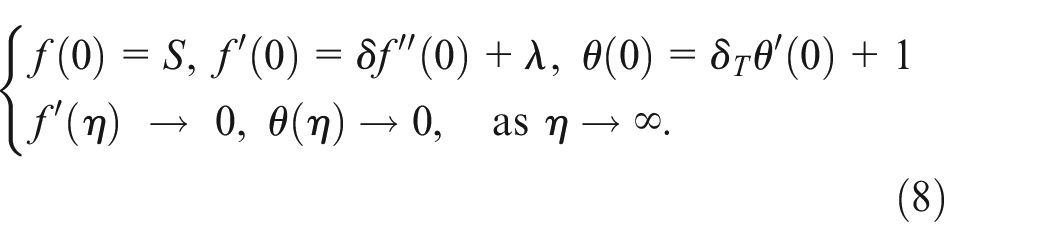
Here,
Key engineering quantities of interest
The physical quantities of significant importance are skin friction coefficient

Here

Stability analysis
In case of existing multiple solutions, it is important to assess stability of achieved solutions to examine their feasibility. The stability of solutions here is assessed using a procedure suggested by Weidman et al. 25 and Merkin. 26 According to this procedure, the governing equations (2) and (4) are converted into unsteady form as:

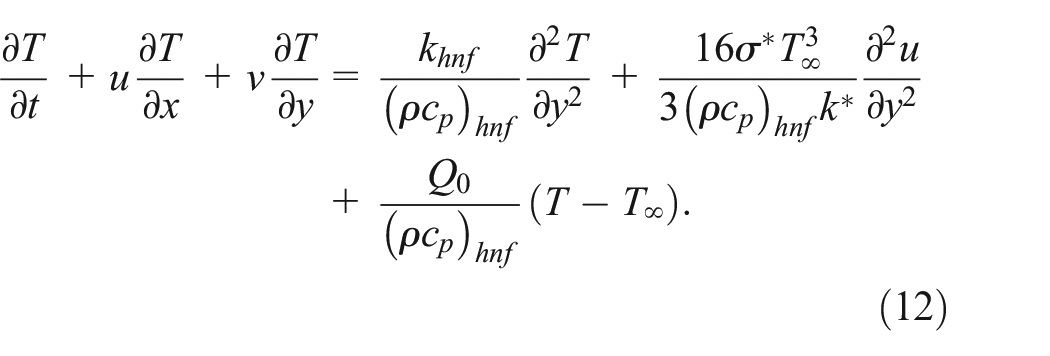
Here,

By using equation (13) in equations (11) and (12), it is obtained:

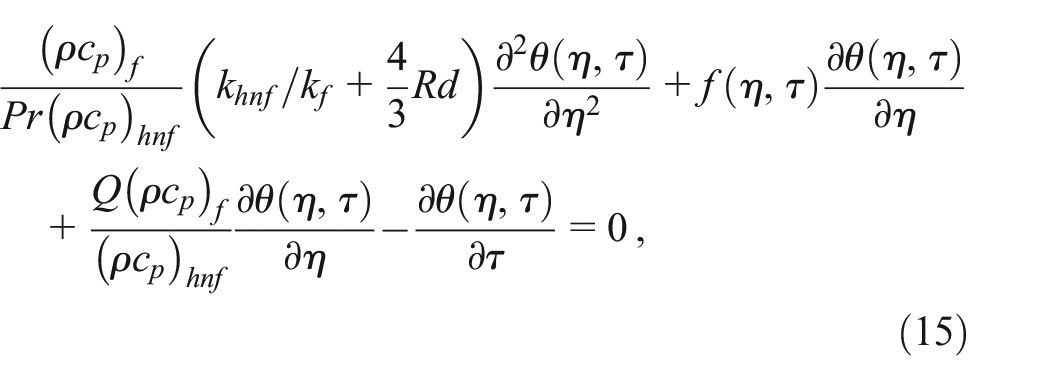
with boundary conditions:

The technique proposed in Weidman et al. 25 can be employed to find the stability analysis owing to dual solutions. Thus, the following functions are introduced.

Here


Subjected to the given constraints:

In view of Harris et al.,
27
possible ranges for eigenvalues might be found by relaxing boundary condition of
Numerical methodology
Maple software is used to get the solution of equations (6) and (7) with specified boundary constraints (8) through shooting technique. 28 This technique converts BVPs (boundary value problems) into IVPs (initial value problems). The specified problem can be written as:


with specified boundary constraints:

where,
Results and discussion
The shooting technique in the Maple Software is utilized in order to numerically solve the system of equations (6) and (7) along with boundary conditions (8). Jaluria and Torrance
29
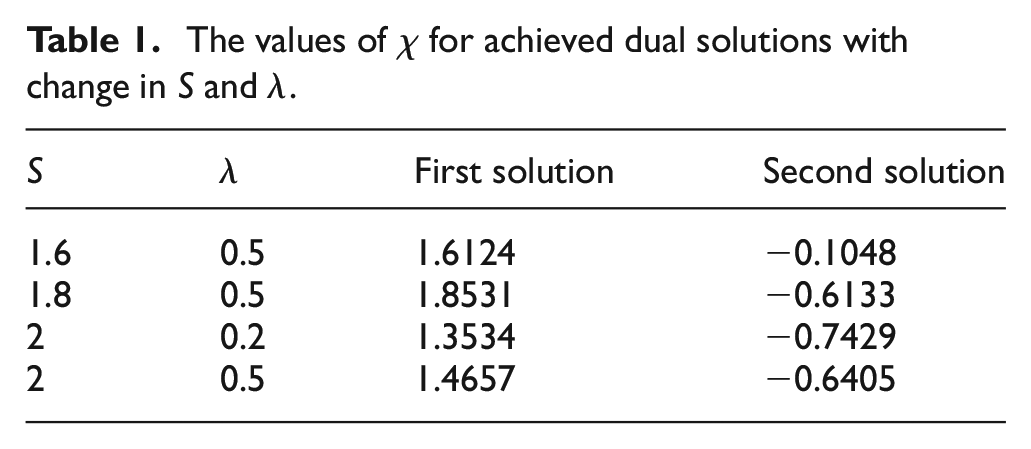
explain this technique. This technique is broadly used by several researchers to resolve all kinds of linear as well as non-linear equations related to fluid flow, heat transfer, and nanoparticles concentrations problems.30–32 Duality in solutions have been found for two distinct initial guesses for un-known values of
The values of
The relative findings of first solution for the local Nusselt number

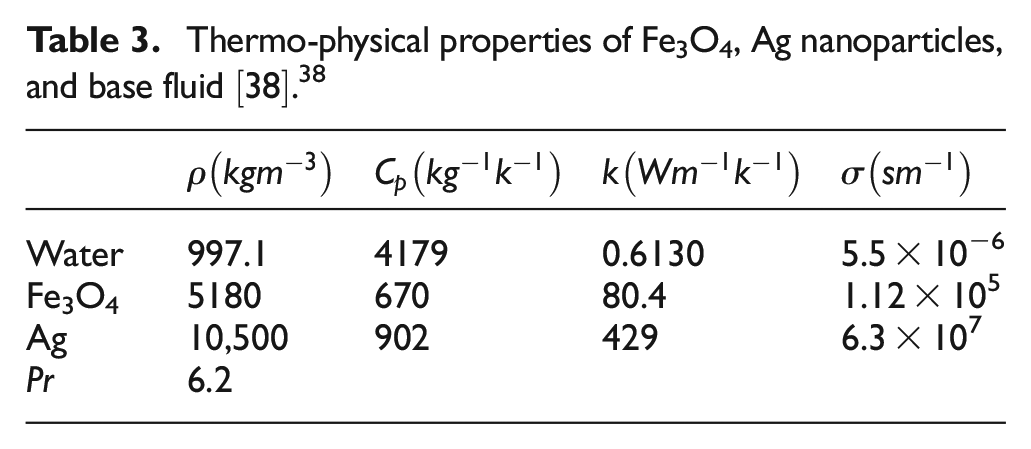
Thermo-physical properties of Fe3O4, Ag nanoparticles, and base fluid
Furthermore, the graphical results indicating the effects of different parameters are presented and discussed below. The effect of parameter

Variation in
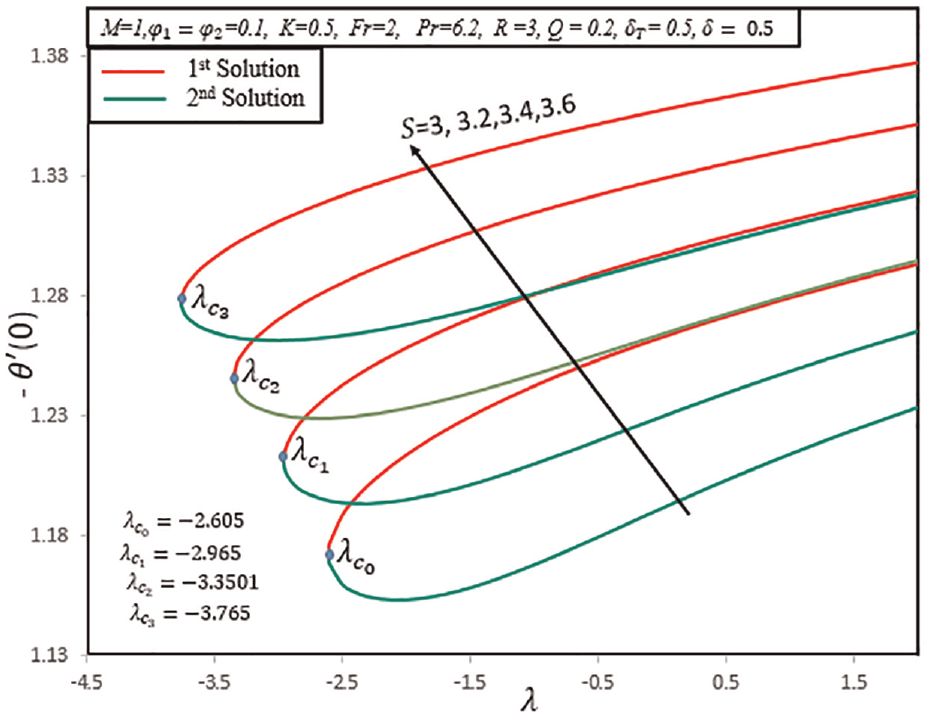
Variation in
Similarly, the influence of nanoparticles’ volumetric fractions
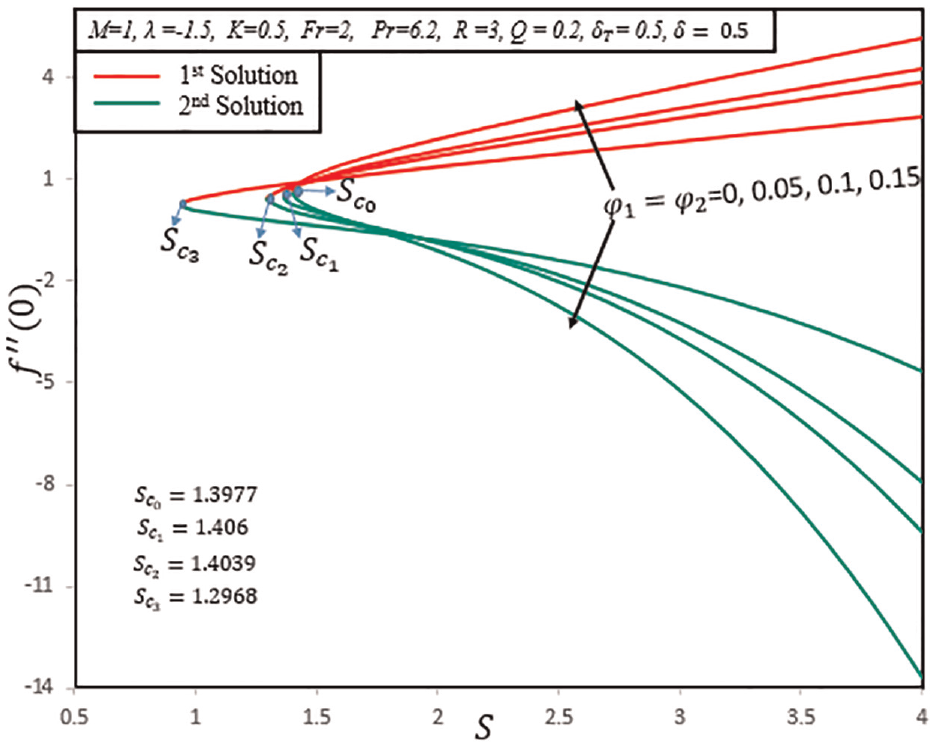
Variation in

Variation in

Variation in
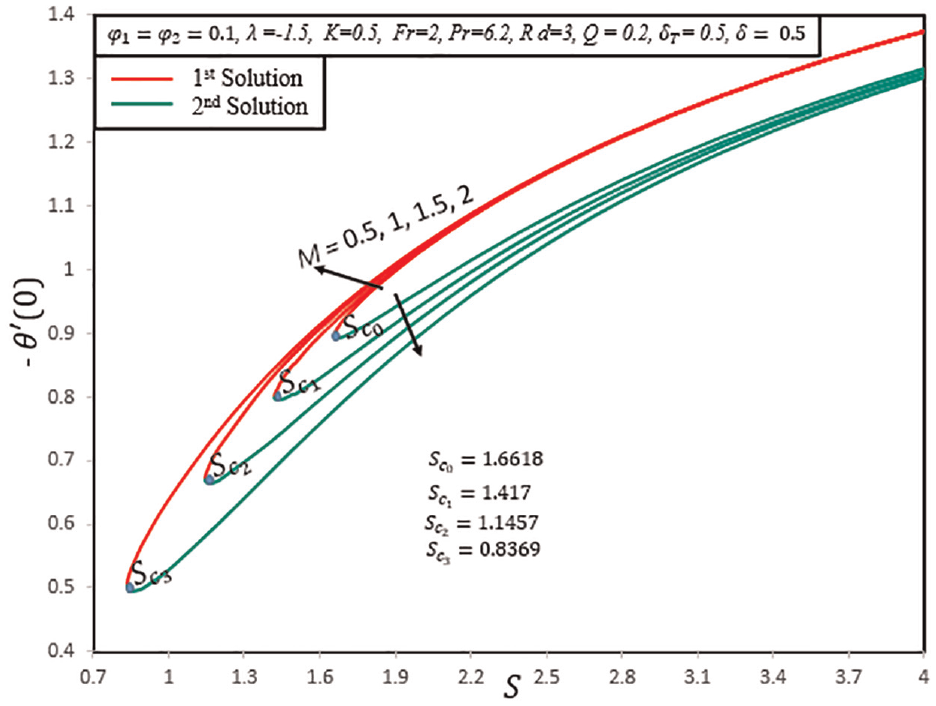
Variation in
Figures 8 and 9 are presented to illustrate the comparative results of the skin friction coefficient and Nusselt number as they vary with the volumetric fractions of nanoparticles in a water-based fluid under three different situations. In Figure 8, it is evident that

Variation in

Variation in
The behavior of different parameters on velocity profiles

Variation in

Variation in
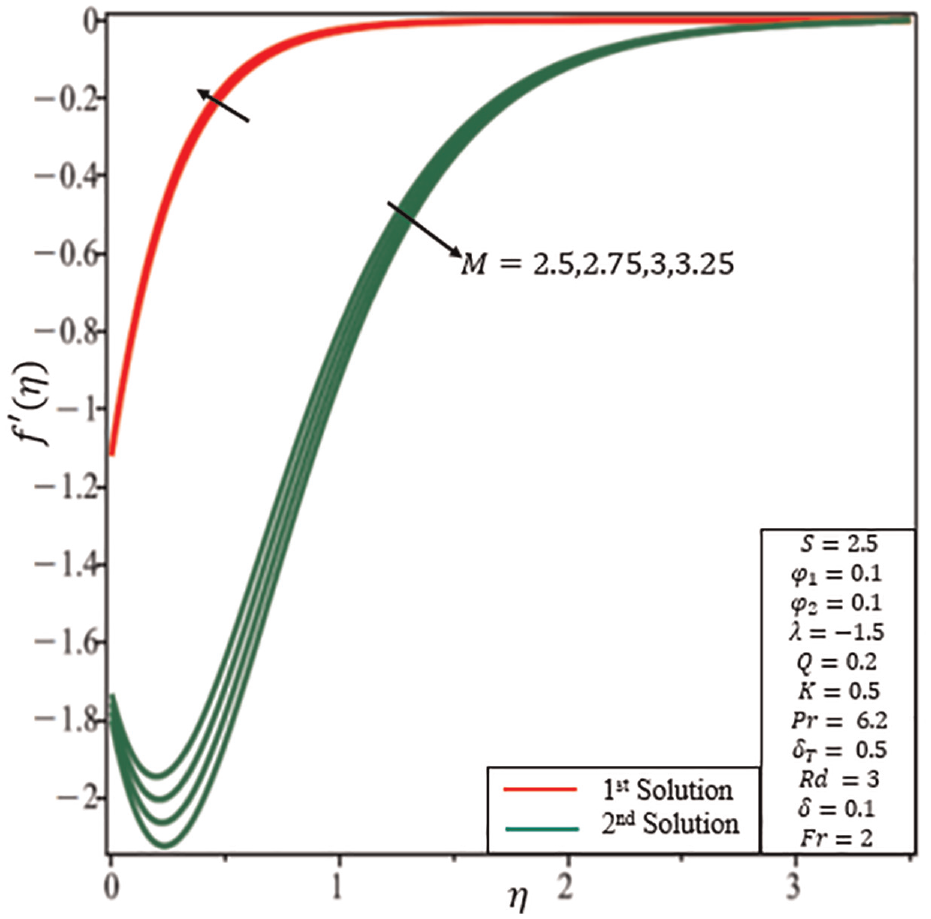
Variation in

Variation in

Variation in
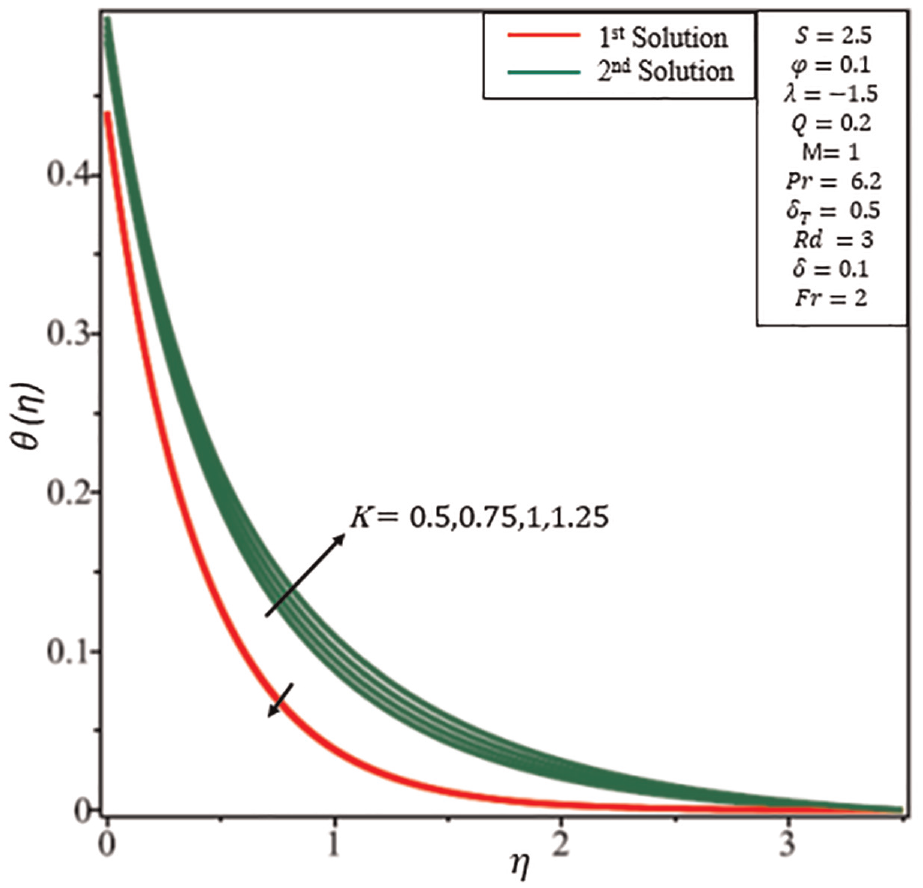
Variation in

Variation in

Variation in

Variation in

Variation in

Variation in

Variation in

Variation in
Physically, a substantial amount of the fluid flows to the outside of the surface due to the presence of pores in the suction process, which decelerates the flow of the fluid. Therefore, fluid velocity as well as temperature, decreases. On the other hand, the increasing rate of magnetic parameter
Figures 14 and 15 respectively, are drawn to show the effects of parameter
Figure 18 shows the impact of the parameter
On the other hand, the thermal boundary layer and temperature are seen decreasing with an increase in heat source/sink parameters
Figures 21 and 22 are drawn to show the impact of slip parameter
Conclusions
In this investigation, two-dimensional incompressible steady Darcy-Forchheimer boundary layer flow, and the heat transfer characteristics of Ag-Fe2O3/water-based hybrid nanofluid induced by a shrinking/stretching surface along radiation and magnetic impacts are considered. In addition, the magnetohydrodynamics, radiation, heat sink/source, and slip effects were also taken in the given examination. The numerical dual solutions were achieved using shooting technique in Maple software. Important results of present study are as follows:
The skin friction
Skin friction and the Nusselt number increase along the variation of suction when nanoparticles volumetric fraction is increased.
Skin friction and the Nusselt number rise with rise in magnetic parameter and as well as the suction parameter.
The Ag-water-based hybrid nanofluid has a greater the rate of the skin friction compared to Ag-
The
An increase in suction, magnetic,
An increase in suction, magnetic, porous permeability parameter, heat source/sink, thermal, and velocity slips parameters decreases the temperature profiles while it is heightened owing to the superior impacts of thermal radiation.
The present study will prove beneficial regarding hybrid nanofluid and for those interested in working on multiple solutions such as dual and triple branch solutions. This work can be extended to three-dimensional flow problems with concentration equation, along with the momentum and heat transfer equations, where chemical reaction parameters can also be considered. In addition, the waste discharge pollutant concentration can also be taken in the extension of this problem.
Footnotes
Appendix
Acknowledgements
The authors are thankful for the support of Researchers Supporting Project number (RSP2023R33), King Saud University, Riyadh, Saudi Arabia.
Handling Editor: Chenhui Liang
Author contributions
Conceptualization, M.A.M., K.J., and U.K.; methodology, M.A.M., K.J., and U.K.; software, M.A.M., K.J., and U.K.; validation, M.A.M., K.J., and U.K.; formal analysis, M.A.M., K.J., and U.K.; investigation, H.B.L. and I.P.; resources, I.P.; data curation, H.B.L.; writing—original draft preparation, H.B.L., I.P., and El-S. M. S.; writing—review and editing, H.B.L., I.P., and El-S. M. S.; visualization, El-S. M. S.; supervision, El-S. M. S.; project administration, El-S. M. S.; funding acquisition, El-S. M. S. All authors have read and agreed to the published version of the manuscript.
Declaration of conflicting interests
The author(s) declared no potential conflicts of interest with respect to the research, authorship, and/or publication of this article.
Funding
The author(s) disclosed receipt of the following financial support for the research, authorship, and/or publication of this article: This work was funded by the Researchers Supporting Project number (RSP2023R33), King Saud University, Riyadh, Saudi Arabia.

Data availability statement
Data will be available on request.