



Abstract
This work examines the micropolar hybrid nanofluid flow on a variable porous elongating sheet using inclined magnetic effects. The fluid is set into motion by stretching nature of the sheet. The effects of heat source/sink and thermal radiation have been utilized in this work together with thermophoresis and Brownian motion effects. Additionally, the Cattaneo-Christov flux model is used to accurately describe mass and heat diffusion by accounting for relaxation time effects, providing a more realistic representation of thermal transport phenomena. The leading equations have been solved using artificial neural network (ANN) method. It has noticed in this work that, when the diamond nanoparticles augments from 0.00 to 0.05 the Nusselt number surges from 0.00% to 8.27% while on the same range of nanoparticles volume fraction it augments from 0.00% to 8.46% for diamond + copper nanoparticles that ensures the dominance of hybrid nanoparticles. Thermal distributions have been increased due to the influence of thermophoresis, Brownian motion, magnetic effects, radiation, and heat source factor while they have decreased with a rise in the thermal relaxation parameter. The linear velocity of the fluid has decreased due to the increase in magnetic factor and variable porous factor. The validation of current work has ensured through comparative analysis of current results with established data set, with a fine agreement among all the results.
Keywords
Introduction
Nanofluid flow consists of nanoparticles suspended in some base fluids. These nanoparticles, which are typically smaller than 100 nm, considerably augment the thermal properties of the fluid as noticed initially by Choi and Eastman. 1 In heat transfer applications, nanofluids exhibit enhanced thermal conductance, allowing for proficient heat dissipation compared to conventional fluids. When nanofluids flow through channels or pipes, the suspended nanoparticles increase the fluid’s thermal flow features, causing a decline in temperature gradients, and improved heat transfer efficiency as detected by Khan et al. 2 This enhanced heat transfer results in higher surface temperatures being cooled more effectively, making nanofluids useful in applications like electronics coolant, automotive, and energy systems. Mahabaleshwar et al. 3 examined nanofluid flow on an accelerated sheet with effect of inclined magnetic field. However, nanofluid flow also impacts velocity profiles due to changes in viscosity; higher concentrations of nanoparticles increase viscosity, which leads to higher frictional resistance and lower flow velocity as revealed by Boujelbene et al. 4 Additionally, the interactions between nanoparticles and the fluid boundary layer can modify flow behavior, such as promoting turbulence or improving mixing. Recently, it has been revealed that when two or more distinct nanoparticles are suspended in a pure fluid, its thermal properties can be significantly enhanced as observed by Lone et al. 5 This new class of fluids is termed as hybrid nanofluid and with this an innovative approach in nanofluids research has opened the new possibilities to improve heat transfer. Nanoparticles, like metals, oxides, and carbon-based materials, can be combined in a fluid to create what is known as hybrid nanofluids. Algehyne et al. 6 highlighted that the synergy between different types of nanoparticles often results in improved thermal conductance compared to fluids with single nanoparticles. This enhancement is attributed to the diverse shapes, sizes, and thermal conductivities of the particles, which promote better heat dispersion within the fluid. Hybrid nanofluids are being explored in industries like automotive, electronics cooling, and renewable energy systems, where efficient thermal management is crucial. Habib et al. 7 discussed nanofluid flow on a paraboloid revolution with effects of variable viscosity by implementing Keller-Box approach. Lone et al. 8 analyzed the irreversibility effects for stagnant point hybrid nanofluid flow on an expanding sheet with thermally radiative effects. Bhatti et al. 9 examined EMHD hybrid nanofluid flow in pipe with applications in geothermal energy. Alqahtani et al. 10 discussed computationally the electrically conducted spinning flow hybrid nanofluid through two parallel sheets. Additionally, these fluids exhibit improved stability and reduced viscosity, allowing for better flow characteristics. As a result, the combination of multiple nanoparticles optimizes not only heat transfer but also energy efficiency. 11 This advancement marks a significant step toward the development of high-performance cooling systems for modern technologies.
Fluid flow with inclined magnetic field is a significant topic in magnetohydrodynamics (MHD), which studies electrically conductive fluids by using magnetic effects. When fluid flow in the presence of magnetic field the flow experience Lorentz force that acts in opposite direction to fluid’s motion. Mirzaei et al. 12 inspected convective thermal transport for MHD fluid flow in a conduit using various flow conditions. Dharmendar Reddy et al. 13 discussed thermal generation and absorption effects on MHD fluid flow on a cylinder with permeable medium. Sarma and Paul 14 highlighted that the inclination of the magnetic field modifies the distribution and intensity of magnetic forces, affecting the flow velocity and pressure distribution within the fluid. This can lead to complex flow patterns, including velocity gradients, secondary flows, and boundary layer effects. The angle of inclination significantly influences these phenomena; when the field is applied perpendicularly, the Lorentz force is maximized, while a parallel field minimizes the effect. 15 In industrial applications like magnetic control of molten metals, cooling systems for nuclear reactors, and MHD power generation MHD plays a vital role. Mao et al. 16 discussed electrohydrodynamic driven fluid flow through an immiscible interface with valveless water pump. Ali et al. 17 examined magneto-hydrodynamics nanoparticles fluid flow through co-axial disks with dynamics of Bogar fluid. The flow behavior under an inclined magnetic field is crucial for optimizing performance of flow system. The inclination angle also affects heat transfer rates and stability in fluid flows, making it important for thermal management applications. 18 In some cases, the magnetic field can suppress turbulence, stabilizing the flow. Furthermore, in geophysics and astrophysics, inclined magnetic fields influence plasma flows in stars and planetary magnetospheres. Thus, analyzing fluid flow under an inclined magnetic field provides insights into both theoretical physics and practical engineering systems.
Fluid flow on a variable porous surface involves the interaction among the fluid and a surface that has a changing permeability or porosity. The surface’s permeability varies in space, affecting the flow dynamics and the distribution of pressure, velocity, and temperature. In such a scenario, the porous medium can either resist or facilitate the flow depending on its porosity distribution. As the fluid moves across the surface, the rate of mass transfer through the porous material varies, influencing the velocity field of the fluid as perceived by Waqas et al. 19 In the case of an increasing porosity, the fluid experiences less resistance, and the velocity increases near the surface. Alnahdi et al. 20 discussed stagnation point flow on a variable permeable space using thermal convective effects. The temperature distribution is similarly affected by the variable porosity. Heat transfer in such flows depends on the fluid’s velocity and the porosity of the surface. In regions where porosity is higher, there is generally more heat transfer due to higher velocity gradients and less resistance to fluid movement. Khanam et al. 21 inspected MHD convective flow on a porous plate placed vertically with varying suction and slip effects. Salama et al. 22 discussed computationally the fluid flow on a porous sheet with spherical pores. On the other hand, lower porosity regions tend to slow down the fluid, leading to a less efficient heat transfer and potentially higher local temperatures near the surface due to reduced convective cooling. Khan et al. 23 revealed that the combined effects of the variable porous surface influence both the velocity and temperature fields, leading to more complex, localized thermal and flow behaviors. Higher porosity increases heat transfer efficiency due to higher fluid velocities and enhanced convection, leading to a more uniform temperature profile. In contrast, lower porosity regions slow the fluid, reducing convective heat transfer and causing localized hot spots or higher temperature gradients near the surface. These variations in velocity and temperature are critical in designing systems involving porous media, like heat exchangers, filtration, and geothermal energy applications. 24 Mahabaleshwar et al. 25 examined radiative impacts on a dusty laminar trihybrid nanofluid flow on a permeable shrinking/ stretching sheet. Waseem et al. 26 studied thermally the radiative effects on non-Newtonian Darcy fluid flow on an inclined sheet with effects of Cattaneo-Christov flux model.
Micropolar fluid flow is characterized by micro-rotational effects, where fluid particles exhibit both translational and rotational motion, differing from classical Newtonian fluids. This theory, introduced by A.C. Eringen,27,28 is useful for describing complex fluids like polymers, suspensions, and biological fluids. When a micropolar fluid flows on an extending sheet, typically modeled with a linear stretching velocity both fluid velocity and micro-rotational velocity are governed by coupled differential equations. Bhatia and Chandrawat. 29 highlighted that near the sheet, boundary conditions often dictate that micro-rotational velocity is proportional to the gradient of the fluid velocity, while far away from the sheet, both velocities diminish. Sulaiman et al. 30 discussed the efficiency of thermal transportations for micro-polar fluid flow with boundary constraints with supervised network and have detected that with surge in material factor there has a reduction in linear velocity while the micro-rotational velocity has augmented with it. Higher couple stress viscosity enhances the micro-rotation, leading to more significant deviations from classical fluid behavior. Additionally, increased micro-inertia or surface spin parameters can further amplify micro-rotational velocity. These rotational effects also influence heat and mass transfer, which is critical in industrial applications like polymer extrusion, metal forming, and lubrication processes. 31 Algehyne et al. 32 examined the augmentation of thermal transportation for micropolar nanofluid flow on a flat vertical sheet. Yuan et al. 33 explored how microfluidic devices had been employed to sort Caenorhabditis elegans, allowing for automated handling, improved sorting accuracy, and enhanced efficiency in biological experiments. The micro-rotation reduces drag, improve energy dissipation, and enhance material processing efficiency. Thus, micropolar fluid dynamics on a stretching sheet is essential for optimizing processes involving non-Newtonian fluids where particle rotation significantly alters the overall fluid behavior.
Artificial Neural Networks (ANNs) are numerical models intended to distinguish patterns and make predictions. Khan et al. 34 has proved that in fluid flow problems, ANNs are particularly useful due to their capability to tackle complex, nonlinear problems which are challenging to evaluate using traditional analytical methods. ANNs can be trained on large datasets generated through experiments or simulations, allowing them to predict flow behavior, temperature distribution, and pressure variations under different conditions. 35 In fluid dynamics, ANNs are often employed to model turbulence, optimize designs, and predict the behavior of nanofluids which are fluids containing nanoparticles that enhance thermal conductance. ANNs can analyze Casson hybrid nanofluids, which exhibit complex, non-Newtonian characteristics, to determine flow behavior in porous media, or between gyrating plates as noticed by Ul-Haq et al. 36 By learning from input data like fluid properties, temperature gradients, and boundary conditions, ANNs provide real-time solutions, reducing the need for computationally expensive numerical simulations. ANNs are also used in conjunction with optimization techniques to improve heat transfer efficiency, which is crucial in industries like aerospace, chemical engineering, and energy systems as observed by Yuan et al. 37 Additionally, their adaptability allows researchers to explore dynamic scenarios, such as varying porosity, viscosity, or magnetic field effects on fluid flow. The integration of ANNs in fluid flow research enhances accuracy and efficiency, enabling better-informed decisions in system design and performance evaluation. This makes ANNs a powerful tool for advancing fluid dynamics and solving real-world engineering challenges. Jegan et al. 38 inspected computationally the bio-magnetic nanofluid flow with impacts of Darcy Forchheimer theory by evaluating modeled equations with ANN. Aslam et al. 39 examined incompressible flow of fluid through diverging and converging channel using the ANN approach. Bairagi et al. 40 discussed this technique (ANN) to simulate MHD radiative fluid flow on a gyrating cylinder.
Research gap
Despite considerable progress in understanding the properties of hybrid nanofluids for biomedical applications, several research gaps remain in the existence literature:
Study of blood based hybrid nanofluid flow with micropolar effects on a variable porous stretching sheet is unexplored by implementing neural network approach. The inclusion of porous medium in such flows is a novel work that has not discussed before.
The motion of the fluid subject to the influence of inclined magnetic field on variable porous space has not revealed.
This study further enhances its novelty by investigating mass and thermal diffusion, governed by the Cattaneo-Christov flux model, over a variable permeable surface under the influence of an inclined magnetic field.
Significance of the work
This work holds significant value in advancing thermal engineering. This study integrates artificial neural networks to effectively solve complex, nonlinear differential equations, governing hybrid nanofluid flows influenced by magnetic fields, radiation, and micropolar effects, on a stretching porous surface. By incorporating the Cattaneo-Christov flux model, which accounts for non-Fourier heat conduction, the work enhances the accuracy of heat transfer predictions in advanced materials. The findings have practical implications in improving thermal systems in aerospace, biomedical devices, and energy systems, where precise thermal control and efficient cooling are critical.
Biomedical applications Cattaneo-Christov flux model
The Cattaneo-Christov flux model, an extension of Fourier’s law that incorporates thermal relaxation time and eliminates the paradox of infinite speed of heat propagation, has valuable biomedical applications, especially in thermal therapies and blood flow analysis. In treatments like hyperthermia used for cancer therapy, accurate modeling of heat distribution within tissues is crucial to avoid damage to healthy cells. The model is also useful in understanding heat transfer in biofluids such as blood, where pulsatile flow and temperature regulation are important for patient safety during surgeries. Additionally, it can help design medical devices like thermal sensors or artificial organs by predicting how heat diffuses in biological environments with more realism than classical models. Moreover, in biomedical applications, the heat transfer rate is checked in areas where temperature regulation is vital for effective treatment and patient safety. This includes cancer therapies like hyperthermia, where heat must be accurately delivered to tumors without harming nearby tissues, and in cryotherapy, where controlled cooling is used to destroy abnormal cells.
Problem formulation
Consider two dimensional micro-polar hybrid nano-fluid flow with nanoparticles of copper and diamond mixed in blood taken as base fluid. Magnetic effects with strength

(a) Geometrical view of flow problem. (b) Dissemination of layers for current problem.
Based on the abovementioned suppositions, we have41–43:





In above equations, the intensity of magnetic field is
The conditions at boundaries are 42

Further


The variables used for transformations are 43

The computational values of copper, blood and diamond are described in Table 1

Below are the thermophysical features of mono and hybrid nanofluids 46 :


Above we have,
By implanting equations (7)–(9) we have from above:


The subjected BCs are described as:

Above

In above equations, several substantial factors arise, as explained below:
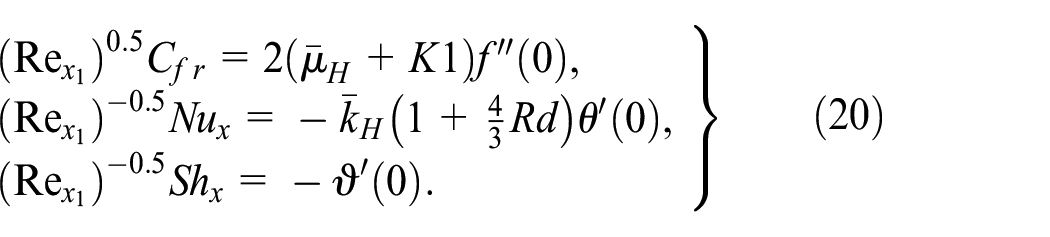
Quantities of engineering interest
The main quantities are skin friction, Nusselt and Sherwood numbers which are described as follows:

With
So equation (18) becomes

Implementing equation (9) in equation (19) we have as follows:
Method for solution
We applied the ANN technique to solve equations (12)–(15) simultaneously in connection of equation (16). The strategy uses the Levenberg-Marquardt Scheme of a Backpropagation Neural Network Algorithm (LMS-BNNA) to handle the problem efficiently. Levenberg-Marquardt is an optimization technique that improves the backpropagation process to converge faster. In this method, the weights of a Multi-Layer Perceptron (MLP) are adjusted when trained to minimize the cost function, which is most commonly Mean Squared Error (MSE). The LMS-BNNA trains over several training epochs, gradually reducing errors and enhancing network accuracy. Incorporating Levenberg-Marquardt optimization, allows the backpropagation algorithm to minimize the errors faster and tackle complex data efficiently. This optimization becomes particularly helpful when the network closes the optimum results, promoting faster convergence. Figure 1(b) clarifies the process of the neural network with input and output values.
The activation used in this work is defined as follows:

The solution presented in this article has been obtained using the Levenberg-Marquardt Scheme of a Backpropagation Neural Network Algorithm (LMS-BNNA) to efficiently handle the complex nonlinear governing equations of the problem. In this approach, we first generated a comprehensive numerical dataset by solving the mathematical model. This dataset includes input-output pairs representing the physical behavior of the micropolar hybrid nanofluid flow under various parameter conditions. Once the dataset was prepared, it was systematically divided into three distinct parts:
Validation
For the purpose of validation, the current results have compared with published work of Ali et al.,
47
Ishak et al.
48
and Abdal et al.
49
In all these three Refs47,48 the authors have used numerical schemes like finite element method, finite difference method and RK-4 approach. This comparison has conducted in Table 2 for variations in common parameter (i.e. Prandtl number) while setting all the other factors as zero, that is,

Results and discussion
This work examines the micropolar hybrid nanofluid flow on a variable porous elongating sheet using inclined magnetic effects. The fluid is set into motion by stretching nature of the sheet. The effects of heat source/sink and thermal radiation have utilized in this work. The well-known Cattaneo-Christov flux model has also employed in the study to regulate the mass and thermal diffusions. The leading equations have evaluated by using ANN method.
Analysis of ANN graphs portrays
The process of neural network has portrayed in Figure 1(b), where the LMS-BNNA process heightens the network structure. Figures 2 to 5 demonstrate the linear velocity, micro-rotational velocity, temperature and concentration scenarios against various substantial factors. The convergence of MSE for various cases has examined in Figures 2 to 5(a). The best performance is achieved at epochs 111, 225, 220, and 399 as noticed in these figures. The gradient of the model for LMS-NNA design has illustrated in Figures 2 to 5(b) with clear evaluation through different stages. These graphical views portray the evaluation of model through initialization, training, optimization and evaluation phases. They identify variations in proficiency measures and the modifications that have been made to increase the correctness and effectiveness of the model. Figures 2 to 5(c) present the error histograms for the design of LMS-NNA. These histograms present a graphical view of error distribution, with the frequency of different magnitudes of errors. From these graphical views the performance and precision of the design can be evaluated. Subject to the relation of EA structures, the curve fitness of the design problem has illustrated in Figures 2 to 5(d). The fitness curves describe how the solutions generated of the modeled problem behave over various iterations, showing how well the evolutionary algorithm (EA) solves the problem. These curves give indications about the algorithm’s convergence, solution quality, and performance as a whole throughout the building process of modeled design. Figures 2 to 5(e) exemplifies the model’s capability to perform regression tasks subject to diverse conditions. The plots represent the model’s success in capturing input-output variable relationship in every scenario. Training, testing, and validation values for regression are all closely clustered around one, indicating high model performance.
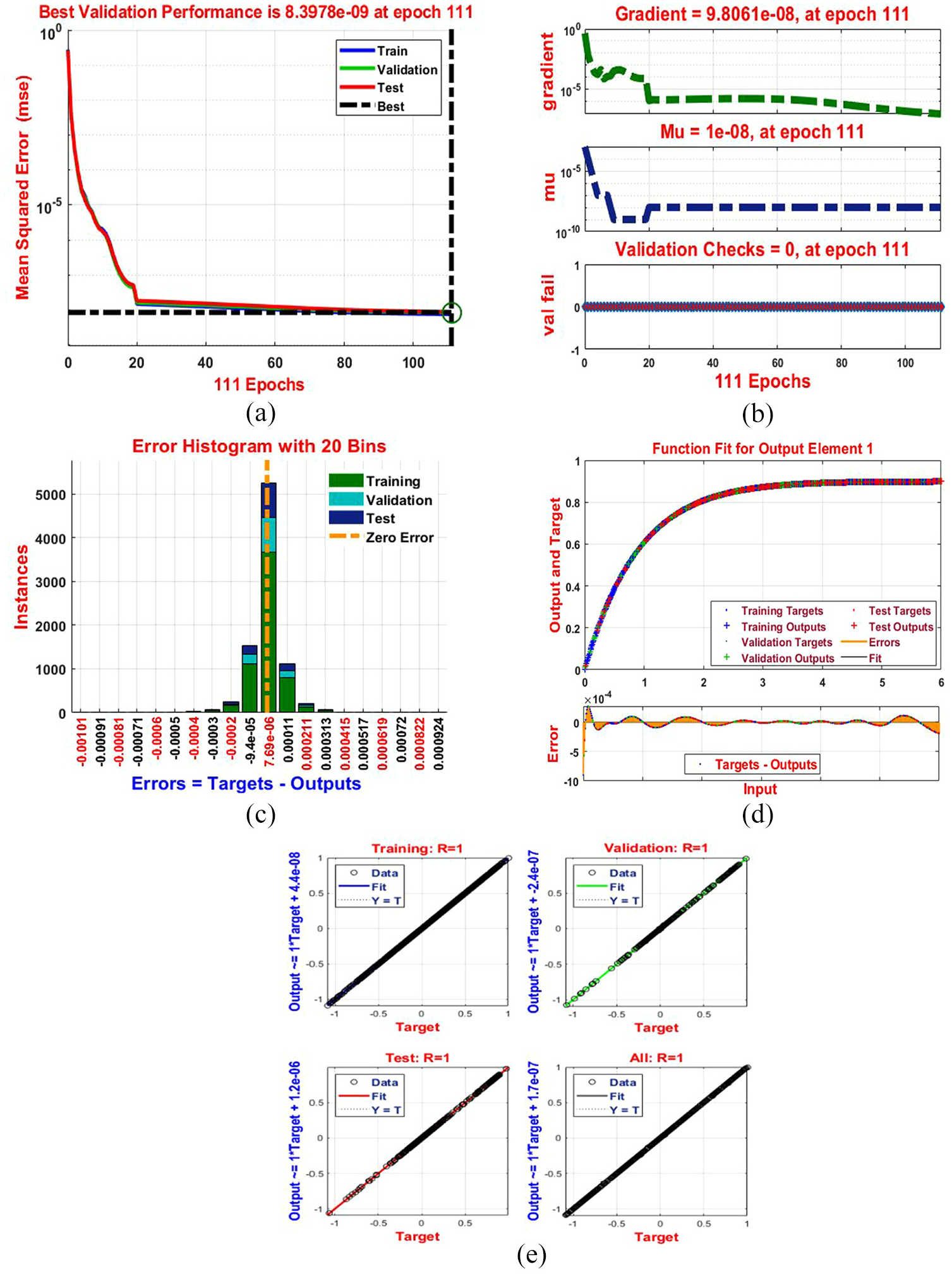
Graphs of LMS-NNA design for velocity scenario. (a) MES outcome. (b) Transition state. (c) Error Histogram. (d) Curve fitting. (e) Regression.

Graphs of LMS-NNA design’s for micro-rotational velocity scenario. (a) MES outcome. (b) Transition state. (c) Error Histogram. (d) Curve fitting. (e) Regression.
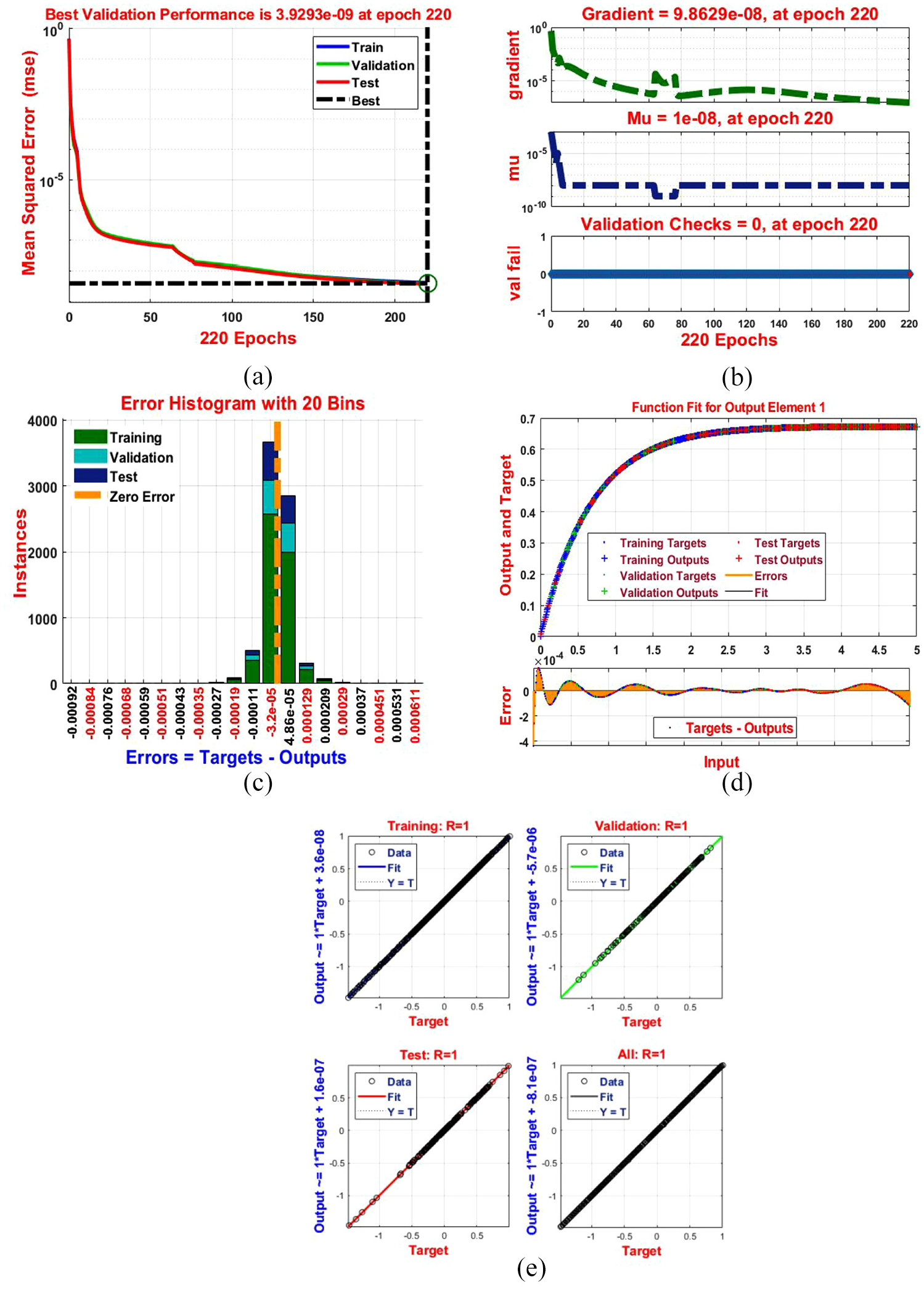
Graphs of LMS-NNA design’s for temperature scenario. (a) MES outcome. (b) Transition state. (c) Error Histogram. (d) Curve fitting. (e) Regression.

Graphs of LMS-NNA design’s for concentration scenario. (a) MES outcome. (b) Transition state. (c) Error Histogram. (d) Curve fitting. (e) Regression.
Linear and micro-rotational velocity distributions
The behavior of velocity

(a) Behavior of
Temperature distribution
The influences of distinct emerging factors on temperature distribution

(a) Behavior of
Concentration distribution
The influence of diverse substantial factors on concentration panels

(a) Behavior of
Discussion of tables
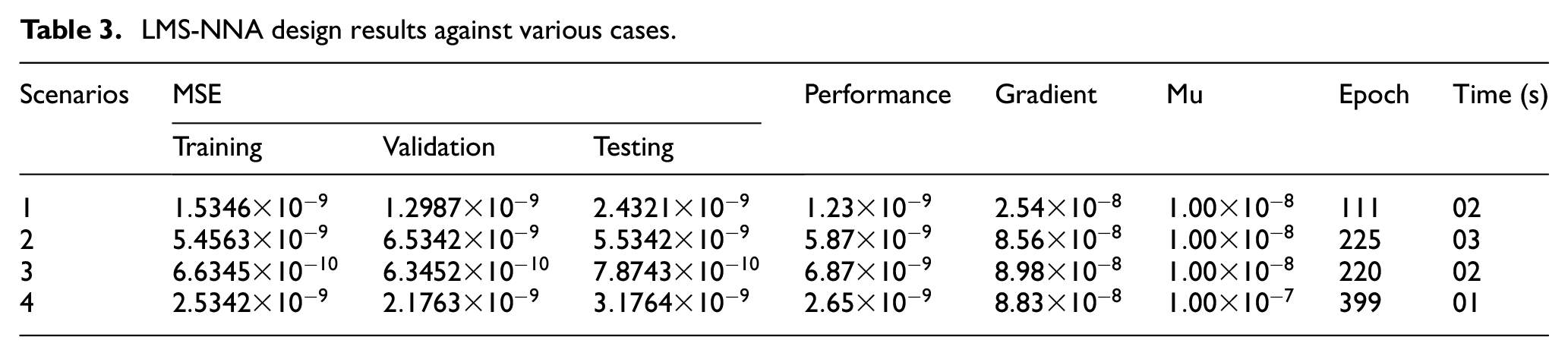
Table 3 illustrates a comprehensive overview of MSE values of testing, training, and validation phases for implementation of LMS-NNA model. Apart from the MSE, it also emphasizes the key performance matrics, such as the mu parameter and the gradient, that are part of the learning process of the model. The table identifies that the model achieves best performance at epochs 111, 225, 220, and 399. These are the top performance points from four unique scenarios of flow profiles. These epochs correspond to the instances during training when the performance of the model was tested with respect to the given metrics. The fluctuations that are noticed in the MSE at various epochs are essential to comprehend the model training dynamics. The fluctuations illustrate about the convergence pattern of the model, the efficiency of parameter, and the modifications that are applied on the internal weights of the network over these epochs. Such precise data is necessary to refine the model and choose the best parameters to maximize the particular artificial neural network design so that it can work optimally for every situation under study. The influences of diverse factors on skin friction
LMS-NNA design results against various cases.
Impacts of various factors on skin friction

Impacts of various factors on Nusselt number

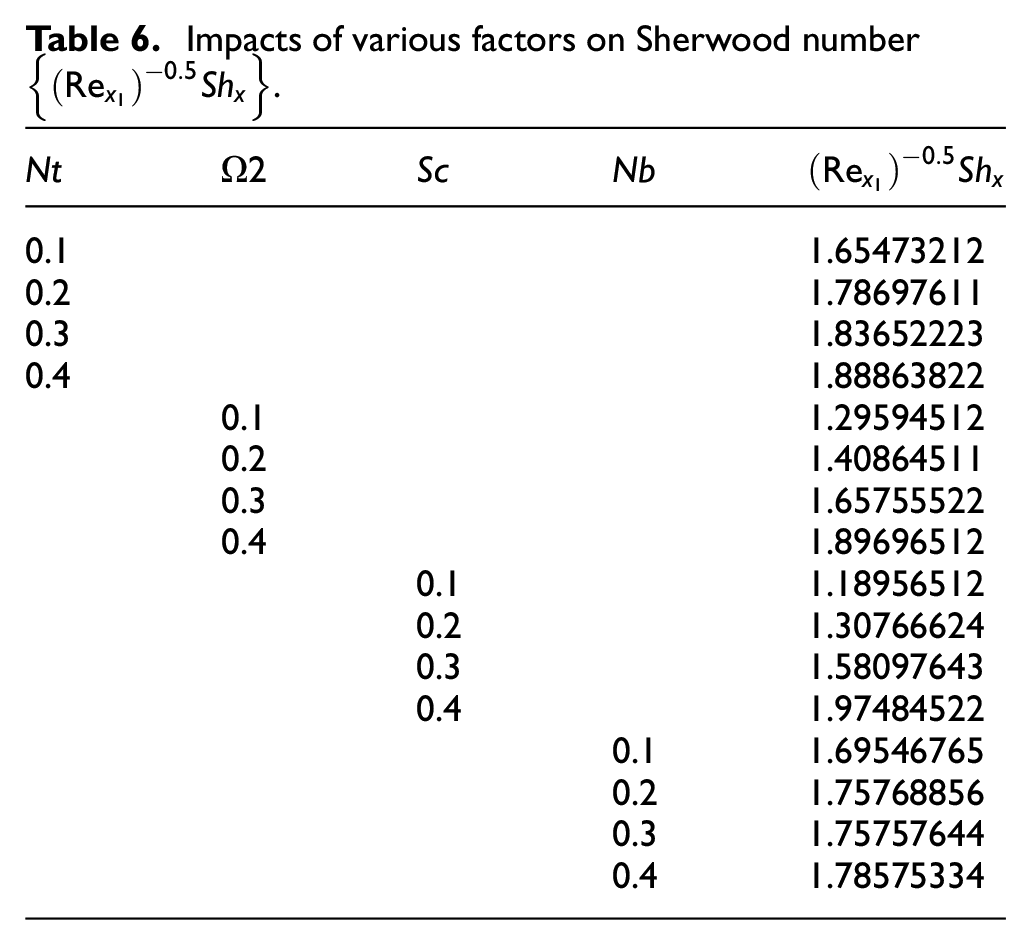
Impacts of various factors on Sherwood number
Percentage growth in heat transfer rate
Figure 9 demonstrates the percentage growth in Nesselt number

Percentage growth in Nesselt number
Conclusions
This research is particularly significant for biomedical applications like hyperthermia in cancer treatment. The study examines micropolar hybrid nanofluid flow on a variable porous elongating sheet with impacts of inclined magnetic field. The fluid is put into motion by stretching nature of the sheet using certain flow conditions. The famous Cattaneo-Christov flux model has also used in the work to control the thermal and mass diffusions. The main equations have evaluated using ANN technique. The below mentioned points have deduced in this study:
The linear velocity of the fluid has decreased due to the increase in magnetic factor and variable porous factor, with AE varying through the range
For the four scenarios the gradient values fall at
The distribution of micro-rotational velocity increased as the material factor grew. This change indicates that this factor had a significant impact on the velocity distribution, with a noticeable rise observed as the factor intensifies.
For surge in magnetic parameter, micro-rotational velocity profiles have intensified in the region on the interval
Thermal distributions have increased due to the influence of thermophoresis, Brownian motion, magnetic effects, radiation, and heat source factor while they have decreased with a rise in the thermal relaxation parameter.
The concentration panels have amplified with a rise in the thermophoresis parameter and decreased with an increase in solute relaxation factor, Schmidt number and Brownian motion factor.
It has noticed in this work that when the diamond nanoparticles augments from 0.00 to 0.05 the Nesselt number
The current work has validated through matching its outcomes with established results by observing a fine agreement among all the results.
Footnotes
Appendix
Notation

| Symbolic notations | Physical description |
|---|---|
| Flow components | |
| Viscosity | |
| Electrical conductivity | |
| Brownian and thermophoresis diffusions | |
| Micro-rotation velocity | |
| Variable porous factor | |
| Magnetic parameter | |
| Heat source parameter | |
| radiation factor | |
| Solute relaxation parameter | |
| Thermophoresis factor | |
| , , | Fluid, sheet’s surface and free stream temperatures |
| Intensity of magnetic field | |
| Density | |
| Vortex viscosity | |
| Heat source coefficient | |
| Micro-inertial factor | |
| Schmidt number | |
| Prandtl number | |
| Brownian motion parameter | |
| Material factor | |
| Thermal relaxation factor | |
| Spin gradient viscosity | |
| , , | Fluid, sheet’s surface and free stream concentrations |
Acknowledgements
The authors extend their appreciation to Taif University, Saudi Arabia, for supporting this work through project number (TU-DSPP-2024-112)
Handling Editor: Oluwole Makinde

Funding
The author(s) disclosed receipt of the following financial support for the research, authorship, and/or publication of this article: This research was funded by Taif University, Saudi Arabia, Project No. (TU-DSPP-2024-112)
Declaration of conflicting interests
The author(s) declared no potential conflicts of interest with respect to the research, authorship, and/or publication of this article.
Data availability statement
All data used in this manuscript have been presented within the article.