



Abstract
The purpose of the present study is to analyse the entropy generation for the hybrid nanofluid mobilised by peristalsis. The hybrid nanoliquid is suspension of copper
Keywords
Introduction
Nanofluids are best heat carriers and are colloidal suspensions of solid nanoparticles in base fluids. Nanomaterials are composed of metals (like gold, copper, silver, etc.), metallic oxides (like
Peristalsis is a phenomena that occurs owing to the contraction and expansion of flexible walls. Its applications are found in engineering and biomedicine. For example food absorption in oesophagus, movement of urine from kidneys to the bladder, vasomotion in capillaries and arteries, movement of chyme in gastrointestinal track, finger pumping and many others. Initially, Latham 5 performed the experimental study for motion of the fluid mobilised by peristalsis. Later Shapiro et al. 6 extended it theoretically and explained the peristaltic flow by incorporating ‘small Reynolds number and large wave length’ approximations. Mishra and Rao 7 reported the transportation of Newtonian fluid through peristalsis in an asymmetric channel.
Magnetohydrodynamics is a securitisation of liquid motion under the influence of applied magnetic field. The investigation of MHD peristaltic flow has become attractive due to its ample implementation in biological and industrial fields. For example in MRI, tumour detection, petroleum industries and metal working process. Joule heating is among one of the salient features of the MHD. Reddy and and Venugopal Reddy 8 monitored the MHD peristalsis phenomenon of nanofluid in the presence of Joule heating with complaint walls. Hayat et al. 9 analysed the consequences of joule heating and slip on mixed convective peristaltic movement of nanofluid with Dufour and Soret impacts. Abbasi et al. 10 analysed the joule heating and radiation impacts on electroosmosis-modulated peristaltic flow of Prandtl nanofluid through tapered channel. Recently, Akram et al. 11 analysed the electroosmotic peristaltic flow of nanofluid by using two different techniques.
The performance of thermodynamical system can be visualised through its entropy generation. Entropy generation overcomes energy disorder. Entropy generation analysis has key role in an industry and bio engineering. Initial work in this regard is done by Bejan12,13 in which author illustrates the major steps to minimise the entropy generation at component level. Later on, Farooq et al. 14 computed the entropy generation and also reported the effects of thermal radiation over peristaltic movement of carbon nanotubes for the case of mixed convection. Abbasi et al. 15 reported entropy generation analysis of nanofluid activated by peristalsis with Hall and temperature dependent viscosity effects.
Latest development is to use hybrid nanofluid, which are manufactured by the suspension of the two or more nanoparticles into base fluid. Thus they have significant thermal conductivity and better heat transfer rate as compared to the traditional nanofluids. Saleem et al. 16 explained the heat transmission rate of blood-based hybrid nanofluid through a tube with ciliated walls. Ali et al. 17 investigated MHD peristalsis of hybrid nanofluid with slip conditions. Zahid et al. 18 and Abbasi et al. 19 carried out thermodynamic analysis of electroosmosis regulated by peristalsis of hybrid nanofluid. Tripathi et al. 20 studied the peristaltic propulsion of electroosmosis induced hybrid nanofluids numerically through microchannel. Prakash et al. 21 and Afsar et al. 22 are some useful recent developments in peristaltic transport of hybrid nanofluid.
The novel features of this investigation are the analysis of entropy generation for the
Problems formulation
Problems statement
Consider the motion of electrically conducting


Where

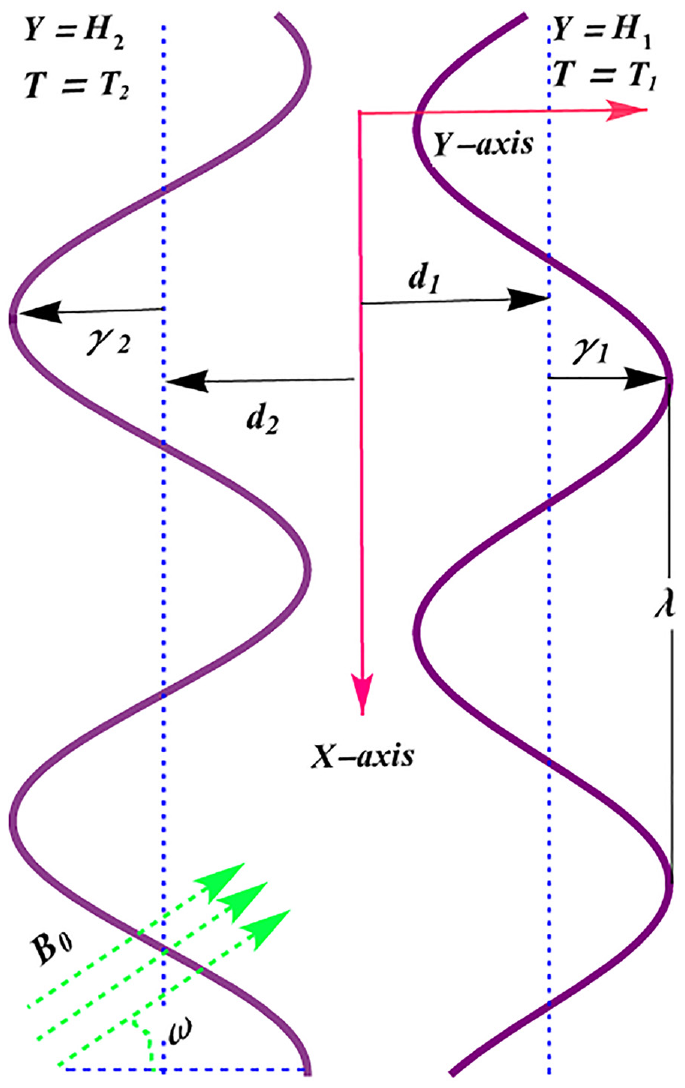
Schematic picture of the problem.
The considerations and assumptions for present study are narrated as:
Asymmetric channel
Hybrid nanofluid
Inclined magnetic field
Mixed convection
Viscous dissipation
Ohmic heating
Heat generation/absorption
Long wavelength and low Reynolds number assumptions.
The Ohms law in the absence of the applied electric field is 24 :

where

Here

Governing equations
The basic equations incorporating MHD (magnetohydrodynamics), viscous heating, mixed convection, heat generation/absorption and Joule heating as per Khazayinejad et al. 24 are described:


In above mentioned equations,
The mathematical expression of skin friction and Nusselt number for hybrid nanofluids at right wall as per References 25–27 are:


The Bachelor’s effective viscosity model 28 and Maxwell electric conductivity model 29 for two-phase flow are:


Where

where
Hybrid nanofluid models.

Here subscripts ℑ stands for fluid,
Numerical data for the thermophysical properties.

The transformation from fixed

Making use of the above transformation, the system of equations (7)–(10) yields:


Non-dimensionalisation
Incorporating the dimensionless parameters and variables defined as per Khazayinejad et al. 24 :

and under the assumption of large wave length and small Reynolds number, equations (16)–(19) can be re-written as:


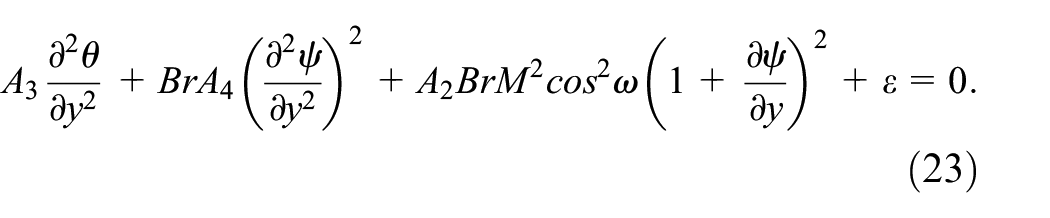
In the earlier mentioned equations
Moreover

The dimensionless mean flow rates in fixed frame

Further

The modified form of skin friction and Nusselt number are:

The stream function satisfies the equation (16) identically. To compute the temperature and stream function, the dimensionless boundary conditions are modified according to Zahid et al. 18 as:


Entropy generation and Bejan number
The dimensional formulation of entropy generation is:
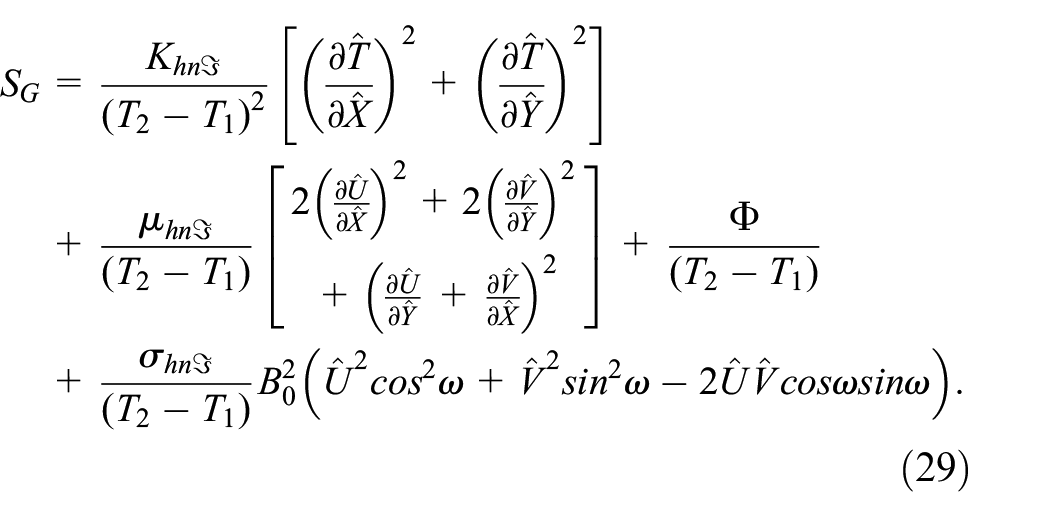
The non-dimensional form is:


Where
Numerical procedure
The built-in numerical technique NDSolve is utilised to solve the dimensionless system of equations (21)–(23) with the aid of boundary conditions (28) in Mathematica. This method is very effective and efficient to solve boundary value problems especially highly non-linear system of equations. Both
Outcomes and discussions
This section analyses the consequences of influential parameters on axial velocity, temperature, heat transmission rate, entropy generation, Bejan number and axial pressure gradient. Graphs are obtained for the fixed parameters
Velocity and temperature
Figure 2(a) to (h) illustrates the consequences of sundry parameters over axial velocity and temperature of hybrid nanoliquids. Velocity profiles are placed on left side and temperature profiles are placed on right side. Velocity of hybrid nanofluid declines for higher values of
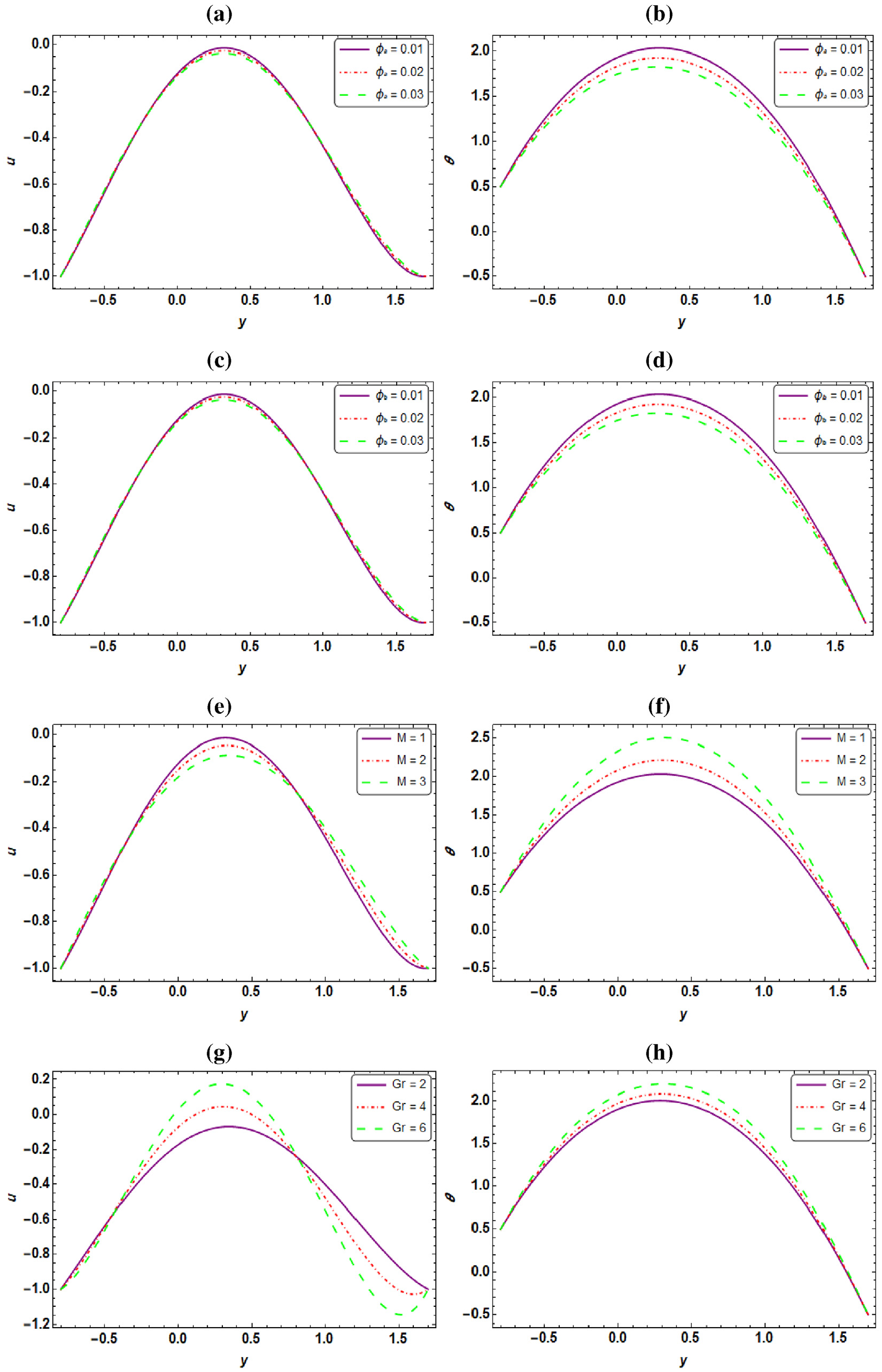
Impact of pertinent parameters on velocity and temperature.
Axial pressure gradient
Figure 3(a) to (d) illustrates the change in pressure gradient for the mentioned parameters. Fluctuation and periodic behaviour in pressure gradient graphs are observed for all values of

Impact of pertinent parameters on pressure gradient.
Heat transmission rate at walls
Figure 4(a) to (d) manifest the heat transmission rate at walls for sundry parameters. Parts (a) and (b) exhibit the increments in heat transmission rate by increasing the amount of hybrid nanomaterials because addition of solid nanoparticles improve the thermal conductivity of the hybrid nanofluid and helps the heat interchange process. An increasing trend of heat transfer rate is noticed on the enlargements of

Impact of pertinent parameters on heat transfer rate at wall.
Entropy generation and Bejan number (Be)
Figure 5(a) to (h) demonstrates the impacts of pertinent parameters on entropy generation and Bejan number. It is worth noting that results for entropy generation are directly related to the temperature. The augmentation in temperature creates disorder in the system and thus enhances entropy. It is evident from first two figure that nanoparticles concentration enhancement invites decrement in

Impact of pertinent parameters on entropy and Bejan number.
Skin friction and Nusselt number
Figure 6(a) to (h) are sketched to show variation in skin friction and Nusselt number against longitudinal distance

Impact of pertinent parameters on Skin friction and Nusselt number.
Trapping phenomenon
Bolus and Trapping phenomena are interesting features in peristaltic transport. Streamlines can be visualised through these features. Bolus identifies the rotational flow under the wave crests and Trapping indicates the flow circumstances near the central line. Figure 7 illustrates the impacts of Hartman number and flow rate on streamlines. The graphs of streamlines are obtained for symmetric channel. It is clear from graphs of left panel that bolus size become small on increasing

Impacts of Hartmann number and flow rate on streamlines.
Comparison with previous results
A comparison table is constructed to check the validity of the adapted technique for limiting case. Numerical values of
Comparison table for limiting case of the present investigation with the results available in previous literature for

Conclusions
The entropy generation for electrically conducting hybrid nanofluid triggered by peristalsis via asymmetric channel is analysed. Impacts of MHD mixed convection, Ohmic heating, heat generation/absorption and viscous dissipation are reckoned. Upshots drawn from this study are summarised below:
Both temperature and velocity slump on the enhancement of volume fraction of solid nanoparticles.
Strong M improves temperature and heat transfer rate.
Enhancement of the concentration of solid nanomaterials and Hartmann number increase pressure gradient.
Higher Gr increases pressure gradient rapidly.
M and Gr increase Entropy generation and Bejan number while concentration of nanoparticles acts oppositely.
Addition of nanoparticles decrease skin friction.
High flow rate increases trapping phenomenon.
Footnotes
Appendix
Handling Editor: Ms. Chenhui Liang
Declaration of conflicting interests
The author(s) declared no potential conflicts of interest with respect to the research, authorship, and/or publication of this article.
Funding
The author(s) received no financial support for the research, authorship, and/or publication of this article.

Data availability
Data sharing not applicable to this article as no data sets were generated or analysed during the current study.