The present work explores the physical aspects of the alumina and silver nanoparticles on the magnetohydrodynamic (MHD) flow of mixed convection micropolar hybrid nanofluid with ethylene glycol + water base fluid via stretching surface embedded in a porous medium. A strong magnetic field is employed normally in the flow direction. The behavior of the suction on the presented flow analysis is discussed strongly. Heat transport phenomena are analyzed. The current model’s mathematical modeling is based on higher-order nonlinear partial differential equations, which are then translated into higher-order nonlinear ordinary differential equations using appropriate similarity transformations. The modeled higher-order nonlinear ordinary differential equations are solved using NDSolve technique. The physical significance of the different flow parameters on the velocity, microrotation, and temperature profiles of the hybrid nanofluid are described in a graphical form. In a tabular form, the skin friction coefficients for nanofluid and hybrid nanofluid against various flow parameters are calculated. Some important results from this investigation are demonstrated that the velocity of the hybrid nanofluid is higher for the stretching ratio parameter and it is detected that the suction parameter enhanced the microrotation profile of the hybrid nanofluid. From the comparison, it is noted that the velocity, microrotation, and temperature of the hybrid nanofluid are higher as compared to the velocity, microrotation, and temperature of the alumina nanofluid and silver-nanofluid.
In the past few years, nanofluids have become more significant in engineering sciences. The proper distribution of nanometer-sized (100 nm) components, such as nanoparticles, nanotubes, nanofibers, or nanowires, in fundamental heat transfer fluids, enabled for the development of this new class of fluids. The reduced thermal conductivity of common liquids such as engine oil, kerosene oil, gasoline, ethylene glycol, and water was a hurdle for researchers and engineers before the introduction of nanotechnology. In engineering and other advanced technology nanofluids play an important role. In engine coolant, delivery of powered goods, microelectronic cooling, fluidized beds, polymer coating, in oil industry and most important nanoparticle processing, nanofluids are used commonly. To address the problem, Choi1 suggested including a sufficient amount of nanosized particles. Choi’s work covered the way for the advancement and development of ways to improve the properties of traditional fluids. Thermal characteristics are considered base fluids. Because of their potential uses, Wong and Leon2 researched on the nanofluids in recent years. Its applications include manufacturing, transportation, fuel cells, microfluidics, microelectronics, medical, and oil recovery. Jang and Choi3, studied the Brownian motion of nanoparticles at the molecular and nanoscale levels influences and the thermal behavior of nanoparticle-fluid solutions. They proposed a theoretical model that accounts for the basic role of dynamic nanoparticles in nanofluids and uncovered an important factor in size-dependent conductivity between solid/solid composites and solid/liquid suspensions, as well as nanoparticle size and temperature. Rashid et al.4 examined the comparison of hybrid nanofluid past a rotating disk. Chon et al.5 demonstrated an experimental relationship for nanofluid heat transfer as a function of nanoparticle size (varying from 11 to 150 nm nominal diameters) over a wide temperature range (21°C–71°C). According to their research, the Brownian motion of nanoparticles plays a critical role in the thermal conductivity development as temperature rises and nanoparticle sizes decreases. Elbashbeshy et al.6 examined the presence of suction and external pressures, and the effect of a new cooling medium (nanofluid) containing and Ag particles on the thermal and mechanical parameters of an unstable expanded cylinder is investigated. The influence of the cooling medium and external loads on the cylinder’s mechanical properties is studied. They discovered that using nanofluid as a cooling medium boosts the surface strength and hardness by 10%–40% and that using as a nanoparticle in a water-based fluid is helpful. Their findings also reveal that irregular motion has a direct influence on the surface’s mechanical characteristics. Kameswaran et al.7 investigated the mass transfer and convective heat in the flow of nanofluid over such a stretched surface when there is viscosity dissipation, hydromagnetic field chemical reactions, and Soret effects. They compared and nanofluids. The Ag–water nanofluid showed higher wall heat and mass transport rates as compared to -water nanofluids. They concluded that magnetic field has the effect of reducing both wall heat and mass transfer rates. Ganga et al.8 examined the behavior of a nanoliquid MHD with heat and mass transfer effects due to a stretched surface. They also investigated the influence of geographical and temperature-dependent internal thermal radiation on the magnetohydrodynamic boundary layer flow of a water-based nanofluid across a stretched surface containing various nanoparticles. They found that linear sheet stretching causes the flow, which was governed by a consistent magnetic field applied to the stretched sheet as a whole. Seth and Mishra9 investigated the effect of MHD on fluid embedded with nanoparticles traveling across a non-linear expanding surface. Xu and Liao10 a time-dependent MHD non-Newtonian flow from an impact stretched wall surface was described. They provide proper and universally valid analytic series solutions in the full confined area for all dimensionless time. Hung11 examined analytically the influence of viscous dissipation on entropy generation for well-grown forced convection for single-phase non-Newtonian fluid flow in circular micro channels. Their results reveal that the effect of viscous dissipation on entropy formation in microchannels is important under certain conditions and should not be neglected.
A new type of nanofluid called “hybrid nanofluids” has been developed, which is more effective than nanofluid. A hybrid nanofluid comprises two different types of nanoparticles distributed in the same fluid. This form of fluid is expected to have better thermal characteristics than base fluid and nanofluid containing single nanoparticles. Hybrid nanofluids are extensively applied in many heat transfer applications, such as refrigeration, coolant in machining, drug reduction, transformer pre-proof cooling, nuclear system cooling, biomedical, generator cooling, and electronic cooling, compared to nanofluids. Researchers are interested in studying hybrid nanofluids in real-world heat transfer challenges because of their capacity to improve thermal properties.12,13 They considered the influence of slip mechanisms such as Saffman lift and Brownian motion, drag force, gravity, virtual mass, pressure gradient, and thermophoresis generated force in nanofluid modeling. They also demonstrated the temperature distribution and pressure drop features of a microchannel heat sink using hybrid nanofluids. Devi and Devi14 studied the heat transfer characteristics of conventional nanofluids and future hybrid nanofluids. In boundary layer flow, he developed a unique type of conventional fluid called hybrid nanofluid to increase heat transmission. The effects of Lorentz force along a three-dimensional stretch sheet subjected to Newtonian heating were also investigated using a new thermophysical features model. He discovered that even when a magnetic field is present, hybrid nanofluid has a higher heat transfer rate than nanofluids . By selecting various and appropriate nanoparticle proportions in a hybrid nanofluid, the necessary heat transfer rate can be obtained. Rashid et al.15 analyzed the non-Newtonian two dimension flow of with convective conditions over a stretching sheet. Suresh et al.16 investigated hybrid particles manufactured using a hydrogen reduction approach from a powder mixture of and Ag. According to their experimental findings, the thermal conductivity and viscosity of the created hybrid nanofluids both rise with the nanoparticle volume concentration. Devi and Devi17 generated the new idea of hybrid nanofluid and have contributed to the improvement of heat transmission in boundary layer flow. Using nanofluids and hybrids nanofluid they also studied the flow through stretching sheet. They compared the value of experimentally thermal conductivity to the proposed model.
In devices with extremely high power output, forced convection is unable to completely remove all heat. Because of this, mixed convection, which mixes forced and natural convection, typically results in what is wanted. In Ref,18 the phenomenon of mixed convection primarily occurs in many industrial and technological applications, such as cooling fan-operated electronic equipment, freezing nuclear reactors during an emergency shutdown, solar collectors, placing a heat exchanger in a low-velocity environment, etc. Through computational approaches,19–21 investigated the free convection of nanofluid in porous cavities. In their simulation of mixed convection heat transfer, Rashad et al.22 considered the non-Newtonian behavior of nanofluids and the flow of such fluids through porous media. Gorla and Chakma23 studied non-Newtonian free convection in porous media containing nanofluids. Their research demonstrates that heat and mass are affected by friction, which is a Lewis digit. In non-Newtonian nanofluid, Chamkha et al.24 investigated the cure for mixed convection in a porous medium. Their results shows that increasing the Brownian motion and buoyancy parameters decreases heat transmission. Using mixed convection, Kliegel25 solved the theoretical heat transfer problem on a vertical flat plate.
The uniqueness of this problem lies in the analysis, the physical characteristics of the alumina and silver nanoparticles on the magnetohydrodynamic flow and mixed convection micropolar hybrid nanofluid over a porous stretched surface are analyzed. Here we have taken water as a base fluid. Features of heat transport are also analyzed. The influence of magnetic field and brownian motion is taken in this investigation. In the present investigation, the effect of suction is strongly discussed. Simulation of the highly nonlinear ODEs is carried out based on the homotopy analysis method. The velocity, microrotation, and temperature of the hybrid nanofluid are computed versus various flow parameters. Skin friction coefficients against different flow parameters are also deliberated. We expect that the present finding will be beneficial in a number of industrial applications, including lubricants fluid, polymer solution, and biological structures.
Model formulation
For the MHD unstable mixed convection flow of a micropolar hybrid nanofluid, a porous stretching/shrinking perpendicular flat plate is used as the flow description. The suggested model is shown in Figure 1, where and are Cartesian coordinates and are interpreted as the and of the surface under the presumption that the axis is along the surface and the axis is along the normal direction. The flow region is located at , and the surface region is at . Mathematically represents the velocity of stretching/shrinking, where the velocity of stretching or shrinking along the axis is represented by the positive constant , and is also an arbitrary constant. The time-inverse dimension is maintained by these two constants. The sign shows the wall mass transfer velocity, where the mass suction is represented, and it is used for mainstream blowing or injection. With the applied variable magnetic field along the -axis, the hybrid nanofluid is considered to be electrically conducting where the intensity of the sheet’s surface magnetic field is . It is believed that a combination of nanofluids can conduct electricity. Due to the extremely low magnetic Reynolds number, the effect of the induced magnetic field is neglected. stands for the wall temperature. Additionally, it is believed that indicates the appropriate temperature at the flat plate’s wall surface, where is the constant reference temperature. The characteristic surface length is , and the opposing, assisting, and forced convection fluxes are denoted by and , respectively.
Geometry of the flow problem.
The layout of the equations and boundary conditions
For this topic, the most important boundary layer equations were observed by Abolbashari et al.26 Devi and Devi17 presented the preceding assumptions, as well as Takabi and Salehi’s27 perceived the popular hybrid nanofluid model,
According to the boundary conditions:
is micro-gyration constant. Significantly show high level concentration. As a result, due to strong particle fluxes, inertial and microstructure components close to the wall’s surface cannot spin. The following precise value of such as displays the disappearing of the non-symmetric component, resulting in weak concentration. The non-symmetric component decreases at the specific number of such that, resulting in poor concentration, whereas the choice provides information on the necessary turbulent boundary layer flows. From equation (5) it also observed that it should be also observed that positive value of is equivalent to stretching, negative value of represents shrinking, and is shown for a fixed flat plate. Furthermore, one presumption is that the hybrid Nano liquid’s spin gradient is specified as where denotes the material parameter.
The hybrid nanofluid model’s physical properties
The mathematical notations utilized for the hybrid Nano fluid in Section 2.2 are electrical conductivity , absolute viscosity , thermal conductivity , specific heat capacity , density , electrical conductivity , and the hybrid Nano fluid’s thermal expansion. The thermophysical properties of the micro polar hybrid Nano fluid developed by Takabi and Salehi27 can be expressed as.
The preceding equations (6)–(10) explain the physical properties of the hybrid Nano fluid, which implies the nanoparticles solid volume fraction, define the conventional base fluid, describe the alumina nanoparticle of and describe the silver nanoparticle . Thy related pure fluid and hybrid nano liquid electrical conductivities, on the other hand, can be represented as , , and respectively. , , and are represents the hybrid nano liquid and pure liquid densities accordingly. , , and are represents hybrid nano liquid and pure liquid thermal conductivity accordingly. Furthermore, , represents hybrid nanoliquid viscosities and pure liquid viscosity. Hybrid nanoliquid , and pure liquid represent thermal expansion coefficients. The specific heat capacities of hybrid nanoliquid are , and pure liquid capacity is . Table 1 summaries the results of silver and alumina hybrid nanoparticles, as well as pure fluid water, as established by Khan et al.29
Base fluid and nanoparticle thermophysical properties.28
Physical properties
Base fluid ( 50:50)
3288
0.00341
0.00509
0.425
1056
Alumina
686.2
0.90
8.9528
4250
Silver
235
1.89
429
10,500
Transformation of governing equations and similarity transformations
The following similarity variables are included for further study26:
Where, mark the necessary stream functions, and designated as and such that:
Thus
Where the mass transfer velocity parameter is with signify case of section and . In the presence of above transformation flow expression take a form.
Following are the transformed boundary conditions:
At this point, denote characteristic length and mathematical ratio of is . In addition, the model under consideration includes the following dimensionless parameters:
The negative value of show the opposing flow, positive value of show flow is assisting, and is convection force. Additionally, the unsteadiness parameter is . The positive value of show that flow is accelerating, the negative value of show that flow is Analysis of gradients:
The major gradients of this model are the heat transfer rate and the desired friction drag , which are described as16
We obtain by combining (11) and (20).
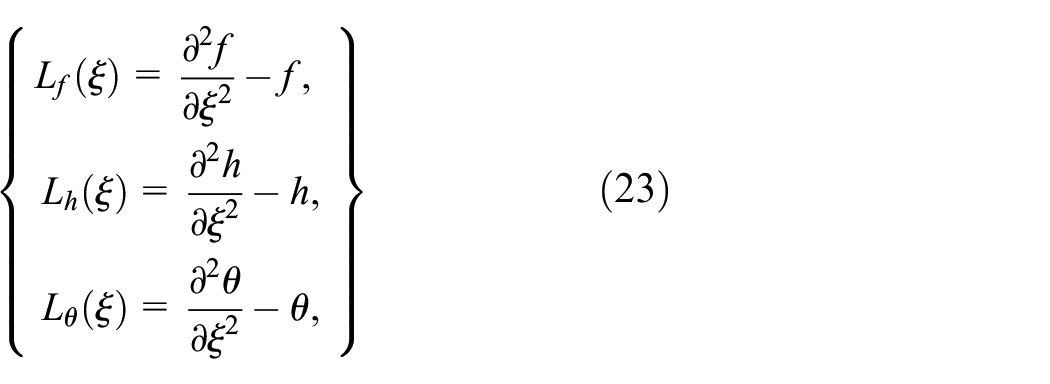
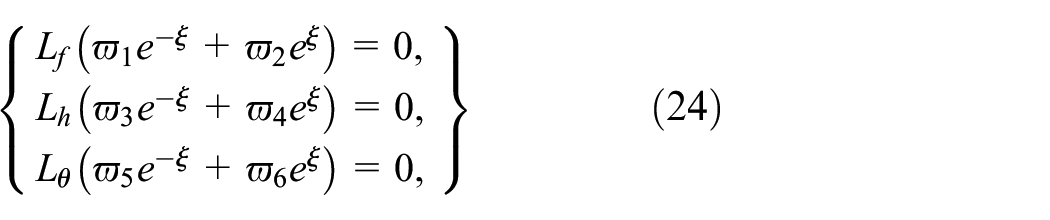
HAM solution
The initial gasses and linear operators are stated as:
with properties:
where are arbitrary constants.
Numerical solution and result and discussion
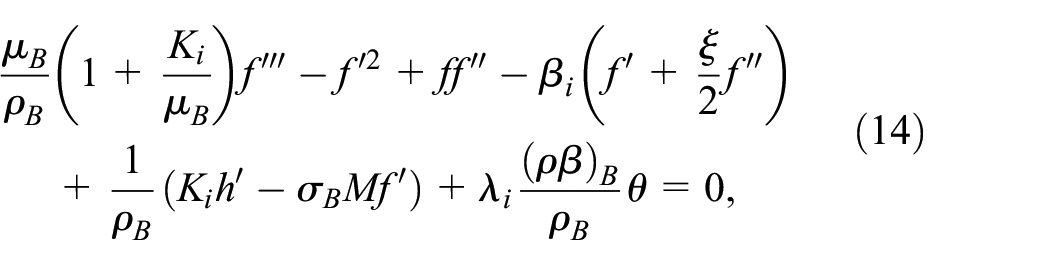
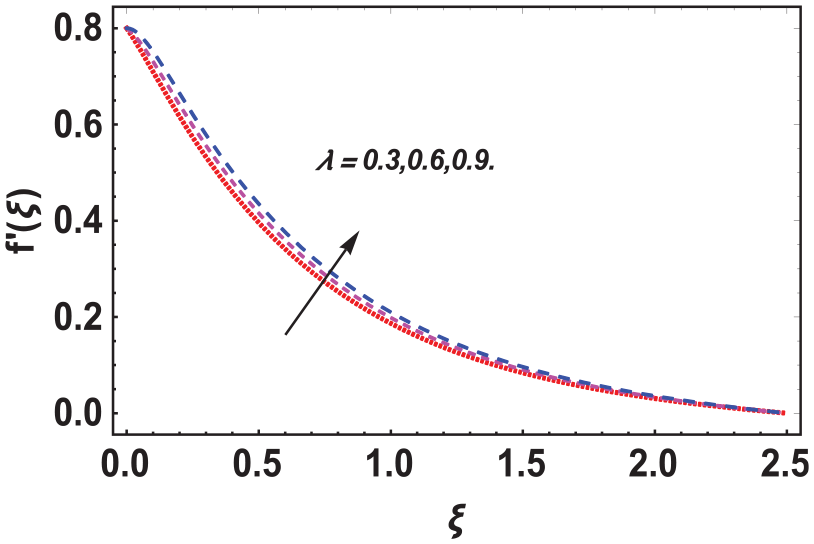
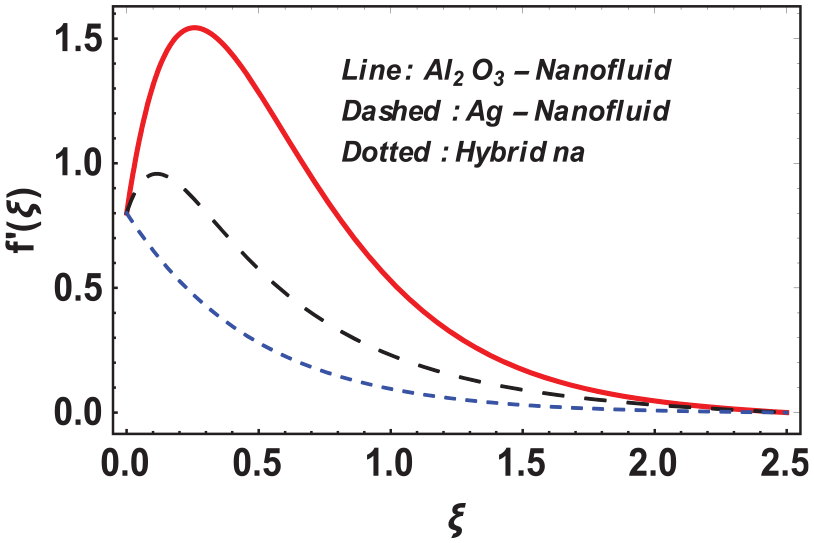
The present proposed mathematical model of the mixed convection flow of micropolar hybrid nanofluid with magnetic field toward the stretched surface fixed in a porous medium is discussed here. The numerical technique called NDSolve, is used to solve the set of nonlinear ordinary differential equations (14)–(16) as well as the required boundary conditions (17). The analysis is performed for unsteadiness parameter , material parameter , mass suction parameter , magnetic parameter , stretching parameter , Mixed convection parameter , and micro gyration parameter . The velocity profile is affected by the unsteadiness parameter , as shown in Figure 2. The is observed to decrease as is increased. When we raise the value of then the thickness of momentum boundary layer is decrease which indicated that lowers the flow rate caused by the stretching sheet. So on increasing , shows decreasing behavior. Figure 3 shows the impact of unsteadiness parameter and angular velocity profile . Higher the value of the , then greater the influence on the . For every instability value, the rises from zero to a peak and then falls back to zero to increase the value of the . Figure 3 also depicts how the behavior of changes when a parameter is unstable. Because the larger layers that follow the stretched sheet can be used to observe the fluid’s overall movement. Figure 4 observed that, the temperature profile is influenced by the unsteadiness parameter . The decreasing augments of the nanofluid, and as is increased, the gradually decrease. This is based on the fact that stretching the sheet causes an increase in heat loss, which causes a reduction in the . It also indicated that the rate of cooling is much faster than the rate of cooling for the steady flow since the rate of heat transfer from the sheet to the fluid decreases with higher values of the . Similar behavior is shown by Suresh et al.16Figure 5 shows the impact of stretching parameter on velocity profile of the nanofluid flow. The increasing augments the of the nanofluid. Actually, the increasing accelerates the stretching rate of the sheet which consequently augments . Therefore, the increasing increases the of the fluid flow. The impact of stretching ratio parameter on the microrotation profile of the hybrid nanofluid is examined in Figure 6. It is observed that expanding values of the stretching ratio parameter increased of the hybrid nanofluid. The effects of the material parameter on velocity profile are shown in Figure 7. This graph illustrates how the velocity falls down when the increases close to the surface and increases in the opposite direction away from it. Furthermore, the boundary layer thickness is unaffected by the . Figure 8 displays how material parameter effects on angular velocity . We see that rising causes to initially drop, and the opposite is true further from the surface. The mixed convection parameter effect on velocity profile is seen in Figure 9. In reality, when flow is present, natural convection dominates, and when flow is missing, forced convection dominates. When which shows that flow is truly taking place under mixed convection conditions and that the impacts of forced and natural convection are of equal relevance. The influence of the buoyancy force might result in the fluid velocity profile in the boundary layer being higher than the external velocity profile , as shown by Figure 9. When the free stream and buoyancy forces are acting in opposite directions, the buoyancy force acts somewhat like an unfavorable pressure gradient to slow the fluid in the boundary layer. Figure 10 show the impact of mixed convective variable and micro rotating velocity . Increasing the magnitude of the by increasing the values of the . is the ratio of buoyancy and viscous forces. As a result, for bigger , a small momentum boundary layer but a strong micro-rotation boundary layer is identified. The fluctuation of velocity profile with magnetic field parameter is shown in Figure 11. It is shown that as increases along the surface then decrease. This emphasizes the fact that introducing a magnetic field to an electrically conducting fluid produces a drug-like effect that slows fluid velocity and demonstrates how increasing the magnetic field lowers fluid velocity. Figure 12 depicts the angular velocity with magnetic field variations. This graph clearly shows that g rises as increasing close to the surface, and simultaneously farther away from the surface. The influence of the micro gyration parameter on the velocity profile is discussed in Figure 13. The angular rotation and fluid velocity inside the boundary layer rises as the is increasing which associated with a large change in the thickness of the boundary layer, so velocity profile is increases as increase. Figure 14 presented the variation of the microrotation profile of the hybrid nanofluid against higher values of the micro gyration parameter . In this observation, it is noted that the higher values of augmented of the hybrid nanofluid. The effect of the mass suction parameter on velocity profile of the hybrid nanofluid is investigated in Figure 15. In this examination, it is clear that velocity profile of the hybrid nanofluid is declined for larger value of the suction parameter . Physically higher value attracts fluid particles to the flat plate’s surface, reducing the fluid’s velocity. In terms of physics, the well-known inverse relationship between velocity and friction is possible. Figure 16 determined the fluctuation in the microrotation profile of the hybrid nanofluid for larger values of the mass suction parameter . In this evaluation, it is clear that the of the hybrid nanofluid is enhanced for larger values of the . Figure 17 explained the comparison of the temperature on the -water nanofluid, -water nanofluid, and -water hybrid nanofluid. It is detected that the temperature of the -water hybrid nanofluid is higher as compared to the temperature of the -water nanofluid and -water nanofluid. The comparison of the microrotation profile on the -water nanofluid, -water nanofluid, and -water hybrid nanofluid is examined in Figure 18. This Figure determined that the microrotation for -water hybrid nanofluid is larger as compared to the -water nanofluid, -nanofluid. Figure 19 presented the comparison of the velocity of the -water nanofluid, -water nanofluid, and -water hybrid nanofluid. It is determined that the velocity of the -water hybrid nanofluid is lower as compared to the velocity of the -water nanofluid, -water nanofluid.
Impact of on .
Impact of on .
Impact of on .
Impact of on .
Impact of on .
Impact of on .
Impact of on .
Impact of on .
Impact of on .
Impact of on .
Impact of on .
Impact of on .
Impact of on .
Impact of on .
Impact of on .
Comparison of nanofluids and hybrid nanofluid temperature profiles .
Comparison of nanofluids and hybrid nanofluid microrotation profiles .
Comparison of nanofluids and hybrid nanofluid velocity profiles .
Table 2 shows the comparison of heat transfer rate for different values of . In this table good agreement is found with previous literature. The influence of the material parameter , unsteadiness parameter , mixed convection parameter , magnetic field parameter , stretching ratio parameter , mass suction parameter , and micro-gyration constant on the skin friction coefficient of the -water nanofluid are discussed in Table 3. In this table, it is observed that of the -water nanofluid is higher for higher values of , , , , and but of the -nanofluid is lower for and . Table 4 determined the variation of on -water nanofluid for higher values of the , , , , , , and . In this evaluation, it is examined that the larger values of , , , and increased of the -water nanofluid but higher values of , , and reduced of the -water nanofluid. The role of , , , , , , and on of the -water hybrid nanofluid are analyzed in Table 4. In Table 5, the increasing behavior is observed in of the -water hybrid nanofluid for expanding values of , , , , , and . Also, it is perceived that of the -water hybrid nanofluid is lower due to the enhancement of the and micro-gyration constant .
Comparison of heat transfer rate for different value of when .
Variation in skin friction coefficient of -nanofluid versus , , , , , , and .
0.2
0.3
0.5
4
0.9
0.9
0.9
1.20337
0.3
1.24633
0.4
1.28346
0.4
1.23850
0.5
1.27337
0.6
1.30160
0.55
0.976692
0.56
0.931392
0.57
0.886104
5
1.44274
6
1.6644
7
1.87171
0.7
0.321913
0.8
0.759613
0.9
1.20337
0.6
0.237766
0.7
0.620198
0.8
0.923621
0.1
1.27893
0.2
1.26992
0.3
1.26079
Variation in skin friction coefficient of -nanofluid versus , , , , , , and .
0.2
0.3
0.5
4
0.9
0.9
0.9
3.17248
0.3
3.16369
0.4
3.15882
0.4
3.19131
0.5
3.21002
0.6
3.2286
0.55
3.16993
0.56
3.16941
0.57
3.1689
5
3.40919
6
3.62721
7
3.83037
0.7
2.42203
0.8
2.79457
0.9
3.17248
0.6
2.963
0.7
3.03195
0.8
3.10176
0.1
3.38188
0.2
3.35687
0.3
3.33154
Variation in skin friction coefficient of -hybrid nanofluid versus , , , , , , and .
0.2
0.3
0.5
4
0.9
0.9
0.9
0.359565
0.3
0.44312
0.4
0.519636
0.4
0.416207
0.5
0.472231
0.6
0.527645
5
0.707755
6
1.0294
7
1.3296
0.7
−0.805931
0.8
−0.226182
0.9
0.219565
0.6
−0.844297
0.7
−0.418686
0.8
−0.0178432
0.1
0.377548
0.2
0.375378
0.3
0.373187
Conclusion
In this examination, the two-dimensional mixed convection flow of micropolar hybrid nanofluid with magnetic field and suction behavior on the stretching surface embedded in a porous medium is investigated. The Alumina and Silver nanoparticles are mixed up into the base fluid water and ethylene glycol (50:50) for the enhancement of the heat transfer of the base fluid. The basic governed equations of the present flow analysis are changed into the ordinary differential equations with the operation of NDSolve technique. During The transformation of the PDEs into ODEs, some physical parameters are obtained and has been discussed in a graphs and tables. Major outcomes of the present study are listed as:
It is investigated that velocity and temperature profile of hybrid nanofluid decrease due to upsurge of unsteadiness parameter while microrotation constant increased with greater value of unsteady parameter.
For stretching ratio, material, and micro-gyration constant and mixed convection parameters, the hybrid nanofluid velocity is higher. For unsteadiness, mass suction and magnetic field parameters of hybrid nano fluids velocity is lower.
It is noticed that the microrotation profile of the hybrid nanofluid is decreased due to the rising of the mass suction, stretching ratio, magnetic field, unsteadiness, and microrotation constant parameters. Also, the decrement behavior is observed in the microrotation profile of the hybrid nanofluid against higher values of the material and mixed convection parameters.
It is determined that the hybrid nanofluids velocity is greater than that of the nanofluid and nanofluid.
It is noted that the microrotation profile of the -hybrid nanofluid is larger as compared to the -nanofluid, -nanofluid.
Further, it is perceived that the temperature of the -hybrid nanofluid is higher as compared to the temperature of the -nanofluid and -nanofluid.
Increment in the skin friction coefficient of the -nanofluid is higher for larger values of the material, mixed convection, unsteadiness, magnetic field, mass suction, and stretching ratio parameters but the skin friction coefficient of the -nanofluid is lower for mixed convection and microrotation constant parameters.
It is examined that the larger values of the unsteadiness, magnetic field, stretching ratio, and mass suction parameters increased the skin friction coefficient of the -nanofluid but higher values of material, and micro-gyration constant and mixed convection parameters reduced the skin friction coefficient of the -nanofluid.
The increasing performance is observed in the skin friction coefficient of the -hybrid nanofluid for expanding values of the material, mixed convection, unsteadiness, magnetic field, mass suction, and stretching ratio parameters. Also, it is perceived that the skin friction coefficient of the -hybrid nanofluid is lower due to the enhancement of the microrotation constant parameter.
Footnotes
Appendix
Handling Editor: Chenhui Liang
Declaration of conflicting interests
The author(s) declared no potential conflicts of interest with respect to the research, authorship, and/or publication of this article.
Funding
The author(s) received no financial support for the research, authorship, and/or publication of this article.
ORCID iD
Amjid Rashid
Data availability statement
The data that support the findings of the study are available from the corresponding author upon reasonable request.
References
1.
ChoiSUS. Enhancing thermal conductivity of fluids with nanoparticles. ASME Fluid Eng1995; 231: 99–105.
2.
WongKVDe LeonO.Applications of nanofluids: current and future. Adv Mech Eng2010; 2: 519659.
3.
JangSPChoiSUS. Role of Brownian motion in the enhanced thermal conductivity of nanofluids. Appl Phys Lett2004; 84: 4316–4318.
4.
RashidADawarAAyazM, et al. Homotopic solution of the chemically reactive magnetohydrodynamic flow of a hybrid nanofluid over a rotating disk with Brownian motion and thermophoresis effects. Z Angew Math Mech. Epub ahead of print 3February2023. DOI: 10.1002/zamm.202200262.
5.
ChonCHKihmKDLeeSP, et al. Empirical correlation finding the role of temperature and particle size for nanofluid (Al2O3) thermal conductivity enhancement. Appl Phys Lett2005; 87: 153107.
6.
ElbashbeshyEMAEmamTGAbdel-wahedMS.Effect of heat treatment process with a new cooling medium (nanofluid) on the mechanical properties of an unsteady continuous moving cylinder. J Mech Sci Technol2013; 27: 3843–3850.
7.
KameswaranPKNarayanaMSibandaP, et al. Hydromagnetic nanofluid flow due to a stretching or shrinking sheet with viscous dissipation and chemical reaction effects. Int J Heat Mass Transf2012; 55: 7587–7595.
8.
GangaBSaranyaSVishnu GaneshN, et al. Effects of space and temperature dependent internal heat generation/absorption on MHD flow of a nanofluid over a stretching sheet. J Hydrodyn2015; 27: 945–954.
9.
SethGSMishraMK.Analysis of transient flow of MHD nanofluid past a non-linear stretching sheet considering Navier’s slip boundary condition. Adv Powder Technol2017; 28: 375–384.
10.
XuHLiaoSJ.Series solutions of unsteady magnetohydrodynamic flows of non-Newtonian fluids caused by an impulsively stretching plate. J Nonnewton Fluid Mech2005; 129: 46–55.
11.
HungYM.Viscous dissipation effect on entropy generation for non-Newtonian fluids in microchannels. Int Commun Heat Mass Transf2008; 35: 1125–1129.
12.
AmbreenTSaleemAAliHM, et al. Performance analysis of hybrid nanofluid in a heat sink equipped with sharp and streamlined micro pin-fins. Powder Technol2019; 355: 552–563.
13.
KumarVSarkarJ.Numerical and experimental investigations on heat transfer and pressure drop characteristics of Al2O3-TiO2 hybrid nanofluid in minichannel heat sink with different mixture ratio. Powder Technol2019; 345: 717–727.
14.
DeviSSUDeviSPA. Numerical investigation of three-dimensional hybrid Cu–Al2O3/water nanofluid flow over a stretching sheet with effecting Lorentz force subject to Newtonian heating. Can J Phys2016; 94: 490–496.
15.
RashidAAyazMIslamS, et al. Theoretical analysis of the MHD flow of a tangent hyperbolic hybrid nanofluid over a stretching sheet with convective conditions: a nonlinear thermal radiation case. S Afr J Chem Eng2022; 42: 255–269.
16.
SureshSVenkitarajKPSelvakumarP, et al. Synthesis of Al2O3-Cu/water hybrid nanofluids using two step method and its thermo physical properties. Colloids Surf A Physicochem Eng Asp2011; 388: 41–48.
17.
DeviSUDeviSPA. Heat transfer enhancement of Cu–Al2O3/water hybrid nanofluid flow over a stretching sheet. J Niger Math Soc2017; 36: 419–433.
18.
GanjiD. D.KachapiS. H. H. (2015). Application of nonlinear systems in nanomechanics and nanofluids: analytical methods and applications. William Andrew.
19.
ToosiMHSiavashiM.Two-phase mixture numerical simulation of natural convection of nanofluid flow in a cavity partially filled with porous media to enhance heat transfer. J Mol Liq2017; 238: 553–569.
20.
AlsaberyAIChamkhaAJSalehH, et al. Natural convection flow of a nanofluid in an inclined square enclosure partially filled with a porous medium. Sci Rep2017; 7: 2357.
21.
GhasemiKSiavashiM.Lattice Boltzmann numerical simulation and entropy generation analysis of natural convection of nanofluid in a porous cavity with different linear temperature distributions on side walls. J Mol Liq2017; 233: 415–430.
22.
RashadAMChamkhaAJAbdouMMM. Mixed convection flow of non-Newtonian fluid from vertical surface saturated in a porous medium filled with a nanofluid. J Appl Fluid Mech2013; 6: 301–309.
23.
GorlaRSRChamkhaA. Free convection past a vertical plate embedded in a porous medium saturated with a non-Newtonian nanofluid. J Nanofluids2013; 2: 297–302.
24.
ChamkhaAJRashadMSubba Reddy GorlaR.Non-similar solutions for mixed convection along a wedge embedded in a porous medium saturated by a non-Newtonian nanofluid: natural convection dominated regime. Int J Numer Methods Heat Fluid Flow2014; 24: 1471–1486.
25.
KliegelJR.Laminar free and forced convection heat and mass transfer from a vertical flat plate. PhD Thesis, University of California, Los Angeles, CA, USA, 1959.
26.
AbolbashariMHFreidoonimehrNNazariF, et al. Entropy analysis for an unsteady MHD flow past a stretching permeable surface in nanofluid. Powder Technol2014; 267: 256–267.
27.
TakabiBSalehiS.Augmentation of the heat transfer performance of a sinusoidal corrugated enclosure by employing hybrid nanofluid. Adv Mech Eng2014; 6: 147059.
28.
NisarKSKhanUZaibA, et al. Numerical simulation of mixed convection squeezing flow of a hybrid nanofluid containing magnetized ferroparticles in (50%:50%) of ethylene glycol–water mixture base fluids between two disks with the presence of a non-linear thermal radiation heat flux. Front Chem2020; 8: 792.
29.
KhanUZaibAPopI, et al. Unsteady micropolar hybrid nanofluid flow past a permeable stretching/shrinking vertical plate. Alex Eng J2022; 61: 11337–11349.