




Abstract
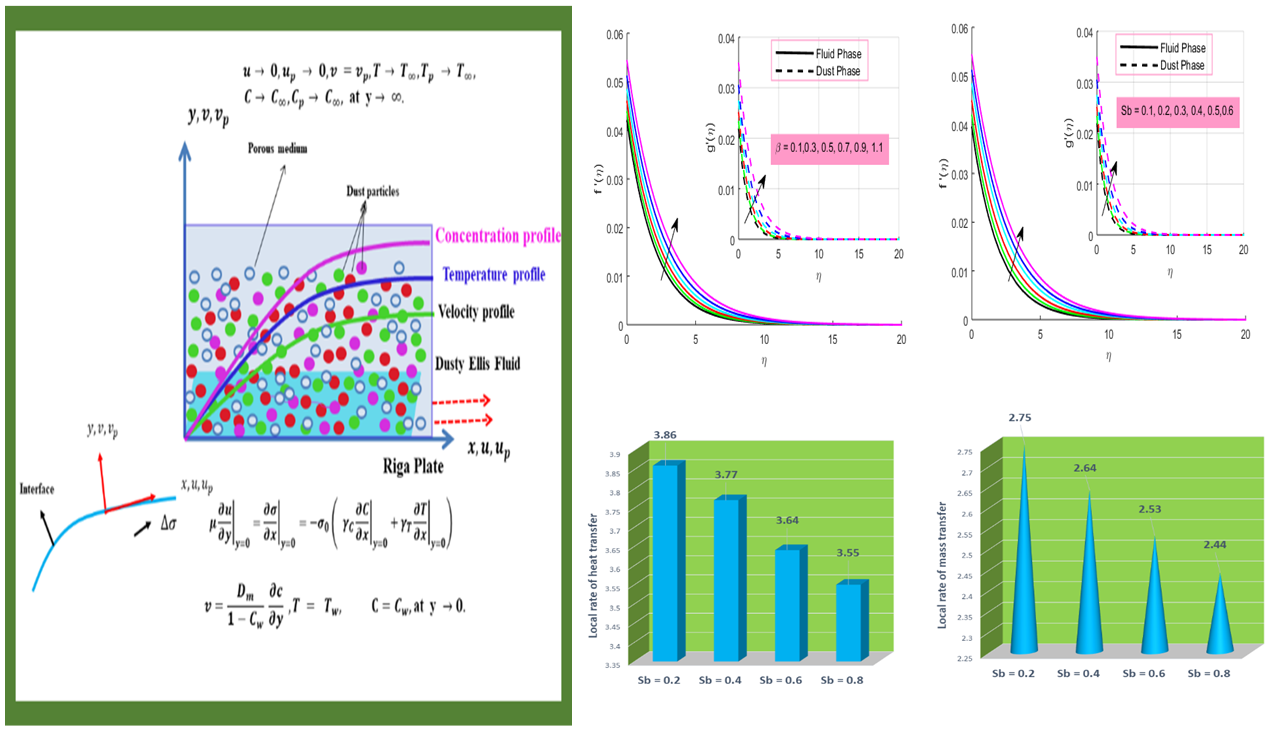
This study examines the influence of Stephan blowing and surface tension gradient on Darcy-Forchheimer of dusty Ellis fluid over a Riga plate with Stephan blowing impacts and porous medium. In the occurrence of Cattaneo-Christov mass and heat flux, mathematical modeling and analysis have been performed. This model is useful for optimizing the design of systems that involve non-Newtonian fluids, like oil drilling, polymer extrusion, and chemical reactors. To optimize thermal management in high-performance machinery, it aids in a more precise knowledge of heat and mass transport mechanisms. This model can be applied to environmental processes such as the dispersion of pollutants in the atmosphere or the cooling of electronic equipment, where fluid dynamics and heat regulation play crucial roles, by incorporating dust particles and surface tension gradients. For both liquid and dust particle phases, the governing non-linear PDEs (partial differential equations) are composed of the principles of momentum, mass, energy, and solutal conservation. By using the similarity variable, PDEs can be transmuted into ODEs (ordinary differential equations). The numerical results of the governing equations are obtained using the shooting approach (RKF-45th). The skin friction, fluid and dust velocity distributions grow as the value of the Stephen blowing parameter upsurges while decline the rate of heat and mass transmission.
Keywords
Get full access to this article
View all access options for this article.