The nanofluid flow between two parallel plates has many applications across various fields of engineering. The addition of nanoparticles to conventional fluids can improve the rheological properties of nanofluids, enhance the heat transfer rate, and have other beneficial characteristics. Therefore, a squeezing flow problem between two parallel plates has been investigated in this article. The nanofluid flow is composed of alumina (Al2O3) nanoparticles and water, which is used as a base fluid. This study is featured according to the recommendations of a previous study to implement the improved residual power series method (IRPSM). The mathematical model is presented in the form of partial differential equations (PDEs), which are then transformed into ordinary differential equations (ODEs) by means of similarity variables. The considered problem is solved by two analytical methods called IRPSM, the homotopy perturbation method (HPM), and a numerical method (NDSolve). The residual errors of both applied techniques are compared to verify the validation of a new method. The comparison of both applied analytical techniques is conducted at the 17th order of approximations. From the obtained results, we confirmed that both techniques are in great agreement and have a very close relationship. The results of both methods are compared with the numerical method, and it was found that the absolute error between the IRPSM and numerical techniques is much more significant than the absolute error between the HPM and numerical techniques. Also, we have seen that the residuals of IRPSM are quite significant in terms of less residual errors than those of HPM. We confirmed that the IRPSM is a more powerful method than the HPM in terms of solving such types of mathematical problems.
Differential equations, whether partial or ordinary, are used to model scientific problems. Typically, these equations cannot be solved analytically; thus, unique methods must be used to solve them. The recently established techniques, including the perturbation approach, to build an analytical solution to these equations have received a lot of attention recently. Techniques for perturbation rely too heavily on the so-called “small parameters.” Therefore, it becomes sense to create some novel analytical methods that are not depending on little factors.
Homotopy perturbation method (HPM), which was proposed by He,1 is one of the most powerful technique to solve nonlinear differential equations. Various mathematical models have been solved by authors in many scientific fields.2–4 The HPM is always valid whether a small physical parameter exists or not. HPM expresses the solution of a differential equation in a form of summation of an infinite series. Furthermore, in order to get the solutions, this technique relies on certain initial guesses for the differential operators. It should be highlighted that false results might arise if these initial guesses are selected in an improper manner. As shown by Ariel,2 Pamuk and Pamuk,3 and Aly and Ebaid,5 the approach does, nonetheless, provide accurate solutions in a large cases where effective initial estimates have been made. Panda et al.6 presented the application of HPM in heat and mass transfer across a rectangular fin. Mallick et al.7 presented the applications of HPM to investigate the unknown thermal factors in an annular fin.
Improved Residual Power Series Method (IRPSM) is the improved version of the residual power series method (RPSM). The idea of RPSM was introduced by Arqub.8 This method is more effective in construction of power series solutions for the linear and nonlinear differential equations. RPSM has no need of linearization, discretization, or perturbation. It is important to note that the RPSM is only applicable for the solution of initial value problems. Based on these observations, Khan et al.9 extended this method for the solutions of boundary valued problems which we then called IRPSM. They compared the results of IRPSM with the results of optimal homotopy analysis method (OHAM), differential transform method (DTM) and exact solutions of the problems they considered. They found that the results of IRPSM are more significant than the other methods and hence an improved version of the RPSM is introduced. Following this method, Dawar et al.10 introduced it in the field of fluid dynamics. They solved a thin film flow problem over a thin film planar surface. They compared their results with the published results11–14 and have found a good agreement among all the methods.
According to the future recommendations of Dawar et al.,10 it is intended in this effort to solve a squeezing flow problem between two parallel plates. Therefore, the nanofluid flow comprising alumina (Al2O3) nanoparticles between two parallel plates is considered in this effort. It is also intended to compare the IRPSM and HPM results to get more effective results from this study. Both the IRPSM and HPM will be tested at 17th order of approximations to confirm the validity of both techniques. Also, the residual errors of both techniques will tell us about the most powerful method to solve such types of mathematical problems. Therefore, to conduct a comparative analysis, we have presented this paper in section-wise. The mathematical formulation of the problem under consideration is presented in Section “Model formulation.” Basic ideas of the HPM and IRPSM are introduced in Sections “Fundamentals of HPM” and “Fundamentals of IPRMS,” respectively. A comparative analysis between HPM and IRPSM is presented in Section “Comparison of numerical, IRPSM, and HPM solutions.” The results obtained by IRPMS and their physical discussion are presented in Section “Results and discussion.” The final remarks are listed in Section “Conclusions and future scope.”
Model formulation
Assume a laminar and time-dependent flow of nanofluid comprising alumina (Al2O3) nanoparticles between two parallel plates. Water is considered to be a base fluid. The two plates are placed in such a way that the lower plate locates at axis and axis remains vertical to the lower plate as shown in Figure 1. The two plates are separated to each other at a distance such that where and are the constants (non-negative). The two plates are squeezes for until they touches and for , the two plates separates. It is also assumed that the upper plate moves toward the lower plates with velocity . The lower plate is maintained at a constant temperature and concentration . Similarly, the upper plate is maintained at a constant temperature and concentration . The impact of heat source/sink is taken into consideration to investigate the heat transfer rate. The impacts of magnetic field, Joule heating, and viscous dissipation are ignored. Thus, the leading equations are defined as15,16:
Geometrical representation of the flow problem.
Continuity equation
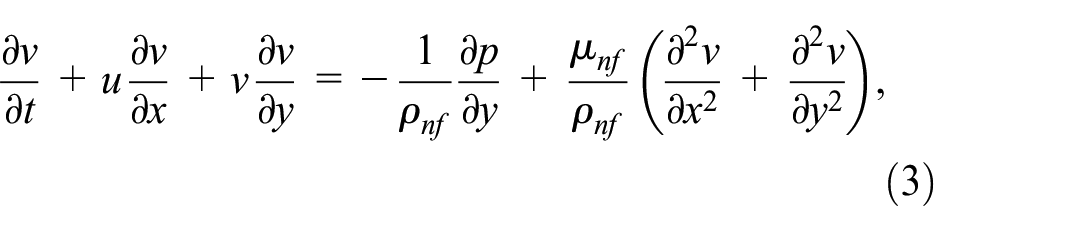
Momentum equations
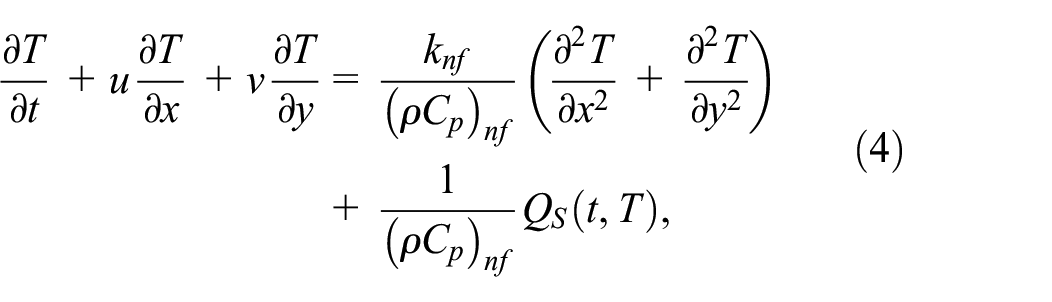
Energy equation
where .
Concentration equation
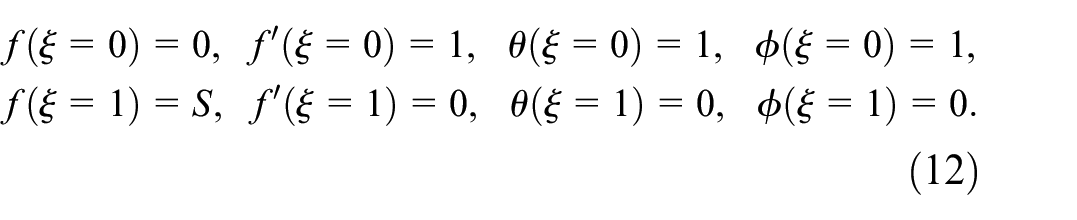
with boundary conditions:
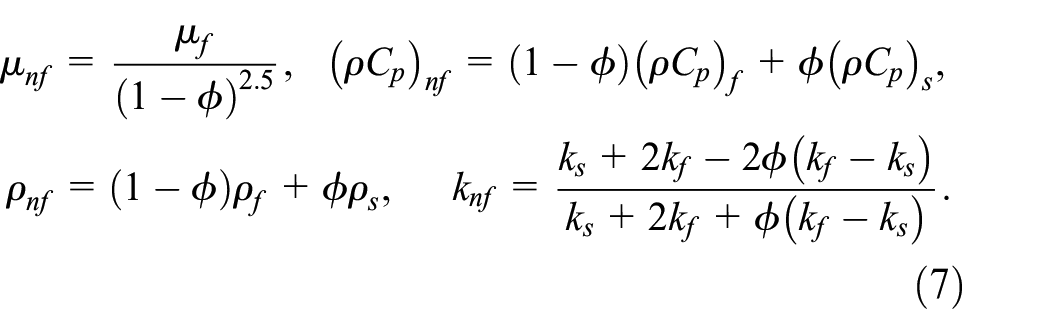
The thermophysical relations are defined as:
The thermophysical properties of the base fluid and nanoparticle are defined in Table 1.
Thermophysical properties of the base fluid and nanoparticle.17
In the above equations, is the general differential equation, is the known analytic function, is the boundary operator, and is the boundary of the domain .
The differential equation can be divided into linear and nonlinear parts. Thus, equation (15) can be written as:
The structure of homotopy perturbation can be written as:
where
Here (embedding factor) belongs to the close interval and is the initial approximation which satisfies the given conditions.
The series solution of equation (18) can be written as:
To get the best solution, this can also be written as:
Implementation of HPM
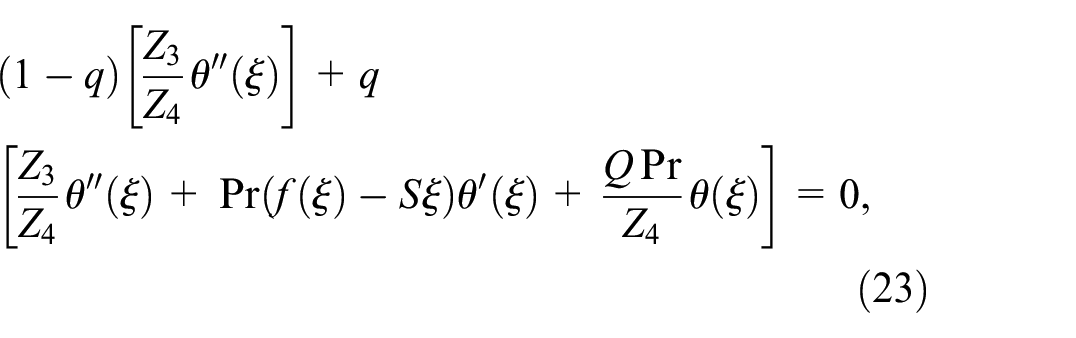
Using HPM, the constructed homotopy for equations (9)–(11) can be written as:
According to HPM, the solutions of equations (22)–(24) can be written as:
Substituting equations (25)–(27) in equations (22)–(24) and comparing the coefficients of various power of . Further, equating the coefficients of various power of to zero and solve by using the boundary conditions. Taking the thermophysical properties from Table 1 and , . Solving equations (22)–(24), the following solutions are obtained at 17th order of approximations:
Equations (28)–(30) are the solutions of the modeled equations by HPM.
Fundamentals of IPRMS
IRPSM provides the power series expansion about the initial point . Let us assume the below order differential equation:
with initial conditions:
In the above equations, is the function to be determined, and are constants. Let us assume the below truncated power series for the solution of a considered problem:
This is the first initial condition of the given problem. In a similar way, the further constants are:
It should be noted that if the given problem is a boundary value problem (BVP), then we consider the boundary conditions of a given BVP as initial conditions and determine later on by using boundary conditions.9,10 For greater values of and , we define the following equation:
where is the truncated power series and is defined as:
The residual function of the considered problem can be determined as:
From equations (31) and (39), the residual function can be defined as:
From equation (41), we can determine the values of . Therefore, the order truncated series can be obtained as:
This is the required series solution of the considered differential equation.
Implementation of IRPSM
From equations (9) to (11), we see that equation (9) is of fourth-order and equations (10) and (11) are of second-order, then according to the basic idea of IRPSM we have to choose the boundary conditions of the given problem as initial conditions by assuming the dummy variables. Therefore, we have the following initial conditions:
Here , and are the dummy variables. It should be noted that here the initial point is considered to be zero ().
Define the following series to solve the system of the given equations (9)–(11):
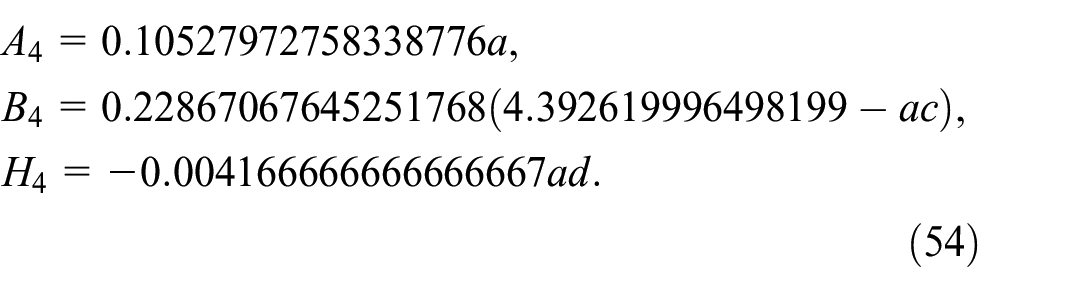
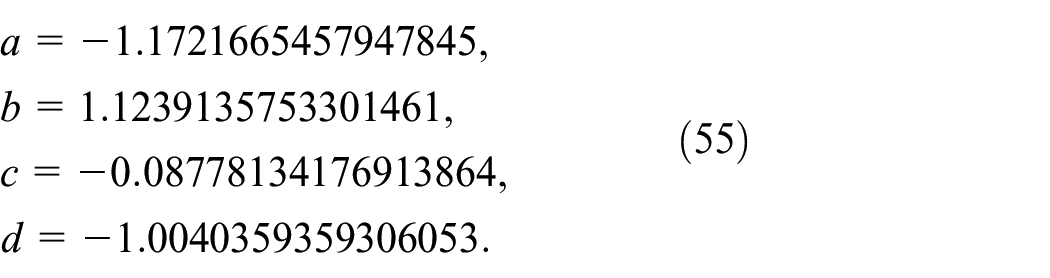
Following the same procedure for further values of , we will get the series solution in terms of dummy variables. Now using the boundary conditions (), we get the following values of dummy variables:
Using the values of dummy variables in the obtained series solution in term of dummy variables, we have the final solution at the 17th order of approximations as:
Equations (56)–(58) are the solutions of the modeled equations by IRPSM.
Comparison of numerical, IRPSM, and HPM solutions
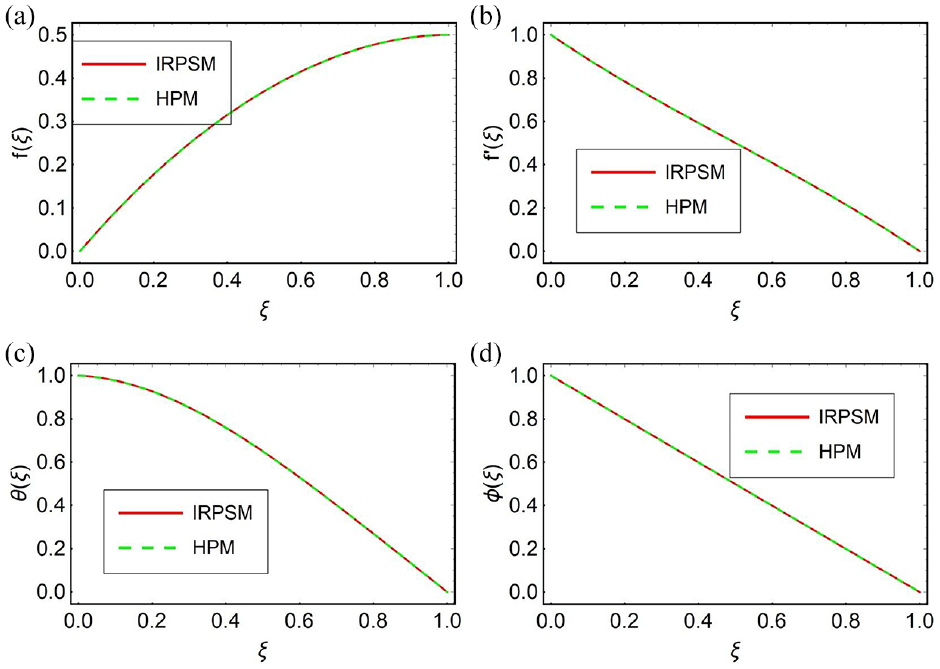
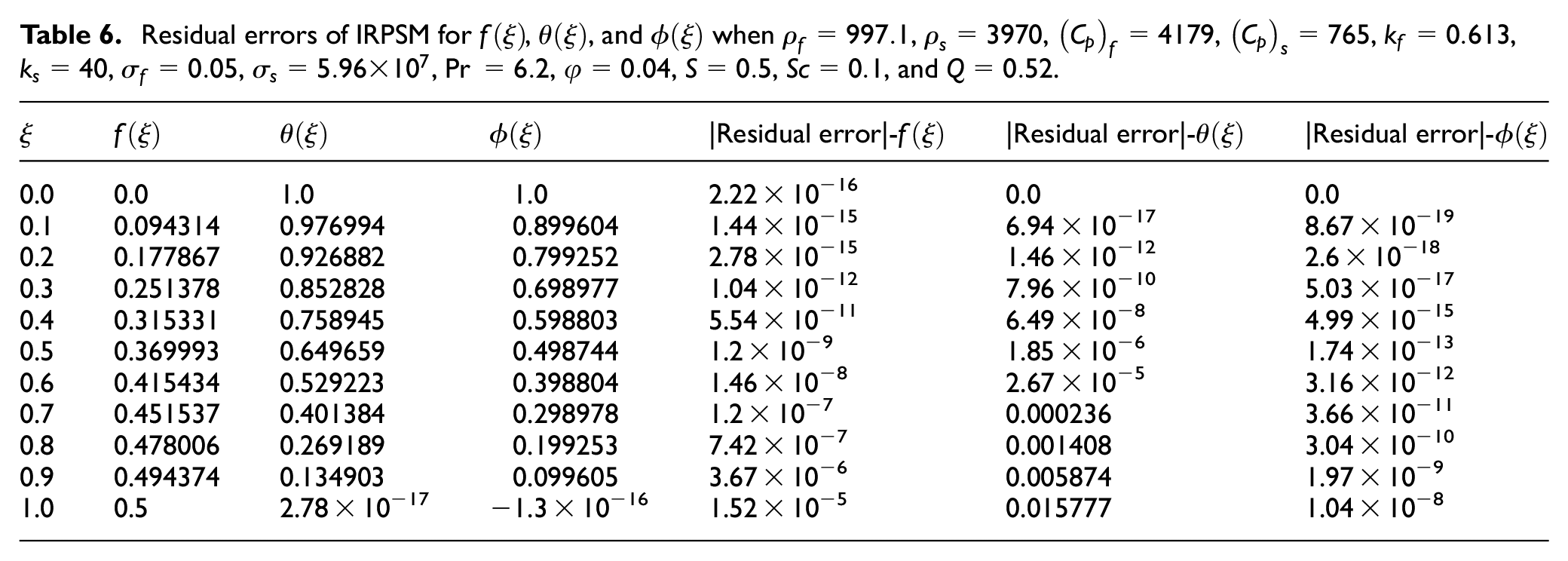
This section presents a comparison among the results obtained through numerical, IRPSM, and HPM techniques. A comparison of both analytical methods is determined at 17th order of approximations. Figure 2(a) to (d) are displayed to compare and verify both the methods for velocity, thermal, and concentration profiles when , , , , , , , , , , , and . From these Figures, it is seen that both the IRPSM and HPM are in great agreement and have a very close relation. Furthermore, Tables 2 to 5 are displayed to verify the results of all the three methods. From these Tables, it is seen that the absolute error between both the IRPSM and numerical methods, and HPM and numerical methods are very significant for solving such type of mathematical problems. Also, it has been found that the absolute error between the IRPSM and numerical method is more significant than the absolute error between the HPM and numerical method. This shows that IRPSM is stronger than HPM. Figure 3(a) to (c), and Tables 6 and 7 are displayed to study the residual of IRPSM and HPM for the velocity, temperature, and concentration profiles when , , , , , , , , , , , and . From here, it can see that the residuals of IRPSM are quite significant in term of less residual errors than that of HPM. Thus, it is confirmed that the IRPSM is more powerful method than the HPM in term of solving such type of mathematical problems.
(a–d) Comparison of IRPSM and HPM for , , , and when , , , , , , , , , , , , and .
Comparison of numerical, IRPSM, and HPM techniques for when , , , , , , , , , , , , and .
Numerical
IRPSM
HPM
|IRPSM-Numerical|
|HPM-Numerical|
0.0
0.0
0.0
0.0
0.0
0.0
0.1
0.094314435
0.094314440
0.094314441
5.438376082800289 × 10⁻⁹
5.655065540843829 × 10⁻⁹
0.2
0.177866916
0.177866921
0.177866924
4.733047370697463 × 10⁻⁹
7.632805804069775 × 10⁻⁹
0.3
0.251377810
0.251377814
0.251377823
3.680829530061658 × 10⁻⁹
1.281748951420525 × 10⁻⁸
0.4
0.315330507
0.315330509
0.315330527
2.552183131498964 × 10⁻⁹
1.9889790869864754 × 10⁻⁸
0.5
0.369992940
0.369992941
0.369992965
1.419649453548999 × 10⁻⁹
2.561280809665334 × 10⁻⁸
0.6
0.415434248
0.415434248
0.415434274
3.593031983051276 × 10⁻¹⁰
2.6765847205290072 × 10⁻⁸
0.7
0.451537123
0.451537122
0.451537145
6.779185546257338 × 10⁻¹⁰
2.178226232718572 × 10⁻⁸
0.8
0.478006308
0.478006306
0.478006320
1.6343567610377363 × 10⁻¹⁰
1.2073171740123456 × 10⁻⁸
0.9
0.494373643
0.494373640
0.494373645
2.435663615241168 × 10⁻¹⁰
1.8916354038722716 × 10⁻⁹
1.0
0.500000002
0.5
0.499999999
2.9360632813890675 × 10⁻¹⁰
2.9360633369002187 × 10⁻⁹
Comparison of numerical, IRPSM, and HPM techniques for when , , , , , , , , , , , , and .
Numerical
IRPSM
HPM
|IRPSM-Numerical|
|HPM-Numerical|
0.0
1.0
1.0
1.0
0.0
0.0
0.1
0.887923985
0.887923961
0.887923971
2.4054897296288402 × 10⁻⁸
1.367782420658159 × 10⁻⁸
0.2
0.784321787
0.784321777
0.784321822
1.0260297833575294 × 10⁻⁸
3.4886982747117656 × 10⁻⁸
0.3
0.686698175
0.686698163
0.686698240
1.2017469908087719 × 10⁻⁸
6.475135605477078 × 10⁻⁸
0.4
0.592799549
0.592799538
0.592799620
1.1212985762121264 × 10⁻⁸
7.021383940930548 × 10⁻⁸
0.5
0.500562288
0.500562277
0.500562326
1.0991628385248475 × 10⁻⁸
3.8885765163421127 × 10⁻⁸
0.6
0.408066955
0.408066944
0.408066936
1.0702497110770537 × 10⁻⁸
1.9034833487197034 × 10⁻⁸
0.7
0.313497623
0.313497613
0.313497545
1.0050415943929636 × 10⁻⁸
7.838485843736365 × 10⁻⁸
0.8
0.215105490
0.215105481
0.215105381
8.958474045916986 × 10⁻⁹
1.0848900433568787 × 10⁻⁷
0.9
0.111176149
0.111176142
0.111176064
7.138337212997392 × 10⁻⁹
8.532178738529517 × 10⁻⁸
1.0
2.0166 × 10⁻⁹
1.2675 × 10⁻¹⁶
6.9575 × 10⁻¹⁷
2.016163491372977 × 10⁻⁹
2.016163548554477 × 10⁻⁹
Comparison of numerical, IRPSM, and HPM techniques for when , , , , , , , , , , , , and .
Numerical
IRPSM
HPM
|IRPSM-Numerical|
|HPM-Numerical|
0.0
1.0
1.0
1.0
0.0
0.0
0.1
0.977013227
0.976993805
0.976699123
0.000019422699891968875
0.0003141045945168619
0.2
0.926919838
0.926881977
0.926349111
0.00003786054906940173
0.0005707267689470941
0.3
0.852882669
0.852828197
0.852146833
0.00005447268216007828
0.0007358362675806696
0.4
0.759013332
0.758944662
0.758212200
0.00006866971285568457
0.0008011318830656311
0.5
0.649738909
0.649658821
0.648962003
0.00008008765882017155
0.0007769061356327489
0.6
0.529311895
0.529223370
0.528628922
0.00008852453192620402
0.000682973173172341
0.7
0.401477858
0.401384220
0.400936567
0.00009363719209759536
0.0005412908034971298
0.8
0.269281888
0.269188716
0.268910570
0.00009317221883436977
0.0003713183356869876
0.9
0.134978035
0.134790653
0.134790246
0.00007549496769715391
0.0001877896946593515
1.0
1.1296 × 10⁻⁸
−1.0061 × 10⁻¹⁶
−1.0061 × 10⁻¹⁶
1.129697783447863 × 10⁻⁸
1.12969779628467 × 10⁻⁸
Comparison of numerical, IRPSM, and HPM techniques for when , , , , , , , , , , , , and .
Numerical
IRPSM
HPM
|IRPSM-Numerical|
|HPM-Numerical|
0.0
1.0
1.0
1.0
0.0
0.0
0.1
0.899604291
0.899604291
0.899604292
2.939015697478453 × 10⁻¹¹
1.3400202059088429 × 10⁻⁹
0.2
0.799252162
0.799252162
0.799252165
2.1723067789025663 × 10⁻⁸
2.6327210411736246 × 10⁻⁹
0.3
0.698977304
0.698977304
0.698977308
1.1000977906405751 × 10⁻⁸
3.838023232560772 × 10⁻⁹
0.4
0.598803252
0.598803252
0.598803257
2.7106095146223197 × 10⁻¹²
4.809796450011561 × 10⁻⁹
0.5
0.498743890
0.498743890
0.498743896
2.330025061780816 × 10⁻¹²
5.354922838485265 × 10⁻⁹
0.6
0.398803754
0.398803754
0.398803759
4.954647803145917 × 10⁻¹²
5.308896489086834 × 10⁻⁹
0.7
0.298978140
0.298978140
0.298978145
2.939015697478453 × 10⁻¹¹
4.613362580840885 × 10⁻⁹
0.8
0.199253037
0.199253037
0.199253040
2.1723067789025663 × 10⁻¹¹
3.3585279002323887 × 10⁻⁹
0.9
0.099604859
0.099604859
0.099604861
1.1000977906405751 × 10⁻¹¹
1.752182510195155 × 10⁻⁹
1.0
1.4282 × 10⁻¹¹
−1.1680 × 10⁻¹⁶
−1.16801 × 10⁻¹⁶
2.7106095146223197 × 10⁻¹²
1.4282321590320099 × 10⁻¹¹
(a–c) Residual error of IRPSM and HPM for , , and when , , , , , , , , , , , , and .
Residual errors of IRPSM for , , and when , , , , , , , , , , , , and .
|Residual error|-
|Residual error|-
|Residual error|-
0.0
0.0
1.0
1.0
2.22 × 10⁻¹⁶
0.0
0.0
0.1
0.094314
0.976994
0.899604
1.44 × 10⁻¹⁵
6.94 × 10⁻¹⁷
8.67 × 10⁻¹⁹
0.2
0.177867
0.926882
0.799252
2.78 × 10⁻¹⁵
1.46 × 10⁻¹²
2.6 × 10⁻¹⁸
0.3
0.251378
0.852828
0.698977
1.04 × 10⁻¹²
7.96 × 10⁻¹⁰
5.03 × 10⁻¹⁷
0.4
0.315331
0.758945
0.598803
5.54 × 10⁻¹¹
6.49 × 10⁻⁸
4.99 × 10⁻¹⁵
0.5
0.369993
0.649659
0.498744
1.2 × 10⁻⁹
1.85 × 10⁻⁶
1.74 × 10⁻¹³
0.6
0.415434
0.529223
0.398804
1.46 × 10⁻⁸
2.67 × 10⁻⁵
3.16 × 10⁻¹²
0.7
0.451537
0.401384
0.298978
1.2 × 10⁻⁷
0.000236
3.66 × 10⁻¹¹
0.8
0.478006
0.269189
0.199253
7.42 × 10⁻⁷
0.001408
3.04 × 10⁻¹⁰
0.9
0.494374
0.134903
0.099605
3.67 × 10⁻⁶
0.005874
1.97 × 10⁻⁹
1.0
0.5
2.78 × 10⁻¹⁷
−1.3 × 10⁻¹⁶
1.52 × 10⁻⁵
0.015777
1.04 × 10⁻⁸
Residual errors of HPM for , , and when , , , , , , , , , , , , and .
|Residual error|-
|Residual error|-
|Residual error|-
0.0
0.0
1.0
1.0
9.35 × 10⁻⁶
0.0
0.0
0.1
0.094314
0.976699
0.899604
2.62 × 10⁻⁵
0.004918
4.02 × 10⁻¹⁰
0.2
0.177867
0.926349
0.799252
2.96 × 10⁻⁵
0.007699
7.92 × 10⁻⁹
0.3
0.251378
0.852147
0.698977
1.9 × 10⁻⁵
0.008337
2.4 × 10⁻⁸
0.4
0.315331
0.758212
0.598803
6.05 × 10⁻⁹
0.007466
4.49 × 10⁻⁸
0.5
0.369993
0.648962
0.498744
1.95 × 10⁻⁵
0.00583
6.27 × 10⁻⁸
0.6
0.415434
0.528629
0.398804
3.16 × 10⁻⁵
0.004014
6.89 × 10⁻⁸
0.7
0.451537
0.400937
0.298978
3.14 × 10⁻⁵
0.002387
5.93 × 10⁻⁸
0.8
0.478006
0.268911
0.199253
1.8 × 10⁻⁵
0.001136
3.68 × 10⁻⁸
0.9
0.494374
0.13479
0.099605
5.28 × 10⁻⁶
0.000331
1.23 × 10⁻⁸
1.0
0.5
−1 × 10⁻¹⁶
−1.2 × 10⁻¹⁶
3.2 × 10⁻⁵
5.09 × 10⁻¹⁷
1.18 × 10⁻¹⁷
Results and discussion
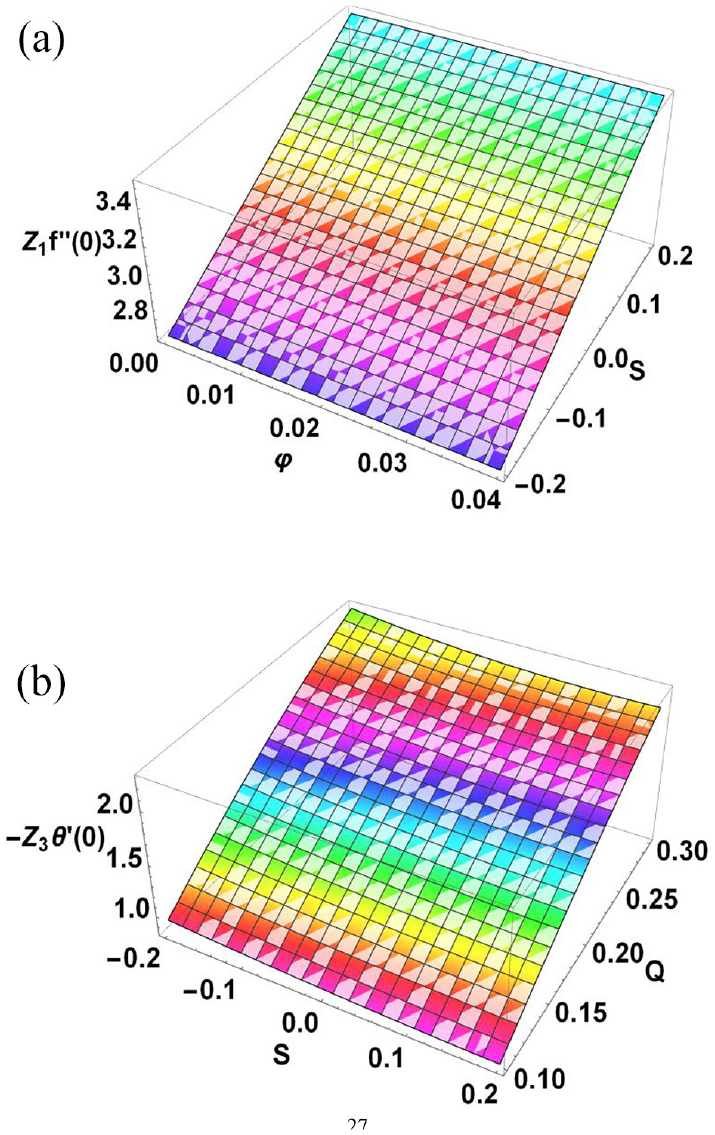
Figure 4(a) to (c) show the impact of on , , and when , , , , , , , , , , , and . From Figure 4(a), it is observed that the higher values of increases . From the given boundary conditions, it is seen that is a boundary parameter and has direct relation with . This means that the higher values of increases . From Figure 4(b), it is observed that the higher values of increases . From here it is see that the greater values of increases both positive and negative values of . A similar impact is also found by Acharya et al.16 From Figure 4(c), it is observe that the positive values of reduce while the negative values of increases . Physically, the negative values of means that the plates become closer and as a result less fraction between the nanoparticles and plates occurs. Therefore, the temperature profile reduces for negative values of . On the other hand, this impact is reverse for positive values of . Figure 5 shows the impact of on when , , , , , , , , , , , and . From this Figure, it is observed that the greater increases . The reason is that the increase in increases the rate of heat transfer which results higher thermal profile. Therefore, the greater increases . Figure 6 show the impact of on when , , , , , , , , , , , and . From this Figure, it is observed that the greater reduces . The higher reduces the Brownian diffusivity which results lower . Therefore, the higher reduces . Figure 7(a) shows the variation in for and . Here, and are varied for different values and all other parameters are taken constant. From here, it is perceived that the greater values of and increases the friction force at the surface of the plate. Figure 7(b) shows the variation in for and . Here, and are varied for different values and all other parameters are taken constant. From here, it is perceived that the greater values of and increases the heat transfer rate at the surface of the plate. Table 8 is displayed to observe the numerical results of and for the increasing when , , , , , , , , , , , and . Here, both the IRPSM and HPM methods are tested for different values of . Again, it is confirmed that both the IRPSM and HPM are applicable for solving such type of mathematical problems.
(a–c) Impact of on , , and when , , , , , , , , , , , and .
Impact of on when , , , , , , , , , , , and .
Impact of on when , , , , , , , , , , , and .
(a and b) Variations in and when , , , , , , , , , , , , and .
Numerical values of and for the increasing when , , , , , , , , , , , and .
HPM
IRPSM
−0.2
−5.1999318
1.0944531
−5.1992456
1.0953475
−0.1
−4.6470133
0.8623464
−4.6474535
0.8635774
0.1
−3.5183300
0.6840077
−3.5154343
0.6850865
0.2
−2.9427700
0.5509772
−2.9453245
0.5515335
Conclusions and future scope
In this paper the squeezing flow problem between two parallel plates has been investigated successfully. The nanofluid flow comprising alumina (Al2O3) nanoparticles and water is used as a base fluid. A comparative analysis among the numerical, IRPMS, and HPM techniques has been successfully presented in this effort. The comparison of both IRPSM and HPM is conducted at 17th order of approximations. From this analysis, it is concluded that:
• The numerical, IRPSM, and HPM techniques are in great agreement and have a very close relation.
• The results of both methods are compared with the numerical method and found that the absolute error between both the IRPSM and numerical techniques, and HPM and numerical techniques are very significant for solving such type of mathematical problems.
• It is seen that the residuals of IRPSM are quite significant in term of less residual errors then those of HPM.
• It is confirmed that the IRPSM is more powerful method than the HPM in term of solving such type of mathematical problems.
Future recommendations
In future, the IRPSM can be implemented to slip flow of nanofluids in a two rotating disk and parallel plates. Furthermore, the convective and mass flux conditions can also be imposed in a nanofluid flow to determine the series solutions via IRPSM. Also, the IRPSM can also be compared with other analytical and numerical methods to check effectiveness of IRPSM.
Footnotes
Appendix
Notation
a
Constant [−]
Concentration
Specific heat
Brownian diffusivity
Thermal conductivity
Pressure
Prandtl number [−]
Heat source factor [−]
Heat source coefficient
Squeezing parameter [−]
Schmidt number [−]
Time
Temperature
Velocity components
Coordinates
Kinematic viscosity
Dynamic viscosity
Density
Electrical conductivity
Volume fraction of the nanoparticle [−]
Characteristic parameter [−]
Physical quantities of interest
Skin friction
Skin friction
Sherwood number
Subscripts
Nanoparticle
Fluid
Nanofluid
Handling Editor: Sharmili Pandian
Declaration of conflicting interests
The author(s) declared no potential conflicts of interest with respect to the research, authorship, and/or publication of this article.
Funding
The author(s) received no financial support for the research, authorship, and/or publication of this article.
ORCID iD
Abdullah Dawar
Availability of data and materials
There is no data associated with this research.
References
1.
HeJ-H.A coupling method of a homotopy technique and a perturbation technique for non-linear problems. Int J Non Linear Mech2000; 35: 37–43.
2.
ArielPD.The three-dimensional flow past a stretching sheet and the homotopy perturbation method. Comput Math Appl2007; 54: 920–925.
3.
PamukSPamukN.He’s homotopy perturbation method for continuous population models for single and interacting species. Comput Math Appl2010; 59: 612–621.
4.
AminikhahH.The combined Laplace transform and new homotopy perturbation methods for stiff systems of ODEs. Appl Math Model2012; 36: 3638–3644.
5.
AlyEHEbaidA.New analytical and numerical solutions for mixed convection boundary-layer nanofluid flow along an inclined plate embedded in a porous medium. J Appl Math2013; 2013: 219486.
6.
PandaSBhowmikADasR, et al. Application of homotopy analysis method and inverse solution of a rectangular wet fin. Energy Convers Manag2014; 80: 305–318.
7.
MallickARanjanRDasR.Application of homotopy perturbation method and inverse prediction of thermal parameters for an annular fin subjected to thermal load. J Therm Stress2016; 39: 298–313.
8.
ArqubOA.Series solution of fuzzy differential equations under strongly generalized differentiability. J Adv Res Appl Math2013; 5: 31–52.
9.
KhanHUllahIAliJ, et al. The solution of twelfth order boundary value problems by the improved residual power series method: new approach. Int J Model Simul2023; 43: 64–74.
10.
DawarAKhanHIslamS, et al. The improved residual power series method for a system of differential equations: a new semi-numerical method. Int J Model Simul. Epub ahead of print 23 October 2023. DOI: 10.1080/02286203.2023.2270884.
11.
DawarAWakifAThummaT, et al. Towards a new MHD non-homogeneous convective nanofluid flow model for simulating a rotating inclined thin layer of sodium alginate-based Iron oxide exposed to incident solar energy. Int Commun Heat Mass Transf2022; 130: 105800.
12.
SheikholeslamiMAshorynejadHRGanjiDD, et al. Homotopy perturbation method for three-dimensional problem of condensation film on inclined rotating disk. Sci Iran2012; 19: 437–442.
13.
AcharyaN.Spectral quasi linearization simulation on the hydrothermal behavior of hybrid nanofluid spraying on an inclined spinning disk. Partial Differ Equ Appl Math2021; 4: 100094.
14.
BerkanSHoseiniSRGanjiDD.Analytical investigation of steady three-dimensional problem of condensation film on inclined rotating disk by Akbari-Ganji’s method Analytical investigation of steady three-dimensional problem of condensation film on inclined rotating disk by Akbari-Ganji. Propuls Power Res2017; 6: 277–284.
15.
Bin-MohsinBAhmedNAdnan, et al. A bioconvection model for a squeezing flow of nanofluid between parallel plates in the presence of gyrotactic microorganisms. Eur Phys J Plus2017; 132: 1–12.
16.
AcharyaNBagRKunduPK.Unsteady bioconvective squeezing flow with higher-order chemical reaction and second-order slip effects. Heat Transf2021; 50: 5538–5562.
17.
DawarAThummaTIslamS, et al. Optimization of response function on hydromagnetic buoyancy-driven rotating flow considering particle diameter and interfacial layer effects: homotopy and sensitivity analysis. Int Commun Heat Mass Transf2023; 144: 106770.
GanjiDDSahouliARFamouriM.A new modification of He’s homotopy perturbation method for rapid convergence of nonlinear undamped oscillators. J Appl Math Comput2009; 30: 181–192.