




Abstract
In this article, mixed convection squeezing flow of a nanofluid between parallel disks is considered. The partial differential equations governing the flow problem are converted into coupled system of ordinary differential equation with the help of suitable similarity transforms. Homotopy analysis method is employed to solve the coupled system of ordinary differential equations. The influence of involved parameters, on velocity, temperature, and concentration profile, is presented graphically coupled with detailed discussion. The results for skin friction coefficient and Nusselt and Sherwood numbers are also a part of this study. Numerical solution is also obtained with the help of Runge–Kutta method of order 4. An excellent agreement is found between analytical and numerical solutions. From the results obtained, we observe that the skin friction coefficient decreases with increasing squeeze number for the case of injection and increases with increase in squeeze number for the case of injection at the walls. Furthermore, Nusselt number gets a rise with increment in squeeze number for the case of injection at the wall and a drop in Nusselt number for the case of suction at the wall is observed when there is suction at the wall. Sherwood number is seen to drop quite steeply with higher values of squeeze number for the injection case and a rise in Sherwood number for the suction is observed when there is suction at the wall.
Introduction
Mixed convection is the combination of natural and forced convection, in which the buoyancy forces are induced due to the change in fluid density with temperature. Depending on the orientation and heating conditions, concentration and temperature changes are now very important in the mixed convection thermal and mass diffusions. This state occurs for relatively small flow velocity and large temperature and concentration differences. In fact, the buoyancy force acting as a pressure incline in the buoyancy layer changes the velocity, temperature, and concentration distributions and, consequently, the Nusselt and Sherwood numbers between the surface and fluid. However, mixed convection flows are encountered in several industrial applications including nuclear reactors cooled during emergency shutdown, heat exchangers placed in low-velocity environments, electronic devices cooled by fans, and solar central receivers exposed to the wind currents. In mixed convection flows, the combined effect of heat and mass transfer has special significance to engineering-related problems that contain energy from both metal and polymer sheets. Mixed convection on the horizontal surface due to a uniform free stream has been studied by many researchers. Mori 1 considered the buoyancy effects in forced laminar convection flow over a horizontal plate for the weakly buoyant flows by expanding the variables. For the first-order perturbations, he presented numerical solution. The buoyancy effects of horizontal boundary layer flow and heat transfer were reported by Sparrow and Minkowycz, 2 in which they point out some minor errors in the solution by Mori 1 and provided the solution for larger Prandtl number. Motivated by these facts, notable amount of research exists for mixed convection flow by a stretching surface.
Squeezing flows between two parallel infinite walls is an important area of interest due to its abundant industrial application including injection modeling, compression, polymer processing, squeezed films in power transmission, and the transient loading of mechanical components. Stefan, 3 in the 19th century, is the first one to give the idea of squeezing flow in terms of lubrication approximation. After the seminal work done by Stefan, many researchers investigated such flows for different geometries. Recently, the magnetohydrodynamic (MHD) squeezing flow of second-grade fluid between two parallel plates was investigated by Hayat et al. 4 Qayyum et al. 5 discussed the unsteady squeezing flow of a Jeffrey fluid between parallel disks. Heat and mass transfer characteristics of squeezing flow of viscous fluid were reported by Mustafa et al. 6 Munawar et al. 7 highlighted the three-dimensional squeezing flow in a rotating channel of lower stretching porous wall.
The term “nanofluids” refers to a liquid suspension of small solid particles with sizes typically of 1–100 nm in a base fluid. Choi 8 initially verified that the inclusion of these nanoparticles in a base fluid enhances the thermal conductivity of the fluids. Common base fluids consist of water, ethylene glycol, oil, and polymer solutions. Nanoparticles are made up of carbides, nitrides, metals (aluminum and copper), or nonmetals (graphite and carbon nanotubes). The size of these nanoparticles plays an important role to enhance heat and mass transfer of the surface and fluid. To highlight the significant effects of Brownian motion and thermophoretic diffusion of nanoparticles, a mathematical model was discussed by Buongiorno. 9 In Buongiorno’s model, the thermal conductivity and the viscosity are taken to be constant. This model takes into consideration the Brownian motion and the thermophoresis effects which are different from the other models used. Also, Buongiorno’s model does not take into account the shape of nanoparticles or the type of nanoparticles involved. This model is called two-phase model due to the presence of Brownian motion and thermophoresis, that is, the temperature and concentration equations are coupled due to the presence of these two terms. The Cheng–Minkowcz problem for natural convective boundary layer flow of a nanofluid occupying a porous space was considered by Nield and Kuznetsov. 10 Kuznetsov and Nield 11 numerically studied the flow of nanofluid past a vertical flat plate. Khan and Pop 12 provided numerical solutions for boundary layer flow of nanofluid over a stretching sheet. Many researchers used Buongiorno’s model to analyze the flow of nanofluids in various geometries. Some relevant studies can be seen in the literature.13–20 The analytic solutions for the problem considered in Khan and Pop 12 by homotopy analysis method (HAM) were computed by Hassani et al. 21 Homotopy solutions for squeezing flow of nanofluid between parallel disks have been obtained by Mustafa et al. 22 Liao 23 presented a new form of HAM and implemented it on as a novel analysis to the field. Different researchers used BVPh2.0 package to solve the equations of various types.24,25
It is revealed from the literature survey that there is no study available that considered the mixed convection squeezing flow of a nanofluid between parallel disks. Due to the nonlinearity of the equations corresponding to these problems, an exact solution is unlikely; so, many analytical techniques, such as homotopy perturbation method, variational iteration method, and variation of parameters method, have been developed to approximate the solutions. Highly nonlinear problems such as the ones discussed above are therefore solved using these techniques. One of such techniques is HAM that has been used to solve many abstract problems in recent past. A numerical solution using Runge–Kutta method of order 4 (RK-4) is also obtained. An excellent agreement is found between analytical and numerical solutions.
Mathematical analysis
A two-dimensional axisymmetric MHD flow of a nanofluid between parallel disks distance apart h with magnetic field practiced vertically is proportional to

Schematic diagram of the problem.
Thus, the governing equations for two-dimensional unsteady flow and heat transfer of a viscous fluids are


Subject to the auxiliary conditions


where
Using the following similarity transform

into equations (2), (3), (4), and (5) after eliminating the pressure gradient from equations (2) and (3), we finally obtain



with the boundary conditions

The suction/blowing parameter A, squeeze number S, Hartmann number mixed convection coefficient

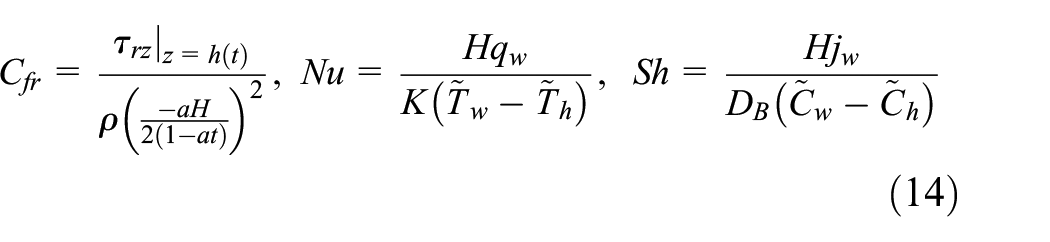
The skin friction coefficient and local Nusselt and Sherwood numbers are defined as
where

With the help of equation (8) we get


Solution procedure for HAM
For this problem, we use the HAM package BVPh2.0 and consider the methodology proposed by Liao.15,16,23 The initial guesses are



Linear operators are chosen as

Above operators satisfy the following linearity conditions


where
Error analysis and selection of optimal values of convergence-control parameters
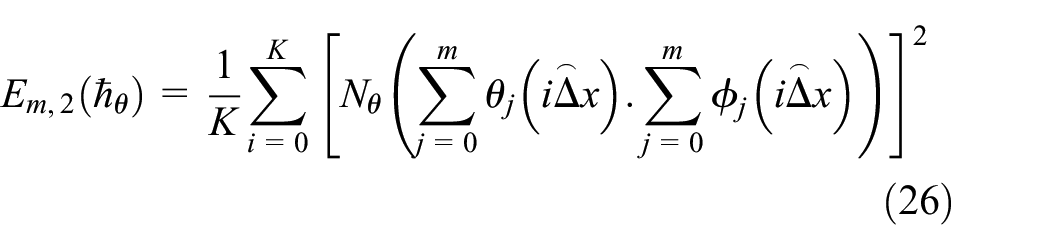
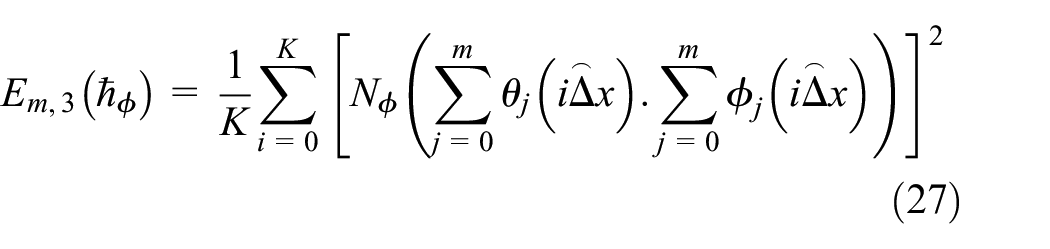
Convergence criterion for the series solutions is highly dependent on the involved parameters. Here, we define total error of the system for

where
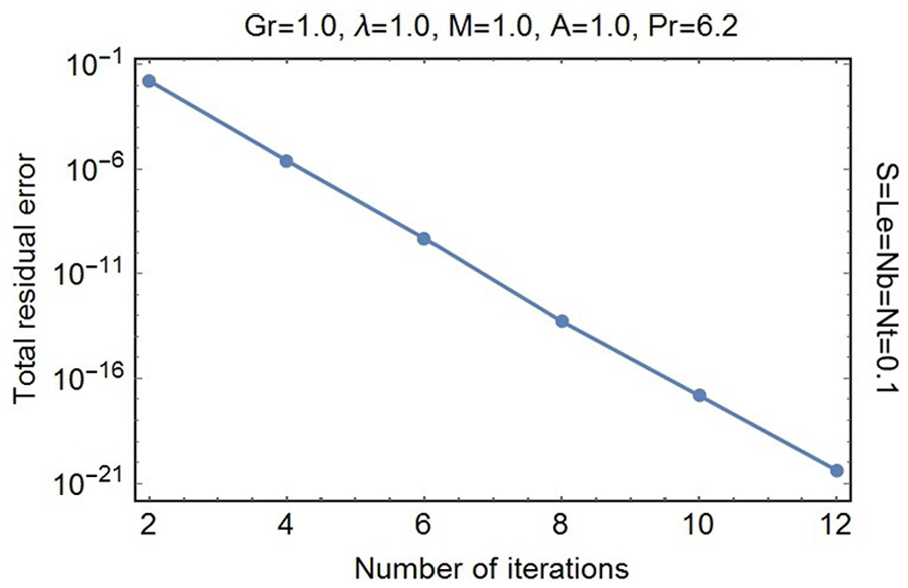
Total residual error versus order of approximations.
The optimal values of these auxiliary parameters for velocity, temperature, and concentration profiles corresponding to the different values of the parameters are given in Tables 1 and 2.
Optimal values of

Optimal values of

Results and discussion
This section is dedicated to highlight the variations in velocity, temperature, and concentration profiles under the effects of varying parameters involved. The effect of the squeezing parameter S on the velocity profile is discussed in Figure 3, where it can be seen that with an increase in squeeze number S the velocity profile
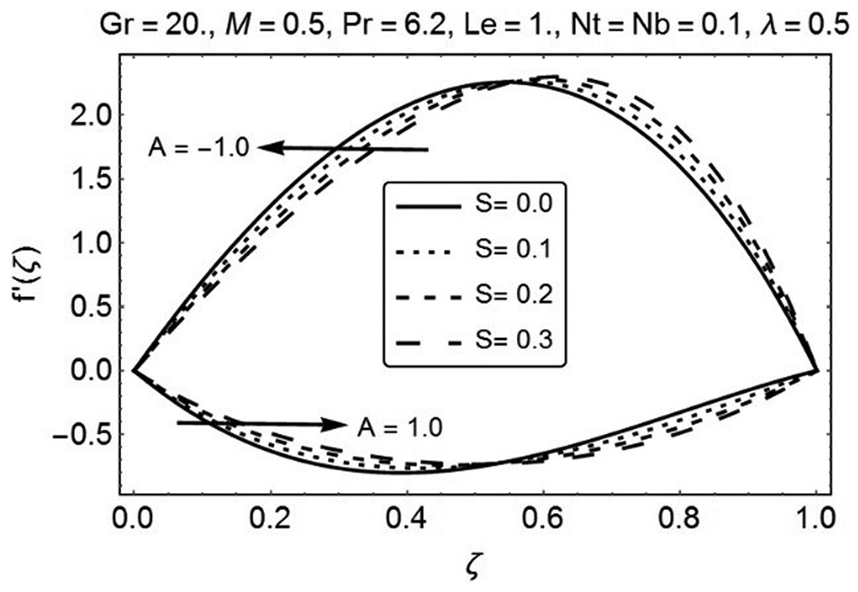
Influence of S on

Influence of M on
Behavior of velocity profile
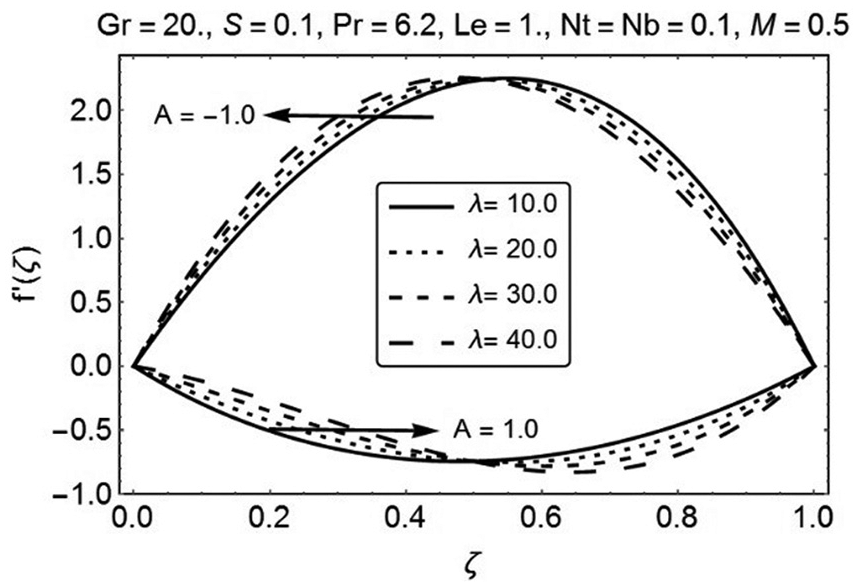
Influence of

Influence of Gr on
Effect of involved parameters on the temperature profile

Influence of S on

Influence of Nb on

Influence of Nt on

Influence of

Influence of Gr on
Physically, the mixed convection parameter depends on the buoyancy force. Therefore, the increase in the mixed convection parameter means an increase in the buoyancy force. An increase in the buoyancy force gives rise to the fluid flow by which the velocity increases and the temperature decreases.
Behavior of concentration profile

Influence of S on

Influence of Le on

Influence of Nb on

Influence of Nt on

Influence of

Influence of Gr on
Figure 13 demonstrates the influence of Lewis parameter Le. The effect of Lewis number is almost similar to the one shown by squeeze number, for both suction (A > 0) and blowing flows (A < 0).
The behavior of Brownian motion parameter Nb on the concentration profile
It is clear that on increasing the thermophoresis parameter Nt the concentration profile
Figure 16 reflects the behavior of mixed convection parameter
Same problem is solved numerically using RK-4. Comparison of analytical and numerical result is presented in Table 3. It can be seen that both numerical and analytical solutions are in outstanding agreement.
Comparison of HAM solution with RK-4.

HAM: homotopy analysis method.
Figures 18–20 show the variations in skin friction coefficient due to magnetic parameter M, mixed convection parameter

Influence of M and S on Cfr.

Influence of

Influence of Gr and S on Cfr.
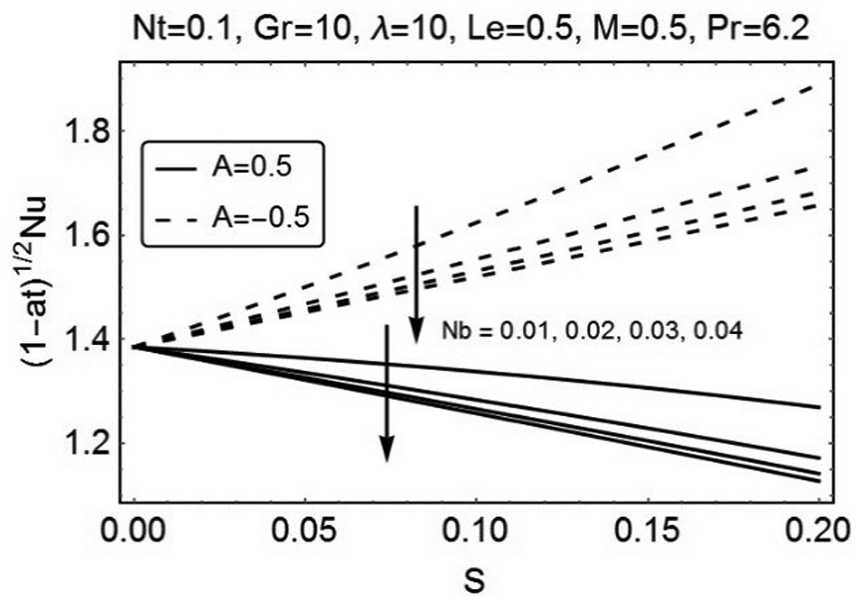
Influence of Nb and S on Nu.
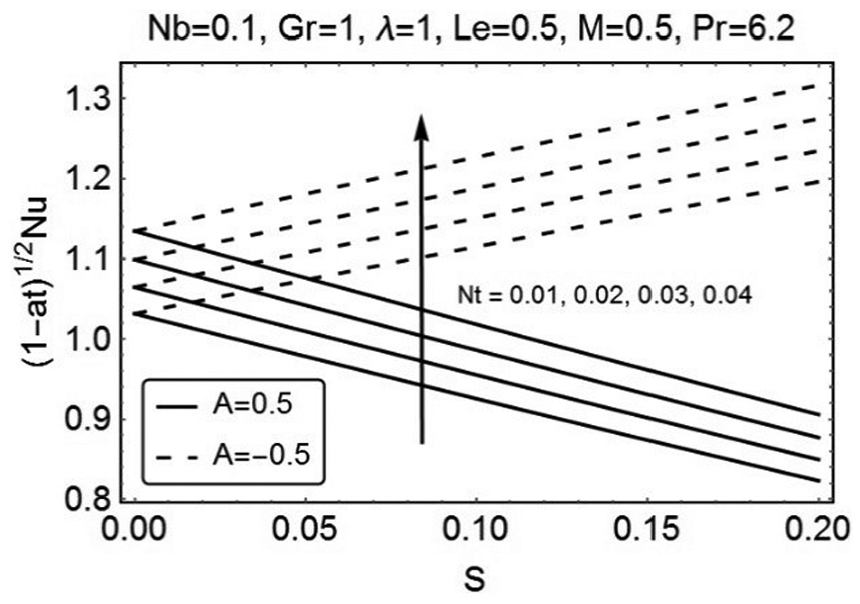
Influence of Nt and S on Nu.
Influence of

Influence of Gr and S on Nu.
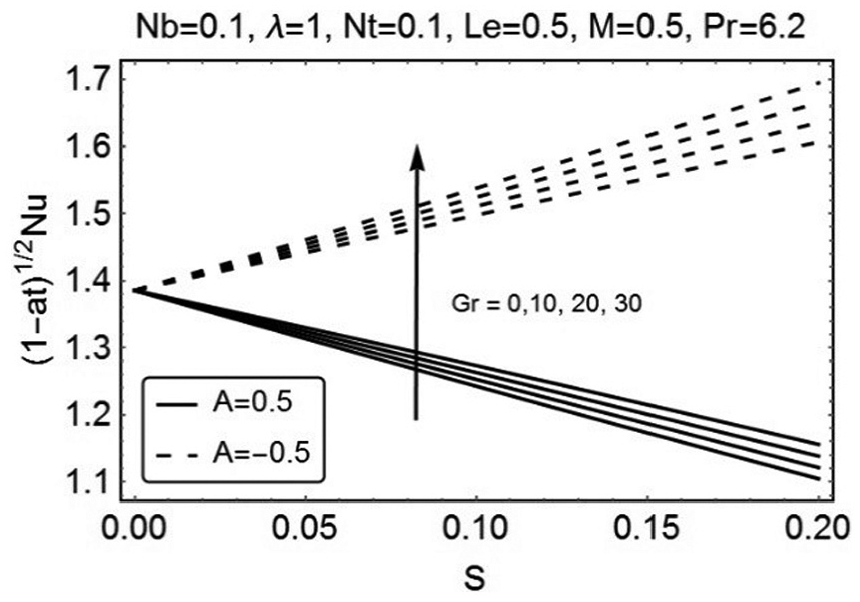
Figure 21 depicts the behavior of local Nusselt number following the changes in Brownian motion and squeeze numbers. Here, it is clear that for smaller values of Brownian motion Nb, the rate of heat transfer at the upper disk slightly decreases with increasing squeeze number. From Figure 22 it is clear that the inverse behavior is observed for the smaller values of thermophoresis parameter Nt. From Figure 23, one can easily see that the rate of heat transfer at upper disk slightly decreases for larger values of
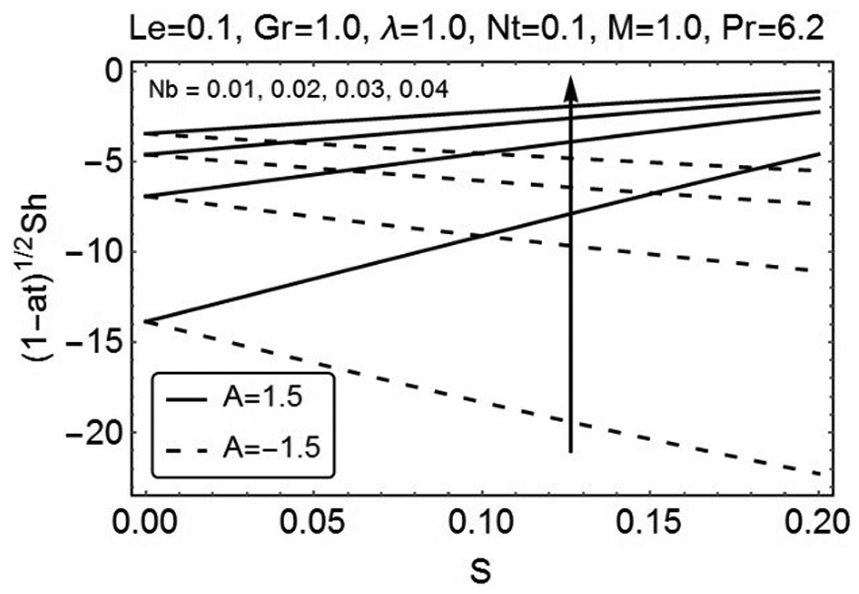
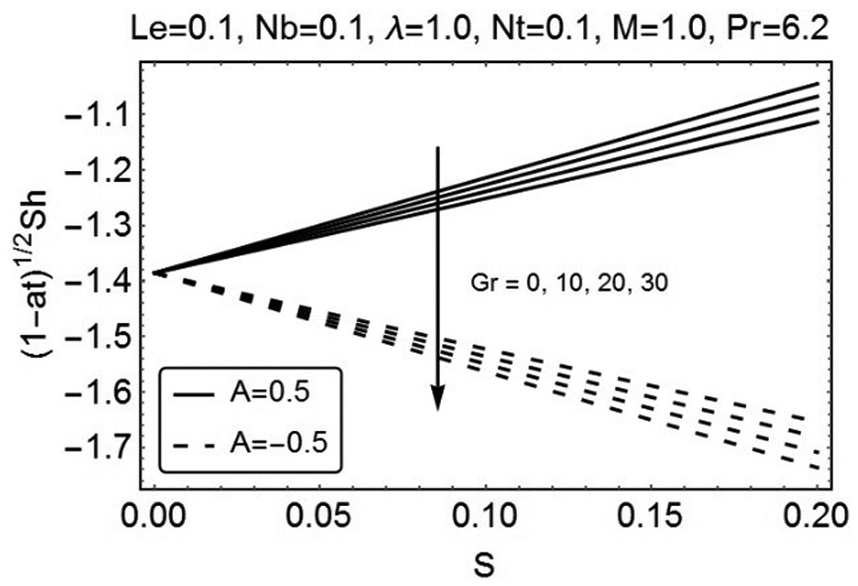
Effects of involved parameters on local Sherwood numbers are presented in Figures 25–29.

Influence of Le and S on Sh.
Influence of Nb on Sh.

Influence of Nt and S on Sh.

Influence of
Influence of Gr and S on Sh.
Figure 25 reflects the influence of Lewis number Le on local Sherwood number. Here, it is clear that the rate of mass transfer at upper disk slightly increases with smaller values of Le for the suction flow, while for the blowing case, it exhibits the inverse variations.
Figure 26 reflects the behavior of Brownian motion parameter Nb. One can easily observe that for smaller values of Nb the rate of mass transfer at upper disk increases rapidly. In Figure 27, this behavior is opposite for the smaller values of thermophoresis parameter Nt. From Figure 28, it can be seen that for larger values of
Conclusion
This article presents a study regarding mixed convection MHD squeezing flow of nanofluid between parallel disks. Base fluid of the channel is considered to be water. The modeled nonlinear differential equations are solved using HAM. An acceptable total error of the system is obtained only at the third order of approximation which shows the efficiency and reliability of the used technique. Effects of all emerging parameters on velocity, temperature, and concentration profiles are plotted with the help of graphical aid. Values of skin friction coefficient, local Nusselt number, and local Sherwood number are also explained graphically. A numerical solution is also obtained using RK-4 under the influence of involved physical parameters to compare the results obtained by HAM and an excellent agreement is observed between the solutions.
Following conclusions are drawn:
The effect of Gr and Nt is same on temperature profile for both suction (A > 0) and blowing cases (A < 0). A rise in temperature is observed. The effect of Nb and
For the suction flow, the concentration profile increases with increasing value of Le, while a fall is observed in concentration profile for increasing value of Le for injection case.
For both the suction and blowing flows, the concentration profile decreases with increasing value of S to thermophoresis parameter and Grashof number, while a rise is observed in concentration profile for increasing value of S to Brownian motion parameter and mixed convection parameter.
For increasing values of Hartmann number M, a rise is observed in skin friction coefficient for the suction flow (A > 0) and for blowing flow (A < 0), a fall is evident with rising M.
Footnotes
Acknowledgements
The authors are highly grateful to the unknown referees for their valuable comments. Author Saleh M Hassan is grateful to Deanship of Scientific Research, College of Sciences Research Center, King Saud University for the providing the required support to the project.
Academic Editor: Mohammad Mehdi Rashidi
Declaration of conflicting interests
The author(s) declared no potential conflicts of interest with respect to the research, authorship, and/or publication of this article.
Funding
The author(s) disclosed receipt of the following financial support for the research, authorship, and/or publication of this article: Author Maslina Darus is highly grateful for the provision Universiti Kebangsaan Malaysia for the provision of grant number: AP-2013-009.