




Abstract
Hybrid nanofluids outperform mono nanofluids in terms of heat transmission. They can be found in heat exchangers, the automobile industry, transformer cooling, and electronic cooling, in addition to solar collectors and military equipment. The primary goal of this study is to scrutinize the magnetohydrodynamic hybrids nanofluid (Copper-oxides and Titanium dioxide/water)
Introduction
Nanofluids are utilized to evolve the thermal conduction and heat transport rate of the main fluid. Base fluids include tri ethylene’s glycols, water, coolants, ethylene’s, lubricating oils and oil, thermoplastic remedies, and biological-fluids. Nanofluids have distinct properties such as homogeneity, highly thermal conduction at low nanoparticle accordion, long-term stability, and minimum obstructing flow paths. As a result, above mention liquids are found in a vast variety of electrical devices, like as micro-electro-mechanical circuits, microchip coolants, micro reactors, and electronic fluid flow projection systems. Nanofluid technologies include structure heating and cooling, heat transfer, conveyance, monitoring, microfluidics, lubrication systems, medicinal procedures, nano cryosurgery, electronic device freezing, cancer therapies, drug delivery, cryopreservation, and imaging. Choi and Eastman
1
postulated that we may produce new category of thermal transport liquid by floating metalized nanoparticles in standard heat transfer fluids. Alghamdi et al.
2
inspected the impact of MHD and thermal source or sink on the movement of hybrid fluid. Bilal et al.
3
are researching the use of thermal radiation to squeeze and dilate permeable walls, allowing a hybrid magnetohydrodynamic nanofluid (Carbon nanotubes and ferrous oxide/water) to flow into a vertical channel. Gul et al.
4
studied the movement of a hybrids nanofluids made up of copper & aluminum oxide molecules. Waini et al.
5
described the hybrid nanofluid, turbulent movement and heat transferal past a stretching or shrinking sheet. Huminic and Huminic
6
investigate the effects of nanofluids and hybrid nanofluids on the creation of volatility in various energy processes with valid boundary constraints and physical settings. Salman et al.
7
address recent breakthroughs in microscale-faced producing heat transfer enhancement in this study. In Nadeem et al.,
8
we investigated the hybrid nanofluid flow via a permeable exponentially stretching tube. The goal of this study, according to Yashkun et al.,
9
was to analyze the heat transport parameters of a magnetohydrodynamic hybrid nanofluid across a longitudinal stretching and shrinking surface in the absence of suction and radiation heat impacts. Jalili et al.,10-13 Talarposhti et al.,
14
Sheikholeslami et al.,
15
and Jalili et al.
16
list other studies in this field. The study focuses on the boundary layer movement of a hybrid nanofluid across a revolving cylinder in the appearance of oblique magnetism, according to Abbas et al.
17
and Aladdin et al.
18
described the properties of suction and magnetization on a revolving plate of hybrid nanofluid flow consisting of water as the main fluid, Aluminum Oxide as nanomaterials, and Copper (Cu) as nanoparticles. Alsaedi et al.
19
quantitatively estimated the flow of a hybrid nanofluid via two coaxially constructed cylinders. According to Acharya,
20
fins of various forms are employed in a range of industrial and technological applications, including semiconductor devices, steam turbines, electrical converters, vehicle radiators, heat transfer, and hydrogen fuel cells, air-cooled automobiles, and so on. Heat generation in high-temperature technological processes under the effect of radiation is a significant event in heat transferable. This phenomenon is momentous in heat transmission and thermal system design. Ashwinkumar et al.
21
investigated the upshot of nonlinear heat radiation on the two-dimensional magnetohydrodynamic flow of a hybrid nanofluid in two different configurations. The linear form is determined to be incorrect for the high-temperature disparity. In the modeled Rosseland estimate, a non-dimensional variable is utilized, and has no effect on the Prandtl number, according to Magyari and Pantokratoras.
22
Recently, nonlinear thermally radiative has been examined, and numerous hybrid nanofluid movements with varied geometries have been reported.23–27 The magneto-hydrodynamic flow with fluctuating fluid properties has piqued the interest of the scientific community. Technology, physical science, and chemical engineering all benefit from research on magnetization consequences. Contact between an electrical conductor fluid and a magnetization has an impact on a variety of technical systems, including magnetohydrodynamics (MHD) turbines, motors, exchanges, and flow separation processes. A great quantity of research on the unique fluid characteristics across numerous geometries with varying flow conditions has been published due to several applications in geophysics, magnetohydrodynamic power production, and so on. Safdar et al.
28
investigated theoretical and computational models for stable MHD Maxwell nanofluid flow along a porosity expanded sheet including gyrotactic organisms. Hussain et al.
29
detect entropy in a hybrid nanofluid flow governed by magnetohydrodynamics, variable viscosity, and coupled convection. The radiative and MHD micro-polar fluid movement on stretching or shrinking sheets of
By examining the laminar and steady flow of a hybrid nanofluid between two parallel permeable plates with a fluctuating magnetization, the continuing research closes a gap in the investigation. The subject at hand will be investigated for the initial period and has never been studied before. The most current study is a first for the field, to the best of the researcher’s knowledge. The impacts of suction or injection through the channel, as well as the effects of other significant elements on the velocity distribution, temperature distribution, Nusselt number, and skin friction, were also evaluated by the researcher.
Mathematical modeling
Hybrid nanofluid flow is considered through two parallel horizontally plates diverged by a distance of
Flow is considered through two horizontal parallel plates.
The effects of thermal radiation and suction/injection are taken under consideration.

Physical model.
Governing equations
The following are the continuity, momentum, magnetic field, and energy conservation calculations for the abovementioned hybrid nanofluids.47–49



Maxwell equations. 49


Where
Energy equation. 46

The radiative heat flux

Thermophysical properties
The hybrid nanofluid heat capacity is represented by
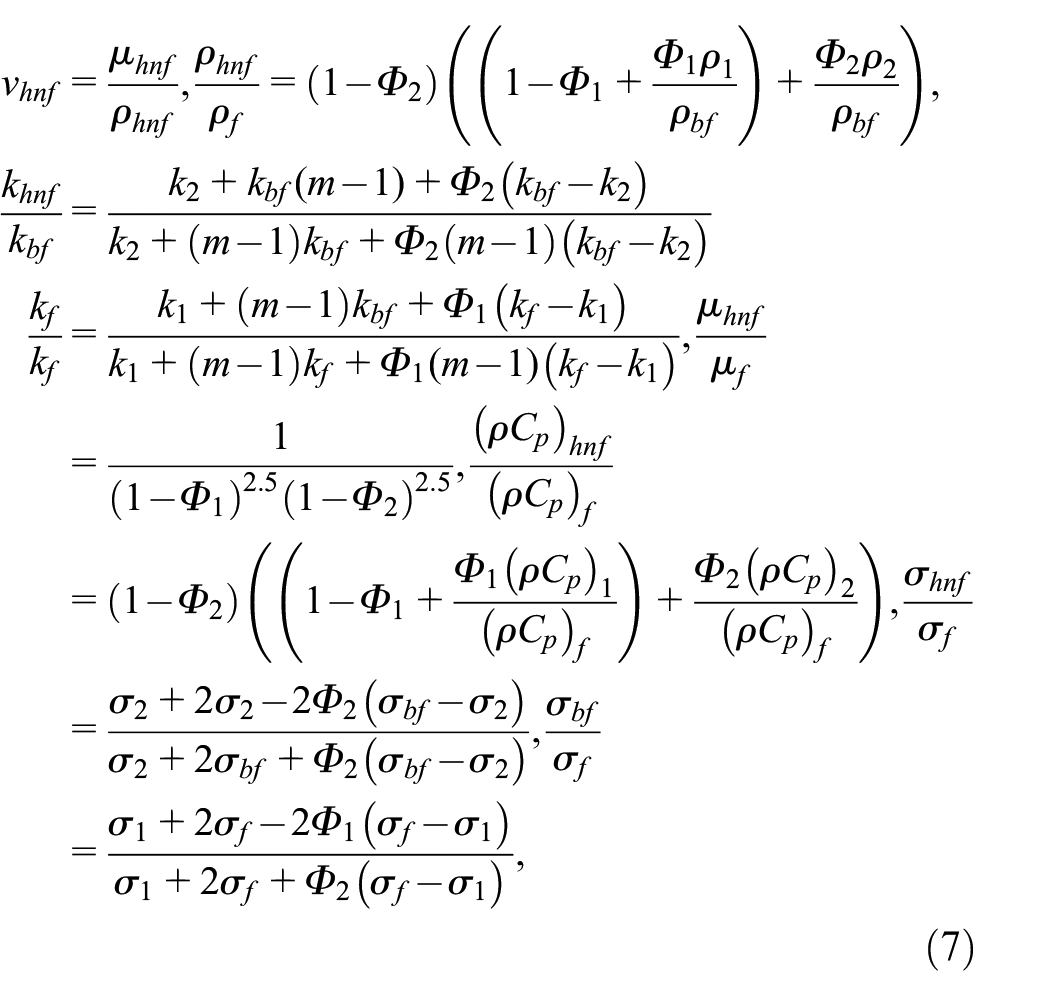
Thermos-physicals properties of base fluid and nano particles are given in Table 1. and

Boundary conditions
The boundary constrains are delineated as follows 48 :

The transformations of similarity listed below 46

Transformed set of equation
The resulting group of ordinary differential equations after the operation of factors of resemblance (9) into (2–6)


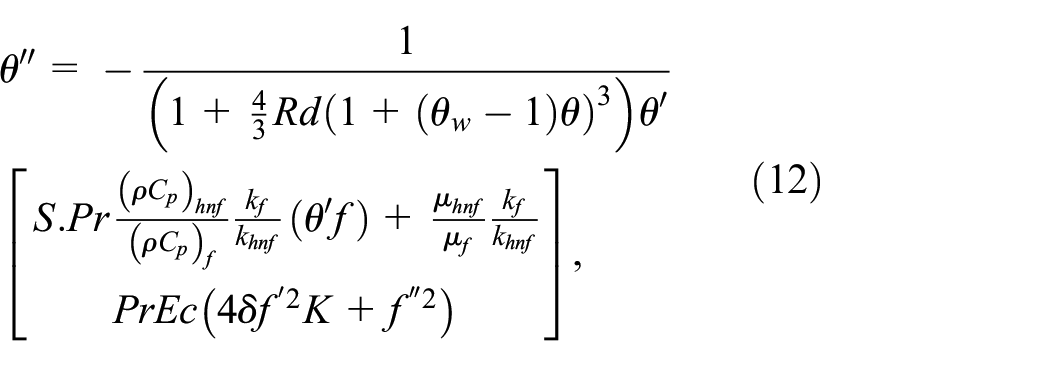
As well as the evaluate boundary conditions

Where the magnetic variable is signified by
Physical components
The Nusselt numbers and skin frictions factors are described below,


Numerical scheme
The arrangement of ordinary differential equations is not acutely sensitive to proper clarification to accomplish an appropriate explanation. The MATLAB computational software bvp4c function and shooting method are used to code the above-mentioned combined ODEs (10–12) and the corresponding boundary constraints (13) Bvp4c is essentially a Labotto-III collocation formula that is used to generate numerical results. Higher-order derivatives of the controlling equations have deviated into a first-order set of ODEs

Applying these translations into equations (10)–(12), we get


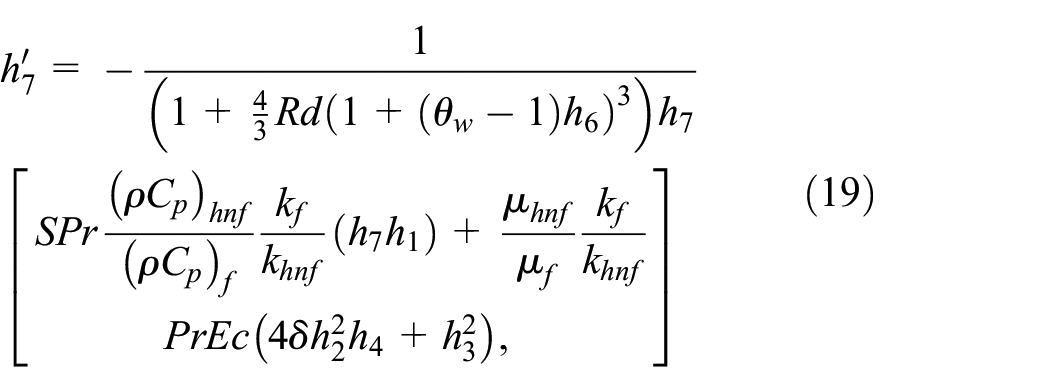
As well as the modified boundary constraints
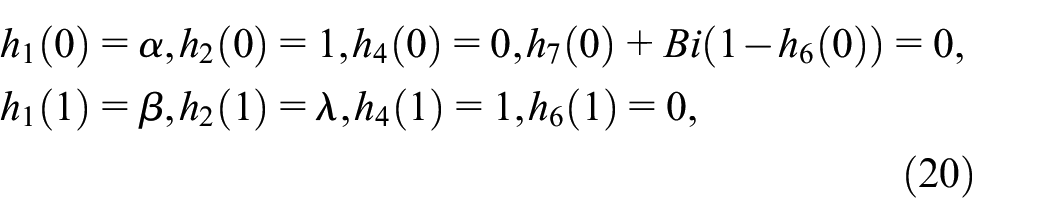
Mesh size and error tolerance are both 0.001 and
We produced ODEs in a q-component group by inserting factor q. We employ q-variable in equations (17)–(19) to generate ODEs in a q-variable group, and therefore



Differentiate by q outcomes in the following method in terms of factor-q values.
Differentiate equations (21)–(23) with respect to

Where coefficient of the matrix is denoted by
Cauchy Problem is

Vector functions are denoted by

With the help of numerical solution:
For the solution to the problem, a complete scheme was adopted.


Taking the appropriate factors,
Demarcated restrictions are commonly implemented for

Where
Response surface method (RSM)
The RSM is used to establish empirical relationships between a variety of input parameters and a variety of outputs. Given that it provides information on the least and most dominant input factors influencing the answers, it is a particularly excellent tool for evaluating multi-response and multi-variable processes. RSM was founded in 1951 by Box and Wilson, 54 and its main objective is response optimization. A collection of mathematical and statistical tools known as the Response Surface Methodology (RSM) can be used to model and analyze problems when a variety of variables affect the interest response. The goal is to make this answer better. The link between the responses and the independent factor in RSM problems is frequently ambiguous. Finding a good estimation for the best feasible connection between y and the group of independent variables is thus the first stage in RSM. In several regions of the independent factors, a moderate polynomial is widely used. If the answer can be precisely characterized by a linear function of the independent variables, then the first-order model is used as the approximation function. The response surface methodology was used to finally establish an empirical relationship between the convective heat transfer coefficient and optimization. To plot contour, sensitivity outcomes and tables, the response surface method is employed. 55
Coding for factors is used.
Sum of square is
The methodology is proposed to be meaningful by the simulation F-value of 3543.59. These values can be seen in Table 2. An F-value this strong might happen owing to interference only 0.01% of the time.
ANOVA for Local Nusselt number.

Simulation aspects are considered meaningful when the p-value is lower than 0.0500. A, B, C, AC, BC, A2, B, and C2 are essential structural components in this instance. Regression coefficients are not meaningful if the value is higher than 0.1000. Simulation minimization may enhance your concept if it has a lot of unnecessary phrases (except those needed to maintain hierarchy).
Table 3 is Boxes-Behnken’s Concept against the real and the coded values, represent the combination of the parameter of volume fraction of nano particles
Boxes-Behnken’s concept.

For the goodness of fit persistence, relay on several indicators is considered. For instance, the first one is the lack of ft which has a p-value
For three responses, three response surface equations are considered. For each model parameters A, B, and C are Nanoparticle volume fraction

In terms of model variables, sensitivity is usually calculated from the response function. Sensitivity analysis, as opposed to model vigor estimation, examines the unusual requirements provided by model output as assigned by input variables.

Results and discussions
The influence of precise emerging variables in the governing flow framework on the velocity concentration, temperature panel and magnetic distribution is evaluated through graphically and tabular form. The influence of different included components such as Prandtl number, magnetic Reynolds number
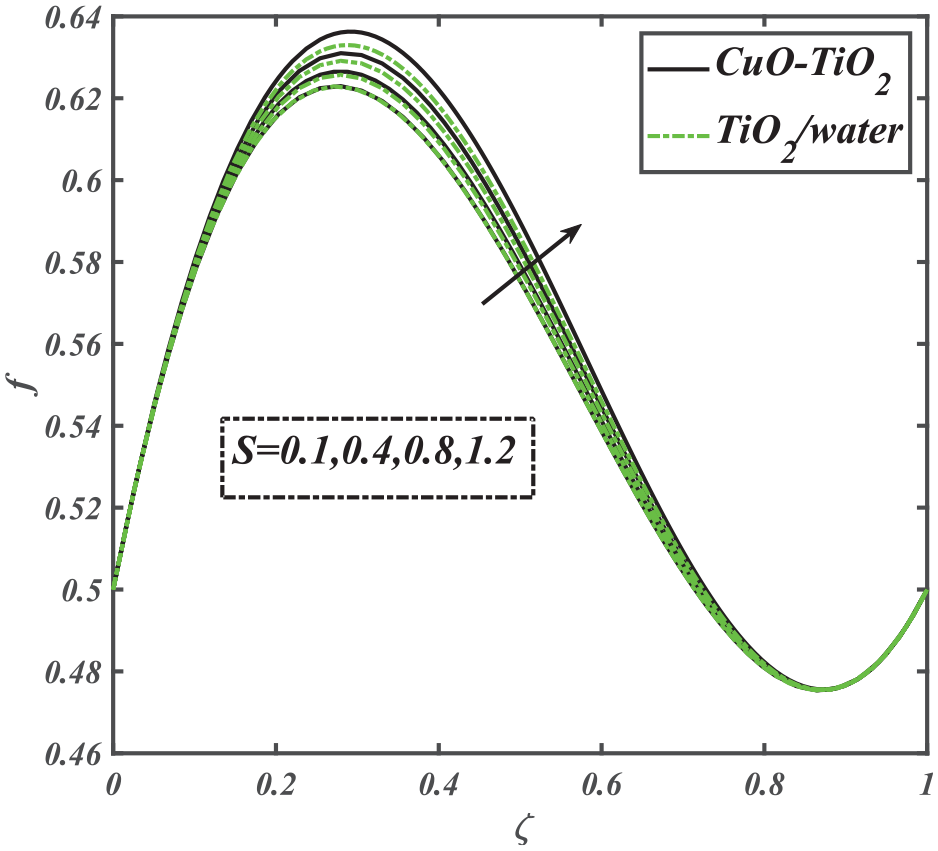
Upshot on velocity distribution

Upshot on velocity distributions

Upshot on velocity distribution

Upshot on velocity distributions

Upshot on velocity distribution

Upshot of
The impact of the squeezing factor

Upshot on the temperature profile

Upshot on the thermal profile

Upshot on the temperature profile

Upshot of radiation parameter

Upshot on the temperature profile
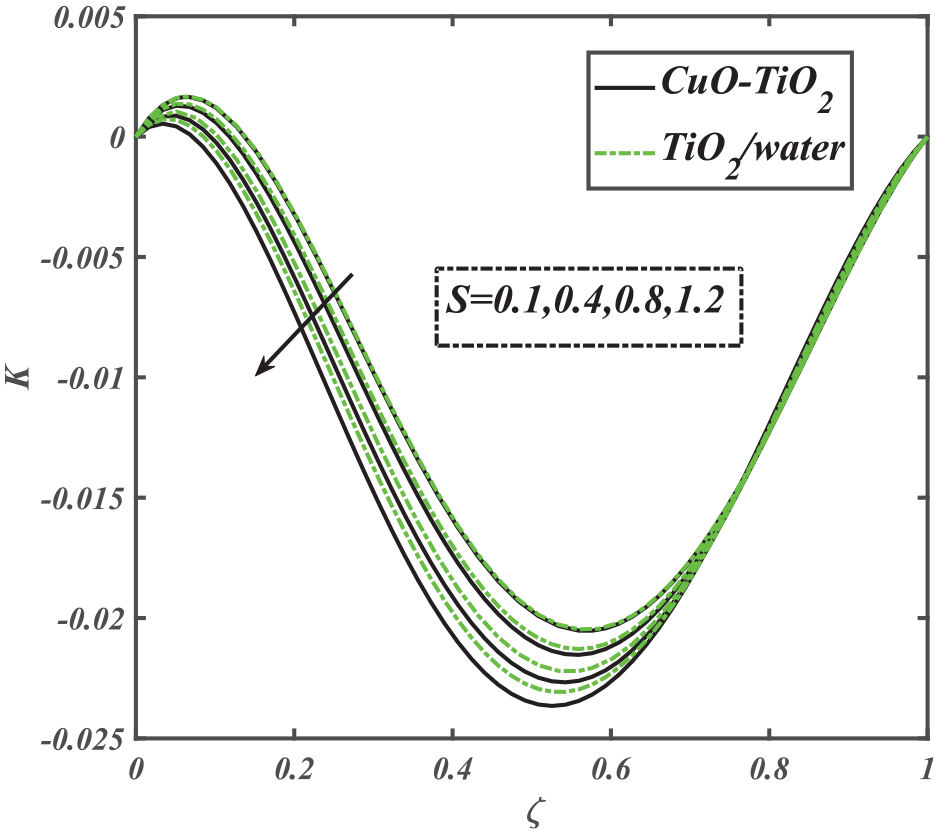
Upshot magnetic field profile
Figure 14 described the residual plots for squeezing flow. This figure describes the percentage of residual on normal probability, residual via fitted value on versus fits, frequency of residual on the histogram, and residual via observation order on versus order. Figure 15 Discussed the contour plot of response via thermal radiation parameter and volume fraction of nano particles. Figure 16 defines the Contour plot of response volume fraction and Biot number. Figure 17 depicted the contour plot of response via radiation parameter and Biot number. Figure 18 mentioned the 3-D surface plot between thermal radiation parameter and volume fraction parameter. Figure 19 represented the 3-D surface plot between radiation and volume fraction. Figure 20 highlighted the 3-D surface plot between Biot number and volume fraction.

Residual plots for squeezing flow.

Contour plot of Nu via thermal radiation and volume fraction.

Contour plot of Nu against nano particle volume fraction and Biot number.

Contour plot of Nu via radiation parameter
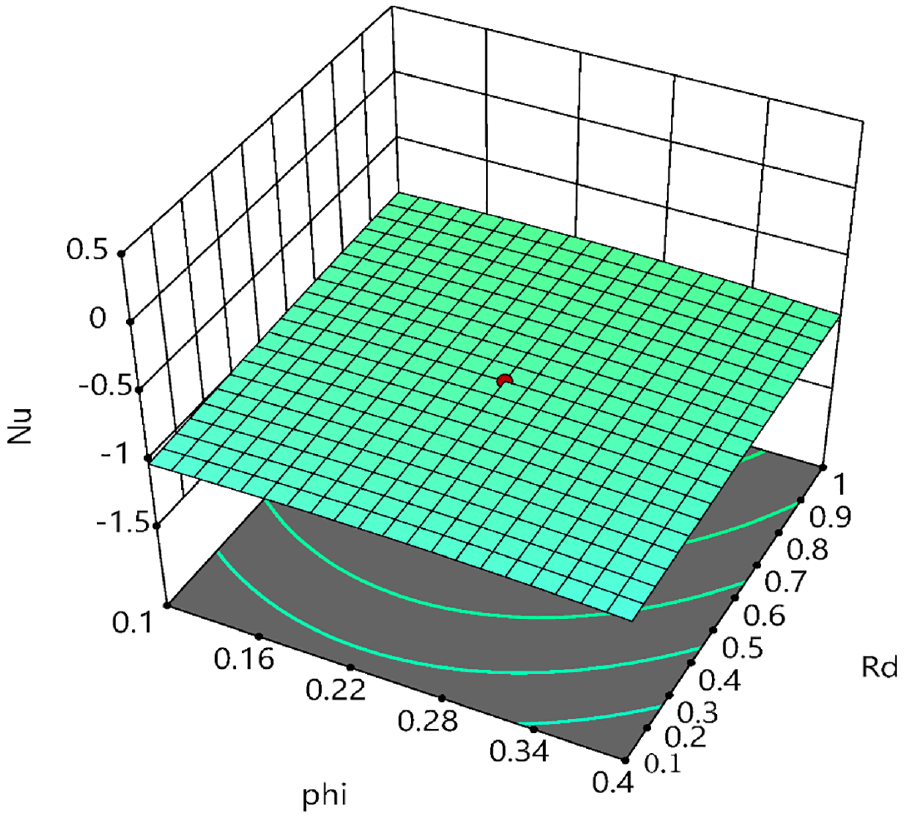
Surface plot Nu via

Surface plot Nu via radiation parameter and Biot number.

Surface plot Nu via volume fraction and Biot number.
Conclusion
A hybrid liquid flow between two plates is investigated in the existence of a magnetized factor. Utilizing resemblance modification, the suggested flow model’s controlling equations are turned into highly nonlinear structures of ordinary differential equations. For the flow model’s formulation, the simulation model bvp4c was operated. On the flow panel, thermal profile, and magnetic panel, the effects of several related factors are presented using various graphs and tables. The response surface method is employed to plot the sensitivity and contour graphs and tables. The key values of the current research are given following:
❖ Due to the improving value of nanoparticle volume fraction, the boundary layer’s consistency is diminished, and the velocity of fluids is raised.
❖ Due to rises outcomes of the Eckert number the temperature of fluids is boosted.
❖ The magnetic distribution of fluids is reduced by increment in the squeezing factor.
❖ Residual plots for squeezing flow, third surface plot via different parameters, and contour plots via various factors are also discussed.
❖ The insertion of nanoparticles into the base fluid significantly develops the velocity of the hybrid nanofluid and the rate of energy transfer.
Applications for hybrid nanofluid flow include petroleum engineering, geothermal engineering, automobile manufacturing, nuclear waste storage, thermal extrusion systems, heat exchangers, energy resources, ventilation, grain storage, and other industries. Because of their high thermal conductivity and low viscosity, hybrid nanofluids may have an impact on heat transfer systems.54,55
Footnotes
Appendix
Handling Editor: Chenhui Liang
Declaration of conflicting interests
The author(s) declared no potential conflicts of interest with respect to the research, authorship, and/or publication of this article.
Funding
The author(s) received no financial support for the research, authorship, and/or publication of this article.
