Study of Three dimensional Darcy–Forchheimer squeezing nanofluid flow with Cattaneo–Christov heat flux based on four different types of nanoparticles through entropy generation analysis
Open accessResearch articleFirst published online May, 2019
Study of Three dimensional Darcy–Forchheimer squeezing nanofluid flow with Cattaneo–Christov heat flux based on four different types of nanoparticles through entropy generation analysis
In this research article, the unsteady nanofluid flow between two horizontal plates is discussed. The main focus of this study is on the explanation of the relative study of water-based nanofluids with four different types of nanoparticles. The nanoparticles selected for this specific research article are copper oxide , aluminum oxide , copper , and silver . The upper plate is moving downward with time-dependent velocity while the lower plate is stretching horizontally. Also the lower plate is made up of porous medium. The stream in permeable region is characterized by Darcy–Forchheimer relation. Cattaneo–Christov heat flux model is used for heat transfer phenomena. Viscous dissipation effect is taken in account. Skin friction and Nusselt number are numerically calculated. Total entropy generation is also discussed for squeezing system. Transformation technique is applied to transform the model from partial differential equations to ordinary differential equations. Homotopy techniques are applied to solve the problem. The influence of important parameters on velocity, temperature, and entropy profiles have been shown graphically and discussed in detail.
The development of high energy storage technologies is basic goal of the researchers and engineers. It is due to very high demand of heating/cooling in industrial processes. It is an indispensable challenge for the researchers to enhance the heat transfer properties of traditional coolants like water, oil, and ethylene glycol which have low thermal conductivity. Due to such motivation, first attempt made by Cho in this direction is to pronounce the thermal conductivity of traditional liquids by adding nanosized metallic particles. The adding of nanosized metallic or any other particles in base fluid makes nanofluids. Nanofluids are essentially suspensions of very small solid particles of size 1 to 100 nm with base liquids, such as water, oil, and ethylene-glycol. These solid particles are called colloids or nanoparticles. The size of nanoparticles must be less than . Those nanofluids are more ideal, in which nanoparticles are smaller than . Both mineral oil and vegetable oil can be used as base fluids for making nanofluids.1 Commonly used nanoparticles are diamond, graphite, silver, copper, nickel, aluminum, carbon nanotubes, nitride, and metallic oxides . Thermal conductivity of the base fluid can be enhanced by adding the nanoparticles in the base fluid. Nanofluids have countless applications in technology, like in computer processer, heat exchangers, combustors, centrifugal and axial blades compressor, microelectronic boards circuit, fuel cells, refrigerators, hybrid-powered engines, gas turbines blades, and air conditioners. Khanafer et al.2 examined the Buoyancy-driven heat transfer flow by using nanoparticles. Extremely different features of nanofluids make them very proficient in various applications. Nanofluids are used in medicine manufacturing, hybrid powered engines, fuel cells, and microelectronics; nanofluids are vastly used in the field of nanotechnology. Nanoparticles have no dissolution properties in the base fluid. Experimental surveys3–7 disclose that pouring of metal powder or metallic oxides in the base fluid increases thermal conductivity, through which heat transfer rates increase. The basic concept of nanoparticles arises in the analysis of heat transfer. Nadeem and Lee8 presented the theory of nanofluid over an exponentially stretching sheet. Over stretching or shrinking surfaces Nadeem and colleagues8–11 examined the influences of nanoparticles for boundary layer flow.
Magnetohydrodynamics (MHD) is a branch of physics in which we study behavior of electrically conducted fluid under the magnetic field. Plasma, salt water solution, and molten metals are the examples of magnetofluids. Sun is also the example of MHD system. Hannes Alfven, who received the Nobel Prize in Physics in 1970, initiated the field of MHD for the first time. Hannes Alfven12 for the first time used the word magnetohydrodynamics in 1942. Recently, Shah et al.13–15 have discussed MHD nanofluids flow with rotating systems. Farady16 conducted an experiment in 1832 over Waterloo Bridge in London in which he studied the flow of salty water through River Thames under the earth’s magnetic field, which produces the potential difference between the two banks of the River Thames. Michael Faraday called this effect Magneto electric conduction. The current was too low to measure with equipment at that time.
The heat transfer properties in many industrial processes have extensive demands in batteries, nuclear reactors, and transportation and so many other applications. In such procedures, different thermophysical properties of different equipment in industries like thermal conductivity are mostly keeping constant. However, pragmatic circumstances claim changing characteristic from these properties. These thermophysical properties of materials change due to temperature smoothly in temperature range of 225 K to 480 K. The law of heat conduction is first time presented by Fourier.17 This Fourier law shows many behavior of heat transfer in many practical phenomena. This law about the heat transfer is “the time rate of the heat transfer through a material is proportional to the negative gradient in the temperature and to the cross sectional area through which the heat is flowing.” But this model was very early presented by Fourier, which is now not fulfilling the needs of modern technology, when any initial disorder is felt instantly through the whole body. Cattaneo modifies Fourier classical model to overcome this difficulty. He adds the term of thermal relaxation time in the original model, which permits the flow of heat through propagation of thermal waves with limited velocity.18 After the Cattaneo18 modification in the classical Fourier model, Christov improved the model presented by Cattaneo and further added the term of thermal relaxation time along the Oldroyd’s supper convicted derivatives, so that the material-invariant formulation may be achieved. For additional readings about production of entropy, see previous studies.20–37 Hayat et al.38,39 discovered entropy generation during nanomaterial flow in spinning coordinates. Nouri et al.40 explored entropy generation of nanofluid flow with spherical heat source. Dalir et al.41 talked about production of entropy in Jeffrey nanofluid flow over stretching surface. Straughan applied Cattaneo–Christov model to explore thermal convection in the flow of incompressible fluid. Cattaneo–Christov equations’ structural stability and uniqueness are deliberated by Ciarletta and Straughan.19 Haddad42 studied the impact of Cattaneo–Christov heat flux for the thermal instability in Brinkman porous medium. Uniqueness of Cattaneo–Christov heat of fluid with constant density is considered by Tibullo and Zampoli.43 Mustafa et al.44 studded rotating flow of magnetite-water nanofluid over stretching sheet with non-linear thermal radiation. Cattaneo–Christov heat flux impact in Jeffrey fluid flow with homogeneous-heterogeneous reactions is studied by Hayat et al.45 Liu et al.46 considered anomalous convection diffusion and wave coupling transport of cells on comb frame with fractional Cattaneo–Christov heat flux. MHD flow of Cattaneo–Christov heat flux for flow of Williamson fluid over stretching surface having variable thickness is analyzed by Salahuddin et al.47 Liu et al.48 studied fractional anomalous diffusion with Cattaneo–Christov flux effects in a comb-like structure. Hayat et al.49 explained the impact of Cattaneo–Christov heat flux in the flow over surface having variable thickness. Hayat et al.50 also employed Cattaneo–Christov heat flux in MHD flow of Oldroyd-B fluid over a stretching surface with homogeneous–heterogeneous reactions. Analytical solution for flow of an Oldroyd-B fluid in the presence of Cattaneo–Christov heat flux is developed by Abbasi et al.51 Maxwell fluid over exponentially stretching surface is calculated numerically by Khan et al.52 Hayat et al.53 examined three-dimensional flow of Jeffrey liquid subject to Cattaneo–Christov heat flux.
Literature of the fluid specifies that most of searches are carried out via constant physical fluid properties like fluid viscosity, surface tension, and thermal conductivity. However, variation in physical properties occurs significantly due to temperature difference. Water viscosity decreases up to 240% with the change of temperature from 284.15 K to 323.15 K.54 The flow and heat transfer over a stretching surface has important applications in the polymer industry. For instance, a number of technical processes concerning polymers involve the cooling of continuous strips (or filaments) extruded from a die by drawing them through a quiescent fluid with a controlled cooling system and in the process of drawing these strips they are sometimes stretched. In these cases, the final product of desired characteristics depends on the rate of cooling in the process and the process of stretching. During the manufacturing of these sheets, the mixture which is issued from a slit is subsequently stretched to achieve the desired thickness. Finally, this sheet solidifies while it passes through effectively controlled cooling system in order to acquire the top-grade final product. Apparently, the quality of such a sheet is definitely influenced by heat and mass transfer between the sheet and the fluid. During its manufacturing process, a stretched sheet interacts with the ambient fluid both thermally and mechanically.55 T. Hayat et al.56 analyze the mixed convection flow of MHD water-based nanofluids containing silver and copper as nanoparticles. From the literature, we observed that researchers have studied the fluids which have low electrical conductivity give more skin friction and drag force during nanofluid flow. The skin friction or drag forces of the nanofluids are reduced by applying electric field externally on such fluids.57 T. Hayat et al.58 studded the MHD entropy generation due to rotating plate in presence of viscous dissipation and Joule heating. Flow due to stretched surface has many industrial and engineering applications for Condensation process, polymer extrusion, drawing of copper wires, die forging and extrusion of polymer, paper production and fiber production are the real life or industrial applications of stretching sheet.59 Entropy generation minimization (EGM) is very beneficial in many systems like microchannel, reactors, curved pipes, fuel cells, gas turbines, chillers, chemical and electrochemical, natural convection, evaporative cooling, solar thermal, regular, air separators, and functionally graded materials.60,61
The aim of our current investigation is to analyze the Cattaneo–Christov heat flux in three-dimensional micropolar nanofluid between parallel, squeezing, porous, and horizontal plates with rotating system. Entropy generation is also discussed in the current investigation. An analytical approach is adopted to tackle the modeled nonlinear coupled equations by using homotopy analysis method (HAM).62–68 The embedding parameters and its impacts are studied graphically.
Problem formulation
We assume the unsteady flow of incompressible viscous fluid between two parallel plates. The nanofluid which is flowing between the two parallel plates may be composed of nanopowder of any one of aluminum oxide , copper oxide , silver , copper and Water as a base fluid. The upper plate is squeezing down with time-dependent velocity , where time-dependent height between two parallel plates. is the viscosity of the nanofluid, and b shows time parameter with dimension per unit time or (time)−1 and . The lower plate is stretched with two forces equal in magnitude but opposite in direction and is applied in such a manner that the origin of the plates does not translate. The elongating velocity of the lower plate is of the form , where a is the stretching perimeter. The whole system is rotating with the angular velocity . Cattaneo–Christov model is taken as heat flux. shows the temperature of the lower plate while represents the temperature of the upper plate and it is assumed that .
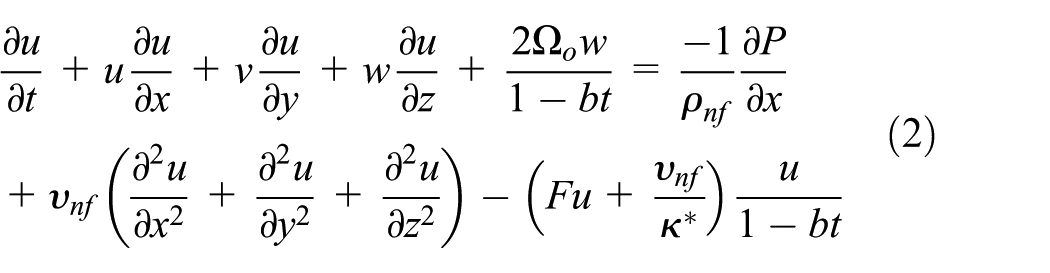
The continuity equation and governing equations of the problem are
The boundary conditions of the modeled problem are of the form
Here are the components of velocity along -axis, respectively. shows absorption coefficient or porosity of the medium, describes viscosity of the nanofluids, defines density of the nanofluids, defines thermal conductivity of the nanofluids, illustrates specific heat capacity of the nanofluids, define the angular velocity, is the relaxation time of heat flux, illustrates the non-uniform inertia coefficient. The boundary conditions explains that the velocity component of the nanofluids along x-axis at is equal to the stretching velocity of the lower plate, that is while shows that there is a suction at the lower plate or at . Temperature of the lower plate is . Velocity of the fluid along x-axis at the upper plate becomes extinct and shows that velocity of the nanofluid along y-axis which is equal to the squeezing velocity of the upper plate. Here the negative sign indicates that the upper plate is moving toward decreasing of y-axis. Temperature of the upper plate is .
According to Xue Model, ratios of different physical characteristics of the base fluid to nanoparticles are
where represents the nanoparticles fraction by volume in the base fluid. Assume that the total volume portion of the nanofluids is 1. Then it is obvious that will be the volume portion of the base fluid. represents the dynamic viscosity of the base fluid (water). is the base fluid density, is the thermal conductivity of the base fluid, is the electric conductivity of the base fluid, and is the specific heat capacity of the base fluid. The subscript indicates solid nanoparticles, f indicates base fluid, and nf indicates the nanofluid and the corresponding symbols indicate the identical terminologies.
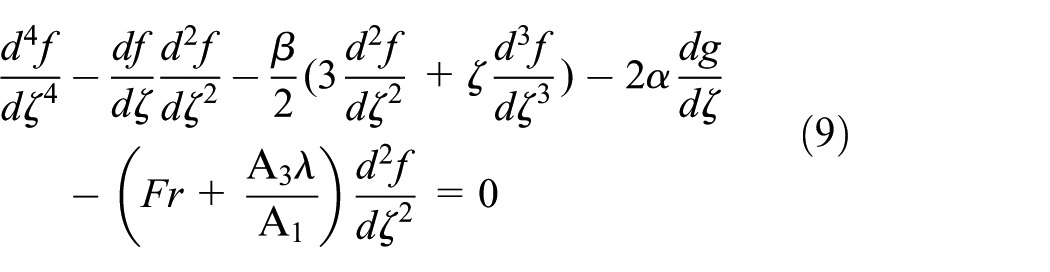
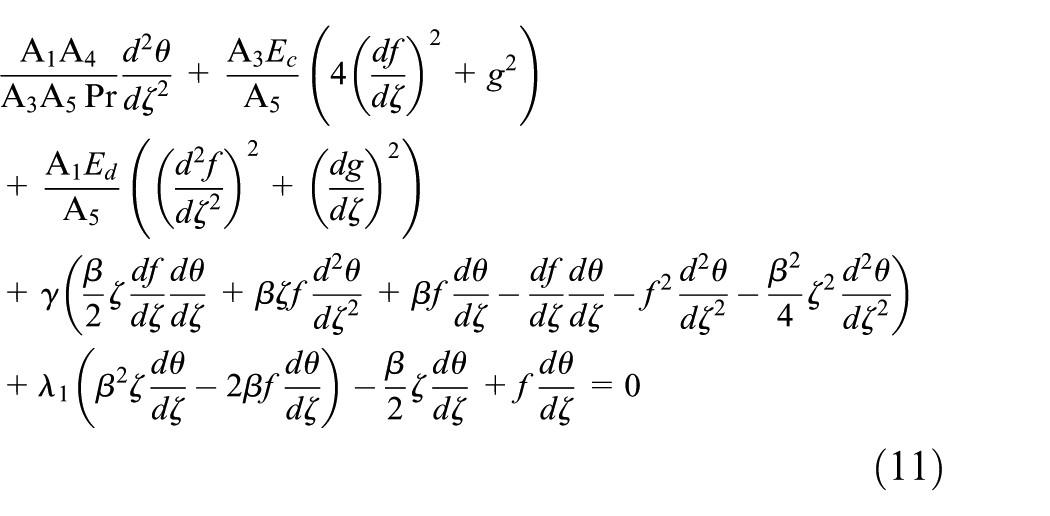
Different constant terms in equations (9)–(11) are expressed as under
Here, describes the ratio of densities between nanofluids and base fluid, describes the ratio of electric conductivities between nanofluids and base fluid, describes ratio of dynamic viscosities between nanofluids and base fluid, describes the ratio of thermal conductivities between nanofluids and base fluid, describes the ratio of specific heat capacities between nanofluids and base fluid, illustrates the rotation parameter, illustrates the squeezing parameter, illustrates the thermal relaxation parameter, defines the suction parameter, demonstrates the porosity parameter, demonstrates the relaxation time, Fr shows the inertia coefficient, shows the Prandtl number, Tr denotes the thermal radiation, and and are local Eckert number and Eckert number, respectively.
The skin friction coefficient of the nanofluids is defined as
where define the wall share stress and is defined as
Heat flows through conduction in solids, while in liquids through convection. Nusselt number is a dimensional number. Nusselt number gives an idea that how heat flowing rate in convection is related to the heat rate flowing in fluids. Nusselt number for the modeled problem takes the form
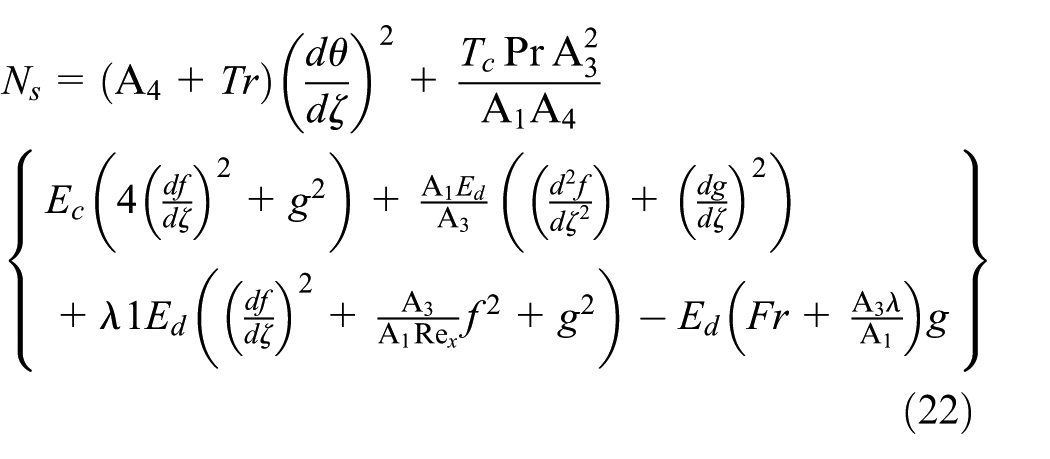
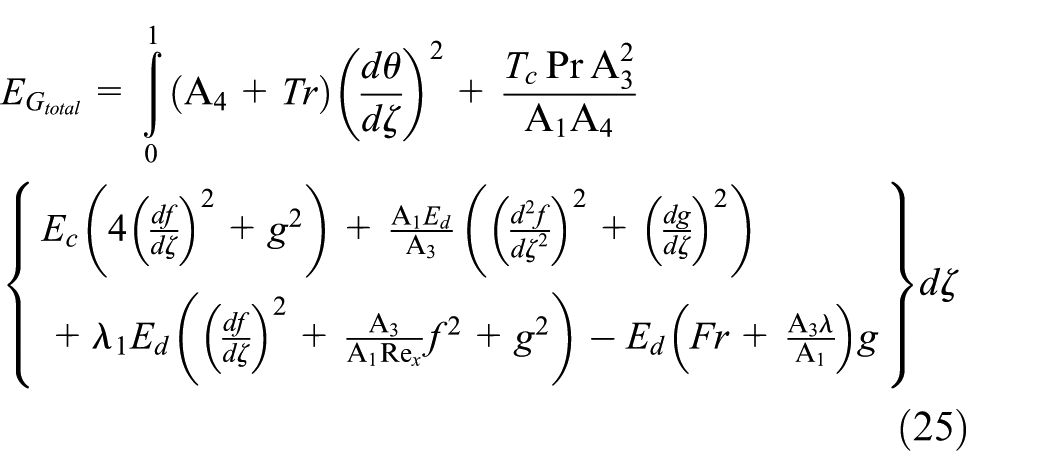
The component form of the dimensionless entropy generation rate can be written as
The entire volumetric entropy production is given by
or
Bejan number
The comparison between rate of entropy generation for heat transfer and the entire entropy production is called as Bejan number. The Bejan number is defined as
Bejan number is a dimensional number and If , It means that dominates. If , It shows that entropy generates due to roughness among nanoparticles and also with the wall/plates, joule heating and sponginess dominate. If , then both heat transfer entropy generation and entire entropy generation are balanced.
Solution by HAM
We implemented HAM to tackle our model equations. HAM is a semi-analytical method to solve the non-linear ordinary differential equations (ODEs)/partial differential equations (PDEs). Basically, the concept of HAM is derived from topology, in which we create a series which gradually converges to the solution of the nonlinear system of ODEs/PDEs. HAM was first introduced by Liao Shijun during his PhD work in 1992.48–51 Later, he modified this method for a nonzero auxiliary parameter . This is non-physical parameter, which provides a simple way to enforce the convergence of the series solution of system of non-linear ODEs/PDEs. The solutions of equations (9)–(11), according to boundary conditions in equation (12), are calculated by HAM. The initial estimates for the equations (9)–(11) are assumed as
The linear operators are defined as
The initial solution is of the form
Here where are arbitrary constants.
The 0th order deformation form with boundary conditions are
The substantial nonlinear operators are planned as
When varies from then expanding with boundary conditions
At we obtain
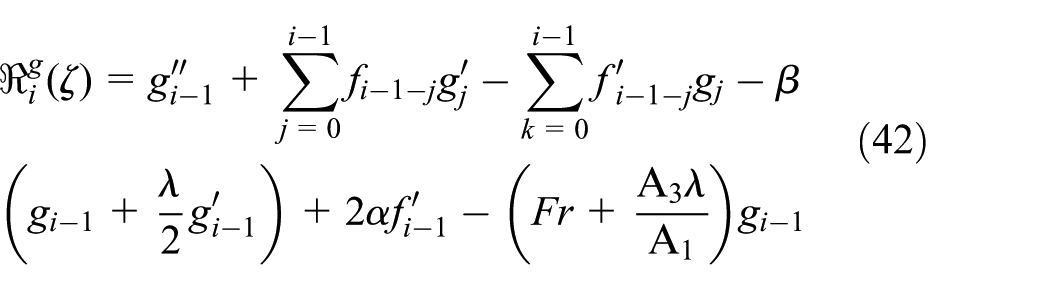
Differentiating 0th order equations, the order deformation equations with boundary conditions are
Here
where
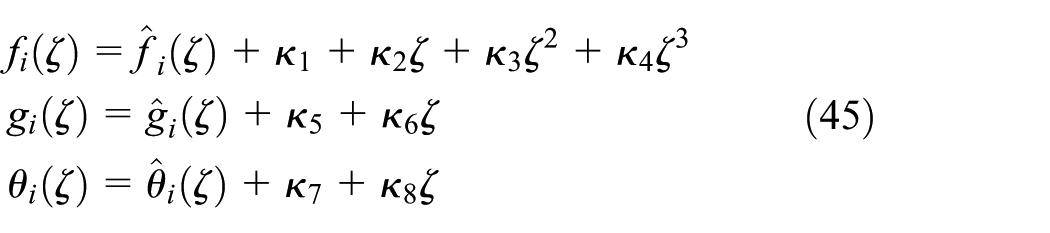
The complete homotopic solutions in general form are indicated as under
Here are the particular solutions of the equations.
Analysis
In this article, we are interested to examine the analytical results of the modeled system of PDEs. The transformed PDEs are numerically solved by HAM. The velocity components , temperature , entropy generation , and Bejan number for nanofluids Al2O3-H2O, CuO-H2O, Cu-H2O, and Ag-H2O are discussed by using different physical parameters. More consideration is given to the squeezing parameter , Hartmann number , porosity parameter , thermal radiation parameter , suction parameter , Prandtl number , and Eckert numbers .
Results and discussion
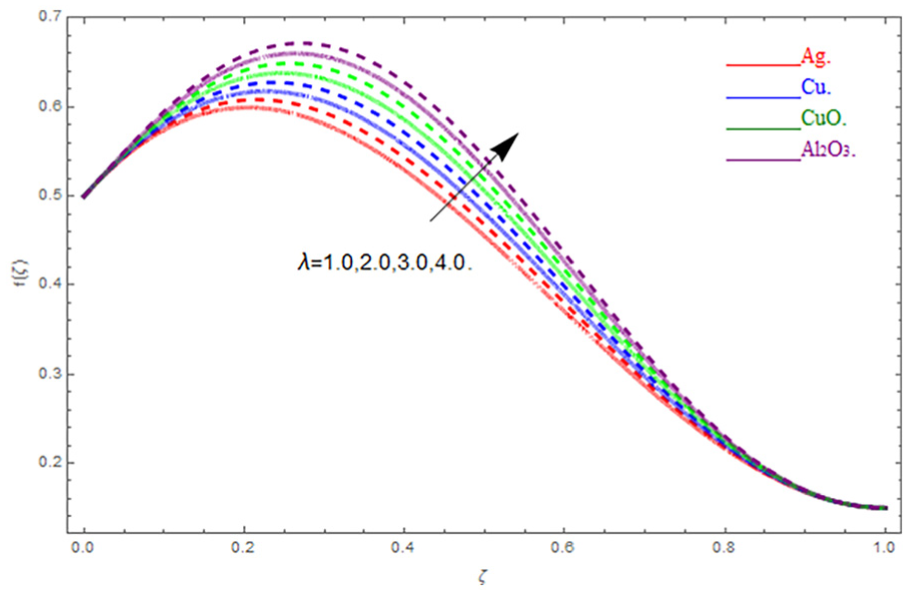
The key motivation here is to explain the important features of different physical parameters on the velocity of the nanofluid and temperature dispersals in nanofluid. The impact of various physical parameters like porosity , suction δ, squeezing , Hartmann number , thermal radiation , Prandtl number , Eckert numbers , and four different nanoparticles water-based fluid over velocity profile are discussed graphically in Figures 2–9. The physical geometry of the modeled problem is shown in Figure 1. The variation in velocity profile of the nanofluid due to four different kinds of nanosized particles (Al2O3, CuO, Cu, and Ag) is discussed graphically in Figures 2–9. In Figures 2 and 3, the velocity components are sketched under the influence of nanoparticles volume fraction . When the nanoparticles volume fraction increases, the velocity components also increases. In Figures 4 and 5, the velocity components are discussed under the influence of porosity . The increase in porosity increases the velocity component . While the porosity parameter increases, the velocity component decreases in the region and increases in the region . The velocity disturbance by squeezing of the plate is discussed graphically in the Figures 6 and 7. When the squeezing parameter increases, the velocity components (, ) increase. Because of squeezing, low space between plates goes to high speed of the nanofluid. In Figures 8 and 9, the velocity components under the influence of inertia coefficient are displayed. We clearly notice in Figure 8 that the increase in inertia coefficient increases the velocity component . But in Figure 9, we realize that the increase in inertia coefficient increases the velocity component in the region and decreases in the region .
Physical sketch of the flow.
Influence of on , when .
Impact of on , when .
Impact of on , when .
Impact of on , when .
Impact of on , when .
Impact of on , when .
Impact of Fr on , when .
Impact of Fr on , when .
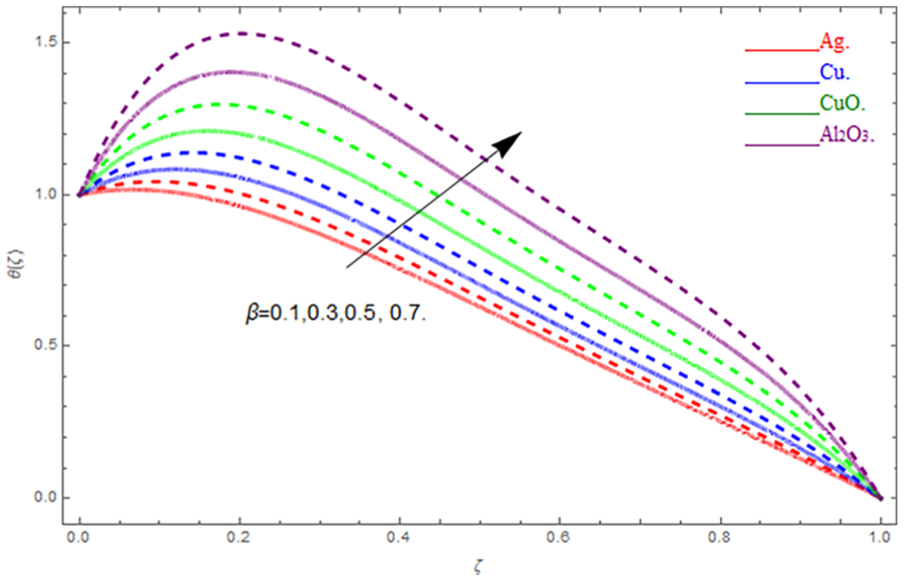
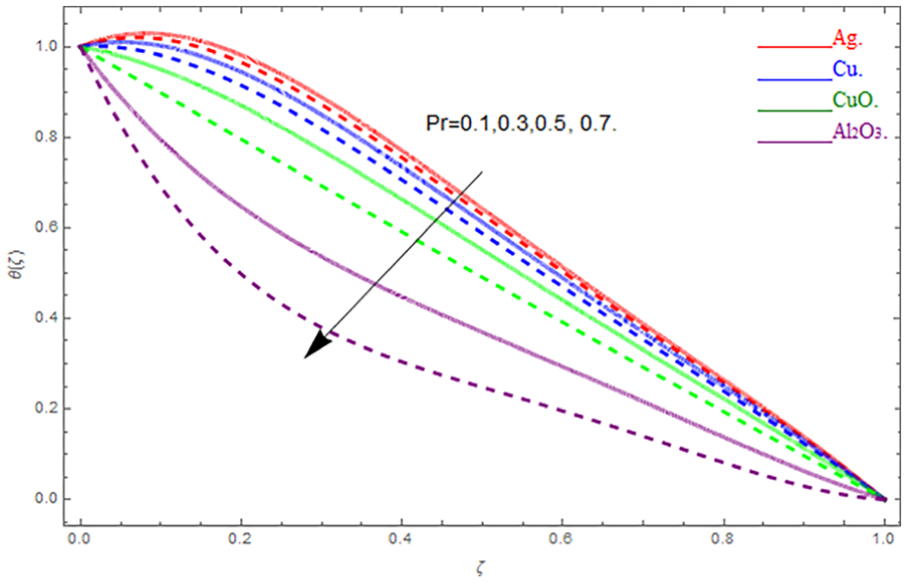
The behaviors of the Prandtl number , Eckert numbers , squeezing parameter , nanoparticles volume fraction , and four different kinds of Nanopowder water-based fluid on temperature profile are portrayed in Figures 10–14. The impact of four different kinds of nanoparticles with water as a base fluid (Ag−H2O, Cu−H2O, CuO−H2O, Al2O3− H2O) on temperature variation is demonstrated in Figure 10. From here, we observe that temperature is predominant for Ag−H2O, Cu−H2O, CuO−H2O, and Al2O3−H2O nanoliquids. Effect of on is shown in Figure 11. Here the temperature profile is increasing function of . It is obvious from the figure that the increase in increases the temperature profile . Figure 12 describes the impact of Eckert numbers on temperature profile . We observed that temperature field increases with larger values of Eckert numbers.
Impact of on , when .
Influence of Ec over , when .
Influence of Ed on , when .
Influence of on , when .
Influence of on , when .
Figure 13 surveyed the impact of squeezing parameter on temperature profile . Clearly, we observed that the temperature rise quickly with the increase in squeezing parameter. Larger squeezing parameter means that upper plate moves downward; hence, interatomic collision of the nanopowder increases due to small space available between the plates and the particles of the nanofluid. When the collisions among atoms of the nanofluid enhance, temperature of the nanofluid enhances. Figure 14 shows the effect of Prandtl number on temperature profile . Here, we examined that temperature field decreases via Prandtl number . Larger values of Prandtl number links to lower heat conductivity; hence, temperature profile is decreased.
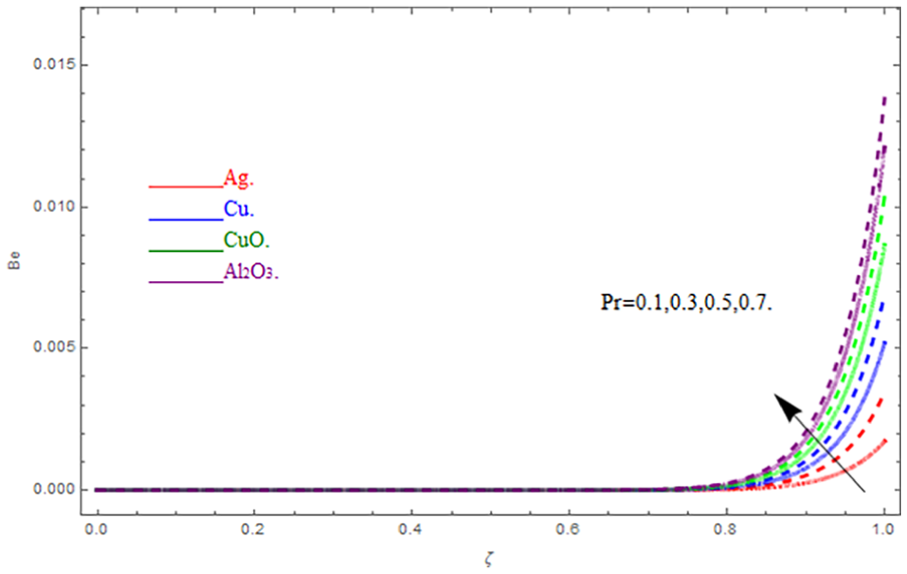
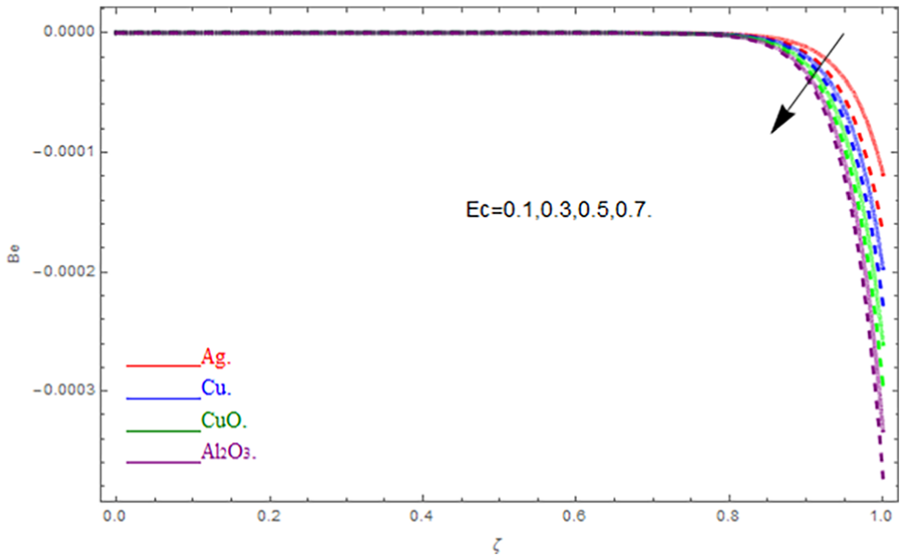
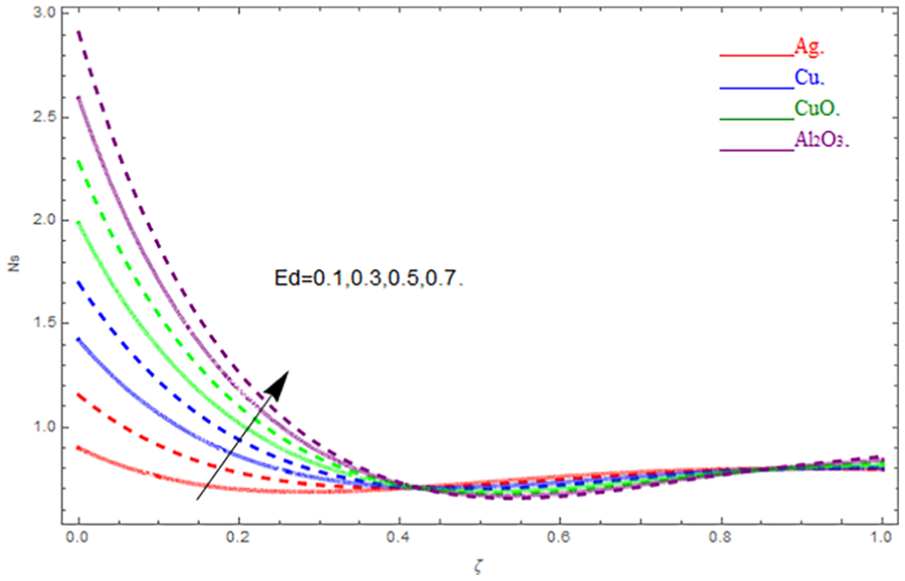
Impacts of different physical parameters like Prandtl number , Eckert numbers , porosity parameter , nanoparticle volume fraction and four kinds of nanoparticles water-base fluids over total entropy production and Bejan number Be are illustrated graphically in Figures 15–24. Figure 15 shows the influence of nanoparticles volume friction on total entropy generation . We see clearly that total entropy generation enhanced in the region with the enhancement in nanoparticles volume friction , but the entropy generation has a very minute change in the region . Figure 16 illustrates the influence of nanoparticles volume friction on Bejan number. Here, we clearly identify that the Bejan number increases with the large values of nanoparticles volume fraction.
Influence of on Ns, when .
Influence of on Be, when .
Influence of on Ns, when .
Influence of on Be, when .
Influence of on Ns, when .
Influence of on Be, when .
Influence of Ec on Ns, when .
Influence of Ec on Be, when
Influence of Ed on Ns, when .
Influence of Ed on Be, when .
Figure 17 illustrates graphically the influence of Prandtl number on the total entropy generation . From here, we see clearly that total entropy generation boost very quickly with the enhancement in Prandtl number . Figure 18 illustrates graphically the influence of Prandtl number over the Bejan number Be. From here, we see clearly the Bejan number enhanced with the enhancement in Prandtl number. Figure 19 shows graphically the effect of porosity of the plates on total entropy generation . In Figure 19, we see that total entropy generation little bit increases with increase of porosity of the plates. Figure 20 displays graphically the behavior of Bejan number Be via porosity of the plates. From Figure 20, we observe that Bejan number Be increases with the increase in Porosity of the plates. Figure 21 displays the behavior of total entropy generation via Eckert number . In this figure, we see clearly that total entropy generation increases with the higher values of Eckert number . Figure 22 illustrates the behavior of Bejan number Be via Eckert number . Here, Bejan number Be slightly falls with the increase in Eckert number . Figure 23 demonstrates the total entropy generation by the variation of Eckert number . From here, we observe clearly that entropy generation boosts rapidly with the enhancement of Eckert number . Figure 24 explains graphically the impact of Eckert number over Bejan number Be. In Figure 24, we see clearly that Bejan number Be falls with the higher parameter of Eckert number .
In Table 1, some physical properties of nanofluid are shown. Table 2 represents the impact of embedded parameters on skin friction coefficient. We see that as increases, skin friction decreases very rapidly keeping the other parameters and fixed. Skin friction decreases via increasing inertia coefficient Fr. We see from the table that with the increase in , the skin friction has a very little disturbance. Skin friction increases with increase in nanoparticles volume friction. The rotation parameter has a very tiny effect on skin friction mean decrease with very tiny difference. Table 3 represents the impact of embedded parameters on Nusselt number. The relation between and Nusselt number is directly proportional, but when we decrease , Nusselt number decreases very slow, keeping other parameter fixed. From the above table, we observe that the increase in the porosity of the plates decreases Nusselt number suddenly. The relation among Prandtl number and Nusselt number is inverse while keeping the remaining parameters fixed. The effect of Eckert numbers over Nusselt number is converse. The increase in Eckert number and decreases the Nusselt number Nu rapidly. From the above table we see that the relation among time relaxation parameter and Nusselt number Nu is direct; when we increase time relaxation parameter , the Nusselt number also increases. The obtained results are compared with previous published61 results. An excellent agreement is found between it.
Some physical properties of nanoparticles and Water (H2O).
In this article, we have investigated the salient features of heat transfer in the squeezing flow of copper oxide , aluminum oxide , copper , and silver based nanofluid in which water has been used as a base fluid, between two rotating parallel plates with lower one stretching with viscous dissipation. The transformed PDEs of this article are solved by HAM. More considerations are given to physical parameters like squeezing parameter , Hartmann number , Porosity , Thermal radiation , Suction parameter , Prandtl number and Eckert numbers .
The key points are summarized as follows:
The velocity profile is increased with the increasing , , , and Fr.
The velocity profile is increased with the increasing .
The velocity profile displayed dual behavior with the escalating , , and Fr.
The temperature profile is increased with the escalating , Ec, Ed, and while decreased with the escalating .
The entropy generation Ns is increased with the increasing , , , Ec, and Ed.
The Bejan number Be is increased with the increasing , , and while decreased with the escalation in Ec and Ed.
Footnotes
Appendix 1
Handling Editor: Roslinda Nazar
Declaration of conflicting interests
The author(s) declared no potential conflicts of interest with respect to the research, authorship, and/or publication of this article.
Funding
The author(s) received no financial support for the research, authorship, and/or publication of this article.
ORCID iDs
Zahir Shah
Waris Khan
Abdullah Dawar
References
1.
ZhangYLiCJiaDet al. Experimental evaluation of MoS2 nanoparticles in jet MQL grinding with different type of vegetable oil as base oil. Clean Prod2015; 87: 930–940.
2.
KhanaferKVafaiKLightstoneM.Buoyancy-driven heat transfer enhancement in a two-dimensional enclosure utilizing nanofluids. Int J Heat Mass Transf2003; 46: 3639–3653.
3.
ChoiSUS. Nanofluids: from vision to reality through research. J Heat Transf2009; 131: 033106.
4.
YuWFranceDMRoutbortJLet al. Review and comparison of nanofluid thermal conductivity and heat transfer enhancements. Heat Transf Eng2008; 29: 432–460.
5.
TylerTShenderovaOCunninghamGet al. Thermal transport properties of diamond based nanofluids and nano composites. Diam Relat Mater2006; 15: 2078–2081.
6.
DasSKChoiSUSPatelHE.Heat transfer in nanofluids—a review. Heat Transf Eng2006; 27: 3–19.
7.
LiMSLinMCCHuangITet al. Enhancement of thermal conductivity with carbon nanotube for nanofluids. Int Commun Heat Mass Transf2005; 32: 1202–1210.
8.
NadeemSLeeC.Boundary layer flow of nanofluid over an exponentially stretching surface. Nanoscale Res Lett2012; 7: 94.
9.
EllahiRRazaMVafaiK.Series solutions of non-Newtonian nanofluids with Reynolds’ model and Vogel’s model by means of the homotopy analysis method. Math Comput Model2012; 55: 1876–1891.
10.
NadeemSHaqRUKhanZH.Numerical study of MHD boundary layer flow of a Maxwell fluid past a stretching sheet in the presence of nanoparticles. J Taiwanins Chem Eng2014; 45: 121–126.
11.
NadeemSHaqRU.Effect of thermal radiation for megnetohydrodynamic boundary layer flow of a nanofluid past a stretching sheet with convective boundary conditions. J Comput Theor Nanosci2013; 11: 32–40.
12.
AlfvenH.Existence of electromagnetic-hydrodynamic waves. Nature1942; 150: 405–406.
13.
ShahZGulTKhanAMet al. Effects of hall current on steady three dimensional non-Newtonian nanofluid in a rotating frame with Brownian motion and thermophoresis effects. J Eng Technol2017; 6: 280–296.
14.
ShahZIslamSGulTet al. The electrical MHD and hall current impact on micropolar nanofluid flow between rotating parallel plates. Results Phys2018; 9: 1201–1214.
15.
ShahZIslamSGulTet al. Three dimensional third grade nanofluid flow in a rotating system between parallel plates with Brownian motion and thermophoresis effects. Results Phys2018; 10: 36–45.
16.
FaradyM.Experimental research in electricity, vol. 1. 2nd ed.London: Richard and John Edward Taylor, 1849, p.55.
17.
FourierJBJ. Theorie Analytique De La Chaleur. Paris, 1822.
18.
CattaneoC.Sulla conduzionedelcalore. AttiSemin Mat Fis Modena Reggio Emilia1948; 3: 83–101.
19.
StraughanB.Thermal convection with the Cattaneo-Christov model. Int J Heat Mass Transf2010; 53: 95–98.
20.
RashidiMMAbelmanSMehrNF.Entropy generation in steady MHD flow due to a rotating porous disk in a nanofluid. Int J Heat Mass Transf2013; 62: 515–525.
21.
RashidiMMKavyaniNAbelmanS.Investigation of entropy generation in MHD and slip flow over a rotating porous disk with variable. Int J Heat Mass Transf2014; 70: 892–917.
22.
RashidiMMAliMFreidoonimehrNet al. Parametric analysis and optimization of entropy generation in unsteady MHD flow over a stretching rotating disk using artificial neural network and particle swarm optimization algorithm. Energy2013; 55: 497–510.
23.
AfridiMIQasimMMakindeOD.Second law analysis of boundary layer flow with variable fluid properties. J. Heat Transf2017; 139: 104505.
24.
DasSJanaRNMakindeOD.MHD flow of Cu-Al2O3/water hybrid Nanofluid in porous channel: analysis of entropy generation. Def Diff Forum2017; 377: 42–61.
25.
DasSBanuASJanaRNet al. Entropy analysis on MHD pseudo-plastic nanofluid flow through a vertical porous channel with convective heating. Alexand Eng J2015; 54: 325–337.
26.
SethGSSarkarSMakindeOD.Combined free and forced convection Couette-Hartmann flow in a rotating channel with arbitrary conducting walls and hall effects. J Mech2016; 32: 613–629.
27.
MkwizuMHMakindeODNkansah-GyekyeY.Numerical investigation into entropy generation in a transient generalized Couette flow of nanofluids with convective cooling. Sadhana2015; 40: 2073–2093.
28.
MakindeODKhanWAAzizA.On inherent irreversibility in Sakiadis flow of nanofluids. Int J Exergy2013; 13: 159–174.
29.
AdesanyaSOMakindeOD.Entropy generation in couple stress fluid flow through porous channel with fluid slippage. Int J Exergy2014; 15: 344–362.
30.
MakindeODEegunjobiAS.Effects of convective heating on entropy generation rate in a channel with permeable walls. Entropy2013; 15: 220–233.
31.
SheremetMAOztopHFPopIet al. Analysis of entropy generation in natural convection of nanofluid inside a square cavity having hot solid block: Tiwari and Das’ model. Entropy2016; 18: e18010009.
32.
SheremetMPopIÖztopHFet al. Natural convection of nanofluid inside a wavy cavity with a non-uniform heating: entropy generation analysis. Int J Nume Meth Heat Fluid Flow2017; 27: 958–980.
33.
SheremetMAGrosanTPopI.Natural convection and entropy generation in a square cavity with variable temperature side walls filled with a nanofluid: Buongiornos mathematical model. Entropy2017; 19:e19070337.
34.
QayyumSHayatTKhanMIet al. Optimization of entropy generation and dissipative nonlinear radiative Von Karman’s swirling flow with Soret and Dufour effects. J Mol Liq2018; 262: 261–274.
35.
KhanMIQayyumSHayatTet al. Entropy generation in radiative motion of tangent hyperbolic nanofluid in presence of activation energy and nonlinear mixed convection. Phy Lett A2018; 382: 2017–2026.
36.
KhanMISumairaSHayatTet al. Entropy generation minimization and binary chemical reaction with Arrhenius activation energy in MHD radiative flow of nanomaterial. J Mol Liq2018; 259: 274–283.
37.
KhanMIHayatTWaqasMet al. Entropy generation minimization (EGM) in nonlinear mixed convective flow of nanomaterial with Joule heating and slip condition. J Mol Liq2018; 256: 108–120.
38.
HayatTKhanMIQayyumSet al. New thermodynamics of entropy generation minimization with nonlinear thermal radiation and nanomaterials. Phy Lett A2018; 382: 749760.
39.
HayatTRafiqMAhmadBet al. Entropy generation analysis for peristaltic flow of nanoparticles in a rotating frame. Int J Heat Mass Transf2017; 108: 1775–1786.
40.
NouriDPasandideh-FardMOboodiMJet al. Entropy generation analysis of nanofluid flow over a spherical heat source inside a channel with sudden expansion and contraction. Int J Heat Mass Transf2018; 116: 1036–1043.
41.
DalirNDehsaraMNourazarSS.Entropy analysis for magnetohydrodynamic flow and heat transfer of a Jeffrey nanofluid over a stretching sheet. Energy2015; 79: 351–362.
42.
CiarlettaMStraughanB.Uniqueness and structural stability for the Cattaneo–Christov equations. Mech Res Commun2010; 37: 445–447.
43.
HaddadSAM. Thermal instability in Brinkman porous media with Cattaneo–Christov heat flux. Int J Heat Mass Trans2014; 68: 659–668.
44.
TibulloVZampoliV.A uniqueness result for the Cattaneo–Christov heat conduction model applied to incompressible fluids. Mech Res Commun2011; 38: 77–99.
45.
MustafaMMushtaqAHayatTet al. Rotating flow of magnetite-water nanofluid over a stretching surface inspired by non-linear thermal radiation. PLoS ONE2016; 10: e0149304.
46.
HayatTQayyumSImtiazMet al. Impact of Cattaneo–Christov heat flux in Jeffrey fluid flow with homogeneous-heterogeneous reactions. PLoS ONE2016; 11: e0148662.
47.
LiuLZhengLLiuFet al. Anomalous convection diffusion and wave coupling transport of cells on comb frame with fractional Cattaneo–Christov flux. Commun Nonlinear Sci Numer Simul2016; 38: 45–58.
48.
SalahuddinTMalikMYHussainAet al. MHD flow of Cattaneo Christov heat flux model for Williamson fluid over a stretching sheet with variable thickness using numerical approach. J Magn Magn Mater2016; 40: 991–997.
49.
LiuLZhengLZhangX.Fractional anomalous diffusion with Cattaneo–Christov flux effects in a comb-like structure. Appl Math Mod2016; 40: 6663–6675.
50.
HayatTFarooqMAlsaediAet al. Impact of Cattaneo–Christov heat flux in the flow over a stretching sheet with variable thickness. AIP Adv2015; 5: 087159.
51.
HayatTImtiazMAlsaediAet al. On Cattaneo–Christov heat flux in MHD flow of Oldroyd-B fluid with homogeneous–heterogeneous reactions. J Magn Magn Mat2016; 401: 296–303.
52.
AbbasiFMMustafaMShehzadSAet al. Analytical study of Cattaneo–Christov heat flux model for a boundary layer flow of Oldroyd-B fluid. Chin Phys B2016; 25: 014701.
53.
MustafaMKhanJAHayatTet al. Simulations for Maxwell fluid flow past a convectively heated exponentially stretching sheet with nanoparticles. AIP Adv2015; 5: 037133.
54.
HayatTQayyumSImtiazMet al. Three-dimensional rotating flow of Jeffrey fluid for Cattaneo–Christov heat flux model. AIP Adv2016; 6: 025012.
55.
FarooqMAhmadSJavedMet al. Analysis of Cattaneo-Christov heat and mass fluxes in the squeezed flow embedded in porous medium with variable mass diffusivity. Res Phys2017; 7: 3788–3796.
56.
BachokNIshakAPopI.On the stagnation-point flow towards a stretching sheet with homogeneous–heterogeneous reactions effects. Commun Nonlinear Sci Numer Simulat2011; 16: 4296–4302.
57.
HayatTQayyumSImtiazMet al. Comparative study of silver and copper water nanofluids with mixed convection and nonlinear thermal radiation. Int J Heat Mass Trans2016; 102: 723–732.
58.
HayatTKhanMKhanMIet al. Electromagneto squeezing rotational flow of Carbon-Water kerosene oil nanofluid past a Riga plate: a numerical study. PLoS ONE2017; 12: e0180976.
59.
HayatTQayyumSKhanMIet al. Entropy generation in MHD radiative flow due to rotating disk in presence of viscous dissipation and Joule heating. Phys Fluid2018; 30: 017101.
60.
KhanMIWaqasMHayatTet al. Colloidal study of Casson fluid with homogeneous-heterogeneous reactions. J Colloid Interface Sci2017; 498: 89–90.
61.
AhmadSKhanMIHayatTet al. Entropy generation optimization and unsteady squeezing flow of viscous fluid with five different shapes of nanoparticles. Colloids Surface A2018; 554: 197–210.
62.
LiaoSJ.The proposed homotopy analysis method for the solution of nonlinear problems. PhD Thesis, Shanghai Jiao Tong University, Shanghai, China, 1992.
63.
NasirSShahZIslamSet al. Darcy Forchheimer nanofluid thin film flow of SWCNTs and heat transfer analysis over an unsteady stretching sheet. AIP Adv2019; 9: 015223.
64.
ShahZIslamSBonyahEet al. Impact of thermal radiation on electrical MHD rotating flow of carbon nanotubes over a stretching sheet. AIP Adv2019; 9: 015115.
65.
KhanNZuhraSShahZet al. Slip flow of Eyring-Powell nanoliquid film containing graphene nanoparticles. AIP Adv2018; 8: 11530233.
66.
KhanAShahZIslamSet al. Darcy–Forchheimer flow of micropolar nanofluid between two plates in the rotating frame with non-uniform heat generation/absorption. Adv Mech Eng2018; 10: 1–16.
67.
SaeedAIslamSDawarAet al. Influence of Cattaneo–Christov heat flux on MHD Jeffrey, Maxwell, and Oldroyd-B nanofluids with homogeneous-heterogeneous reaction. Symmetry2019; 11: 439.
68.
KumamPShahZDawarAet al. Entropy generation in MHD radiative flow of CNTs Casson nanofluid in rotating channels with heat source/sink. Math Prob Eng2019; 2019: 9158093.