



Abstract
Air spring isolator is the crucial component of ship floating raft isolation system. However, due to various factors such as manufacturing errors and installation conditions of air spring isolators, abnormal contacts cannot be avoided in the internal limiters of air spring isolator, resulting in the acoustic short circuit fault. This leads to a significant decrease in isolation effectiveness. To address this issue, experiments on the acoustic short circuit fault of air spring isolators are conducted, and the experimental results are analysed. Then the causes behind the phenomena and results of the acoustic short circuit experiments are further elucidated through finite element simulations and mathematical theory analysis. The research results indicate that the acoustic short circuit of air spring isolators affects the isolation effectiveness. The more severe the acoustic short circuit fault, the greater its impact on the isolation effectiveness, particularly in the low-frequency isolation component. This is because, during the acoustic short circuit of air spring isolators, the rubber part of the internal limiter comes into contact, causing an increase in the stiffness of the air spring support, thereby resulting in an increase in the modal frequency of the isolation device and consequently severely impacting the low-frequency isolation effectiveness.
Keywords
Introduction
With the rapid development of modern intelligent manufacturing technology, ship mechanical equipment has gradually achieved high speed, automation and heavy load capabilities. However, due to the high load, large size and rapid operation of ship mechanical equipment, the vibrations generated by large-scale equipment on ships pose extremely high risks.1–3 This not only affects the precision of instruments and meters on ships, shortens the service life of equipment, but also causes stronger vibrations that can bring out structural damage to equipment and lead to safety accidents.4–7
The vibration and noise levels of ships are the key indicators of concern for large shipbuilding enterprises and companies around the world. The vibration and noise reduction technology of ships is a standard for evaluating the development level of the ship.8,9 The excitation that causes local or overall vibration of the ship includes structural vibration caused by propulsion and main engine drive, as well as vibration caused by various related inertial forces of the hull.10,11 The underwater radiated noise of the ship will expose the ship location, which will have a great impact on the stealth effect, detection ability and the ecological environment of marine organisms.12,13 Therefore, suppressing the vibration and noise of ships is very important.
The main forms of ship vibration reduction are absorption, isolation and resistance.14,15 Isolation technology uses isolation devices to prevent dynamic coupling between the vibration source and the ship shell structure. Vibration waves attenuate in the direction of propagation through the isolation device, thereby reducing the vibration energy transmitted to the ship shell structure. Vibration isolation technology is widely used and suitable for various vibration control.16,17 Therefore, vibration isolation technology is the most widely used vibration control scheme in ships.
Ship vibration isolation technology is mainly divided into three stages, namely single-layer vibration isolation technology, double-layer vibration isolation technology and floating raft vibration isolation technology.18,19 The ship floating raft vibration isolation system is generally composed of vibration source equipment, upper elastic components, middle raft body, lower elastic components and base, etc. Below the numerous vibration source equipment on the upper layer of the floating raft, several vibration isolators are installed to carry and reduce vibration. Among them, air spring isolators are suitable for vibration and noise reduction of various power equipment on ships. It has the advantages of small size, strong bearing capacity, adjustable attitude, excellent vibration isolation effect and high reliability.20–22 Thus, the air spring isolator has a very wide range of applications in the ship floating raft isolation system.
When the air spring isolators are installed in the actual ship floating raft isolation system, their vibration isolation performance often falls far short of the design expectations, significantly impacting the acoustic stealth capabilities of the ship. At present, many scholars study the optimization design method of air spring isolator to improve the vibration isolation effect. Li et al. 23 proposed to adopt universal joint and connection structure to optimize the design of the original air spring isolation device to improve the vibration isolation effect. Yang et al. 24 proposed a new high-static and low-dynamic stiffness structure of air spring isolator to improve the low-frequency vibration isolation effect by optimizing the structure of air spring isolator. Zhang et al. 25 studied the influence of different materials and air pressure on the stiffness of air spring isolator to optimize them. Cheng et al. 26 proposed a method to optimize the winding angle of the air spring cord to improve the reliability of the air spring isolator. Due to the working medium of air spring isolator is air, the change of air pressure will affect the attitude of the air spring isolator, and then affect the effect of the vibration isolator. In this regard, He et al.27–29 proposed an attitude control method for the air spring isolation device. By optimizing and adjusting the inflation and deflation processes of multiple air springs, they achieve high-precision control of the attitude of the air spring isolation device to ensure vibration isolation effectiveness.
The previous research primarily focused on the design, optimization and control of air spring isolators, with limited literature addressing the phenomenon of ‘acoustic short-circuit’ in the internal limiters of air spring isolators. However, due to the lack of sufficient experimental data, it is also difficult to adopt deep learning methods. 30 In practical engineering applications, air spring isolators typically incorporate internal limiters to ensure vibration stability, impact stability and protection against extreme conditions. The clearance of limiters is usually set within the range of 3–20 mm to ensure the safe and reliable operation of the air spring isolators. 31 However, due to various factors such as manufacturing errors and installation conditions of air spring isolators, abnormal contacts cannot be avoided in the internal limiters of air spring isolator, leading to ‘acoustic short-circuit’. This is a common but often overlooked issue in practical engineering. The ‘acoustic short-circuit’ failure in air spring isolators can significantly deviate from the expected design vibration isolation performance, which is a major factor affecting the effectiveness of ship floating raft isolation system. Therefore, this study conducted experiments, simulations and mechanism analysis on the ‘acoustic short circuit’ fault of air spring isolator. The main contributions are as follows:
(1) The vibration isolation performance of ship floating raft isolation system under the condition of acoustic short circuit fault of air spring isolator is studied, which provides reference for the analysis of vibration isolation effect of ship in actual operation.
(2) Through experimental research and simulation analysis, the impact of different degrees of acoustic short circuit of air spring isolators on the vibration isolation effect of ship floating raft isolation systems is studied, providing a basis for determining the degree of acoustic short circuit of air spring isolators in practical engineering.
(3) From the mechanism point of view, the theoretical reason of vibration isolation performance caused by acoustic short circuit fault of air spring isolator is analysed, which provides mathematical explanation and reliable theoretical basis for practical engineering application.
The following contents are as follows. Section ‘Ship floating raft isolation system’ introduces the ship floating raft isolation system. Section ‘Experiments, simulation and mechanism analysis of acoustic short circuit fault of air spring isolator’ discusses the engineering test, simulation analysis and mechanism research of acoustic short circuit fault of air spring isolator. Finally, Section ‘Conclusions’ gives the summary and conclusions.
Ship floating raft isolation system
The early vibration isolation technology used in ships is single-layer vibration isolation technology. The single-layer vibration isolation device is composed of the protected equipment, the base and several vibration isolators in the middle. However, the single-layer vibration isolation device will produce standing wave effect, which makes the isolation performance of the whole single-layer vibration isolation system unstable in the middle and high frequency band, and the isolation effect is greatly reduced. Double-layer vibration isolation technology can break through the limitations of single-layer vibration isolation system, but the parameter selection of the intermediate mass block of the double-layer vibration isolation system has strict requirements. Besides, unqualified intermediate mass block will lead to poor vibration isolation effect, and the double-layer vibration isolation system will occupy more space and quality. In order to overcome the shortcomings of double-layer vibration isolation technology, the floating raft isolation system is obtained by improving the double-layer vibration isolation system. 32 The ship floating raft isolation system is shown in Figure 1.

The ship floating raft isolation system. 32
For ship floating raft isolation system, multiple vibration source devices are integrated and installed on an intermediate raft body platform. The vibration waves generated by the vibration source equipment will pass through the upper vibration isolator, middle raft body and lower vibration isolator in turn on the propagation path to the base. The vibration energy will be attenuated by the floating raft system in three stages and then transferred to the base, so that the vibration wave transmitted to the base will attenuate greatly, then effectively reduce the vibration transmitted to the hull and inhibit the generation of noise. The air spring isolator used in the floating raft isolation system is the key equipment that affects the vibration isolation effect. This work focuses on the study of the acoustic short circuit fault after the installation of the air spring isolator.
Experiments, simulation and mechanism analysis of acoustic short circuit fault of air spring isolator
Experimental study
The test bench is composed of floating raft, four vertical support airbags (1#–4#), four lateral support airbags (5#–8#), hull, testing systems and equipment, etc. The entire experimental measurement system is shown in Figure 2.

The acoustic short-circuit test: (a) the schematic diagram of test structure, (b) the internal structure of air spring isolator and (c) the air spring isolator and experimental measurement process.
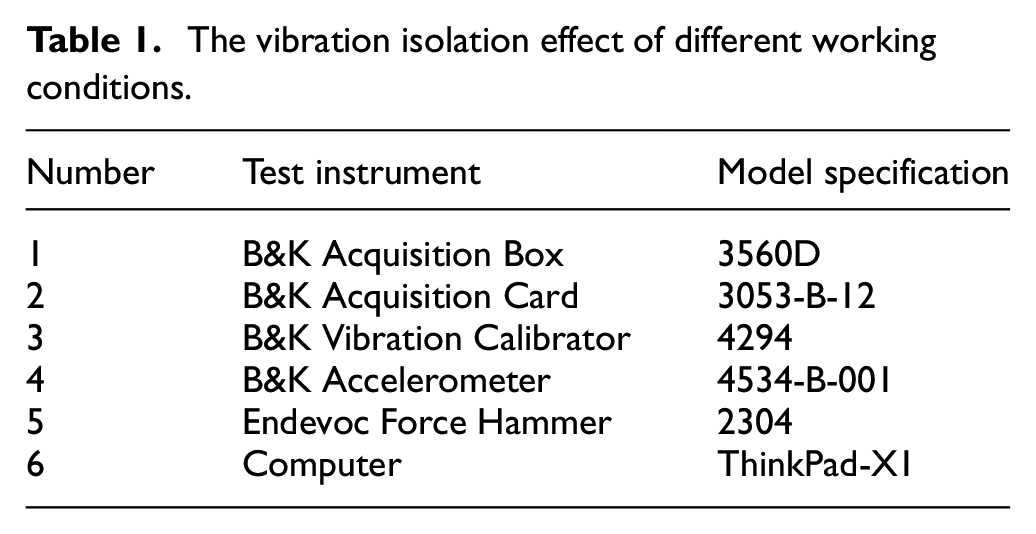
The experimental instruments utilized during the experiment are listed in Table 1. The main technical parameters of the B&K 4534-B-001 accelerometer are as follows: the sensitivity is 100 mV/g; the measurement range is ±500 g; the frequency response (±1 dB) is 1 Hz–12 kHz and the mounting resonance is greater than or equal to 50 kHz.
The vibration isolation effect of different working conditions.
After setting up the test bench and sensor equipment, the acoustic short-circuit fault test of air spring isolator can be carried out. Under the condition that the vertical air spring isolator and the starboard side air spring isolator are normally inflated, the port side air spring isolator is deflated until the pressure of the air spring isolator is 0 MPa, which causes the internal limit gap of the air spring isolator to contact and leads to the acoustic short circuit fault.
The BK accelerometer is arranged near the upper and lower mounting surfaces of the vertical and lateral air spring isolators (shown in Figure 2(c)), and a force hammer is used to strike the geometric centre of the floating raft in a vertical downward direction. The vibration characteristics are measured under the normal operation of the air spring isolator and the discharge of the port side air spring isolator. The results of vibration isolation effect under different working conditions obtained by the test are shown in Table 2.
The vibration isolation effect of different working conditions.

From Table 2, after the port side air spring isolator deflates, the vibration isolation effect of the vertical and lateral air spring isolator shows a significant downward trend, and is generally reduced by 5–10 dB in the middle and low frequency band (5–200 Hz). The vibration isolation effect of the 1# air spring isolator is even reduced 9.8 dB. The reason for this phenomenon is that, after the portside lateral airbag is deflated, the rubber parts of the internal limiter of the air spring isolator will come into contact with each other (shown in Figure 2(b)), thereby increasing the support stiffness of the air spring isolator. With the increased support stiffness of the air spring isolator, the stiffness of the floating raft support is also affected, thereby impacting the vibration isolation effect. Through this experiment, it is demonstrated that if the air spring isolator experiences an acoustic short-circuit fault, the vibration isolation effectiveness of the isolation system will decrease, primarily due to changes in the stiffness of the air spring isolator.
For the 1# air spring isolator, the vibration spectrum obtained through the test is shown in Figure 3.

The vibration spectrum of 1# air spring isolator.
From Figure 3, the frequency of the vibration isolation system structure increases slightly after the release of the port side air spring isolator. Specifically, the frequency is 10.5, 59 and 154.5 Hz under normal working conditions, but increases to 11.5, 60 and 159 Hz after the release of the port side air spring isolator. In the low frequency part of 0–50 Hz, it can be seen that there is a big difference in the frequency between the normal state and the port side air spring isolator deflating state. While the change is small in the frequency part of 50–200 Hz, that is, the frequency of the low frequency part changes obviously, and the acoustic short circuit of air spring isolator has a great impact on the low frequency vibration isolation effect. The reason for the increase in frequency is the occurrence of an acoustic short circuit fault in the air spring isolator. When the air spring isolator experiences an acoustic short circuit fault, the rubber parts of the internal limiter inside the airbag come into contact with each other, resulting in an increase in the stiffness of the isolation system. The stiffness of the isolation system is directly proportional to the frequency, thereby causing an increase in frequency.
Simulation analysis
The simulation model is established based on the test bench, and the simulated structure and parameter settings are shown in Figure 4.

The simulated structure and parameter settings: (a) the geometry structure and finite element model of ship floating raft isolation system and (b) the parameter settings during the simulation process.
As can be seen from Figure 4, the model established includes the floating raft, four air spring isolators and the hull. The length, width and height of the floating raft are 1, 1 and 0.02 m, respectively. The air spring isolators are arranged at the four corners of the floating raft. In this simulation model, the finite element elements are adaptive elements. The element size is 0.005 m, with a total of 1,531,218 nodes and 320,000 elements.
By changing the support stiffness of air spring isolator to simulate the acoustic short circuit state. The normal support stiffness of air spring isolator is 35 kN/m. The support stiffness is set to 70 kN/m in the state of slight acoustic short circuit. The support stiffness is set to 350 kN/m in the state of severe acoustic short circuit. The calculated modal frequencies under three states of air spring isolator are shown in Table 3. Among them, the installation frequency refers to the vibration isolation frequency of the vibration isolation system, and the structural frequency refers to the natural frequency of the structure.
Modal frequency of vibration isolation system.

From Table 3, when the support stiffness of air spring isolator increases, the modal frequency of vibration isolation system increases. This is because when the support stiffness of the air spring isolator increases, the overall stiffness of the isolation system also increases. The modal frequency of the isolation system depends on the system’s mass and stiffness. Increasing the support stiffness of the air spring isolator is equivalent to increasing the system’s stiffness, thereby causing an increase in the modal frequency. The installation frequency obviously increases. When the support stiffness is 35 kN/m, the installation frequency is 4.7, 6.7 and 7.8 Hz. When the support stiffness increases to 350 kN/m, the installation frequency is increased to 7.1, 18.6 and 19.6 Hz, respectively. For the structural modal frequency, the overall change is small, but the structural modal frequency changes obviously in the low frequency part, which indicates that the acoustic short circuit of air spring isolator has a greater impact on the low frequency vibration isolation effect. Therefore, through simulation analysis, it is concluded that the acoustic short-circuiting of the air spring isolator affects the vibration isolation effectiveness of the isolation system.
Mechanism analysis
In order to further analyse the change law of acoustic short circuit of air spring isolator, the following research is carried out from the mechanism level. As can be seen from Figure 1, the limit gap between the limiters 1 and 2 of air spring isolator is 5 mm. When the limit gap is 0 mm, the rubber part of the limiter 1 will contact with the rubber part of the limiter 2, causing the support stiffness to increase. When the limit gap is further reduced, the contact will increase substantially, resulting in the further increase of the support stiffness. In order to analyse the floating raft isolation system, the mathematical model of the floating raft isolation system is established, and is shown in Figure 5.

The diagram of the floating raft isolation system.
As can be seen from Figure 5, the mathematical equation of floating raft isolation system can be expressed as

It is very difficult to directly solve equation (1). In order to analyse the change rule of vibration isolation effect, the simplified mechanical model is adopted, as shown in Figure 6.

The simplified mechanical model.
According to Newton’s second law, the vibration differential equation of the simplified mechanical model can be obtained as

Solving this differential equation yields the following result.

where
Then the following formula can be obtained through calculating the vibration isolation effect.

where
For the equation (4), by setting different frequency ratios
As can be seen from Figure 7, the force transmittance curve must pass (
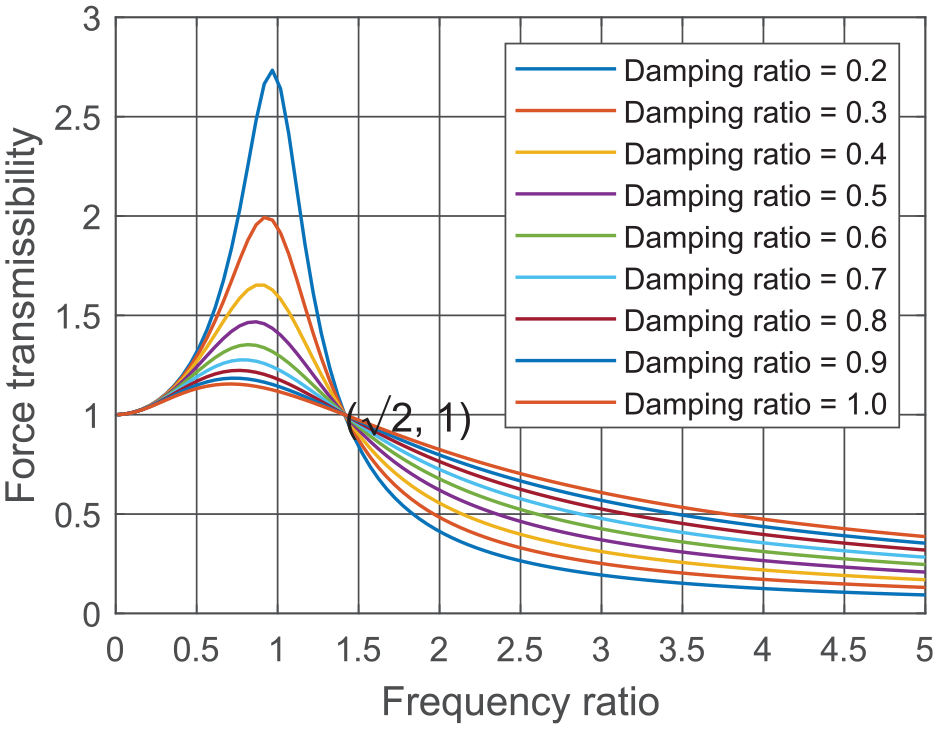
The force transmissibility curve of simplified mechanical model.
Discussion
From the perspective of the floating raft isolation system model, when the air spring isolator experiences an acoustic short circuit fault, the rubber parts of the internal limiters of the air spring isolator come into contact with each other, leading to an increase in the support stiffness of the air spring isolator. The rubber thickness of the internal limiters of the air spring isolator used in this paper is 2 mm. When the limit gap is further reduced, it exacerbates the acoustic short-circuit fault of the air spring isolator.
As the acoustic short circuit increases the support stiffness, it elevates the overall stiffness of the isolation system. Since stiffness is proportional to frequency
From the mathematical model of the floating raft isolation system, the primary reason for decreased isolation effectiveness during the acoustic short circuit test is the stiffness increase caused by the air spring isolator’s acoustic short circuit. Hence, adjusting the internal limiter clearance during installation becomes essential to prevent acoustic short circuits in practical engineering applications.
Conclusions
Air spring isolator is the key equipment in the ship floating raft isolation system. This paper analysed the impact of acoustic short circuit on the vibration isolation system through experiments. The reasons for the reduced effectiveness of the isolation system in the experiments are analysed from simulation and mathematical perspectives. The following conclusions can be drawn from this study:
(1) The acoustic short circuit of air spring isolator will increase the support stiffness of floating raft isolation system, resulting in a significant decrease in vibration isolation effect. In the experiments conducted in this paper, the vibration isolation effectiveness decreased by 5–10 dB.
(2) The acoustic short circuit of air spring isolator will cause the modal frequency of vibration isolation system to increase. In particular, the modal frequency of the low frequency part increases significantly. From the simulation analysis, as the support stiffness increases from 35 to 350 kN/m, the installation frequency increases from 4.7, 6.7 and 7.8 Hz to 7.1, 18.6 and 19.6 Hz. According to the theoretical analysis results, the performance of vibration isolation system deteriorates with the increase of mode frequency. Therefore, the acoustic short circuit fault of the air spring isolator seriously affects the vibration isolation performance.
(3) Based on the vibration isolation effectiveness and modal frequency, a rapid assessment criterion can be provided for detecting the acoustic state of the air spring isolator after actual installation. In the event of an acoustic short-circuit fault, the vibration isolation performance can be effectively improved through adjustments to the limiter clearance of the air spring isolator.
In the future, a set of rapid acoustic state detection tools for air spring isolators will be developed for practical engineering use.
Footnotes
Handling Editor: Dr Zhi Fang
CRediT authorship contribution statement
Shuai Wang: Conceptualization, Investigation, Software, Writing-original draft. Minyue Lu: Supervision, Conceptualization, Methodology, Writing-review & editing. Haitao Tan: Conceptualization, Investigation. Shiliang Jiang: Conceptualization, Investigation. Miao Zhang: Investigation. Wei Liu: Conceptualization, Investigation. Jiachi Yao: Supervision, Conceptualization, Methodology, Writing-review & editing.
Declaration of conflicting interests
The author(s) declared no potential conflicts of interest with respect to the research, authorship, and/or publication of this article.
Funding
The author(s) disclosed receipt of the following financial support for the research, authorship, and/or publication of this article: This work was supported by the National Key R&D Program of China (No. 2017YFC0307800), the Beijing Association for Science and Technology Youth Talent Lifting Project.
