



Abstract
Blade wrap angle is one of the main parameters of centrifugal pump, which has an important influence on the internal flow characteristic and pump performance. In this work, five impeller models with different blade wrap angles (85°, 95°, 105°, 115°, and 125°) are established on the condition of other impeller parameters remain unchanged, whose external characteristic, internal flow, and wear were analyzed by numerical simulation method. The results show that the influence of blade wrap angle on efficiency is more significant than head, has a certain effect on the internal flow field of the centrifugal pumps and effects the wear position of pressure surface. With the increasing of blade wrap angle, the pump efficiency increases companied by the pump head decreases slightly, the area of higher speed at the outlet of the impeller tends to decrease, the higher speed wake area at the end of the blade pressure surface breaks and shrinks, the vortex in the impeller passage is fewer and smaller, the turbulent kinetic energy and morphology of vortex inside the pump decreases gradually, and the wear rate of the flow passage components shows a pattern of first decreasing and then increasing.
Keywords
Introduction
In sewage treatment, oil transportation, agricultural irrigation, and other industries, centrifugal pumps are commonly used to transport two-phase flow media containing solid particles that has a great influence on the hydraulic performance and wear of centrifugal pump.1–3 In the all wear of centrifugal pump, the wear of impeller accounts for a large part. The geometrical parameters of impeller are closely related to the efficiency, service life, and stability of centrifugal pump. Therefore, reasonable impeller wrap angle is of great significance for improving performance and service life of solid-liquid two-phase flow centrifugal pump. The influence of the geometrical parameters of impeller such as blade number, blade wrap angle, and blade outlet angle on the performance of centrifugal pump has been widely studied by scholars in the world. Liu et al. 4 found that the blade number of impeller affects the performance of pump significantly, and the head of model centrifugal pump increases with the increasing of blade number in non-cavitation and cavitation conditions. Tan et al. 5 studied the influence of blade wrap angle on pump performance and believed that the larger blade wrap angle has higher efficiency and more stable operation. Li et al. 6 compared the flow characteristics of conventional mixed-flow pumps with those equipped with circumferential spoke structures of varying depths, the result turned out that circumferential spoke structures enhance significantly the stall performance of mixed-flow pumps. Ding et al. 7 studied the influence of blade outlet angle on the performance of high specific speed centrifugal pump, the results show that with the increase of flow rate, the hydraulic loss of impeller increases with the increase of blade outlet angle. Fořt 8 studied the hydraulic efficiency of pitched blade impeller, the results turned out that the hydraulic efficiency of inclined blade impeller increases significantly with the decrease of pitch angle, and increases with the decreasing of impeller inner diameter ratio. Li et al. 9 proposed a prediction model considering impeller rotational acceleration and fluid inertia of transient energy characteristics in a mixed-flow pump. The accuracy of the model is better than traditional quasi-steady-state calculation model. Tao et al. 10 found that blade shape had little influence on particle motion, and fewer blades could reduce the constraint of blade on particle motion. Nishi et al. 11 analyzed the radial thrust of two single-blade impellers with different blade outlet angles and discovered that the impeller with the larger blade outlet angle had better performance. The impeller parameters of centrifugal pump not only affect the transmission of single-phase medium, but also the two-phase medium. Li et al. 12 employed the entropy production theory to evaluate the energy losses inside the mixed-flow pump and analyzed the components of energy loss of the impeller and guide vanes. Turbulent dissipation was found to be the main source of energy loss and high turbulent dissipation zones are concentrated at the trailing edge of the blade. Peng et al. 13 carried out hydraulic optimization design of wear of centrifugal pump impeller. The blade surface wear was effectively reduced by changing the blade outlet shape. Derakhshan and Bashiri 14 reasonably optimized the impeller using neural network algorithm. Lu et al. 15 found that the pump efficiency is affected mainly by the impeller blade angles and especially the blade outlet shroud angle by optimizing the matching between impeller and diffuser. Cai et al. 16 studied the influence of different backward blade shapes on the wear characteristics of mud pump by using particle model and heterogeneous model, and the wear characteristics of the pump were predicted according to the vorticity of the front and rear enclosures. Stephan and Graeme 17 studied a simple mud pump model to predict the effects of different design parameters on the wear of the impeller suction sealing. Li et al. 18 indicated that the efficiency of sewage pumps increases with decreasing of the outlet angle and increasing of the wrapping angle. Shojaeefard et al. 19 believed that changing the geometric structure of the impeller could improve the performance of the centrifugal pump. CFD method is effective to analyze the performance of centrifugal pump,20–22 and more and more current studies focus on the influence of physical parameters of transmission medium on centrifugal pump,23–25 relatively, there are little studies on the relationship between impeller structure and two-phase flow. In this work, the semi-open impellers models with different wrap angles are established by SolidWorks software, and the internal flow and wear of model pumps were studied by numerical simulation using Fluent software. The results will provide a reference for the optimal design of blade wrap angle.
Numerical calculation
Geometric model and mesh
The prototype pump with semi-open impeller was studied and the main design parameters of pump as shown in Table 1.
Main design parameters of prototype pump.

Blade wrap angle is the included angle of two axial surfaces at the intersection of blade profile and impeller inlet and outlet edges. Five impellers with different wrap angle (i.e. 85°, 95°, 105°, 115°, and 125°) were designed with other parameters unchanged. Figure 1 shows the impellers with different blade wrap angle.

The model of impellers with different blade wrap angles.
The calculation domain of centrifugal pump consists of inlet pipe, impeller, and volute. In order to reduce the influence of inlet and outlet fluid on the internal flow field of the pump, the length of the inlet pipe is four times diameter of the pump inlet. The grid of the calculation domain is generated by ICEM. Considering the complexity of flow channel, a non-structural grid with better adaptability was adopted. The minimum mesh quality is 0.3 and the minimum mesh angle is 18°. The grid of the impeller is refined, and the range of the impeller Y plus is from 54 to 70. Figure 2 shows the grid model for the whole calculation domain.

Grid of calculation domain: (a) centrifugal pump and (b) impeller.
At the same flow rate, eight grid models were used to evaluate the influence of grid number on centrifugal pump head. As shown in Figure 3, the pump head remains almost constant from the fifth grid. Hence, the sixth grid 337.275 × 10⁴ was selected for subsequent numerical calculation.

Grid independence.
Governing equation and boundary condition
Solid-liquid two-phase flow in centrifugal pump belongs to turbulent motion. Considering the interaction between solid and liquid phases, Euler-Lagrange method is adopted. All numerical simulation calculations are based on the following assumptions:
(1) Liquid phase water is a continuous phase and incompressible. The physical properties of the phases are constant.
(2) Solid phase particles are spheres. Phase transition and deformation during transportation are ignored.
(3) Temperature variation and interphase heat transfer are not considered.
(4) The solid-liquid phase is coupled in a bidirectional manner.
The governing equation is as equations (1)–(3):


Where
The particles move in the flow field are mainly affected by various forces such as gravity, pressure gradient force, drag force, and additional mass force. The effects of Basset force, Saffman force, and the gravitational attraction of blade surface on solid particles may cancel out each other. The particle trajectory equation in the simplified Euler-Lagrange method is as equations (4)–(7):



DPM and RNG k-ε model in Fluent are used to study the internal flow and wear of the pump with different blade wrap angles. The inlet of the centrifugal pump is set as the velocity inlet, and the outlet is set as the outflow. The initial velocity of the discrete phase and the continuous phase are assumed to be equal, and the initial concentration of the discrete phase is uniform. The rotor-stator interface is sliding mesh motion (SMM). The time step is 1.15 × 10⁻⁴ s. The wall surface is set as no slip wall.
Model verification experiments
In order to verify the accuracy of the simulation, the hydraulic performance of the pump was tested at the d s = 1 mm, C v = 5%, ω = 95° related with different flow rate (0.4Q d , 0.6Q d , 0.8Q d , 1.0Q d , 1.2Q d ). The experimental loop is shown in Figure 4.

Experimental system.
The head and efficiency curves at different flow rates are shown in Figure 5. The numerical results are larger than the experimental ones due to the mechanical losses and flow losses in the pump experiment. The maximum error between simulation and experiment is less than 6%. Which shows that the numerical simulation method is practicable, the results of numerical simulation are reliable, and the model can be used to calculate the detailed flow field of two-phase flow at different blade wrap angles.

Hydraulic performance curves of the pump.
Results and analysis
The parameters of simulation calculation are determined according to the operating conditions of the model pump experiments. The influence of blade wrap angle on the flow and wear characteristics of centrifugal pump was studied on the conditions of rated flow Q d = 16 m3/h, particle diameter d s = 1 mm, and volume concentration C v = 5%.
Hydraulic performances
Figure 6 shows the hydraulic performance curves of pumps with different blade wrap angles. With the increasing of blade wrap angle from 85° to 125°, the pump head presents a general trend of decline, but the efficiency increases. The maximum differences of head and efficiency at different wrap angles are about 4.2% and 11.1%, respectively. Compared with the head, the blade angle has a more significant effect on the efficiency. For the head has a great relationship with the flow speed of the mixture fluid at inlet and outlet of impeller, although the speed at the inlet of the blade with different wrap angles are almost the same, the change of wrap angle will cause the change of circumferential velocity of mixture fluid at impeller outlet. When the blade wrap angle increases, the flow angle at the impeller outlet decreases, the head decreases as a whole. However, the blade with the larger warp will cause the flow medium in the impeller passage closer to the blade, which reduces the flow loss in the passage and improves the efficiency.

Hydraulic performances at different blade wrap angles.
Internal flow characteristics
Velocity distribution
As shown in Figure 7, the velocity of the fluid in the impeller increases gradually and reaches the maximum value at the outlet of the impeller. When the high speed fluid enters the volute, the kinetic energy of the fluid is transformed into pressure energy, and the velocity decreases. With the increase of blade wrap angle, the high speed area at the impeller outlet decreases, also, the fracture and shrinkage of high speed area appeared in the wake of blades, which attribute to as the blade wrap angle increases, the impeller passage becomes narrower, the effective flow area decreases, and the liquid velocity in the passage increases slowly, moreover, the longer blade profile makes the particle movement consume more energy, and the liquid kinetic energy at the impeller outlet decreases.
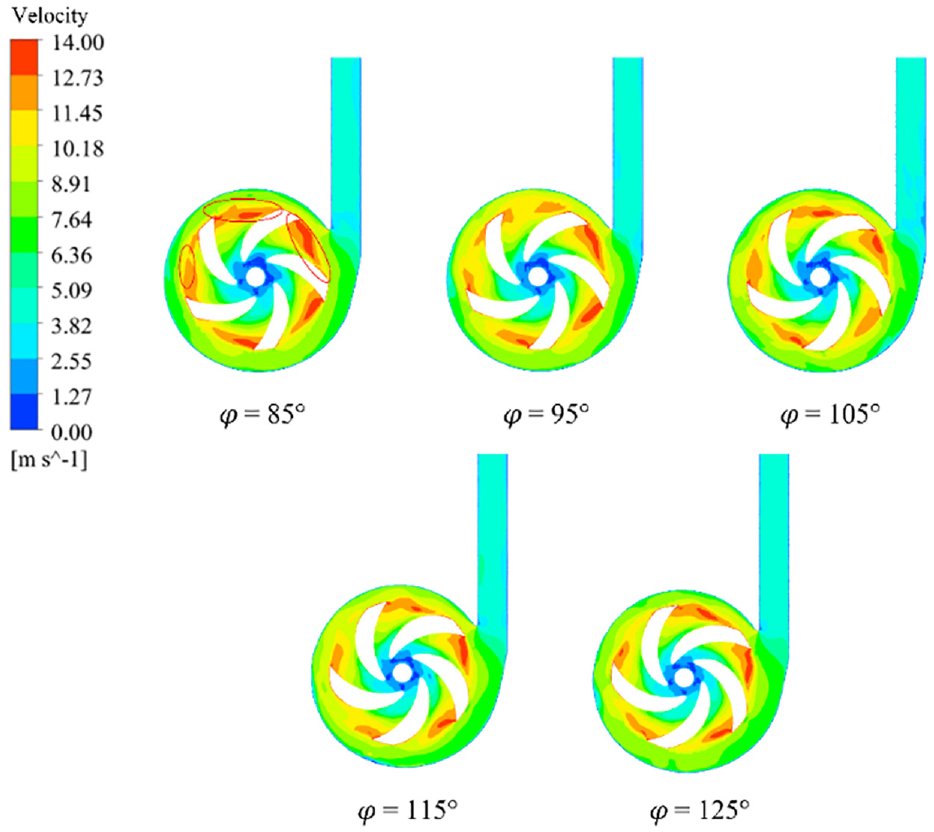
Velocity contour.
Compared with closed impeller, the stability of flow in centrifugal pump with open impeller or semi-open impeller is worse. The vortexes with different sizes are easily formed in the impeller due to turbulence. Figure 8 shows the velocity streamlines of impeller passages with different blade wrap angles. The size, number, and distribution area of the vortex in the flow channel of impeller with smaller wrap angle is obviously more than that of larger wrap angle. And the vortexes are closer to the inlet area of the impeller. When the blade wrap angle is smaller, the vortex in the impeller passage is generated quickly. As the fluid flows, the vortex is continuously extended and diffused. The smaller the blade wrap angle, the shorter the blade profile, and the more vortexes are likely to occur. Vortex is also a manifestation of energy loss, which are agree with that the efficiency and head of the pump with larger wrap angle are higher.

Velocity streamlines of impeller passages
Turbulent kinetic energy distribution
Turbulent kinetic energy reflects the magnitude of turbulence pulsation of the fluid, and its variation is directly related to energy consumption and flow stability. The greater the turbulent kinetic energy, the more energy the fluid consumes, the worse the flow stability is. Figure 9 shows the cloud image of turbulent kinetic energy inside the centrifugal pump with different wrap angles, and reveals that the turbulent kinetic energy decreases with the increasing of blade wrap angle. It is due to that the impeller is main working component in the pump cavity, the turbulent kinetic energy in the impeller flow field is usually greater than that in the volute. Furthermore, the turbulent kinetic energy on the pressure side of the blade is larger than that on the suction side. Also, with increasing of wrap angle, the turbulent kinetic energy in the volute increased locally.
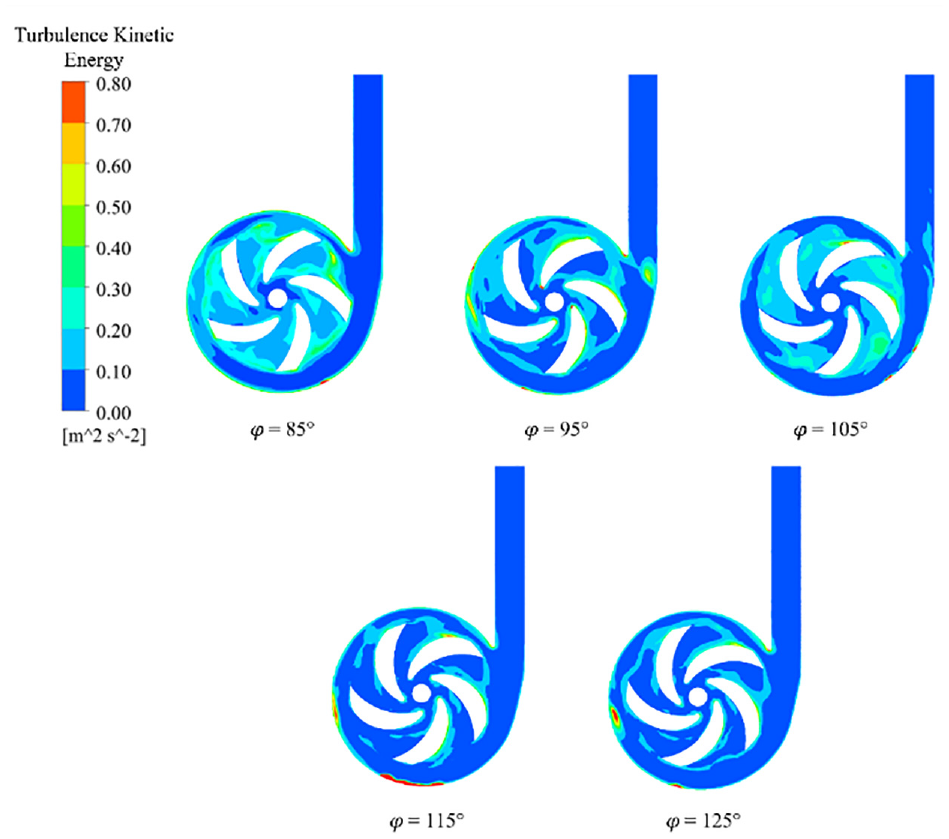
Distribution of turbulent kinetic energy in the pump.
Vorticity distribution
Due to the complex of internal flow, the vortex is formed inevitably in operating centrifugal pumps, and the vorticity can serve as an indicator of internal flow instability in the pumps. Figure 10 shows the distribution of vorticity in the axial cross section of a centrifugal pump with different blade wrap angles. It is evident that the vorticity in the axial cross section decreases with increasing of blade wrap angle, which is consistent with the trend depicted by turbulent kinetic energy in Figure 9. Notably, higher vorticity are observed in the impeller flow field compared to that in the volute flow field, particularly on the pressure surface and the wake of blade. Furthermore, an elevated vorticity region appears on the volute surface, which displays the region with high turbulent kinetic energy and indicates a more pronounced flow instability with this area.
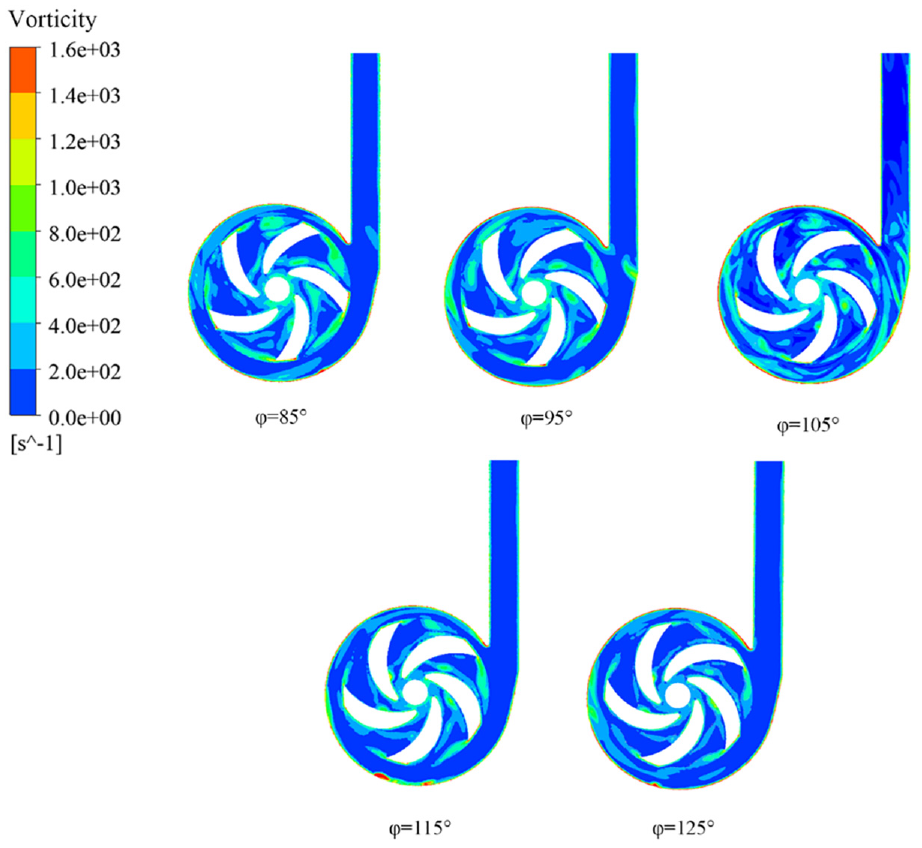
Distribution of vorticity in the pump.
Omega criterion vortex distribution
The internal vortex morphology of the pump has a certain impact on its internal flow, in order to better observe the vortex distribution in the 3D flow passage, the vortex structure is characterized by the Omega criterion, and the threshold value is selected as 0.78. Figure 11 shows the distribution of Omega vortex inside the pump with different wrap angles, and it is found that the vortexes are mainly concentrated in the suction surface of the blade and gradually develop to the pressure surface. With the increasing of the blade wrap angle, the overall vortexes are also reduced. Additionally, the vortex at the impeller outlet decreases, and the narrowing of the impeller passage also results in the vortex structure smaller.

Spatial distribution of vortex in the pump.
Wall shear force
Wall shear force is a common resistance, reflecting the internal flow characteristics of the pump to a certain extent. As shown in Figure 12, the wall shear force acting on the blade is larger and concentrated both at the junction between the pressure surface and the hub and the tail of the blade, which are related with the particle motion track in centrifugal pump. When the centrifugal pump transports solid-liquid two-phase medium, the effect of solid particles on the wall force is far greater than that of liquid. Due to the centrifugal action of the rotor, particles parallel to the pressure surface have greater kinetic energy at the tail of the blade, which is the one of the reasons that the impeller shear force increases locally. Also, the increase of blade wrap angle increases the friction of fluid on pressure surface, which causes the head loss. This is roughly consistent with the change of pump head reflected in Figure 6.

Wall shear force.
Wear characteristics
Impeller wear characteristics
The wear of the semi-open impeller is mainly concentrated on the pressure surface of the blade and close to the boundary between the blade and the hub, which is mainly due to the impact and abrasion of particles on the impeller wall under the action of centrifugal pump rotor. As shown in Figure 13, the variation of blade wrap angle has a certain influence on the wear characteristics of impeller. The pressure surface of the blade has two obvious areas of severe wear at 85° and 95°wrap angle. However, the pressure surface of blade with 105°, 115°, and 125° larger wrap angle has only one severe wear area, respectively. The number of wear areas may be due to the secondary or multiple impacts of particles on the pressure surface caused by the vortex in the impeller passage. The flow passage of impeller with larger wrap angle is relative longer and narrower than that with smaller wrap angle, consequently, the particles move along the pressure surface are not easy to flow off, the wear of blade is mainly abrasion. A wear area with smaller width and larger length reflects in the impeller wear cloud diagram (See Figure 13). With the increase of wrap angle (105° ≤ ≤ 125°), the length of main wear area also increases. In summary, the blade wrap angle affects particle motion and has a great influence on blade wear.
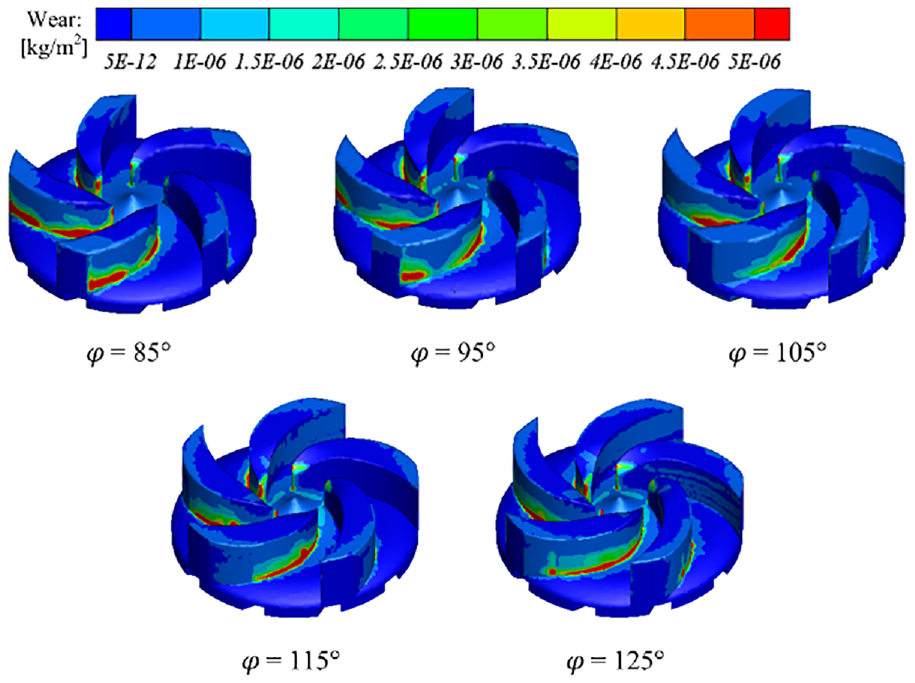
Clouds diagram of impeller wear.
The wear rate reflects the speed of wall wear. Figure 14 shows the average wear rates of different parts of the impeller. The wear of impeller is mainly concentrated on the pressure surface. With the increase of wrap angle, the wear rate of pressure surface changes obviously, showing a trend of first decreasing and then increasing. When the blade wrap angle is 115°, the average wear rate of pressure surface is the minimum.

Average wear rate of impeller.
Volute wear characteristics
Figure 15 shows the wear of the volutes relate with different wrap angles blade. The main wear areas of volute and impeller are almost on the same axial plane. The length and width of the main wear area of the volute are affected by the blade wrap angle. And as shown in Figure 16, the wear rate of volute presents a downward trend on the whole with the increase of blade wrap angle. The decrease of particle velocity at impeller outlet is the main reason for this phenomenon.

Clouds diagram of volute wear relate with different blade wrap angle.
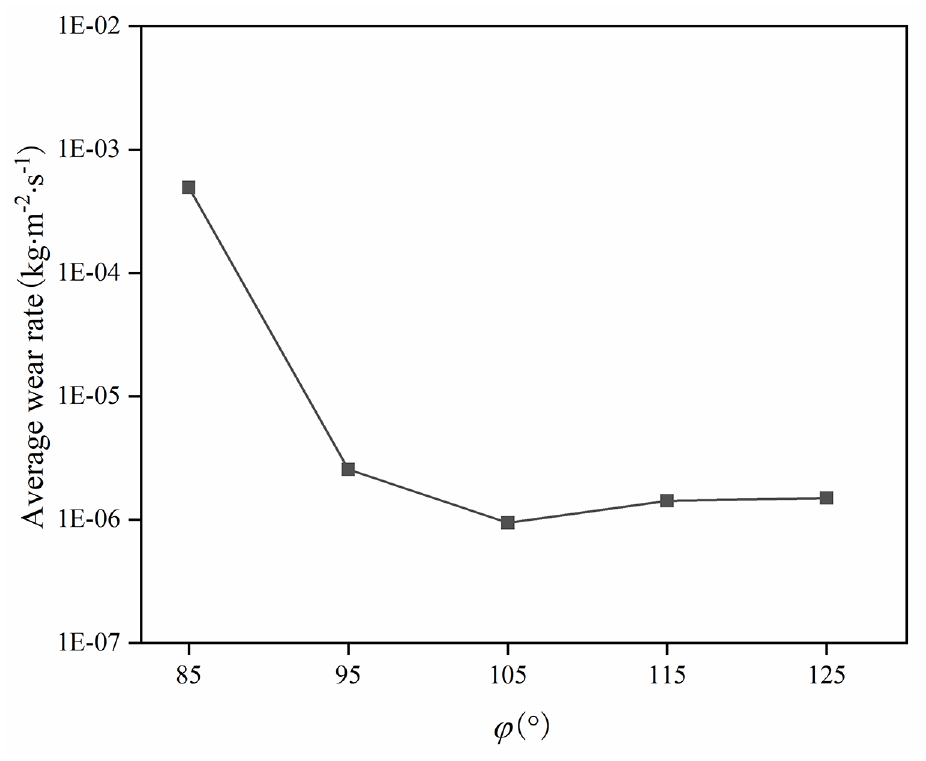
Average wear rate of volute relate with relate with different blade wrap angle.
Conclusions
In this manuscript, the influence of blade wrap angle on the internal flow and wear characteristics of pump is studied by Euler-Lagrange method with three-dimensional unsteady two-phase coupling. The main conclusions are as follows:
(1) The blade wrap angle has a certain influence on the hydraulic performance of the solid-liquid two-phase centrifugal pump, compared with head, the effect on efficiency is more significant.
(2) The blade wrap angle has obvious influence on the flow in the impeller passage, with the increasing of blade wrap angle, the high-speed area at blade outlet decreases first and then increases. The larger wrap angle, the fewer and smaller flow vortex, less turbulent kinetic energy and higher hydraulic efficiency.
(3) The blade wrap angle has a significant effect on impeller wear, especially on the pressure surface. With the increase of wrap angle, the main wear area of pressure surface shrink along with the wall shear of the impeller increases, and the volute wear reduces.
Footnotes
Appendix
Notation

| Q d | the flow rate at design point, m3/h |
| H | head, m |
| n s | rotate speed, rpm |
| D in | inlet diameter, mm |
| D out | outlet diameter, mm |
| Z | number of blades |
| C v | volume concentration |
| d s | particle diameter, mm |
| density, kg/m3 | |
| mixed pressure, Pa | |
| volume fraction | |
| relative velocity, m/s | |
| mass transfer from phase i to j | |
| viscosity, Pa s | |
| the explicit part of the momentum exchange phase | |
| the average velocity of the discrete phase particles, m/s | |
| the momentum exchange coefficient of the average phase of a particle | |
| the coefficient of exchange between phases | |
| virtual mass force, N | |
| Saffman force, N | |
| lift force, N | |
| liquid velocity, m/s | |
| particle velocity, m/s | |
| grain density, kg/m3 | |
| particle relaxation time, s | |
| grain diameter, m | |
| drag coefficient | |
| , , | constant |
| Reynolds number |
Handling Editor: Jianjun Feng
Declaration of conflicting interests
The author(s) declared no potential conflicts of interest with respect to the research, authorship, and/or publication of this article.
Funding
The author(s) disclosed receipt of the following financial support for the research, authorship, and/or publication of this article: The authors thanks for the financial support of National Key Research and Development Program of China (2022YFE0126600), Major Science and Technology Projects of Zhejiang Province (No. 2021AA002), and National Natural Science Foundation of China (No. 51676174).

Data statement
The data that support the findings of this study are available on request from the corresponding author.