



Abstract
The mechanical seal performance in reactor coolant pump (RCP) is of great importance for the efficient and safe operation of primary loop in nuclear power plant. The sealing medium filling inside the seal encounters strong thermal gradient. In this paper, thermo-viscous effect on sealing characteristics with two typical mechanical seal faces, namely the tapered-end-face and wave-tilt-dam, is numerically studied, by introducing the temperature-viscosity equation according to the real physical properties of the sealing medium. Performance of mechanical seal with two different temperature-viscosity equations are compared. In addition, the influence of thermo-viscous effect on cavitation is also analyzed. It is revealed that the temperature-viscosity variation significantly influences the internal flow field, temperature field, two-phase distribution, and the opening force as well. With low base film thickness, the temperature difference will reduce 58% as considering the thermal effect on viscosity, and the difference in leakage may be as high as 43%. Also, the prediction of cavitation under small film thickness indicates that the thermo-viscous effect decreases the cavitating area. This work contributes to the mechanical seal design and performance prediction by assessing the thermal influences on viscosity of seal medium, and meanwhile revealing the effect on the possible cavitation event.
Introduction
Reactor coolant pump (RCP) is the most critical equipment and the only device which rotates in the primary loop of a pressurized-water-reactor nuclear power plant. 1 The RCP works under high-temperature and high-pressure conditions and in a radioactive environment, which needs serious care on the sealing of motion pair to prevent leakage. 2 Two types of mechanical seal are usually used in RCPs, namely taper-end-face mechanical seal 3 and wave-tilt-dam mechanical seal (Figure 1). 4 The operation of mechanical seal links to the bearing lubrication theory. In our previous work, the influence of structural parameters on wavy-tilt-dam hydrodynamic mechanical seal performance has been investigated. 2 The wavy-tilt-dam mechanical face seal was proposed by Young and Lebeck, 5 it generated hydrostatic and hydrodynamic effects, respectively, at radially tapered direction and circumferentially wavy direction. It possessed relatively large opening force, and was suitable for high-parameter conditions. Etsion and Burstein has developed a mathematical model to predict the performance for such type of seals with regular microsurface structure. 6 Liu et al. also established a theoretical model to study the mechanism of wave-tilt-dam mechanical seals. 7 The influence of structural parameters such as amplitude, taper, damping radius, and wave number at different rotational speeds and seal pressures was investigated. Cochain et al. performed both numerical and experimental study of the face waviness influence on the seal leakage, 8 in which the Reynolds equation was used in numerical simulation. The results showed that the amount of leakage increased with the increase of waviness amplitude. The higher leakage rate of corrugated seals was due to the higher average oil film thickness. Srivastava et al. developed a novel thermoelastic hydrodynamic lubrication model for the mechanical seals used in RCP, 9 by coupling the Reynolds equations for fluid flow and the thin film energy equation for heat transfer. The thermal deformation and mechanical deformation of the solid region was also analyzed by the finite element method. Djamaï et al. further developed a finite element model for a thermohydrodynamic mechanical face seal, 10 taking account of cavitation, face deformations, and heat transfer in the seal rings. It was shown that the thermohydrodynamic seal had better performance than the equivalent flat faces seal, with lower friction and face temperature, but no cavitation was found. Liao et al. proposed a dimensionless reliability parameter as the objective function to optimize the mechanical seals in RCP based on a fluid-solid strong-interaction model, 11 and the optimization was done accompanying with fluid-structure interaction (FSI) analysis.

(a) structure of mechanical seal assembly in an RCP, and (b) schematic of the wave-tilt-dam seal.
During normal operation, strong power-heat conversion took place within the mechanical seals. Mayer showed that the end-face friction would generate a large amount of heat in the sealing gap, leading to the wear and thermal deformation. 12 The extra heat inevitably influenced the thermal balance, and subsequently the fluid flow inside the seal. This would considerably alter the performance of mechanical seal. Brunetière and Modolo proposed a correlation formula between the overall Nusselt number (Nu) of rotating rings and static disks based on numerical data. 13 The heat source was modeled locating at the contact between the rotor and stator, and related to the temperature distribution in the solid structure. It was shown that Nu was approximately proportional to the square root of the Reynolds number (Re), but exhibited a weaker dependence on the Prandtl number (Pr). Ayadi et al. experimentally studied the thermal behavior of mechanical seal with the aid of embedded thermocouples. 14 The temperature distribution and heat flux, as well as Nu were obtained by solving the heat transfer equation. It was revealed that the temperature rise increased sixfold as the rotating speed raised from 1000 to 6000 rpm and the fluid pressure from 1 to 5 MPa. Blasiak and Pawinska established a mathematical model for the heat transfer process of a non-contact face seal which was used to separate the working medium from the external environment. 15 Such a non-contact seal restricted fluid leakage through gaps to be lower than a few microns. During the operation of the rotor, an intense conversion of mechanical energy into heat occurred. Liu et al. established a three-dimensional fluid-heat coupling model for corrugated mechanical seals, and studied the heat transfer characteristics for both fluid and solid domains. 16 It was shown that the thermal deformation in the radial direction was larger than the deformation caused by waveness in the circumferential direction. And the maximum temperature of the film would decrease as the wave number increased. Ding and Lu also experimentally measured the temperature distribution in the seal, whilst establishing a mathematical model considering heat transfer process and thermal deformation for non-contact face seal.17–19 Besides, extensive studies have considered the thermal-mechanical fluid-structure coupling problem in mechanical seals, for a better prediction of seal performance and design.11,20–22
On the other hand, cavitation may also arise in the fluid region of mechanical seal during running. 23 Nau first experimentally observed the cavitation phenomenon of liquid film on a mechanical seal face. 24 To model the cavitation process, Brunetière derived a general formulation of the Reynolds equation for gas and liquid lubricant of mechanical seal, including the cavitation phenomenon, 25 which was capable of continuous description of cavitation in liquid lubricant. For the aspect of flow field from the radial direction, tip-leakage vortex (TLV) cavitation might also be a challenge in the mechanical seal. TLV cavitation and its control strategies has been well discussed by Cheng et al. 26 Zhang et al. studied the static and dynamic characteristics of high-speed water-lubricated spiral groove thrust bearing (SGTB) considering cavitation and centrifugal effects. 27 A turbulent lubrication model based on gas-liquid two-phase flow was established, and the effects of cavitation and centrifugal force on static and dynamic characteristics of SGTB were analyzed. A set of experimental equipment was established to test the static and dynamic characteristics of SGTB, and the model considering cavitation and centrifugal force showed more accurate prediction than existing results. Liu et al. established a three-dimensional thermal-elastic-hydrodynamic model for a wavy-tilt-dam mechanical seal, 28 and studied the sealing mechanism under quasi-start-up and steady-state conditions. It was found that the cavitation occurred as the rotation speed increased, which caused both hydrostatic and hydrodynamic mechanisms to be active.
From the above review, it was concluded that many studies have considered the thermal influence on flow field, thermal deformation, and few dealt with the cavitation in the liquid film in mechanical seal end face clearance. Though the Reynolds equation derived from the flow lubrication model are widely adopted, and can well describe the viscosity-temperature relationship of oil, there is still a large deviation in describing the thermo-viscous effect of water. In the latter scenario, good accuracy can only be achieved in a small temperature range. Besides, Jacoboson-Floberg-Olsson (JFO) cavitation boundary conditions are often used to predict the cavitation features; however, they are difficult to well predict the mechanical seal performance. Therefore, this work intends to first establish a viscosity-temperature equation that accurately characterizes the thermo-viscous dependence of the working fluid for an RCP. Secondly, three-dimensional flow field in the mechanical seal is numerically captured, in line with the Zwart-Gerber-Belamri (ZGB) cavitation model, and thus the cavitation mechanism of the end face liquid film and its development progress, as well as the seal performance are analyzed.
Numerical methodology
Seal geometry and parameters
The mechanical seal is composed of a rotating moving ring and a sealing cavity with a fixed static ring. The end face of the rotating ring is usually in the shape of a flat surface, and the surface of the static ring is tapered with a certain amplitude. For a wave-tilt-dam seal, the wavy trough and dam appear periodically on the tapered surface. As the seal is running, hydrostatic and hydrodynamic effects start working when the sealing medium flows through the gap between rotating and static rings.
Figure 2 shows the structure of a wave-tilt-dam mechanical seal. The thickness of liquid film in the gap of sealing ring reads as:

where Ro and Ri are the outer and inner radii of the sealing ring, respectively. Rd is the dam radius and r is the radius at any point. β is the taper angle of the stator face, and is expressed as:

in which ht is the taper height of the outer radius. k is the wavenumber, ha is the wave amplitude, and the dimensionless parameter α = ha/ht is a measure of dam height, which is already described in our previous study. 2 The basic geometric parameters and operating conditions are given in Table 1, which is consistent with Liu et al. 7

(a) the structure of wave-tilt-dam mechanical seal, and (b) the liquid film in the sealing gap, the dimension shown is in x:y:z = 1:1:100 for a clear contrast.
Geometric parameters of hydrostatic seal. 7

Seal leakage is a key parameter representing the mechanical seal’s performance. If the leakage is too small, the end faces of the seal ring may directly contact, thus causing the wear of the seal ring. While if the leakage is too large, the seal fails. In the numerical simulation, the mass flux of leakage is monitored at the outlet of the seal, that is, at r = Ri. Sealing opening force represents the bearing capacity of the liquid film in the seal ring clearance, which reads as:

The temperature of sealing medium has a significant effect on the mechanical seal of an RCP. Too high temperature will cause phase change of liquid film, leading to the vibration of sealing surface during operation and hereby sealing failure. In addition, high temperature will also cause thermal deformation of the sealing ring, thus increasing the friction, and further deteriorating the working environment. The temperature of the working medium increases gradually along the flow direction, so the maximum temperature occurs at the outlet. In this study, the average temperature difference between the outlet and the inlet is used as one of the parameters to measure the performance of mechanical seals, which is defined as:

Governing equations
For a steady flow of incompressible flow medium, the governing equation includes the continuity equation, Navier-Stokes equation (steady flow), and energy equation, which are


where

in which symbol “:” is double dot product.
The cavitation model:

wherein, the subscript v is for the vapor phase, and the source terms Re and Rc account for the mass transfer between the vapor and liquid phases in the cavitation process. Calculation of the growth and collapse process of cavitation bubbles is the key to determine the source terms Re and Rc. ZGB model is more functional and has a faster computational convergence speed for this case. It does not need to specify additional initial boundary conditions to predict the cavitation phenomenon. 29 In the ZGB model, the evaporation and condensation terms are:


For the thermo-viscous effect, several formulae have been used to characterize the viscosity-temperature relationship of fluid, including the Reynolds equation, Slotte equation, Vogel equation, etc. 30 As aforementioned, these equations can only give good accuracy in a small temperature range. For example, the Reynolds equation 31 is:

where η is the viscosity-temperature coefficient, T is the temperature of sealing medium and T0 is the reference temperature, respectively. To describe the viscosity-temperature relationship of water, the dependence of viscosity on pressure and temperature should be considered. Since the change of viscosity with pressure is neglectable, only the change of viscosity with temperature is considered. The values of viscosity were taken from open-accessed Refprop 9.1, where the pressure was set as 5.0 MPa and temperature was from 323.15 K to 473.15 K with an interval of 10 K. The fitting curve is shown in Figure 3. The difference between the fitting equation and the experimental value is less than 0.1%. It is seen there is a clear difference between the Reynolds equation and the fitted curve.


Viscosity changes with temperature under different conditions.
Boundary conditions
According to the relative motion of rings, the static ring surface is set with no-slip boundary condition, while the moving ring is set with a rotating speed of 1500 rpm. Pressure inlet and pressure outlet conditions are set at the outer radius location and inner radius location, respectively. Specifically, the total inlet pressure is 5.0 MPa, the temperature is 323.15 K, the static pressure at the outlet is 0, and the reference pressure is 101,325 Pa. Due to the fact that the geometric model of the mechanical seal of wavy end face has periodicity, only one periodic part (40° in the circumferential direction) is selected for numerical simulation, similar to our previous work. 2
Numerical method
In numerical simulations, the SIMPLE algorithm is adopted to decouple pressure and velocity. The second-order discrete-scheme is used for the spatial discretization of the pressure field, while the second-order upwind discrete scheme is applied to the momentum equation and energy equation. Considering the flow condition, direct simulations of the above governing equations are performed.
The mesh independence was verified by modifying the numbers at axial, radial and circumferential grids. In this study, tapered-end-face mechanical seals with a base film thickness of 2 μm are selected for grid independence verification. Figure 4 shows the inlet-outlet temperature differences (ΔT) and fluid leakage (M) with different grid numbers for the cases with or without considering the thermo-viscous effect. It can be seen that for both cases, as the number of grids increases both ΔT and M tend to be stabilized. When the computational domain grids increase from 4 million to 7.5 million, they are changed by 0.03% and 0.07% respectively without considering the thermo-viscous effect, and changed by 0.09% and 0.08% respectively as considering the thermo-viscous effect. Therefore, 4 million grids have been selected for further numerical calculations under different working conditions. Also, from this verification, it is seen that the temperature-viscosity dependence indeed influences the mechanical seal performance.

Variation of M and ΔT as the mesh increases (a) the thermo-viscous effect is ignored and (b) equation (12b) is used for the temperature-viscosity dependence.
Results and discussions
In this work, the thermo-viscous effect on the sealing characteristics of two typical mechanical seal faces, namely the tapered-end-face, and wave-tilt-dam, was numerically studied. First, results of mechanical seal performance with the conventional Reynolds equation (equation (12a)) and the new temperature-viscosity equation (equation (12b)) were compared, and also with those where the thermo-viscous effect was ignored. Then the influence of thermo-viscous effect on mechanical seal performance under different thicknesses of the base film was investigated.
In addition, the influence of thermo-viscous effect on the cavitation of mechanical seal face was analyzed. For the mechanical seal with wave-tilt-dam, the width ratio of the dam is fixed to be 1, and the thickness of basic film varies within the range between 2 and 10 μm. The mechanical seal with tapered-end-face corresponded to the case when the width ratio of dam is 0.
Influence of thermo-viscous effect on mechanical seal performance
The sealing ring gap of a mechanical seal in an RCP is usually at magnitude of microns. A lot of heat is generated through viscous shear of the liquid film between the faces and around the fast rotating moving ring. Table 2 shows the temperature difference between the inlet and outlet of the mechanical seal with tapered-end-face and wave-tilt-dam of 2 μm gap, for the cases with and without considering the thermal influence on fluid property. The temperature difference for the two different seals is found to be 125.54 K and 145.89 K. Corresponding viscosity is also found to decrease by more than 71.5% and 74.6%, respectively. Therefore, the thermal effect of the sealing medium should be considered for accurate prediction of the mechanical seal performance.
Influence of thermo-viscous effect on the performance of two kinds of mechanical seal (2 μm gap).

The influence of the thermal effect is remarkable, as seen from the calculated results. For both types of mechanical seals, the temperature difference is greatly decreased as compared with case where the thermo-viscous effect is ignored, whilst the fluid leakage greatly increases, due to the thermal-thinning nature of water. These results are reasonable, since the increase of discharge can take away more friction heat, and the temperature difference between inlet and outlet of mechanical seal is further reduced. However, the opening forces are less affected by the thermo-viscous effect, which indicates the average pressure level are similar to each other in the gap (noting that the pressure distribution varied for different seal structures).
By comparing the two temperature-viscosity equations, the Reynolds equation gives smaller viscosity than the actual physical property. Thus, it overestimates the leakage discharge of the seal medium. It is also observed that the mechanical seal with wave-tilt-dam is more sensitive to the thermo-viscous effect. Under the same working conditions, the temperature difference of wave-tilt-dam seal is larger than that of tapered-end-face seal, thus leading to smaller leakage discharge and opening force.
To further understand the internal flow field of the sealing liquid film, Figure 5 respectively show the temperature distribution in tapered-end-face mechanical seal and wave-tilt-dam mechanical seal at z = 0.5 μm plane, for the cases with and without thermal effect. The results show that the temperature of the working medium in the tapered mechanical seal increases gradually from the inlet to the outlet, reaching the maximum value at the outlet. For the mechanical seal with wave-tilt-dam, there is a local minimum temperature in the peak region, while the temperature in the trough region is significantly higher than that in the peak region. The temperature distribution in the planar region near the exit tends to be uniform. When considering the thermo-viscous effect, the maximum temperature decreases and the minimum temperature remains unchanged but the low-temperature region expands.

Temperature distribution for two types mechanical seals at z = 0.5 μm plane, with 2 μm thickness gap. Up row is for tapered-end-face seal and bottom row for wave-tilt-dam seal. (a1, a2) thermo-viscous effect is ignored, (b1, b2) equation (12a) is adopted, and (c1, c2) equation (12b) is used.
Figure 6 shows the pressure distribution in tapered-end-face seal and wave-tilt-dam seal, respectively, at z = 0.5 μm plane. Similarly, the pressure distribution in wave-tilt-dam seal differs from that of the tapered-end-face seal, due to its wavy surface. While the pressure distribution in tapered-end-face seal is almost the same with or without considering thermal effect, however, that in wave-tilt-dam seal considering thermo-viscous effect is different. It is indicating that the performance of wave-tilt-dam seal is more sensitive to the thermal effect.

Pressure distribution for two types mechanical seals at z = 0.5 μm plane, with 2 μm thickness gap. Up row is for tapered-end-face seal and bottom row for wave-tilt-dam seal. (a1, a2) thermo-viscous effect is ignored, (b1, b2) equation (12a) is adopted, and (c1, c2) equation (12b) is used.
To be specific, for the mechanical seal with wave-tilt-dam, extreme value regions appear between wave peak and wave trough respectively. The maximum values appear near the entrance and the minimum values appear near the exit. When considering the thermal effect, the local maximum values decrease while the local minimum values increase.
Influence of film thickness on mechanical seal performance
The base film thickness is another key parameter of mechanical seal in RCPs, which directly links to the fluid temperature gradient, the opening force of the seal, and leakage discharge in the seal. Therefore, it is of great significance to study the influence of base film thickness on mechanical seal performance when the thermal effect is taken into account.
Shown in Figure 7 is the distribution of temperature differences between the inlet and outlet for both the tapered-end-face and the wave-tilt-dam mechanical seals with various film thicknesses, with and without considering the thermo-viscous effect. The simulation results show that the temperature difference is significantly large at low base film thickness. With the increase of base film thickness, the viscous shear force, and the corresponding friction-induced heat decrease. When the film thickness reduces to 5 μm, the temperature difference is less than 10 K without considering the thermal effect, and at 10 μm thickness, the temperature difference is only about 1.7 K. It is obvious that thermo-viscous effect is significant at small film thickness conditions.

Temperature difference between inlet and outlet of mechanical seal for different film thickness with and without the thermo-viscous effect: (a) tapered-end-face and (b) wave-tilt-dam. T-V effect refers to thermo-viscous effect.
Figure 8 shows the mechanical performance of two types of seals under varied film thicknesses, including the opening forces and leakage. The results show that, when the thermo-viscous effect is considered, the opening force of the tapered-end-face and wave-tilt-dam mechanical seals changes by 19.6% and 16.3% with the increase of the base film thickness from 2 to 10 μm, respectively. It’s readily seen that the configuration of tapered-end-face mechanical seal is more sensitive to the variation of film thickness. Nevertheless, for the parameters under consideration, it is found that the opening force of mechanical seals is not sensitive to thermal effects. At a base film thickness of 2 μm, the maximum difference of opening forces between different curves is less than 3%.
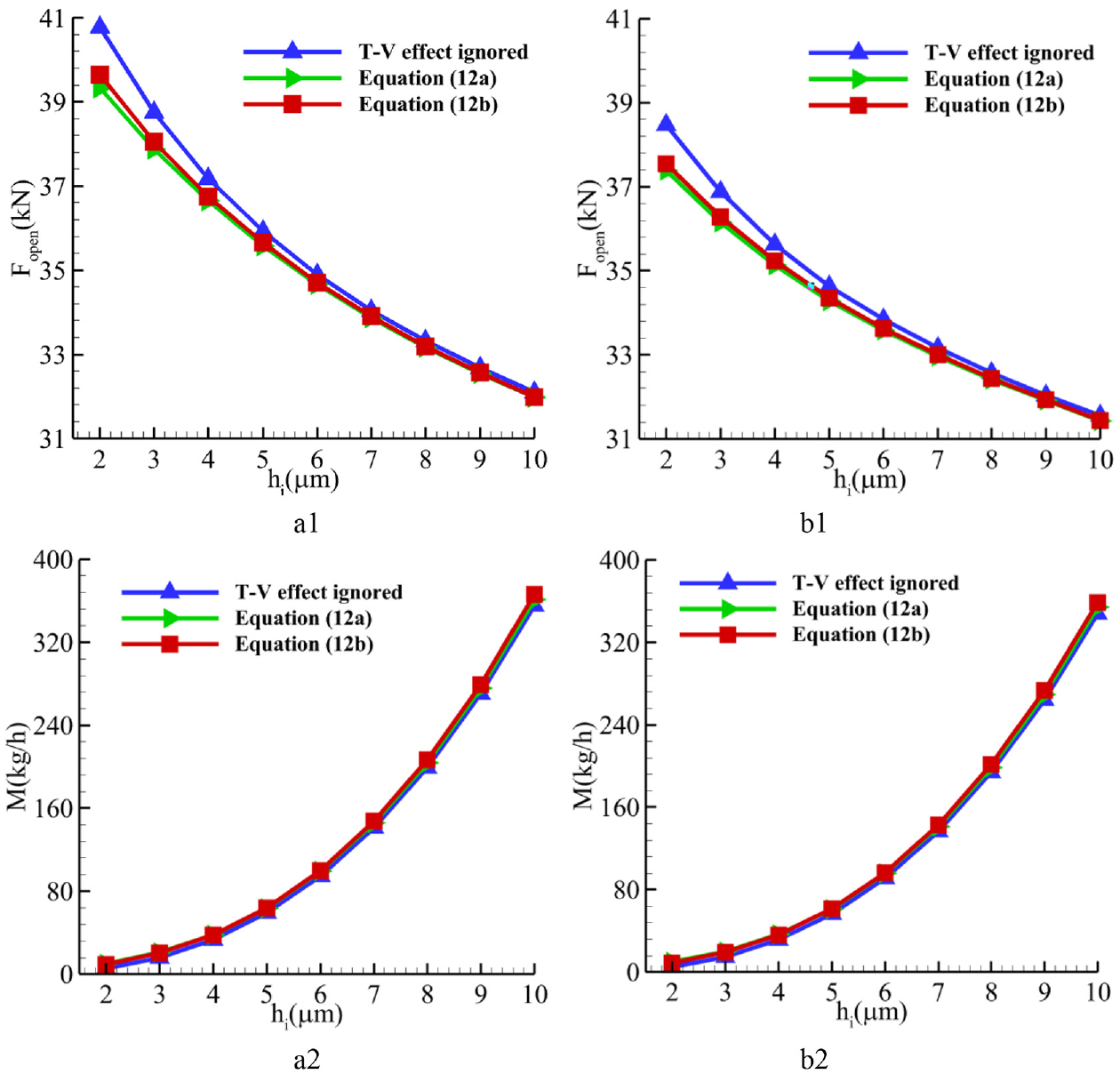
Comparison of the opening forces (up row) and leakages (bottom row) of mechanical seals under different film thickness with and without the thermo-viscous effect: (a1, a2) tapered-end-face and (b1, b2) wave-tilt-dam. T-V effect refers to thermo-viscous effect.
For the leakage discharge, as the film thickness gets large from 2 to 10 μm, the leakage dramatically increases up to a 100 times. However, the thermal effect on the discharge for both types of seals is not obvious. At large film thickness, the performance of seals gradually deteriorates.
In summary, for various base film thicknesses, the leakage and opening force are slightly affected by both the viscosity and thermal effect. Meanwhile, with the increase in thickness, there are significant increases in both leakage discharge and heat removal, thus the temperature difference between the inlet and outlet decreased sharply.
Influence of thermo-viscous effect on cavitation characteristics
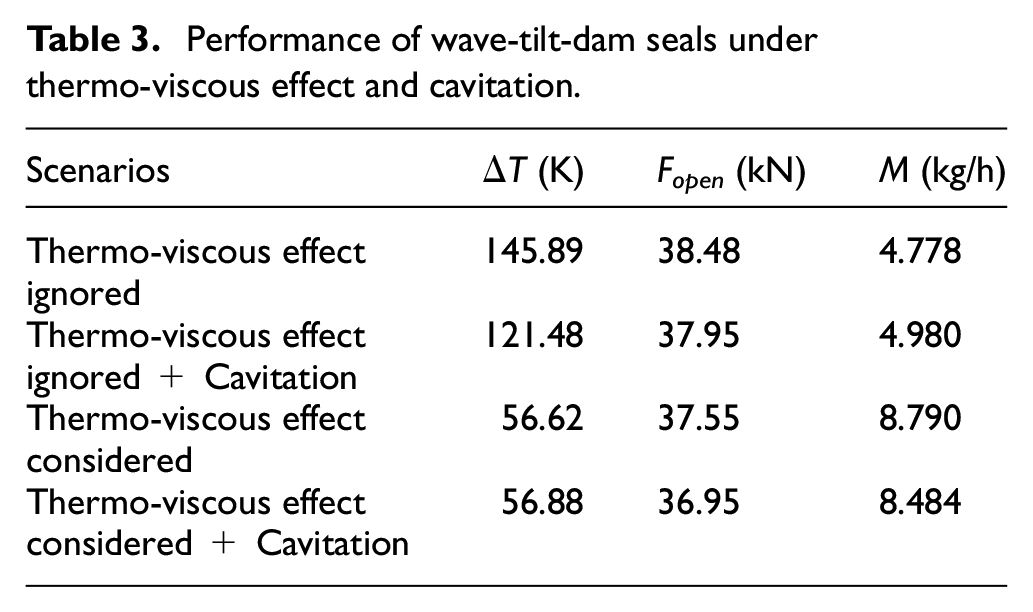
To carefully clarify the cavitation event in the base film flow, numerical simulations have been conducted by introducing the cavitation model. For two types of mechanical seals, it was shown that no cavitation was found in the tapered-end-face seal for all cases, however, cavitation occurred in the wave-tilt-dam seals at cases with low base film thickness. Thus, as follows, wave-tilt-dam mechanical seal with 2 μm film thickness is chosen to analyze the influence of thermo-viscous effect on cavitation characteristics.
Table 3 presents the temperature difference between inlet and outlet, seal leakage, and opening force under four conditions, that is, without considering thermal effect, without considering thermal effect but considering cavitation, considering thermal effect, and considering thermal effect and cavitation. From the comparison, it is revealed that cavitation has a certain influence on the seal performance, while the thermal effect influences the seal performance the most, as discussed before. With the thermo-viscous effect, the temperature rise is almost the same (0.5% deviation) as considering the cavitation process, however, both leakage discharge and opening force slightly decrease (around 3.5% and 1.6% respectively) under the cavitation case.
Performance of wave-tilt-dam seals under thermo-viscous effect and cavitation.
To further understand the flow field and cavitation effect, the temperature field, pressure field and vapor phase fraction are displayed in Figure 9, where the cases with and without thermal effect are compared. For both cases, there are local regions of low temperature corresponding to wave peaks of wave-tilt-dam seal. The low- and high-pressure regions appear at the wave troughs and wave peaks respectively, while the cavitation occurs at the troughs. Compared to the case of no thermal effect, the temperature rise greatly decreases under thermo-viscous effect, as expected. And also, the area of low-pressure region reduces, and hereby the cavitation region gets smaller.

Flow field inside the wave-tilt-dam mechanical seal by considering cavitation. Up row: thermo-viscous effect is ignored; bottom row: thermo-viscous effect is considered. (a1, a2) temperature field, (b1, b2) pressure field, and (c1, c2) volume fraction of vapor phase.
Figure 10 gives the representative streamlines and velocity fields in the liquid film, which are shown in 3D field, though the liquid film is quite thin. It is shown that the cavitation zone blocks the streamlines of the liquid phase, where the thermo-viscous effect leads to a smaller cavitation region. Such a two-phase flow is entrained by the circumferential movement of the seal, participating in the heat transfer process between solid and liquid. It is also revealed that the circumferential flow driven by the rotating ring overwhelms the pressure-driven flow through the radial direction, which hereby supports the running of the mechanical seal.

Representative streamlines (a1, a2) and velocity fields (b1, b2) in the liquid film of wave-tilt-dam mechanical seal. Up row: thermo-viscous effect is ignored; bottom row: thermo-viscous effect is considered.
Conclusions
Numerical simulations and performance analysis of thermal flow inside the mechanical seals of RCPs have been conducted. The influence of thermo-viscous effect, film thickness and cavitation on the seal’s performance is also studied, including the temperature rises, fluid leakages and opening forces. Overall, the internal flow induced viscous shear friction generates heat in the sealing ring clearance, leading to a temperature rise, and such heat should be removed by the leakage discharge, which hereby influences the opening force of the mechanical seal.
Following conclusions are drawn.
The thermo-viscous effect is of crucial importance to the performance prediction of mechanical seals, especially under conditions with low film thickness. When the thickness of the base film is 2 μm, for the tapered-end-face seal, the temperature difference between inlet and outlet, opening force and leakage are reduced by 58.4%, 2.7% and increased by 67.6%, respectively, as compared to the case where the thermal effects are ignored. Considering the thermal effect can better describe the heat and mass transfer in this case, and simulations with the newly fitted temperature-viscosity equation can predict more reasonable results than those with the conventional Reynolds equation.
The thermo-viscous effect also influences the accurate prediction of the flow field and cavitation area, and the wave-tilt-dam seal is more sensitive to the thermal effect than tapered-end-face seal. In other word, considering both thermal effect and cavitation leads to more accurate results, and which is of importance for the seal design and normal operation.
Footnotes
Handling Editor: Chenhui Liang
Declaration of conflicting interests
The author(s) declared no potential conflicts of interest with respect to the research, authorship, and/or publication of this article.
Funding
The author(s) disclosed receipt of the following financial support for the research, authorship, and/or publication of this article: This work is supported by National Natural Science Foundation of China (51976043), Liaoning Revitalization Talents Program (XLYC2007083), Liaoning BaiQianWan Talents Program (LNBQW2020Q0141) and Talent scientific research fund of LNPU (2020XJJL-010).
