Heat transfer analysis in hydromagnetic flow of couple stress fluid in presence of homogeneous and heterogeneous chemical reactions over a porous oscillatory stretchable sheet
Open accessResearch articleFirst published online February, 2023
Heat transfer analysis in hydromagnetic flow of couple stress fluid in presence of homogeneous and heterogeneous chemical reactions over a porous oscillatory stretchable sheet
The prime objective of this theoretical study is to investigate the flow, mass, and heat transfer in the time-dependent couple stress fluid over a permeable stretching oscillatory surface. The effect of applied magnetic field is also taken in the momentum equation. In addition, the energy equation is modeled by incorporating thermal radiation and heat generation. Furthermore, the concentration equation is designed in presence of homogenous and heterogeneous chemical reactions. The flow mechanism occurs because of the to and fro motion of the surface about a fixed point. For similar solution of the developed flow problem suitable similarity transformations is adopted. The analytical solution of the obtained flow equations in the form of partial differential equations (PDEs) is attained by utilizing a valuable method called Homotopy analysis method (HAM). An extensive assessment is performed to study the influence of various involved parameters namely the couple stress parameter, the relation of the parameter of the surface oscillatory frequency to its stretched rate constant, the Prandtl number, the strength of heterogeneous and homogeneous chemical reactions parameters, Schmidt number, heat production parameter and magneto-porosity parameter on the flow, concentration and temperature distributions, skin friction coefficient, and rate of heat transfer via tables and graphs and are discussed in detail. It is observed that the amplitude of velocity and skin friction coefficient shows a declining response with varying values of the couple stress parameter and it increases for higher values of the magneto-porous parameter.
Due to the numerous remarkable applications in many manufacturing and engineering processes, a number of engineers and researchers have considered the exploration of boundary layer stretching flows of non-Newtonian fluids with different velocities such as linear, nonlinear, exponential, and oscillatory during the last few decades. The most valuable industrial processes of motion of non-Newtonian liquids are wire drawing, artificial fibers, hot rolling, glass blowing, aerodynamic extrusion of plastic sheets, paper production, polymer extrusion process, distillation of towers and cooling of electronic chips etc. In all of these processes, the wall stretching velocity and stretching rate have a significant impact on the final product’s superiority. To the best of our information, Crane1 was the first who scrutinized the liquid flow problem over stretchable surface by taking into account linear velocity and find out its solution in exact closed form. Because of such most importance of non-Newtonian fluids in industrial procedures, a number of researchers have expanded the Crane concept for non-Newtonian fluids in various directions over curved and flat stretching surfaces. Rasool et al.2 has investigated magnetohydrodynamic Darcy-Forchhemier nanoliquid flow over nonlinear stretching sheet. Bhatti et al.3 has performed a numerical study to compute the numerical solution of activation energy and gyrotactic microorganism in magnetized nanofluid across a porous plate. Bhatti et al.4 has studied the magnetized flow of hybrid nanofluid across a flat elastic surface in the presence of solar energy. In another research article, Bhatti et al.5 performed a numerical study of hybrid nanofluid flow over a circular stretching surface with non-Darcy medium. On the other hand, in many manufacturing procedures such as metallurgy and textiles, a fascinating situation might arise when the stretching surface moves consistently with periodic velocity in a back and forth direction around its plane. Analysis of heat transfer based on modified Fourier’s law in flow of Maxwell fluid over an oscillatory stretching surface was done by Sami et al.6 In another article, Sami and Shahzad7 has considered the effects of thermophoresis in third grade nanofluid across oscillatory moving surface. Naveed et al.8 has discussed the effects of heat transport phenomena on curvilinear flow of micropolar liquid across an oscillatory curved stretched sheet. Imran et al.9 has investigated the consequences of thermal and mass relaxation parameters on Eyring-Powell fluid past over a curved oscillatory wall.
Couple stress fluid is a supreme significant type of non-Newtonian liquid which was initially presented by Stokes.10 Couple stress theory is simply an extension of conservative viscous notion that supports couple stress and couples in body. Examples of couple stress liquid are colloidal liquids, lubricants, and blood which contain electro-rheological and synthetic properties. Devakar et al.11 has performed an analytical research for motion of couple stress liquid with slip boundary conditions. Ali et al.12 has analyzed the various aspects of heat transport phenomenon on couple stress liquid motion due to the oscillation of oscillatory flat stretching surface in the existence of permeable material. Sami et al.13 has discovered analytical results of the mixed convective flow of couple stress nanoliquid on a stretchable oscillatory surface. Alabdan et al.14 has considered the impacts of variable viscosity for flow of couple stress nanoliquid due to oscillatory stretched sheet.
The inspection of hydromagnetic motion of an electrically conducting liquid with heat production and convective heat transport mechanism has attained a great deal of attention from various investigators, researchers and engineers due to its large number of practical utilizations in many industrial and technological operations likely in the designing purpose of cooling systems, hydromagnetic generators, storage of thermal energy, cooling of underground electric cables, gas turbine, electric motors, solar power technology, pumps, and space vehicle reentry. Sheikh and Abbas15 have considered the impacts of heat production on flow of hydromagnetic fluid across stretchable oscillatory sheet. Some researchers like Sami16 and Imran et al.17 inspected various fluid motion problems across oscillatory stretchable surfaces with heat production. Sami et al.18 has evaluated the effects of magneto-nanoparticles in non-Newtonian liquid motion across convectively oscillating moving surface. Khan et al.19 has calculated numerical simulation of hydromagnetic Power law fluid flow with convective boundary condition. The outcomes of thermal radiation on viscous fluid motion across the convectively heated oscillatory curved stretchable sheet were investigated by Abbas et al.20 Naveed et al.21 has scrutinized the analytical results of Williamson liquid motion across convectively heated curved oscillatory Riga surface.
Many chemically reactive structures such as catalysis, biomedical processes, and combustion comprise both homogeneous and heterogeneous chemical reactions. The correlation between such chemical reactions is very complex. Physical examples of such processes in which homogeneous and heterogeneous chemical reactions occur include dispersion and fog deposition, food processing, ceramics manufacturing, polymers and hydrometallurgical processes. Waini et al.22 has investigated hybrid nanofluid flow with homogeneous and heterogeneous chemical reactions. Zeb et al.23 has calculated the consequences of homogeneous heterogeneous chemical reactions on flow of non-Newtonian ferrofluid toward a stretching sheet. Effects of homogeneous and heterogeneous chemical reactions on motion of Casson nanoliquid due to curved oscillatory sheet were analyzed by Abbas et al.24 Upreti et al.25 has investigated the homogeneous–heterogeneous reactions effects in sisko nanofluid flow past across convectively heated stretching sheet.
A systematic examination of literature survey reflects that no one has yet studied the flow and transport mechanism (mass and heat transfer) in a couple stress fluid on an oscillatory stretching surface. Therefore, the prime motivation of the present study is to study the flow, heat, and mass transfer analysis in a non-Newtonian couple stress fluid. Furthermore, the impacts of heat generation along with thermal radiation is also considered in energy equation. The consequences of both homogeneous and heterogeneous chemical reactions are also incorporated in the concentration equation. The developed flow equations in the form of nonlinear PDEs are solved analytically by employing an effective technique known as Homotopy analysis method. The influence of pertinent parameters on velocity, temperature and concentration fields are shown graphically and in tabular form and are discussed in detail.
Problem explanation
Consider the two dimensional and time-dependent boundary layer flow of an incompressible couple stress liquid across a porous stretchable oscillatory sheet (see Figure 1). The sheet oscillates about a fixed point with oscillatory velocity , which is considered the cause of flow mechanism. Here denotes the stretching rate and oscillatory frequency of the surface respectively. A persistent magnetic field having strength is enforced along the normal direction of the oscillatory surface. Induced magnetic field impacts are excluded by choosing extremely low Reynolds numbers. Let the oscillatory wall temperature is and the ambient temperature is with . Additionally, homogeneous and heterogeneous chemical reactions are considered for two species and respectively. The homogeneous chemical process for cubic autocatalysis is stated as
Schematic flow geometry.
And heterogeneous chemical reaction on the catalyst sheet surface is
Here and represents the concentrations of two chemical species and , whereas and are rate constants. By letting the aforementioned assumptions, the boundary layer equations for chemically reactive flow of couple stress fluid can be written as
The associated boundary conditions are
here are considered the fluid velocity parts along directions, are the density, couple stress viscosity, kinematic viscosity, and temperature, is the suction mass velocity and is the injection mass velocity, is the specific heat capacitance, and are the diffusion coefficients and indicates the radiative heat flux which is stated as
where expresses the absorption coefficient and represents the Stefan-Boltzmann constant.
By means of Taylor series, the term which is used in equation (9) can be expanded as
The associated boundary conditions has the following dimensionless form
In above equations is the dimensionless couple stress parameters, is the relation parameter of surface oscillation frequency parameter to its stretched constant parameter, is the suction/injection parameter, is the Prandtl number, is the magneto-porous parameter, is the heat production parameter, is the homogeneous reaction strength parameter, is the radiation parameter, and is the heterogeneous reaction strength parameter respectively.
In this section, we have discussed the Homotopy analysis method, which is used to compute the analytical solution in series form of the governing equations (13), (14), and (19) with corresponding boundary conditions indicated in equation (20) by considering the following expressions24
That satisfying
Here are denotes some arbitrary variables.
If , and are non- zero auxiliary variables then the zeroth-order deformation equations are established as follows
Subject to boundary conditions
Where implies an embedding parameter and the associated non- linear operators are of the form
Put and in equations (28), (29), and (30), we obtain following solutions respectively
And
By employing Taylor series, we can develop , and as
The convergence of the accomplished equations (38), (39), and (40) are highly influenced by the range of , and . Consequently , and should be precisely designated so that the above equations (38), (39), and (40) are converge at
Differentiate zeroth order deformation equations (28)–(30) and boundary condition equation (31) by -times w.r.t embedding parameter , then set , and at the last divided by , on can attained
Where
And
Results and discussion
The principal objective of this part is to demonstrate the graphical and tabular outcomes of dissimilar involved flow parameters, likely the couple stress parameter ratio parameter of sheet oscillatory frequency parameter to its constant rate parameter radiation parameter and magneto-porous parameter , heat production parameter and homogeneous reaction strength variable Biot number Schmidt number Prandtl number suction/injection parameter and heterogeneous reaction parameter on the fluid motion velocity field, the concentration and temperature distribution, the drag surface force coefficient and on Nusselt number respectively in detail.
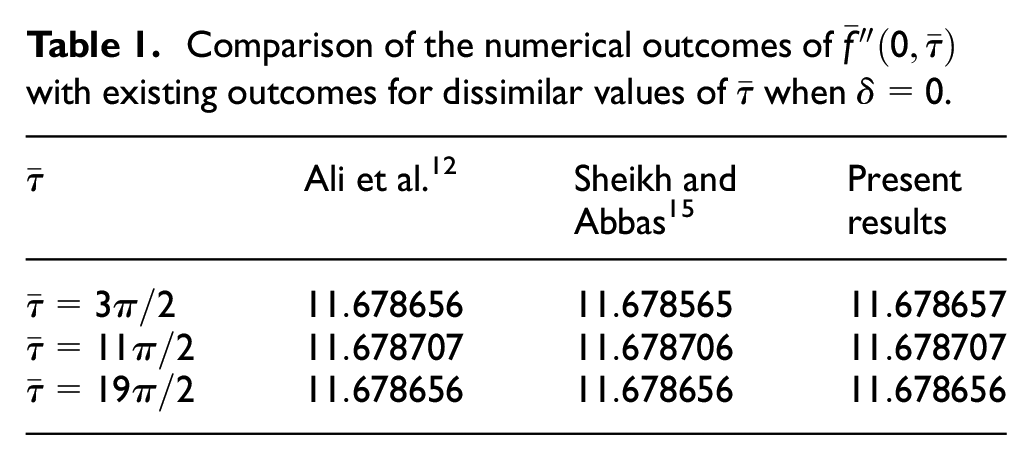
Table 1 is constructed to perform the comparison between the outcomes of the present research and the results of the existing literature by taking couple stress parameter at different time instants, and they are found to be in good agreement.
Comparison of the numerical outcomes of with existing outcomes for dissimilar values of when .
Table 2 detects that the magnitude of local Nusselt number depicts elevating behavior with uplifting values of However, its magnitude decreases with heat production parameter
Numerical assessment of at with and fixed.
0.5
1.0
0.5
0.2
0.249538
2.0
0.248909
3.5
0.248274
0.5
1.5
0.249619
3.0
0.249863
4.5
0.250108
1.0
0.3
0.216338
0.6
0.266130
0.9
0.315872
0.5
0.3
0.345269
0.4
0.427215
0.5
0.498153
Figure 2(a) to (c) expound the consequences of , and on the profile of velocity at fixed position from the wall of the sheet for intervals of time . This figure clearly represents that the liquid velocity amplitude diminishes for rising values of suction/injection parameter and parameter of couple stress . Whereas, it grows for upward values of parameter
Variation in amplitude of : (a) influences of , (b) influences of , and (c) influences of by keeping other parameters.
The influences of on at some fixed time instant and are illustrates in Figure 3(a) and (b). The profile shows diminishing behavior with parametric values of . Figure 4(a) and (b) is drawn to explain the outcomes of on at and respectively. It is clearly detected that profile is decreased by an increase in . Figure 5(a) and (b) presents the effects of couple stress variable on at and . This figure confirmed that velocity profile is reduced for varying . Figure 6(a) and (b) demonstrates the impacts of on at and fixed. It is witnessed that profile is declining function of .
Consequences of on for unalike intervals of time: (a) and (b) .
Impacts of on : (a) and (b) .
Consequences of on profile for unalike intervals of time: (a) and (b) .
Consequences of on : (a) (b) .
The variation in temperature distribution profile under the influences of different parameters namely and at is discussed through Figure 7(a) to (d). From Figure 7(a), (b) and (d) it can be noticed that the temperature profile shows increasing response for improving values of , and . However, from Figure 7(c) it is clear that is decreased by mounting values of
Change in temperature profile : (a) influences of , (b) influences of , (c) influences of , and (d) influences of .
The impacts of , and on concentration distribution profile at is explained in Figure 8(a) to (d). Figure 8(a) and (c) show increasing response of concentration profile with varying values of and , while Figure 8(b) and (d) depicts reducing behavior of for enhanced values and
Alteration in concentration profile for : (a) influences of , (b) influences of , (c) influences of , and (d) influences of
Figure 9(a) to (d) interprets the influences of dissimilar parameters such as , and on for It is clearly seen that amplitude is diminished with and is enlarged with uplifting values of , , and
Variation in skin friction coefficient : (a) influences of , (b) influences of , (c) influences of , and (d) influences of .
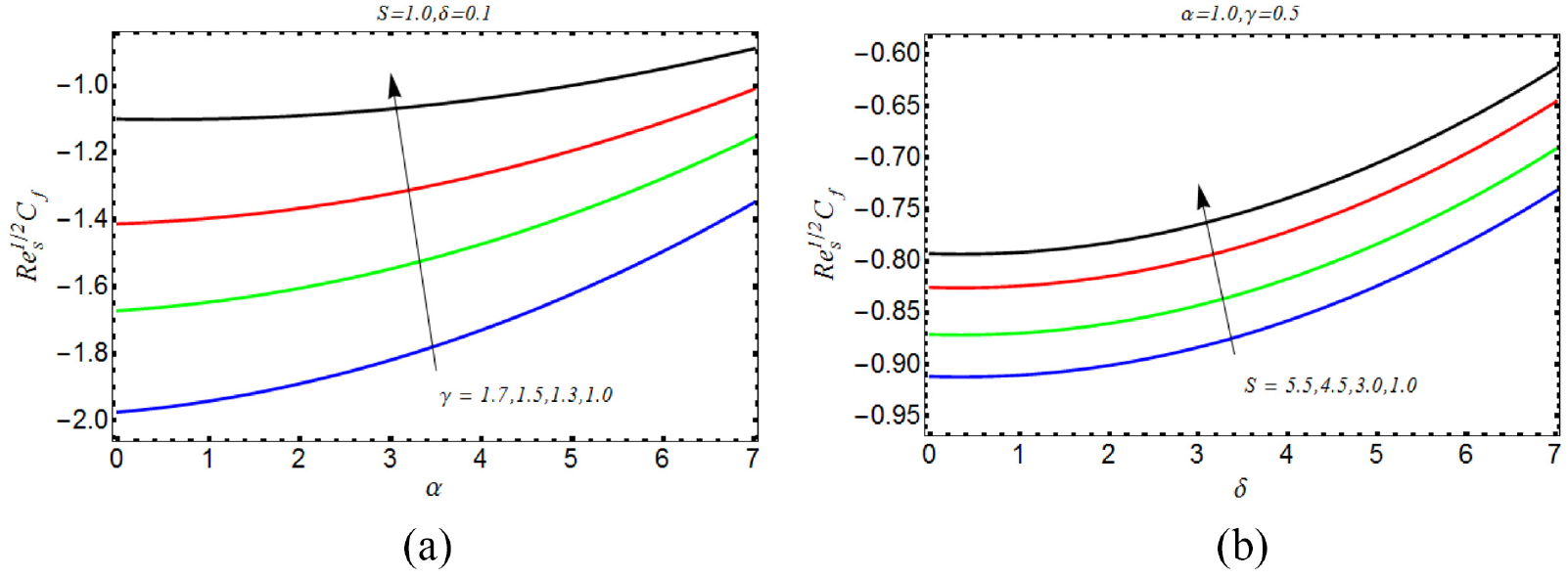
Figure 10(a) and (b) elucidates the consequences of versus and versus at . The magnitude of is enhanced for with and , however it is declined with enhancing values of and
(a) Variations in with versus and (b) variations in with versus when .
Figure 11(a) to (d) illustrates the outcomes of various parameters , and on surface concentration profile at the instants . It is noticed that the amplitude of is reduced with and . Whereas, it is increased with growing and
Variation in profile of surface concentration at: (a) influences of , (b) influences of , (c) influences of , and (d) influences of by keeping other parameters fixed.
Concluding remarks
In this research inquiry, the consequences of homogeneous and heterogeneous chemical reactions on thermally radiative unsteady flow of couple stress liquid over an oscillatory stretching porous surface have been observed. Also the consequences of porous medium and constant magnetic field are considered in momentum equation. Here, the major key findings of the current assessment are presented as follows
The amplitude is declined for increasing values of and Whilst, it improved for
At time and , the velocity of the profile show diminishing behavior with varying values of , and . However, it shows increasing response with
The temperature distribution is reducing function of Prandtl number . While, it increases for , and
The improvement in profile of concentration distribution is noted with an enhancement in and However, it shows opposite trend for and
For mounting values of ,, and the skin friction coefficient amplitude depicts growing response and it declines with
At time , the magnitude of skin friction coefficient enhances with upward values of and , and for higher and , it shows the opposite trend.
The amplitude of surface concentration reduces by increasing and and it rises up for uplifting values of and
The Nusselt number magnitude is growing function of Whilst, its magnitude depicts opposite manner with
Footnotes
Appendix
Acknowledgements
We are thankful to the honorable reviewers for their encouraging comments and constructive suggestions to improve the quality of the manuscript.
Handling Editor: Chenhui Liang
Declaration of conflicting interests
The author(s) declared no potential conflicts of interest with respect to the research, authorship, and/or publication of this article.
Funding
The author(s) received no financial support for the research, authorship, and/or publication of this article.
ORCID iDs
Muhammad Naveed
Muhammad Imran
References
1.
CraneLJ. Flow past a stretching plate. Zeitschrift für angewandte Mathematik und Physik1970; 21: 645–647.
2.
RasoolGShafiqAKhaliqueCM, et al. Magnetohydrodynamic Darcy–Forchheimer nanofluid flow over a nonlinear stretching sheet. Phys Scr2019; 94: 105221.
3.
BhattiMMShahidAAbbasT, et al. Study of activation energy on the movement of gyrotactic microorganism in a magnetized nanofluids past a porous plate. Processes2020; 8: 328.
4.
BhattiMMÖztopHFEllahiR. Study of the magnetized hybrid nanofluid flow through a flat elastic surface with applications in solar energy. Materials2022; 15: 7507.
5.
BhattiMMEllahiRHossein DoranehgardM. Numerical study on the hybrid nanofluid (Co3O4-Go/H2O) flow over a circular elastic surface with non-darcy medium: application in solar energy. J Mol Liq2022; 361: 119655.
6.
SamiUKAliNHayatcT, et al. Heat transfer analysis based on cattaneo-christov heat flux model and convective boundary conditions for flow over an oscillatory stretching surface. Therm Sci2017; 23: 172–455.
7.
SamiUKShehzadSA. Brownian movement and thermophoretic aspects in third-grade nanofluid over oscillatory moving sheet. Phys Scr2019; 94: 095202.
8.
NaveedMImranMAbbasZ. Curvilinear flow of micropolar fluid with cattaneo–christov heat flux model due to oscillation of curved stretchable sheet. Zeitschrift für Naturforschung A2021; 76: 799–821.
9.
ImranMAbbasZNaveedM. Flow of eyring-powell liquid due to oscillatory stretchable curved sheet with modified fourier and fick’s model. Appl Math Mech2021; 42: 1461–1478.
10.
StokesVK. Couple stresses in fluids. Phys Fluids1966; 9: 1709–1715.
11.
DevakarMSreenivasuDShankarB. Analytical solutions of couple stress fluid flows with slip boundary conditions. Alex Eng J2014; 53: 723–730.
12.
AliNUllah KhanSSajidM, et al. MHD flow and heat transfer of couple stress fluid over an oscillatory stretching sheet with heat source/sink in porous medium. Alex Eng J2016; 55: 915–924.
13.
SamiUKShehzadSARaufA, et al. Mixed convection flow of couple stress nanofluid over oscillatory stretching sheet with heat absorption/generation effects. Results Phys2018; 8: 1223–1231.
14.
AlabdanRKhanSUAl-QawasmiAR, et al. Applications of temperature dependent viscosity for cattaneo–christov bioconvection flow of couple stress nanofluid over oscillatory stretching surface: a generalized thermal model. Case Stud Therm Eng2021; 28: 101412.
15.
SheikhMAbbasZ. Effects of thermophoresis and heat generation/absorption on MHD flow due to an oscillatory stretching sheet with chemically reactive species. J Magn Magn Mater2015; 396: 204–213.
16.
SamiUKShehzadSANasirS. Unsteady flow of chemically reactive Oldroyd-B fluid over oscillatory moving surface with thermo-diffusion and heat absorption/generation effects. J Braz Soc Mech Sci Eng2019; 41: 72.
17.
ImranMAbbasZNaveedM, et al. Impact of Joule heating and melting on time-dependent flow of nanoparticles due to an oscillatory stretchable curved wall. Alex Eng J2021; 60: 4097–4113.
18.
SamiUKShehzadSAAliN. Interaction of magneto-nanoparticles in Williamson fluid flow over convective oscillatory moving surface. J Braz Soc Mech Sci Eng2018; 40: 1–12.
19.
Waleed Ahmad KhanMIjaz KhanMHayatT, et al. Numerical solution of MHD flow of power law fluid subject to convective boundary conditions and entropy generation. Comput Methods Programs Biomed2020; 188: 105262.
20.
AbbasZImranMNaveedM. Time-dependent flow of thermally developed viscous fluid over an oscillatory stretchable curved surface. Alex Eng J2020; 59: 4377–4390.
21.
NaveedMAbbasZImranM. Analytical simulation of time dependent electromagneto-hydrodynamic flow of Williamson fluid due to oscillatory curved convectively heated Riga surface with variable thermal conductivity and diffusivity. Proc IMechE, Part E: J Process Mechanical Engineering2021; 236: 09544089211062357.
22.
WainiIIshakAPopI. Hybrid nanofluid flow with homogeneous-heterogeneous reactions. Comput Mater Contin2021; 68: 3255–3269.
23.
ZebHBhattiSKhanU, et al. Impact of homogeneous-heterogeneous reactions on flow of non-Newtonian ferrofluid over a stretching sheet. J Nanomat2022; 2022: 1–11.
24.
AbbasZImranMNaveedM. Impact of equally diffusive chemical reaction on time-dependent flow of casson nanofluid due to oscillatory curved stretching surface with thermal radiation. Arab J Sci Eng2022; 47: 16059–16078.
25.
UpretiHJoshiNPandeyAK, et al. Homogeneous–heterogeneous reactions within magnetic sisko nanofluid flow through stretching sheet due to convective conditions using Buongiorno’s model. J Nanofluids2022; 11: 646–656.