This article is based on the mathematical model constructed to analyze the simultaneous flow and heat transfer of two nanoliquids (Casson and Williamson) in the presence of gyrotactic microorganisms and cubic autocatalysis chemical reaction through a porous medium under the potentiality of buoyancy forces. Heterogeneous reaction existing on the surface is described by isothermal cubic autocatalytic chemical reaction, whereas homogeneous reaction is taking place at far field described by first-order kinetics. Similarity transformations are used to get the different order differential equations from the governing equations which are solved via an efficient technique namely homotopy analysis method. The effects of all the non-dimensional parameters on velocity, temperature, concentration, and density of motile microorganisms are shown through graphs and elucidated. Velocity increases with the Weissenberg parameter and decreases with the Casson nanofluid parameter in the presence of magnetic field and porous medium. Temperature decreases with the high values of slip condition. The dual behavior of concentration profile for the strength of homogeneous reaction parameter is observed. Flow of microorganisms decreases based on the parameters of porous medium, magnetic field, and heterogeneous chemical reaction. There exists an excellent agreement between the present and published work.
The assortment of the structure, propulsive movement, and nutritive behavior of phytoplankton has long motivated the fluid physicists. Microplankton is the basic part of the food chain and supports the biochemistry of most marine aquatic. Microbes’ extended species of microorganisms including bacteria up to jellyfish cannot be ignored in an ecosystem because of its diverse nature and cumulative biomass. Largest reservoirs of phytoplankton that reside in the ocean are providing more than half of the world oxygen. Bioconvection is the dynamic phenomenon produced in the motion of swimming microbes that are much flattened than water medium. These microorganisms swim toward the upper portion of fluid in response of outer impetuses like chemical gradient, light intensity, or gravity results of an upper denser surface due to the accretion of motile microorganisms. The density imbalance creates gravitational instabilities after getting to a critical position and eventually the microbes drop causing bioconvection. Very simply in bioconvection, the density of macroscopic convective flow is higher than water. The main advantage of merging microorganisms in nanofluid is to enhance the mass transfer for improving the stability and reliability of nanofluid.
Bioconvection nanofluid is used in a fuel cell, bio-diesel, bio-reactor, bio-microsystem, and gas-bearing sedimentary, and so on. On account of such applications, Khan1 analyzed the bioconvection in second-grade thin film nanofluid containing gyrotactic microorganisms and nanoparticles through specific boundary conditions model named as passively controlled nanofluid model which is key for complex bioconvection pattern relevant to real life. Zuhra et al.2 studied the time-independent, two-dimensional (2D) magnetohydrodynamic second-grade nanofluid flow that contains gyrotactic microorganisms and illustrated the impacts of various parameters reliant to the non-dimensional model, skin friction, rate of heat transfer, the mass of nanoparticles, and microorganisms.
Non-Newtonian fluid is a rising feature of multiscale and structural fluid material ranging from polymer melt to colloidal suspension. High demand of industrial and technological science intensifies the importance of non-Newtonian fluids used as physical gel, multi-grade oil, liquid detergents, paints (polymer melts and polymer solution), and so on. Khan et al.3 discussed the thermophoresis and thermal radiation effects on non-Newtonian thin film liquid in the regime of heat and mass transfer past a stretching sheet. Main finding of their work is the significant role of variable thermal conductivity and viscosity of non-Newtonian thin film fluid flow.
Advancement in nanotechnology led to new innovative class with special property of heat transfer called nanofluid. Non-Newtonian nanofluid is the homogeneous mixture of base liquid (non-Newtonian fluid) like carboxy methyl cellulose (CMC) with nano-sized particles , rods or tubes in ethylene glycol used with specific quantities to enhance the thermal conductivity that work on high cooling/heating-based problems of electronic appliances. The effects of nanofluids depend on nanoparticles (types, size, and shape), concentration, nature of base fluid, volume fraction of nanoparticles, pH, temperature, nanoparticle clustering, heat transport, and so on. The first experimental study on nanofluid to enhance the thermal conductivity was performed at the US Argonne National Laboratories. Then Choi4 reported the innovative work on nanofluid in which he presented the ideas to enhance thermal conductivity using suspension containing ultrafine particles. Experimental observation has been made by Beg et al.5 based on rheology and lubricity properties of drilling fluid including different nanoparticles (silica, titanium, etc.). The aim of their work was to assess the rheological characteristics of various nanoparticles in mud, taking water as a base fluid that supports to decrease drag and torque during the construction of swerved wells. Titanium nanoparticles show better results to improve lubricity and rheological features of drilling fluid at 0.6% (w/w) concentration. Viscoelastic fluid passing through the curved pipes with slip boundary conditions has been studied by Norouzi et al.6 They employed the Oldroyd-B scheme to the transport of dilute polymeric solutions in curve pipes, where Weissenberg number and slip coefficients greatly affected the viscoelastic flow. It is found that maximum velocity position changes from pipes center toward the outer side of curvature when increment occurs in slip coefficient. Beg et al.7 examined the mathematical model for steady, force convection, and hydromagnetic polymeric nanofluids flow under the influence of magnetic force. Four types of nanoparticles with three base fluids are taken into account for the flow model. It is observed that silver nanoparticles enhance flow, energy, and induced magnetic field. Unsteady, magnetohydrodynamic chemically reactive, rotating micropolar fluid flow past a vertical plate under the Hall current and viscous dissipation model is investigated by Sheri and Shamshuddin.8 They used variational finite-element method and examined physical quantities like skin friction, wall flux, surface heat flux, and mass flux through rotational and viscosity parameters. Beg et al.9 developed a numerical scheme for steady, magnetohydrodynamic, heat and mass convection flow through the inclined surface with the effect of heat generation and Soret diffusion model. Numerical method Nachtsheim–Swigert shooting iterative technique is used for computing the result of the flow model. It is observed that the magnetic field parameter depresses the skin friction, and mass transfer rate is decreased by heat source parameter. Khan et al.10 worked on nanofluids and discussed the impacts of thermophoresis and Brownian motion parameters on hydrodynamic thin film second-grade flow. Zuhra et al.11 discussed thin film non-Newtonian Casson and Williamson nanofluids flow in the presence of heat transfer properties with water as the base fluid which contains graphene nanoparticles. In addition, magnetic field is also considered in that flow model. Khan et al.12 studied 2D steady flow problem with magnetohydrodynamic water-based nanoliquids like and under thin film, which is sprayed on a stretching cylinder with heat conduction. The spray rate depends on film size. Zuhra et al.13 analyzed the gyrotactic microbes and nanoparticles in an unsteady symmetric flow along with heat transfer in second-grade nanofluid lying between parallel horizontal plates, in which the lower plate is stationary. They discussed the notion of unsteadiness parameter in the situations when two plates are close to each other or far away. Khan et al.14 analyzed the graphene type of nanoparticles using Powell–Eyring fluid on time-dependent magnetohydrodynamic 2D thin film flow, in which the graphene nanomaterial enhances thermal conductivity with the water base fluid.
On the contrary, an important area for heat conductivity in industrial applications is the usage of porous medium containing pores (voids). Porosity of a substance is the volume of storage capacity that can grip the fluid. Porous medium is specially characterized by its porosity while the other medium used on an industrial level is derived from this porosity are tensile strength, tortuosity, permeability, and electrical conductivity. Porous medium increases the interface surface area between solid and fluid surfaces, as it is the composition of solid (matrix) and fluid (gas, water, oil, etc.) which can help to enhance the heat transfer effects. Other applications of porous medium are heat exchangers, porous burners, solar collectors, and porous blades. Shamshuddin et al.15 used a porous plate for Casson fluid with chemical reaction and thermal radiation effects. Relevant parameter impacts are computed in graphs by finite-element method. The radiative thermal parameter is caused to elevate temperature, while the chemical reaction parameter depressed the concentration profile. Magnetohydrodynamic micropolar fluid flow with heat and mass convection under the influence of viscous dissipation and chemical reaction is investigated by Sheri and Shamshuddin et al.,16 where viscosity parameter has an inverse relation to the flow and micropolar field.
Palwasha et al.17 analyzed porous medium in a non-Newtonian nanofluid thin films flow with magnetotactic microbes using the passively controlled nanofluid model and discussed the effects of different parameters on heat and mass transfer as well as gyrotactic microorganisms. Khan et al.18 investigated porous and other parametric influences on momentum and temperature derived from the steady boundary layer flow and heat transfer of a second-grade thin film fluid through a porous surface. In that study velocity and temperature profiles become slow with porosity. Ramzan and Bilal19 discussed the flow model containing unsteady second-grade fluid with thermal radiation through a permeable vertical sheet. Umavathi and Hemavathi20 studied the flow and heat transport of nanofluid in composite porous medium and investigated the behavior of Grashof number, solid volume fraction, and Brinkman number using five different types of nanoparticles in the base fluid. It is concluded that they obtained the maximum quantity of Nusselt number from silver nanoparticles.
Homogeneous–heterogenous cubic autocatalysis chemical reactions are new phenomena in nanofluid field used to illustrate catalysis, for fibrous insulation, in artificial formation of fog, and in environmental science to control water and air pollution. Raees et al.21 analyzed the homogeneous–heterogeneous model to scrutinize the mixed convection gravity-driven thin film flow of nanofluid. Their further discussion was done on buoyancy parameter and strength of homogeneous–heterogeneous parameters. Homogeneous–heterogeneous chemical reaction is considered in nanofluid due to its significant role in chemical reaction mechanisms like autocatalysis, catalysis oxidation, combustion, and biochemical system on commercial level. Khan et al.22 analyzed the effect chemical reactions over the entropy generation flow of Williamson fluid in the presence of viscous dissipation and magnetic field. Their study elaborated the increase in temperature distribution for Weissenberg and Eckert numbers. Kameswaran et al.23 investigated the cubic autocatalysis process of homogeneous–heterogeneous chemical reactions in nanofluid and concluded that strength of nanofluid heterogenous reaction decreases the nanofluid concentration at the surface. Williams et al.24 investigated the isothermal behavior of homogeneous–heterogeneous chemical reactions in air on methane/ammonia and propane flowing over platinum. Significance of autocatalytic homogeneous–heterogeneous chemical reactions and Cattaneo–Chirstove heat flux has been studied by Sarojamma et al.25 for a micropolar fluid. They proved that concentration of homogeneous nanofluid at surface decreases in the presence of microstructures and catalyst, and it increases due to diffusion ratio.
The problems of dynamic world led to the use of analytical and numerical techniques to find out the appropriate solutions of highly nonlinear and complex models. Although advancements in programming (like Mathematica, MATLAB, Maple, C++, JAVA etc.) facilitate to solve such heavy, time-consuming, ordinary differential equation/partial differential equation (ODE/PDE) problems, it is still the focused field for researchers to create and analyze advance techniques that evaluates results of the nonlinear equations having multiple parameters arising from natural phenomena. In literature, the running techniques are finite difference method (FDM),26 variational iteration method (VIM),27 differential transform method (DTM),28 homotopy analysis method (HAM),29–31 homotopy perturbation method (HPM),32 and optimal homotopy asymptotic method (OHAM).33–35 Zuhra and colleagues36,37 applied OHAM to seventh-order time-dependent Kortewege-de-Vries (Kdv) equations, to Benjamin–Bona–Mahoney and Sawada Kotera equations successfully and proved the closed agreement through comparison with exact and various other methods. Khan et al.38 implemented OHAM to solve the nonlinear coupled differential equations evaluating from Berman’s model of viscous flow in porous channel and elaborated the effect of Reynolds number in the process of wall injection/suction. Islam et al.39 solved the singular boundary value problems through the same technique.
It is proved from the above investigative study that the dynamic phenomenon is affected by different parameters, boundary conditions, and geometries like Palwasha et al.’s40 study on stretching sheet, like Khan et al.’s41 study on gravity-driven problem, and like Khan et al.42, who showed the study in a three-dimensional rotating system. Literature43–46 also has a study under high magnetic field effect, a study which shows the effect of inclined magnetic field, a study for hybrid nanofluid, a study on thin film graphene nanoliquid and so on. However, these studies have not discussed homogeneous–heterogeneous chemical reaction effects.
The homogeneous–heterogeneous chemical reactions that are produced in forced or in free convective region is an emerging area of recent research in gravity-driven flow. Interest toward this side is rare in literature. For this purpose, it is attempted to analyze the behaviors of homogeneous–heterogeneous chemical reactions and gyrotactic microorganisms in gravity-driven Casson and Williamson nanofluids flow through a porous medium with heat transfer. Buongiorno’s model has been used for this purpose. Employing suitable similarity transformations, the governing equations of the model are transformed to non-dimensional system of differential equations which are solved through a powerful semi-analytical technique named as HAM. Impacts of relevant parameters on the velocity, temperature, nanofluid concentration, and density of motile microorganism profiles are displayed through graphs and discussed.
Description of the problem
Two-dimensional, steady, laminar, thin film flow containing incompressible nanofluids are considered, which are falling down along a vertical solid surface in the presence of homogeneous–heterogeneous reactions. Temperature of nanofluid is assumed constant at vertical surface while is the temperature of far field from the surface (Figure 1). A transverse magnetic field of strength is applied in positive direction, normal to the surface. There is no applied voltage. Magnetic Reynolds number is small, so the induced magnetic field and Hall effects are considered as negligible.
Geometric model of the problem with coordinate system.
Chaudhary and Merkin47 represented a simple model for homogeneous–heterogeneous reactions that is used in cubic autocatalytic reactions in isothermal catalyst particles
In addition, single and first order reaction exist on the catalyst surface as
where and denote the concentrations of species and , respectively, and are constant rate of concentrations. Reactant is to be assumed at distant field with concentration, whereas reactant does not exist in external flow. Furthermore, it is assumed that the quantity of heat released during the homogeneous–heterogeneous chemical reaction is too small as negligible, so there is no term related to heat transfer in energy equation.
The basic governing boundary layer equations of 2D, steady thin film heat and mass transfer flow with gyrotactic microorganisms and heterogenous–homogeneous chemical reactions are as in literature17,21
where
The boundary conditions are
where denotes the heat transfer coefficient due to . To satisfy the boundary conditions, must be assigned the value of 0.
shows that the surface temperature is the result of convective heating procedure which is indicated by the coefficient of heat transport and temperature of the hot fluid under the surface. shows the passively controlled nanofluid model boundary conditions. The passively controlled nanofluid model boundary conditions17 are better than actively controlled nanofluid model boundary conditions30 since these are more realistic. Note that in Figure 1 geometry, the concentration notations are used which are handled like.21
In equations (1)–(7), the velocity components and are taken in and directions, respectively. In equation (2), a dimensionless number is used to switch the momentum equation to Williamson nanofluid flow when is used and to Casson nanofluid flow when . is the kinematic viscosity with as dynamic viscosity and is the constant density of nanoliquid. and denote the dynamic viscosity of Casson and Williamson nanofluids where the superscripts and denote the Casson and Williamson nanofluids.
is the free stream velocity of boundary layer. is the gravitational acceleration. is the parameter of Casson nanofluid, where and are the volumetric thermal expansions (substance expand or contract in all directions due to changes in temperature) of Casson and Williamson nanofluids, respectively. is the difference between the densities of cell and base fluid, where the subscripts and denote nanofluid and base fluid at the far field, respectively. is the electrical conductivity. is the pressure, is the concentration, is the fluid temperature at the vertical surface. is the permeability of porous medium and is the Forchheimer resistance factor, is the thermal diffusivity of nanofluid defined by thermal conductivity , density , and heat capacity . and are the coefficients of diffusion rate of species and . denotes the thermal diffusion (Soret effect) and is the microorganisms diffusivity. With reference to boundary layer approximations, the internal dissipation process of energy that takes place in homogeneous thermodynamics system which has been ignored so all the fluid quantities are constant. Moreover, it is assumed that buoyancy produced through the nanoparticles concentration is insignificant, so there is no difference between and . is the volumetric fraction of motile microbes. represents the average swimming velocity vector of motile microorganisms, where is the maximum speed of motile microorganisms in response to chemical concentration (coefficient of chemotaxis).
To achieve the non-dimensional form of equations (2)–(6), (8), and (9), the following similarity transformations have been used
Using equation (10) in equations (2)–(6), (8), and (9), the final set of governing non-dimensional equations of flow, temperature, homogeneous–heterogeneous chemical reactions and gyrotactic microorganisms concentration are achieved as
It is accepted from the application of heterogeneous–homogeneous chemical reactions process that the diffusion coefficients and of chemical species and are of different size. On the contrary, if and are equal, that is, by taking 23 and equations (13) and (14) are reduced to equation (16) as
consequently, the overall boundary conditions become
In equations (11), (12), and (15)–(17), is Weissenberg number used for the viscoelastic flow, and are the parameters of buoyancy forces caused by volumetric expansion of Casson and Williamson nanofluid, respectively, such that . is the buoyancy ratio parameter, is the Rayleigh number associated with buoyancy-driven flow. is the reduced heat transfer parameter, is the porosity parameter, while is the inertial parameter. is the parameter of magnetic field. Other parameters are Prandtl number , Schmidt number , Lewis number . (proportion of the diffusion constants). Peclet number is , is the coefficient of strength of homogeneous reaction, whereas is the parameter for strength of heterogeneous chemical reaction. is defined as the ratio between Brownian motion and thermophoresis physical diffusivity such that .
Physical quantities2 used here are the skin friction coefficient , local Nusselt number , local wall mass flux coefficient , and mass flux of microorganisms , where , and .
is the shear stress, is the heat flux, is the mass flux, and is the motile microorganisms flux at surface.
Using the similarity transformations of equation (10), the non-dimensional form of skin friction, Nusselt number, wall mass flux, and wall flux of motile microorganism are as follows
where is the local Reynolds number.
Series solutions by homotopy analysis method
HAM29,40–46 is used to compute the semi-analytical series solutions of equations (11), (12), and (15)–(18). The initial guesses and auxiliary linear operators proposed by Liao29 for the velocity , temperature , homogeneous–heterogeneous chemical reactions , and microorganisms concentration are as follows
with the properties
where are the arbitrary constants.
Zeroth-order deformation problems
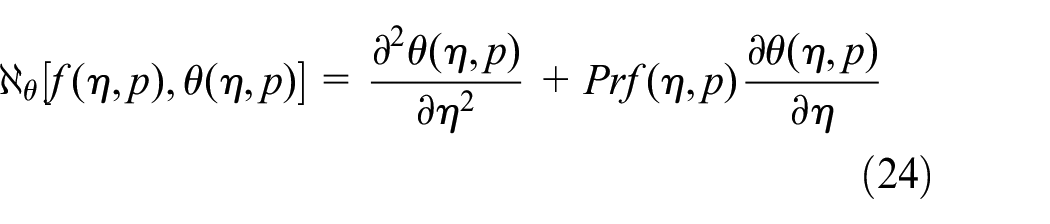
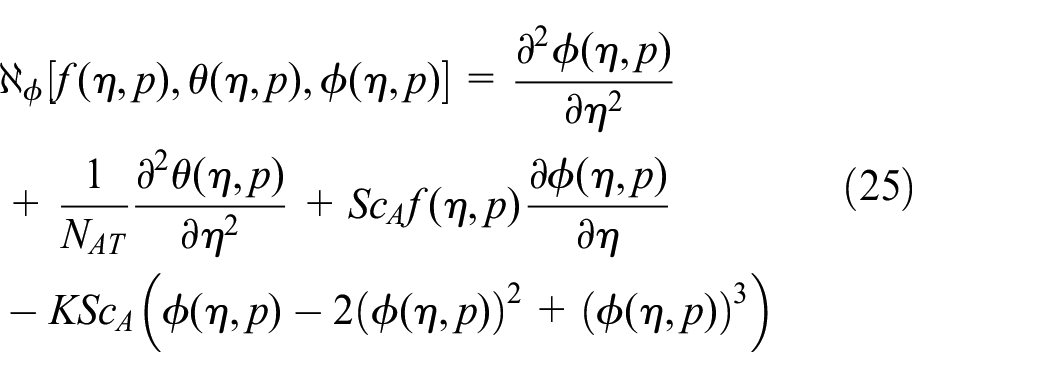
Presenting nonlinear operator as
where is an embedding parameter such that .
According to homotopy, zeroth-order deformations are
where is non-zero auxiliary parameter.
Equations (27)–(30) have the following boundary conditions, respectively
When the parameter (initial value of range) and (final value of range), the following equations become
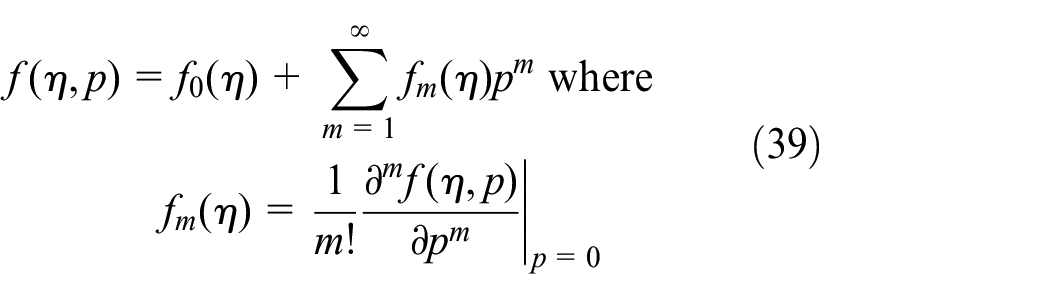
becomes to for , becomes to , becomes to and becomes to when assumes the values from 0 to 1. Using Taylor’s expansion on equations (35)–(38), it is obtained as follows
Convergence of series solutions depends on auxiliary parameter . The value of is taken in such a way that the series in equations (39)–(42) converges at , hence results of equations (39)–(42) are
mth-order deformation problems
Taking derivative of the pairs of equations ((27), (31)), ((28), (32)), ((29), (33)), and ((30), (34)) then dividing by and substituting result the following
General solution of equations (47), (50), (53), and (56) with particular solutions , and are the following
Results and discussion
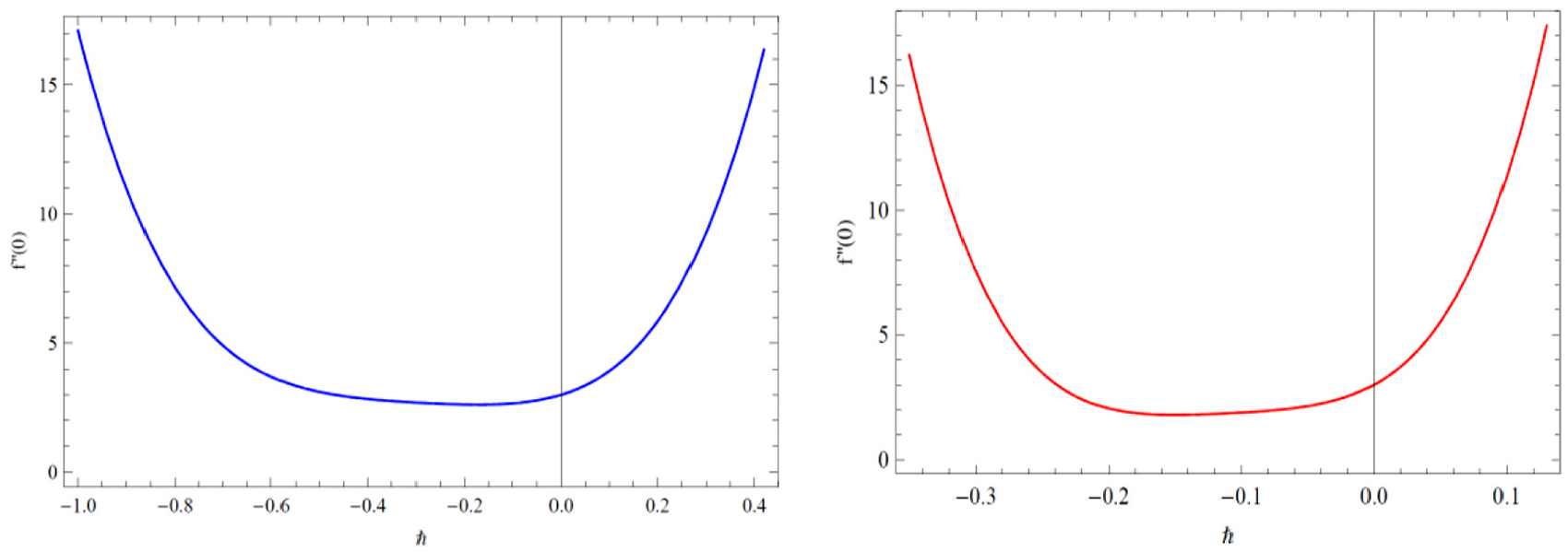
HAM is used to evaluate the solution of the nonlinear differential equations with boundary conditions derived from non-Newtonian nanofluids flow model using the homogeneous–heterogeneous chemical reactions in the presence of a magnetic field. The homotopic solution derived from equations (11), (12), (15), and (18) is expressed for non-dimensional velocity profile , non-dimensional temperature profile , non-dimensional chemical concentration profile , and non-dimensional motile density microorganisms concentration profile . The h-curves are drawn in Figures 2-5. Effects of different parameters related to these profiles have been discussed through graphs in Figures 6–24. For the convergence region formulated by Liao29 for the HAM, plays a key role in the convergence of the semi-analytical solution to exact form. Appropriate curve for velocity is drawn in range and , for temperature curve range is and , the range of chemical concentration profile is and , for microorganisms concentration interval is and for Williamson (blue line) and Casson (red line) nanofluids, respectively.
curve29 of for Williamson and Casson nanofluids respectively.
curve29 of for Williamson and Casson nanofluids respectively.
curve29 of for Williamson and Casson nanofluids respectively.
curve29 of for Williamson and Casson nanofluids respectively.
Velocity behavior for variations in M.
Velocity behavior for variations in .
Velocity behavior for variations in .
Velocity behavior for variations in .
Velocity behavior for variations in .
Velocity behavior for variations in .
Velocity behavior for variation in .
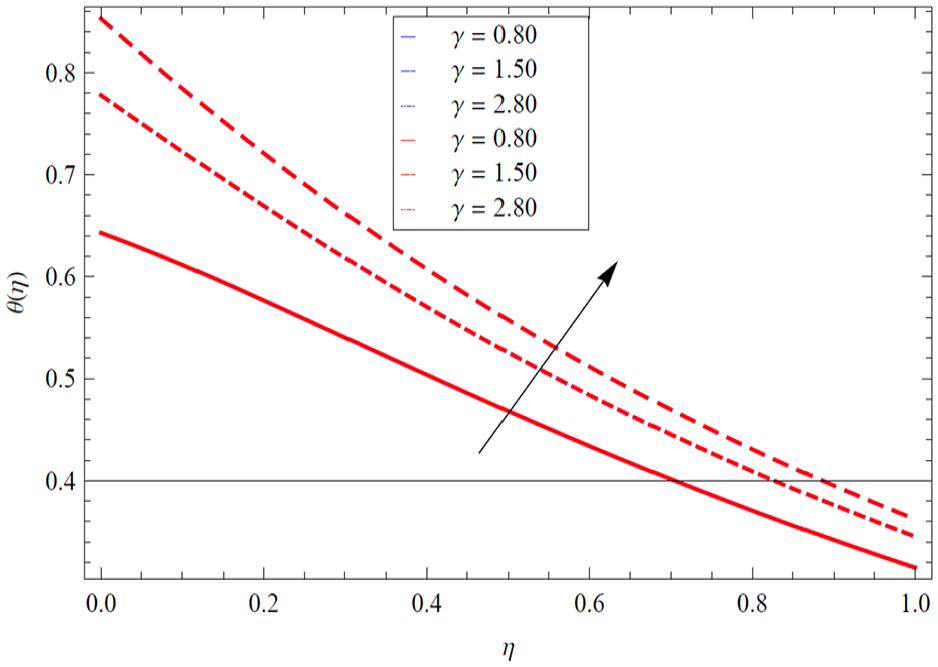
Temperature behavior for variations in .
Temperature behavior for variations in .
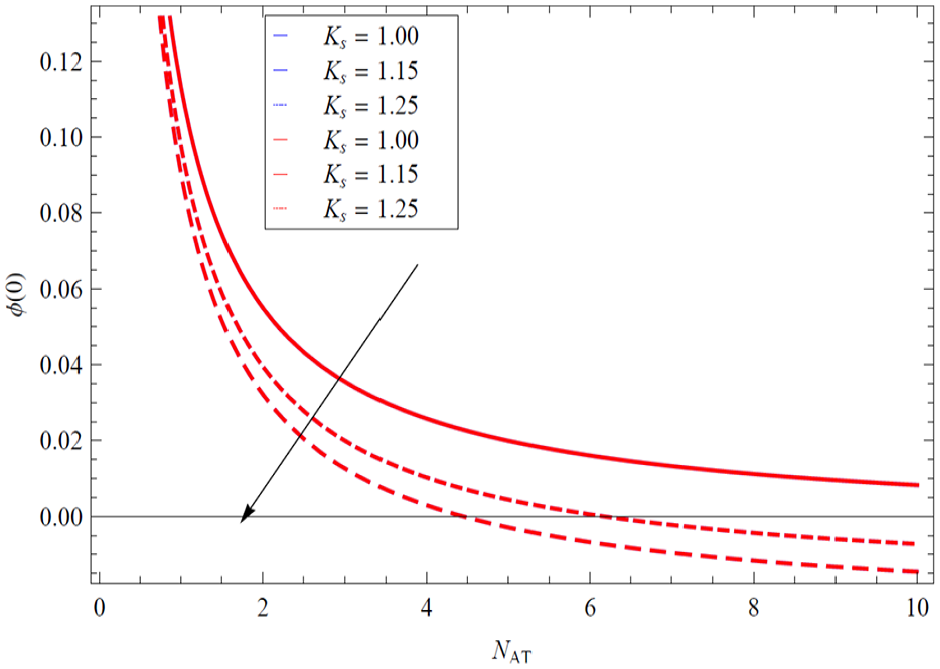
Chemical reaction concentration behavior against for variations in .
Chemical reaction concentration behavior against parameter for variations in .
Chemical reaction concentration behavior against for variations in .
Chemical reaction concentration behavior against for variations in .
Chemical reaction concentration behavior against for variations in .
Microorganisms concentration for variations in .
Microorganisms concentration for variations in .
Microorganisms concentration for variations in .
Microorganisms concentration for variations in .
Microorganisms concentration for variations in .
Velocity profile
Figure 6 shows the effect of magnetic field on fluid flow, which in combination with shear stresses decreases the flow speed. Magnetic field produces the magnetic impact of electric charges in motion of fluid. Due to collaboration with nano-sized particles, this electric charge produces resistance to the flow of fluid. When parameter increases from 0.5 to 2.5, it shows the decrement in velocity profile. Weissenberg parameter is a non-Newtonian Williamson nanofluid parameter showing its effect in Figure 7. Physically, shows the comparison between elastic and viscous forces. It is related to stress relation time of fluid with the specific duration of time. The effect of is seemed to the direct consequence of normal stress. Figure 7 shows clear rise in velocity as small increment in occurs. In Figure 8, increasing values of Casson parameter causes decrement in the yield stress and suppresses the velocity field. Physically, Casson nanofluid parameter produces a resistance in fluid flow. It possesses shear thinning property with infinite viscosity at zero shear rate. Equation (11) shows the porosity parameter present in the non-dimensional form of velocity equation. Shelter effect of porous fence porosity produces resistance due to the solid fibers in porous medium. With large porosity, porous drag force increases, causing low motion of nanofluid. Figure 9 depicts the effect of porosity parameter that suppresses velocity because of the damping effect of Darcy’s resistance (defined as the direct proportional relation between the fluid flow rate through porous media). Inertial parameter is the coefficient of second-order nonlinear term representing the high pressure on fluid velocity. Figure 10 shows the decreasing effect for the values of that develops the Forchheimer resistance and so the flow decreases. The behavior of the buoyancy ratio parameter seems against the velocity profile in Figure 11. Greater values of the buoyancy forces increase the nanoparticles in base fluid which produce more viscosity in fluid causing to slow down the motion of fluid. Rayleigh number is directly related to buoyancy force. Figure 12 illustrate the volumetric buoyancy forces parameters of Williamson fluid impact on fluid flow causing to decrease the motion thereby control the flow.
Temperature profile
Equation (12) reveals that temperature profile depends on heat convection of non-Newtonian nanofluid having the auto catalyst chemical reactions. Non-dimensional parameters that affect temperature are Prandtl number and reduced heat transfer parameter . Prandtl number is reliant to heat transfer from moving fluid to solid body. It signifies the thickness of thermal boundary layer and thickness of hydrodynamic boundary layer. If Prandtl number is one then it indicates that the thickness of thermal boundary layer is equal to the velocity boundary layer. In Figure 13, temperature rises as Prandtl number increases from a lower value to a higher value. Figure 14 displays the increasing behavior of temperature profile against the increasing values of reduced heat transfer parameter .
Homogeneous–heterogeneous chemical reactions profile
The main feature of this article is the chemical reaction in fluid flow in the presence of gyrotactic microorganisms concentration based on homogeneous–heterogeneous auto catalyst. Both the reactions are combined through with . Considering the buoyancy forces, left irrotational free stream is unaffected by keeping the thermal boundary layer less than free stream velocity. That is why, the value of Prandtl number is taken larger than one, which means that the thermal boundary layer thickness is not beyond the velocity boundary layer thickness. Discussing various parameters of concentration of chemical reaction on the surface , Figure 15 shows the decreasing behaviors of against the strength of homogeneous parameter with the small variations of (rate of heterogeneous reaction parameter). Small increment in the rate of heterogeneous reaction rapidly drops the chemical concentration against . Figure 16 reveals that the strength of homogeneous reaction decreases at surface against parameter , as in , the temperature difference is inversely proportional to the reaction at the surface. Figure 17 displays the dual behavior of concentration profile for the ascending range of homogeneous reaction parameter . Physically homogeneous reaction parameter refers to the chemical reaction, in which reactant and product are in the same phase. Initial half range shows the decreasing concentration, while in other half range, concentration function increases gradually. While the heterogeneous chemical reaction defines the measuring of strength of heterogeneous reaction used for two phases increasing the efficiency of chemical concentration. (ratio of Brownian motion parameter and thermophoresis parameter ) is inversely proportional to the concentration field. As fast Brownian motion causes high chemical reaction on the surface, the non-uniformity of chemical concentration of nanoparticles increases, where considering high thermophoresis parameter results in less homogeneity in concentration. Figure 18 projects that reduction of chemical reaction is happened on the species concentration for high range of . Schmidt number is the ratio between rate of viscous diffusion to molecular diffusion rate. So, with rising quantities of Schmidt number , viscosity of fluid becomes high, which provides resistance to fluid flow, so increasing the Schmidt number enhances the viscosity rate causing high chemical reaction which is displayed in Figure 19.
Density of motile aquatic microorganisms profile
The movement of microorganisms is affected by the external stimuli (optical, chemical, and light taxes), magnetic field, porous medium, and chemical reaction created by homogeneous–heterogeneous auto catalyst. It is noticed that variation occurs on magnitude of motile density concentration due to homogeneous reaction parameter and heterogeneous reaction parameter in the presence of magnetic field and the porous medium. Other parameters like buoyance and of Casson and Williamson nanofluid, Peclet number , and the ratio parameter of Brownian motion versus thermophoresis are also discussed. Figure 20 reveals that enlarging of homogeneous strength rate in single phase can evaluate the bioconvection concentration profile, while heterogenous chemical reaction rate effect is opposite as seen in Figure 21. With the increasing strength rate of heterogeneous reaction, two different phase reactions cause prevention to concentration process. Similarly, the buoyancy forces increase via larger and , yielding faster velocity which can elevate the microorganism concentration field slowly. In Figure 22, the larger values of M causes high magnitude of microorganism concentration since implementation of magnetic property on fluid flow creates the Lorentz forces (resistive type forces), which slows the momentum of fluid thereby making faster the distribution of microorganisms concentration. In Figure 23, the magnitude of motile density microorganisms decreases when the porous parameter enlarges due to the large porosity, the velocity at which the fluid decelerates, which disturb the micro swimmers moment. The inertial parameter related to microorganism concentration has the same effect of as in Figure 23. Figure 24 shows the impact of Peclet number on density of motile microorganism concentration which is reliant to the function of micro swimmers speed and the diffusion rate of microbes.
Skin friction coefficient, local Nusselt number, local wall mass flux and local wall microorganisms flux
Skin friction coefficient, Nusselt number, wall mass flux, and wall microorganisms flux are important physical quantities. The impact of porosity parameter on , , , and in the form of numerical values is tabulated in Table 1, where other parameters are fixed. For validation of the results, comparison has been made with Zuhra et al.2 in Table 1.
Numerical values of skin friction, Nusselt number, mass flux, and microorganisms flux for different values of where , .
Steady, laminar, thin film flow containing non-Newtonian nanofluid model is considered, in which the homogeneous–heterogeneous chemical reactions have been taken into account. The salient features of related parameters have been discussed as follows:
Velocity profile elevates with the Weissenberg number , while it declines for the rising values of magnetic field parameter , Casson nanofluid parameter , inertial parameter , buoyancy ratio parameter , Rayleigh number , and volumetric buoyancy expansion parameters , of Williamson and Casson nanofluids parameters, respectively.
Temperature increases with the Prandtl number and reduced heat transfer parameter .
Behavior of the heterogeneous reaction parameter against the homogeneous reaction parameter and weakens the chemical concentration. Homogeneous reaction parameter weakens the chemical reaction when heterogeneous reaction parameter increases. Schmidt number and reduced heat transfer parameter enhance the concentration.
Homogeneous reaction parameter increases the density of motile aquatic microorganisms while heterogeneous coefficient , magnetic field parameter , porosity parameter , inertial parameter , Peclet number , and show resistance to the motile microorganisms concentration.
Skin friction coefficient and wall flux of microorganisms increase gradually with the porosity parameter . With high porosity parameter, Nusselt number and mass flux are reduced.
Footnotes
Appendix
Notation
Parameter names
Notations
Defined mathematical values
Weissenberg number
Volumetric expansion of Casson nanofluid
Volumetric expansion of Williamson nanofluid
Buoyancy ratio parameter
Rayleigh number
Reduced heat transfer parameter
Porosity parameter
Inertial non-dimensional parameter
Magnetic field parameter
Prandtl number
Schmidt number
Lewis number
Proportion of the diffusion constants
Peclet number
Homogeneous reaction parameter
Heterogeneous reaction parameter
Ratio between Brownian motion and thermophoresis
Skin friction coefficient
Local Nusselt number
Local wall mass flux coefficient
Local mass flux of microorganisms
Handling Editor: James Baldwin
Declaration of conflicting interests
The author(s) declared no potential conflicts of interest with respect to the research, authorship, and/or publication of this article.
Funding
The author(s) received no financial support for the research, authorship, and/or publication of this article.
ORCID iD
Noor Saeed Khan
References
1.
KhanNS.Bioconvection in second grade nanofluid flow containing nanoparticles and gyrotactic microorganisms. Braz J Phys2018; 43: 227–241.
2.
ZuhraSIslamSKhanNS, et al. Magnetohydrodynamic second grade nanofluid flow containing nanoparticles and gyrotactic microorganism. Comput Appl Math2018; 37: 6332–6358.
3.
KhanNSGulTIslamS, et al. Thermophoresis and thermal radiation with heat and mass transfer in a magnetohydrodynamic thin film second-grade fluid of variable properties past a stretching sheet. Eur Phys J Plus2017; 132: 11.
4.
Choi StephenUSEastmanJA. Enhancing thermal conductivity of fluids with nanoparticles. No. NL/MSD/CP-84938; CONF-951135-29. Argonne National Lab., IL (United States), 1995.
5.
BegOASanchez EspinozaDEKadirA, et al. Experimental study of improved rheology and lubricity of drilling fluids enhanced with nano-particles. Appl Nanosci2018; 8: 1069–1090.
6.
NorouziMDavoodiMBégOA, et al. Theoretical study of Oldroyd-B visco-elastic fluid flow through curved pipes with slip effects in polymer flow processing. Int J Appl Comput Math2018; 4: 108.
7.
BegOAKuharatSFerdowsM, et al. Modeling magnetic nanopolymer flow with induction and nanoparticle solid volume fraction effects: solar magnetic nanopolymer fabrication simulation. Proc Imeche, Part N: J Nanomaterials, Nanoengineering and Nanosystems2019; 233: 27–45.
8.
SheriSRShamshuddinMD.Finite element analysis on transient magnetohydrodynamic (MHD) free convective chemically reacting micropolar fluid flow past a vertical porous plate with Hall current and viscous dissipation. Prop Power Res2018; 7: 353–365.
9.
BegOABegTAKarimI, et al. Numerical study of magneto-convective heat and mass transfer from inclined surface with Soret diffusion and heat generation effects: A model for ocean magnetic energy generator fluid dynamics. Chin J Phys2019; 60: 167–179.
10.
KhanNSGulTIslamS, et al. Brownian motion and thermophoresis effects on MHD mixed convective thin film second grade nanofluid flow with Hall effect and heat transfer past a stretching sheet. J Nanofluids2017; 6: 812–829.
11.
ZuhraSKhanNSKhanMA, et al. Flow and heat transfer in water based liquid film fluids dispensed with graphene nanoparticles. Result Phys2018; 8: 1143–1157.
12.
KhanNSGulTIslamS, et al. Magnetohydrodynamic nonliquid thin film sprayed on a stretching cylinder with heat transfer. J Appl Sci2017; 7: 271.
13.
ZuhraSKhanNSShahZ, et al. Simulation of bioconvection in the suspension of second grade nanofluid containing nanoparticles and gyrotactic microorganisms. AIP Adv2018; 8: 105210.
14.
KhanNSZuhraSShahZ, et al. Slip flow of Eyring-Powell nanoliquid film containing graphene nanoparticles. AIP Adv2018; 8: 115302.
15.
ShamshuddinMDMishraSRThummaT.Chemically reacting radiative Casson fluid over an inclined porous plate: A numerical study. In:SrinivasacharyaDReddyK. (eds) Numerical Heat Transfer and Fluid Flow. Lecture Notes in Mechanical Engineering. Singapore: Springer, pp. 469–479.
16.
SheriSRShamshuddinMD.Heat and mass transfer on the MHD flow of micropolar fluid in the presence of viscous dissipation and chemical reaction. Proc Eng2015; 127: 885–895.
17.
PalwashaZIslamSKhanNS, et al. Non-Newtonian nanoliquids thin film flow through a porous medium with magnetotactic microorganisms. Appl Nanosci2018; 8: 1523–1544.
18.
KhanNSGulTIslamS, et al. Thin film flow of a second-grade fluid in a porous medium past a stretching sheet with heat transfer. Alex Eng J2017; 57: 1019–1031.
19.
RamzanMBilalM.Time dependent MHD nano-second grade fluid flow induced by permeable vertical sheet with mixed convection and thermal radiation. PLoS ONE2015; 10: e0124929.
20.
UmavathiJCHemavathiK.Flow and heat transfer of composite porous medium saturated with nanofluid. Prop Power Res2019; 8: 173–181.
21.
RaeesAWangRZXuH.A homogeneous-heterogeneous model for mixed convection in gravity-driven film flow of nanofluids. Int Commun Heat Mass Transf2018; 95: 19–24.
22.
KhanMKumarAHayatT, et al. Entropy generation in flow of Carreau nanofluid. J Mol Liq2019; 278: 677–687.
23.
KameswaranPKShawSSibandaP, et al. Homogeneous-heterogeneous reactions in a nanofluid flow due to a porous stretching sheet. Int J Heat Mass Transf2013; 57: 465–472.
24.
WilliamsWRStenzelMTSongX, et al. homogeneous-heterogeneous combustion. I. Experimental results over platinum. Combust Flame1991; 84: 277–291.
25.
SarojammaGVijaya LakshmiRNaryanaPVS, et al. Exploration of the significance of autocatalytic chemical reaction and Cattaneo-Christov heat flux on the dynamics of a micropolar fluid. J Appl Comput Mech2019; 6: 77–89.
26.
SteppellerJ.On a high accuracy finite difference method. J Computat Phys1975; 19: 390–403.
27.
AbbasSMehdiD.Variational iteration method for solving a generalized pantograph equation. Comput Maths Appl2009; 58: 2190–2196.
28.
SepasgozarSValipourP.Application of differential transformation method (DTM) for heat and mass transfer in a porous channel. Prop Power Res2017; 6: 41–48.
29.
LiaoSJ.A short review on the homotopy analysis method in fluid mechanics. J Hydrodyn2010; 22: 882–884.
30.
KhanNSGulTKhanMA, et al. Mixed convection in gravity-driven thin film non-Newtonian nanofluids flow with gyrotactic microorganisms. Result Phys2017; 7: 4033–4049.
31.
ZahirSIslamSAyazH, et al. Radiative heat and mass transfer analysis of micropolar nanofluid flow of Casson fluid between two rotating parallel plates with effects of Hall current. J Heat Transfer2019; 141: 022401.
32.
JavidiGGolbabaiA.A numerical solution for solving system of Fredholm integral equations by using homotopy perturbation method. Appl Math Comput2007; 189: 1921–1928.
33.
MarincaVHerisanuNNemesI.An optimal homotopy asymptotic method with application to thin film flow. Cent Eur J Phys2008; 6: 648–653.
34.
MarincaVHerisanuN.Application of optimal homotopy asymptotic method for solving nonlinear equations arising in heat transfer. Int Commun Heat Mass Transf2008; 35: 710–715.
35.
MarincaVHerisanuNBotaC, et al. An optimal homotopy asymptotic method applied to steady flow of a fourth-grade fluid past a porous plate. Appl Maths Lett2009; 22: 245–251.
36.
ZuhraSUllahHShahIA, et al. Generalized seventh order Korteweg- de Vries equations by optimal homotopy asymptotic method. Sci Int2015; 27: 3023–3032.
37.
ZuhraSIslamSShahIA, et al. Solving singular boundary values problems by optimal homotopy asymptotic method. Int J Diff Eq2014; 1: 287480.
38.
KhanMUZuhraSAlamM, et al. Solution to Berman’s model of viscous flow in porous channel by optimal homotopy asymptotic method. J Eng Appl2017; 36: 191–199.
39.
IslamSZuhraSIdreesM, et al. Application of optimal homotopy asymptotic method on Benjamin-Bona Mahony and Sawada kotera equations. World Appl Sci J2014; 31: 1945–1951.
40.
PalwashaZKhanNSShahZ, et al. Study of two dimensional boundary layer flow of a thin film fluid with variable thermophysical properties in three dimensions space. AIP Adv2018; 8: 105318.
41.
KhanNSShahZIslamS, et al. Entropy generation in MHD mixed convection non-Newtonian second-grade nanoliquid thin film flow through a porous medium with chemical reaction and stratification. Entropy2019; 21: 139.
42.
KhanNSZuhraSShahQ.Entropy generation in two phase model for simulating flow and heat transfer of carbon nanotubes between rotating stretchable disks with cubic autocatalysis chemical reaction. Appl Nanosci2019; 9: 1797–1822.
43.
KhanNSZuhraSShahZ, et al. Hall current and thermophoresis effects on magnetohydrodynamic mixed convective heat and mass transfer thin film flow. J Phys Commun2019; 3: 035009.
44.
KhanNSGulTKumamP, et al. Influence of inclined magnetic field on Carreau nanoliquid thin film flow and heat transfer with graphene nanoparticles. Energies2019; 12: 1459.
45.
KhanNSKumamPThounthongP.Renewable energy technology for the sustainable development of thermal system with entropy measures. Int J Heat Mass Transf2019; 145: 118713.
46.
KhanNSZuhraS.Boundary layer flow and heat transfer in a thin-film second-grade nanoliquid embedded with graphene nanoparticles. Adv Mech Eng2019; 11: 84428.
47.
ChaudharyMAMerkinJH.A simple isothermal model for homogeneous-heterogeneous reactions in boundary-layer flow. I. Equal diffusivities. Fluid Dyn Res1995; 16: 311–333.