In this theoretical study, we have discussed the impacts of Soret and Dufour on the flow of time-dependent couple stress fluid across a stretchable curved oscillatory surface with magnetic field. The to and fro motion of the surface causes the flow phenomenon. The boundary layer flow equations depicting the flow phenomena are expressed in mathematical form by means of a curvilinear coordinates system along with some suitable similarity variables. The developed flow equations in the form of partial differential equations are then solved analytically by utilizing a valuable method called the homotopy analysis method (HAM). A detailed examination is performed to evaluate the influence of various involved parameters namely, the non-dimensional radius of curvature, couple stress parameter, magnetic parameter, the relation of the parameter of the surface oscillating frequency to its stretching rate constant and Soret and Dufour numbers on velocity field, pressure distribution, concentration and temperature distribution, rate of heat transfer, coefficient of skin friction, and rate of mass transport via graphs and are explained in detail. It is confirmed that the amplitude of velocity and pressure distribution exhibits reducing behavior with higher values of the couple stress parameter. The concentration and temperature profiles also diminish with varying time instants.
Over the last few decades, owing to its abundant and noteworthy applications in many industrial and engineering processes, several researchers and engineers have considered the exploration of boundary layer stretching flows with modified velocities included linear, nonlinear, exponential, and oscillatory. These processes include wire drawing, hot rolling, artificial fibers, paper production, the distillation of towers, glass blowing, polymer extrusion process, aerodynamic extrusion of plastic sheets, and cooling of electronic chips, etc. In all such operations, the quality of the finished product relies heavily on the surface stretching velocity and stretching rate. To our best knowledge, Crane1 was firstly analyzed the flow problem over stretching surface by considering linear velocity and identified its solution in closed form. Many researchers expanded the idea1 in various directions over a flat and curved stretching surface for various kinds of viscous fluids. Sajid et al.2 has attempted to discuss the flow of viscous fluid across the curved stretchable sheet by considering the effects of a radius of curvature in the sheet. Abbas et al.3 has examined the stretchable motion of viscous liquid toward a curved sheet in the presence of constant magnetic field. Saif et al.4 has considered the significance of convective heat transfer in the flow of viscous liquid toward a nonlinearly curved stretching surface. Amjad et al.5 has conducted numerical investigation for Williamson fluid motion toward an exponential curved stretchable surface. Wang6 takes into consideration the flow problem due to oscillatory stretching sheet. After Wang, Abbas et al.7 has considered the influences of thermal and velocity slip over the oscillating stretchable surface. The effect magnetic field on flow of thermally radiative viscous fluid motion across the convectively heated curved oscillatory surface was addressed by Abbas et al.8 Imran et al.9 has computed the consequences of heat generation and Joule heating on oscillatory flow of ferrofluid across the curved stretching surface. For a more comprehensive study, Refs.10–17 provide a more extensive review of the scientific literature on various flow problems on different flow geometries.
Many real-life fluids, including blood, ketchup, yogurt, mud, clay coatings, apple sauce, melted plastics, polymer melts, certain oils, and greases are classified into non-Newtonian fluids. These fluids have a complex correlation between shear stresses and strain rates which means that Newton’s law of viscosity does not comply with non-Newtonian liquids. The prominent characteristics of all these fluids cannot be presented through an exclusively constitutive relationship. Many scientists and engineers have been attracted to the exploration of non-Newtonian liquids due to its broad practical utilizations in the nuclear and chemical industries; the petroleum industry, plastic foam manufacturing, polymer solutions, and bioengineering, etc. Based on different physical features, a variety of flow models for such liquids are available in the literature. Couple stress fluid is an important type of non-Newtonian liquid that Stokes18 first purposed. Simply, the concept of couple stress is the expansion of the conventional viscous idea that supports couple stress and couples in the body. Because of rotational contact between liquid particles, the stress tensor in the couple stress concept is considered anti-symmetric. The anti-symmetric part of the tensor would enhance the order of the momentum equation from two to four. Examples of couple stress liquid are lubricants, colloidal liquids, and blood which contain electro-rheological and synthetic properties. Ali et al.19 have discussed the various features of heat transfer phenomena on hydromagnetic couple stress liquid motion flow across an oscillatory stretchable surface in the existence of a porous medium. Analytical findings of the mixed convective motion of couple stress nanoliquid above on oscillatory stretchable surface with heat generation effects have been found by Khan et al.20 Albadan21 has evaluated the consequences of temperature dependent viscosity for bioconvection motion of couple stress nanofluid toward oscillatory sheet. Heat transfer analysis with impacts of nonlinear thermal radiation in three-dimensional couple stress fluid motion over permeable stretching surface was done by Tarakaramu et al.22
The examination of an electrically conducting hydromagnetic flow with combined heat and mass transport has received a great deal of interest from various researchers, investigators, and engineers due to its large number of utilizations in many industries and technological operations likely in the designing purpose of cooling systems, food processing, hydromagnetic generators, cooling towers, instruments of blood flow measurement, packed sphere bed, spinning of fibers, electric motors, pumps and flow meters and many more. The hydromagnetic motion of viscoelastic liquid was investigated by Alharbi et al.23 under the influence of energy and mass transportation on a permeable stretchable sheet. The impact of heat and mass transportation on hydromagnetic micropolar liquid flow across a curved stretched sheet was analyzed by Yasmin et al.24 Whenever heat transport and mass transport occur at the same time in a flowing fluid, then the association between the driving potentials and the fluxes is often more complex. It has been distinguished that heat alteration is also induced by the concentration gradients, which is termed as diffusion-thermo (Dufour) effects. Moreover, the production of mass flux due to thermal gradient is known as the thermal-diffusion (Soret) effect. Generally, in most of the studies relating to heat and mass transport phenomenon impacts of Soret and Dufour are usually ignored because they are weaker in order of magnitude than the impacts defined by Fourier’s and Fick’s theories. However, some disciplines like geosciences, petrology, nuclear waste disposal, and hydrology, etc. in which such phenomena’s play an important role. Zheng et al.25 has analytically inspected the effects of Soret and Dufour on hydromagnetic viscous liquid motion over an oscillatory stretching surface. Dufour’s and Soret impacts on the magnetohydrodynamic flow of Powell-Eyring fluid through oscillatory stretched sheet were determined by Khan et al.26 Imtiaz et al.27 have analyzed the impacts of Dufour and Soret on viscous fluid flow across curved stretching surface. Physical characteristics of Dufour and Soret impacts on mixed convection flow of non-Newtonian fluid over nonlinear sheet was investigated by Akbar et al.28 Seid et al.29 has conducted an analytical investigation to evaluate the outcomes of Soret and Dufour numbers in nanoliquid flow across a vertical stretched sheet. Siddique et al.30 have explored the effects of Soret and Dufour on unsteady motion of viscoelastic nanoliquid over an exponentially stretching sheet.
An analysis of literature survey reflects that most of the researchers have paid special attention to examine the various attributes of heat and mass transfer in the flow of non-Newtonian fluid on a linear, nonlinear and oscillatory stretching flat or curved surface. But no one has yet considered to examine the influence of Soret and Dufour effects in the flow of couple stress fluid on a curved oscillatory surface. Therefore, the prime objective of the present research is to explore the heat and mass transport phenomena with Soret and Dufour impacts on a couple stress liquid across a curved oscillatory stretchable surface. The formulated flow equations in the form of PDEs are highly nonlinear in nature which are than solved analytically by employing an effective analytical method namely the homotopy analysis method (HAM). The influences of various pertinent parameters on flow, energy and concentration are shown graphically and are discussed in detail.
Problem explanation
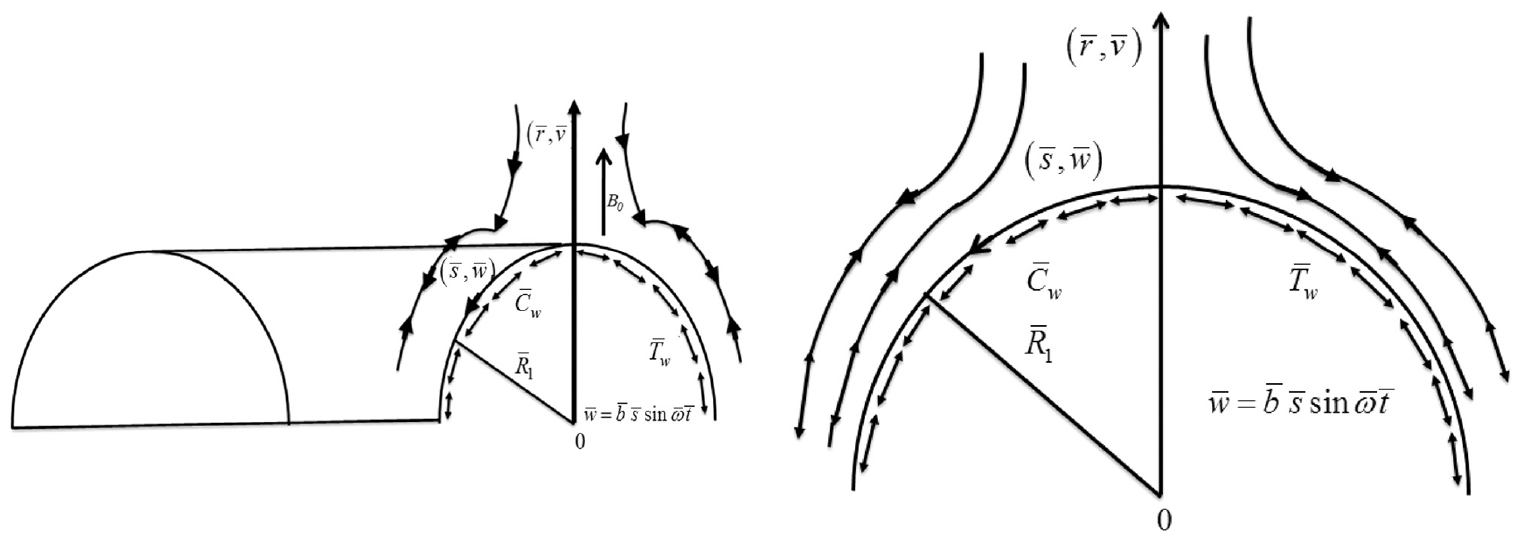
Consider a laminar, incompressible and unsteady flow of couple stress liquid past toward a stretchable curved oscillating sheet that coiled in the form of a semi-circle having radius (see Figure 1). The sheet velocity is considered the cause of the flow mechanism. Here denotes the oscillatory frequency and stretchable rate of the sheet, respectively. A persistent magnetic field having power is forced along the radial direction of the surface. The influences of convinced magnetic field are omitted by choosing very low Reynolds numbers. Let be the surface temperature, is the surface concentration, is the ambient fluid temperature, and is the concentration away from the surface with and . The flow equations for the specified problem are provided by
Flow geometry.
In above equations is the velocity vector, the Laplacian operator, is the pressure, is the current density, is the magnetic flux vector, is the temperature, is the density, the coefficient of mass diffusion, is the couple stress viscosity, and is the kinematic viscosity, is the specific heat capacitance, is the mean temperature of the fluid, is the concentration susceptibility, is the ratio of thermal diffusion and is the concentration.
The current density is defined as
For current flow problem, consider the velocity field of the form
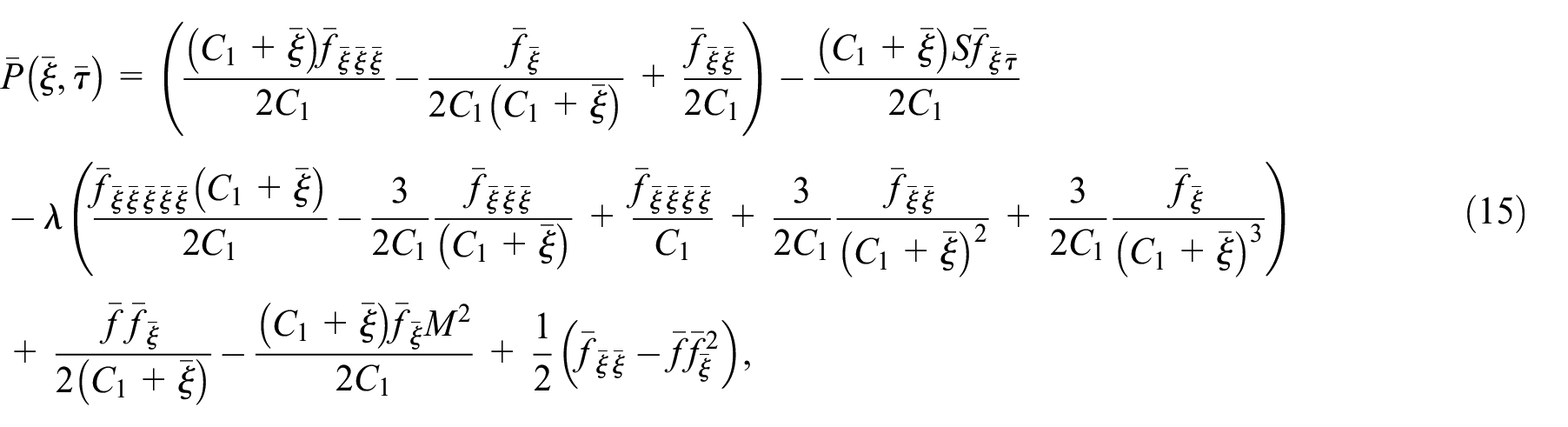
here are considered the fluid velocity parts along with directions. By employing equation (6) along with boundary layer approximations equations (1)–(5) can be expressed in curvilinear coordinates system as8,27
where, the dimensionless couple stress parameters, radius of curvature variable, the parameter of surface frequency to its stretched constant, the Prandtl number, the magnetic parameter, the Dufour number, the Schmidt number, and the Soret number respectively.
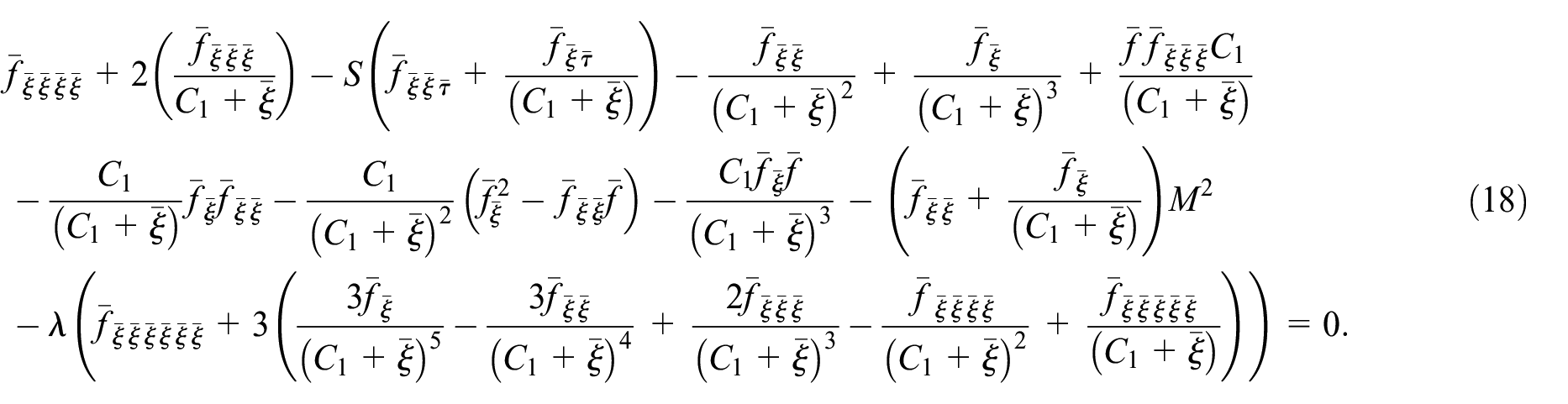
After elimination of the pressure expression present in equations (14) and (15), the equation for the velocity of the fluid is attained as
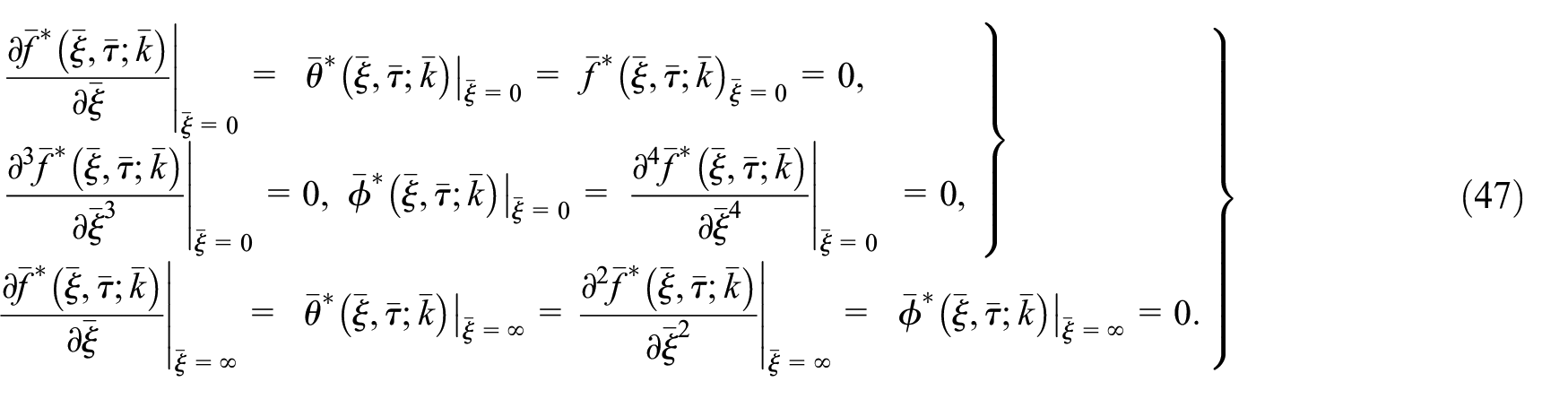
The relevant boundary conditions reduce as
The rate of heat transport, coefficient of skin friction, as well as mass transport along the curved wall are characterized as
In this section, we have focused our attention on exploring the methodology by incorporating the HAM, which is utilized to determine the series solution of the developed equations (16), (17), and (18) with governing boundary conditions indicated in equation (19) by considering the following expressions:
which hold the following outcomes
here are denotes some arbitrary constants.
Let signifies an embedding parameter, , and are non- zero auxiliary parameters. By constructing the equation for zeroth- order deformation as
subject to boundary conditions
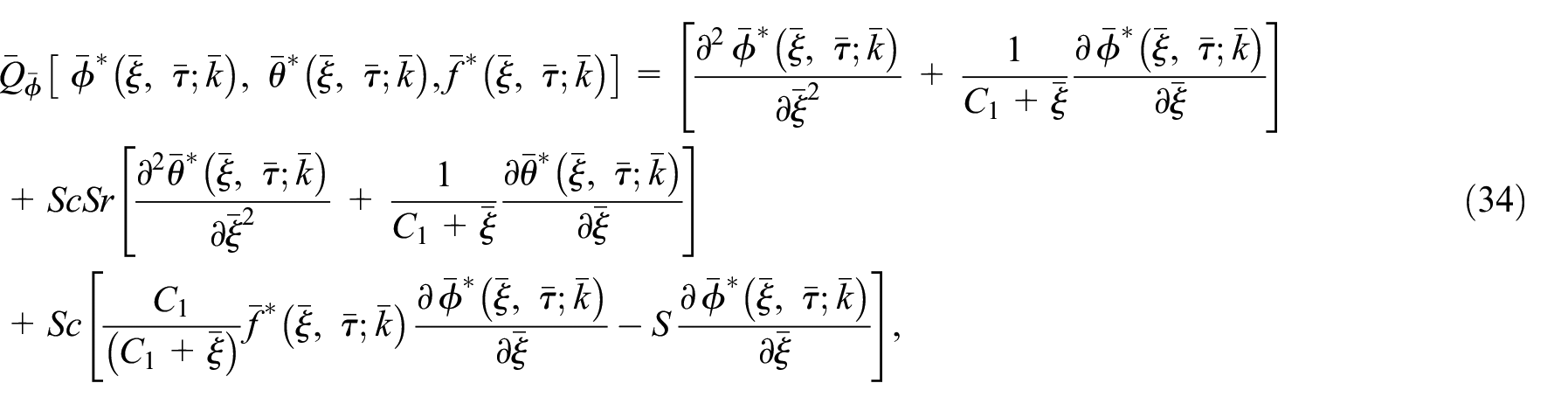
The connected non- linear operators are of the form
Put and in equations (28), (29), and (30), we obtain following solutions respectively
And
By employing Taylor series, we can expand , and as
Inserting equations (38), (39), and (40) in (28–30) and by equating coefficient of like powers of leads to the BVP for , and . Note that equations (28), (29), and (30) comprises auxiliary parameters , and . The convergence of the series representing in equations (38), (39), and (40) are highly dependent upon , and . Therefore , and should be accurately selected so that the above series (38), (39), and (40) are convergent at
Differentiate equations (28)–(31) by -times w.r.t embedding parameters , then set , and at the last divided by , we have
Where
And
The general solution is given as
where , and represent the particular solution. For the boundary conditions given in equation (47), the constants , are formulated as
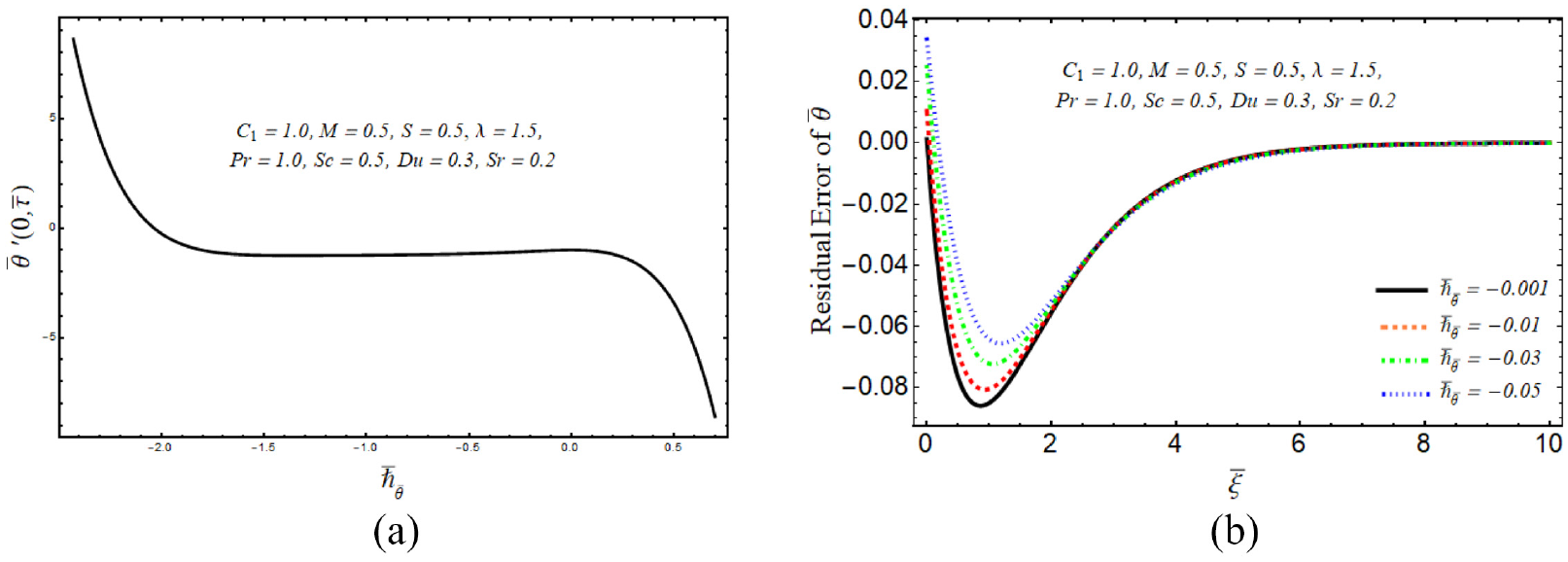
To confirm the convergence of the acquired series using HAM via curves, the appropriate choice of the non- zero auxiliary variables , and are very imperative to guarantee the convergence of the solution. Figures 2(a), 3(a) and 4(a) present such curves showing the feasible region of , and for a given set of parameters. From these figures, it is clear that the convergent solution can be achieved for , and . Moreover, Figures 2(b), 3(b) and 4(b) are designs to display the residual errors of , and for different values of auxiliary parameters and by keeping other parameters fixed. These figures reveals that optimal values for minimum residual errors of , and are , and respectively.
h-curve and residual error for velocity at seventh iteration.
h-curve and residual error for temperature at seventh iteration.
h-curve and residual error for concentration at seventh iteration.
Result and discussions
In this segment, the graphical outcomes of divergent involved flow parameters such as couple stress parameter relation parameter of surface frequency oscillation parameter to its stretched constant parameter Soret number and magnetic parameter , Dufour number and Prandtl number dimensionless radius of curvature , and Schmidt number on the fluid flow velocity field, the pressure field, the concentration, and temperature distribution, the coefficient of skin friction, the local Sherwood and Nusselt and numbers are analyzed and explained in detail respectively.
Table 1 is constructed to scrutinize the validity of the present analytical outcomes with the existing published literature by taking the couple stress parameter and the radius of curvature parameter at different time instants, and they are found to be in good agreement.
Comparison of the numerical results of with existing results for divergent values of when and
Figure 5(a) to (d) illustrates the three-dimensional physical behavior of the axial and the normal parts of the velocity by letting and .
3-Dimensional view of velocity parts (For and ).
The response of the streamlines of the axial and normal velocity parts at various time interval is demonstrated through Figure 6(a) to (c) and Figure 7(a) to (c). Figures 6(a) and 7(a) portray the symmetrical response of streamlines. While Figures 6(b), (c), 7(b) and (c) show the oscillatory behavior of streamlines.
Alterations in streamlines of the axial velocity with and . (a) (b) (c) .
Variations in streamlines of normal velocity part with and . (a) (b) (c) .
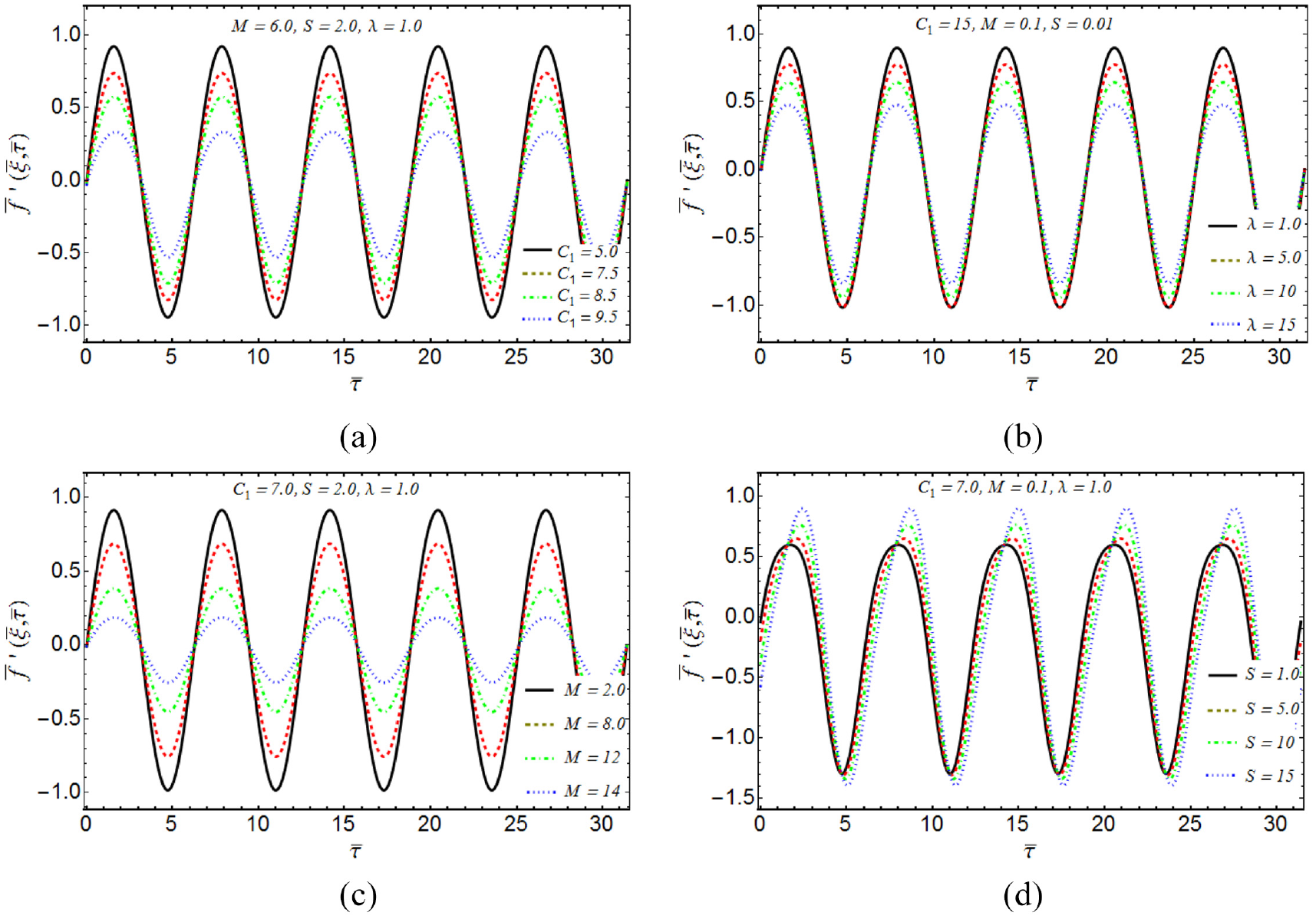
Figure 8(a) to (d) interpreted the influence of diverse variables likely and on the profile of flow velocity at a fixed location from the wall of the surface for . This figure depicts that the fluid velocity amplitude diminishes for upward values of radius of curvature couple stress parameter and whereas it grows with parameter
Deviation in velocity field when .
The influences of parameters and on fluid velocity description at some fixed time instant are depicted through Figure 9(a) to (d) respectively. The velocity profile shows the diminishing response with parametric values of and .
Deviation in velocity field when .
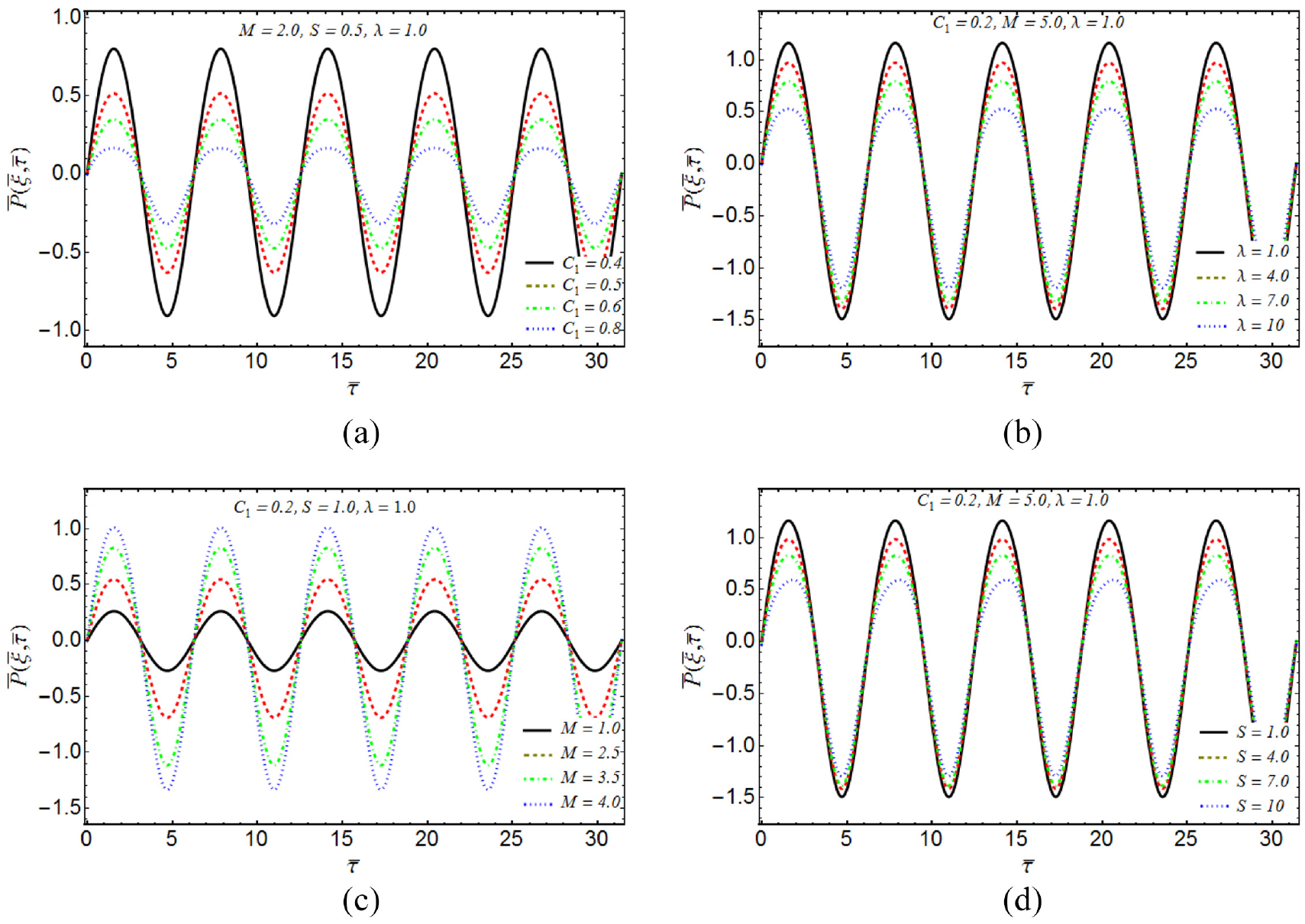
Figure 10(a) to (d) is plotted to demonstrate the outcomes of unalike concerning parameters and on pressure distribution for It is detected that amplitude is decreased by an enlarge in and While it enhances with magnetic parameter
Alteration in pressure profile .
Figure 11(a) to (d) presents the consequences of various parameters like and on at . It is confirmed from Figure 11(a) that temperature profile is enhanced for varying . Figure 11(b) shows that for upward values of , the thermal boundary layer thickness and temperature field are boosted. It is due to an increase in Dufour number that causes the enhancement in energy flux because of the concentration gradient which is responsible for enlarging the temperature. While, it is diminished due to and (see Figure 11(c) and (d)). This is due to the fact that the Prandtl number and thermal diffusivity have an inverse relationship. When the Prandtl number rises, the fluid thermal diffusivity decreases, which causes the fluid temperature to decline.
Deviation in temperature profile .
The variation in concentration distribution profile under the influences of different parameters namely and at is discussed via Figure 12(a) to (d). From Figure 12(a), (c) and (d) we have seen that the concentration profile shows growing behavior for improving values of and . Large values of cause an enhancement in temperature flux, so the concentration profile enlarges. However, from Figure 12(b) it is clear that concentration profile is decreased by increasing .
Deviation in concentration profile .
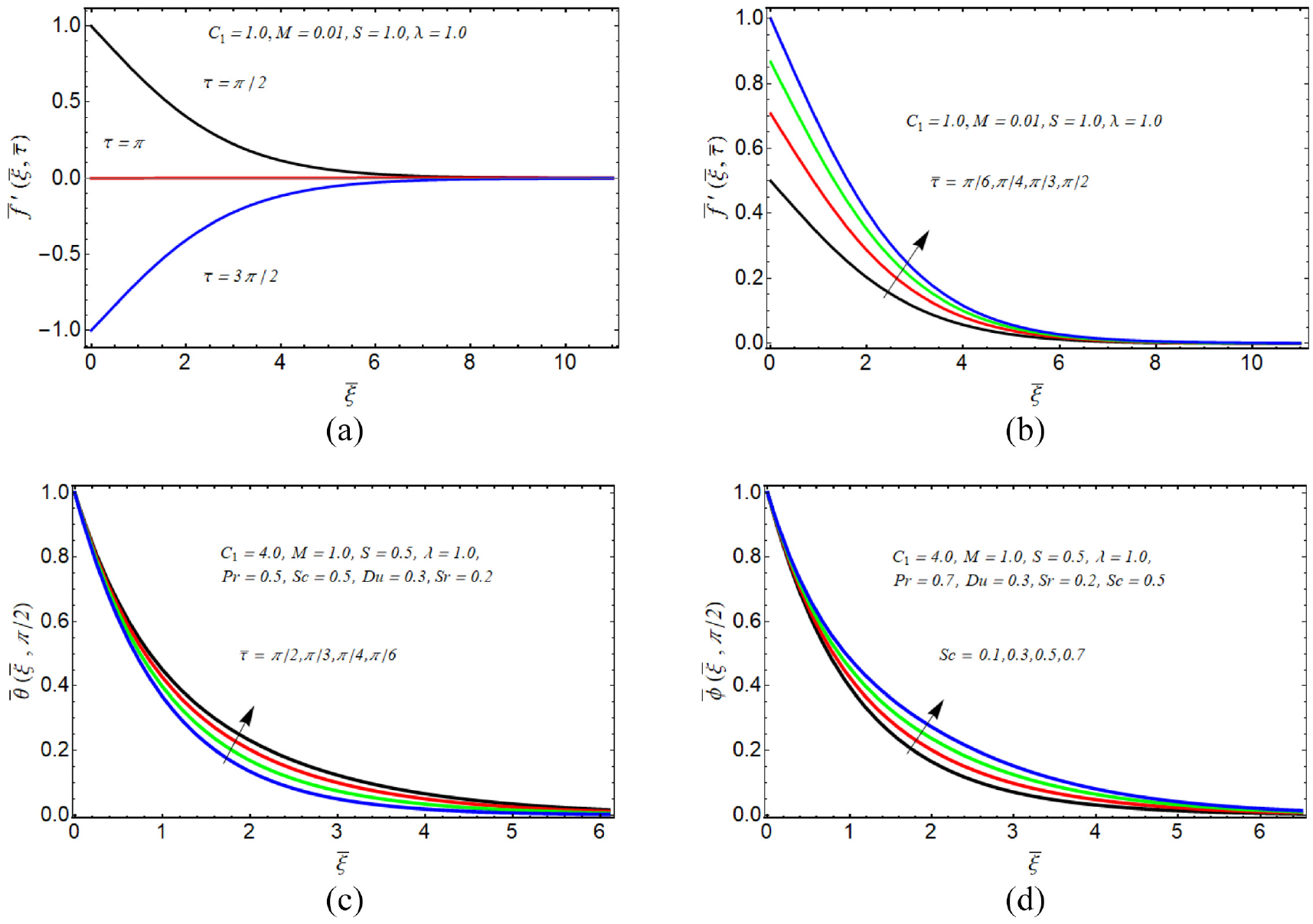
Figure 13(a) to (d) demonstrates the impacts of diverse time intervals and on profiles of velocity, temperature, and concentration respectively. Figure 13(a) elucidates that the limit of lies between (−1 and 1), this is due to the fact that the surface is considered to be oscillatory. It can be seen from Figure 13(b) to (d) that uplifting values of the fluid flow velocity shows a growing response while temperature and concentration are diminished.
Influences of dissimilar values of (a and b) on profile (c) on temperature profile (d) on the fluid concentration profile .
Figure 14(a) to (d) interpreted the influences of dissimilar parameters such as and on for It is clearly seen from this figure that amplitude is diminished with and is enlarged with uplifting , and .
Change in skin friction coefficient .
Figure 15(a) and (b) illustrates the outcomes of Dufour number and Prandtl number for time intervals on . This Figure clarifies that with improving the values of the amplitude of local Nusselt number is decreased and for varying it is enhanced.
Variation in Nusselt number .
Figure 16(a) and (b) portrays the impacts of the Schmidt number and on Sherwood number for time One can be observed from this figure that the amplitude of growing due to . Whilst, it declines for
Alteration in Sherwood number .
Concluding remarks
In this investigation, the impacts of Dufour and Soret on time-dependent boundary layer motion of Couple Stress liquid across curved oscillatory stretchable surface have been analyzed. Also, the consequences of the magnetic field are taken into account in the momentum equation. Here, the key findings of the current analysis are presented as follows
The amplitude of is declined for increasing values of and whilst, it improved for
At a time for varying values of and parameter the fluid velocity is decreased.
The pressure distribution amplitude is decreasing function of and However, it increases for
The improvement in temperature distribution is noted with an increment in and However, it shows the opposite response for and
For growing values of and the concentration, distribution depicts growing response, while it declines for Schmidt number and
The surface drag force amplitude is diminished with . While for increasing values of and the surface drag force amplitude is increased.
The amplitude of heat transport rate coefficient declines by mounting the and it rises for uplifting values of Prandtl number
The amplitude of local Sherwood number shows decreasing manner with increasing and for growing Schmidt number it is amplified.
The profile of velocity enhances with varying instants of time whereas, concentration and temperature profiles show diminishing behavior.
Footnotes
Appendix
Acknowledgements
We are thankful to the honorable reviewers for their encouraging comments and constructive suggestions to improve the quality of the manuscript.
Handling Editor: Chenhui Liang
Declaration of conflicting interests
The author(s) declared no potential conflicts of interest with respect to the research, authorship, and/or publication of this article.
Funding
The author(s) received no financial support for the research, authorship, and/or publication of this article.
ORCID iDs
Muhammad Imran
Muhammad Naveed
Zaheer Abbas
References
1.
CraneLJ.Flow past a stretching plate. J App Math Phys ZAMP1970; 21: 645–647.
2.
SajidMAliNJavedT, et al. Stretching a curved surface in a viscous fluid. Chin Phys Lett2010; 27: 024703.
3.
AbbasZNaveedMSajidM.Heat transfer analysis for stretching flow over a curved surface with magnetic field. J Eng Thermophys2013; 22: 337–345.
4.
SaifRSMuhammadTSadiaH, et al. Boundary layer flow due to a nonlinear stretching curved surface with convective boundary condition and homogeneous-heterogeneous reactions. Phys A Stat Mech Appl2020; 551: 123996.
5.
AmjadMAhmedIAhmedK, et al. Numerical solution of magnetized Williamson nanofluid flow over an exponentially stretching permeable surface with temperature dependent viscosity and thermal conductivity. Nanomater2022; 12: 3661.
6.
WangCY.Nonlinear streaming due to the oscillatory stretching of a sheet in a viscous fluid. Acta Mech1988; 72: 261–268.
7.
AbbasZWangYHayatT, et al. Slip effects and heat transfer analysis in a viscous fluid over an oscillatory stretching surface. Int J Numer Methods Fluids2009; 59: 443–458.
8.
AbbasZImranMNaveedM.Time-dependent flow of thermally developed viscous fluid over an oscillatory stretchable curved surface. Alex Eng J2020; 59: 4377–4390.
9.
ImranMAbbasZNaveedM, et al. Impact of Joule heating and melting on time-dependent flow of nanoparticles due to an oscillatory stretchable curved wall. Alex Eng J2021; 60: 4097–4113.
10.
NaveedMImranMAbbasZ.Curvilinear flow of micropolar fluid with Cattaneo – Christov heat flux model due to oscillation of curved stretchable sheet. Z Naturforsch A2021; 76: 799–821.
11.
AkhtarSShahNA.Exact solutions for some unsteady flows of a couple stress fluid between parallel plates. Ain Shams Eng J2018; 9: 985–992.
12.
ImranMAbbasZNaveedM.Flow of Eyring-Powell liquid due to oscillatory stretchable curved sheet with modified Fourier and Fick’s model. Appl Math Mech2021; 42: 1461–1478.
13.
NaveedMAbbasZImranM.Analytical simulation of time dependent electromagneto-hydrodynamic flow of Williamson fluid due to oscillatory curved convectively heated Riga surface with variable thermal conductivity and diffusivity. Proc IMechE, Part E: J Process Mechanical Engineering. Epub ahead of print 1December2021. DOI:10.1177/09544089211062357.
14.
PriyadharshiniPArchanaMVAhammadNA, et al. Gradient descent machine learning regression for MHD flow: metallurgy process. Int Commun Heat Mass Transf2022; 138: 106307.
15.
NaveedMImranMAbbasZ, et al. Analysis of entropy generation and Joule heating on curvilinear flow of thermally radiative viscous fluid due to an oscillation of curved Riga surface. Int J Mod Phys C2022; 33: 2250087.
16.
ShahNAWakifAEl-ZaharER, et al. Numerical simulation of a thermally enhanced EMHD flow of a heterogeneous micropolar mixture comprising (60%)-ethylene glycol (EG), (40%)-water (W), and copper oxide nanomaterials (CuO). Case Stud Therm Eng2022; 35: 102046.
17.
AbbasZImranMNaveedM.Impact of equally diffusive chemical reaction on time-dependent flow of Casson nanofluid due to oscillatory curved stretching surface with thermal radiation. Arab J Sci Eng2022; 47: 16059–16078.
18.
StokesVJ.Couple stresses in fluids. Phys Fluids1966; 9: 1709-1715.
19.
AliNUllah KhanSSajidM, et al. MHD flow and heat transfer of couple stress fluid over an oscillatory stretching sheet with heat source/sink in porous medium. Alex Eng J2016; 55: 915–924.
20.
KhanSUShehzadSARaufA, et al. Mixed convection flow of couple stress nanofluid over oscillatory stretching sheet with heat absorption/generation effects. Results Phys2018; 8: 1223–1231.
21.
AlabdanRKhanSUAl-QawasmiAR, et al. Applications of temperature dependent viscosity for Cattaneo – Christov bioconvection flow of couple stress nanofluid over oscillatory stretching surface: a generalized thermal model. Case Stud Therm Eng2021; 28: 101412.
22.
TarakaramuNSatya NarayanaPVSivajothiR, et al. Three-dimensional non-Newtonian couple stress fluid flow over a permeable stretching surface with nonlinear thermal radiation and heat source effects. Heat Transf2022; 51: 5348–5367.
23.
AlharbiSMBazidMAAGendyMSE. Heat and mass transfer in MHD visco-elastic fluid flow through a porous medium over a stretching sheet with chemical reaction. Appl Math2010; 01: 446–455.
24.
YasminAAliKAshrafM.Study of heat and mass transfer in MHD flow of micropolar fluid over a curved stretching sheet. Sci Rep2020; 10: 1–11.
25.
ZhengLCJinXZhangXX, et al. Unsteady heat and mass transfer in MHD flow over an oscillatory stretching surface with Soret and Dufour effects. Acta Mech Sin2013; 29: 667–675.
26.
KhanSUAliNAbbasZ.Soret and Dufour effects on hydromagnetic flow of Eyring-Powell fluid over oscillatory stretching surface with heat generation/absorption and chemical reaction. Therm Sci2018; 22: 533–543.
27.
ImtiazMNazarHHayatT, et al. Soret and Dufour effects in the flow of viscous fluid by a curved stretching surface. Pramana2020; 94: 1–11.
28.
AkbarTAhmedKMuhammadT, et al. Physical characteristics of Dufour and Soret effects on MHD mixed convection flow of Williamson fluid past a nonlinear stretching porous curved surface. Waves Random Complex Media. Epub ahead of print 20January2022. DOI: 10.1080/17455030.2021.2023233.
29.
SeidEHaileEWalelignT.Multiple slip, Soret and Dufour effects in fluid flow near a vertical stretching sheet in the presence of magnetic nanoparticles. Int J Therm2022; 13: 100136.
30.
SiddiqueINadeemMAwrejcewiczJ, et al. Soret and Dufour effects on unsteady MHD second-grade nanofluid flow across an exponentially stretching surface. Sci Rep2022; 12: 11811–11814.