



Abstract
This paper shows the stagnant point flow of Powell-Eyring hybrid nanofluids due to a stretching sheet. The Xue and Yamada-Ota based on hybrid nanoliquid have been subjected to a comparison study that has been scrutinized. The suspension of two nanoparticles
Introduction
A nanofluid is a kind of colloidal suspension of nanoparticles that may be produced by dispersing a tiny proportion of nanoparticles into a base fluid with low thermal conductivity. Most nanoparticles consist of metals, metal oxides, or carbon-based compounds. Nanomaterials have drawn significant demand from a wide variety of fields as a direct result of the rapid growth of nanomaterials and the discoveries made in the scientific community. Nanofluids are primarily used in the areas of fiber technology and thermal engineering. Using nanoliquids in such designs to improve thermal properties and enhance the rate of heat characteristics is fundamental to achieving the goal of improved cooling. The remarkable thermophysical properties of nanofluids have inspired numerous scholars to investigate nanofluids in engineering and industrial features. These features include food processing, solar thermal system, underground water, oil drilling, and amongst others. The research done in the literature1,2 has resulted in a comprehensive knowledge of the colloidal suspension of nanoparticles to produce nanofluids to improve thermal conductivity. Due to a recent upgrade, a special class of nanofluids known as hybrid nanoliquid has been included in obtaining nanofluids. The prime benefit of studying a hybrid nanoliquid is that it can be controlled by defining an appropriate mixing of two or more nanoparticles with the base fluids. This is the case because hybrid nanofluids include more than two nanoparticles. In addition to their outstanding ability of thermal conductivity, hybrid nanoliquids have the potential to deliver significant advantages since nanoparticles are effectively disseminated throughout the fluid. Xu 3 used an extended model of hybrid nanofluids to research the flow of hybrid nanofluids, including a wide variety of nanoparticles. Researchers from Fallah et al. 4 looked at the hybrid nano liquid flow with a revolving disc. Tassaddiq et al. 5 equated the nanoliquid and the hybrid nanoliquid while also doing a mass and heat transfer study. Farooq et al. 6 investigated the second law of thermodynamics through hybrid nanofluid flow. The impact of non-linear thermal radiative through hybrid nanoliquid flow was conducted by Usman et al. 7 Chu et al. 8 conducted a thermal analysis of a hybrid nanofluid using a numerical method. Wang et al. 9 explained the Carreau hybrid nanofluid with different nanoparticles immersed in a porous medium. Revathi et al. 10 pondered the significance of the tri-hybrid nanofluid with CMC water in the presence of chemically reactive and convective flow. Animasaun et al. 11 examined the time-dependent flow of Darcian Forchheimer flow of tri-hybrid nanofluid over a horizontal surface.
The developing field of engineering known as hybrid nanoliquid has caught the attention of many researchers looking for behavior to increase the efficiency of coolant procedures used in the engineering industry. These researchers were finding behaviors to improve the effectiveness of coolant techniques. A nanoliquid is a fluid created when powerful particles with diameters smaller than 100 nm are propagated in fluids. Nanoliquids may be used in a variety of applications. One of the noticeable properties of a nanoliquid is its poor thermal properties, which are the characteristics that might hinder the role of heat transfer. Generally, heat transfer fluids, like water motor oil and (CH2OH)2, have a restricted rate of heat transfer abilities and cannot satisfy the cooling needs of today’s society due to this weakness. Other heat transfer fluids, such as kerosene, are more effective at transferring heat. Nanoparticles in suspension have the potential to enhance the movement of fluid with the heat transport of the ordinary liquid. The researchers are conducting extensive investigations to shed light on various facets related to nanofluids. Nanoliquid foam was investigated by Gul et al. 12 in a revolving channel using CCH heat flux with a hybrid nanofluid. Ramzan and Shaheen 13 looked at the effects of the C–C heat flux on the nanoliquid flow while being influenced by the H–H reaction. Nanoliquid comprised of CNTs and Darcy-Forchheimer was first shown by Hayat et al. 14 They created their essential fluid out of water. The C–C influence on Tangent hyperbolic liquid flow merged with second-order slip was started by Ramzan et al. 15 They solved the issue by using a methodology known as the Runge–Kutta Fehlberg method. Abbasi et al. 16 discussed the impact of the slip mechanism on hybrid nanoparticles using a wave curve surface.
One of the models of non-Newtonian fluid complexity is the Powell-Eyring model. This model’s ability to be dubbed the viscosity relaxation theory makes it a candidate for this category. The Powell-Eyring fluid has favorable positions due to other non-Newtonian fluids in terms of their properties. 17 Instead of being based on an empirical correlation, the Eyring–Powell fluid is built using concepts from the theory of liquid kinetics. According to the kinetic theory of fluids, the bonds between liquid molecules may be of any strength or weakness. According to the Powell–Eyring paradigm, the link of a vital molecule coincides with the non-Newtonian rapport, whereas the bond of fewer molecules correlates with the Newtonian connection. Therefore, the fluid of Powell-Eyring can increase or decrease the shear rate. This indicates that it may overcome the challenges posed and the power law liquid. 16 Non-Newtonian fluid with various of the researchers due to different geometries were carried out by Refs.18–21 Nazeer et al.22,23 examined the Eyring–Powell fluid in a pored channel using numerical and analytical methods. Patel and Timol 24 made the models of Powell–Eyring more significant and effective with their improvements. The nature of it was pretty complicated. The MHD flow of Eyring–Powell liquid was evaluated numerically by Sher Akbar et al. 25 This strategy was used to analyze the magnetic flux across an extended plate. The MHD flow of Eyring–Powell fluid over a cylinder using Newtonian heating was elaborated by Hayat et al. 26 Riaz et al. 27 researched the impact of Eyring–Powell fluid in a rectangular channel. Recently, Ahmed et al. 28 probed the MHD flow of Eyring Powell nanofluid due to three different geometries.
In real-life applications involving boundary layer flow developed by shrink or stretch surfaces in various industry procedures such as polymer production, glass production, modern extrusion procedures, and many others. These problems can be applied in a variety of contexts. At first, Crane 29 thought of using a sheet that could be stretched to watch the fluid flow, and he explained the solution to the issue in its bunged form. Later, a variety of study has been produced due to the sheets contracting and expanding. Munawar et al. 30 discovered the exact solution to the flow issue due to slip effects between two stretched sheets. The time-dependent flow of hybrid nanofluid transmission of heat phenomena across a stretch/shrink surface was described by Waini et al. 31 Manjunatha et al. 32 researched the boundary layer flow of a hybrid nanofluid past a stretchy surface. The authors, Devi and Devi, 33 computed the 3-D flow of the combined effect of Newtonian heating with Lorentz force on a hybrid nanofluid due to stretchy sheets. Miklavčič and Wang 34 described the time-independent flow behavior using a shrunk sheet as a visual aid. Fang et al. 35 discovered the unsteady flow of viscous fluid flow that involves the participation of a shrinking surface. Fang 36 and Fang and Zhang 37 investigated the power-law fluid on the boundary layer flow due to a stretching sheet. Rohni et al. 38 researched the transmission of heat with flow mechanisms using a shrinking sheet. Their research was based on the idea that suction effects occur in nanofluids. Stretching with different phenomena with effects and different geometries has been described in Refs.39–42
In the research carried out by Abbas et al., 43 an investigation of the Xue and Yamada-Ota model characteristics of a hybrid nanofluid was carried out while it passed a stretching surface. They investigated the flow problem that occurred behind a stagnation point. We have extended their work and built a mathematical model for the flow and heat transfer of hybrid nanofluid (AA7072-AA7075/EG) across a stretching surface with a stagnation point as a result of being motivated by the works that have been shown above, particularly the study that was conducted by Abbas et al. 43 The current article has the originality to examine the impact of the Eyring-Powell hybrid nanoliquid toward stagnant flow using the Xue and Yamada-Ota model. This research, to establish a hybrid nanofluid by the suspension of two nanoparticles AA7072 and AA7075 with ethylene glycol (EG) base fluid. In addition, this research investigates an additional consequence that arises from the interaction of two models of hybrid nanofluid (Yamada-Ota and Xue) with the occurrence mentioned earlier. The calculation is carried out using the bvp4c procedure to accomplish this goal. The goal of this study was to find answers to the following related research questions:
I. How does the velocity of the dynamics of chemically reactive EG conveying AA7072 and AA7075 compare to the case of EG conveying AA7072 and AA7075 at different levels of stagnant velocity, volume fraction, and fluid velocity? Also, how does this compare to the case of EG conveying Xue and Yamada-Ota model.
II. In the presence of varying amounts of thermal radiation, volume fractions of the overall hybrid nanofluid, and heat sources, to what extent does the addition of AA7072 nanoparticles to the already present chemically reactive EG conveying AA7072 and AA7075 nanoparticles affect the temperature distribution across the domain? This question will be addressed in the following way:
An examination is made of a graphic depiction of the Xue and Yamada-Ota models for the properties of the fluid, comprising the velocity profile and temperature distribution related to the limitations of the different variables. The numeric values of Skin friction and Nusselt number connected to the variables are assessed and visually identified.
Model formulation
Assume that an incompressible, unsteady boundary layer flows toward the stagnant flow past a stretching sheet with the convective condition. For the hybrid nanofluid, Non-Newtonian Powell–Eyring mathematical model is considered. Two nanoparticles namely
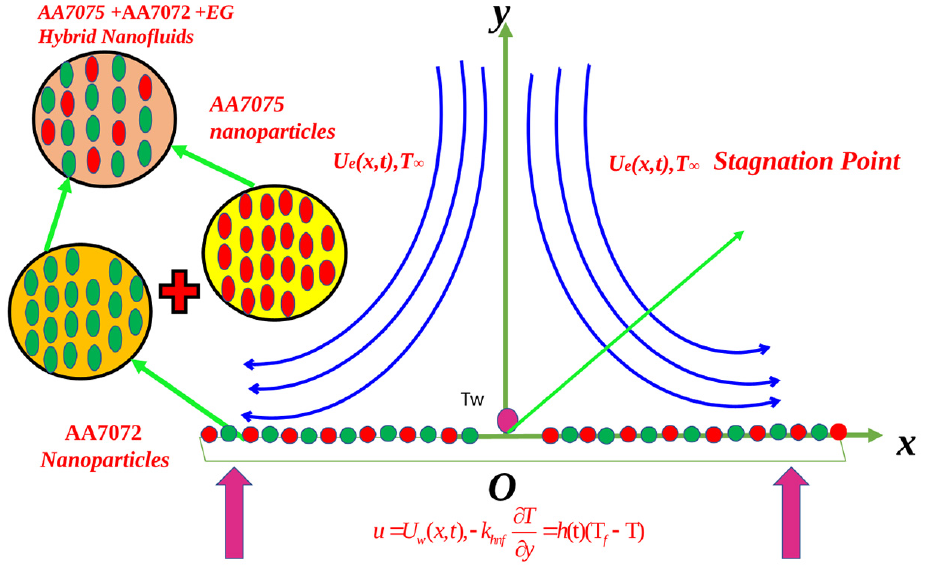
Geometrical representation of the flow problem.
Based on the aforementioned presumptions, the expression in terms of partial differential equations is used to create the mathematical model. The Eyring-Powell hybrid nanofluid model can be presented in terms of a system of differential equations.44–46

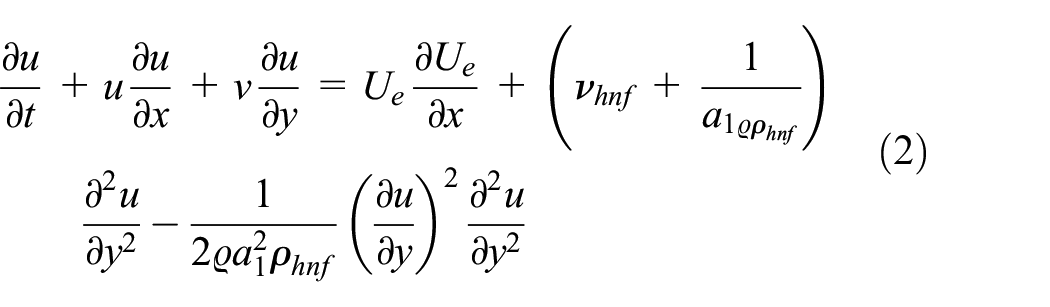


The boundary constraints are applied as follows:

Here,
Similarity transformation
It is necessary to carry out the appropriate transformation that follows.

The noteworthy nanofluid models have been carried out through Yamada-Ota 44 and Xue 45 models. These models were considered in an extension for hybrid nanofluid flow by Abbas et al.43,47 and considered the solid nanoparticles with ordinary fluid.
In addition, the thermophysical characteristics of the Yamada-Ota 44 and Xue 45 hybrid nanofluid are demarcated as:


The Xue model 42 can be designed in the form of nanofluid and hybrid nanofluid
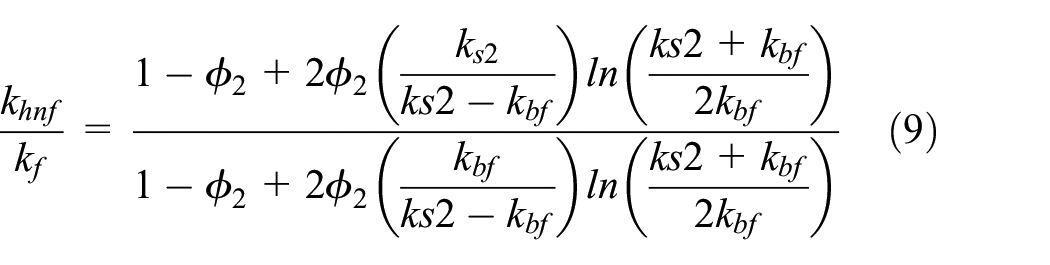
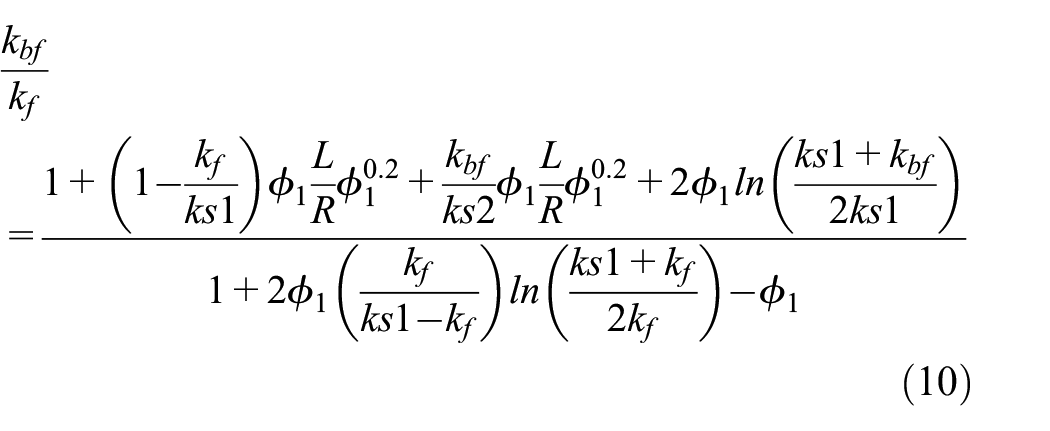
Using the similarity transmission explained in equation (6), equations (2) and (3) have rendered into the ODEs


The boundary conditions are described as:

In which:



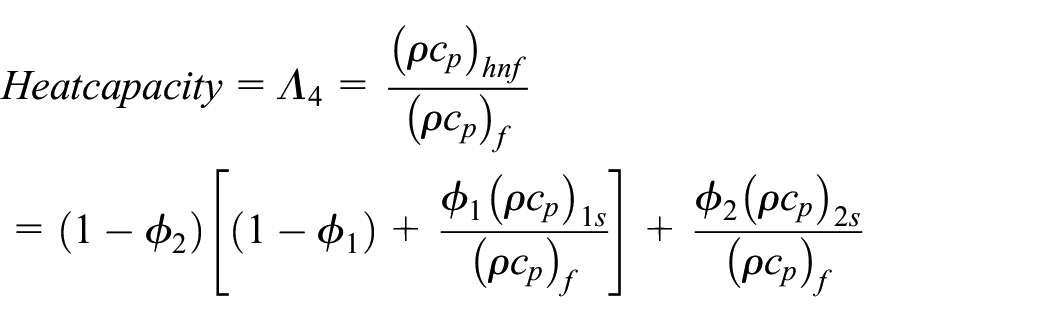
In the above expression, the formulation symbols
Thermophysical significance of the hybrid nanofluid.

However, the transformation equations non-dimensional physical quantities can defined as the unsteady variable
The drag friction

The

Given equations (6) and (15), we get
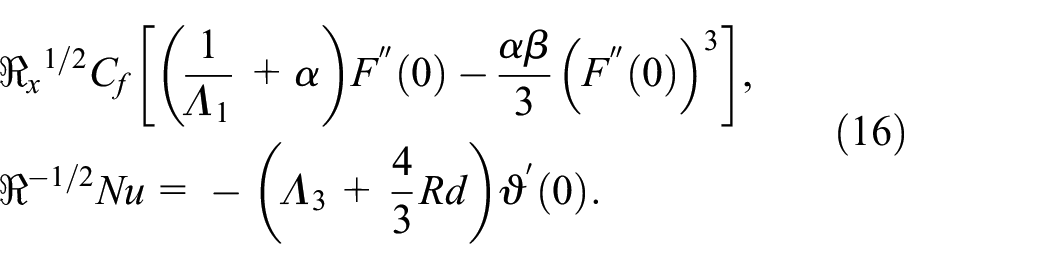
Where
Numerical solution
Using the Bcp4c approach, a set of nonlinear ordinary differential equations (11) and (12) along with the boundary conditions (13) are utilized numerically. In the beginning, the set of highly ordinary differential equations (11) and (12) and (13) are changed into first-order differential equations by following the approach that is outlined



Boundary conditions is

Iterations are done with the numbers until an accuracy of
Result and discussion
Using graphical illustrations, the role of the numerous mechanisms of the flow profiles containing velocity
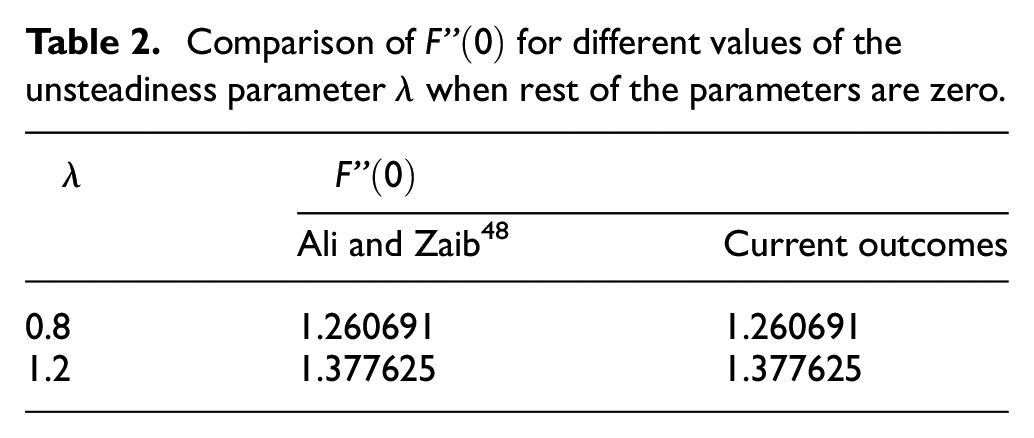
Comparison of
Numerical values of

Numerical values of

Velocity effect
Figure 2(a) to (c) presents the significance of fluid variable
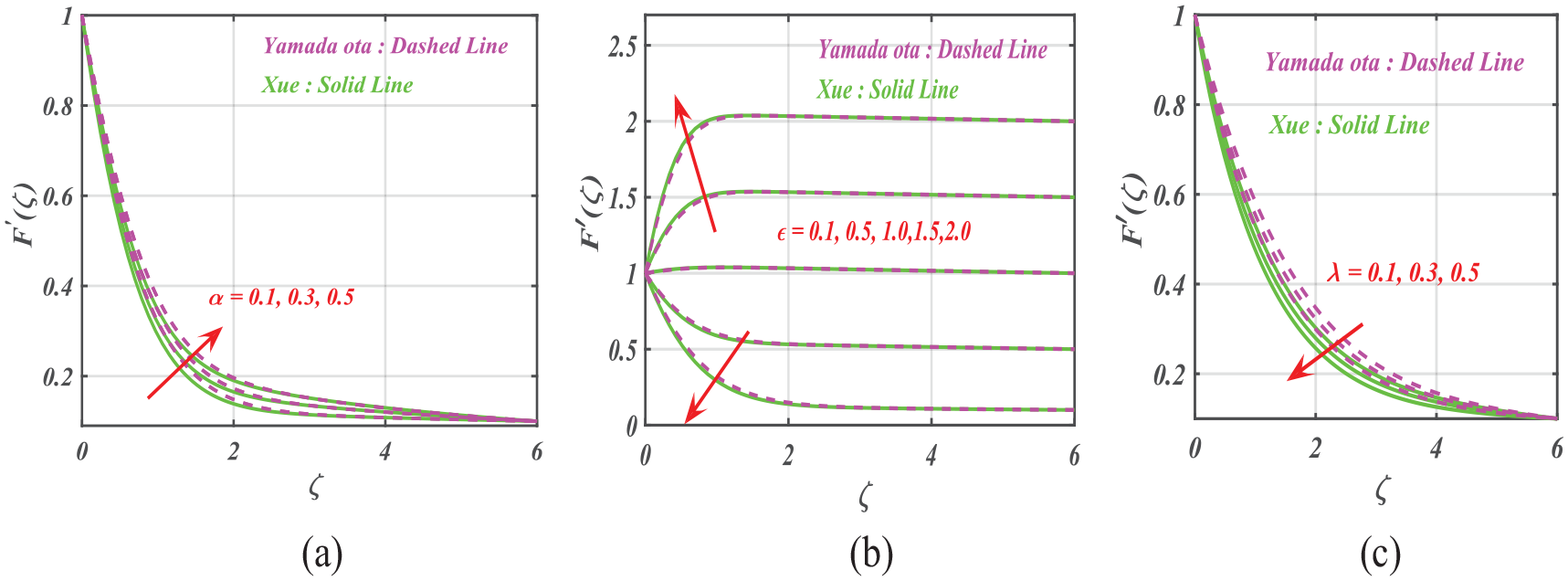
(a–c)
Temperature effect
The impact of fluid variable

(a and b)

(a and b)
Figure 5(a) and (b) reveals the
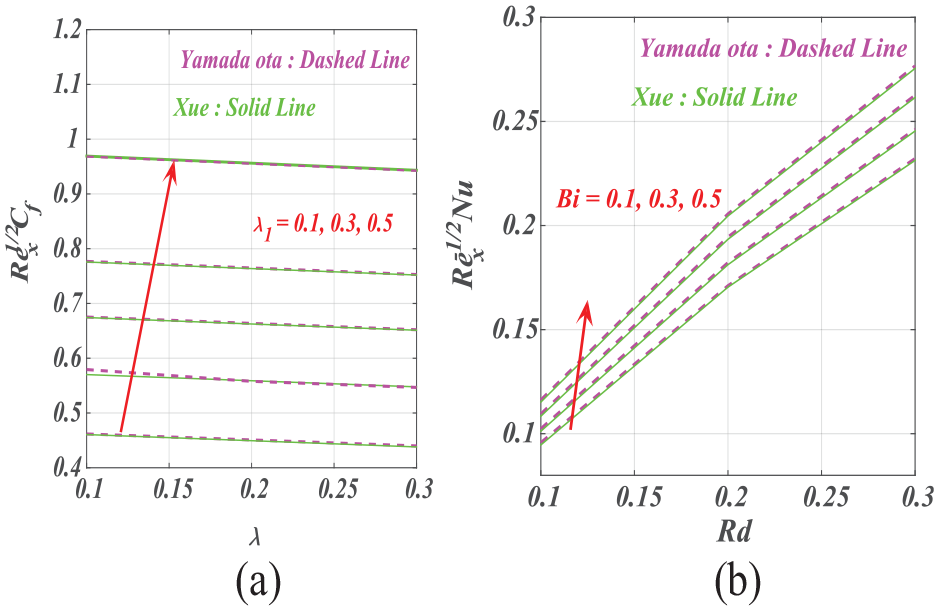
(a and b)

(a and b) Bar plot of
Xue and Yamada-Ota models are plotted for stream line as sketched in Figure 7(a) and (b). While the mixture of Xue and Yamada-Ota model has been exhibited in Figure 8. Figure 9(a) and (b) is sketched to view the contour plot for Xue and Yamada-Ota models.

Stream plot of

Mixture of Stream plot of Yamada-Ota and Xue model.

(a and b) Contour plot of Yamada-Ota and Xue model.
Conclusion
In this exploration, the unsteady stagnant flow of Eyring-Powell hybrid nanofluid
The temperature curve
The temperature distribution
Thermal radiation
The Xue model produces fewer values as compared to the Yamada-Ota model.
Footnotes
Appendix
Notation

| constant | |
| Fluid parameter | |
| Unsteady parameter | |
| Thermal radiation | |
| Biot number | |
| Stretching parameter | |
| Prandtl number | |
| Kinematic viscosity of EG | |
| Density of EG | |
| Thermal conductivity | |
| Heat capacity of EG | |
| Shear stress | |
| Skin friction | |
| Nusselt number |
Handling Editor: Chenhui Liang
Declaration of conflicting interests
The author(s) declared no potential conflicts of interest with respect to the research, authorship, and/or publication of this article.
Funding
The author(s) received no financial support for the research, authorship, and/or publication of this article.
Data availability statement
All data used in this manuscript have been presented within the article.
