According to researchers, the nano-particles utilized in nano-fluids are typically comprised of metals, oxides, carbides, or carbon nanotubes. Nano-fluids have a wide range of applications including heat transfer, soil remediation, lubrication, oil recovery, and detergency. The current study focuses on the investigation of the active and passive control of nanoparticles between the squeezing plates in the presence of a magnetic field. The traditional Navier-Stokes nano-fluid equation along with the Maxwell equation, the magnetic force term, the energy equation, and the volume fraction equation are converted into the ordinary differential equations for establishing natural parameters. The Coupled systems of non-linear ODEs are then solved numerically through parametric continuation method. The Nusselt number, entropy generation, and nanoparticles volume fractions profiles are shown graphically to see the effect of several parameter under consideration. For accuracy, the results obtained by PCM has been compared with the result by BVP4C. It has been observed that the increase in the squeezing parameter decreases the fluid temperature. The active control of nano-particles decreases the mass transfer while passive control increases the mass transfer. Also, the active and passive of nanoparticles increases the temperature gradient with the increase of thermophoresis parameter. The same but opposite behavior is also observed for mass transfer. The increase in , , and for active and passive of nanoparticles and boundary layer thickness decreases the entropy generation.
Researchers have been interested from several decades in studying the squeezing flow due to its uses in knee joints, petroleum industry, hydraulic machines, and pumping of heart. Stefan1 considered the Newtonian liquid for the first time in 1874 and developed the theoretical results for lubrication. The works of Salbu2 and Thorpe and Shaw3 are more practical, as they have analyzed the compressible squeezing flow with inertia effect and without inertia effect. Many researcher’s studied squeezing flow in their own perspective.4–12 Many researchers have also studied the transfer of heat in the human body and determined the heat transfer in a human body through the principles of heat transfer in engineering systems. Heat is transferred by the movement of fluids on the surface of the body refer to convection. This convective fluid phenomenon can occur either in a gas or in a liquid. Heat transfer properties are studied by Mahmood et al.13 in 2007. They have studied the squeezing fluid flow in a porous medium. In addition to that, Mustafa et al.14 in 2002 investigated the effect of mass and heat transfer for various characteristics in the viscous fluid flowing through the parallel squeezing plates. They have analyzed the effect of local Nusselt number, the Eckert number and the Prandtl number , and concluded that the increase in local Nusselt number lead to increases in the Eckert number and the Prandtl number because Nusselt number contains both and . Thereafter, Domairry and Aziz15 in 2009 have studied the effect of Magnetohydrodynamic terms in the viscous fluid between parallel disks and investigated the effects of Hartman number in the squeezing fluid flow. Hashmi et al.16 in 2012, analyzed the effect of Hartman number in the flow of nanofluids through squeezing plates and the governing equations of the model have been solved by the Homotopy Analysis Method (HAM). Pourmehran et al.17 in 2015 used the two semi-analytical methods (Least Square Method and collocation method) for the possible solution of heat transfer and unsteady squeezing nanofluid. Furthermore, they discussed the effects of various physical parameters for the values of skin friction and Nusselt number by placing the plates on horizontal axis. Singh et al.18 in 2016, studied the influence of slip velocity, magnetic field, and concentration for an unsteady fluid flow and heat transfer on parallel plates. For its numerical results, they have used Range-Kutta of order (four to five) in the frame of shooting techniques which produced interesting results for the following parameters as Schmidt number, Hartman number, Nusselt number, velocity and concentration on Sherwood number, velocity slip parameter, Skin friction, squeeze number, and volume fraction of nanoparticle on temperature. Further, Siddiqui et al.19 in 2008, studied the hydromagnetic influences of a viscous fluid in horizontal parallel plates and the proposed model is solved by HPM. Sheikholeslami et al.20 in 2015, investigated the effect of forced convection heat transfer and nano-uniform magnetic field on nanofluid and found interesting results and the proposed model was then solved by the numerical scheme. Further, Sheikholeslami et al.21 in 2015, studied the nanofluid flow in two-stage simulation with heat transfer on parallel plates, and the constructed model is solved by HPM. Next, Sheikholeslami and Ganji22 in 2015, examined the provision of mass transfer and heat transfer in a parallel channel on unsteady nanofluid in the viscous dissipation existence and the effect of radiation. A group Okango et al.23 in 2014 studied Hall current effect in the existence of variable magnetic fields in the vertical porous flat plates and the flow between them. The flow is steady and the selected domain is laminar, but the whole system rotates with a uniform angular velocity around the normal axis of the plate. Situma et al.24 in 2015 observed the group of equations that shows the flow is a combination of momentum equation, generalized Maxwell equations, energy equation, and OHM law. These equations are solved by a numerical scheme called the finite difference method. Hatami et al.25 in 2015 investigated the effect of all possible parameters of nanofluids flow and heat transfer in the presence of variable magnetic fields through parallel plates. Acharya et al.26 in 2016, proposed a model of squeezing flow of Cu-water and Cu-kerosene nanofluid with the magnetic field and used DTM and RK-4 numerical scheme for its solution.
As we know Entropy generation is used to measure the degradation in the performance of engineering systems and dissipated useful energy such as rate processes and transport. Bejan27,28 in 1982 and 1995 suggested in their proposed model that the flow of variable parameters can be taken to reduce the irreversibility in the heat transfer process through specific convective. Hijleh et al.29 in 1999, observed through a rotating cylinder the laminar mixed convective of the entropy and concluded that the increase in buoyancy parameter and Reynolds number occur due to the increase of entropy generation. Tasnim et al.30 in 2002, reviewed the study of the first law and second law of thermodynamics regarding the flow properties and heat transfer in the presence of a magnetic field through two parallel vertical plates with a porous medium. Makinde31 in 2002, introduced the influence of entropy generation in the diminishing variable viscosity fluid film through the vertical heated plate with convection cooling was carried out. Mahmud et al.32 in 2003, studied the effects of magnetic field on the entropy generation in the presence of mixed convection channel. Al-Odat et al.33 in 2004, studied the effects of entropy generation through the laminar flow past flate plate in the existence of magnetic field. They noticed that the magnetic field intensity lead to increased the rate of entropy generation. Futher, Atlas et al.34 in 2016, observed the thermal radiation effects on mass transfer and heat transfer in the nanofluid flow through two parallel plates.In addition, they have studied the active and passive ability of nanoparticals. The impacts of hall and ion slip from the time dependent MHD-free convective rotating flow through the explanatory bent surface have been investigated.35 It is stated from the results that avoid flow reversal in the presence of the magnetic field. In a liquid-saturated, permeable annulus, the influence of Nanostructure Factors on natural convection is statistically examined.36 It is shown that the increase of heat transmission in Rayleigh and Darcy at a specific aspect ratio greatly increases and the average number of Nusselt increases. The study using FEM of the existing Y-shaped fine and NEPCM thermal storage designs is studied by the Sheikholeslami et al.37 The investigation indicated that the number of Reynolds and the volume percentage of FMWCNT had a substantial impact on thermal transmission.
Many researchers studied squeezing flow of magneto-nanofluid16–21,34,38 and developed theoretical analysis for entropy generation. The above literature revealed that in the current time no previous research has been conducted on the active and passive control of the nano-particles in a squeezing flow under the influence of a variable magnetic field in the two dimensinl Cartesian plane between parallel and squeezing plates. In addition, the effect of a variable magnetic field on mass transfer is also a new work in this area.
Mathematical problem formulation
we consider nanofluid between two parallel plates apart from each other at a distance of . The parameter indicate separation phenomena if otherwise indicate squeezing phenomena. Electric field of variable intensity is introduced in the region between the plates. The co-ordinates system is selected on the surface of the bottom plate as shown in Figure 1.
Geometry of the problem.
The following assumptions are.
Flow is an incompressible, laminar, and unsteady.
The gravitational and the entrance and exit effects are negligible.
The various defined functions regarding nanofluid volume fraction, velocity components, and temperature must satisfy the boundary conditions given in equation (16). The nanofluid modeled by a set of governing equations in Atlas et al.34:
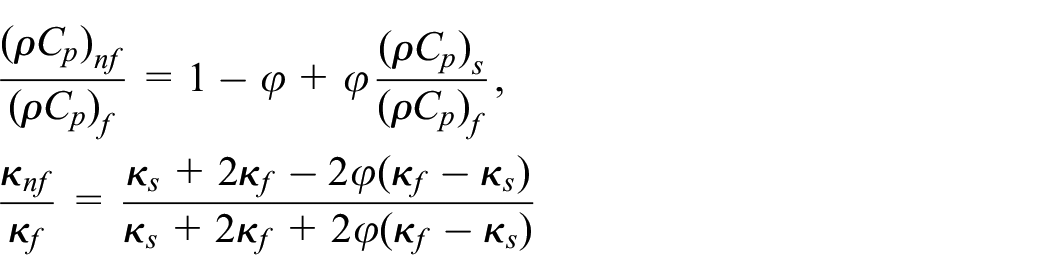
The density nanofluid is , the dynamic viscosity nanofluid is , the thermal conductivity nanofluid is , and the effective heat capacity nanofluid is in17:
We have considered heat flux radiation as stated by Rosseland’s approximation that is is the radiative heat flux and by using the Rosseland approximation for radiation for an optically thick layer one can write14
It is assumed that the temperature differences within the flow are such that the term may be expressed as a linear function of temperature. This is accomplished by expanding in a Tailor series about and neglecting second and higher order terms, we get
and so
The magnetic field are denoted by and , , the nanofluid viscosity, the represent pressure, the electric current, the thermal conductivity of nanofluid, the electric charge density, the nanofluid dynamic viscosity, the electric field, the reference temperature, specific heat of nanofluid, the magnetic induction. the temperature field, the coefficient of thermophoretic diffusion, the concentration parameter, and is the diffusion coefficient of the diffusing species.
The following boundary conditions are
For Active control of nanoparticles:
For Passive control of nanoparticles:
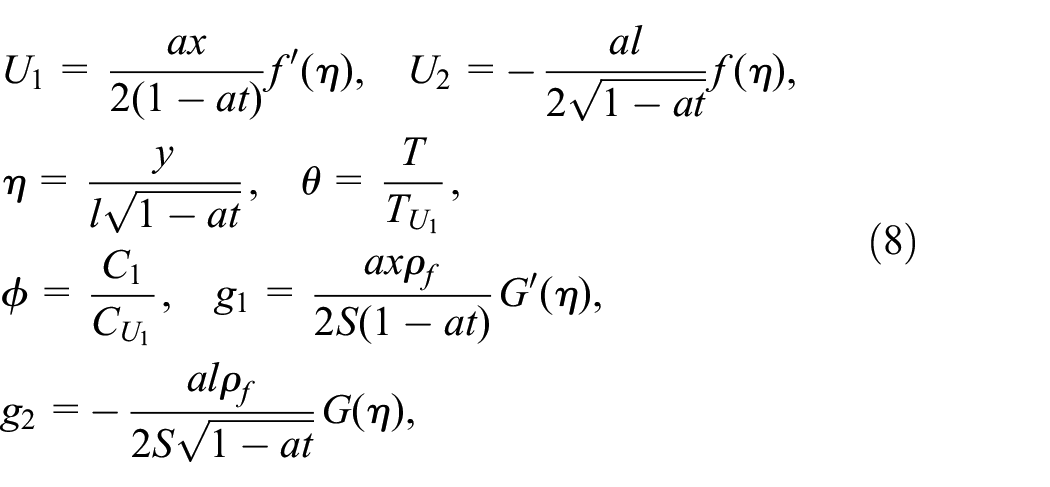
In order to introduce the natural parameters which describe the nanofluid flow characteristics we have introduced a set of similarity transformation and converted the system of PDEs into a nonlinear coupled system of ODEs.
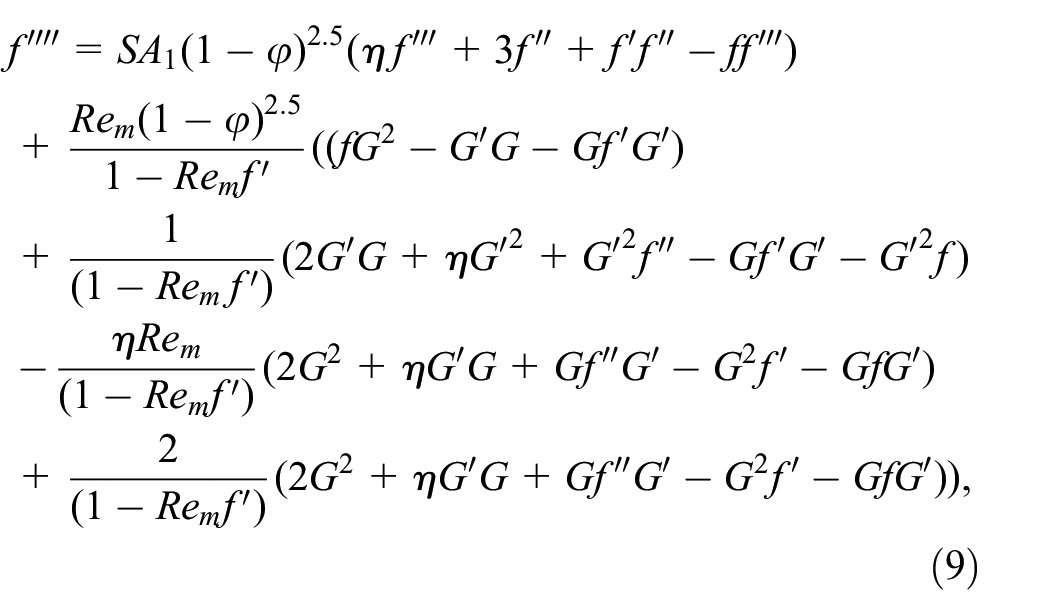
after eliminating pressure from equations (2)–(5) and making use of transformation we arrive at
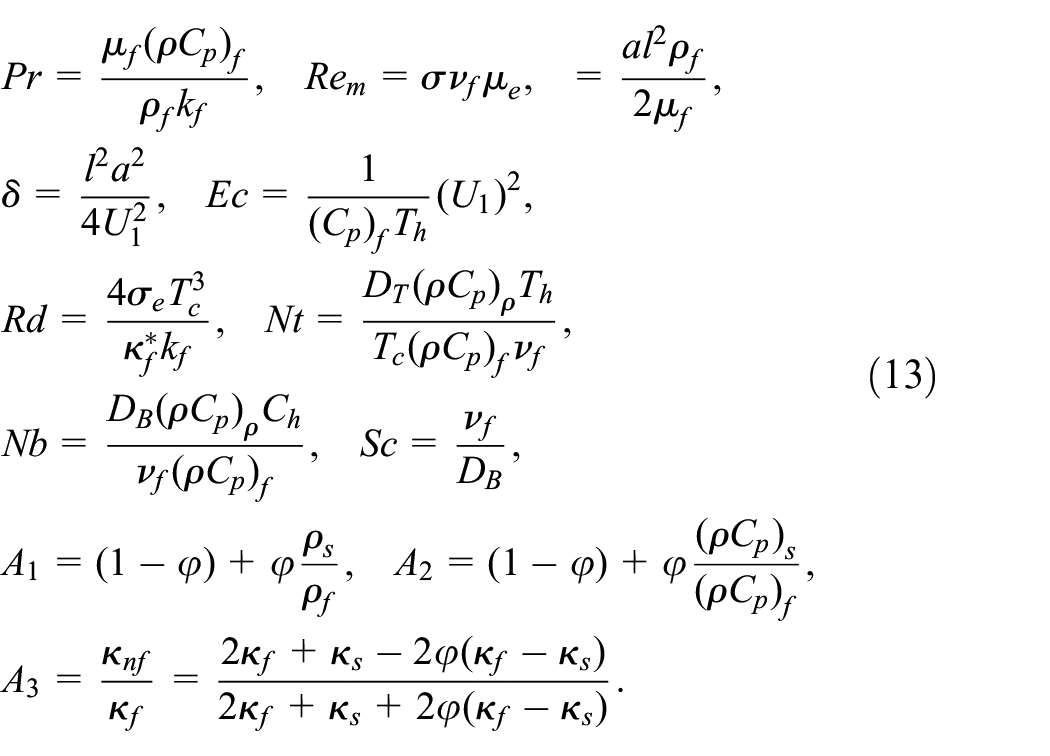
where is the squeeze number, the Lewis number, the magnetic Reynold’s number, the Eckert number, the thermophoretic parameter, the Radiation parameter, the Brownian motion parameter, and is the Prandtl number. , , and are the constants of non-dimensionless. The following parameters are defined as,
And the conditions of the boundaries were reduced as follows:
In case of active control of nanoparticles
For passive control of nanoparticles
Entropy generation
After transformation the entropy generation may be selected as29:
where and are the reference temperature, the electric current, thermal conductivity of nanofluid, the density of electric charge, the electric field, the velocity vector, the entropy generation rate, the characteristic rate of entropy generation is , the ratio of temperature is a dimensionless form , respectively. The nondimensional form of the entropy generation can be taken as
where , , and are the entropy generation because of heat transfer, fluid friction, and magnetic field respectively. The Bejan number is defined as the ratio of entropy generation due to heat transfer to the total entropy generation and is written as :
The important physical parameters such as Nusselt number and skin friction coefficient can be written explicitly as follow,
After making use of similarity transformation, we obtain
Numerical solution by PCM
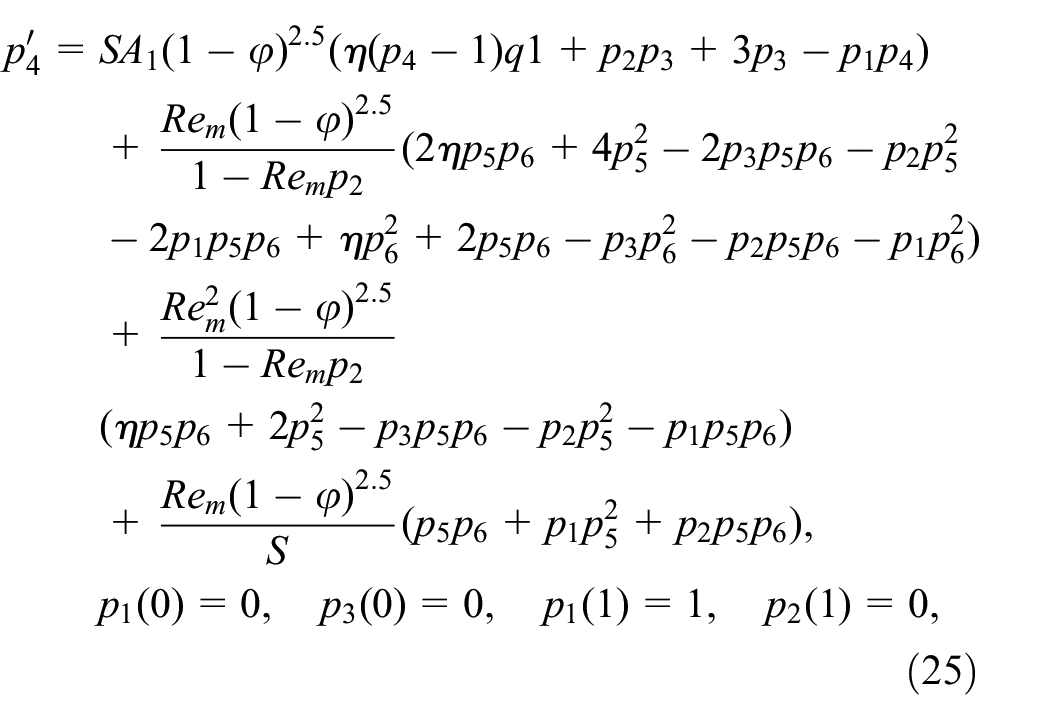
For the solution of the highly nonlinear coupled system of differential equations (9)–(12) with boundary conditions, equations (14) and (15) is solved by the Parametric continuation method.39 The algorithm of the aforementioned robust numerical scheme for the system of equations is as follows.
The system of first-order ODEs for the system of BVP. For the transformation of equations (9)–(12), (14), and (15) into a system of the first order ODEs, we use the following suppositions.
The introduction of a parameter introduces -parameter family of ODEs.
Differentiation with respect to is obtained at the consideration of sensitivity in the following system for the parameter q1:
where the coefficient matrix is , the remainder is and , .
The consideration principle application and Cauchy problem
Where are two not defined vector functions and we have to solve the following two Cauchy problems for each component. We are generally satisfied with the model of ODEs.
and on left boundary conditions.
The numerical solution of the Cauchy
A contained system is expressed for the numerical solution of the current problem as given:
Taking of correspondent co-efficients
Hence, the aforementioned boundary conditions are utilized only for , where , the ODEs sensitivity solution can be used to implement and its corresponding matrix form as given:
where .
Results and discussion
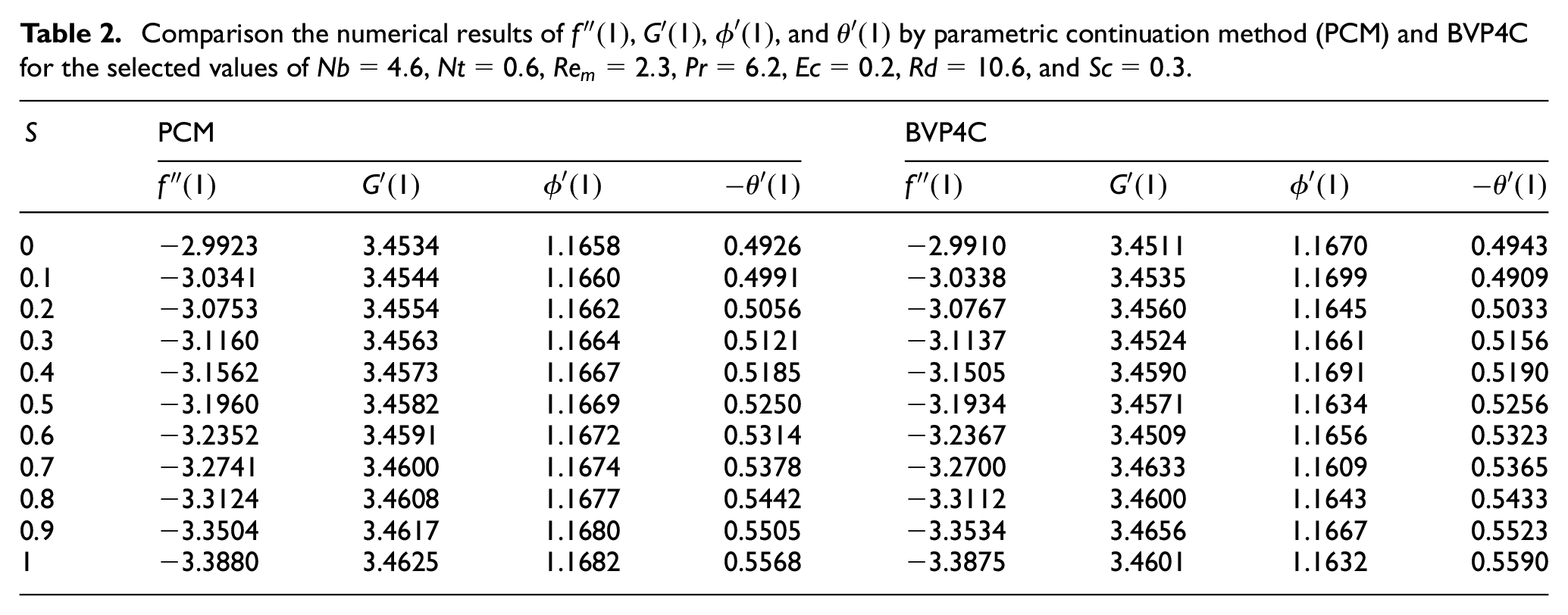
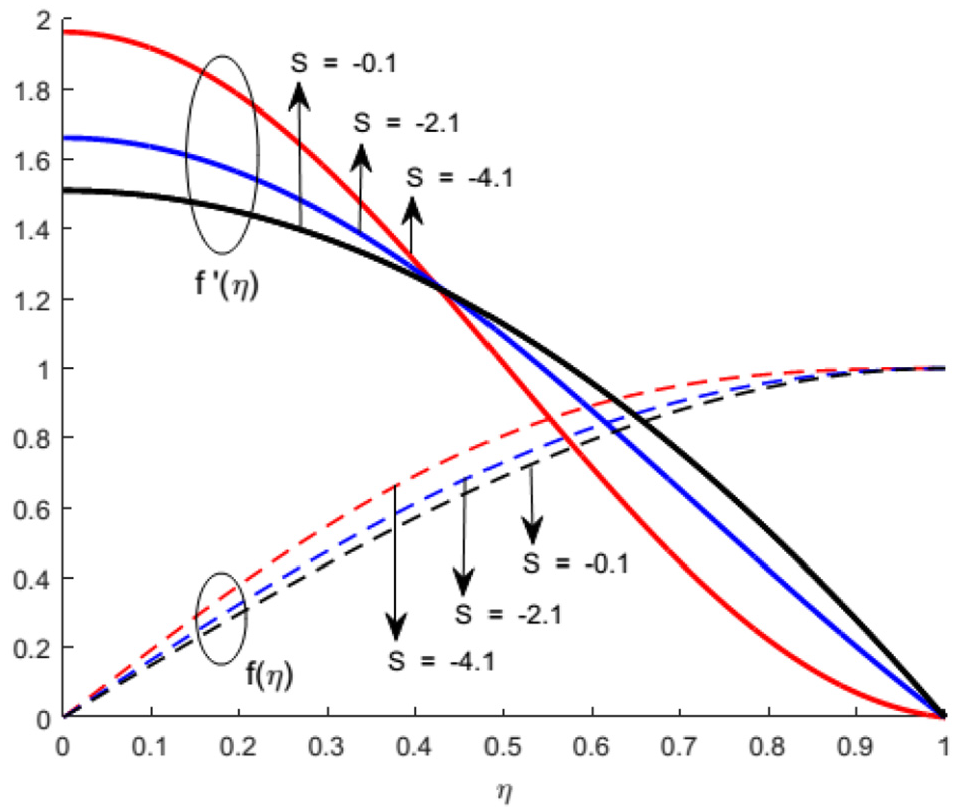
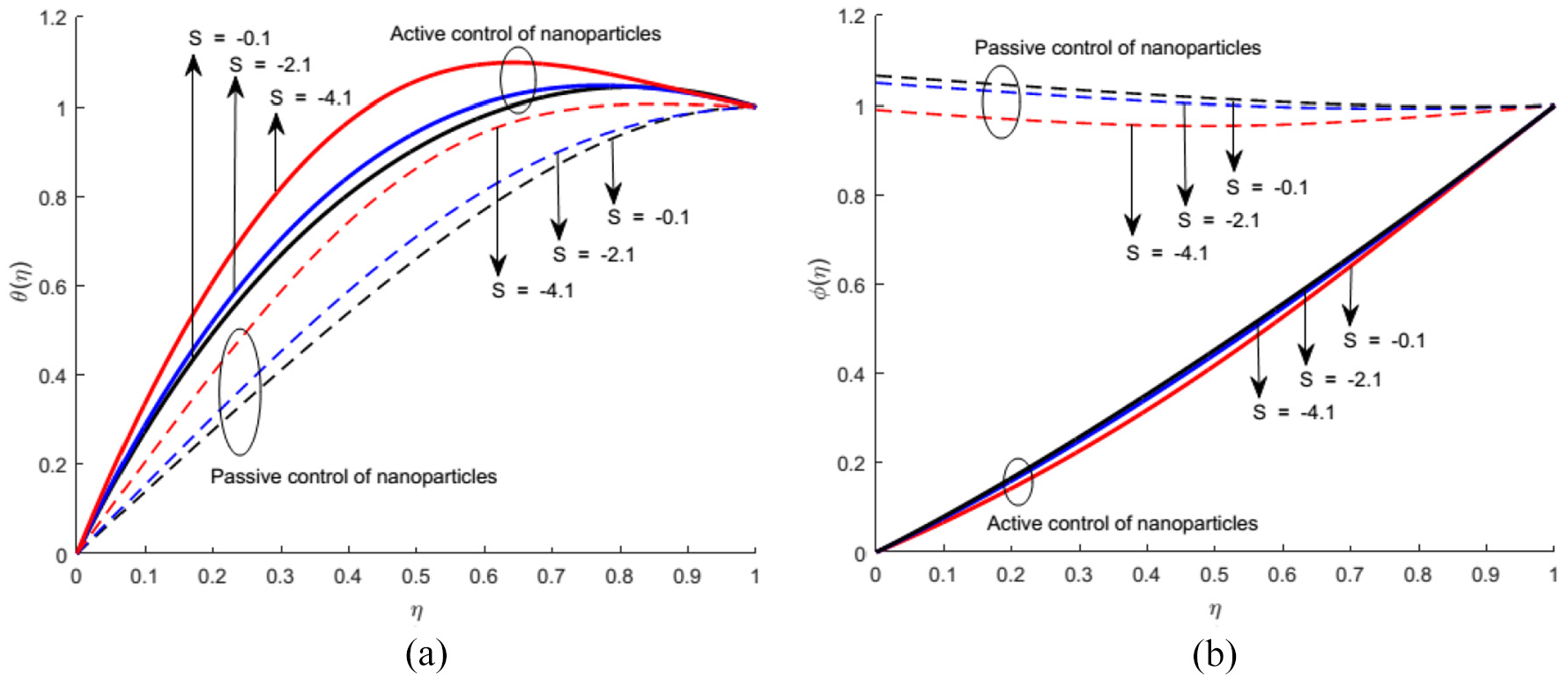
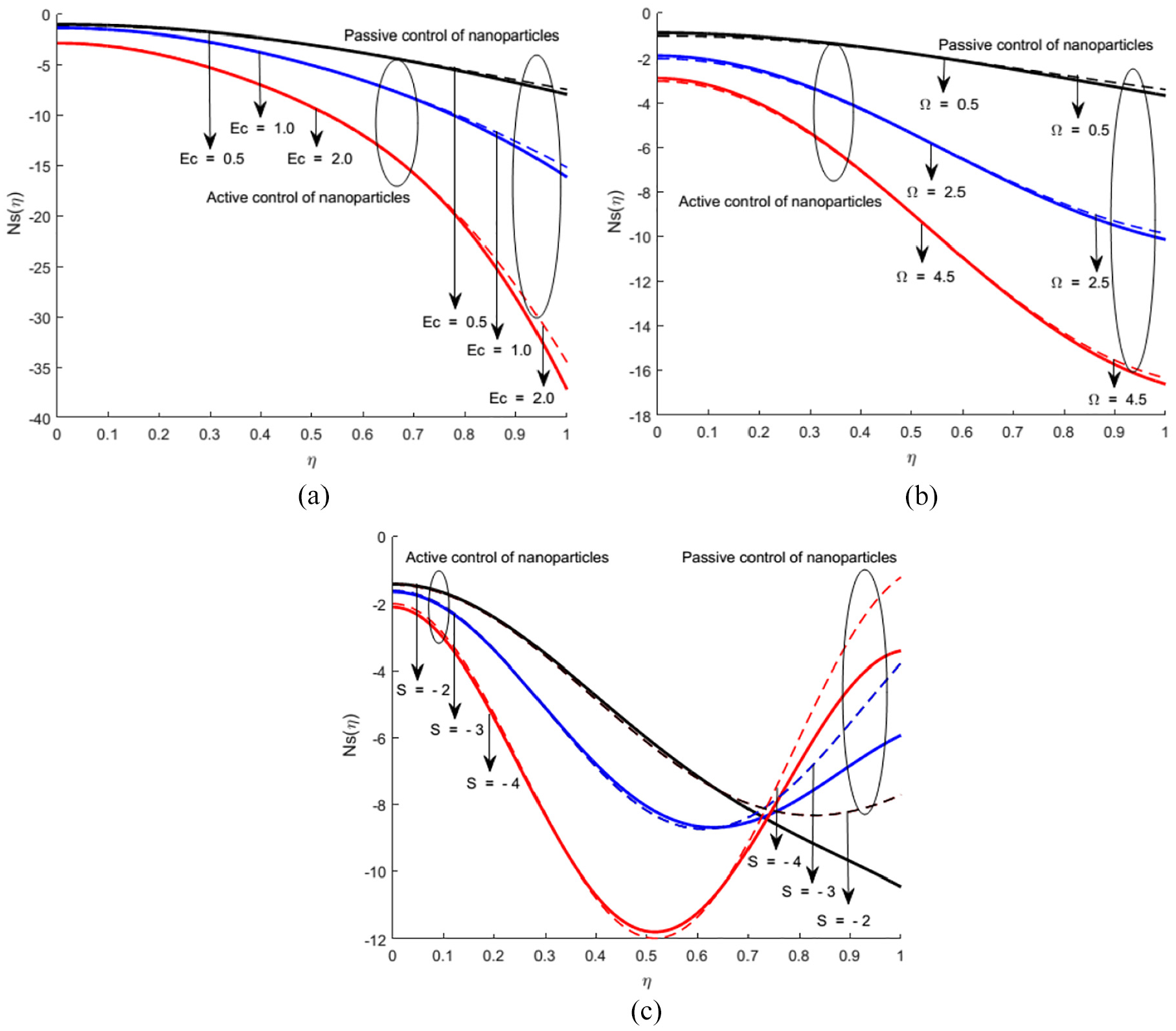
The physical system has been modeled by a system of equations (11)–(14) and (19) with boundary conditions equations (16) and (17) which involve Navier-Stoke equation, set of Maxwell equations, energy equation for entropy generation, and volume fraction of nanoparticles. The thermophysical properties of Nano-particles given in Table 1. Keeping in mind the preceding literature of PCM used for the problem of computational fluid dynamics(CFD), so this numerical scheme has been used for the solution of the system and the results are tabulated in the Table 2 and displayed graphically in Figures 2 to 11. Table 2 is made to compare the accuracy of PCM and BVP. It is clear that the results of both the methods are in a good agrrement. Figure 2 shows the effects of on the velocity profile and . The squeeze Reynolds number is the ratio between the normal velocity of the upper disk and the kinematic viscosity of the fluid. It is important to note that small or big values of mean the slow or rapid vertical velocity of an upper disk toward the lower disk. Positive values of also mean that the upper disk is moving away from the lower disk or a increase in the distance between disks, whereas negative values of means that the upper disk is moving toward the lower disk or a decrease in the distance between disks. It is obvious, that the increase in squeezing number lead to increase the axial velocity .This is because when the plates go away from one another the concoction of the nanofluids particles disperses and hence the particles will have a small collision between the plates. Near the plates, the squeezing parameter has a significant effect on the . The increase in the squeezing number lead to an increase in the velocity profile when , otherwise decreases when . Figure 3(a) displays the mass and the temperature profile for different values of squeezing number in the presence of active and passive control of nanoparticles. This reveals that the increase in the squeezing parameter decreases the temperature profile, in the same way, the mass profile reduces due to active control of nanoparticles and rises due to passive control nanoparticles. Figure 4 shows the effects on mass profile due to the fluctuation in . It expresses the relationship between a flow’s kinetic energy and the boundary layer enthalpy difference, and is used to characterize heat transfer dissipation. It has been observed that the increase in Eckert number lead to a decrease in the temperature profile for active and passive control of nanoparticles. In the same way, the distribution of mass reveals that the boundary layer thickness grow due the increase in for active and passive nanoparticles. Figure 5 displays the influence of on both mass and temperature profiles for active and passive of nanoparticles. The radiation parameter 31 defines the relative contribution of conduction heat transfer to thermal radiation transfer. It is obvious that an increase in the radiation parameter results in increasing temperature within the boundary layer. It has been noticed that the increase in the radiation parameter cooling down the heat transfer of the fluid while increasing the mass transfer for active and passive of nanoparticles. Figure 6 explains the effect of the thermophoretic parameter on the mass and temperature profile for active and passive of nanoparticles. Thermophoresis is a force generated by the temperature gradient between the hot gas and the cold wall effecting the particulate movement toward the cold wall.The increase in the thermophoretic parameter increases the temperature profile for active and passive of nanoparticles while the mass profile increases for the passive of nanoparticles and decreases for the active of nanoparticles. Figure 7 shows the effects of various nanoparticles for active and passive of nanoparticles. The fluctuation in the heat transfer is displayed in Figure 7(a) which reveals that the Alumina temperature is greater than the copper temperature and the copper temperature is greater than the Titanium temperature for active and passive of nanoparticles. The variation in the mass profile is shown in Figure 7(b), which shows that for active and passive of nanoparticles the mass profile of Titanium is greater than the mass profile of copper and the mass profile of copper is greater than the mass profile of Aluminum. We can observe in Figure 8(c), the increase in the increases the local entropy generation parameter near by the lower plate surface but the effect is reversible when the plate goes away from the lower plate. In addition, in the vicinity of the lower plate, the entropy generation is maximum in all cases where the velocity and the temperature profiles are maximum. It reflects that the lower plate gives solid support to entropy generation. From Figure 8(a) and (b), we have noticed that the entropy generation is getting down due to raising the values of and for active and passive of nanoparticles and increase in the thickness of the boundary layer. Figure 9(a) displays the effect of for active and passive of nanoparticles on the Bejan number. Bejan number is the ratio of heat transfer irreversibility to total irreversibility due to heat transfer and fluid friction. The Bejan number varies due to the fluctuation in and it diminishes for various values of after . It is evident that the entropy generation grows in the vicinity of plates for active and passive of nanoparticles, while insignificant variation has been noticed close to the middle of the channel. From Figure 9(b) and (c), we have observed the effect of and on the Bejan number, which shows that the increase in and lead to decrease entropy generation all over the domain for active and passive of nanoparticles. Figure 10(a) displays the effect of on skin friction for active and passive of nanoparticles. It can be observed that an increase in squeezing parameter is decreasing the skin friction due to the increase in the distance between the two plates. The increase in lead to decrease . From Figure 10(b), it has been observed that the skin friction rises due to the rise in the and it is only due to the shrinking in the thickness of the thermal boundary layer near the upper plate.
The thermophysical properties of water and nanoparticles.
Pure water
997.1
4179
0.613
Silver
10,500
235
429
Copper
8933
385
401
Alumina
3970
765
40
Titanium oxide
4250
686.2
8.9538
Comparison the numerical results of , , , and by parametric continuation method (PCM) and BVP4C for the selected values of , , , , , , and .
PCM
BVP4C
0
−2.9923
3.4534
1.1658
0.4926
−2.9910
3.4511
1.1670
0.4943
0.1
−3.0341
3.4544
1.1660
0.4991
−3.0338
3.4535
1.1699
0.4909
0.2
−3.0753
3.4554
1.1662
0.5056
−3.0767
3.4560
1.1645
0.5033
0.3
−3.1160
3.4563
1.1664
0.5121
−3.1137
3.4524
1.1661
0.5156
0.4
−3.1562
3.4573
1.1667
0.5185
−3.1505
3.4590
1.1691
0.5190
0.5
−3.1960
3.4582
1.1669
0.5250
−3.1934
3.4571
1.1634
0.5256
0.6
−3.2352
3.4591
1.1672
0.5314
−3.2367
3.4509
1.1656
0.5323
0.7
−3.2741
3.4600
1.1674
0.5378
−3.2700
3.4633
1.1609
0.5365
0.8
−3.3124
3.4608
1.1677
0.5442
−3.3112
3.4600
1.1643
0.5433
0.9
−3.3504
3.4617
1.1680
0.5505
−3.3534
3.4656
1.1667
0.5523
1
−3.3880
3.4625
1.1682
0.5568
−3.3875
3.4601
1.1632
0.5590
Effect of and for with fixed values of .
Effect of (a) and (b) for with fixed values of .
Effect of (a) and (b) for with fixed values of .
Effect of (a) and (b) for with fixed values of .
Effect of (a) and (b) for with fixed values of .
Effect of (a) and (b) for nanoparticles with fixed values of .
(a) The effect of on entropy generation with different values of . (b) The effect of entropy generation for with values of . (c) The effect of entropy generation for with values of . With fixed values are .
(a) The effect of on Bejan number with values of . (b) The effect of Bejan number for with values of . (c) The effect of Bejan number for with values of . With fixed values are .
(a) The effect of Nusselt Number for with different values of . (b) The effect of Nusselt number for with different values of . With fixed values are .
(a) The effect of Skin friction for . (b) The effect of Skin friction for . With fixed values are .
Concluding remarks
In the present paper, the Navier-Stokes equations along with heat/mass transfers are taken into account for the squeezing flow of a viscous fluid between two parallel plates. The flow is also under the influence of an external applied magnetic field. The governing equations (1)–(5) are reduced to a system of ordinary differential equations (9)–(12) using similarity transformation given in equation (8). The parametric continuation method and BVP4c are used to investigate the problem. The effects of the involved physical parameters are thoroughly studied through graphs and tables. The following findings are concluded:
The increase in the decreases . The has many influences on in the vicinity of plates such as the increase in Squeezing number lead to an increase in the , when , but the reverse trend is noticed, when .
It has been observed that the increase in the decreases the temperature profile. But for active of nanoparticles the mass profile decreases and for passive control of nanoparticles the mass profile increases.
The active and passive of nanoparticles temperature profile increases, when increases. Similarly, for active control of nanoparticles mass profile decreases and for passive control of nanoparticles it increases, when increases.
The radiation parameter has a significant effect on mass and temperature profile for active and passive of nanoparticles.
The increase in , , and for active and passive of nanoparticles and boundary layer thickness decreases the entropy generation.
Footnotes
Handling Editor: Chenhui Liang
Declaration of conflicting interests
The author(s) declared no potential conflicts of interest with respect to the research, authorship, and/or publication of this article.
Funding
The author(s) received no financial support for the research, authorship, and/or publication of this article.
ORCID iDs
Muhammad Sohail Khan
Rehan A Shah
Aamir Khan
References
1.
StefanJ.Versuche die scheinbare Adhasion, Sitzungsberichte der kaiserlichen Akademie der Wissenschaften. Vienna: Mathematisch Naturwissenschaftliche Classe, Band II. Abteilung Wien, 1874. vol. 69, pp.713–735.
2.
SalbuEOJ. Compressible squeeze films and squeeze bearings. J Basic Eng1964; 86: 355–364.
3.
ThorpeJFShawWA.Developments in theoretical and applied mechanics. Oxford: Pergamon Press, 1967.
GuptaPSGuptaAS.Squeezing flow between parallel plates. Wear1977; 45: 177–185.
6.
VermaRL. A. Numerical solution for squeezing flow between parallel channels. Wear1981; 72: 89–95.
7.
SinghPRadhakrishnanVNarayanKA.Squeezing flow between parallel plates. Ing Arch1990; 60: 274–281.
8.
ElkouhAF.Fluid inertia effects in a squeeze film between two plane annuli. J Tribol1984; 106: 223–227.
9.
Phan-ThienNTannerRI.Lubrication squeeze-film theory for the Oldroyd-B fluid. J Non-Newton Fluid Mech1984; 14: 327–335.
10.
KompaniMVenerusDC. Equibiaxial extensional flow of polymer melts via lubricated squeezing flow. I. Experimental analysis. Rheologica Acta2000; 39: 444–451.
11.
HoffnerBCampanellaOHCorradiniMG, et al. Squeezing flow of a highly viscous incompressible liquid pressed between slightly inclined lubricated wide plates. Rheologica Acta2001; 40: 289–295.
12.
HeJH.Some asymptotic methods for strongly nonlinear equations. Int J Mod Phys B2006; 20: 1141–1199.
13.
MahmoodMAsgharSHossainMA.Squeezed flow and heat transfer over a porous surface for viscous fluid. Heat Mass Transf2007; 44: 165–173.
14.
MustafaMHayatTObaidatS.On heat and mass transfer in the unsteady squeezing flow between parallel plates. Meccanica2012; 47: 1581–1589.
15.
DomairryGAzizA.Approximate analysis of MHD squeeze flow between two parallel disks with suction or injection by homotopy perturbation method. Math Probl Eng2009; 19: 903–916.
16.
HashmiMMHayatTAlsaediA.On the analytic solutions for squeezing flow of nanofluid between parallel disks. Nonlinear Anal Model Control2012; 17: 418–430.
17.
PourmehranORahimi GorjiMGorji BandpyM, et al. Retracted: analytical investigation of squeezing unsteady nanofluid flow between parallel plates by LSM and CM. Alex Eng J2015; 54: 17–26.
18.
SinghKRawatSKKumarM.Heat and mass transfer on squeezing unsteady MHD nanofluid flow between parallel plates with slip velocity effect. J Nanosci2016; 2016: 1–11.
19.
SiddiquiAMIrumSAnsariAR.Unsteady squeezing flow of a viscous MHD fluid between parallel plates, a solution using the homotopy perturbation method. Math Model Anal2008; 13: 565–576.
20.
SheikholeslamiMRashidiMMGanjiDD.Numerical investigation of magnetic nanofluid forced convective heat transfer in existence of variable magnetic field using two phase model. J Mol Liq2015; 212: 117–126.
21.
SheikholeslamiMHatamiMDomairryG.Numerical simulation of two phase unsteady nanofluid flow and heat transfer between parallel plates in presence of time dependent magnetic field. J Taiwan Inst Chem Eng2015; 46: 43–50.
22.
SheikholeslamiMGanjiDD.Unsteady nanofluid flow and heat transfer in presence of magnetic field considering thermal radiation. J Braz Soc Mech Sci Eng2015; 37: 895–902.
23.
OkongoMOGichohiPNMugambiJM.Hall current effects on a flow in variable magnetic field past an infinite vertical porous flat plate. Int J Res Appl Sci2014; 19: 9717113.
24.
SitumaHSigeyJKOkelloJA, et al. Effect of Hall current and rotation on MHD free convection flow past a vertical infinite plate under a variable transverse magnetic field. SIJ Trans Comput Netw Commun Eng2015; 3: 59–65.
25.
HatamiMJingDSongD, et al. Heat transfer and flow analysis of nanofluid flow between parallel plates in presence of variable magnetic field using HPM. J Magn Magn Mater2015; 396: 275–282.
26.
AcharyaNDasKKunduPK.The squeezing flow of Cu-water and Cu-kerosene nanofluids between two parallel plates. Alex Eng J2016; 55: 1177–1186.
27.
BejanA.Entropy generation through heat fluid flow. New York, NY: Wiley, 1982.
28.
BejanA.Entropy generation minimization. New York, NY: CRC Press, 1995.
29.
HijlehABassamKHeilenWN.Entropy generation due to laminar natural convection over a heated rotating cylinder. Int J Heat Mass Transf1999; 42: 4225174233.
30.
TasnimSHShohelMMamunMAH. Entropy generation in a porous channel with hydromagnetic effect. Exergy2002; 2: 300–308.
31.
MakindeOD.Thermodynamic second law analysis for a gravity-driven variable viscosity liquid film along an inclined heated plate with convective cooling. J Mech Sci Technol2010; 24: 899–908.
32.
MahmudSTasnimSHMamunMAH. Thermodynamic analysis of mixed convection in a channel with transverse hydromagnetic effect. Int J Therm Sci2003; 42: 731–740.
33.
Al-OdatMDamsehRAl-NimrM.Effect of magnetic field on entropy generation due to laminar forced convection past a horizontal flat plate. Entropy2004; 6: 293–303.
34.
AtlasMHaqRUMekkaouiT.Active and zero flux of nanoparticles between a squeezing channel with thermal radiation effects. J Mol Liq2016; 223: 289–298.
35.
Veera KrishnaMAmeer AhamadNChamkhaAJ. Hall and ion slip effects on unsteady mhd free convective rotating flow through a saturated porous medium over an exponential accelerated plate. Alex Eng J2020; 59: 565–577.
36.
DogonchiASNayakMKKarimiN, et al. Numerical simulation of hydrothermal features of Cu–H2O nanofluid natural convection within a porous annulus considering diverse configurations of heater. J Therm Anal Calorim2020; 141: 2109–2125.
37.
SheikholeslamiMHaqRUShafeeA, et al. Heat transfer simulation of heat storage unit with nanoparticles and fins through a heat exchanger. Int J Heat Mass Transf2019; 135: 470–478.
38.
HayatTAzizAMuhammadT, et al. Active and passive controls of Jeffrey nanofluid flow over a nonlinear stretching surface. Results Phys2017; 7: 4071–4078.
39.
KhanMSShahRAKhanA.Effect of variable magnetic field on the flow between two squeezing plates. Eur Phys J Plus2019; 134: 219–231.
40.
ShahRAKhanAAliA.Parametric analysis of magnetic field-dependent viscosity and advection–diffusion between rotating discs. Adv Compos Lett2020; 29: 2633366x1989637.
41.
KhanAAli ShahR.Influence of cross-diffusion and radiation on mixed convection between rotating discs in the presence of a variable magnetic field. Eur Phys J Plus2019; 134: 52.