




Abstract
There is a growing demand for more focus on developing and testing theories in implementation science (IS). This involves creating and testing theories about the different dynamics contributing to implementation strategies’ success or failure in different settings. While the application of realist methodologies is gaining traction in IS, their contributions to the field have not been explicitly articulated. To this end, we highlight six potential contributions of realist methodologies to IS: (1) leading with ontology, (2) formulating “program theories” of implementation strategies, (3) opening up the “black box” of implementation strategies, (4) moving from “context as nuanced” to “context as causal”, (5) mixed-methods integration for causality-based theorizing and (6) embracing the complex and adaptive nature of health systems. Through these six potential contributions, realist methodologies can greatly contribute to understanding the role of implementation strategies in improving the uptake of evidence-based interventions. This combination calls for IS and realist methodologies to join forces when appropriate, adding an additional dimension to both IS and realist work. Such integration can enhance the transferability and contextualization of evidence-based practice by more fully accounting for the complex interplay between implementation components, contextual conditions, actors, causal mechanisms, and expected outcomes.
Introduction
Implementation science (IS) requires more rigorous theory application, which is becoming increasingly urgent. Numerous calls have been made for addressing this need in IS, with recent advocacy for theorizing that explores how evidence is adopted into practice (Ridde et al., 2020; Wang et al., 2023). These authors call for more theorizing about the ‘problem’ (i.e. how implementation barriers cause or contribute to poor implementation) and ‘solution’ (i.e. how and under what conditions implementation strategies improve implementation). Some efforts are being made to elucidate the functional relationships between implementation determinants (the factors that act as barriers or facilitators to implementation, including essential preconditions), and causal mechanisms, the underlying processes through which an intervention produces change, as well as how contextual variables shape the resulting outcomes (Klasnja et al., 2024). Avoiding rigorous theory application in IS can lead to fragmented findings that weaken intervention design, practical usability and explanatory power.
To address this challenge, scholars have encouraged engagement with a wider range of philosophical and theoretical traditions (Kislov et al., 2019). In this context, the increasing use of realist-informed methodologies in IS stems from their ability to explicitly account for the role of context in shaping implementation outcomes. Scholars have argued that realist thinking not only provides more nuanced explanations of causality, but also redefines context itself. Rather than treating context as an external factor to be checked for compatibility, realist approaches position it as endogenous to the intervention’s program theory, that is, an integral part of how and why outcomes are produced (Francis-Auton et al., 2023; Hinrichsen et al., 2025; Long et al., 2024; Rycroft-Malone et al., 2012; Sarkies et al., 2022, 2023). Yet, the primary mode of contribution of these papers is through theory generation and the development of specific guidance derived from their realist methodology, rather than an explicit, exhaustive mapping of their findings against potential wider IS contributions.
We build on this previous work by making explicit six potential contributions of realist methodologies to IS. Our identification and proposition of these six potential benefits of integration are based on the authors’ experiences in the realist philosophy of science, extensive application of realist methodologies in other health research and practice fields, and considerable work in IS. This paper first explains the practical, philosophical, and epistemological foundations of realist methodologies, presenting the realist philosophy of science as a promising approach for IS research. It then outlines six potential applications within the IS field.
Realist Methodologies for IS
Realist methodologies offer a promising avenue for IS. These methodologies are theory-led approaches to research and evaluation that seek to understand not only whether an intervention works, but for why, how, for whom and under what conditions it works. Central to realist thinking is that outcomes are generated by generative mechanisms operating in particular contexts. This makes them especially valuable for evaluating complex social programs and interventions, where results can vary widely depending on local conditions and participant experiences (Moore et al., 2018). Realist methodologies are especially suited to IS because they articulate the very challenges that make implementation work complex. IS is not only concerned whether implementation efforts are effective, but also with understanding how to adapt, sustain and scale it across diverse and complex settings (Proctor et al., 2010). Realist methodologies, through their complexity based philosophical foundation, provide a robust approach to unpacking these intervention implementation goals through explicit theorizing. Interventions, implementation strategies, and policies have a theoretical underpinning, whether it is made explicit or not. The central activity in conducting realist-informed research is to unveil these theories that explain how to accommodate method integration, how it works, for whom, and under what circumstances. Three realist-informed methodological approaches are predominant in extant literature: realist research, realist review/synthesis, and realist evaluation (Figure 1). Realist-informed methodologies are based on a scientific approach to constructing explanatory models and theories (Kazi, 2003). To this end, realist methodologies start with an initial program theory (which includes the theory underpinning the implementation strategy) and move on to refine the initial theory (Manzano, 2016; Mukumbang et al., 2021). Realist methodologies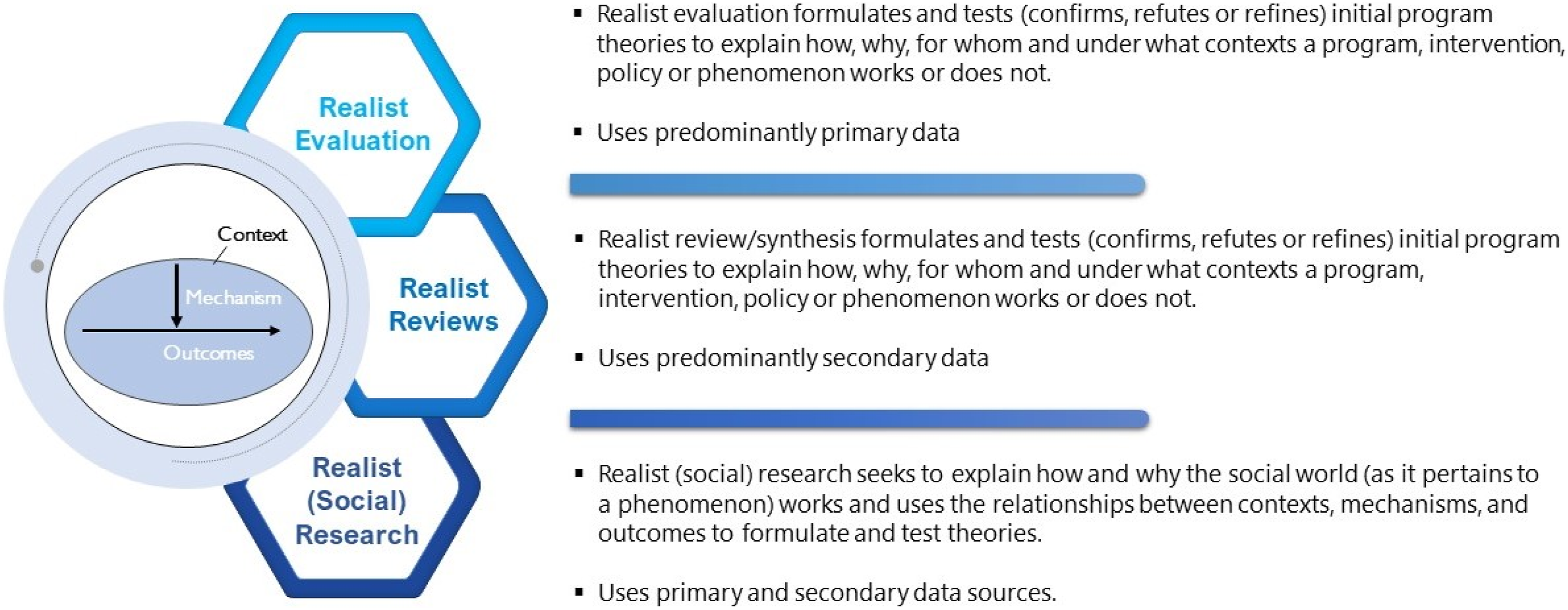
The theory-testing phase follows the theory-gleaning phase. The program theory of change includes embedded hypotheses, such as the idea that training will increase knowledge and self-efficacy for implementing the intervention. In the second phase of a realist study, these embedded hypotheses are tested using primary and secondary data. The final phase involves refining or consolidating the theory based on the findings from testing the individual hypotheses. Realist-informed research allows researchers to choose suitable investigative techniques based on their study objective and the nature of their implementation strategy. In this way, it offers a useful logic that, in synergy with IS, complements and strengthens the two approaches.
Philosophical Foundations of Realist-Informed Methodologies
Realism, the philosophical position claiming that reality is knowable, underpins realist methodologies. The principles of scientific realism and critical realism are the main foundations of realist methodologies (Mukumbang et al., 2023). Scientific realism focuses on understanding the world by developing theories and models, while critical realism emphasizes the processes and methods of creating these theories. Critical realism also uses causal language to describe the world, explaining the processes and interactions among mechanisms and contextual conditions to explain observations. Scientific and critical realism provide complementary perspectives for realist methodologies, contributing to theory and understanding causal processes in scientific explanation and practical action. In addition to these key distinctions, scientific and critical realism share similar understandings regarding the existence of a mind-independent reality, generative causation, (in)transitive entities, stratified reality, open systems, emergence, and retroductive theorizing (Mukumbang et al., 2023). These principles will be briefly explained and applied in the context of IS.
Mind independence stipulates that reality exists whether we perceive it or not. Reality does not depend on different languages, social constructs, and conceptualizations we use to understand, as they do not determine what is real. Although reality is mind-independent, it can be captured partially and imperfectly using theories, models, and frameworks. This partial and imperfect understanding of reality can be attributed to (1) our observations and experiences being interpreted through language, constructs, and existing conceptual frameworks, (2) our knowledge is derived from observing, experiencing, and interacting with an infinitely intricate and constantly evolving universe from a specific contextual standpoint and (3) our ability to represent and communicate knowledge depends on symbols, language, and technology, implying that our representation of reality is concept-dependent or model-dependent (Sayer, 2000).
To uncover the underlying causal entities (mechanisms) responsible for the empirical observations we make, the researcher must examine the events/actions that led to them. This is understood in realist terms as generative causation (Pawson & Tilley, 1997). This approach to understanding reality captures the notion of ontological depth, which Bhaskar (1975) captures as three functional levels of stratified reality (Figure 2). Levels of reality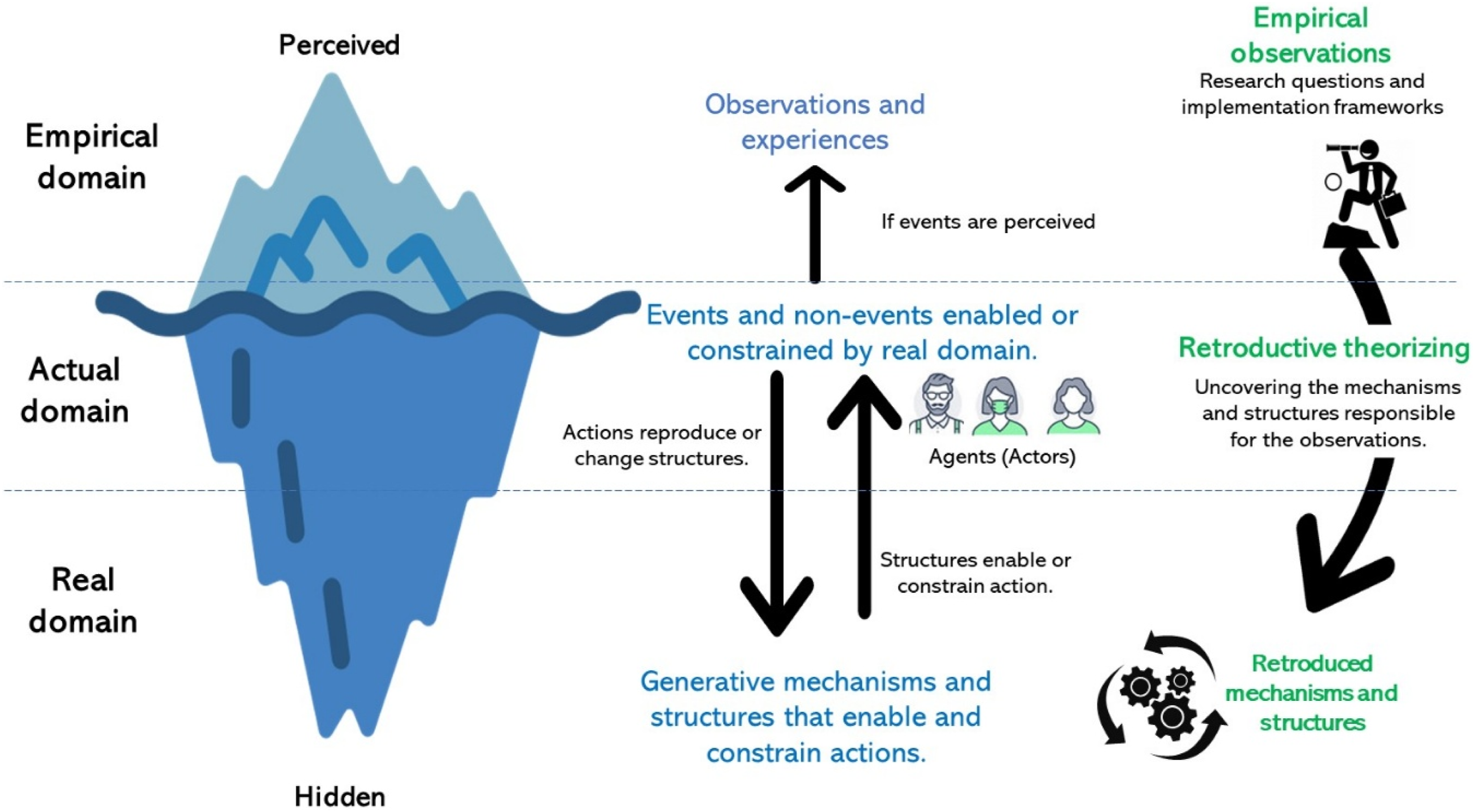
Research activities can predominantly capture those events or outcomes experienced by the relevant actors at the “Empirical” level. The events and non-events are situated at the next level, the “Actual,” as they represent things that “actually” happened, although not all are experienced. Entities such as structures (policies, laws, longstanding relationships, and guidelines) and mechanisms (underlying causal powers like motivation, trust, and empowerment) are situated in the “Real” where events are generated. These structures and mechanisms can generate an outcome (event) when activated under certain conditions. For instance, when healthcare provider training is implemented to improve skills to accurately measure blood pressure using a new instrument, mechanisms such as knowledge acquisition, motivation, and self-efficacy are at play. Important context conditions to consider would be the hospital’s policies and attitude towards healthcare provider training, availability of training resources and trainers, including incentives such as promotions. In this example, to investigate the effect of the training provided, the realist evaluator can capture the outcomes and experiences of the healthcare providers empirically using research methods such as program data, interviews, and surveys to explain the (un)changed pattern of behavior, which occurs at the “Empirical.” The execution of appropriate blood pressure techniques using the new instrument or failure to do so are considered events happening in the “Actual.” Realist-informed theorizing will understand how and why there is observed improvement in blood pressure measurements and would require unearthing the mechanisms and structures in the realm of the “Real” (e.g., improved knowledge acquisition).
One contribution of critical realism towards realist methodologies is the notion of a layered open system, each with unique emergent properties. The existence of specific mechanisms at each level or stratum defines that level. The stratification includes physical, chemical, biological, psychological, psychosocial, behavioral, social, cultural, and economic layers (Danermark et al., 2005; Sayer, 1992). Mechanisms at a lower level can create conditions for unfolding mechanisms at a higher level. While mechanisms may emerge from lower strata, they are not reducible to those strata and thus should be researched in the strata they operate to explain their operation. Danermark et al. (2005) proposed that any investigation into social phenomena should consider diverse explanations of phenomena at multiple levels. The implication of this layered ontology for implementation scientists is that explaining implementation outcomes and evidence adoption requires understanding various mechanisms at numerous levels: biological, psychological, interpersonal, and cultural. This multi-layered or ecological approach to understanding implementation outcomes is captured in frameworks such as the Consolidated Framework for Implementation Research (CFIR) model (Damschroder et al., 2022).
Emergence is a characteristic of open systems, where many structures, mechanisms, and entities continuously interact. A system’s behavior results from the actions and interactions of agents and unfolds unpredictably over time and across space (May et al., 2022). The health system within which implementation strategies are implemented is a part of the open social system, whereby the system’s performance depends on the organization’s size, funding approach, structure, and ideology focused on affordable and accessible care. Implementation strategies’ outcome(s) depend on interactions and negotiations between the participants and the contexts. For instance, when a program is introduced to a community organization, its success, and long-term sustainability will rely on its ability to co-adapt with the organizational system and the relevant actors over time. Each event occurs within a distinct temporal, spatial, cultural, and socio-historical context, and the initial conditions in each situation will inevitably impact the subsequent course of events (Brunson et al., 2023).
Realist program theories are formulated using realist-informed heuristic tools such as the Context-Mechanism-Outcome (CMO) configuration (Pawson & Tilley, 1997). In eliciting the program theory of an implementation strategy, using the CMO configuration, the investigator strives to configure the causal relationship between the context within which the strategy is implemented (individual, organizational, and environmental; inner and outer settings), the mechanisms that are activated by the strategy and the expected implementation outcomes (Mukumbang et al., 2019). CMO configurations are used to postulate how programs (strategies) activate mechanisms (M) in actors under specific contexts (C) to bring about alterations in outcomes (O). For instance, providing free training to nurses on the use of a new blood pressure machine (strategy) to achieve accurate blood pressure readings (fidelity—implementation outcomes) at a facility with transformational leadership (Context) could motivate, empower, and improve the nurses’ self-efficacy (generative mechanisms). Formulating realist-informed causal theories is achieved through retroductive theorizing: uncovering the underlying mechanisms and structures to explain how the observation occurred (Jagosh et al., 2022).
Having defined some of the key realist tenets with some relevant examples, we will now discuss how these principles and processes can be seamlessly integrated into IS to strengthen the implementation scientist’s endeavor toward generating more effective, context-sensitive, and sustainable interventions.
Applying Realist Principles to IS – Six Potentials
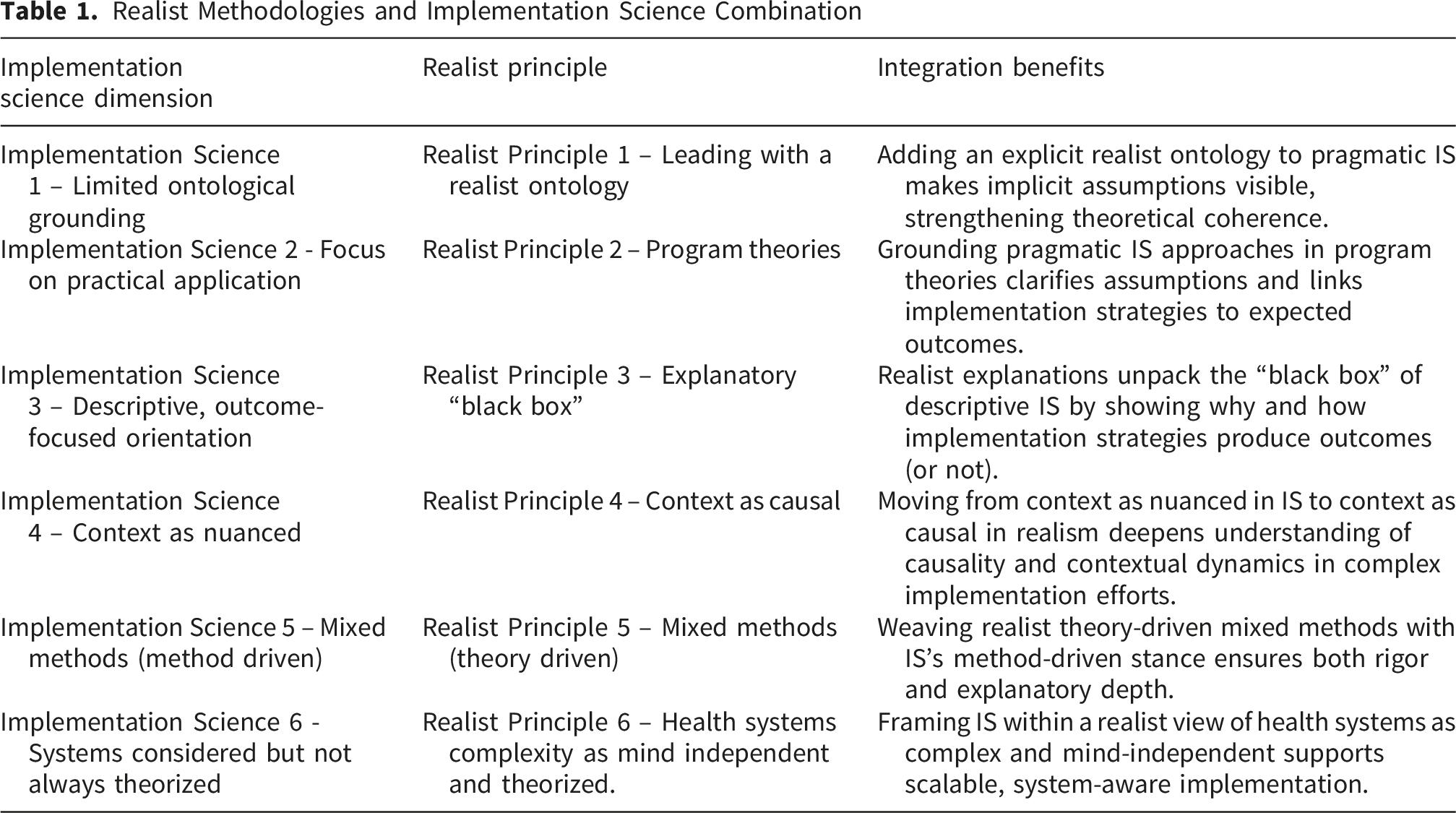
Following the relevant philosophical tenets discussed above, we identify six potential contributions of realist methodologies to implementation science: (1) leading with ontology, (2) formulating “program theories” of implementation strategies, (3) opening up the “black box” of implementation strategies, (4) moving from “context as nuanced” to “context as causal”, (5) mixed-methods integration for causality-based theorizing and (6) embracing the complex and adaptive nature of health systems.
Leading with Ontology
A realist philosophy begins with an explicit ontological stance. Unlike many other approaches, realism fully embraces its philosophical foundations. We argue that IS could also benefit from a clear ontological positioning and from maintaining ontological fidelity throughout the research and practice process. IS is inherently complex, and much of its decision-making is necessarily pragmatic—a practical, sensible approach to situations, focusing on useful solutions and real-world results rather than theoretical ideals or strict rules (Maw et al., 2024; May et al., 2016). Yet, this pragmatism can create a blind spot. Realist ontology postulates the existence of a mind-independent reality. Any theory or model we develop is therefore inevitably partial and fallible since our access to this reality is always limited. Recognising this fallibility is crucial for IS. Implementation efforts should be understood as humble, adaptive, and open to revision. IS unfolds across diverse settings (communities, organizations, and cultures) each influenced by political, economic, social, and historical conditions (McCormack et al., 2002). This is particularly true for complex interventions, where outcomes are context-dependent and require flexible tailoring.
There are some aspects of reality (intransitive reality) that exist even when humans are not there to interpret them; and there are some aspects of reality (transitive reality) that exist because they are in relation to humans and their meaning making. Some IS approaches risk over-stretching by attempting to treat social or contextual realities as fully malleable. A realist ontology, by contrast, reminds us that the role of IS is not to reshape reality, but to equip people, organisations, and systems to respond effectively to it. If IS loses sight of ontology, it risks conflating epistemology with ontology and thereby committing what Bhaskar termed the epistemic fallacy (Bhaskar, 1975). This fallacy arises when we reduce what exists to what can be known or measured.
Consider the following scenario. An implementation scientist is evaluating a new program to improve diabetes care in community health clinics. The intervention provides clinician training, patient education materials, and a digital tracking tool. First, the researcher surveys clinicians to identify potential barriers and facilitators to implementing these implementation strategies. Respondents highlight time pressures and scepticism about the strategies, so the researcher concludes these are the determinants affecting implementation. Here, they have reduced determinants to what was reported, overlooking deeper forces (i.e. leadership turnover or weak communication structures) that shape the implementation climate regardless of whether participants recognise them. Second, in analysing survey and interview data, the researcher notes that no one mentioned funding as a barrier. They infer that financial resources are not an issue because staff hesitated to discuss it. In this case, the lack of data was mistaken for evidence of absence. Finally, after six months, some clinics showed improved patient outcomes. The researcher attributes this to “improved clinician engagement,” calling it the mechanism behind the change. Yet, engagement is an outcome, generated by deeper mechanisms (such as professional identity being reinforced when clinicians see patients benefit, or a culture of peer support being triggered by the training). By collapsing observable outcomes into mechanisms, the underlying generative processes remain hidden. Each of these missteps illustrates how IS can fall into the epistemic fallacy by equating what can be observed with all that exists. A realist ontology helps avoid this trap by insisting that unobserved but real structures and mechanisms continue to shape outcomes.
In summary, weaving a realist ontological commitment into IS research ensures that implementation efforts are (1) ontologically and epistemologically coherent, (2) positioned in the most fruitful space for theory generation and testing, and (3) oriented toward both the observable and the unobservable. In this sense, realist methodologies offer IS an important contribution, that is, a philosophical grounding that resists the epistemic fallacy and enhances the explanatory power of the field. This is achieved through formulating program theories, which is discussed in the next section.
Formulating “Program Theories” of Implementation Strategies
The realist premise is that the real (mechanisms and structures), the actual (events which may or may not be observable), and the empirical (evidence of experiences and observable events) are elicited through a series of hypotheses, also known as program theories. While designing implementation strategies to improve the adoption or the rolling out of an evidence-based intervention, implementation scientists implicitly make assumptions on how and why the strategy would enhance the adoption or fidelity of the evidence-based intervention (Akiba et al., 2021). Logic models in implementation research allow the scientist to understand how and why evidence-based intervention and the implementation strategies work to produce intended outcomes. Consequently, there is strong advocacy for adopting logic models in implementation research (Chanfreau-Coffinier et al., 2018).
Nevertheless, most implementation theories, logic models, and frameworks do not include postulated mechanisms for generating clinical and implementation outcomes as a combination of resources (e.g., components of a strategy) and responses (e.g., participants’ perceptions and attitudes) to understand the effects of the strategy. Smith et al. (2020) designed an Implementation Research Logic Model (IRLM) that explicitly considers mechanisms. One critical element missing still is the consideration of the complex interactions between the determinants (context conditions), the implementation strategy components, and mechanisms to account for the observed outcomes.
Realist methodologies start and end with theories and developing a program theory is based on the premise that programs and strategies are theory incarnate. By this we mean that the implementation strategies can be developed through the creation of initial explanatory statements describing a particular strategy, explaining why, how, and under what conditions the implementation outcomes occur, predicting the strategy’s outcomes, and specifying the requirements necessary to achieve the desired strategy effects (Sharpe, 2011). The development of the initial program theory requires creative thinking (rooted in practice, literature, and sometimes primary data collection) that occurs at the outset of a realist study, which is beneficial to the strategy’s evolution (Jagosh et al., 2022). These theories are then refined, refuted or confirmed through the implementation research process and the empirical evidence, thereby producing middle range theories - theories that lie between granular working theories and all-encompassing grand theories, offering explanations that are abstract enough to be generalizable yet specific enough to be empirically testable (Merton, 1968; Mukumbang & Wong, 2025) that more accurately capture the causal mechanisms at play in the specific implementation context.
Program theories link activities and outcomes, often expressed through logic models, to explain how and why the desired change is expected to occur. Realist-informed logic models add the mechanism components to represent how ‘the mechanisms introduced by the proposed strategy into pre-existing contexts can generate outcomes’ (Kazi, 2003). The realist logic model follows a generative model of causality, where causal links are shown by providing a detailed explanation of the events that occur between the cause and effect, the introduction of a generative mechanism (Figure 3). Theory of change and mechanisms
During the planning or design phase of the implementation strategy, the program theory can be utilized to demonstrate how various elements of the strategy are intended to interact and to identify the intermediate outcomes of the strategy. Such an elaborate program theory indicates the goals and objectives of the strategy and the pathways through which they could be attained. For instance, while developing a nurse-delivered mHealth intervention (Motivation Matters!) to support antiretroviral therapy adherence among women who engage in sex work and are living with HIV in Mombasa, Kenya, Aunon et al., 2023 conducted a pilot randomized controlled trial assessed the efficacy, participant-level feasibility, and acceptability. Aunon et al. (2023) then developed a realist program theory hypothesizing causal chains based on the IRLM when planning for a Type I hybrid implementation research (Figure 4). Initial program theory diagram
In summary, grounding pragmatic IS approaches in realist program theories helps implementation researchers clarify their assumptions from the outset and explicitly link implementation strategies to expected outcomes This also helps in the process of “opening the black box,” a further contribution that will be discussed in the next section.
Opening the “Black Box” of Implementation Strategies
Realist inquiries aim to understand how the world works by unraveling the mechanisms and structures responsible for observations. This notion warrants the realist researcher unraveling the mechanisms responsible for implementation outcomes. Realist research is focused on unveiling the mechanisms of interventions and implementation strategies and how different context conditions trigger them. Unearthing the generative mechanisms of observed outcomes is known as opening the black box, which leads to understanding how and why the components of the interventions, program, and implementation strategies lead to the outcomes. The “black box” would show that the strategy failed because it did not activate the mechanism(s) or because some contextual factor(s) inhibited the mechanism’s effects (Astbury & Leeuw, 2010).
Realists and implementation scientists concur that a mechanism can be responsible for an observed outcome but differ in their conceptualization of mechanisms. Generally, a mechanism is understood as processes or events through which an implementation strategy operates to affect desired outcomes (Lewis et al., 2018; May, 2013; Smith et al., 2020). In IS, a mechanism can be a determinant change, a proximal implementation outcome, an aspect of the implementation strategy, or a combination of these factors in a multiple-intervening effect model (Smith et al., 2020). In realist approaches, however, mechanisms are underlying causal powers or processes. They are not a change in a determinant (contextual factor): a change in a determinant may trigger a different mechanism and thus change outcomes. Nor can they be a proximal outcome: mechanisms are causes of outcomes. Most significantly, they cannot be an aspect of the implementation strategy itself because aspects of implementation strategies can trigger different mechanisms in different contexts.
Based on the epistemological views of the realist philosophy of science, mechanisms have three characteristics: (1) they are usually unseen or hidden, (2) they cause the outcome, and (3) the same mechanism can produce different results in different contexts (Lacouture et al., 2015). Dalkin et al. (2015) argue that breaking down the concept of mechanism into its parts aids in understanding the distinction between resources (activities, engagements, opportunities, and restrictions) offered by the strategy and how the implementation strategy changes the reasoning of the actors. To this end, “Resources (constraints and opportunities) + Reasoning = mechanism” is a commonly used formula to conceptualize realist-informed mechanisms.
The growing interest in this “black box” thinking within IS is promising, as it directs attention beyond surface outcomes to the underlying processes shaping whether and how implementation succeeds. Much of this work, often framed through logic models or causal pathway mapping, emphasises identifying inputs, activities, and outcomes in a structured way. While valuable, these approaches can remain relatively descriptive. They chart what happens, but they do not always explain why outcomes differ across contexts or how mechanisms are triggered. Realist methods extend this logic by explicitly “opening” the black box. By this, we mean shifting evaluation from a primarily outcome-focused exercise to one that makes explicit the mechanisms through which implementation strategies generate effects, and the contexts that enable or constrain those mechanisms. In practice, this entails showing the “workings out” of implementation (why strategies succeed in some settings and not in others) rather than reporting only whether they succeed.
An “open” evaluation process therefore contrasts with a “closed” one in two ways. First, it treats explanation and theory refinement as the unit of analysis, rather than treating methods or outcomes as ends in themselves (Pawson et al., 2005). Second, it acknowledges the fallibility of any single explanation and deliberately seeks evidence that can test, refute, or refine emerging theories. This openness allows implementation scientists to pursue depth as well as breadth, not only scaling strategies “vertically wide and flat,” but also digging “horizontally deep” into the causal pathways that determine success or failure. In this way, realist methods contribute to IS by moving beyond descriptive accounts of the black box to explanatory accounts that strengthen cumulative theory-building.
Considering that an implementation strategy works through actors (e.g., healthcare workers), mechanisms (M) are used to explain how the implementation strategy (S) unfolds in a particular context (C) and through the various actors (A) to produce the observed outcomes (O) (Mukumbang et al., 2016). Representing the strategy modalities (S) and the relevant actors (A) provides a comprehensive representation of how, why, for whom, and under what circumstances an implementation strategy works. Following this causality conceptualization, a strategy-context-actor-mechanism-outcome configuration can provide a comprehensive analytical tool in IS (Salter & Kothari, 2014). The explanatory power of program theories is beneficial in understanding further why and how an implementation strategy was successful, providing knowledge that could be useful in similar settings or implementation strategies. Understanding the workings of the program theory is also useful when an implementation strategy does not work; the black box would show that the strategy failed because it did not activate the mechanism(s) or because some contextual factor(s) inhibited the mechanism’s effects.
Taken together, a focus on explanation and theory refinement equips implementation researchers with the logic needed to generate more precise recommendations. Understanding the “how” and “why” of implementation provides critical insight into how strategies should be adapted across different services, populations or contexts. From a realist perspective, this latter context is essential and will be discussed in greater detail below.
Moving from “Context as Nuanced” to “Context as Causal”
Epistemologically, the realist philosophy of science seeks to investigate the causal relationships between social events and the underlying social mechanisms to understand programs or services better. The impact of social structures and the social context within which the social event occurs results from the interaction of the social context, triggering existing mechanisms. It is of utmost importance in implementation research as it occurs in various settings, including communities and cultures, influenced by economic, political, social, and historical (McCormack et al., 2002). In IS, context is often understood as the internal and external environment in which healthcare practices take place, shaping and adding nuance to implementation efforts. The identified determinants, together with the broader backdrop, help explain why implementation unfolds in particular ways. Realist approaches, however, extend this view by treating context not merely as a backdrop but as part of the causal chain itself. In this perspective, mechanisms are only activated (or not) when the appropriate contextual conditions are present. Thus, context is not simply a source of nuance, but a critical factor in establishing causality through program theory development.
In IS, context is conceptualized as inner and outer settings (Damschroder et al., 2022) or preconditions and moderators (Lewis et al., 2018). The Context and Implementation of Complex Interventions (CICI) framework (Pfadenhauer et al., 2017) specifies context as comprising seven domains, including geographical, epidemiological, socio-cultural, socio-economic, ethical, legal, and political. The framework further specifies that context can be located on a micro, meso, and macro level. In trials and quasi-experimental approaches like stepped wedge designs, data from multiple units are typically combined in the primary analyses. While this approach provides robust evidence of overall effectiveness, which is one helpful way of understanding whether a particular implementation strategy works, it does not unpack significant differences between facilities. Nevertheless, the differences between the clinics are essential for understanding how context shapes outcomes.
Implementing evidence-based practices in contexts different from those where the original evidence was generated is complex and challenging, often requiring contextual adaptation (Chambers & Norton, 2016). This is particularly true for complex interventions with multiple context-dependent outcomes requiring flexible tailoring. Moreover, complex interventions often involve long causal chains connecting the intervention to its outcomes. It is acknowledged that adaptations to such interventions may compromise fidelity and effectiveness (Breitenstein et al., 2010), especially when the successful context is not adequately captured and conveyed to implementers planning to replicate it in a different setting.
While developing realist-informed theories, the explicit consideration of context includes understanding the history, which explains how things came to be and not otherwise (de Souza, 2014). We argue that describing how the implementation strategy works should be linked to the programmatic, organizational, cultural, and historical contexts to improve the theory’s explanatory power. For example, Adams et al. (2016) conducted a realist evaluation to identify and optimize the role of community health workers for the scale-up of Maternal and Newborn Health programs in rural Bangladesh. The authors unpacked the different contextual elements within their theory formulation as follows. These communities have limited access to formal health care (historical context) and limited maternal and child healthcare plans (programmatic context) awareness. They also highlighted that women in these communities often feel isolated from healthcare services (cultural context) and are usually intimidated by healthcare providers (organizational context). These contextual conditions helped to understand why the implementation strategy was useful and how it achieved the observed outcomes.
While developing and testing theories, relevant contexts must be embedded in the theory formulation process. The context is embedded in the theory formulation process, using the configuration to represent a way forward for delivering explanatory models for IS. These configurations illustrate the (1) contextual circumstances conducive to triggering change, (2) theoretical causal mechanisms for how and why observed impacts occurred, and (3) impact on implementation outcomes. These configurations can be tested through a mixed methods approach, which are highlighted next.
Mixed-Methods Integration for Causality-Based Theorizing
At the level of the empirical, realist research is allowed to use different empirical methods and approaches (Renmans & Pleguezuelo, 2022). In this case, realists are pragmatic about adopting the technique most suitable to describe implementation outcomes. Mixed and multi-methods designs are commonplace in implementation research. A multi-method design uses two or more methods from various research paradigms within a research project, such as qualitative and quantitative approaches, to address distinct study objectives. In contrast, mixed methods involve collecting and analyzing data and integrating findings (Creswell & Creswell, 2017).
Findings obtained from separate methodological endeavors that are not “integrated” do not draw out the complete explanatory picture of the phenomenon under investigation. For example, in one of the study objectives, quantitative approaches such as quasi-experimental studies may be used to investigate the effectiveness of the implementation strategy. In parallel, qualitative methods like interviews or focus groups can assess implementation outcomes such as feasibility, acceptability, and appropriateness (Hamilton & Finley, 2020). Guided by frameworks such as CFIR, qualitative methods are also used to explore the determinants of the intervention/implementation strategy (Silver et al., 2023). Qualitative methods are also used to analyze organizational readiness to inform the design of implementation strategies to improve intervention adoption (Ramanadhan et al., 2021).
As such, most IS studies adopting quantitative and qualitative methods could be more aptly described as multi-method studies. Fetters et al. (2013) encourage integrating (mixing) quantitative and qualitative results through narrative, data transformation, and joint display. Nevertheless, a joint display merely displays patterns (e.g., high- and low-performing health facilities differ in CFIR construct A, B, and C but not D). However, integration means that qualitative and quantitative research methods provide causal explanations for the observed differences (Guetterman et al., 2020). Program theories offer one way of integrating quantitative and qualitative results and explaining how and why the observed outcomes occur.
Realist-informed methodologies are method-neutral, favoring the integration of qualitative and quantitative methods. Retroductive theorizing adopted in realist-informed methodologies encourages the adoption of mixed methods approaches to construct robust theories (Mukumbang, 2021). Schutz Leuthold et al. (2020) proposed a comprehensive mixed methods approach with a convergent design to enhance our understanding of the context and mechanism that affect the addition of primary care nurses (PCN) to the staff of family medicine practices in Switzerland. The implementation strategy consists of a three-day training program to enhance their roles as PCNs in GPs’ practices. Adopting a mixed methods realist evaluation approach, they sought to adopt quantitative and qualitative data to understand the new organizational model’s implementation (feasibility, fidelity, acceptability, and costs) and effectiveness (healthcare services use, patient experience, staff experience, and patient-level costs) (Schutz Leuthold et al., 2020).
Informed by the CMO configuration tool, the authors proposed using a before-and-after comparison to establish the effectiveness of the new model (outcome). They planned to use electronic records and questionnaires to evaluate feasibility, fidelity, and acceptability outcomes. The intention is to use interviews, focus group discussions, and non-participant observations to explore practices’ contextual implementation conditions and mechanisms of action to explain the observed implementation and effectiveness outcomes (Schutz Leuthold et al., 2020). Using the CMO configurational tool to inform the program theory development, the authors proposed synthesizing the data from both sets of data sources to build semi-predictable patterns of CMOs specific to each GP’s practice, which can then be synthesized again to understand more broadly what works, for who in which circumstances and why.
Concluding, the distinctive contribution of a realist perspective to the already widespread enthusiasm for mixed methods in IS lies in its focus. In realist work, qualitative and quantitative components are not combined simply for breadth or methodological robustness. They are deliberately mobilized to test, refute, and refine theory. The logic of mixing methods thus comes from the need to build an evidence-informed understanding of the implementation process, rather than from a method-driven commitment to rigidly following predefined protocols. In this way, the unit of analysis is the theory under study (how mechanisms operate in context) rather than the methods themselves. This positions mixed-methods IS studies as ontologically coherent and theory-driven, rather than as eclectic “cocktails” of methods that risk producing little cumulative insight. This is particularly important when trying to understand complex systems, which is the sixth and final point described below.
Embracing the Complex and Adaptive Nature of Health Systems
Within open social systems like health systems are the activities of agents (thoughts and actions) interacting within structures (organized social institutions like a healthcare facility and patterns of institutionalized relationships), and these interactions can lead to new or emergent outcomes. The notions of open systems and emergence in the realist philosophy of science underpin the concepts of complexity and adaptations in IS. The design and implementation of evidence-based intervention and implementation strategies take place in health systems, which are complex adaptive systems. As such, the anticipated implementation outcomes of these systems can be hard to predict due to their complex nature.
The complex nature of healthcare systems and the characteristics of these complex systems and their networks suggest several moving parts, and a change in one element may cascade to changes in other system parts (Ratnapalan & Lang, 2020). These alterations in the system are usually geared towards self-organizing. The self-organizing property of complex adaptive systems makes them resilient to most perturbations to any constituent parts. Nevertheless, healthcare systems may become unexpectedly unstable under certain conditions, triggered by often unforeseeable events like the COVID-19 pandemic. Consequently, an evidence-based practice should consider context and such perturbations. In implementation research, adopting quantitative-dominated approaches such as randomized controlled trials (RCTs) can lead to contextual factors and external influences of context conditions being treated as potential effect modifiers and confounders. Bias due to the confounders can be addressed through random assignment, so the groups are balanced regarding these factors. While we agree that RCTs can address effect modification and investigate some contextual factors through subgroup analyses, realist methodologies capture the system’s adaptation to external influences through their integral consideration of context.
Complex systems thinking and models are already well established in IS, and the realist conception of context adds important causal explanation. Yet a key difference lies in ontology. Implementation researchers often take a pragmatic stance, asking: “What is the most useful and practical thing we can do to help within this system?” By contrast, the realist begins by asking: “What exists independently of our thoughts?” This shift is significant, because it anchors model-building in a recognition that complex systems are not only shaped by human agency but also structured by real mechanisms and relations that operate whether or not we observe them. For implementation researchers, this means developing models that go beyond surface-level interactions to include underlying, and sometimes unobservable, causal processes. The guiding question therefore becomes: “What underlying emergent mechanisms, existing independently of our perceptions, are generating the outcomes we see within complex systems and contexts?”
A recent example comes from a UK study conducted during the COVID-19 pandemic, which evaluated through a realist lens a first-contact physiotherapy strategy. This strategy involved specialist and advanced practice physiotherapists working in primary care to manage patients presenting with musculoskeletal disorders (Jagosh et al., 2022). The authors illustrated how, during the COVID-19 pandemic, they had to abandon the theories developed at the study’s outset in favor of theories that became increasingly relevant in the context of the COVID-19 pandemic. Regarding the overall intervention, COVID-19 could be classified as a confounding factor and balanced by arm if this were an RCT. The COVID-19 pandemic exemplifies the need in some instances to study the causal impact of emergent changes in real-time; realist evaluation can account for such new and divergent contextual changes that emerge during implementation research in complex dynamic contexts (Jagosh et al., 2022).
Combining Realist Methodologies and IS
Realist Methodologies and Implementation Science Combination
Discussion
This paper highlighted six potential applications of realist-informed methodologies in IS. Firstly, by explicitly integrating program theories into practical application, IS can ensure that pragmatism is not exercised in a vacuum but rather anchored within the workings of the strategies under investigation. Such anchoring allows decision-making to be both context-sensitive and theoretically informed. As the field increasingly recognises the value of theorizing, it is important to acknowledge that theorizing for its own sake is insufficient. Without a guiding principle, theorizing risks becoming like drawing a detailed map without a compass. It describes the terrain but offers little orientation for purposeful action. This limitation can have significant repercussions at later stages of implementation, when sustained buy-in and iterative enhancement of strategies may be undermined by earlier blind spots. This challenge connects directly with the realist position, which begins with ontology. For IS, this means theorizing should not only describe what is observed but also aim to explain underlying generative processes. Combining a realist ontology with the realist semantic notion, where theories are judged by their capacity to provide adequate explanation, offers a productive path forward (Ruyant, 2020). It encourages IS to move beyond surface-level regularities and engage with deeper causal structures. In doing so, IS can strengthen its capacity to guide practice in ways that are both pragmatically grounded and theoretically robust, ensuring that strategies are better equipped to adapt and endure across diverse settings.
As implementation researchers probe more deeply into hidden causal mechanisms, the workings of interventions can be illuminated with greater clarity and depth. This effort to “open the black box” is critical, as it enables researchers to explain not only whether a strategy succeeds or fails but also how and why it does so in specific circumstances. Such explanatory work shifts the focus from description to causation, and in doing so, strengthens the interpretive and practical value of implementation research. Central to this endeavour is the recognition of context as causal (Greenhalgh & Manzano, 2021). Moving beyond nuance towards explicit causal reasoning allows researchers to conceptualise context not merely as the setting in which a strategy is deployed but as an active set of conditions that interact with interventions to produce outcomes. When examined through a causal lens, context expands to include dimensions that might otherwise be overlooked (e.g. cultural norms, legal frameworks, social structures, financial incentives, among others). These dynamics enable and constrain the very mechanisms through which strategies operate. Opening the IS process in this way requires researchers to broaden their perspective, embracing complexity rather than reducing it to confounding variables. By doing so, they create richer explanations of implementation dynamics that better capture the interplay between interventions and their environments. Such an approach equips IS to account for variation across contexts and ultimately to design strategies that are both more adaptive and more sustainable.
IS already employs a wide range of methods and acknowledges the centrality of systems for the success of strategies (Brownson et al., 2022; Nilsen et al., 2013). This systems orientation is not new, nor is it something introduced uniquely by realist thinking. The distinct contribution lies instead in the explicitly theory-driven nature of realist approaches. While IS values methodological plurality, the absence (or only partial use) of theory often limits inquiry to surface-level description. A theory-driven orientation shifts the focus from documenting patterns to explaining them. This does not require sacrificing methodological rigour. On the contrary, it enhances rigour by making assumptions explicit, clarifying causal propositions, and situating findings in relation to existing theoretical work. By integrating qualitative insights into mechanisms and contextual influences with quantitative measures of outcomes and variation, IS can generate richer and more transferable explanations. Realist-informed, theory-driven inquiry thus strengthens the cumulative knowledge base. Findings do not stand alone but build systematically on prior theoretical and empirical work. The result is a more transparent, rigorous, and explanatory IS, one better equipped to guide strategies across diverse and complex health systems.
We also acknowledge potential challenges in bringing these two traditions together. If integration is attempted without sufficient care, the result may be a form of conceptual “circumlocution” that is neither fully one nor the other, thereby weakening both impact and rigor. There is also the risk of disciplinary defensiveness. Scholars from IS and realist traditions may critique one another’s work as not being authentically aligned, which could create division rather than synergy. Such risks highlight the importance of clarity, methodological discipline, and mutual respect in efforts to bridge these approaches. Implementation challenges are increasingly complex and demand interdisciplinary perspectives (Beidas et al., 2022; Vantard et al., 2023). Collaboration across traditions is therefore not a luxury but a necessity. Education, dialogue, and the careful application of realist principles within IS (and vice versa) can reduce siloed working and promote more integrative approaches. By foregrounding shared goals rather than disciplinary boundaries, both fields stand to benefit. We are confident that this collaborative endeavour between two strong social science traditions has more to gain than to lose. Done thoughtfully, such integration can enhance explanatory power, improve practical relevance, and ultimately strengthen the collective impact of IS.
Conclusion
Our goal for highlighting the potential contributions of realist methodologies is to accentuate the role of IS in adapting interventions for particular groups or contexts. Without it, knowing what needs to be changed and why it needs to be changed is potentially not as explicit as it could be. Knowing how to adapt interventions becomes essential when considering scaling out: understanding how particular aspects of context affect underlying change processes makes realist program theory portable, whereas relationships between determinants and strategies may be specific to a certain situation and, therefore, less portable. We, thus, believe that integrating realist methodologies could add significant value and significant original contribution to knowledge in IS. In particular, realist methodologies offer an ontologically robust way to articulate causal explanations that travel beyond a single implementation context, enabling researchers and practitioners to anticipate how an implementation strategy may unfold elsewhere and why. This strengthens learning across cases, supports equity by clarifying for whom the evidence-based interventions are more likely to benefit, and provides a transparent rationale for adaptation decisions. By bringing theoretical precision into IS, realist methodologies may help move the field beyond descriptive accounts of barriers and facilitators towards explanatory accounts that accumulate transferable insights. We therefore see realist methodologies as essential not only for adaptation but for advancing the explanatory power and cumulative knowledge base of IS.
Footnotes

Ethical Considerations
Our study did not require an ethical board approval because it did not directly involve humans or animals.
Funding
The authors received no financial support for the research, authorship, and/or publication of this article.
Declaration of Conflicting Interests
The authors declared no potential conflicts of interest with respect to the research, authorship, and/or publication of this article.
Data Availability Statement
The data that support the findings of this study are available from the corresponding author upon reasonable request.