




Abstract
Considering the time children spend in schools and the impact this time has on their present and future lives, developing a better understanding of their school experiences is crucial for those interested in childhoods and children. Such understanding requires methodologies that respect children’s evolving capacities and rights, while addressing the methodological challenges arising from their marginalised position. This paper introduces ‘A School Day,’ a board game for participatory play-based research co-created with children that was used to explore children’s experiences of primary school while in Second Class (7-8 years old) in Ireland. The board game is one of the participatory methods employed in the Children’s School Lives study (CSL), a mixed-method dual-cohort longitudinal study of primary schooling in Ireland, tracking over 4,000 primary school children across 184 schools, with an in-depth qualitative case study analysis carried out in 12 schools. This paper describes the co-creation process of the game as a rights-based method for data collection and uses the evidence of its implementation to argue for the recognition of play as a valuable methodological approach in classroom-based educational research. The approach offers accessible and active opportunities for children to share ‘insider knowledge’ and articulate perspectives on sensitive and complex issues –countering more passive data collection methods, through the ‘universal language’ of play. In this paper, we simultaneously critically reflect on the power imbalances inherent in adult–child relations and the school context, emphasising the importance of reflexivity in employing play as a research tool. By detailing the co-creation, piloting, and implementation processes of the board game, this paper highlights both the methodological possibilities and ethical challenges of playful research. It demonstrates how play can foster meaningful participation, inclusion, and respect for children’s rights and capabilities in qualitative educational research.
Keywords
Introduction
The United Nations Convention on the Rights of the Child (UNCRC; UN, 1989) enshrines a comprehensive set of universal, inalienable, indivisible, and interdependent rights affecting virtually all areas of children and young people’s lives. While the Convention pertains to all children and young people below the age of eighteen years, the Committee on the Rights of the Child underscores the need to recognise young children – those up to the age of eight years – as equal holders of all rights enshrined within (UN, 2005). This is particularly relevant in relation to Article 12 of the Convention which sets out children’s right to express their own views on matters affecting them and have those views given due weight in accordance with their age and maturity (Lundy et al., 2012). Such conditionality with respect to children’s age and maturity – shaping their evolving capacities – represents a threat to the participation of young children in particular, reflecting an opportunity to restrict their autonomy and self-expression in this regard (UN, 2005). Yet, the General Comment pertaining to Article 12 (UN, 2009) importantly emphasises the ability of children to form their own views from the youngest of ages, even when they are unable to do so verbally, stating that full implementation requires the recognition of all forms of communication, including children’s play, drawings, or paintings. Against this backdrop, the Lundy (2007) model of participation provides a useful conceptualisation of Article 12 in relation to four distinct, albeit interrelated, elements which are presented in chronological order: i. Space – children must be given safe and inclusive opportunities to form and express their views ii. Voice – children must be facilitated to express their views iii. Audience – children’s views must be listened to iv. Influence – children’s views must be acted upon as appropriate.
The former two elements of the model reflect children’s right to express their views, while the latter two elements relate to children’s right to have those views given due weight. The growing recognition of children’s right to participation – including that of young children – detailed above has influenced a proliferation of research which actively and meaningfully engages children as co-researchers, reflecting a shift from research ‘on’ or ‘about’ children, often associated with developmental psychology, to research ‘with’ and ‘by’ children (Bradbury-Jones et al., 2018; Gleasure et al., 2024). Such trends acknowledge several limitations, including the complexity for adults to access and fully understand children’s experiences, responding with a commitment to affirm children’s unique insider knowledge as experts of their own lives (Donegan et al., 2023; Perry-Hazan, 2016). Adopting a children’s rights approach when researching with children emphasises their role as rights-holders and, as such, are capable of understanding and taking an active role throughout the research process that will provide an expert perspective and unique insights (Lundy & McEvoy, 2012; Martinez Sainz et al., 2024). Importantly, however, such participatory research with children can be situated across a diverse spectrum, with varying levels of child participation (Holland et al., 2010; Montreuil et al., 2021) and strategies to facilitate the expression of young children (Lundy et al., 2015; Martinez-lejarreta et al., 2024).
Children’s participation in school-based research does, however, necessitate sustained critical engagement with issues of tokenism and structural power asymmetries, particularly those embedded in adult-child and generational dynamics (Devine, 2003, Devine & Luttrell, 2013; Spyrou, 2011, 2024; Tisdall & Punch, 2012). Within school settings, normative hierarchies rooted in adult authority can significantly delimit the scope of children’s agency in research processes. This underscores the imperative for ongoing reflexivity regarding researcher positionality and the epistemological and practical limits of participation. While the notion of ‘voice’ is insufficient on its own, it remains a foundational entry point; what is often dismissed as tokenism may, in practice, constitute an initial yet essential step toward more meaningful, rights-based participatory methodologies (Lundy, 2018).
Playful Research and Play-Based Research Methods
Play-based research is traditionally rooted in developmental and socio-constructivist approaches, with particular prevalence in early childhood studies (Canning, 2020; Clark & Moss, 2001; Kirsch & Mortini, 2023; Walsh et al., 2019). In recent years, however, child-centred and participatory research has expanded across the broader social sciences (Bakhtiar et al., 2023; Blaisdell et al., 2018; DeCosta et al., 2023; Horgan & Martin, 2021; Montreuil et al., 2021; Samonova et al., 2022; Sevón et al., 2025). This shift is driven in part by the increasing recognition of children’s sociologies (Alanen, 2011; Spyrou, 2018; Tisdall et al., 2024; Zeiher et al., 2007) and by the growing emphasis on rights-based research methodologies that prioritize children’s voice and participation (Arnott & Wall, 2022; Devine, 1999; Lundy, 2007, 2018; Lundy & Cook-Sather, 2016; Mallon & Martinez Sainz, 2021; Martinez Sainz et al., 2024; McMellon & Tisdall, 2020; Sun et al., 2023). In line with these developments, we emphasize that children’s play is formally enshrined as a fundamental right under international law (Davey & Lundy, 2011; UN, 2005). Article 31 of UNCRC recognizes not only children’s right to rest and leisure but also their right to engage in play and recreational activities appropriate to their age, strengthening the case for playful methodologies as rights-based research with children; particularly relevant for meaningful participatory research in the early years (Tisdall, 2015).
Playful methodologies and methods have demonstrated the potential to amplify children’s voices in both pedagogical and research spaces (Canning, 2020; Donegan et al., 2023; Gleasure et al., 2024; Lewis-Dagnell et al., 2023). Previous studies have shown these can facilitate discussions on sensitive topics (Powell et al., 2020), while creating meaningful, engaging, and inclusive spaces for children to share their experiences (Neag, 2019). These approaches are particularly effective for helping children who struggle with verbal articulation in expressing and assigning meaning to their experiences (Kirsch & Mortini, 2023; Lewis-Dagnell et al., 2023; Neag, 2019); for fostering participant empowerment (Canning, 2020), lessening power imbalances; and for offering alternative modes of expression to traditional methods such as interviews and focus groups (Bergelson et al., 2019; Gleasure et al., 2024).
The use of playful methods in research with children does not, in itself, dismantle the entrenched power dynamics that shape adult–child interactions, particularly within school contexts where power dynamics may be structural reinforced (Devine, 1999, 2003; Spyrou, 2011, 2024; Tisdall & Punch, 2012). Participatory tools risk becoming symbolic rather than substantive, with play simultaneously exposing and concealing asymmetries of power. Ensuring that such approaches transcend performative inclusion requires sustained critical reflexivity. Rather than dismissing imperfect efforts as tokenistic, Lundy (2018) argues that they may represent necessary, pragmatic steps toward realizing children’s participatory rights. Acknowledging play’s dual function –as both a mode of expression and a context regulated by adult control, enables a more nuanced understanding of its possibilities and limitations. While playful methodologies and methods can enhance participant experience and facilitate meaningful data collection (Campo et al., 2019), they do not inherently guarantee children a “direct or transparent means” of expressing themselves (Buckingham, 2009, pp. 648–649). This is particularly significant to manage risks of extractive practices – ‘parachuting’ in and out of children’s lives without fostering meaningful engagement. Collaborative and context-sensitive research design is therefore critical to mitigating these risks and promoting ethical, rights-based methodologies (Alderson & Morrow, 2020; Christensen & Prout, 2002; Horgan & Martin, 2021; Nicholas et al., 2019).
Co-Creation and Participatory Research With Children
Co-creative research practices are increasingly used to gain ‘insider knowledge’ of children’s experiences and gain valuable insights into the mechanisms that connect with their peers (Cuevas-Parra, 2020; Donegan et al., 2023; Wall et al., 2024). In this paper, we outline the process of co-creating a playful method of data collection, where children participated in the ideation and creation of a board game designed as a research tool within an educational context. This approach was part of a broader mixed-method, longitudinal national study in Ireland: Children’s School Lives (https://cslstudy.ie/).
Following Nicholas et al. (2019) in their definition, we distinguish co-creation from wider play-based and participatory methods in that it places its primary emphasis on the quality of processes and relationships within the research process, rather than just as a means to an end. In co-creative research, process quality is both a means and a goal—though not the sole justification for the research, it remains a key part of the desired outcome. From this conceptual underpinning, we build upon Lundy’s (2007) model of child participation as a ‘toolbox’, to explore the potential of board games as a complementary research methodology in educational settings highlighting how these methods can be enhanced when designed with and by children (Bradbury-Jones et al., 2018; Gleasure et al., 2024; Mostowfi et al., 2016; Punch, 2002).
Board Games as a Method of Data Collection
Distinguished from digital games by their medium, board games rely on direct, face-to-face interaction — typically defined by a stable set of rules that dictate the number of pieces on a playing surface, their positions, and the possible moves players can make (Rogerson & Gibbs, 2018). Beyond recreation, board games have the potential to serve as motivational research and learning tools, stimulating curiosity and discovery, while enhancing content engagement through elements of fun, competition and rewards (Bayeck, 2020; Hashim et al., 2023).
Their playful yet structured nature makes them well-suited for educational settings, addressing educators’ concerns within Ireland about balancing the unstructured nature of play-based learning with primary school curricula (Gray & Ryan, 2016; Martinez Sainz et al., 2023; O’Sullivan et al., 2025). From a research perspective, board games have been recognized for their potential to reveal social behaviours and interactions, particularly through peer cooperation and conflict resolution (Kirsch & Mortini, 2023; Türkoğlu, 2019). Aligned with broader playful methodologies, they have also been shown to facilitate discussions on complex or sensitive issues (Bayeck, 2020; Neag, 2019) and provide alternative modes of expression for children who struggle with verbal articulation, including those with special educational needs (SEN; Türkoğlu, 2019).
As potential catalysts to increased research participation, motivation and engagement, board games and other playful methodologies and methods can, however, present certain challenges and risks particularly for children. The risk of research obligation — particularly in the context of children feeling pressured to participate while in the company of peers. This highlights the importance of informed and age-appropriate consent (Alderson & Morrow, 2020). With careful design, however, the appeal of board games can enhance opportunities to collect data in ways that feel natural and enjoyable for children (Deterding et al., 2011), while observing children’s decision-making and ‘real time’ social interactions (Zosh et al., 2018). The structured nature of this playful research provides consistency across participants, making data collection more reliable than some other play-based approaches (Gee, 2008; Marchetti, 2021). It also enables the triangulation of behavioural observations, verbal responses, and performance outcomes (Kafai & Burke, 2015). Effective design must, however, be age-appropriate and culturally relevant (Flanagan & Nissenbaum, 2014), with researchers acknowledging their role as the ‘least adult’ (Mandell, 1988) during gameplay. In line with Neag (2019), we emphasize that board game methodology is not inherently ‘better’ than traditional qualitative methods but serves as a complementary tool with the potential to generate more nuanced data.
The research aim of the paper is to explore the potential of playful research methods of data collection in school settings to better understand children’s experiences of school and schooling. The paper introduces the co-creation process of a board game as an age-appropriate method to support children’s voice in and beyond research, it describes its implementation, to then reflect on the potential and limitations of the method in order to contribute to the growing literature on playful research and research designed ‘with’ and ‘by’ children (Bakhtiar et al., 2023; Bradbury-Jones et al., 2018; Cuevas-Parra, 2020; Lundy et al., 2012; Mostowfi et al., 2016).
Research Design
This paper draws on data from the Children’s School Lives (CSL) study, Ireland’s national longitudinal study of primary schooling. The study employs a cross-sequential cohort design over a five-year period (Devine et al., 2025). The study traces the experiences of two nationally representative cohorts of approximately 4,000 children, drawn from nearly 200 primary schools across Ireland, as well as those of their teachers, principals, and parents. Schools in the study reflect the full diversity of school types in Ireland, in terms of size, location, gender profile, denomination/patronage, and socioeconomic context. Additionally, in-depth case studies are conducted annually in a sub-sample of 12 schools. These case studies involve qualitative ethnographies lasting up to two weeks in each school, incorporating a range of research methods, such as field notes based on classroom and schoolyard observations, standardised observations of pedagogy and interactions, interviews and focus groups with children, families, teachers, principals, and other school personnel, as well as a range of participatory research methods with children (Crean et al., 2024; Donegan et al., 2023; Gleasure et al., 2024; Greaves et al., 2024; Martinez Sainz et al., 2024).
Overview of Case Study Schools

Research Method in Practice
Space and Voice: Co-Creating the Board Game
The inception of the board game arose from discussions within the research team on how to a) encourage younger children to engage in more complex and sensitive topics related to equality and inclusion and b) to ensure that children who struggled with reading would be supported further to express their voice. An intergenerational dialogue between a lead researcher and a child, similar in age, gave rise to the idea of a board game. An adult researcher of the CSL study consulted with a child of the same age (8 years old) and school level (Second Class) as one of the Cohorts in the study, what he considered suitable research methods of data collection to provide the safe and inclusive space for participants to form and express their views. Through this dialogue, the idea of creating a board game emerged and the collaborative process of co-creation started encompassing three phases: - - -
Once the adaptation process was completed, all the materials for the board game were revised and changed when needed. The co-creation process and general objective of the agreed version of the game were summarised by the child researcher as follows: Right now, I’m 10 years, but when I did the project, I was 8. At first, me and [the adult researcher] spent some time thinking about the game, then I suggested to look at some other board games, after that, we started to design the board game. The first thing we had to do was think of a topic, so we decided the theme would be school. Then we had to think of the objective, we agreed to make the objective to finish the game with the least homework books. So, we draw a board with the school activities: lunch, P.E, Maths, English, yard and music. After we finished the game, we invited my friends over to play the game to test it out. In the end my friends loved it.
The board game ‘A School Day’ is a roll-and-move game to be played in groups of 4-5 children, where each player has to make their way through the school day and finish with the least amount of homework possible. The winner is the player with less homework once every player has crossed the finish line (Figure 1). Board of ‘A School Day’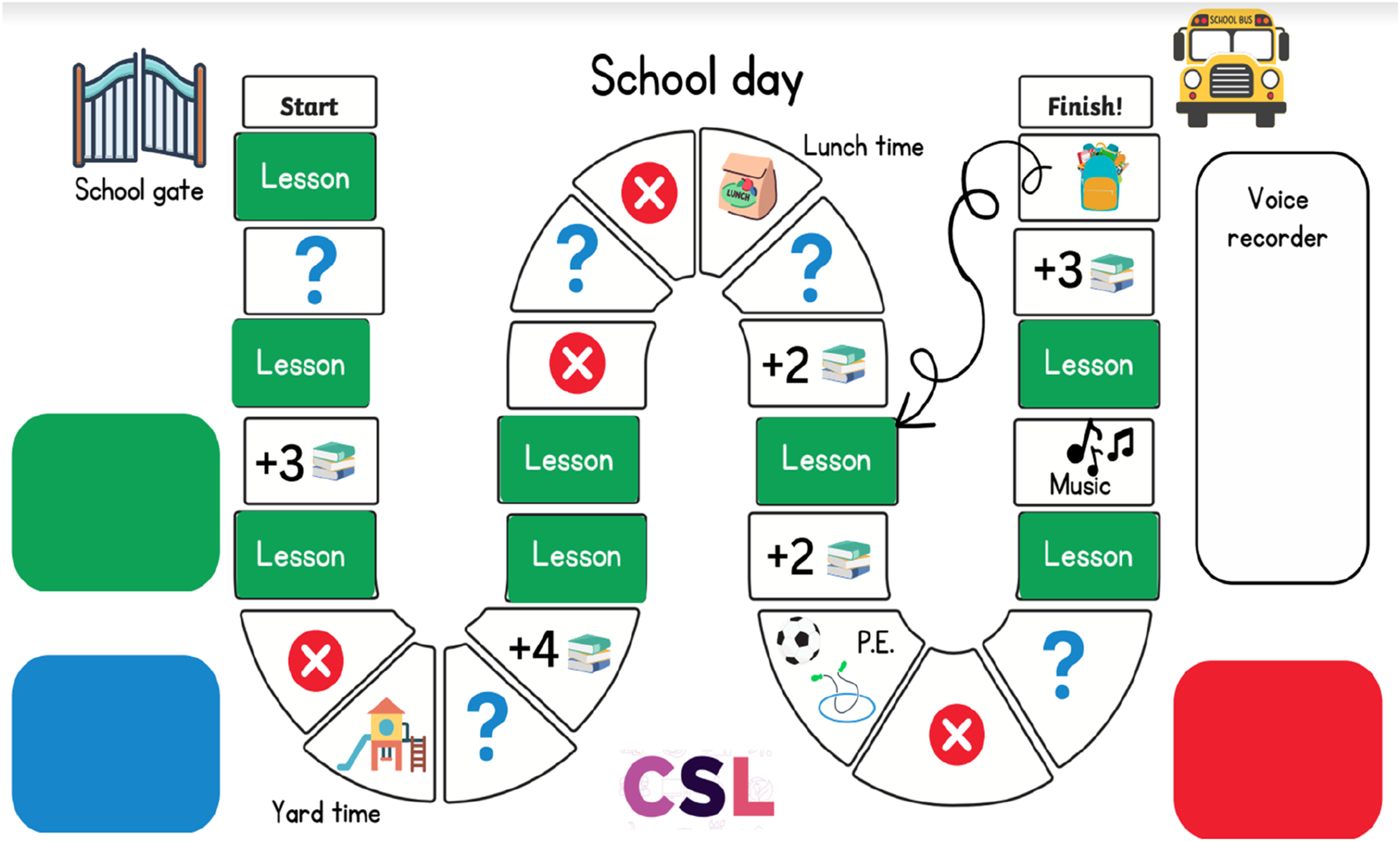
At the start of the school day, each player has 5 tokens of homework, players will take turns to roll the dice and move as many spaces along the board as the dice number. When a player lands on a lesson or question they have to read a ‘lesson’ or ‘question’ card from the decks and respond. When a player lands on a stop sign they have to read a ‘stop’ card and follow the instructions. When a player does not answer the question they have to go back one space. When a player lands on a +2, +3, +4, etc. they will get the amount of homework shown in the space. When the player lands in special spaces, the following rules applied: • Yard time - they give one homework to another player • Lunchtime - they give two homework tokens to another player • P.E. - they give three homework tokens to another player • Music - they give four homework tokens to another player • School bag - they have to go back to a lesson
3
Once the overall design of the game was agreed upon, the research team then drew on the development of questions prompted through the board game that aligned with the core themes of the CSL study: equality, voice, inclusion, experiences of teaching and learning, wellbeing, and engagement (Figure 2). Examples of question cards and lesson cards of the board game
Space and Voice - Piloting the Board Game
The board game method was first piloted in Tory, one of the seven case study schools described previously, with a sub-sample of 18 children to ensure the method effectively supported children in forming and expressing their views and experiences. The purpose of conducting a pilot was to compare two possible approaches for the use of the method in educational settings, as well as to identify any revisions necessary for its implementation in the remaining six case study schools. The first approach to implementation, the ‘whole-class approach,’ involved children (N=14) remaining in their classroom and independently playing the board game in groups of four or five. Voice recorders were placed on the board game mats and were visible to all children. A researcher circulated around the classroom, observing and documenting the children as they played the game, but provided little intervention, support, or direction. The second approach, the ‘withdrawal approach,’ involved a group of children (N=4) leaving the classroom with a researcher to complete the board game in a separate room within the school. A voice recorder was again placed on the board game mat and was visible to all children. However, with this approach, the researcher regularly scaffolded the children as they played the game, providing support with turn-taking, reading of prompts, and resolution of conflicts. The set up of the pilot is shown in Figure 3, with the ‘whole-class approach’ inside the classroom (square) and the ‘withdrawal approach’ outside. Children without parental consent (NC) were identified with support from the teacher, grouped and allowed to play the game, to avoid excluding them from the activity, but data was not collected from their table. Set up for piloting the board game ‘A School Day’
Children engaging in both approaches enjoyed playing the game and engaged well with the prompts provided. Voice recordings for the whole-class approach were audible and individual children’s contributions were understandable. However, children engaging in the ‘whole-class approach’ struggled to follow the rules of the game at times and became upset due to misunderstandings and disagreements. While children engaging in the ‘withdrawal approach’ also required continuous guidance and support, their contributions were richer and more detailed. Groups with five children in the whole-class approach also struggled with long wait times between turns which led to some children becoming restless and impatient. Arising from this pilot, it was decided that the withdrawal approach would be implemented with three groups of four children from each of the remaining six case study schools. This would allow a researcher to scaffold the children with their playing of the board game and reduce wait times between turns to support engagement.
Space and Voice: Implementing the Boardgame
The board game was implemented in the other six case study schools described above with the remaining children from the sample (N=72), facilitated by one/two researchers in each school. The withdrawal approach described in the pilot was used, and as a result, only children with parental consent play the game in the remaining schools. Children’s assent was sought at the beginning of the game, when children were asked if they wanted to take part in the research by playing the game. One girl in Broadhaven expressed she did not want to take part and as a result she abandoned the group and did not play; in Cashla a boy was hesitant to play because there were only girls in the group, but when given the chance to either try to play the game or abandon the group he decided to take part. There were instances in which assent had to be re-negotiated when children removed themselves from playing game (eg. when they became too distracted or decided to play by themselves something else) but then decided to come back and play. Researchers used these opportunities to discussed assent and remind all children that it was up to each of them to take part in the research through the game.
Children were grouped by their teachers, who allocated them based on their social relationships as well as their reading competence levels to flag to the researchers groups that might need additional support in the game while reading the cards. Children were not aware of the rationale behind the group selection. This grouping strategy allowed observations on peer dynamics, decision-making, and engagement. The implementation phase successfully integrated the board game into diverse school environments, engaging children across different reading ability levels and social backgrounds. Most children were eager to participate, especially groups of children highly competent in reading the prompts and questions, some of whom wanted to replay the game. Practical challenges included managing group dynamics, maintaining order (notably in one school where the game became overly competitive), and keeping some students that struggled with reading the questions engaged. The game did, however, create a structured yet flexible environment that allowed children to express opinions within familiar school-related scenarios (Hashim et al., 2023). This required scaffolding by the researcher, with quick decision-making necessary as needs emerged (Alderson & Morrow, 2020).
Audience: Observing Play with the Board Game
Summary of Observation Notes of the Game Implementation in the CSL Case Study Schools
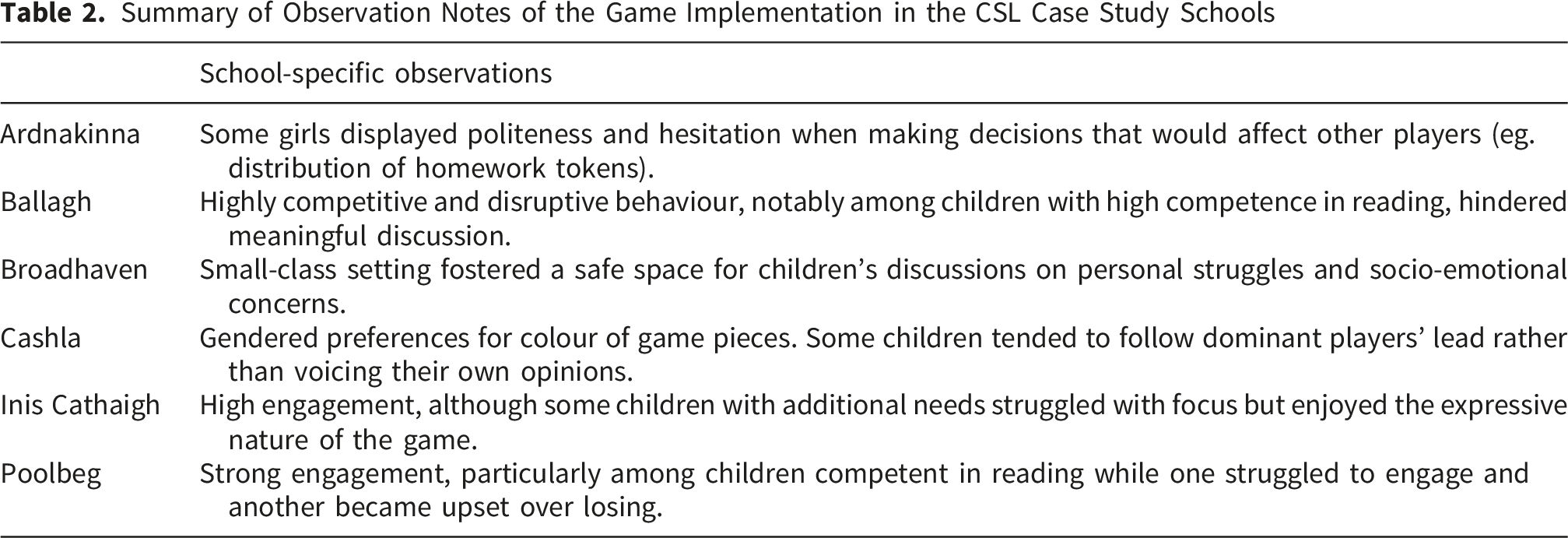
The observational and fieldwork notes from researchers implementing the game were compared and collectively discussed. The reflective discussions, while raising some considerations needed to be further explored or contextualised, confirmed that the game fostered open conversations among children, allowing them to share their lived experiences of school and schooling in a relaxed and playful environment. Three broad themes emerged from the observations: gendered behaviours and discussions about equality, peer dynamics for decision making, and emotional and behavioural responses.
Gendered Behaviours and Discussions on Equality
The game encouraged discussions on classroom experiences, and the impact of ethnicity, social background, and gender dynamics on such experiences. It supported expression of views, particularly among children who might have struggled to do so otherwise, reinforcing the inclusive aim of the method which was to find novel ways to encourage children to express their views particularly those who often struggle to be heard (Blaisdell et al., 2018; Devine, 2000; Lewis-Dagnell et al., 2023). The board game, as intended through the questions developed by the researchers, allowed for discussions on sensitive and complex issues related to equality that might have been more difficult through direct questioning in an interview or focus group. For example, ethnicity was discussed in terms of language, accent, and skin colour (most prominent in Inis Cathaigh). Some children found it uncomfortable discussing economic inequality, particularly in Broadhaven, where they used softer terms like “poor is a strong word” when discussing poverty. Children could articulate markers of wealth and poverty, however, they tended to identify them through material possessions and personal appearance (e.g., ‘poor’ children looking unkempt or not having ‘nice clothes’). Aware of the sensitive nature of the topic, researchers observed for signs of distress among participants when ethnicity and economic inequality were discussed as required in the implementation protocols of the method. None of the participants showed signs of distress during discussions of these sensitive issues while playing the game or in the debriefing session after the end of the game across the six schools.
Distinct patterns around gender behaviours emerged during game interactions and were evidenced within decisions made, in line with evidence on the impact of gender in the wider CSL study (Devine et al., 2025). Boys typically preferred blue or green game pieces, while girls favoured pink or purple. Boys often acted independently, while girls engaged in more collective decision-making. Boys tended to display more competitiveness and initial reluctance to participate, whereas girls were more likely to explain their choices and exhibit apologetic behaviours, particularly when allocating homework tokens. In one school, girls pointed out that a particular student was the ‘only boy,’ reinforcing gender-based social dynamics. Leadership roles were also observed, with some boys especially taking charge to resolve conflicts, while others engaged in distracting behaviours.
Peer-Dynamics, Social Interactions and Decision-Making
The distribution of homework cards was a key moment in the game that allowed to observe how children navigated social structures. Decision-making during the game was largely influenced by peer relationships, with children often allocating homework tokens based on friendships rather than strategic thinking. While some children took a diplomatic approach, for example, sharing homework tokens equally, others assigned them based on friendships or who was leading the game at the time. In several schools, competitiveness sometimes led to rule-breaking behaviours, such as hiding tokens, which disrupted the flow of the game and interfered with the intended collaborative environment.
Emotional and Behavioural Responses
The game highlighted diverse behavioural and learning dynamics. Emotional and behavioural responses varied widely among children. Children identified as highly competent in reading, were the most engaged and collaborative, contributing actively to the game, while quieter or struggling children often hesitated to assert their views and appeared to feel pressure playing the game and ‘falling behind’. Some children became highly competitive and overly fixated on winning the game, which hindered their ability to engage meaningfully with the questions and reflect on the prompts given through the game questions. Some children with additional needs become distracted or overly giddy when playing, requiring additional redirection from researchers to answer the questions or focus on the rules, yet they engage positively with the game. The board game created an open and expressive space for children to reflect and express their views, a core intention in its development. Further, the children’s discussion of the game highlighted their views on the engaging nature of the method, with many of them contrasting their experience of playing the board game with the structured classroom setting, which they sometimes found restrictive. Some children mentioned feeling hesitant to speak up in class, even when they knew the answers. One child with additional needs in Inis Cathaigh described this experience as feeling like she ‘would burst’ when not able to express herself in class.
Audience and Influence: Assessing the Boardgame
The board game as a research method managed to successfully engaged children in the research process, including those who were initially reluctant to participate. For instance, in Cashla, even a ‘popular’ boy, who showed initial reluctance to participate, became highly involved. The game’s interactive nature encouraged high engagement, with many children expressing a desire to replay it, reflecting its appeal as a learning tool, through fast, active and exploratory forms of participation (Sardone & Devlin-Scherer, 2016; Türkoğlu, 2019). One of the key strengths of the game was its ability to encourage negotiation and decision-making (Kirsch & Mortini, 2023; Lewis-Dagnell et al., 2023; Türkoğlu, 2019). Children were not only involved in the game itself but also actively engaged in discussions about homework token distribution, justifying their choices and fostering peer dialogue. This collaborative and playful approach fostered reflection and social negotiation, encouraging children to articulate their decisions and reasoning to peers building children’s competencies as active agents (Devine, 2003; Donegan et al., 2023; Gleasure et al., 2024; Martinez Sainz et al., 2024). However, instances in which children did not engage with the board game in the way it was anticipated or even preferred by researchers, including getting distracted, stopping playing the game momentarily, cheating or focusing on winning rather than discussing the prompts, were also ways in which children demonstrated their agency while negotiating power relations and participation in research processes (Koch, 2019; Wilkinson & Wilkinson, 2018).
The boardgame upheld children’s rights to participate, play, and have their voices heard in meaningful, age-appropriate contexts by providing opportunities for children to discuss the themes of the study in a more playful manner. By creating space and facilitating voice in this manner, the board game method affirms children’s unique insider knowledge as experts of their own lives (Donegan et al., 2023; Gleasure et al., 2024; Perry-Hazan, 2016), thereby ensuring the realisation of the third element of the Lundy model – audience, wherein children’s views are listened to. The board game as a research method proved to be an effective tool for rights-based research with children, where the right of young children to have weight attributed to their opinions and experiences in the places they inhabit is well established (Devine & Luttrell, 2013; Lundy, 2018; Martinez Sainz et al., 2024).
The boardgame made it easier for children to form their views and to convey their understandings and experiences because as a method it focused on their perspective and played to their strengths and familiar experiences (Coyne & Carter, 2018; Tisdall et al., 2024). Through their playful participation, children voiced complex thinking about social inequality, ethnicity, gender and inclusion due to the opportunity and means created by the game. However, the creation of spaces in research that facilitate children’s voice particularly in relation to sensitive experiences such as inequality and exclusion remains challenging (Bayeck, 2020; Devine et al., 2004; Lewis-Dagnell et al., 2023; Neag, 2019). In this context, the board game method provided a key resource whereby sensitive topics, often ethically difficult to approach in research with children, were be brought up and addressed by the children themselves. However, this raises the possibility of children who are impacted negatively by inequality or exclusion to feel particularly vulnerable when these discussions take place in the game; therefore researchers must adhere to the principle of no maleficence when implementing this playful method to protect children from emotional harm during the research process through clear and sensitive protocols.
In the fieldwork, clear communication of the rules and boundaries for the game and the presence of an adult researcher as an attentive/protective audience created an environment where the young participants felt at ease. In addition, the fun and enjoyment experienced as children responded to the questions and made their way across the board, built rapport with both the researcher and the other members of the group. When the children felt at ease, they were having fun and in control of their discourse, facilitating the creation of a ‘safe’, appropriate space (Lundy, 2007), wherein they had the opportunity to introduce and express views on sensitive issues impacting their lives. At times during the fieldwork, prompted by the questions or the discourse between the children themselves, sensitive topics such as their experiences of migration, poverty or gender discrimination were brought into the conversations. For example, one young child from a migrant background talked about her distress at receiving corporal punishment in her old school abroad, and contrasted this to more positive educational experiences in her current school in Ireland. In this way, the board game method facilitated access to children’s inner discourses on how critical social issues and inequalities shape and impact their young lives complimenting the other child-appropriate participatory methods in the study.
Equally, for children with additional educational needs who often struggle with focus and structured classroom activities, the game was an engaging approach to participate in research and an expressive outlet, enabling greater involvement than in other learning settings (Türkoğlu, 2019). The hands-on nature of the board game made it particularly accessible for students with different learning abilities. It allowed them to participate actively in their own learning, making complex topics more approachable and understandable. This flexibility in catering for diverse learner needs also underscores the potential for board games as a pedagogic tool, addressing concerns raised by teachers in the difficulty of balancing play-based learning with primary school curricula (Gray & Ryan, 2016; Martinez Sainz et al., 2023; O’Sullivan et al., 2025).
Concluding Discussion
Inclusion is a core aspect of the Lundy (2007) model of children’s participation, and the barriers to their inclusion in the board game are an important consideration for the method. While most children enjoy discussing their school experiences, those who face difficulties with literacy or verbalisation may find some questions difficult to access at times. Time constraints were an issue during the pilot and if children are slow to read or understand their question, they may not have time to fully respond or expand on their answers, particularly if other children are eager to move the game forward (Sardone & Devlin-Scherer, 2016; Türkoğlu, 2019). Additionally, some children may not understand what is being asked or lack the vocabulary to articulate their thoughts fully. This may necessitate additional scaffolding from the researcher. Despite these limitations, meaningful participation is still possible for all children. However, those with communication or literacy difficulties may require more guidance to express what matters to them, which could be considered as a limitation of the method.
For those with additional needs, the structured turn-taking format sometimes proved difficult, as their high energy levels made it hard to stay focused (Türkoğlu, 2019). Quieter or struggling students, particularly in Cashla, found it challenging to verbalize their responses beyond simple phrases, which led to disengagement in some cases. In certain instances, the competitive nature of the game resulted in disruptions, with some students focusing more on ‘winning’ than on engaging in meaningful discussion, as seen in Ballagh. Others engaged in momentary self-withdrawal, as noted in Poolbeg. These observations highlight the need for strong scaffolding and facilitation to ensure the focus remains on the research goals while acknowledging children’s agency in those instances. Furthermore, social dynamics influenced participation, with peer popularity occasionally affecting the quality of individual reflection and decision-making. Moreover, even though it was not observed during the implementation, it is possible that social dynamics result in children’ experiencing social pressure to keep playing the game. These instances underscored the importance of flexibility, active observational techniques and quick appropriate action on the researcher’s part to ensure the game’s intended outcomes were achieved and all children’s voices were heard. Another important consideration with respect to the implementation of the board game as a research method relates to the issue of physical space and resources. While children could certainly independently play the board game for enjoyment in almost any context, our pilot highlighted that its implementation as a research method requires scaffolding from a researcher in a more private space. Such space and resource requirements may act as a limitation to its implementation in some research contexts.
When implemented in the remaining six schools, the board game demonstrated flexibility and adaptability, proving effective across diverse school settings, socio-economic backgrounds, and academic competencies. Its success was, however, most pronounced in smaller group settings, particularly when using the same withdrawal technique as tried within the pilot. This approach allowed for more focused interactions, better management of individual needs, and greater engagement, ensuring that all students had the opportunity to participate and contribute meaningfully to the game.
Several important ethical considerations remain, however, which should be noted. First, it is necessary to consider the issue of ownership in the co-creation of a research method with children such as that described here. Within a discourse of empowering children as co-researchers and co-creators (Cuevas-Parra, 2020; Donegan et al., 2023), the question of ownership of intellectual property remains ambiguous. Second, it is important to consider whether the implementation of our board game as a research method represents an instrumentalisation of play. As noted previously, much as children’s right to participation, Article 31 of UNCRC (UN, 1989) enshrines children’s fundamental right to engage in play and recreational activities (Davey & Lundy, 2011). As such, the ethical question arises as to whether it is appropriate to intervene as adults in children’s enjoyment of this right for the purposes of researching their lives. Indeed, while certainly more participatory and inclusive than approaches previously characterised as research on or about children (Bradbury-Jones et al., 2018; Gleasure et al., 2024), it nonetheless remains a somewhat extractive adult pursuit which instrumentalises a fundamental right of children.
It is also important to highlight that feedback was not provided to children on the findings arising from our implementation of the board game method. As noted, the board game represented one small element of the broader design of the CSL study, limiting our ability to provide specific feedback to participants on individual methods. Nonetheless, child-friendly reports have been created and shared with participating schools on the findings of the study more broadly, representing a more general form of feedback to participating children – albeit not on the board game specifically. Additionally, for children participating in the board game method, knowledge of the influence of their contributions on policy was an important motivating factor. For instance, one child involved in the pilot at Tory spoke directly to the voice recorder to communicate her desire that the government would remove a load of gravel situated in front of her house. As such, while specific feedback was not provided to children on their participation in the method, their awareness of potential influence may reflect a particular trust in researchers to authentically represent and advocate for their concerns.
Through the co-creation, pilot and implementation of the ‘A School Day’ board game, the Children’s School Lives study demonstrated how playful methods can create inclusive spaces for research participation among young children. Despite the identified limitations, the play-based method proved to be effective in supporting children in forming and expressing their views not only about their school experiences but also about sensitive and complex topics that might have remained unexplored through traditional research approaches. The board game facilitated playful participation in research by engaging children in an inclusive and accessible manner. In addition, the board game addressed power imbalances inherent in adult-child research relationships (Devine, 1999, 2003). These findings reinforce the value of embracing play as a key approach within educational research, offering researchers an inclusive and engaging pathway to access children’s authentic views on their school lives.
Footnotes

Funding
The authors disclosed receipt of the following financial support for the research, authorship, and/or publication of this article: The Children’s School Lives longitudinal study is funded by the National Council for Curriculum and Assessment (Ireland).
Declaration of Conflicting Interests
The authors declared no potential conflicts of interest with respect to the research, authorship, and/or publication of this article.