



Abstract
In recent decades, photovoice has become a popular method in research that involves children as active research participants. This paper focuses on the procedures and methods of gathering and interpretation of data from a photovoice project with children in rural Sierra Leone. Photovoice in this project was an integral part of a more wide ranging multi-modal study on gender, well-being and schooling of primary school children. The inclusion of photovoice as an additional method of data collection added another lens through which we could understand children’s everyday experiences and encourage their active involvement in the research process. The paper discusses the steps of analysis, showing the benefits of the combination of visual and textual methods and presents reflections on the work with relatively young primary school children with no prior experience with photography.
Introduction
Qualitative research widely uses visual methods to gain a deeper understanding of the lived experiences of people, their everyday realities, values and norms (Gibbs et al., 2002; Schell et al., 2009; Wang, 1999). As Harrison argues visual images can provide ‘wider cultural perspectives and … views of how things are or should be’ (2002, p. 857). One of the methods that incorporates visual images as the main means of data gathering is photovoice. First introduced by Wang & Burris, 1994, photovoice as a process in which ‘people can identify, represent and enhance their community through a specific photographic technique’ (Wang, 1999, p. 185) is widely used in research with various groups of people including those who are most vulnerable and powerless (Devine & McGillicuddy, 2019; Luttrell, 2010, 2020). As a method, it draws substantively on the framework of feminist theories, Freirean traditions of education for critical consciousness and the principles of participatory action research (Pain, 2012; Wang et al., 2000). It stresses the importance of agency and voice of research participants, and the promotion of dialogue between participants, researchers and stakeholders (Luttrell, 2013).
In recent decades, photovoice has become a popular method in research that involves children as active research participants. The popularity of photovoice in research with children reflects the general shift in research approaches to children’s lives, increasingly recognising children’s role as active researchers of their own lives. While in the past, the majority of child-related research was on or about children; today the inclusion of children’s voices has become a key focus (Bruner, 2004; James, 2007). This shift was inspired especially by the theoretical development of the new sociology of childhood that underlined the centrality of children’s agency to research about and with children. In so doing, childhood studies researchers aim to gain a deeper understanding of generational orders, power dynamics between adults and children and the agentic power of children to co-construct social realities (Alanen & Mayall, 2003; Devine, 2013; Morrow, 2003; Punch, 2005; Spyrou, 2011). This also includes the closer examination of children’s views and perspectives of the social world and ‘their understanding of the rights and the wrongs of their daily life’ (Mayall, 1994, p. 2). In this paradigm, children are understood as capable actors that see the world through ‘different eyes, ask different questions and have different concerns’ (Spyrou, 2011, p. 152).
Photovoice can provide a good opportunity for children to share their perspectives on the world around them and exercise their ‘voices’ (Sancar & Severcan, 2010). In contrast to more traditional approaches such as interviews where researchers are placed in the position of power to ask specific questions (Nairn et al., 2005, p. 224), photovoice provides more space for the free expression of views, and as Luttrell (2010) notes, their multiple voices. It can help to overcome the overrepresentation of children who master verbal abilities and the exclusion of those who are too shy or do not have the confidence or verbal skills to express themselves in an interview setting (Darbyshire et al., 2005). Through inclusion of these children, researchers can restore ‘epistemological justice’ (Skeggs, 2002) and potentially reduce the risks of reproducing symbolic violence in child-adult/researcher relationships (Clark, 2003; Warming, 2011).
Children with cameras become researchers of their own lives, culture and reality (Kolb, 2008). Photovoice facilitates children in representing themselves and their communities in specific ways that reflect their unique perspectives. Literature argues that children’s photos can introduce new topics and meanings that might be otherwise overlooked or misunderstood by adult researchers (Burke, 2005; Luttrell, 2010). This shift of roles in the research creates a new level of engagement between adult researchers and child participants (Kolb, 2008) and potentially can reduce the power imbalance that immanently exists in child–adult researcher relationships.
However, as some scholars argue it would be a mistake to view children’s perspectives as frozen and singular. Rather, they are fluid and dynamic (Gallagher & Gallagher, 2008; Komulainen, 2007; Richards et al., 2015; Warming, 2011) and photovoice facilitates a snapshot of children’s multidimensional and pluralistic views. Nor is photovoice free from child–adult power dynamics. However, such dynamics are transformed through the opening up of more participatory spaces for children’s voices within the given framework of the research project. The nature of children’s agency in photovoice projects exists in the context of the relationships between children and researchers as well as being embedded in the social and cultural contexts of particular locations. Notwithstanding, the adult researcher remains a powerful figure who creates these participatory spaces for children and establishes certain rules within them. The role of the adult becomes even more visible during the analysis stage of the photovoice research project when the questions about the borders between children’s meanings and adults’ interpretation arise (Luttrell, 2010). These questions on boundaries and the reflective positioning of the researcher within the photovoice space are also reinforced by a general lack of transparency over how the data may be analysed and interpreted. A minority of photovoice studies discuss the analytical procedures and interpretation of data (Luttrell, 2010; Wang & Hannes, 2020). However, a majority of papers focus on the results of such interpretations.
In this paper, we seek to fill this gap in the child related literature on photovoice by focussing on the procedures and methods of gathering and interpretation of data from a photovoice project with children in rural Sierra Leone. In our research, project photovoice was one component of a larger multi-modal study on gender, well-being and schooling of primary school children in rural Sierra Leone. We will present the steps of analysis of photos and the reasons behind them along with the reflections on the work with relatively young primary school children with no prior experience with photography.
Methods
The paper draws on the photovoice project that was a part of a larger research project ‘Safe Learning Study’. This longitudinal mixed methods study examines gender relations, literacy, well-being and schooling of primary school children in rural Sierra Leone (Samonova et al., 2020). The fieldwork took place in the Tonkolili district in the northern part of the country which is one of the poorest districts in the country. The qualitative element of the longitudinal study comprised the case study of four rural communities over a 3-year period. These communities were chosen based on several factors: ethnic and linguistic diversity, socio-economic diversity (mining and agriculture-based communities) and types of schools located in communities (government-owned, mission-owned and unapproved community schools 1 ).
This was a multi-modal study. The main qualitative methods used were in depth semi-structured interviews and group discussions with children, their parents, teachers and community members, repeated over a three-year period. In addition, other more participatory methods were also used to deepen insights and provide children with the opportunity to express their opinions freely, in verbal and nonverbal ways. This was especially important given the cultural context where children are not used to expressing their individual opinions (Devine, Bolotta, et al., 2021). During the first year of data collection, we conducted drawing exercises with children and organised children-led village tours. In the second year of data collection, we introduced photovoice as a new method of data collection in order to provide children with opportunities to exercise their voices that would not be restricted by their drawing abilities (which are limited in the context of extreme poverty), confidence, verbal skills and the pressure of the presence of adults.
Research Sample for Photo Voice Activities.

As with other research projects, our photovoice activity was underpinned by ethical considerations (Liebenberg, 2018; Papademas & International Visual Sociology Association, 2009). As Teti, 2019 mentions, ethics in photovoice is continuous, given the evolving and responsive nature of the research design (see also Holtby et al., 2015), thus we adapted a ‘situated ethics approach’ in which ethics considerations are ongoing throughout the research process (Ebrahim, 2010) and is ‘situated in the contexts in which data is produced’ (Clark et al. 2010, p.89). We had to think critically about the very basics of the project such as the choice of technology. Our choice of digital cameras as the most suitable technology posed several ethical questions on safety and cultural sensitivity of the research (Allen, 2012; Tarrant & Hughes, 2020). To minimise possible risks, we followed the ethical procedures approved by the University human ethics research committee as well as by the Ministry of Education and the Ministry of Social Welfare of Sierra Leone. During the planning process, we not only carefully judged the risks associated with the use of relatively expensive devices in the context of extreme poverty (Tarrant & Hughes, 2020) but also discussed the cultural aspects of the introduction of a technology that might be unfamiliar to children (Rose, 2016). As Punch (2002) argues, it may be irresponsible to introduce children to new technology that they would not be able to access after the completion of the project. Though children in rural Sierra Leone are usually familiar with the idea of a digital photo and have seen it/heard about it from older siblings and other community members who possess modern smartphones with a camera function, most of them have never taken photos themselves or had a printed photo in their hands. Thus, we had to consider the impacts of these new experiences to avoid unrealistic expectations that may arise among children and make sure that this activity does not break any local unwritten rules (Mitchell, 2011, see also Joanou (2009) on the ethics of camera selection). Before the start of the research, all research participants were informed about the purpose of the research and had an option to opt out. A two-step process of consent involved firstly securing the consent of parents/guardians followed by assent from the children themselves. Further, all participants had the right to withdraw from the study at any point.
The case study children were introduced to the idea of photovoice and asked to identify a friend with whom they would like to complete this activity. On the one hand, inclusion of case study children’s friends in the process of data collection allowed us to expand the sample of participants and include the perspectives of children outside our immediate case studies. On the other hand, it also positively affected confidence of the children who were not used to taking pictures. Moreover, the discussion about photos to be made with a friend helped to crystallise the ideas about what objects/people might be photographed. Then, children were given initial training on the work with digital cameras. In this training we discussed how to use cameras (switch on/off, take picture, see the photos and delete the ones that you do not like); what the basic principles of photography are (do not shake the camera, keep the camera straight, do not take photos against the sunlight etc.) and general ethical rules such as to ask permission if you take a photo of someone. We also discussed the possibility of the use of cameras in the local context along with children’s expectations and hopes related to the use of cameras. During this training, children had time to practice new skills and took portraits of each other that we later printed and distributed to them. To print these photos, we used a small portable photo printing device that enabled us to make coloured prints directly from cameras in a standard photo size (9 × 13 cm). Children were visibly happy to receive these photos as despite the familiarity of children with the idea of photography in general and digital photography; in particular, they had never had a printed photo of themselves in their possession.
Frequency of Themes of Children’s Photographs.
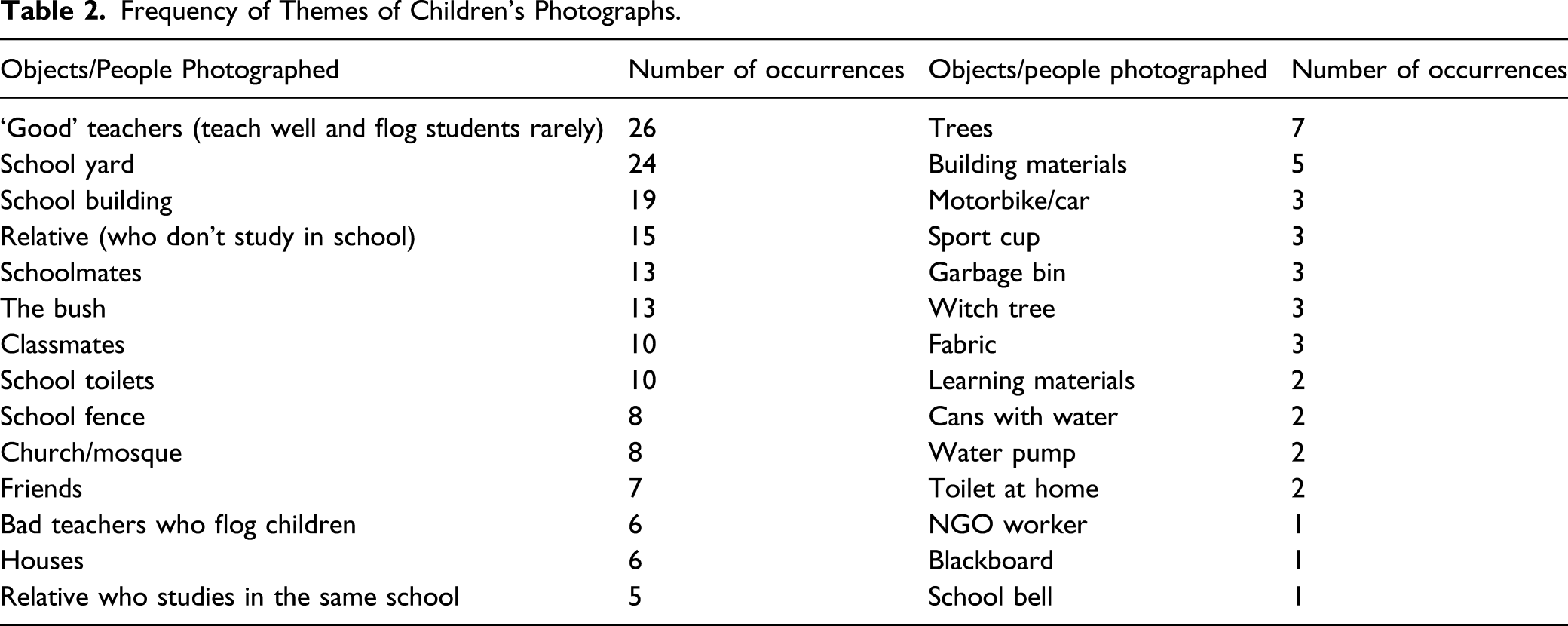
The decision to focus on school rather than the wider community was dictated by our concerns about the safety of small children carrying expensive (for that context) digital cameras. Yet, children’s out of school lives was also important to the research. To gather additional data about life in the community, we selected an additional group of six children from class 6 (3 boys and three girls) in one of our case study villages, Karanba. We asked them to take up to 10 photos of the things they like and do not like in their village. In contrast to their younger counterparts, class 6 children (who were typically between 12 and 14 years old) felt more at ease moving around the community with cameras. The limitation of the numbers of photos allowed children to focus on the main things they would like to share with us (Allen, 2012) as well as helped us to facilitate a fruitful discussion about all photos taken by children which would not be possible if children took unlimited number of photos.
After the task was completed, we conducted group discussions that were guided by questions suggested by Wang and Burris (1994) such as ‘What do you see on this picture’? ‘What is happening here’? ‘Why did take this picture’? (see also Luttrell, 2013). Participants were able to verbalise their ideas presented in the photos and discuss them with their peers. These conversations were recorded and later transcribed. Additionally, follow on individual interviews with each of the case study children (12 in total) were also conducted to gather a wider perspective on children’s everyday experiences in school and at home.
In contrast to many other photovoice projects, this project was not an independent action oriented research but should rather be seen as one component of a multi-modal study on gender, well-being and schooling of primary school children in rural Sierra Leone. The inclusion of photovoice as an additional method of data collection facilitated a better understanding of some aspects of children’s everyday life and provided the children with a rare opportunity to express their views both verbally and nonverbally and to practice new skills.
In total, participants produced more than 200 photos. Both interviews and photos were analysed with the help of MAXQDA software.
Reflections on the Process
While the overall experience of working with children was positive, there were also several constraints that required careful planning and strategic decisions from the research team. Firstly, the UCD researchers are outsiders in these communities. In order to overcome language and the cultural barrier as white western researchers, we were accompanied by interpreters/co-researchers who spoke the local languages. To reduce the risk of possible misinterpretations, we conducted extensive training with these interpreters and explained to them in detail the purpose of the project and its ethics and logistics. Our extended time in the field over three years facilitated the development of relationships with these local co-researchers.
The greatest concern, however, was connected with safety of the children (see also Fay, 2018; Creighton et al., 2018). Given that in rural Sierra Leone there is no opportunity to develop film, the use of cheap disposable cameras was not possible. Moreover, digital photography was more familiar to children than analogue photography as most of them have never seen an analogue camera but know about digital cameras installed in smartphones. At the same time, only a minority of people in villages owns smartphones, which are locally seen as luxurious items not suitable for children. Children were thus given digital cameras and the researchers had a portable device to print out their photos. However, in conditions of extreme poverty, such digital cameras might be seen as valuable assets and could be taken away from children by adult community members, older siblings etc. This issue was seriously discussed among the team and local assistants/interpreters. As Montreuil and Carnevale (2016) argue, the balance between children’s best interests and their recognition as active social agents requires specific context related considerations. That is why during the discussions, we took into consideration several factors including objective dangers and children’s subjective feelings of safety. Based on our expertise and the local knowledge, the research team decided that it is safe to conduct photovoice with younger children on the school grounds where the risks of encounter with adults other than teachers are minimal, while older children who were more confident to move around the village were asked to take photos in their community.
The use of the school grounds as a research field, however, led to other difficulties. While schools are seen as a ‘safe’ territory, they have their own rules and dynamics that are often embedded in the wider social context (Anderson & Jones, 2009). Power relations between teachers and students might create potential sources of risk for children and bias in data (Fay, 2018). As Fay’s study from Zanzibar shows, the unwanted involvement of teachers in the photovoice process can negatively impact not only the data but also the willingness of children to participate in the activity and their emotional and physical well-being (Fay, 2018). Sensitive to these risks, our relationship with the schools and extended periods of presence (including our work with teachers in other elements of the research that involved their own voices on schooling) was paramount in their tolerance of our ‘intrusions’ yet willingness to remain at a distance while working with the children. Further, trust developed with the children over time through our extended observations (and repeat visits to the field site) was also key. We explained to the children that we valued their safety and privacy and would not share any of the pictures with teachers without their permission. All discussions took place outside the school ‘under the mango tree’ and none of the teachers were present there (Figure 1). The research site.
An additional difficulty was linked with the children’s total lack of experience of working with cameras. While children were familiar with the general idea of a (digital) photo, they had never used (and even seen) digital cameras in their lives previously with the exception of seeing photos on the small number of smartphones owned by some youth in the community. Thus, in the beginning of the project, an extensive camera training session was conducted where children learnt basic camera functions and rules (e.g. switch on/of, zoom, use flash light and check photos) on photography. Despite their lack of experience, most of the children were able to handle the camera well and demonstrated their competencies through the good quality of the majority of photos. Only in one case did a girl struggle with the camera and could not take all the photos she wanted to take.
However, while the lack of knowledge of how to use cameras could be overcome by camera training, the lack of experience in taking pictures could not be compensated for so easily given the limited time frame of the exercise. That is why some pictures were taken accidently or did not show the objects children wanted to take photos of. The picture below (Figure 2) was intended by Ramatu
3
to show goats that came to the school compound and distracted the children from their school work. However, Ramatu did not take into account that the goats were moving, and as a result, we have a picture of a rock (which is without a doubt interesting in itself as an example of school surroundings but obviously is not what the photographer intended to show). In other cases, the main object/person for the picture was placed in the corner of the image, which created an impression that the main focus of the photo is something else. There were goats (a photo taken by a girl Ramatu).
The discussions with children after the photos were taken helped us to identify these issues. We began such discussions with simple questions such as ‘what do you see on this picture’? ‘what is happening on the picture’ and ‘why it was taken’ (Wang & Burris, 1994). At this point, many children acknowledged that some objects/people appeared on their photos accidentally. Another photo taken by Ramatu shows a wall in the classroom with posters and a teacher in the corner of the room
4
. For a Western researcher, it might seem that the main focus of the photo are these posters as they are located just in the middle of the picture, but Ramatu provided an alternative interpretation: - This is class 1 teacher on the photo (pointing at the small figure in the corner of the photo). I took a picture of her because I like her. She teaches in our class sometimes and she teaches us well. - There are also posters in this photo, did you want to have them on the picture? - No, they are just there on the wall, I wanted to make a photo of the teacher not of the posters.
While such ‘mistakes’ do not reduce the quality of the data itself, they reduce the applicability of certain visual analysis methods that are traditionally used for photo analysis, and we had to take these issues into account while conducting the analysis of the data. Many methods of visual analysis focus not only on the objects presented on photos but also on the way they are presented (Knoblauch et al., 2008; Wang & Hannes, 2020). It is argued that camera angles, formal composition of photos and perspective projections are important elements of visual analysis of images that can provide valuable information about the meanings of photos and perspectives of the photographer (Knoblauch et al., 2008). However, as interviews with children show in this research project a lot of children’s decisions on angles and composition were not intentional, and in many cases, the composition does not exactly reflect the intended meaning due to the lack of previous experience. This dictated some methodological decisions and reduced our repertoire of the methods of the visual analysis.
The other obstacle that we faced during the photovoice was unsurprisingly the excitement of the children and their desire to take pictures of everything they found somehow interesting. It was especially visible during the sessions with the younger class two students. Despite the fact that we had stressed several times that they should keep in mind the limited number of photos we asked them to take, most children returned to us with much more photos of various things that were not always connected with the main task. In many cases, children acknowledged that they took these pictures just because they liked the very process of taking photos, rather than because the objects on photos mean something for them. Yet, these photos were undoubtedly relevant to a more general insight into the living worlds and perceptions of the children. Moreover, it is important also to recognise that the activity is not just a task imposed by adults but something that is created by adults and children together and children’s own pleasure and joy of taking photos is an important part of the research process. Such excitement with new objects that children have never seen before is understandable and predictable. A good solution for this issue may be allocation of more time to training and photo exercises where children can take as many photos as they like before they start the actual activity. It might also improve children’s skills and enable them to take exactly the photos they want to take. In contrast, older children were more focused on the research task and took only pictures they saw as relevant for the main topic.
Group discussions and individual interviews that followed the photovoice helped to reduce possible bias and misinterpretation of photos. The combination of textual descriptions and the visual image created a more comprehensive picture of children’s perceptions of their surroundings and worked as triggers for further discussions. As white westerners and adults, we drew on our ‘outsider’ status to encourage the children to explain the context through their eyes. This approach enabled children to act as experts who themselves brought narratives to the photos and shared their knowledge with ‘least knowing’ (Holland et al., 2010) white researchers. Though as many researchers point out, verbal expression may create barriers for certain groups of children and negatively affect their ability to participate in the research (Darbyshire et al., 2005). In our case, the differences between younger and older children in our group and individual discussions were visible. The majority of older children were able to provide extended explanations of the stories behind their photos, while some younger children seemed to have difficulties with justification of their choices and explaining their photos. While this might be linked to their younger age, it was undoubtedly also connected with the general antipathy/disapproval of children expressing their views within the existing social and cultural context. Sierra Leone is a gerontocracy (Bolten, 2012), where children have traditionally been placed at the bottom of the social hierarchy (Devine, Samonova, et al., 2021). The younger children are, the less voice they have. It might be beneficial to organise training sessions not only in terms of taking pictures but also in terms of asking children to provide descriptions and explanation of their photos. This would enable them to get used to this procedure, aiding their confidence and freedom during the main task of the photovoice.
Despite these challenges, the project can be seen as valuable both in terms of quality of data generated through the photos and level of children’s engagement. Photos and discussions about them added depth in our understating of issues related to educational practices, safety and everyday life in the case study communities. Love, care and pride in family and friends were especially pronounced as visual representations of what children did not like in their everyday lives. This experience showed that children of first classes in primary schools can actively take part in photovoice research despite the lack of any previous experience with cameras. Our research has also shown that more time training of both visual and verbal skills is sometimes needed and that thoughtful planning and development of strategies to minimise all risks would overcome some of these hurdles.
Analytical Procedures
Multilevel Analysis of the Photos
This research project combines two methods of analysis: semiotic analysis of the images and thematic analysis of both images and texts. This combination of textual and visual analysis allowed us to include both verbal and nonverbal data in our analysis (Catalani & Minkler, 2009; Wang, 1999) and thus to overcome some limitations of using just one type of data. Moreover, closer semiotic analysis of photos provided additional insights into the everyday school practices, school infrastructure and social norms related to education and gender. Given the longitudinal nature of our design, this informed further questions in interviews with children and adult community members.
The first step of analysis was the identification of meanings of photos using the semiotic approach that defines a photo as sets of signs or system of meanings (Bohnsack, 2008). This approach distinguishes between the signifier and the signified (Barthes, 1967), or in other words, between the objects portrayed on the image and their meanings. In the context of analysis of photos, we can speak about two layers of analysis: the first step of the analysis was to examine the denotation level of the photo or to find out what or who is shown there. The connotation level, in turn, reveals what these objects/persons represent or in other words what meaning they have and what story is hidden behind the image (see also van Leeuwen, 2005).
The photo (Figure 3) was taken by Jacob, a class six boy, not far from the school and shows a tree (in particular, a tamarind tree) and a bench under the tree. On the denotation level, we may learn about the local surroundings and nature and make some conclusions about the infrastructure in the community. However, it is the second level of the analysis that reveals the connotation of the photo that represents deeply embedded cultural/spiritual practices in Jacob’s lifeworld related to ra-ser (witchcraft in the Temne language). Specifically the photograph shows the place where witches gather during the night hours. This layer of meaning was revealed in our group discussion with Jacob and his peers and raised important issues around local beliefs in supernatural beings, its role in the community life and the links between profane and sacred worlds that were central to the children’s constructions of ‘good’/safe and unsafe places in their lives. A witch tree (a photo taken by a boy Jacob).
A second example of the interplay between denotation and connotation levels of analysis is the photo taken by Sia, a class two girl (Figure 4). Her picture shows a school bell on the ground and for her represents the importance of coming to school punctually and the prevalence of corporal punishment for late comers. As Sia explains: I like to come to school in time. I feel good about it because when you are late teachers will flog you and I don’t like to be flogged. A school bell (a photo taken by a girl, Sia).
Thus, while on the denotation level this picture demonstrates an everyday school object and provides some information about the school infrastructure, the connotation level reveals everyday practices of corporal punishment in a particular school as well as the feeling of children who experience these practices as an essential part of their lives.
As we have seen in these examples, the analysis of two levels of photos was combined with close reading of interviews and group discussions. This combination of textual and visual analysis provided first-hand explanations of the meanings of the pictures. This was especially valuable in a context where, as outsiders, we were given privileged access to local knowledge. The combination of visual and textual analysis facilitated the reduction of interpretation bias and extended understanding of the children’s local realities.
However, not all meanings identified on the connotation level came from the children’s interviews. Photos are a rich source of meanings and not all meanings were necessarily intended by the children. The photo below (Figure 5) shows a teenage girl carrying a big pan on her head. During the discussion of taking this photo, a girl, Isa explained that this is her sister who dropped out from school due to pregnancy and who helps her to study at home. This explanation itself provides rich data and a fertile ground for further exploration of girls’ and women’s everyday life in the community including early pregnancies, barriers for pregnant girls to attend school, as well as about literacy dynamics at home (Devine et al., 2021a, 2021b). But the picture itself also represents a teenager who works (in this case sells small agriculture produce – what can be read from the pan on her head) which tells another story about the incidence of child work, sources of income suitable for women and gendered labour division. My sister dropped out from school (a photo taken by a girl, Isatu).
While this level of meaning is crucially important for the data analysis, the level of denotation or the objects or people that appear on the photo is also useful to gather additional data about everyday realities. Children’s photos provide valuable information about the everyday realities in schools and the communities that are often taken for granted by them and are not necessarily articulated in interviews. Such details as school infrastructure, interior of classrooms, school compound or the village surrounding that are rarely addressed in conversations expand our understanding of the everyday experiences of children in the rural Sierra Leone.
Coding Process
An additional core element of the analysis was thematic coding of the data, which had several steps: coding of individual interviews and group discussions, coding of photos and the establishment of the links between photos and interviews. Interviews and group discussions were coded, and main themes were identified according to the principles of thematic analysis (Braun & Clarke, 2006). The next step was coding of photos, which had two stages: during the first stages, the level of denotation was analysed and objects presented on the picture were coded. The next stage was the coding the connotation level of photos based on the previous analysis of meanings. For example, the picture below (Figure 6) shows a blackboard in a classroom. During the first stage of coding, we used such codes as ‘school materials’, ‘school’ and ‘literacy’ – these codes describe the objects presented on the picture. At the same time, Saio, a class two student, who took this photo explained the reason behind it in the following way: When the teacher writes something on the blackboard and I am able to read it I will feel good about it and also when the teacher calls me out to solve problems on the blackboard and I do it well I will feel good among my colleagues. Picture 6, A blackboard (a photo taken by a girl, Saio).
Thus, this photo not only shows the classroom interior and the blackboard, but also represents the good feelings for Siao associated with studying in school. That is why during the second stage of coding such codes as ‘happy’, ‘like in school’ and ‘positive climate [in school]’ were added. In this way, two layers of the meaning of this picture were captured and coded for the further analysis.
The inclusion of both boys and girls in the photovoice project enabled initial comparison of both visual and verbal data, which helped to foreground certain patterns of gender norms and practices in schools as well as the wider community. For example, in the same discussion about the blackboard, Saio mentions that she thinks that boys are more ‘brilliant’ (or capable) students in her class then girls because girls have to do a lot of domestic work and do not have enough time to study at home.
The last step of the analysis was to create links within one MAXQDA document between photos and interviews. Using the features of this software, we were able to create interactive transcripts and photos that link elements of photos with the description from the interviews and group discussions. The last step of the analysis was to establish links between photos and the whole corpus of interviews conducted during the fieldwork including interviews with teachers, principals and parents. For example, photos that represented the widespread use of corporal punishment in school (such as the photo of a bell) were linked with quotations from students’ and teachers’ interviews. This created a polyphonic multilevel narrative of various perceptions of this phenomenon by various relevant actors. For example, in this stage of the analysis, we can see voices of children who are flogged regularly, voices of teachers who claim that corporal punishment is not used anymore in schools as well as voices of parents and elders in families who argue that corporal punishment is needed to help children to stay ‘on the right track’ (Devine, Samonova, et al., 2021).
Such triangulation helped us to capture different perspectives on issues significant for children’s lives as well as to identify differences and similarities within and across different groups of interviewees. This has subsequently been used to supplement further detailed analysis of the whole corpus of the qualitative data.
Conclusions
This research project aimed to capture children’s perspectives on everyday lives in school and communities through the methods of photography. Photovoice in this project was an integral part of a more wide ranging multi-modal study that comprised various methods of data collection including more traditional approaches through semi-structured interviews and field observations, alongside more participation oriented methods such as children-led village tours and drawings. The adaptation of photovoice provided an additional lens through which we could understand the children’s everyday experiences and encourage their active involvement in the research process. After the end of the activities, children took their pictures printed on a digital printer with them at home and were able to keep them and show them to friends and relatives later.
In this paper, we discussed our steps in conducting photovoice and analysis of the data, showing the benefits of the combination of visual and textual methods of analysis. An underpinning assumption of our research was that the children were competent social actors, who, when given the opportunity and supported to do so, could convey meanings and facilitate deeper interpretations of the everyday in their lives. Central was the development of a framework that enabled the children to use their whole creative potentials in successfully completing the task. The carefully formulated open-ended task gave children freedom to make meaningful choices of the things they would like to show and allowed them to include multiple narratives in their photos. Though we do not claim that the photographs reflect the only possibilities of children’s views, recognising that such views are plural and fluid (Clark & Richards, 2017), they provide an important snapshot on the variety of issues children see as important in their everyday life. Moreover, the inclusion of both boys and girls of different ages provided a complex picture that reflected age and gender norms embedded in their everyday practices and perceptions.
The combination of visual methods of the photo analysis with the textual analysis of interviews added to the robustness of our analysis of photos. At the same time, it helped us to overcome the limitations of the use of verbal information only and contribute to ‘epistemological justice’ (Skeggs, 2002) through facilitating voices of all children independent of their abilities to express themselves verbally. The analysis of the visual component also enriched the study through looking at the levels of meanings and signs that are immanently present in the images. The establishment of links between images and the whole corpus of the interviews, in turn, created a multilevel polyphonic picture of the perspectives, views and values of children and adults.
Footnotes
Declaration of Conflicting Interests
The author(s) declared no potential conflicts of interest with respect to the research, authorship, and/or publication of this article.
Funding
The author(s) disclosed receipt of the following financial support for the research, authorship, and/or publication of this article: This study is supported by Concern Worldwide.
