




Abstract
New types of transgressive qualitative research can embrace more collaborative forms of truth-sharing and meaning-making, leading to more multivocal insights to advance shared knowledge-building and development goals in broader-reaching ways. In this study, I turn towards a participatory approach to data collection and analysis to explore new and more multivocal ways of developing knowledge in partnership with youth. I take this turn with the goal of conducting research that feels more honest, both in terms of analytic accuracy and in terms of analytic ethics. In this, I seek a transgressive validity that centers the humanity of both researcher and participant. In particular, I introduce and unpack critical participatory co-analysis as a transformative method for knowledge co-construction from multiple data points and perspectives, grounded in participant expertise in their lived experiences and contexts. This analytic method is an enactment of a critical commitment to multivocal truth and power-sharing in participatory research, leading to more complex and multilayered findings in closer partnership with participants. This paper explores the process of completing a qualitative dissertation study through participatory data cogeneration and critical participatory co-analysis, including steps navigated in partnership with youth, and the significance of these steps for reaching conceptual and methodological advancements in the work. Implications are discussed for enhancing mutuality and transparency between researcher and participants across all steps of analysis.
Keywords
The Need for a New Analytic Method
New types of transgressive qualitative research can embrace more collaborative forms of truth-sharing and meaning-making, leading to more multivocal insights to advance shared knowledge-building and development goals in broader-reaching ways. Participatory research approaches offer tools for centering “unique perspectives of youth,” valuing youth as experts and worthy partners whose participation can strengthen research communities by “contributing to knowledge of social issues” (Teixeira et al., 2021, p. 144).
Research approaches that support exploring reality in the world as a shared object to be studied and transformed (Freire, 2007, p. 37), however, require dominant interpretive frames and assumptions to undergo continual, critical analytic disruption. This aligns with feminist, postmodern forms of reasoning or truth-seeking that are distrustful of dominant metanarratives (Lather, 1993), a bridging of “ethics and epistemology together in self-conscious partiality” that “leaves space for others to enter, for the joining of partial voices” (p. 683). In essence, youth can help to critique, challenge, and replace dominant adultist assumptions about youth lives, advancing collective knowledge in smarter and more ethical ways.
In my dissertation, I wanted to take a participatory approach in order to embrace youth-centered lenses for gathering, analyzing, and interpreting information. I had seen examples of participatory methods in action, but I often saw projects become just a little bit less participatory when it came time to analyze participatory efforts. Both for my participants and for myself, I wanted the analysis part of my research to feel better: friendlier, more transparent, more comfortable, and more ethical. I sought to move my research away from adult lenses as the norm, in order to gain insights that could be “more attuned to children’s values, goals and perspectives” (Montreuil et al., 2021, p. 1). Reaching this higher level of attunement could also offer me greater analytic accuracy, with a transgressive validity centering the fact that researchers and participants are human beings (Lather, 1993). This approach draws from traditions of democratic and liberatory pedagogies that “articulate the value of community voice and challenge the dominant paradigms that locate “expertise” within institutions, moreover with adults” (Teixeira et al., 2021, p. 144). It involves using research as a tool to support youth to see the world as it is and as it could be, and working in partnership with youth to help illuminate those dimensions of the world to others (Freire, 2007).
Importantly, this means that youth participatory research can hold more interpretive power than research on youth that employs adult views of youth data. For me, it was not just about plurality. It was about changing how my research process was oriented from the beginning, and this changed what findings were possible. This expanded my ability as a researcher to access knowledge as “new social meanings can be generated: meanings that were not available to each individual alone” (Bjorbækmo et al., 2022, p. 1). Youth participatory approaches helped me to evolve how I defined and implemented the processes and purposes of research, shifting towards engaging with youth as agentic intellectual contributors to research design, data generation, and data analysis (Montreuil et al., 2021).
Taking a Critical Approach to Youth Participatory Research
Here, I purposely lean towards and layer on explicitly critical scholarship that seeks to frame research as an opportunity and tool for disrupting structures that can slow down liberatory efforts. While participatory research is offered as a potentially liberating tool, its takeup and application require constant attention to counter institutional inertia towards status quo practices such as adultism (Teixeira et al., 2021) and white supremacy culture (Okun, 2021). Changing how research is oriented, then, necessitates an unlearning process as well as an embracing process (Thambinathan & Kinsella, 2021), because adult researchers inevitably enter this work with adult lenses that require examination, unpacking, challenging, and redirecting with the help of youth expertise. For example, I entered the research collection process with some ideas about what types of stories I’d want to hear from my youth participants. My goal was to illustrate life pathways into, through, and/or with STEM learning, so I knew I wanted to include youth narratives from their time in the afterschool program I ran and other places where they did science or engineering like our town’s science center. I had no idea that one participant, Keke, would consider her pediatrician’s office as part of her STEM pathway. But she explained that it helped her explore potential medical futures by taking home the office’s collection of patient informational pamphlets about symptoms of infection and treatment options. This site would not have been included in my narrative of Keke’s pathway if I had not employed youth-friendly participatory methods like asking “What did I miss?” during interviews, or if I did not put effort into developing a genuine, candid, and trusting relationship with her to allow her to feel comfortable correcting my mistakes. In this way, participatory approaches can be made more transformative by enacting them through a critical lens, cutting through typical adult-centered lensing and authority to instead center justice-aligned goals like shared vulnerability and brutal honesty in work with youth.
Research through a critical justice approach seeks to move beyond distributive and relational views of equity, to understand many different and intersecting forms of injustice as simultaneously acting on youth efforts across space and time (such as the injustice of overlooking locations where youth learn because they do not fit a white adult researcher’s preconceived definitions of learning environments). As Milner IV et al. (2018) explained, “homogenous communities do not exist” (p. 12), and equity issues must be explored across many social categories of life and practice. This is informed by Sleeter’s (2015) “race and class visible equity in access” acknowledging intersections of racism and classism in the classroom, as well as Milner (2013) argument for pedagogy that equips youth to identify and challenge intersecting forms of inequity across “the many isms and phobias that they encounter” in their lives (p. 40). Leaning towards a working definition of equity that acknowledges multiple and intersecting forms of power and oppression, I also lean towards a working definition of critical that fits with this acknowledgement of complexity in structures of injustice. I start with an understanding drawn from intersectionality literature that critical refers to “criticizing, rejecting, and/or trying to fix the social problems that emerge in situations of social injustice” (Collins & Bilge, 2016, Section 2). Any such endeavor will require multiple perspectives and intersecting layers of analysis to uncover what dominant discourse actively seeks to bury.
This concept of criticality seeks to disrupt repertoires of reproduction in research through questioning post-positivist assumptions of neutrality by presenting them as problems to be examined. Such disruption seeks a liberatory turn through praxis that combines research and practice in solidarity towards justice-oriented change by engaging in “critical thinking,” as a tool for re-humanization through a re-seeing of the world and the power-mediated discourse structuring it (Freire, 2007, p. 81). It requires an understanding of how positionings and actions are grounded in and always mediated by historical and social contexts of injustice (e.g., Collins & Bilge, 2016).
Study Context
My desire for centering criticality at the core of participatory work informed my dissertation in several ways including increased attunement to my own researcher positionings’ consequences for how I saw and interpreted youth data and the related urgency of inviting into that dissertation more direct youth voices and perspectives. This started with focusing on the voices and perspectives of youth with whom I had already developed relationships of collegiality and candor.
My relationships with the participants of my dissertation began when I joined a Michigan community center’s afterschool STEM program as a teacher in my first year as a graduate student. I ended up designing programming and teaching there for almost a decade, as I decided to stay after receiving my PhD (I took a postdoc 1 hour away, but commuted to that job and stayed in my same neighborhood in order to maintain strong ties to my community and the STEM program families).
Two participants (Amara and Keke) were high schoolers whom I had known and taught since they were sixth graders, and who had become teen mentors for the afterschool program. Three (Jazmyn, José, and Sincere) were middle school members of the program. Jazmyn was a gifted student with a passion for a variety of topics; during this study she began a new art business taking commissions via her mom’s Facebook account, and she starred in her local cable access channel’s hands-on science television show. José skipped into rooms, often danced and sang while working, always offered to assist peers with troubleshooting, and started a YouTube channel to highlight other members’ projects. Sincere was his school’s seventh grade class president who used his social skills to get more people to join our program, and he often brought his younger sister into our makerspace to get her opinions on his engineering projects. Amara (described by her twin sister Keke as the “quiet” one) loved reading fiction and mentoring younger program members. Keke (described by her twin sister Amara as the “loud” one) discovered engineering through a hobby of “breaking stuff to see the inside,” and she and her sister presented their prototypes at conferences from NYC to Palo Alto. See Greenberg (2019) to read full stories about each youth.
My relationships with these youth and their families spanned multiple years (e.g., one family I’ve known since their oldest child was in the fourth grade — she is now in college). As a part of being together in relationship with research participants and their families, taking a critical stance of self-examination towards my positionality was central and non-negotiable in this work. Importantly, the community center and the afterschool STEM program within it are predominantly Black youth spaces with racially diverse staff, grounded in the community and neighborhoods surrounding it. My positionality as a White educational researcher within racist societal matrices of power necessitated critical reflections on how I interacted with youth in the program and in this study (Matias et al., 2014). Working as both a teacher and researcher at the center provided multiple “generative spaces” for this reflection (Sleeter, 2016), including considering how different research methods can exacerbate power inequities between youth and adults.
Study Approach: Critical Ethnographic Participatory Research
In this work, I sought more thorough and open approaches to exploring youth lives that could better center those youth as the recognized experts of their own life experiences. So I started with the goal of building upon critical and participatory traditions of research, especially research concerned with race-visible (e.g., Milner, 2007) and gender-visible equity and ethics in research with youth participants (Sprague, 2016). I wanted to learn more directly from participants, in their words and from their perspectives. This was especially important from my positionings as a White, adult researcher-teacher who was not a member of their immediate family, had not known them across their entire lives, and had not shared in some of the structural barriers they had experienced. Even in our shared spaces of learning and practice, I recognized that they were experiencing those spaces in ways I could not see or access without their explicit guidance (e.g., emotional experiences, friendships, tensions in navigating power structures, etc.).
I engaged in critical ethnographic participatory research, a combined term to describe the layering of critical ethnographic and participatory methodologies and methods. Critical ethnography positioned my participant observations and interviews toward seeing cultural contexts of youth practices while recognizing the existence of power structures framing and interacting with those contexts (Carspecken, 2013). It allowed me to approach the research with a critical sensibility for how research can privilege particular forms of knowledge (Zou & Trueba, 2002). It helped me to foreground power and relationality in researcher-researched interactions, acknowledging that research can be a tool to “resist and survive” if we are willing to treat research as a relational act and to treat participants’ stories as forms of power (Zou & Trueba, 2002, p. 293). I hoped for tools that could support the use of my dissertation as a way to fight alongside youth for their recognition, a rejection of top-down relationality and “White gaze” ethnography in favor of intimacy that can embrace the nuance of human experience (Wright, 2023).
Layering critical ethnography with a participatory approach then helped me further centralize youth perspectives and walk through research steps together. I wanted to attend to my limits as a White adult researcher writing about the lives of Youth of Color who were actually living them, so I designed my study in such a way that ensured I was not the only writer of their stories. This echoes Gutiérrez et al.’s (2017) claim that, “Participatory approaches to education research highlight the intensely relational nature of conducting research with and alongside historically marginalized communities, relations that are always mediated by dynamics of race and power” (p. 35). Using methodology and method as resources for recognizing this relationality allowed me to honor and leverage our differing expertise across the study, leading to more multilayered findings and representational forms.
In this critical ethnographic participatory approach to a dissertation, my participation in the youth lives I was studying became a subject to explore together with more transparency than might otherwise have been available to us. The research approach helped us to remain open to looking at where our relationships and the overlaps between our learning program and our research project influenced shifts in their pathway construction efforts and/or shifts in how we studied those efforts. I was able to directly ask youth, for example, what my role was, if any, in particular events they had discussed as key to their pathway efforts. This allowed me to see where I was merely observing change versus eliciting change in their pathways (e.g., through my teacher/mentor actions in their afterschool STEM Program, in their museum youth action council, in my brokering efforts with parents and community leaders, etc.).
In addition, our afterschool program’s historical context as a participatory design-based research project necessitated an attendance to how much of what we were studying was reflective of generalizable structures of power and practice that might be seen elsewhere (e.g., in other afterschool STEM programs) and how much was reflective of structures we had deliberately co-designed together to support successful youth pathway construction. Drawing from the critical ethnographic tradition of research helped me to zoom in on these reflections in specific ways. For example, in interviews, I was able to ask youth to consider what components of different events in their afterschool program made them supportive for their pathways (e.g., including which mentor and/or peer interactions, and how), but also what could have gone better or felt more supportive (e.g., including which mentor and/or peer interactions, and how). A context of deep partnership aided in mutual transparency within a relationship of non-judgment and trust during such interviews. This allowed youth a space to state, for example, what components were missing from my mentorship that they hoped to find from a STEM expert when they entered college, or why a particular moment we had shared together was influential for their development of a sense of belonging and recognition in STEM.
What We Analyzed: Co-Generated Portfolios of Youth STEM Pathways
My dissertation investigated how youth who engage in informal STEM programs construct pathways across their varied spaces of learning and development towards desired futures in STEM. This involved exploring what pathway-making efforts look like over space and time, how efforts are structured and/or supported, and how youth, in their own words, understand those efforts. Youth are active learners, thinkers, creators, and problem-solvers who get inspired to develop complex knowledge and skills and seek pathways to desired futures. Helpful opportunities to do so through supplementary and informal STEM programs, however, remain more limited for students from communities already marginalized in STEM, with White and high-income students still gaining access to after school programming in much higher numbers (Harvard Family Research Project, 2006). Exacerbating this issue, there is not enough research documenting the characteristics of out-of-school programs (Lauer et al., 2006), and even less research documenting what youth directly identify as helpful or supportive for their learning and development in informal STEM. I wanted a new approach for collaborating with youth as partners so that I could learn more directly from them, in their words and from their perspectives.
In order to learn from youth insights, I needed to enter the work with methods that welcomed youth to contribute to the research how they wanted. We co-created “STEM pathway portfolios” as a critical participatory form of data cogeneration, so that youth and I could view visual representations of their learning lives, a visual tool to support my researcher analysis and my ability to represent their stories more faithfully (as well as a public-ready artifact that youth could present to others directly). These were multimodal documentations of youth development with a focus on STEM learning across their lives. They were also handy ways to help participants self-curate their collections of learning life artifacts (photos, videos, written thoughts) within an interactive, password-protected website format. See Figure 1 below for an example of this multimodality from José, and see Greenberg (2019, pp. 277-285) for full portfolios from each youth. Selected Slides From José’s Pathway Portfolio.
This portfolio co-construction process was a way to co-explore the forms, components, and tensions of youth pathways, and this co-exploration shifted and expanded possibilities for our findings. These portfolios drew from understandings of embedded case studies but developed those cases through a critical participatory co-construction process. Youth critiques of my interview protocol drafts, for example, enhanced my ability to enter the field with confidence in the precision of my researcher tools because the “researched” was also the “researcher” with me. In this way, we also drew from the critical ethnographic tradition of recognizing the researcher as research tool, but we used a participatory approach for honing that tool.
We used Google Slides for its simplicity which enabled multimodal construction over the course of 10 weeks. Each week, I hosted two-hour group meetings at the community center, in the city’s science museum, or the nearby state university. Sessions were designed and facilitated to allow for multiple ideas, perspectives and relationships to co-guide the process. Youth began by authoring a single STEM pathway portfolio from a co-developed Part 1 protocol, written by me and edited by them. See Greenberg (2019, pp. 286–293) for full portfolio and interview protocols. The protocol prompted youth to identify pathway components (places, resources, feelings, etc.,) and to provide visual artifacts representing components. As youth curated their portfolios, they brought in photos, video, audio, text, social media screenshots and more as artifacts of their STEM pathway work. I reminded them of moments they had mentioned to me earlier or moments we had experienced together in our afterschool program. If they mentioned a special event I had attended, I offered to add photos I had taken of them to their slides. Then to reflect on that portfolio construction process, youth completed an additional interview. This generated additional data on what their STEM pathways said about them, and how and who they hoped to affect through sharing their pathways. Then, co-editing pathway narrative chapters that I wrote about them provided youth-adult co-analysis of all this data. As a final step, some youth took action with their data, inspired by their own STEM pathway experiences.
These portfolios served as visual representations of life turning points and learning efforts, allowing us a shared artifact to sit with and unpack. It also served as a structure to organize pathway data into a presentation-ready format, for youth to show their parents and the public (they presented them at a participatory research convening at my university, and at a community event in town). As we first started discussing the possibility of presenting this research and not just writing about it, we decided that a slideshow medium would be helpful. But youth wanted more “exciting” options for sharing the complexity of our multidimensional work. So the slideshows became multimodal collections with videos, GIFs, photographs of people and work products like prototypes, screenshots of social media and websites, drawings, emojis, and full paragraphs of explanations to get all the ideas out there. Keke designed a visualization of her life as a board game (Figure 2). Amara designed a stop-motion scene of her life using characters she made out of playing cards (Figure 3). José started his presentation with a word of advice for future generations (Figure 1). Keke’s Boardgame-Type Representation of Her Life. Amara’s Stop-Motion Scene of Dealing With a Bully in Her Science Classroom.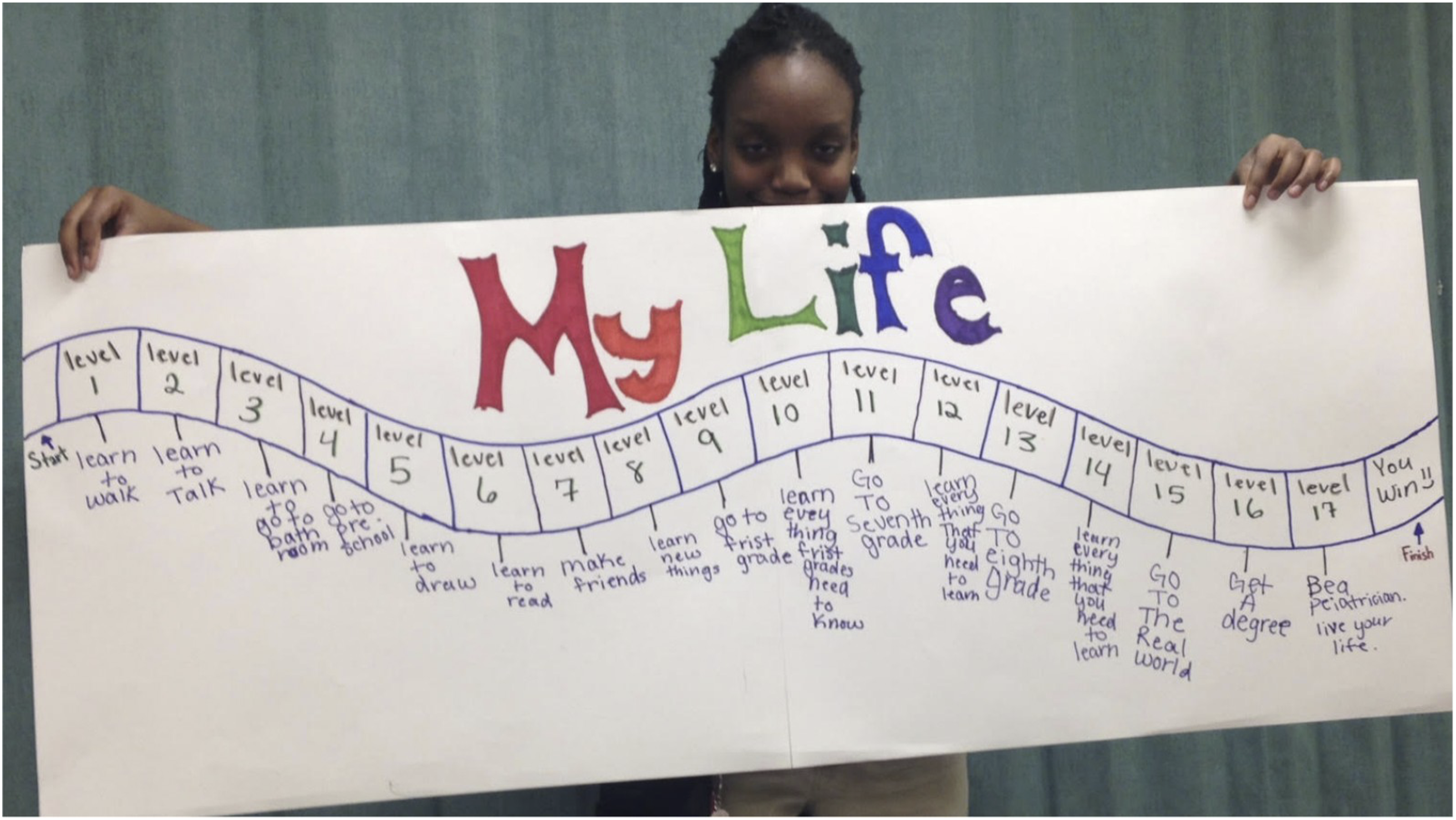

Important to note is that rather than have youth construct these portfolios and then exit the data cogeneration process, youth research partners maintained a level of control over their data throughout the next steps of my study’s procedure. Following portfolio co-construction, youth participated in a second round of critical ethnographic participatory work including two components: a) recorded reflections on their portfolios as artifact interviews (c.f., Tan et al., 2013), and b) continued/intermittent portfolio editing, whenever they wanted to, until the day I defended my dissertation and we all celebrated with a party. This enhanced my ability to reach more complex findings by allowing me access to youth expertise on their data throughout all stages of the research. Even as the study progressed into analytical work, youth had access to their portfolios and changed their data when they felt it was necessary (e.g., through them or a parent texting me a life update or a photo to add to their portfolio, through them deleting, suggesting, or directly entering new text, etc.). This new type of effort helped us to better understand the complex components, structures, and interactions of youth pathway construction efforts, illustrating Bjorbækmo et al.’s (2022) argument that in qualitative research we have the capacity to “literally participate in each other’s sense-making” (p. 8).
How We Analyzed It
Commitment to partnership with youth researchers drove my decision to take up co-analysis of youth STEM pathways and what supports them. I sought a participatory lensing for this work as I have consistently found that asking youth for their perspectives on topics, and their ideas for approaches to take, leads to more creative, more accurate, and more richly detailed research. I sought a critical lensing for this co-analysis as I became deeply invested in working towards greater analytical power-sharing within the interwoven contexts of our longitudinal relationships (I partnered with youth I had known for at least two years, some up to five years). I wanted to incorporate a form of constant comparison to allow concepts to emerge as data was still being co-generated (Strauss & Corbin, 1998), so I knew that iterative cycles of co-analysis would structure my analytic approach. I also preferred for cycles of co-analysis to take different forms (e.g., highlighting written text, verbally reflecting on multimedia portfolios, co-editing open code lists, etc.), to keep it interesting and to potentially help us see different things.
A foundation of trust through shared vulnerability helped me to co-analyze youth lives as we continued to work together in an afterschool STEM learning and practice community. We were also able to mutually leverage relationships we had built together to push beyond traditional limits of participatory research. In this, I followed Bjorbækmo and colleagues’ (2022) caution: “If children are to be involved, and to experience being involved, the relationship between children and researchers has to be open, shared and based on trust. It needs to be one where researchers support children, give them the opportunity to express their opinions and knowledge, and help them make their own decisions” (p. 9).
This looked like, for example, establishing and upholding a shared space of trust for disagreements to be voiced without fear or risk of shame. Frequently, youth could be heard saying things like “that’s dumb” or “no offense, Day, but that sounds boring” about a potential research action I had suggested undertaking. Sometimes, I could be heard pushing back (e.g., “I still think it could be helpful to write up some memos of your narrative like this, so I’m gonna try it myself and then get back to you and let you know how it goes.”). Sometimes, this meant switching gears entirely, leading to impromptu brainstorming sessions to co-plan alternative data generation or analysis protocols. Always, this involved reflection of my own perspectives and interactions and where either of those could or should change, acknowledging that youth agency happens in relational praxis, through personal interactions (Bjorbækmo et al., 2022).
Critical Participatory Co-Analysis, Step by Step
Procedural Guide for Critical Participatory Co-Analysis.

Step 1
For example, there was a poster on a wall in the community organization in which I hung out with participants and ran an afterschool STEM club. On this poster were two arrows. One was a straight line and the other was squiggly and looping. One participant began comparing his pathway to that poster, drawing squiggly lines in the air while explaining, “…Like success is not a straight line. It’s gonna go like all this and this and this and this.” Another participant pulled from his favorite anime to describe his pathway with STEM as a “dragon ball”, an orb of power that others helped him to hold.
Step 2
Step 3
In these meetings with youth, we used red lines and red text to mark up the text together in Keynote as co-editors. I shared that my dissertation committee expected me to discuss some key findings from their narrative data, so I had added little memos here and there that alerted us to potential themes I thought I had seen, which gave youth the opportunity to reject potential findings or alter them. For example, the potential theme of “multimodality” changed to “multidimensionality” through this process, because we decided that the former was more about tools, and the latter was more about how they saw and interacted with their pathways.
In this way, potential themes were figuratively and literally highlighted as open codes for the next step of co-analysis. We notated and highlighted components of their narratives that we both decided were important to their pathways, needed to be removed or explained differently, led to follow-up questions, or appeared multiple times. If a narrative component appeared multiple times, I alerted them to it and added a memo about it.
Step 4
Step 5
I layered the data forms detailed above with other critical ethnographic data collected as part of our larger, continued research efforts in our makerspace. This included long-form interviews, participant observations, teacher field notes I conducted after every teaching session, and additional participant artifacts (e.g., collecting and analyzing STEM learning products like engineering designs made by participants who are also members of our afterschool program). This layering assisted me in creating cases that served as examples of different types of pathway representations. It also helped me uncover types of movement (e.g., people moving across learning settings and sharing their ideas across those settings) that I might not have been able to see through other qualitative research methods such as survey or narrative research methods. Finally, critical ethnography and participatory research approaches are designed to identify and explore often-messy, intersectional complexities of disruption and difference (e.g., problems of too many overlapping or quickly changing variables to cleanly separate without direct guidance/input from participants or without methods that embrace longitudinal data). Topics in learning and development across/along youth pathways (e.g., power structures, roles and practices, actions of allies, etc.,) appeared more easily in descriptive data generated via a critical, participatory approach.
The Importance of Partnership (or, why How We Analyzed Data Mattered)
Exploring youth pathways of learning and development presented youth partners and me with an opportunity to develop new approaches and tools to more thoroughly and accurately see and understand youth efforts across space and time. I echo Clark and colleagues (2022) who argue that youth co-researcher partners are “able to provide insight into the design elements and an added layer of methodological triangulation” (p. 2). Youth are worthy intellectual partners in exploring life, and their participation in analysis can greatly enhance analytic rigor.
The level of local depth and connected complexity that we reached in our shared work led to higher-validity findings about youth pathways and the structures that frame and support them, using Lather’s (1993) paralogical and voluptuous forms of transgressive validity. This is because critical ethnographic participatory methods of data cogeneration with youth allowed us to embrace and foreground complexity, tensions, and problems of representation as central to our research effort. In this combined approach, there was space to explore the intersectionality of participant experiences and space to see those experiences through participants’ own lenses. For example, at one point during co-analysis, youth participant Jazmyn expressed that for her, gender was a more salient identity category than race in the context of local power-laiden interactions that oppressed her personally. She had grown up in a positive and supportive Black community in which she did not have to deal with racism directly as much as she had to deal with sexism from peers. For her at the time of our study, racism was a higher grain size issue, but sexism was often a more viscerally experienced daily obstacle limiting how she was able to move with and through STEM learning. So we went back into her narrative and re-read it together to make ensure her pathway’s complications were communicated clearly.
The participatory co-analysis developed in this study assisted me in achieving trustworthiness of claims in alignment with the idea of “showing rather than telling” as a criterium of quality in qualitative research (Tracy, 2010, pp. 843-844). First, the process provided opportunities to enhance analytic credibility through explicit connection-making between claims, direct quotes and richly descriptive examples from the youth pathway data, and related literature towards a triangulation-equivalent crystallization of findings across knowledge communities (Tracy, 2010, pp. 843-844). Related to this, the multivocality built into the design of participatory co-analysis, and our longitudinal relationships that lay the foundation for that work, acted as a guarantor of a more intense or deeper level of interpretation-collaboration with participants that resulted in a higher quality of claims (Tillmann-Healy, 2003). Thanks to my long-term relationships with Jazmyn’s mother and great-grandmother, for example, I was often already quite informed about various contextual data points and anecdotes related to stories that Jazmyn would tell me in interviews. I could see her stories as more layered and I could ask more targeted followup questions when I had already heard similar narratives from multiple different perspectives. Tracy (2010) suggests that multivocality could be achieved in a process by which the researcher “seek[s] input during the processes of analyzing data and producing the research report” through soliciting member reflections and member critiques (p. 844). In this case, multivocality had begun much earlier, and then participatory analytic methods extended it further.
Our partnership work also challenged traditional structures of authority in research with self-reflexive positioning and multiplicity of voices throughout the research process, what Lather (1993) required for what she called voluptuous validity in an echo of Haraway’s (2013) demand for working with self-conscious partiality. The depth and complexity of findings was made possible only through reimagining what research could look like and include, in trusted and open partnership with youth and within long-term relationships of mutuality. The longitudinal critical ethnographic data already collected from multiple years of working together, and our long-term relationships outside of the study, added crucial layers to data cogeneration and co-analysis processes. This temporal and relational depth pushed us beyond some traditional limits of research like time and perspective. As Bjorbækmo and colleagues (2022) explained, participatory sense-making is about “pushing and being pushed, moving and being moved… about being exposed to one another’s views, experiences, and opinions… about people being with each other” (p. 9). Future research using this approach would not look the same or reach the same complexity of findings without such a context of time, trust, and friendship with youth and their families.
These relationships of trust allowed for expanded forms of input-seeking, helping our participatory co-analysis reach further than reflection- and critique-as-afterthought, towards co-creation as central to our work along each step of research production. This allowed us to use member reflections as merely one of many, layered opportunities for building off of our foundational cogeneration of data towards a cogeneration of findings. In essence, the process helped us to “produce new glasses, through which to see what is not immediately visible and perceivable, as well as what it can be or what it could become. The glasses of the potentiality!” (Roggero, 2014, p. 517). This reimagining process opened me up to new understandings of possibilities for youth-adult co-analysis.
Critical Participatory Co-Analysis: Research Analysis Reimagined
Critical participatory co-analysis of our co-generated data produced more complex and critically informed findings that could better assist us in advancing research on youth learning and development pathways, STEM education, and critical participatory methodologies and methods. It enhanced our growth together as partners and the research we produced through that partnership. Both youth and I shared at different points that reimagining methods of analysis made us feel powerful by expanding our possibilities for reaching findings together and strengthening our mutual trust in one another and in the process. Findings that resulted from critical participatory co-analysis were more richly layered and more attentive to critical tensions inherent in the dynamic nature of pathway construction over time. There were multiple instances, for example, in which our reimagining of traditional practices of participant member-checking led us to completely different directions in our findings than would have been possible otherwise (e.g., through me asking them not just to confirm a quote, but to confirm its relevancy to a particular turn in their narrative, and to wonder with me on its possible connection to one of our co-developed claims).
This analytical advancement of the participatory research tradition raises important questions about what is possible in research with youth and what components of taken-for-granted research repertoires are ripe and waiting for more attention and redesign. But this analytic method required specific conditions for enactment, including sustained follow-through of analytical commitments on my end and sustained buy-in from youth partners at multiple levels during the months in which analysis was conducted, written up, and edited. Following through on these commitments was an analytic imperative as well as a relational imperative, underlying how the ethics involved in critical ethnographic participatory work are intersecting. Positioning youth partners as akin to internal review board members with final approval over all research actions helped me to assume primary responsibility for research-production labor while checking my own desire to make non-participatory decisions about how to direct that labor. In this way, I sought to strike a balance between owning my dissertation knowledge production but not seeking sole ownership over the intellectual property of our knowledge co-creation about youth pathways. In attempting a new participatory approach to knowledge construction, I had to critically question my own actions in each step of the analytic process, “as a contested and partial process in tension with the institutional and cultural durability of the more linear knowledge transfer paradigm” (Anderson & McLachlan, 2016, p. 295).
If truth is a shared reality, research can become a shared endeavor that welcomes the critical reflection of actors across multiple power positionings (Freire, 2007, p. 68). Advancing methodologies and methods is an important part of educational research (e.g., Sawyer, 2022), and the field is ripe for new visions to help reimagine itself as a field of shared endeavors. Scholars have turned towards reconfiguring research to center the relationality between researcher and researched (e.g., Daelman et al., 2020; Ríos & Patel, 2023) and have requested a rethinking of research approaches to better align data generation with context (Pigott et al., 2021). They have centered a consideration of ethics and power dynamics as part of participatory methods selection (Montreuil et al., 2021) and have emphasized privileging participant perspectives in co-research processes (e.g., Duea et al., 2022; Phillips et al., 2022).
I offer critical participatory co-analysis as a transformative tool that led our research collaborative to new knowledge built from diverse data points and perspectives and grounded in the acknowledgment of youth expertise over their own lived experiences and contexts. This analytic approach, informed by critical ethnographic and participatory sensibilities, is a joyful commitment to multivocality, deep relationality, and ethical power-sharing in research on youth lives. Our co-analysis methods helped us reach richer findings together on how youth experienced and made sense of their efforts as they moved towards their futures. It also helped us reimagine what youth-adult research could be, feel like, and produce. In future research efforts, critical participatory co-analysis could be built upon in a variety of directions, including different specific steps for co-editing and reaching a shared understanding of project completion. The commitment to co-analytic ethics and relationality is prescriptive, but the specific steps for fulfilling that commitment should be transparently co-determined by researcher and participants, so they may look different across enactment context.
This paper presents new methods of analysis and considers how they enhanced my ability as a researcher to learn about and represent youth lives and experiences. For adult researchers working with youth as research partners, more participatory analytic methods can be a tool for more equitable and ethical research interactions and outcomes. This can be especially important for researchers who do not share family histories and identities with the communities and populations of youth with which they work. But it is also important for anyone who hopes to transform the processes and products of research about-and-with youth. All of this means that critical participatory co-analysis can be a helpful tool for reaching greater mutuality, multivocality, transparency, and depth of understanding between researcher and those who are researched.
Footnotes
Authors’ Note
A section of this manuscript appeared in the 2020 International Society of the Learning Sciences annual conference proceedings (Greenberg, 2020).

Funding
The author disclosed receipt of the following financial support for the research, authorship, and/or publication of this article: This work was supported by the National Science Foundation DRL#1647033.
Declaration of Conflicting Interests
The author declared no potential conflicts of interest with respect to the research, authorship, and/or publication of this article.