




Abstract
Current global challenges demand greater university-business relationships to achieve effective solutions. That is why the Action Research (AR) methodology has become popular among academics. Often, these academics are master’s students equipped with classroom knowledge, attempting to tackle organizational issues through their theses. However, the literature is scarce on how this methodology, when applied to master’s theses, effectively resolves these kinds of problems and contributes to the creation of new knowledge. In this paper, we address these gaps through a case study at a Latin American university that uses AR in master’s theses. We present two primary arguments: Firstly, the AR methodology in the master’s thesis contributes to resolving real business problems through direct knowledge transfer. Secondly, analysing this AR application might generate new knowledge. Our investigation’s findings have significant lessons and implications for the theoretical foundations of AR, scholars, and practitioners, particularly in the limited adoption of this methodological approach in other master’s programs around the globe.
Keywords
Introduction
Over the last decade, Action Research (AR) has gained significant attention from academics and practitioners. This is due to its apparent ability to solve real problems because of the involvement of academics in practitioners’ processes in companies (Clouet & Alfaro-Tanco, 2024). AR allows, for example - in the case of universities - not only to generate new knowledge but also to strengthen collaboration with industry (Mejía-Villa & Alfaro-Tanco, 2017), to foster learning by doing, and to apply academic research to the solution of real business problems (Ali, 2020). Consequently, AR has been seen as an important aspect of university-industry collaboration, where both parties benefit from tailor-made solutions in exercises of open innovation and co-creation of new knowledge (Alfaro-Tanco et al., 2023). AR has been used in different developed and emerging economic contexts, and in both, universities play an important role (Ali, 2020), according to the specific needs of each economy. In emerging economies, for example, universities collaborate with industry for reasons other than the commercialization of IP, e.g., the need to solve a social or business problem (Roncancio Marin et al., 2022), and where the individuals are not only academics, but also experienced practitioners and adults who work in companies or industry.
However, despite the growing number of studies in AR, only some arise from master’s theses. An uncommon case corresponds to master’s programs that have implemented their research process based on the AR Project for all their students in a mandatory manner. This statement is supported by a search of academic articles on AR applied to master’s theses. The search equation used was ‘action research’ AND ‘master’s thes*’, filtered by English language. As a result, we obtained only seven articles from Web of Science and 19 from Scopus. However, four of them were repeated in both databases, which means that only 22 articles were identified. Of these, only three present experiences of master’s programs that have implemented AR to develop the students’ theses. One of the papers is on a master’s thesis in construction management (Hauck & Chen, 1998), another paper is on a mathematics education thesis (Miller, 2017), and the other is about applying a framework to analyze the multi-dimensional interactions of land with water, energy, and food systems (Durán-Díaz, 2023). Even more, to the best of our knowledge, we still lack a framework that sheds light on how AR applied to master’s theses can be used together to address companies’ problems and create knowledge from this experience, how this process occurs, and what its mechanisms and drivers are. Consequently, and in line with the above, in this paper we address the following research question: • What are the lessons learned from applying the action research methodology to all the theses of a master’s program in innovation management?
To answer this question, we conducted a case study at a prestigious university in an emerging country, such as Colombia (South America). We collected data from all master’s students in an innovation management graduate program. The contribution of this study is threefold. First, it advances qualitative methodology and graduate education by documenting the application of AR in master’s theses, offering practical insights for both scholars and practitioners. Second, it expands the literature on AR by proposing a framework that integrates AR with Creative Problem Solving (CPS) in practice-oriented graduate programs. Third, it demonstrates how AR can effectively address real organizational challenges through the development of master’s-level research projects. Overall, the results of our investigation carry significant implications for the theoretical underpinnings of AR, for scholars engaged in this field, and for practitioners. This is particularly noteworthy given the infrequent adoption of AR as a methodological approach in master’s programs worldwide.
This paper is structured as follows. First, we describe the research setting where the study is conducted. Second, we elaborate a theoretical framework on university-industry relationship, knowledge production and transfer, and AR for the master´s thesis. Third, we explain the methods used to answer the research question. Fourth, we present the findings of our research. The fifth section presents a discussion, lessons learned, and an agenda for future research, and the final section presents the conclusions, limitations, and a glossary for this study.
Research Context
The Master’s in Innovation Management (MIM) from the Universidad de La Sabana (Colombia, South America) is a program opened in January 2021. It was designed as a part-time master’s program in a face-to-face modality for middle managers (with an average age of 36) who wish to deepen their management of innovation. Its general objective has been ‘to train experts with a practical and investigative emphasis in the mastery of strategically managing innovation with a focus on creative leadership for solving problems and taking advantage of opportunities. This is to increase the value creation and capture in the organization, achieving greater competitiveness and reaching its sustainability in the light of ethics, responsibility, global vision, and critical thinking’.
Theoretical Framework
The scope of our paper encompasses three topics: university-industry (U-I) relation, knowledge production transfer, and AR. Following, we show the main findings we have obtained from looking for papers that combine these topics, and we build a framework based on Figure 1. Then, focused on the Master’s thesis, we develop two Figures to show how to integrate AR in these studies. Theoretical framework defined by the authors
The University-Industry Relationship and the Knowledge Production and Transfer
In recent decades, universities have shifted from being institutions focused primarily on teaching and research to institutions that actively foster innovation, entrepreneurship, and technology transfer, contributing to economic development and knowledge generation (Bogers & Steinbuch, 2023; Etzkowitz, 2016; Wright, 2014). This change aligns with the fourth-generation university model, which integrates research and teaching and takes a proactive role in co-creating sustainable development in collaboration with a broad spectrum of internal and external stakeholders. In essence, it signifies a shift toward the quadruple helix model, where society, alongside academia, industry, and government, plays a pivotal role in driving knowledge creation and innovation (Bogers & Steinbuch, 2023; Oztel, 2020). In this framework, society not only takes part but plays a central role as a driver of knowledge creation and innovation, while also capitalizing on the technological advancements emerging from universities (Perkmann et al., 2021). However, these alliances vary according to the context (Roncancio Marin et al., 2022): In developed economies, they focus on intellectual property such as patents and licenses, resulting from university research (Liñán et al., 2016), while in developing economies, they prioritize social objectives (Roncancio Marin et al., 2020). In this scenario, open innovation has generated interest in industrial, legal, and social sectors (Schillo & Kinder, 2017) and universities play an active role in addressing social issues through alternative approaches, like AR. Sun and Turner (2023) highlight how universities and industry can mutually benefit from collaborations and they illustrate it with a collaboration between an academic college with a non-corporate centric that focus at a public research university and a corporate entity within the healthcare field.
On the other hand, it is well known that knowledge can be produced in different environments. Nowotny et al. (2001), based on Gibbons et al. (1994), distinguish between mode 1, purely academic and monodisciplinary, and mode 2, multidisciplinary and focused on solving complex and relevant social problems. Within this framework, the concept of actionable knowledge emerges, uniting scientific rigor with practical relevance to enhance the understanding of phenomena and address real-world problems (Wood et al., 2023). This type of knowledge requires mechanisms that connect scientific rigor and practical relevance, such as participatory methodologies and AR, which enable a dual contribution by involving researchers with stakeholders (Alfaro-Tanco et al., 2021; Coghlan, 2007). In business schools, this involves balancing academic validity and business applicability (Van Aken, 2005). Likewise, knowledge management, including its production, absorption, acquisition, reproduction, and transfer, is fundamental for development and competitiveness (Cohen & Levinthal, 1989), thus promoting university-business cooperation (Pereira & Franco, 2022).
Theoretical Mechanisms: AR as a Catalyst for U-I Knowledge Transfer
Initially, AR was a research methodology that originated with the seminal works of Collier (1945), Lewin (1946), Chein et al. (1948) and Curle (1949), which have continued to evolve in various areas of knowledge over the years. From a process perspective and the management field, Shani and Coghlan (2021, p. 520) point out that ‘AR may be defined as an emergent inquiry process in which applied behavioural science knowledge is integrated with existing organizational knowledge and applied to address real organizational issues. It is simultaneously concerned with bringing about change in organizations, developing self-help competencies in organizational members, and adding scientific knowledge. Finally, it is an evolving process that is undertaken in the spirit of collaboration and co-inquiry’.
Complementing this definition, it could be added that Mong and Standal (2022) highlight that AR is carried out with people and not on them. Therefore, the people involved are not the investigation’s object but co-constructors within the research process (Casey, 2018). Thus, this interaction aims to help them improve what they do (Kemmis, 2009). In summary, according to Mediavilla et al. (2025) AR is not a conventional research method, because it encourages the use of different research methods and acts as a “meta-methodology” that offers a particular perspective to study the interaction between different methods in the research of real-world situations (Attwater, 2014). Ates et al. (2025) shows that AR aims to address the practical issues associated with a particular problem and to contribute to broader academic objectives. This is achieved through collaborative efforts closely associated with knowledge co-creation in university-firm collaborations.
It is important to note that the vision of AR as a meta-methodology has been supported by various researchers, who provide complementary perspectives on its scope. For example, authors such as Dick et al. (2015), Cordeiro et al. (2017), and Erro-Garcés and Alfaro-Tanco (2020) agree that AR can be approached from two main perspectives: on the one hand, as a structured tool for visualizing and managing projects; and on the other, as a flexible framework that allows for the combination of qualitative and quantitative methods, thus facilitating data triangulation in projects developed under this methodology. It should be noted that, although AR allows for integrating various methods within an iterative process, its application also presents challenges when the phases and specific purposes of the techniques used are not clearly defined. Therefore, the success of AR as a meta-methodology lies not only in its ability to combine approaches but also in its critical, structured implementation, which must be consistent with the project’s objectives.
To achieve a satisfactory experience in the development of this type of research, Shani and Coghlan (2021) present a comprehensive AR framework made up of four factors: (i) the external and internal context, as well as the field of knowledge of the investigation; (ii) the quality of relationships between members and researchers; (iii) the quality of the dual AR process; and (iv) the results at the managerial and academic level. From another perspective, Alfaro-Tanco et al. (2023) identify four main factors for success in the development of doctoral theses in management and business, including: at the individual level, the PhD student and his/her supervisor; and at the institutional level, the organization and the university. Additionally, Mediavilla et al. (2025) highlight the action of the “AR Sherpas” as a success factor. In general, they are teams with complementary skills, experienced in the knowledge and application of AR, who have learned from their successes and failures. The AR Sherpas are the backbone of these research experiences and help to achieve the goals. According to Mediavilla et al. (2025), their capabilities should be: experience and knowledge in the application of AR; “high altitude acclimatization,” that is, adaptation to difficult environments such as organizations, and strength and endurance to withstand difficult situations and continue safely until reaching the goal. Some authors emphasize that AR helps promote U-I relations as one of the advantages of the AR approach. For example, Jones and Coates (2020) show how university-firm collaboration may be promoted with AR studies. Rodriguez-Ferradas et al. (2023) emphasize the importance of strengthening university–firm collaboration, advocating for mutually beneficial relationships between researchers and managers.
Authors such as Nsanzumuhire and Groot (2020) highlight the need for future research on U-I collaboration in low-income countries, where the industry is still nascent, and collaborations remain weak. In this sense, there should be an orientation towards adopting a more AR approach. As an example, Sasidevan et al. (2025) develop an AR project in India to promote climate resilience. They show how their experiences can be classified as “Adaptive Innovation”, a model rooted in AR and reflective practice. This study highlights the relevance of AR in “bridging the gap between theory and practice, challenging traditional hierarchies between universities and communities (p. 1942). Torres et al. (2023) also, showing as AR can be especially useful in emerging countries. This paper shows that public policies to foster entrepreneurship ecosystems are usually ineffective in emerging countries. They propose AR as a useful tool “for the qualification of entrepreneurs for the structuring of new businesses through remote orientation, connecting the country’s main economic centers to emerging areas (p. 402)”
Figure 1 integrates three topics around the scarce interaction between universities and companies/organizations as a current and relevant problem: the low university-company relationship, the generation and transfer of knowledge between them, and the AR methodology as a way to close this gap.
Action Research for Master’s Thesis
Aware that AR can play an important role in fostering research focused on generating a greater practical impact in the industry (Mediavilla et al., 2025), we developed a theoretical framework (Figure 2) that describes the dynamics and components of a system to make AR the foundational methodology for all theses in a master’s program. Dynamics and interactions in an AR project for a master’s thesis. Source: Based on Shani and Coghlan (2021), Alfaro-Tanco et al. (2023) and Mediavilla et al. (2025)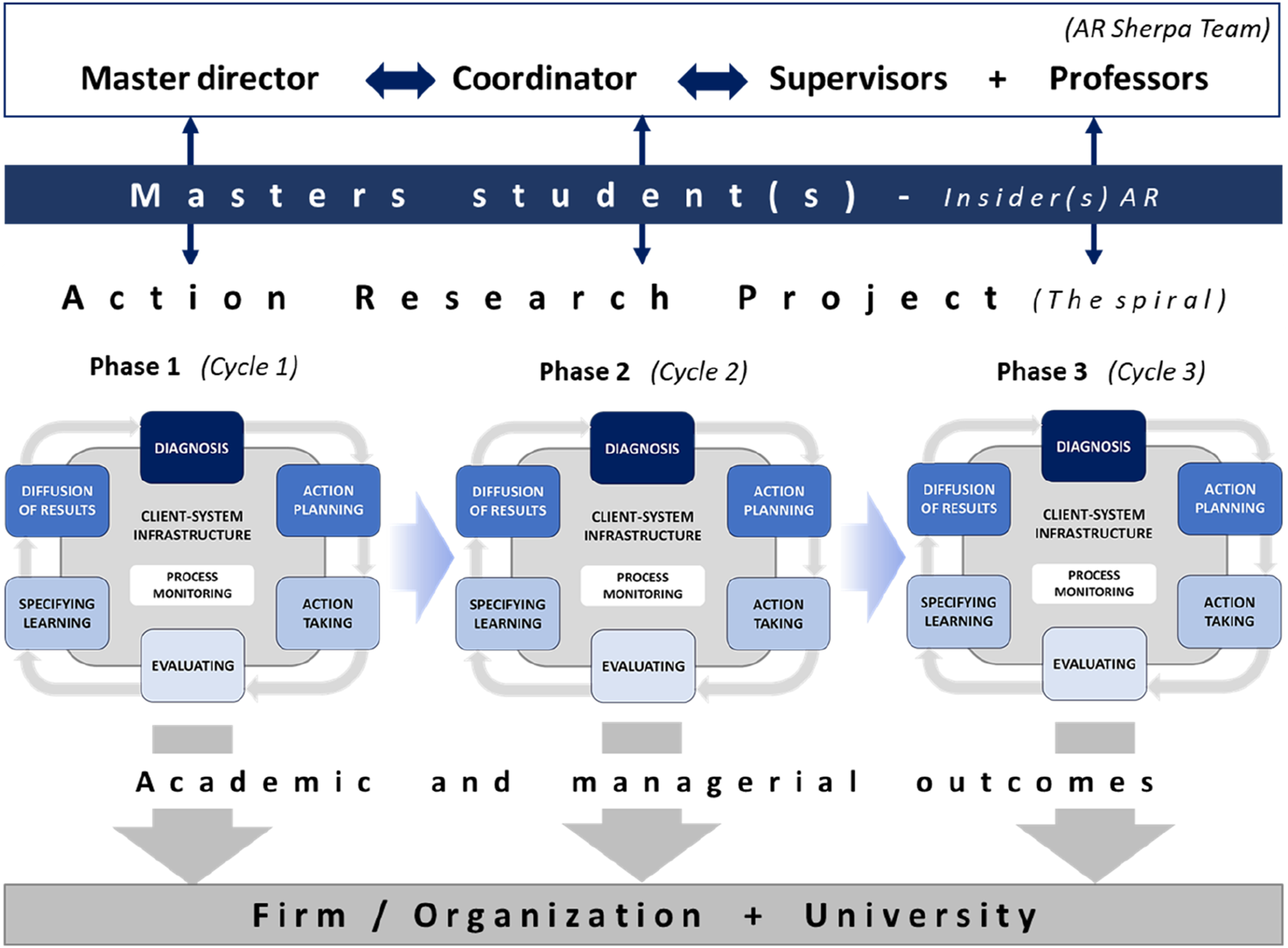
In this context, the individual factors become more complex due to the interaction of more people (AR Sherpa Team) who support the academic and the coordination of the process. They interact across several cycles within the AR spiral, each of which generates results for the organization and the university.
The articulating axis of this dynamic is the AR process, composed of cycles, spirals, and projects. The cycles have five stages, plus the results diffusion stage added by Avella and Alfaro (2014), the client system infrastructure proposed by Susman and Evered (1978), and the system monitoring proposed by Coughlan and Coghlan (2002), as shown in Figure 3. AR project’s cycles. Source: Based on Avella and Alfaro (2014), Susman and Evered (1978) and Coughlan and Coghlan (2002)
Likewise, these cycles are connected in a sequence called the spiral of AR cycles, or in a more dynamic version, the action research cycle reloaded (Maestrini et al., 2016), because this articulates the different types of AR proposed by Chein et al. (1948) as they are AR diagnostic, empirical, participatory, and experimental. Finally, when there is a certain intention and a long-term process, all these components can be integrated into an AR Project (ARP), as a particular practice within AR methodology. According to Mejía-Villa and Alfaro-Tanco (2017, p. 195), an ‘ARP is a broad concept that includes and interrelates, in a flexible way and different moments, diverse AR types, cycles of AR stages and research methodologies under a particular spiral of cycles to get a general aim. Thus, the types of AR process act like big phases or long-time periods under which several cycles can be developed’.
In the context of an ARP applied to a part-time master’s thesis, students are executives of firms or organizations. Therefore, they maintain their role as co-constructors (Kemmis, 2009) and acquire the role of insiders AR for developing their thesis project in the same organization where they work daily (Morales-Contreras et al., 2024). Thus, Rynes et al. (1999) affirm that the insider AR context is the strategic and operational environment that executives face in their managerial work. For this reason, Coghlan (2007, p. 294) confirms that the business field is suitable for research in AR, stating that ‘issues of organizational concern, such as systems improvement, organizational learning, the management of change and so on are suitable subjects for AR, since (a) they are real events which must be managed in real time, (b) they provide opportunities for both effective action and learning, and (c) they can contribute to the development of the theory of what really goes on in organizations’. It should be noted that although this insider AR proposal by Coghlan (2007) is for PhD students, it is possible to adapt it to master’s students by understanding their context and particularities.
Within these particularities lie the personal and professional needs and expectations of master’s students, who seek to grow and advance professionally within their organizations or sectors while increasing their knowledge and developing new skills. Likewise, the program’s characteristics, such as its curriculum, learning assessment, study and research methodologies, schedules, and thesis process, among others, constitute rules of the game to be followed. It is a system in which the insider AR and people who support him/her at the university and the company will be immersed and must be respected during the study period.
Susman and Evered (1978, p. 588) called this infrastructure ‘client system ', which is the social system in which the members face problems to be solved by AR. It may be one of the face-to-face groups, an organization, a network of organizations (Trist et al., 1977) or a community’. According to this, the monitoring task proposed by Coughlan and Coghlan (2002) has great importance since it will coordinate the client-system infrastructure (for a better understanding, review Figure 3). All this dynamic is articulated under an ARP that, according to Mejía-Villa and Alfaro-Tanco (2017), corroborates that AR is a meta-methodology that, as an umbrella, coexists with other quantitative and qualitative methodologies (Erro-Garcés & Alfaro-Tanco, 2020). According to them, various research methodologies can be articulated in the different phases and cycles of the ARP. Specifically, for a master’s degree in innovation management, an ARP is an open, collaborative innovation practice between universities and industry that develops applied research through a coordinated system, proposing and implementing novel, resolutive, well-elaborated, and synthesized solutions for organizations (Besemer & Treffinger, 1981). For this reason, many methodologies that complement AR in this context draw on creativity, innovation, strategy, and design, among other disciplines. Some examples of these methodologies include Creative Problem Solving (CPS) (Puccio et al., 2005), Design Thinking (Brown, 2008), Design-driven Innovation (Verganti, 2009), Theory of Inventive Problem Solving (TRIZ) (Mann, 2001), and Stage-Gate (Cooper, 2008).
For the MIM program, the complementary methodology in the ARP phases is the CPS. In some cases, students used some of the models mentioned above in the last ARP phase. The CPS is a creative process originally proposed by Osborn (1953). Its latest version, presented by Puccio et al. (2005) is called the ‘CPS: The Thinking Skills Model’ (CPS: TSM). It comprises three major stages (clarification, transformation, and implementation) containing seven steps (from Assessing the Situation to Formulating a Plan). Additionally, each step involves specific thinking and affective skills to facilitate the process (Figure 4). Creative problem solving: the thinking skills model (CPS: TSM) (Puccio et al., 2011, p. 47)
Methods
This research carried out a case study approach and applied a mixed design with multiple data sources, which increase the reliability and internal validity of the results (Yin, 2018). Data were collected from two surveys, a focus group, the analysis of relevant documents from the master’s program, and several coordination meetings and informal discussions with directors and students. Finally, to have a complete picture of the research, the diverse sources of information were triangulated (Denzin, 1978; Jick, 1978).
Regarding surveys, the researchers designed two questionnaires using a Likert scale: one for students and the other for thesis supervisors, based on their expertise and the literature review of the AR methodology. The student questionnaire included 25 items grouped into four sections: general information, development of the master’s thesis, general comments, and concluding remarks. The questionnaire for supervisors included 31 items grouped into six sections: the same four as the students’ questionnaire, plus sections on ARP and CPS methodologies, and another on the deliverables for the Professional Practices and Final Project I and/or II subjects. The surveys were administered from March 2023 to January 2025. In total, 96 students and 18 master’s thesis supervisors were invited to participate. Finally, the response rate was 100% for supervisors and 62.5% for students.
The focus group was carried out with eight master’s thesis supervisors and the Coordinator of Professional Practices and Final Project (CPFP) subjects. This activity aimed to gather supervisors’ opinions on their experiences with their supervised students. Supervisors were asked to discuss the lessons learned from developing their students’ ARPs and identify opportunities for ARP improvement.
The authors conducted the documentary analysis. It included mainly diverse sources: qualified registration documents for the master’s degree in innovation management, master’s degree databases, the general guidelines for the AR course, the Professional Practices, and Final Project I and II, and the final documents of the thesis. The document analysis follows the steps of skimming, reading, and interpretation (Bowen, 2009). Finally, to complement the data used for this study, researchers also consider information gathered from coordination meetings and students’ informal opinions on the development of their master’s thesis.
Data Validity and Reliability
To ensure the validity and representativeness of the results, all participating supervisors and students were given equal access to the survey instrument. The survey was implemented using Google Forms, chosen for its compatibility with mobile devices and ease of use. In addition, clear information was provided about the study’s objectives, data confidentiality, and the voluntary nature of participation. To mitigate non-response bias among supervisors, the form was sent a second time by email, and they were reminded verbally during regular meetings. Likewise, an additional period of time was allowed to facilitate their participation. For students, a follow-up strategy was implemented that sent the survey twice per semester via institutional email. These mailings were reinforced with reminders sent via WhatsApp groups established for each cohort at various points during the academic period. The objective of this strategy was to maximize the response rate without putting undue pressure on participants, respecting their time and academic workload. An extension was also offered to complete the questionnaire. This comprehensive approach reduced the risk of non-response bias and strengthened the quality of the data collected.
The validity of the focus group was ensured through a rigorous methodological design that included strategic participant selection, clearly defined objectives, and systematic analysis. Participants were selected for their experience supervising degree projects, which enabled the collection of informed, relevant perspectives on the educational process. To ensure data credibility, a validated semi-structured guide was used, and the session was moderated by two researchers, fostering an atmosphere of openness and reducing opinion bias. During the discussion of the guiding questions, thematic saturation was evident, as the participants agreed on the key themes without any new categories emerging. This confirmed that the central aspects had been sufficiently explored, strengthening the consistency and reliability of the qualitative findings. Additionally, the focus group was recorded with informed consent, and its subsequent analysis enabled a deep, coherent interpretation of the findings.
To classify the innovations developed in the degree projects, we used The Ten Types of Innovation model proposed by Keeley et al. (2013), which served as a conceptual framework for defining the coding criteria. Initially, one of the researchers systematically applied the defined criteria to 100% of the projects analyzed. Subsequently, a second researcher—an expert in innovation—reviewed all the initial coding, identifying discrepancies that were discussed and, when necessary, adjusted by consensus. It should be noted that when comparing the codings, 90% agreement was found, indicating a high level of consistency in the application of the criteria. It should be noted that although a statistical coefficient such as the kappa index (κ) was not calculated, this collaborative process ensured the reliability and consistency of the analyses.
Finally, to strengthen the internal validity of the study and enrich the interpretation of the findings, methodological, data, and researcher triangulation was applied (Creswell, 2009; Denzin, 1978). Methodological triangulation combined qualitative (focus group) and quantitative (survey) techniques, allowing the phenomenon to be approached from different perspectives. Data triangulation integrated the final thesis documents, the results of the surveys administered to students and supervisors, and the focus group conducted with supervisors and the thesis coordinator. Finally, researcher triangulation was achieved through the classification of innovations and joint data analysis, in which the study’s researchers actively participated. This triangulation exercise contributed to a more robust, coherent, and contextualized interpretation of the results.
Results
We hereby present the research findings from four distinct perspectives: (i) an elaborate depiction of the management and structure of the ARP as a research methodology for MIM program, (ii) a description of the profiles of academics and students involved in this process, (iii) an overview of the outcomes derived from the ARP process, and (iv) an evaluation of the progress and coordination of the AR process, its participants, and its outcomes.
The Management Process of the Action Research Projects in the Master’s Theses
Phases Description of the Master’s Thesis as an AR Project

The AR process begins from the first day of classes as students learn the fundamentals of creativity and innovation, the CPS process, market research, and data analytics, among others. This knowledge and these skills help them tackle Phase 1 (diagnostic) of the ARP, which takes place in the AR course at the end of the first semester. In this class, they receive basic training in applied research, including its qualitative and quantitative methods and techniques. In addition, they must conduct an innovation diagnosis within the organization they choose. Specifically, the focus is on defining (i) a specific problem that requires innovation to solve it and (ii) identifying strategic problems that require management of innovation in this organization. Solving the first problem creatively and collaboratively is the objective of Phase 2 (participative) of the ARP (second semester), while proposing a new or improved model for innovation management is the objective of Phase 3 (participative) of the ARP (third semester). It is important to mention that Phase 2 aims to develop the Creative Leadership capacity, while Phase 3 aims to develop their capacity to manage innovation.
In AR class, students recognize AR as a meta-methodology that, in an ARP scheme, serves as a general guide (umbrella) for the three phases of their thesis. In the middle of this course, the CPFP assigns an expert professor who knows the type of innovation required and/or the sector of the chosen organization to advise students in writing their diagnostic document for ARP Phase 1 (see Figure 5). Master’s thesis processes driven by AR
In the second semester, Phase 2 of the ARP is developed in a participatory way because it seeks to implement a creative solution that arises from co-creation among students (insiders in AR) and teams from their organization, as well as from research on the problem being analyzed. To guide this dynamic, the CPFP assigns the experts from the previous phase as Supervisors of Professional Practices and Final Project for each thesis. This innovative process occurs within the framework of the Creative Leadership for Professional Practice class. Here, students act as ‘consultants’ who lead and facilitate the innovation process. However, since they are experiencing an ARP, they must simultaneously research to apply new knowledge to the innovative solution and create knowledge from this experience. Consequently, they attend the Final Project I class in parallel, where they act as ‘researchers’ by stating the research questions and objectives, building conceptual frameworks, describing the development of the CPS, and presenting the results and conclusions. In summary, they write a progress document for their ARP that describes Phases 1 and 2 in detail.
In the third semester, students carry out Phase 3 of their ARP in a participatory manner, with the support of the same director previously assigned to them. The objective of this phase is to propose a new or improved innovation management model for the same organization or a specific area within it. For this purpose, in the Professional Practice of Innovation Management class, students (as consultants) develop the CPS methodology or another innovation methodology in collaboration with the organizations’ teams. At the same time, in the Final Project II class, students (as researchers) analyze academic and practical models of innovation management that can feed into the design of the model to be proposed in the organization. Finally, they synthesize all this in the final thesis document, which includes the three ARP phases.
The process of feedback and evaluation of learning is constant during the three semesters. To achieve this, multiple teachers support students with advice and feedback on their innovations and models. Regarding the evaluation of the ARP, the AR class is evaluated by its two teachers, the courses of Professional Practices and Final Project I are reviewed by the supervisors of Professional Practices and Final Project, and Final Project II is evaluated by two external expert juries who the CPFP assigns to assess the final oral and written presentation of the thesis that includes the three phases of the ARP.
Human Talent Interacting in the Master’s Degree
The program has a group of 18 directors who support students in developing their two professional practices and the final projects I and II. In general, 61% are male, of whom 36% studied a bachelor’s in business administration, 82% have completed a master’s degree, and 45% have teaching as their main activity. Regarding females, we found that 29% are industrial engineers, 57% hold master’s degrees, and slightly more than half are engaged in university teaching. These data show that directors are not only trained in organizational issues but are also connected to the business world, which is very valuable for students.
Regarding the characteristics of the master’s degree students who have completed Phase 2 and Phase 3 of the ARP (96 in total), 68% are female, and 32% are male, with average ages of 34 and 39 years, respectively. We also identified that slightly more than 70% of them studied careers in management and engineering and work as middle managers, serving as directors or coordinators in companies across banking, insurance, technology, telecommunications, health, and education. It is interesting that 74% of men and 83% of women have between 5 and 20 years of work experience, which is key to the development of their master’s thesis.
Outcomes of the AR Process in the Master’s Degree
Synthesis of Phase 2 Results Proposed by Students-Insiders AR

Source: Table by authors.
aBased on (Keeley et al., 2013), the Total number of master’s theses: 59
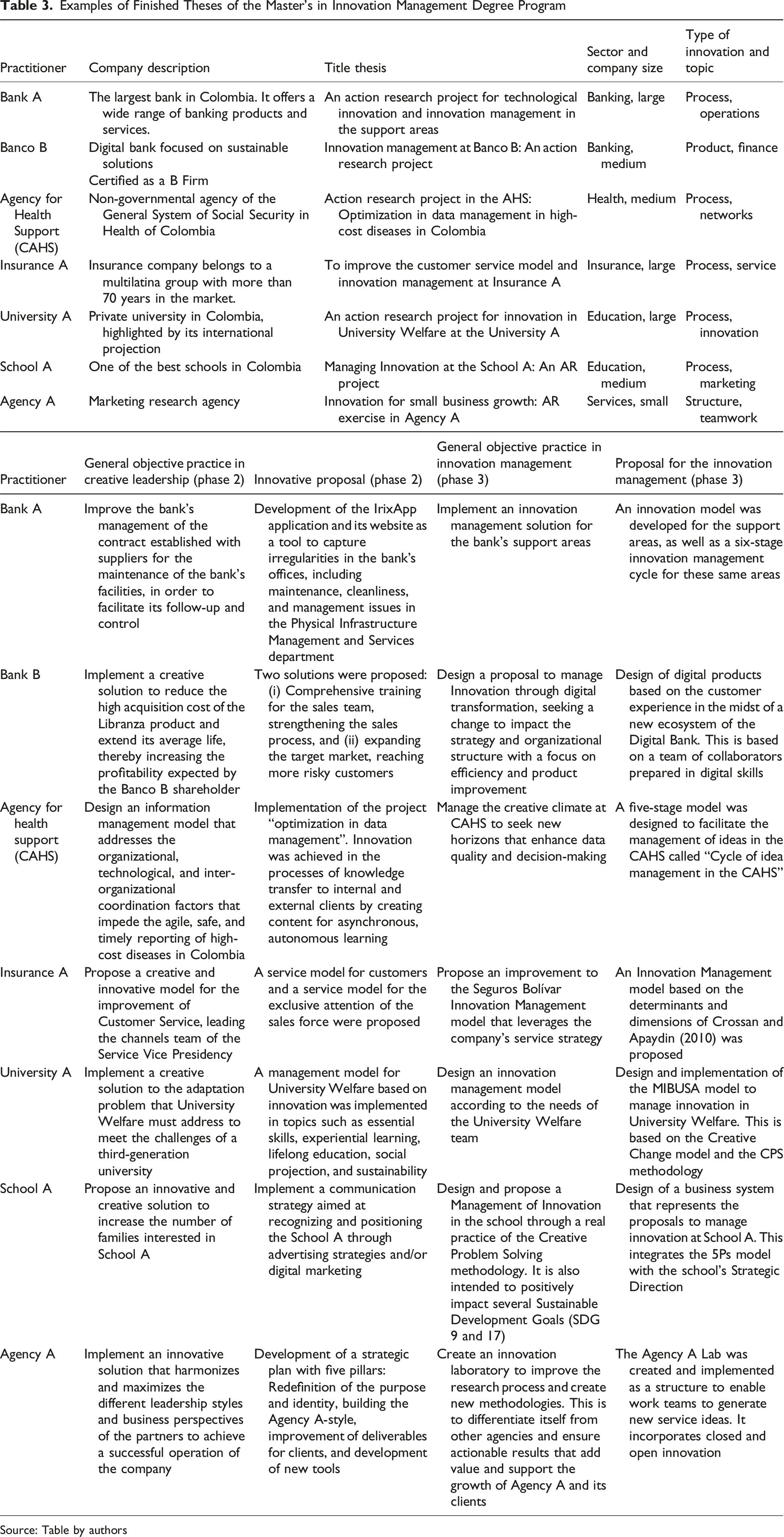
Examples of Finished Theses of the Master’s in Innovation Management Degree Program
Source: Table by authors
Our analysis reveals that 61% of the proposed solutions comprised process innovations that found applicability across diverse sectors, including commercial, digital, operational, and service, among others. Additionally, a significant category emerged: product innovations, encompassing the introduction of novel financial, digital, training, and packaging products. These inclinations towards innovation in processes and products can be attributed to students’ areas of expertise (mainly management and engineering) and, in most cases, to their operational responsibilities as middle managers. To provide further insight and evidence for the creation of knowledge mode 2, we have included some examples of phase 2 innovations in Table 3.
Out of the 59 current theses, we have observed that 43 have successfully completed phase 3. This is because a group of students has completed the three semesters of the program (phase 3 of ARP), while another group is studying the second semester (phase 2 of ARP). Upon thorough analysis, we have discovered that the proposed innovation management models primarily revolve around innovation management models, innovation culture models, process models for transforming problems into innovative projects and solutions, as well as innovation laboratories that serve as spaces for team reflection and idea generation. These models, in general, have been constructed based on creativity models such as the Creative Change Model (Puccio et al., 2011) and the CPS. However, they have also incorporated other models, such as the Dimensions and Determinants of Crossan and Apaydin (2010), Design Thinking (Brown, 2008), Lean Startup (Ries, 2011), Agile Management (Walter, 2021).
An Overall Reflection on the Progress and Coordination of the AR Projects
Feedback on the Management of the AR Process, Participants, and Outcomes

Min.: Minimum/Max.: Maximum/Avg.: Average/SD: Standard Deviation/ARP: AR Project/CPS: Creative Problem SolvingTotal surveyed: 18 Directors/Supervisors & 96 Students. Response rate: 100% and 62.5%, respectively
Source: Table by authors
In general, we found that the patterns of both evaluations are similar, and the average scores are above 4.0 in most cases. However, the standard deviation is high, indicating that the scores are more spread out from the mean. Overall, the two aspects most valued by the directors are the support they receive from the CPFP (4.8) and the use of the ARP to deliver practical solutions to the companies where their students develop their theses (4.6). For their part, students consider that the support they receive from their direct bosses (4.4) and from the company (4.2) in developing the ARP are the most valuable aspects and are therefore the best evaluated.
Regarding the difference in perception between students and supervisors on the contribution of AR to solving company problems (supervisors 4.5 and students 3.9), we consider this occurs by supervisors give more value to the solutions developed by students due to the experience as AR Sherpas but also because they give more value to the U-I relationship, while students are beginning to apply ARP as practical research to solve organizational problems. On the other hand, the low score (3.5) from students and supervisors on the promotion/recognition of students in their companies may reflect the fact that job promotions are a medium-term process. At the same time, the results of each phase of the ARP are immediate. Additionally, since some students develop their ARP in pairs, one of them is not recognized in his/her own company. Finally, it is important to note that both supervisors and students consider that the application of ARP not only helps solve real societal problems but also enables the generation of new knowledge.
Discussion, Lessons, and Future Research Agenda
This research is aligned with the future agenda proposed by Shani and Coghlan (2021), who pointed out that the emerging areas of AR applied to business and management were: (i) new ways to work using innovative methodologies (design thinking and agile), (ii) innovation leadership and leadership capabilities, and (iii) new ways of organizing and conducting the research process. Likewise, this investigation considers the success factors proposed by Shani and Coghlan (2021) and Alfaro-Tanco et al. (2023) (mentioned in the theoretical background section) but applied to the master’s thesis context. Finally, this proposes new insights for the AR methodology.
Characteristics of an AR in the Context of a Doctoral Thesis Versus a Master’s Thesis

Source: Table by authors
With respect to institutional factors, a significant portion of the responsibility lies with the master’s program leadership, which oversees the curriculum and supplementary educational endeavors that run parallel to the research line. This differs from the doctoral context, where the supervisor assumes a central role in all aspects. In contrast, in the master’s program, the student, acting as an insider AR, assumes the primary responsibility in managing the relationship with the firm or organization. Due to the expedited nature of the master’s process, there is limited interaction between the supervisor and the external organization.
From the perspective of the individual factor, students as insiders AR tend to prioritize practical experience and solutions over knowledge generation. At the same time, supervisors focus on supervising multiple students, which requires faster assistance within a less flexible curriculum. For this reason, the second lesson concerns the formation of an “AR Sherpa Team” comprised of supervising professors well-trained in the AR methodology, with excellent relationships with students, processes, and ARP infrastructure. In parallel, the third lesson is the creation of a General Coordination of the ARP Process, supervised by a professor or administrator who facilitates and fosters collaboration and relationships throughout this process. With this, we corroborate the importance of the Client-System Infrastructure and the Monitoring Process in the management of AR cycles, proposed by Susman and Evered (1978) and Coughlan and Coghlan (2002) respectively. Given the differences between the contexts of doctoral and master’s programs, we can affirm that while the research process differs significantly in terms of focus, scope, time, and effort expended, it does not necessarily differ in terms of the quality and novelty of the research and solutions implemented.
From the perspective of generating organizational solutions, the fourth lesson is the application of ARP in master’s theses, which proves to be effective, as evidenced by the outcomes observed in phase 2 of the 59 theses completed to date. Additionally, this effectiveness is further demonstrated by the 43 innovation management models proposed for the companies involved in the research, which have progressed to phase 3. The impact of ARP is particularly pronounced in a program like MIM, which combines ARP with CPS, as this innovation methodology begins with problem identification and ensures the collaborative design and implementation of novel, useful, well-developed, and synthesized solutions. According to this, the fifth lesson is that AR as a meta-methodology fits very well with methodologies, practices, and tools from the fields of creativity and innovation because they present similar working styles, agile action frameworks, complement each other, and share common steps. Likewise, a sixth lesson emerges from the discovery that AR develops creative leadership capacity (Puccio et al., 2011) in MIM students, as evidenced by the positive results presented in the subjects of Creative Leadership Practice and Innovation Management Practice, and as Shani and Coghlan (2021) proposes as a future challenge for AR.
Furthermore, it is noteworthy to highlight the creation of actionable knowledge, specifically Mode 2 (Coghlan, 2007), which enables organizations to acquire knowledge and enhance their capabilities in agile and team-based work. Thus, the seventh lesson is that the application of ARP in master’s theses not only facilitates the creation of actionable knowledge (mode 2) but also its transfer from the academic realm to organizations through student insider AR. However, it is important to note that the knowledge generated is not strictly scientific (mode 1 knowledge), but rather specific and applied in its focus. In light of this, within the framework of the ARP for master’s theses, we propose an eighth lesson, which is the establishment of a novel type of AR cycle named ‘Reflection and theoretical development’ (see Figure 6), which complements the four types proposed by Chein et al. (1948). This cycle would involve research professors, either individually or in collaboration with students (who would likely be program graduates at that point), undertaking research using the Grounded Theory methodology (Glaser & Strauss, 1967). This approach would enable the development of general theories derived from the collective cases of ARP projects undertaken by students (Teram et al., 2005; Wastell, 2001). In this scenario, the ARP process, which is standardized within the master’s research field, would serve as a valuable source of information comprising comparable case studies conducted within the same domain of knowledge and highly similar contexts. Furthermore, this new AR cycle could also incorporate the use of the Case Study methodology to disseminate successful business cases that have emerged from the research efforts of the students (Avella & Alfaro, 2014). Traditional AR cycles complemented by a new AR cycle based on reflection and theoretical development
For emerging countries, particularly in Latin America, the ninth lesson is the application of ARP in master’s theses as an alternative and effective mechanism for the transmission, assimilation, and creation of new knowledge within companies. This is because companies sponsoring the studies of their executives can benefit not only from the knowledge acquired by the student (insider AR), as an individual, but also from the knowledge and methodologies assimilated by the teams within the organization who participate in that executive’s master’s thesis.
Future research endeavors should aim to deepen further our understanding of the impacts of ARP in master’s theses on organizations. Comparative research could be conducted, comparing traditional research methodologies employed in master’s theses with the implementation of ARP in master’s theses. Another avenue of research could explore the complementary relationship between ARP as a meta-methodology and other research methodologies and tools. Subsequently, it would be valuable to analyze the impact of master’s ARP on the professional development of students who have experienced it.
Cross-Context Adaptation
Likewise, it is important to highlight the necessity to explore the contrast of perceptions of different actors (e.g., students, supervisors, bosses, support teams, program directors, etc) involved in the development of an AR. Finally, to strengthen the evidence of the long-term value of AR, it is proposed that future studies track the professional outcomes of ARP graduates. These outcomes could include career advancement, leadership appointments, and measurable organizational impact. By systematically documenting these trajectories, researchers can better demonstrate how AR contributes not only to academic development but also to meaningful change in professional settings (Court & Greenwood, 2025; Durán-Díaz, 2023; Guertler et al., 2019, 2020; Kiong Tee & Yee Chia, 2025; Miller, 2017; Vergi & Meristo, 2025) it is possible to find that all of them share the basic structure of AR (planning, action, and reflection) and manage to generate academic knowledge (theoretical frameworks, publications, reflective theses) while applying solutions in educational practice (Miller, 2017; Vergi & Meristo, 2025), organizational practices (Court & Greenwood, 2025; Guertler et al., 2019, 2020), and territorial practices (Durán-Díaz, 2023). In all of these, the gap between academic knowledge and professional practice is bridged through collaboration between stakeholders. Therefore, these not only develop theory but also implement solutions, such as pedagogical innovations, community projects, and business solutions. They have a common objective: the transformation of practices such as improving teaching (Miller, 2017; Vergi & Meristo, 2025), optimizing innovation processes (Guertler et al., 2019, 2020), strengthening territorial governance (Durán-Díaz, 2023), or developing leadership (Court & Greenwood, 2025).
Cross-Analysis of AR Experiences

Conclusions
The objective of this research was to present insights and lessons learned on the potential of AR methodology applied to the management of master’s thesis processes, for resolving organizational problems and generating new knowledge. Through a case study conducted at a university in Colombia, we have addressed this knowledge gap by investigating perceptions and interactions between students and supervisors involved in master’s theses that employed AR to tackle issues in their respective companies. Based on our findings, we present four significant conclusions.
The first conclusion pertains to the AR methodology for solving real organizational problems and to knowledge transfer. Our results reveal that the inclusion of AR methodology in a master’s thesis contributes to resolving organizational challenges by creating actionable knowledge (mode 2). This is facilitated by direct knowledge transfer from the classroom to the organization, with the master’s student-insider AR serving as the catalyst and champion. Furthermore, for successful knowledge transfer, it is crucial to consider the socio-economic characteristics of the context. As indicated in the results section, master’s students are often experienced professionals holding leadership positions in their respective companies/organizations, therefore facilitating organizational change via AR.
The second conclusion focuses on the potential of AR for actionable knowledge (mode 2) generation. Our findings demonstrate that the rigorous analysis of a group of master’s theses can contribute to the expansion of the scientific literature on AR. Since master’s theses encompass various topics and students work in diverse business sectors, the approaches employed by students for each specific case, when aggregated by sector or knowledge field, can pave the way for future research into different dimensions of the AR methodology. In other words, the scientific study of master’s theses might lead to the development of new conceptual frameworks, processes, methodologies, and other contributions, indicating that AR is an even more fertile research area than previously expected.
The third conclusion allows us to affirm that the AR methodology, with its combination of academic and practical results, offers a powerful tool for bridging the gap between academia and other organizations present in its ecosystems, which allows universities to evolve toward collaborative and co-creation models, such as fourth-generation universities (Bogers & Steinbuch, 2023; Oztel, 2020).
Finally, a fourth conclusion about the practical application of ARP in master’s programs arises from the understanding that, in Colombia and Latin American countries in general, master’s students are older (on average, 36 years old). In addition, these are part-time programs in which all students work to pay for their studies. Likewise, the students are insiders, which facilitates the development of ARP. This contrasts with the European context, where master’s degrees usually last one year, are full-time, and students are on average 23 years old, recent university graduates, unemployed, or with minimal work experience. This situation makes it challenging to implement the ARP, as they do not work, the master’s degree is short, and they do not have an environment in which to apply the ARP. However, in European and American executive MBA programs (part-time and two years in length), as well as in master’s degrees in the health field, students study for two years and remain interns in health institutions. In summary, the key variables are the student’s role within the company, their job stability there, the company’s approval for them to carry out the ARP there, and the duration of the academic program, since the application of AR requires time.
Limitations
Similar to other studies, this research has some limitations. First, the data on the implementation of innovations was obtained from the final documents of the students’ theses, which may involve perception biases. To validate these findings, a longitudinal follow-up study of each case would be advisable to confirm the actual degree to which the proposed solutions were implemented.
Second, the replicability of the thesis development model using the ARP depends on the profile of the students and the master structure. Participants in this master’s program are professionals with work experience who work full-time. This limits their availability to attend classes but enables them to implement the ARP within their own organizations. Conversely, young students without professional experience or connections may find it more challenging to apply this model. This characteristic restricts the transferability of the approach to other educational contexts. However, a viable alternative would be to establish university–business partnerships that facilitate these students’ access to organizations where they can develop their projects and contribute to solving real-world problems.
Finally, the integration of CPS and ARP development requires methodological sequencing and a minimum execution time for divergence and convergence activities, which enable solutions to be found for the studied problems. However, this requirement does not always align with the urgent dynamics of organizations. One possible solution would be to adjust the duration of the master’s program, allowing students to devote more hours per week to their academic training and thus be able to advance more quickly in the development of their projects.
Glossary
Action Research
It is a term used to describe a family of related approaches that integrate theory and action with a goal of addressing important organizational, community, and social issues together with those who experience them. It focuses on the creation of areas for collaborative learning and the design, enactment, and evaluation of liberating actions through combining action and research, reflection, and action in an ongoing cycle of cogenerative knowledge (Coghlan & Brydon-Miller, 2014).
Action Research Project (ARP)
It is a broad concept that includes and interrelates, in a flexible way and different moments, diverse AR types [diagnostic, empirical, participatory, experimental], cycles of AR stages [diagnosing, action planning, action taking, evaluating, specifying learning], and research methodologies under a particular spiral of cycles to get a general aim. Thus, the types of AR processes act like significant phases or long-time periods under which several cycles can be developed (Mejía-Villa & Alfaro-Tanco, 2017, p. 195).
Creative Problem Solving (CPS)
It is a model designed to capture the essence of the creative process. Using this approach, creative thinking can be deliberately applied to resolve open-ended problems. CPS is a structured methodology that is used to enhance creative thinking in individuals and teams (Puccio et al., 2006, p. 20).
Mode 1 Knowledge
It refers to that knowledge that is mono-disciplinary and purely academic (Nowotny et al., 2001).
Mode 2 Actionable Knowledge
It refers to that knowledge that is multidisciplinary and is focused on solving complex and relevant societal problems (Nowotny et al., 2001).
AR Sherpa Team
A team of supervising professors with extensive training in AR methodology, recognized for their strong rapport with students and their comprehensive understanding of the processes and infrastructure involved in AR Projects (Mediavilla et al., 2025).
Footnotes
Acknowledgement
We are grateful for the active participation of the students and professors of the Master’s Program in Innovation Management at Universidad de La Sabana, especially Professor Jaime Humberto Martínez, General Coordinator of the Professional Practices and Final Project of the program. We also thank to the International School of Economics and Administrative Sciences for giving us the time and resources necessary for the development of this research.

Ethical Considerations
The Research Subcommittee of the International School of Economics and Administrative Sciences – EICEA (Universidad de La Sabana) authorized a formal research project through Act No. 085 on May 10, 2023. The committee, which is composed of research group directors, evaluated the project’s relevance, academic quality, and ethical aspects.
Consent to Participate
All the professors who participated in the focus group gave their informed consent when they accepted the invitation and again at the beginning of the activity. The students who participated in the survey also gave their consent at the beginning of the online questionnaire.
Funding
The authors disclosed receipt of the following financial support for the research, authorship, and/or publication of this article: This work was supported by the Universidad de La Sabana under the Project “Relación entre estrategia, innovación, sostenibilidad e industria 4.0 en organizaciones en países de economías emergentes” EICEA-155-2023.
Declaration of Conflicting Interests
The authors declared no potential conflicts of interest with respect to the research, authorship, and/or publication of this article.
Data Availability Statement
The datasets generated during the current study are not publicly available due to confidentiality stated in the informed consent authorized by participants.