




Abstract
This study contributes to the call for more reflexive accounts of arts-based participatory research by offering an in-depth account of the backstage processes of participatory video (PV) research projects with older adults. Drawing on two projects involving older adults in the context of research on age-friendly cities, we investigate how different film roles influence power dynamics within participatory video research. Using a responsive evaluation approach, we analysed various forms of data, including field notes, notes of group reflections, and focus groups transcripts. Our findings show that flexible film roles on the one hand, such as camera operator, interviewer, editor, or overall member of the film crew, offered diverse and meaningful pathways for engagement. Communicative spaces were fostered by flexibility, playfulness, and relational responsiveness. However, these same roles also introduced new power dynamics. Film roles carry specific associations of skill, talent, ascribed attributes, and authority, enabling co-researchers to negotiate power and to amplify voices in distinct ways, while marginalising and silencing others, within and beyond the group. Where art-based participatory research often (implicitly) claims or suggests to represent “the voices” of the communities involved, power imbalances undermine the legitimacy of such representative claims. This can have far reaching implications when the output of such projects inform public policy, advocacy and quality improvement, and this can contribute to epistemic injustice. We argue that in order to navigate these power dynamics participatory video research requires attentiveness to power, needing situated work and reflection throughout the process.
Keywords
Introduction
“We rented a van for the nine of us; our film crew consisting of seven co-researchers- older adults who are learning to make their own film- and two academic co-researchers. “All of us, packed together inside this little van, it cannot get any crazier” I (the first author) say, as I enjoy this shared moment of adventure. Margaret, a 85+ year old woman, responds with a big grin on her face: “Well, it can never be too crazy for me!”. We all laugh, as we approach the community housing initiative the group selected to visit for our participatory research about meaningful ageing. We help each other get out of the bus. Albert immediately sees something he wants to capture on camera. “Look at this inviting space… how can one be lonely here? Get the iPads out.” I distribute them; Joyce, Wilma, and Albert take one. Albert steps fluently into his roles as director, cameraman and co-researcher: “The camera rolls, everyone, shhh!” he yells, as he starts filming.”
Although a nice shared moment within a group of co-researchers, the exclamation “The camera rolls, everyone, shhh!” does shine a light on a core tension in participatory research. The exclamation “everyone!”, suggests inclusion and a call for action, as often linked to participation (Urbaniak & Wanka, 2023). However, the immediate “shhh!” reflects a power dynamic where voices can be silenced. In this article this tension will be explored.
As cities across the globe grapple with rapidly ageing populations, the need to develop age-friendly urban environments becomes increasingly urgent (van Hoof & Marston, 2021; World Health Organization, 2007). To develop environments that are inclusive and responsive to the needs of people as they age, participation of older adults in policy, practice and research is essential (Buffel, 2018; van Hoof & Marston, 2021; World Health Organization, 2007).
Across disciplines participation is now recognised as a cornerstone for more inclusive and responsive systems and environments (Abma et al., 2019; Buffel, 2019; Fischer et al., 2021; Sanoff, 2011; Slager & Tavy, 2024; Tavy et al., 2022; van de Bovenkamp, 2024; van Hoof et al., 2021). Recent scholarship has expanded to include older adults not only as informants, but as co-researchers within participatory projects (Barrie, 2023; Buffel, 2018; Groot & Abma, 2022; James & Buffel, 2022; Urbaniak & Wanka, 2023; Wood et al., 2022). Participation in research and policy-making is positioned as a way to strengthen democratic legitimacy, improve policy relevance, and create more equitable and inclusive systems (Sanoff, 2011; Teunissen & Abma, 2010).
Despite this growing emphasis, significant challenges remain in ensuring meaningful participation, particularly for older adults who often remain underrepresented in participatory research (Urbaniak & Wanka, 2023). Although participatory research aims to be inclusive, it risks tokenism, often positioning older adults as contributors rather than equal partners (Corrado et al., 2019; James & Buffel, 2022). For participation to be meaningful, the perspectives of people involved need to be of influence in the decision-making process (Dedding & Slager, 2013). As Fricker (2007) argues in her work on epistemic injustice, genuine knowledge production must engage the perspectives of those the research is intended to serve. Ensuring meaningful participation requires, amongst others, approaches and processes that allow individuals to engage on their own terms, allowing for different modes of expression and contribution (James & Buffel, 2022).
“The Camera Rolls, Everyone, Shhh!!”
Participatory video (PV) can be a promising approach in this regard (von Faber et al., 2020). Here members within a community create their own films, thereby enabling them to narrate their stories from their perspectives. By incorporating a range of roles, such as camera operation and interviewing, this method offers pathways for people to engage in various ways and provides a means for sharing diverse positions without relying solely on verbal articulation of perspectives (Lunch & Lunch, 2006). This can increase the inclusiveness of participation. However, based on our study we show that power dynamics also play a role in such projects, which are partly related to these roles. These power dynamics shape which voices are heard and how the filmed narrative is constructed. While PV creates opportunities for inclusion, it also needs work and ongoing reflection on power relations, as these shape decision-making processes and can result in exclusion.
This paper explores the dual role of participatory filmmaking as both an inclusive approach and a space where power relations emerge and shift and voices can be amplified or silenced. Drawing on two PV projects involving older adults in the context of age-friendly cities, we investigate the following research question: How do different film roles influence power dynamics within participatory video research with older adults?
Theoretical Background
While participation has become a popular paradigm in research and practice, it often masks uneven power relations. Traditional participatory projects are often designed in a way that demand specific competencies, such as articulating opinions in formal meetings, which unintentionally excludes people (van de Bovenkamp et al., 2013; van de Bovenkamp & Trappenburg, 2009). Moreover, power dynamics within these participation processes can exclude certain voices or knowledge that is considered less relevant by dominant actors involved (van de Bovenkamp, 2024). This raises questions about whose voices are prioritised and underscores the necessity of tailoring participation processes to the needs of marginalised groups, including those in vulnerable circumstances (Goedhart et al., 2021). As scholars argue, research design should prioritise inclusion and flexibility to meet the diverse needs of participants (Fischbein et al., 2024) and actively account for diversity, and difference through methodological adaptation as a normative process (Wayland & Watharow, 2025).
Arts-based and visual research methods have gained prominence as promising pathways to enhancing participation as they hold potential to be more inclusive (Phillips et al., 2024; Phoenix & Chamberlain, 2025). Arts-based approaches have demonstrated accessibility for participants while generating rich, evocative data (Coemans & Hannes, 2017) and can mediate relationships in a positive way (Groot, 2021). Through photovoice and photoproduction studies older adults were engaged in research on the age-friendliness of their communities (Barrie et al., 2019; Chan et al., 2016; Mysyuk & Huisman, 2019; Novek et al., 2012; Ronzi et al., 2016). Participatory video as a method for co-producing age-friendly cities offers another interesting example as von Faber et al., (2020) showed. Even though art-based visual methods are experienced as valuable in different studies, the backstage processes are still understudied, presenting an opportunity to explore its potential and challenges further (von Faber et al., 2020).
Participatory video originated within the field of community development in the 1960s, social work, and social action research (Lunch & Lunch, 2006). Forms are diverse, ranging from short video workshops to more extensive processes. A shared objective across these approaches is the use of film as a medium for marginalised or underrepresented groups to represent their lived experiences (White, 2003). Moreover, film is widely regarded as a potent tool for conveying experiential knowledge (MacDougall, 2006). In addition, the process of filmmaking itself is often seen as transformative, facilitating the development of new skills, fostering social interaction, bonding, and promoting critical reflection (White, 2003). Shaw (2012) argues that PV has the potential to open spaces for social dialogue, provide a reflective structure through which participants can examine their lives and negotiate their own norms and actions, support the exercise of agency through collaboratively authored production, and create opportunities for groups to influence wider social agendas by circulating their films in broader public or institutional settings. PV is said to hold potential to disrupt dominant gazes to enable multiple, partial ways of seeing and foster democratic knowledge production (Buire, 2022; Kindon, 2003).
There, however, is a gap between PV’s ideals and actual practice. PV takes place in complex social and situated realities that need to be acknowledged and navigated, as Shaw (2012) argues. A more recent body of work builds on this more critical and reflective stance on PV (Fraser et al., 2022; Gubrium et al., 2014; Holland et al., 2010; Kindon, 2016; Milne, 2016; Rogers, 2014; Shaw, 2012, 2014; Walsh, 2014; Whiting et al., 2018). Power dynamics play a role within these projects. In this study power is recognised, as informed by Elias (1978), as a relational construct that is continuously negotiated within social interactions and structures. Shaw (2012) and Kindon (2016) call for a deeper critical engagement with the complexities of power that structure PV processes, even warning hierarchies and epistemological violence can be reproduced by PV projects if attended uncritically.
This is in line with critique on art-based research. Though holding transformative potential, there is a lack of adequate critical reflection on research processes (Coemans & Hannes, 2017). Similarly, James and Buffel (2022) argue that for participatory research with older adults to reach its full potential, it must be embedded with reflexivity and transparency.
This study contributes to the call for more reflexive accounts in art-based participatory research with older adults by offering insight in backstage processes, highlighting how different roles influence power relations in PV research.
Method
Setting and Procedures
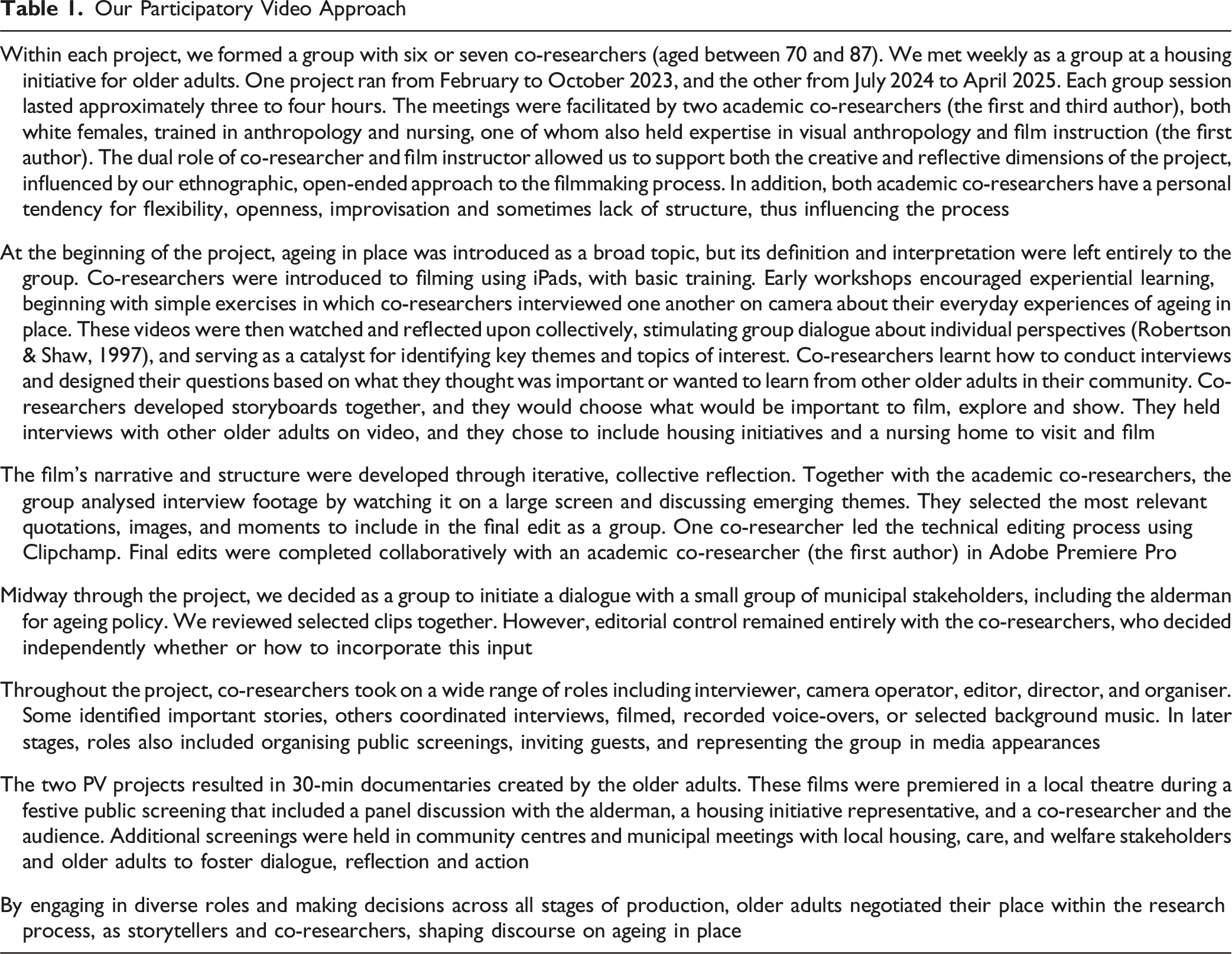
Our Participatory Video Approach
Research Design
This study employed a qualitative research approach using a responsive evaluation approach with a variety of qualitative methods to assess the PV process. Responsive evaluation actively involves stakeholders, in this case older adults in the role of co-researchers, ensuring their perspectives shape the process (Abma, 2005; Abma et al., 2019; Guba & Lincoln, 1989; Stake, 1975). By incorporating co-researchers’ experiences, responsive evaluation fosters mutual learning and deeper understanding (Abma, 2005). This approach acknowledges plurality and allows the design to emerge gradually through dialogue with co-researchers (Stake, 1975).
Recruitment
Purposeful sampling was used to identify information-rich cases (Palinkas et al., 2015). The first PV project was introduced at a housing facility for older adults scheduled for renovation, a housing facility between independent and institutional living. All residents aged 65+ were invited via letters, e-mail and a building notice. Additional informational meetings led to the participation of three residents. Additionally, three older adults who had participated in a previous PV project joined the new group, having stayed in contact with the first author. A seventh co-researcher joined spontaneously after attending a session later on in the project. Co-researchers (nine in total) were aged 70 to 87 and had different educational and professional backgrounds, from employee at a bakery, prisoner guard, to entrepreneur, and two made use of a walking stick. They had different cultural backgrounds, including individuals born in the European part of the Kingdom of the Netherlands and on the ABC islands (Aruba, Bonaire and Curaçao). After the first project, several co-researchers remained active and continued to organise screenings. Four expressed interest in starting a new PV cycle, and two new co-researchers, who had been interviewed in the first film, joined the second project.
Data Collection
Used Data Collection Methods and Type of Data

Data Analysis
The collected data were anonymised and analysed using reflexive thematic analysis as outlined by Braun and Clarke (2006, 2013). An inductive, data-driven approach was taken, where coding and theme development were guided by data rather than predefined analytical categories. There were moments where terminology of previous research, such as concepts as relational responsiveness, or insights from previous experiences of the first author in participatory processes, for example regarding playfulness, offered a meaningful fit with the data, and were therefore used. Here the researcher’s role and influence in the creation of themes should be recognised (Braun & Clarke, 2013). The data were part of a broader study on PV projects of the first author, and this paper builds on one analytic strand, power, which was produced as a significant pattern in the wider analysis and was further examined and deepened through additional research. The first and third author familiarised themselves with the dataset through their participation in all meetings, through immediate post-meeting reflections, allowing for ongoing engagement from two perspectives. The first author wrote down preliminary analytic observations, read all transcripts and fieldnotes, and coded the dataset in an iterative and reflexive way, using the comment function in Microsoft Word. Codes were arranged and examined to identify patterns of shared meaning. These patterns were refined into themes, which were reviewed against coded data and the wider dataset, and further developed. Themes were defined and named. Interpretations were discussed with co-researchers, providing opportunities to nuance and deepen the analysis (Harvey, 2014). Here we decided on ‘the story’ of each theme. Final themes were then developed into the narrative presented in this paper. The three themes presented in the results section of this paper represent the final outcome of this process.
Ethical Considerations
We applied the ethical criteria as formulated by The International Collaboration for Participatory Health Research (ICPHR) as guidelines, guided by ethical principles of mutual respect, equity and inclusion, democratic participation, active learning, making a difference, collective action and personal integrity (ICPHR, 2013). Participants provided written informed consent. Ethical considerations were continuously addressed and reflected upon within the research group of co-researchers throughout the project. All participant names are pseudonymised, and in situated vignettes minor elements have been adapted to protect anonymity without altering the core meaning.
Results
In this chapter we first explore how flexible film roles, playfulness and relational responsiveness within the PV process created inclusive pathways for older adults to meaningfully participate within our group. However these roles also introduced new power dynamics, distributing power within the group unevenly. The second part examines these dynamics. In the last section, this power extends beyond our group, where film roles performed by co-researchers affected which voices were amplified or silenced in the wider community.
Through anonymised vignettes, based on field notes and group reflections, situated examples are presented. Vignettes were selected based on critical situations.
“The Camera Rolls, Everyone!”: Inclusive Pathways Through Flexible Filmmaking Roles, Playfulness, and Relational Responsiveness
We first explore how adopting flexible film roles opened up diverse and meaningful ways for older adults to engage as co-researchers within the group. In addition we shed light on the role of playfulness and relational responsiveness in this process.
We developed an exercise to enhance co-researchers’ filmmaking skills to tell their story to convey a message to an audience. Inspired by an exercise from one of the academic co-researchers’ study in visual ethnography, we tasked pairs of co-researchers with creating a storyboard and a two-minute film depicting the process of making tea. The exercise aimed to learn co-researchers to analyse specific situations (what they consider key elements) and use visual language effectively. Some pairs began with detailed plans, filling out the storyboard forms they received, while others improvised after brief discussions. Joyce and Wilma created a narrative about someone pretending to be sick and asking for tea. They identified the social aspects of drinking tea and making tea for someone and started filming. This quickly turned into a playful, laughter-filled session where the other groups would leave their own plan, or lack of, to join this narrative. A few filmed the situation (departing from the prepared exercise), while others would direct the situation, start collecting props, or act as a figurant in the movie. There was a role for everyone. As academic co-researchers we flexibly let go of the prepared plan and just had fun as a group. At the next meeting, the group watched the short edited film together, laughing at the humorous acting, the bad dress up and missed attempts to stay off-camera while filming. Even a year later, during a new project, a co-researcher warmly referenced this moment as we all laughed.
Co-researchers noted how they liked working on a shared product (in this case the documentary) as a member of the film crew, learning, developing or expressing skills related to the roles of camera operator, interviewer, director or editor and experiencing new things together as a group. As hinted on in the vignette above: everyone found a role, executed well or not, within the group during the filming of the scene. The diverse pathways that were created through the different film roles, contributed to the inclusive space often experienced. This happened throughout, where small groups of co-researchers would form to go and interview and film other members from the community in small teams. Roles were freely self-selected and co-researchers could freely experiment with them. Agnes: “My role is always clear to me.” Joyce: “It goes quite naturally. Margaret, you really have a knack for interviewing, you should’ve been on TV… We all have something we’re best at.” Agnes: “And during the interview with that couple, Martha also did some filming.” Wilma: “Yes, that was fun too.” Margaret: “We truly are a team.”
Importantly, the different roles mediated different ways of being in the group. Some members preferred to remain more in the background, like two of the co-researchers who quietly operated the second camera, capturing things they found interesting or focusing on technical aspects. While others liked taking the lead, through interviewing or organising interviews. This diversity of engagement styles was welcomed.
We carefully set up the project in a way that kept roles open and adaptable. Co-researchers could remain in the same role or switch between them depending on what felt right to them in each moment. This flexibility helped prevent frustration with “difficult interviews”, physical complaints with holding the camera or frustrations with technology and allowed room for trial and error.
Within the process we as academic-coresearcher also took on a new role, for we were not only academic co-researcher, but also “film instructors”. Unlike the authority often associated with academic researchers, the role as film instructor was perceived as practical, collaborative, and focused on skill-building and creativity, thus influencing power dynamics.
The filmmaking exercise of “making tea” (Vignette 1), was initially designed with care and clear pedagogical aims. Yet, what unfolded in practice was an enactment of play, improvisation, and emergent collectivity. This playfulness as a group was characteristic of our filmmaking process, as we would often experience moments like this. As one of the co-researchers would often say during the sessions: “It’s really fun, and if nothing comes of it, it’s still fun.” We adapted our role in practice, not only accommodating what emerged but appreciating it as valuable in its own right. Thus the space that emerged was created not through the potential and flexible design of the film roles alone, but also through playfulness and relational responsiveness in the moment.
“Shhh!”: Navigating Power Dynamics Within the Group
The same film roles that created flexible pathways for participation within our PV research, also introduced new power dynamics, distributing power within the group unevenly.
Albert had grown into a skilled editor and he would technically edit the themes we selected as a group during our sessions. He wanted to show us something. As we all gathered, he presented his own version of a small clip for the ending of the movie, where he made his own voice-over about loneliness. The group appreciated this version, complimenting his skill and the message. However, one member expressed that it did not fully represent the overarching narrative of the story they created. Albert immediately expressed openness to working towards a shared version. We scheduled to collaboratively construct the voice-over the following meeting. However, in parallel, behind the scenes without our knowing, one co-researcher privately requested Harold to prepare a version in advance. Harold was a particularly skilled and creative writer. This talent was greatly valued and celebrated by the group. However the enthusiasm for his abilities by the group sometimes overruled other voices as some of the co-researchers would often push him forward. Harold shared his pre-written version during the following meeting. The voice-over was immediately well received by the group due to its cleverness and professionalism. As co-researchers with academic background, we felt that this version, though well written and performed, did not necessarily adequately represent the diversity of positions within the group. According to us, it carried a more personal-political perspective, carrying sentences as ‘if we care for each other, that would mean enormous societal cost savings’, and consisted the slogan ‘Grow old, stay young’ - although catchy, reflecting a more normative stance on ageing - that diverged from broader positions and did not resonate with all co-researchers’ views in our experience. This framing, risks marginalising other, less ‘active’ experiences of growing older. Additionally, it overshadowed the earlier version created with such enthusiasm by Albert.
Film roles, and cultural or personal connotations about those roles, and individual talents or skills that shape how they are performed, enable control over key aspects of storytelling. This influences which voices are amplified or excluded, as illustrated in Vignette 2.
The acquired skills of the two co-researchers in Vignette 2, gave them the possibility to construct their own version of the final narrative, they had the means and power to construct a narrative on their own. Examples of this could be seen throughout the process. For example, skilled interviewers subtly gained influence, as their ability to steer conversations affected the narratives that were collected. The roles of filming and directing gives power to capture what catches your eye or what you strategically want to include, both planned or spontaneous. Technical expertise in editing also granted certain individuals the potential of influence, as many co-researchers found editing too complex. This occasionally led to selective inclusion or exclusion of key quotes, requiring group discussions and reviewing of all the material together to ensure balanced representation. Technical skills also gave power in unexpected ways: in one case, a co-researcher made an (for her) unusual filming error partially cutting someone out of the frame at a key moment, this was in favor of an interview she did herself. Intended or not, this raises questions about whether technical errors can be used, to exclude certain voices from the project.
However, just stepping into a role or demonstrating skill is not enough, the role also has to be accepted by others. For example, the individual exercise of narrative authority of Albert, in vignette 2, was contested by one of the group members. Whereas Harold, was pushed forward to write a voice-over, thus granted power in setting the final narratives. Roles can thus also be ascribed by peers, based on attributes or skills they associate with a good performance of a certain role. The role performance of Harold was applauded, which legitimated his power to determine the story. The execution of his text aligned with the group’s established expectations and appreciation of what constitutes a high-quality voice-over in terms of style and delivery. Even though the content did not reflect their full stories, as some later acknowledged.
As academic co-researchers we found these power dynamics challenging. In Vignette 2, conflicted aspects came together in a single situation: we wanted to make sure all voices had impact, wanted to “protect” the richness of the data the group gathered, while at the same time value both co-researchers who created the different voice-overs. We were uncertain how to proceed but had to act in the moment. Additionally: time pressure loomed as we had already scheduled a film premiere at a nearby theatre. We decided to construct a new version of the voice-over, synthesizing elements from both existing drafts while ensuring alignment with the overarching themes the group had documented throughout the project. By reviewing both versions collectively, we identified key elements to retain, crafting a final voice-over that remained close to the co-researchers’ contributions. We individually reached out to all co-researchers via WhatsApp or phone calls to discuss which aspects they considered most crucial to emphasise.
As Harold later explained as we reflected on the situation as a group, he experienced the situation as too messy, with us wanting to give everyone a say, explaining: “if the director of The Godfather had let everyone have a say, that film would never have been that great……You need one painter to hold the brush.” Here he did work in adjusting his individual expectations in favor of the group process and the collectively constructed outcome, or as he explained: “By becoming more flexible and thinking ok, then the movie will be only as great as we as a group can make it”. This shows the work done by all involved during the project in negotiating power dynamics, amongst others negotiating content, and emotional and relational work recognising and validating each other’s contributions as can also be seen in the vignette.
Thus, film roles influence power relations within the group and navigating these dynamics requires work, as illustrated in this section.
“Shhh!”: Navigating Power Dynamics Beyond the Group
Power mediated through film roles extended beyond the group: in the performances of these roles co-researchers gain power to include, exclude, amplify, or obscure voices of others within the community.
While rewatching interviews together, the topic of neighbourly care is brought up by one of the co-researchers. As we talk about neighbourly support, Joan shares the story of her neighbour, who experienced illness and Joan offered her support. Joan suggests interviewing her neighbour. In a small team, they spontaneously organise to conduct the interview together during the following week. Harold will lead the interview while Joyce and Joan handle the filming. For Joan it feels too involved to do the interview herself. They arrange to meet at the neighbour’s home. In the next meeting, we watched back the interview on the large screen in the community room of the senior complex. We fall silent. The woman speaks openly about her experiences and life. “Wow, the story really hits you when you watch it like this,” Joan says. Joyce adds, “It feels a bit uncomfortable.” I (the first author) feel the same: it’s as if we’re witnessing something not meant for us, an intimate story shared in private with a neighbour in a living room, now projected on a big screen. We discuss whether including this footage in the film is ethically appropriate. Joan finds the interview powerful, “raw emotions are made visible”. Later, Joan casually shares that at the beginning of the interview she had told her neighbour, “You must lay everything bare…..tell the whole story!”
The moment as revealed in Vignette 3, shows how co-researchers, in their roles as filmmakers, were shaping, curating, and authorising which stories were told and how, gaining power over stories of members in their community. Joan’s statement that the neighbour had to “lay everything bare” is emblematic of a subtle yet significant exercise of narrative power, linked to her performance of the role of director and member of the filmcrew. While framed as an encouragement toward honesty, it also reflected a normative ideal of what constituted a “good interview” according to her: “one that is emotionally raw and vulnerable”. That the interview took place in an intimate setting, within a trusting relationship between neighbours, added further complexity: the same conditions that possibly enabled the neighbour to speak openly may have also limited her ability to refuse or moderate the level of disclosure. Our silence during the screening, followed by mixed reactions, signals an unease with the ethics of amplifying such personal narratives through film, watching intimate stories in whole other contexts, especially when those featured are not fully embedded in the filmmaking process as co-researchers themselves. Although we organised to have coffee with the neighbour which led to a nice talk and mutual decisions about what to share, and when looking back the neighbour is happy with the overall experience and the portraying of her story, the ethical tension around exposure through film remained unresolved.
The shared feeling of group ownership over the film and process also held the potential to silence others outside of the group. In informal conversations, a co-researcher casually mentioned that she had dismissed a neighbour who had shown interest in participating because the man did not speak Dutch fluently. “You have to be able to speak Dutch to participate in a film like this,” she explained. These decisions, while seemingly small or logistical in the eyes of co-researchers, reflected how power over access and inclusion was enacted.
Power over the included stories was also enacted after the film was finalised. At the final screening in a theatre, one neighbour, who had previously approved his interview footage after watching back the materials in a private setting, became uncomfortable seeing himself on a large screen during the premiere in the theatre. Initially, the co-researchers resisted taking out shots, citing the signed consent form, their concerns that the story would lose meaning if altered, and their view that it was “their film”. Their response underscored a perceived collective authorship and a sense of narrative integrity that, in their view, outweighed the individual’s discomfort. We, as academic co-researchers, stepped in and stressed that participants must always retain the right to withdraw according to our professional and personal ethical views. Eventually, one of the co-researchers talked with the participant and shots were visually overlaid. This situation is still looked back upon by co-researchers and academic co-researchers as a moment of conflict between both.
Interestingly though, the completion of the films did not close the narrative but instead opened new spaces for negotiation. By screening the film in community centres, and municipal policy meetings on ageing in place, with co-researchers, other older adults and professionals present, it became clear that the film could serve as a catalyst for conversation and reflection. In these settings, viewers engaged with the themes presented in the film, reinforcing them, reflecting on them or questioning omissions.
Throughout the process, we organised moments of reflection as a group. Here we collectively looked back at situations or reflected on decisions that had to be made. We also introduced structured discussion prompts, for example little notes with “I couldn’t look at myself in the mirror if…”, that we would fill in. These prompted us all to consider ethical boundaries and revisit assumptions. Yet consensus was not always reached; ethical discomforts were honestly acknowledged, but not necessarily resolved, as can be seen in the following excerpt of a reflective session, reflecting on taking out shots if interviewees want to withdraw: Albert: “And I didn't like the way you reacted then.” Joyce: “No!” The first author: “And I didn't like the way you reacted then.”
These moments became spaces of mutual learning where, as Albert noted for example, he had learnt over the year from Shirley’s more empathic approach towards ethical dilemmas.
As seen in this section, film roles within PV projects can mediate subtle, or not so subtle, forms of inclusion and exclusion and narrative control. While the collaborative nature of the work fostered ownership and solidarity, it also introduced complex power dynamics, particularly when telling stories about or involving those outside the core group.
Discussion
First, this study shows that despite the inclusive intentions of participatory video (PV) and art-based methods (Phillips et al., 2024; Phoenix & Chamberlain, 2025), new power dynamics emerge that can silence some voices while amplifying others. These findings are particularly relevant for advancing arts-based research. Participatory research aims to challenge dominant structures (Chambers, 1997; Dedding & Aussems, 2024), yet persistent hierarchies, reliance on ‘usual suspects’, intersectionality and contextual power structures may undermine its transformative potential (Bourke, 2009; Dworski-Riggs & Langhout, 2010; Egid et al., 2021; Hunt et al., 2014; Kulmala et al., 2024; Muhammad et al., 2014; Muntinga et al., 2024; Shaw, 2014; van de Bovenkamp et al., 2013). Power is everywhere, arts-based research is no exception.
Our study shows how PV reconfigures the relational field of power and how different creative roles mediate power. These roles, such as interviewer, camera operator, editor, voice-over or member of the film crew, are linked to skill, talent, and ascribed attributes enabling co-researchers to negotiate new positions within the group, in relation to their communities and in the construction of the narrative produced. Drawing on Elias’s (1978) relational understanding of power, we found that filmmaking roles reconfigured patterns of interdependence. Our findings resonate with Shaw (2014), who highlights that PV literature often underestimates the “messy realities” of multi-layered power dynamics. By showing how creative roles mediate influence in both the process and the narrative produced, our study illustrates mechanisms through which these messy realities can unfold, extending Shaw’s work by demonstrating how specific filmmaking roles mediate power-bearing positions. Thus this study contributes to a more nuanced understanding of how power can operate in art-based projects.
Art-based participatory research often implicitly suggests that it can represent “the voices” of communities involved, but our findings show that power dynamics undermine the legitimacy of such representative claims. This is important when the outcomes of such projects can have far reaching implications informing public policy, quality improvement, research and advocacy, and thus can contribute to epistemic injustice. As Kindon (2003), Rogers (2014), and Walsh (2014) warn, PV is not inherently empowering; if left unreflective, it may reproduce the very inequalities it aims to challenge. Academic co-researchers have significant responsibility to reflexively assess dynamics, governing inclusion to avert injustice (Wayland & Watharow, 2025).
The second lesson we want to highlight is that as power dynamics and imbalances will always be there and cannot be ‘solved’, the point is rather how to engage with them in an ethical way. PV is often presented as a technique or method, yet our findings underscore that it is relational and requires ongoing negotiation, in line with Shaw (2014, 2020). As shown in the results, we worked with a flexible structure, where co-researchers could engage through different flexible roles. Attentiveness, playfulness, and relational responsiveness were essential to co-creating and sustaining what we came to see as a communicative space (Abma et al., 2019). In line with Verhage et al. (2024), we argue that the promise of inclusive research lies in relational design and praxis.
Throughout the process we were often confronted with the need to act without clear guidance in order to navigate power imbalances. Shaw (2014, 2012) emphasises that tensions in PV projects must be addressed through ongoing, responsive negotiation. We argue this requires what Groot and Abma (2022) and Banks (2016) refer to as “ethics work”: work that must be done to understand, decide and act on what is needed in situated everyday issues. This includes framing, identity, emotional, and relational work (Groot & Abma, 2022). The (re)construction of the voice-over (see Vignette 2) is one example where this was done. Ethics work was done by the whole team of co-researchers. At times, we succeeded in navigating tensions; at other times, we may have failed to fully perceive or adequately respond to what was unfolding. In these moments, multiple values, experiences, and motives intersected under time pressure. Here the notion of tinkering (Mol et al., 2010) and more specifically collective tinkering (Heerings et al., 2021) is relevant: we engaged in ongoing, experimental, attentive negotiation and adjustment in response to the situational complexities at hand (Mol et al., 2010).
Our study also shows the value of shared reflection on power dynamics as part of participatory practice. We created space for joint reflection with co-researchers (Groot & Abma, 2022) on ethical dilemmas, power dynamics or emerging tension, including our own roles. Here ethics work was a group effort (Groot, 2021). This kind of ongoing, collective reflection should not be confined to the design or analysis stages, but should be woven through the entire process (Banks, 2016). These shared moments, although not always leading to agreement, and sometimes marked by discomfort, did enable mutual learning and understanding.
Taken together, these findings show that meaningful participation does not emerge from blindly following fixed participatory methods, but from ongoing work by both academic co-researchers and co-researchers. This work requires time, flexibility and responsiveness. Yet this is not often recognised, resourced, or rewarded within academic structures (Dedding et al., 2022; Fraser et al., 2022). A shift is needed to legitimise and prepare researchers, co-researchers and policymakers for the ongoing work required to sustain meaningful participation (Dedding et al., 2022). To guide such shift, Dedding et al. (2022) argue for an alternative conceptualisation of participation, as acting and work. They propose moving beyond Arnstein’s (1969) ladder of participation to recognise the ongoing, interactive work required (de Graaff et al., 2021; Dedding et al., 2022). The metaphor of the ladder suggest a stepwise progression towards “more” or “better” participation, veiling the situated, relational and often unpredictable nature of participatory practice. Such models shape the way we think and act. For art-based participatory approaches to be meaningful, academic and institutional practices must be reimagined so that the work that is needed is recognised, legitimised and enabled (Dedding et al., 2022).
Strengths and Limitations
This study offers an in-depth look behind the scenes of two PV projects with older adults, with a specific focus on power dynamics. Its focus on filmmaking roles addresses an underexplored area in arts-based research and demonstrates how creative roles can reconfigure power relations within and beyond the group. However, several limitations should be acknowledged. First, co-researchers did not play an active part in the writing of this paper, reflecting academic structures’ biases toward written outputs, timelines, and researcher dominance (Corrado et al., 2019). Second, macro-level factors, such as broader contextual and stakeholder dynamics were beyond scope, though structural forces shape participatory processes and influence group dynamics (Shaw, 2012, 2014). Third, the impact of PV on broader change is underexamined. While community screenings stimulated dialogue, and reflective and affective qualities of film may negotiate positions, this does not necessarily lead to change, as audiences reinterpret stories through their own frames and “being heard” rarely translates into action (de Maaker, 2022; Frank, 2010; James & Buffel, 2022; MacDougall, 1998; Postma, 2022; Shaw, 2012; van de Bovenkamp, 2024; Walsh, 2014). Moreover, as Walsh (2014) and Rogers (2014) argue, framing PV as empowering can inadvertently individualise responsibility, shifting attention away from the structural conditions that constrain collective action and change. Further research could examine the situated work required to foster impact after a film is completed.
Conclusion
This study contributes to the call for more reflexive accounts in art-based participatory research by offering insight in backstage processes, highlighting how power dynamics play a role in participatory video research. What this study contributes to existing literature is an exploration of how arts-based methods, PV in particular, can introduce new roles that reconfigure power relations. On the one hand, PV opened up pathways for co-researchers and academic co-researchers to engage through flexible film roles, such as camera operator, interviewer and editor. This contributed to inclusion of co-researchers. Communicative spaces were fostered by flexibility, playfulness, and relational responsiveness. Filmmaking roles, however, are not neutral; they carry specific associations with skill, talent, ascribed attributes, and authority, and influence how co-researchers negotiate power and which voices are amplified or marginalised, within and beyond the group. Where art-based participatory research can (implicitly) claim to represent “the voices” of the communities involved, power imbalances undermine the legitimacy of such representative claims. This can have far-reaching implications when the outputs of such projects inform public policy, advocacy and quality improvement, ultimately contributing to epistemic injustice. These findings show that meaningful participation in art-based research, such as PV, requires attentiveness to power, with ongoing, situated work and reflection throughout the process for this type of research to reach its potential.
Footnotes
Acknowledgments
We thank the co-researchers for working with us, the work they did, and for sharing experiences with us. We thank the older adults that were interviewed by the co-researchers for sharing their stories and often welcoming us in their home. We thank the community, the municipality and local housing, care, and welfare stakeholders involved. In addition: we thank Sam Schrevel for being a critical friend while working on this article, sharing reflections on power dynamics.

Ethical Considerations
This study did not fall under the Dutch law on research involving human subjects (WMO). Written informed consent was given by participants, and consent was asked throughout the project whenever audio was recorded. Ethical considerations were continuously addressed with co-researchers throughout the project. Oral informed consent by participants was given for the publication of this article.
Author Contributions
Zsuzsu Tavy: Conceptualization; Methodology; Formal analysis; Investigation; Resources; Data curation; Writing - Original Draft; Writing - Review & Editing; Visualization; Project administration. Hester van de Bovenkamp: Writing - Original Draft; Writing - Review & Editing; Supervision. Anita Ham: Methodology; Formal analysis; Investigation; Writing - Review & Editing. Jeroen Dikken: Writing - Original Draft; Writing - Review & Editing. Joost van Hoof: Conceptualization; Resources; Writing - Review & Editing; Supervision; Project administration; Funding acquisition.
Funding
The authors disclosed receipt of the following financial support for the research, authorship, and/or publication of this article: The project Werkplaats Sociaal Domein Ondersteuning Ouderen 2023 - 2025 was supported through a grant (90001107) of the Ministry of Health, Welfare and Sports of the Netherlands. The project Werkplaats Sociaal Domein Ondersteuning Ouderen 2023 – 2025 was coordinated by Professor Suzan van der Pas of the principal grant holder Leiden University of Applied Sciences.
Declaration of Conflicting Interests
The authors declared no potential conflicts of interest with respect to the research, authorship, and/or publication of this article.
Data Availability Statement
The data supporting the findings of this study are not publicly available due to privacy and confidentiality considerations. Data may be available from the corresponding author upon reasonable request, subject to ethical review and approval by co-researchers.