




Abstract
Dominant approaches to participatory research with children and young people provide ‘training’ for young researchers. In this process there is a risk of schooling out of them their unique insights on how to do research with their peers. This paper proposes an approach to critical reflection which uses the notion of reflecting on the disturbing moments of punctum (Barthes, 1980) in research practice, and uses some of Aristotle’s conceptions of knowledge to help consider the learning that is useful and exchanged in the process of conducting research. We apply this approach to critical reflection to explore a large scale collaborative research study with children and young people in England. This process of reflection reveal that children and young people can teach academics about the need for transparency around facilitation of cocreated spaces of shared learning; the value and possibilities of young-researcher-led off-script peer interviewing; how to mirror young researchers’ wisdom about when to be in silent exchange in moments of interviewing; how to embrace surviving difficult shared experiences as an opportunity to talk about difficult things; how to voice sensitive stories without exposing vulnerabilities; and how to play with data in creative analysis. We argue that this approach to critical reflection can encourage a turn away from the dominant idea of academics delivering ‘training’ in participatory research with children and young people and towards a notion of ‘collaborative learning’ in which everyone’s competences are valued.
Keywords
Introduction
Despite more than twenty years of critique of research that claims to be participatory, children and young people still tend to be investigated, rather than leading and directing the use of research resources (Pole et al., 1999; Lohmeyer, 2020). There is often a lack of clarity about the stages of research in which children and young people have made decisions, and little description of how power is shared within any one stage (Montreuil et al., 2021). In participatory research, children and young people tend to be given training or capacity building in research practices by adult academics (Bradbury- Jones et al., 2018; Montreuil et al., 2021; Larkins et al., 2021). The assumption appears to be that academics know best how to do participatory research; but children and young people have a lot to teach academics about how to do research and critical inquiry (Moore et al., 2006; Ryu, 2022). In this article, we engage with Ryu’s (2022) suggestion that there is need for greater reflection on who is learning what from whom in participatory research with children. We also respond to Montreuil et al.’s (2021) call for greater transparency within participatory research processes, by proposing an approach to critical reflection that values everyone’s unique knowledges and retains the potential for children and young people to challenge academic orthodoxy. This is not to undervalue academic knowledge. Rather, our aim is to highlight some of the gifts children and young people bring to a collaborative pedagogy of how to conduct research and to provide theoretically grounded tools to aid critical reflection.
The approach to critical reflection we outline has developed from a collaborative study, initiated by children and young people (Stories 2 Connect). Complying with the dominant participatory tradition, in our application for UK Arts and Humanities Research Council funding we promised to undertake periods of activity labelled ‘training young researchers’. Reflecting on this once we commenced, we felt that we had, as Socrates describes, fallen into incorrect use of language (in this case ‘training’) through failure to give a proper account of what we do (Chappelle, 2012:179). Like us, other collaborative researchers may persist with the language of training and capacity building for similar reasons: to comply with language and funding expectations. We may also have internalised dominant conceptions of childhood as a time of incompetence (see Canevale, 2020 for overview of the many ways this is expressed in ontologies, epistemologies and methods). Research practice may reflect aspects of this generational bias despite our best intentions. We suggest that the value of the approach to critical reflection proposed in this paper lies in our engagement with the uncomfortable and hidden, using Barthes’ notion of punctum, and the recognition of children’s expertise by reference to Aristotle’s conceptions of knowledge. Wider engagement with this theoretically grounded approach to critical reflection may enable a turn in participatory research practice with children, mirroring that encouraged by post-colonial critique (Thambinathan and Kinsella, 2021), namely to go beyond seeking advice about methods and towards learning from younger community members about appropriate methodologies, ethics and how to be together in research situations.
Learning About research by and with Children
Research by and with children and young people, often called participatory research, covers a wide variety of approaches, including coproduced and peer-led research (Mason and Watson, 2014). But increasingly participatory research is understood to at least involve children or young people having an element of influence over some or all stages of a research study beyond their choice about which methods to engage with to express their perspectives (Montreuil et al., 2021).
Although the benefits of children or young people’s active involvement in knowledge production remains contested (Hammersley, 2015), the value of participatory research is increasingly recognised across a wide range of academic disciplines (Montreuil et al., 2021; Larkins et al., 2021). Past failures to recognise the benefit of children’s contributions in research may arise from generational relations that perpetuate the notion that incomplete children and youth, in need of education, are inherently less capable than adults of generating knowledge (Alanen and Mayall, 2001). Now, children’s participation in research is championed as a right and a means of promoting emancipation and democratising knowledge creation (Powell and Smith, 2009), although empowerment through research is far from inevitable (Montreuil et al., 2021). The value of children’s unique perspectives, standpoints and expertise in their own lives and multiple and intersecting experiences are emphasised (Alanen and Mayall, 2001; Carnavale, 2020). Importantly for this article, young researchers’ involvement is known to enhance research studies. Children and young people who act as advisors to studies or as peer researchers contribute by improving study information design; increasing study recruitment rates; encouraging more open discussions; and helping to ensure that research questions are relevant (Bradbury-Jones et al., 2018; Larkins et al., 2021). They may, for example, strengthen the methods and ways of being together that enable participants to communicate in modes that are comfortable (Moore et al., 2006; Larkins, 2016; Dan et al., 2018), and improve knowledge exchange strategies.
Despite the many ways in which children and young people’s participation can strengthen research methodologies, the need for comprehensive training for young researchers is often repeated without detail of what needs to be learned (Bradbury-Jones et al., 2018). Or, when training content is detailed, there is wide variety in the initial areas covered, including methods, ethics, communication, teamwork, decision-making, and photography (Montreuil et al., 2021). Early findings from a systematic review of reviews (Larkins et al., 2021) show that children who are being trained on how to do research are expected to attend research courses that may last up to 16 weeks. These may ‘channel the stories children tell’ and shape children and young people to fit into predetermined academic norms (Brownlie, 2009:702). As noted in relation to adult community researchers, this practice may ‘promote hegemonic research methods and knowledges, with the imposition of western, male and privileged research approaches and paradigms onto communities’ (Horner, 2016: 35). In relation to children and young people, this colonialism is extended as the methods imposed may also be adultist (Alanen and Mayall, 2001). There is a risk that the emancipatory, epistemological and functional value of participatory research with children and young people will be undermined if children and young people’s unique competences are trained out of them, rather than valued.
Understanding is needed, by both young and academic researchers, about how to embark on collaborative studies, but academics are not the unique holders of this knowledge. Guidance on learning for research, co-authored with children and young people (Larkins and Young Researchers 2014; Alderson, 2019) notes that adults need to learn how to think about each individual in every group of young researchers; how to enable each young researcher to have the influence they wish in every stage of research; how to build relationships and trust; how to adapt methods, opportunities and roles to suit preferences of each individual; how to value differences but work towards agreements; and how to make it fun. Reviews of recent participatory research with children (Bradbury-Jones et al., 2018; Larkins et al., 2021) stress again the imperative of learning how to ensure marginalised voices are not excluded or silenced. This might involve understanding how to open up spaces for dissent and commit to recognition and solidarity in participatory action research as an intersectional praxis (Fine and Torre, 2019) and how to develop skills in intra-active reflexivity, so that power and other tensions can be co-examined (Call-Cummins et al., 2019; Montreuil et al., 2021). Young researchers involved in the present study (Dan et al., 2019) suggest the need to develop skills in safeguarding; creating opportunities for networking between children and young people; and strategies to strengthen impact so that collaborative research improves lives.
Some of what needs to be learned about how to do participatory research has therefore been clearly articulated by children and young people, and some of the academics working with them. However, taking a deep approach to understanding children’s voice (Carnevale 202), we recognise that some of what children and young people teach us about doing research is not articulated in words in the designated moments of shared reflection that we create. To learn about power dynamics and place value on children and young people’s marginalised knowledges, there is benefit in dialogue with young researchers, but also the need for space for academics to step back, to journal, to engage in conversations, to write, and to look at relationships, positions and interpretations (Aldana et al., 2016; Chou 2015; Satchwell et al., 2020). As Ryu (2022) notes, there is need for academics and teachers to sit with the discomfort of not knowing how to pursue an inquiry, and to allow insight to arise from children. In this article we therefore sit back, and reflect on insight and discomfort in a study co-initiated by young people, outline the theoretical grounding that supported our critical reflection, and explore what this revealed in terms of what academics can learn from children and young people about how to ‘do’ research.
The Participatory Study
Stories 2 Connect started from conversations between an established group of young researchers (see www.ucanmakechange2.org) and the two authors of the paper. Together we cocreated the idea of a research project in which young people would interview other young people about overcoming life’s challenges (their idea) and then work with creative writers (our idea) and makers of digital artefacts (a shared idea), to transform our findings into fictionalised stories that could be retold physically and digitally. The aim was to challenge the stigma faced by children in and on the edge of alternative care (their idea) and to promote understanding of how to help children deal with challenges in their lives (our idea). This study involved 12 young people as researchers (YRs), working with academic researchers (ARs), creative writers, and designers of phygitals (physical artefacts with digital elements), to create more than 50 stories of sociological fiction (https://stories2connect.org/). Stories 2 Connect remains one of a small handful of studies (Bradbury-Jones et al., 2018) where from the start, disabled and disadvantaged children and young people have cocreated a large-scale research project, shaping the aims written into the grant application, contributing to staff recruitment, taking a lead in planning, delivering and reviewing progress, and co-designing and co-authoring outputs. Ethical approval for the study was given by the University of Central Lancashire Ethics Committee and informed consent was secured from all YRs and participants (and parents or carers of anyone aged under 16 years). YRs are referred to by pseudonym here to protect the confidentiality of characters in the stories they created.
The process of critical reflection was ongoing. Throughout we engaged in conversations and draw-write activities with the young researchers (in individual interviews and group discussions). At the end of the study they reflected on the whole process and their own stories through conversations which were sometimes recorded; outputs from these have been published elsewhere (Dan et al., 2019; Satchwell, 2019; Satchwell and Davidge, 2018). This article, authored by the two lead academics for the study, was developed through a private space of reflective dialogue, where we could freely name our weaknesses and moments of perceived failure. These discussions were voice recorded and written during the course of three writing retreats in 2018-2021. The authors listened back to moments and contexts of insight identified in these conversations, discovering discrepancies, misremembrances and contradictions that might otherwise have lain undisturbed and unchallenged. We wrote accounts of these as scenic compositions, using Lorenzer’s (1977) notion of emotionally charged moments as adapted by Froggett et al. (2014). Creating visually rich prose brought to our minds’ eyes the research moments we had lived together and our thick sense of what children and young people were voicing to us, as participant observers in these webs of relationships (Carnevale, 2020).
Theoretically Grounded Critical Reflection
We interrogated these scenic compositions using theoretical concepts proposed in previous literature on participatory research, related to process, power sharing, collaboration and emancipatory concepts of validity. Using critical definitions of participation and validity (see for example Larkins, Kiili and Palsanen 2014; Lather, 1993) confirmed the findings of existing reviews of participatory research (Bradbury-Jones et al., 2018; Kiili and Larkins 2018; Facca et al., 2020), namely that: 1) physically coworking with YRs increased influence and reduced the moments when decisions were taken without them, and 2) strong reflexivity is needed to understand how the meanings of different adult and young researchers and authors are layered into notions of voice and the fabrication of findings. The focus of this article is what we found through engagement with Barthes’ (1980) notions of studium and punctum and elements of Aristotle’s (2000) conceptions of knowledge (notions of phrónêsis, aisthêsis, episteme and tékhnê), as these helped reveal and value the learning that was exchanged and cocreated.
Barthes’ (1980) notions of studium and punctum were recommended by Cook (2009) and Horner (2016), as a prompt to enable reflection on the mess of action research and identification of moments of theoretical and experiential knowing. Barthes described a photograph as studium where one can see the competent application of technical knowledge to the process of making (1980: 48). In contrast, the punctum within a photo, ‘jumps out of a scene like an arrow… a mark, a rupture, a roll of the dice…that stands out to me…bruises me, grips me’ (1980:48-49 Author’s translation). Scenes may be ‘punctuated’, ‘punctured’ and ‘mottled, by sensitive spots’ (ibid). Cook (2009) suggests that in any scene of research, the knowledge that is aligned with our affiliations and conventional ways of knowing may be described as the studium; and argues that researchers should take the risk of engaging with the unsettling half-understood punctum in order that new knowledge and learning can be unearthed. Switzer et al. (2019) also stress the value of reflecting on punctum, as that which ‘wounds’ or ‘pricks me’, to embrace these moments as new openings towards missing understandings. The first element of our approach to critical reflection was therefore to lay bare the holes and the blemishes (punctum) that rupture the safe application of standard practice (studium) in our scenic compositions (see Box 1 for our working definitions).
Box 1 – Working definitions of Barthes’ punctum and stadium
Studium – expected, conventional and technically competent contents of a scene Punctum – sensitive spots, ruptures, and wounds which disturb the expected scene
We embraced some Aristotelean conceptions of knowledge as a lens for looking into the moments of punctum and studium in part because Fals-Borda (2001: 32) suggests that thinking about phrónêsis helps action researchers understand how to ‘find a peaceful and measured path in achieving the aspirations that arise during and from our research’. In the uncomfortable moments of punctum we realised that we were very far from this sense of peace. This inspired us to reread Aristotle, to explore diverse conceptions of knowledge (see Chappelle 2012 for a summary), and to engage in dialogue with a fellow academic with expertise in Aristotle. In our eventual analysis, we used interpretations of some of these conceptions of knowledge, as outlined below.
Aristotle’s concept of phrónêsis has long been seen as a useful tool for reflection on collaborative and action research with adults (e.g. Greenwood, 2008; Sanderse, 2016; Horner, 2016), although rarely applied to research with children. Phrónêsis can be defined as ‘prudence’, ‘practical wisdom’ or ‘judgement’ in achieving justice in or perfecting a goal which arises from within the activity we are pursuing (Eikeland, 2006). In a given situation, phrónêsis encompasses the normative and intellectual dispositions that guide attitudes and action which enable an intrinsically valued activity to work at its best for the collective good. Phrónêsis may be expressed as reasoned speech, persuasion and demonstration to convince an autonomous mind. It must present thinking and reasoning ‘as openly as possible to the mindful judgement of others, trying to show, and convince, making them see, but still respecting their autonomy’ (cf. Rh1378a6-21 in Eikeland, 2006:34). Phrónêsis may deliberate (quickly or slowly) about the appropriate means in the here and now, but the ends are always ‘ethical virtue … “happiness” … competent, well-functioning, flourishing activities’ (Eikeland, 2006: 28). Phrónêsis also encompasses how to ‘deal with egotistical, strategic, manipulative behaviour in others without itself becoming like this’ (Eikeland, 2006:29). In perceiving or feeling the specific thing to be done in a specific moment, phrónêsis must take into account the emotional and intellectual dispositions of other people, and their skills and attitudes (Eikeland, 2006; Chappelle 2012).
Like Eikeland (2006), who cautioned that action research cannot be understood just as phrónêsis, in our scenic compositions we too identified episteme (broadly defined as stable scientific or theoretical knowledge of objects and as embodied skill in a field of activity which can be acquired through perception or direct experience). We also found resonance with Chappelle’s (2012) suggestion of aisthêsis, which can be understood as experiential knowledge, for example knowing how to ride a bike without falling off being a matter of feel rather than mastering theory. There were also traces of tékhnê, as anticipated by Chappelle (2012) and Eikeland (2006), that is, excellence in making from an external object that which can be conceived of at the beginning and the skills necessary to ‘realise’ what one intends to create.
The second element of our approach to critical reflection was the slow work of reorienting our thoughts on learning about research from children and young people, holding these four relatively unfamiliar Aristotelean concepts close to our hearts and embracing deep challenges to our comfortable working practices (Kuntz and St Pierre 2020). Our aim was not to do philosophy (badly) but rather to use working definitions of these concepts that might help to deconstruct our established ways of seeing the world (studium) and to unpick dominant thinking in our discipline. Rather than settled definitions that all academics would accept, the definitions provided in Box 2 are the indicative meanings we found it useful to employ.
Box 2 – Working Versions of Aristotelean Ways of Knowing Used in Our Analysis
Aisthêsis: the embodied feel for a situation or thing. Phrónêsis: the embodied knowledge of virtuous action for collective good in a specific moment. Episteme: stable scientific or theoretical knowledge of objects. Tékhnê: technical skill and craft in a predictable process of creation
Learning From Young Researchers on how to do Participatory Research
When applying our theoretically grounded approach to critical reflection to consider Stories 2 Connect, we found that throughout the research journey, academics had learned from young researchers and each other and vice versa, through a complex interweaving of ‘academic’ and ‘non-academic’ knowledge and ways of being. When reflecting on individual scenic compositions, we found that what one of us experienced as studium (expected application of technical skill) was sometimes experienced by another as punctum (surprising and often disturbing insights). Extracts from our scenic compositions are presented below (on preparing for fieldwork; questioning and responding during fieldwork; silence in interview situations; anonymising on the hoof; and understanding data), followed by analysis of the diversity of knowledges being shared in these moments.
Preparing for Fieldwork
In Stories 2 Connect our journey started with a cocreated learning event.
Scene 1: First Meeting
On a summer afternoon, a large university classroom is filled with sunlight and a mass of both experienced and newly recruited YRs who have diverse backgrounds - in alternative care, caring and being disabled. This is day one of a two-day learning event codesigned to respond to YRs’ request for information about the study and experimentation with creative methods. The room heaves with laughter, discussion, art materials. Cath feels responsible: this is her area of lead within the study and she is encouraging mess and experiment. Experienced YRs have been leading activities to explore content they were familiar with, including confidentiality and consent. ARs and YRs co-presented a model interview and all group members experimented with the format, transforming it to ask questions about highlights in each other’s lives. The planned walking interviews and fictional story-telling methods have been dropped as the experimental interviews took so long. YRs are raising concerns about each other’s capacity to interview sensitively, and suggesting ways of managing emotions. The YRs and their accompanying workers show varying levels of happiness and comfort. One young person is distressed and thinking of leaving, the others are trying out activities. A new research assistant (RA) looks a little startled but is still smiling. Candice is delighted but puzzled. While Cath, who looks outwardly calm, has been playing soccer in a university corridor with the young person who is thinking of leaving. As the clock ticks towards the end of the day Cath walks away from the soccer and back to the middle of the classroom. She engages the group in a listening game to create a shared focus and a feeling of safe play. She produces a flipchart board, requests a circle of chairs, and asks the RA to facilitate a discussion on how the interviewing fieldwork should be done in our collaborative study. On the board, Cath writes up YRs’ questions, using their exact words, ready for us to work on collaboratively in subsequent workshops.
In this scene, the anticipated studium is that YRs are offering knowledge in the form of aisthêsis (embodied feel for a situation). YRs were educating ARs and each other about how to be and how to communicate in ways that are intelligible and comfortable to their peers. The YRs reflected on their personal experiences to identify what is needed in a research guide and what words might feel most comfortable, how consent and confidentiality must be managed and what warm-up activities may put other young people at ease. This echoes the well-recognised functional knowledge that young people bring into the role of co-researcher (e.g. Burke et al., 2019) which enables them to contribute knowledge about what is likely to feel right to other young people in a given situation.
This scene also highlights that for some young people, personal experience includes participation in research, and that their already developed tékhnê (technical knowledge and skill in research) may also contribute to collaborative learning. ARs and some experienced YRs were also sharing technical knowledge about what it means to do research ethically.
Reflecting on the facilitation of the space in this scene, Candice identified phrónêsis in Cath’s apparently unconscious response to the group, progressing together towards their shared goal of a cocreated guide, whilst also attending to the emotional needs of various individuals. For Cath, however, it was a matter of aisthêsis (an embodied feel for the situation having been in many similar situations in the past) and tékhnê (the skill of play in the craft of bringing a group through a messy process of collaborative deliberation). Uncomfortably, reflecting on the facilitation in this scene Cath experienced punctum in the sight of herself trying to stay in control without transparency - trying to maximise the comfort of group members, in a context of divergent feelings across the group, but without articulating that this was the aim. Would verbalising the reasons for use of play to pull everyone together have been more appropriate, or might the process have been disrupted by naming her protective impulse? Or perhaps YRs, used to the conventions of groupwork, knew what she was doing and consented to cocreate a playful focus? Whatever the unspoken agreement at the time, there is learning in this scene about the use of power - more transparency might be achieved if approaches to group facilitation were discussed with the whole group, before these are deployed.
Questioning and Responding in Interviewing
Returning to our journey, the next scene we present is from fieldwork. With cocreated interview guide prepared, and after practice interviews with each other, the young researchers identified places in their community where they could recruit and interview other young people: educational settings, youth groups and specialist settings for disabled and care-experienced children and young people. Within these places the YRs identified ways of approaching potential participants, sometimes suggesting a snowballing approach and naming known individuals; other times asking that professionals send out invitations to all service users. The result was that YRs often interviewed known people in known places.
Scene 2: YR Aisha Interviews Two Young Men
In a small town in North West England, Candice waits in the car park of a small block of supported living apartments for disabled young people, where she is due to support a young researcher to conduct interviews. YR Aisha, who has a diagnosis of autism, arrives prepared to interview two young men with similar diagnoses. Candice is interested to see how the event unfolds, relishing the opportunity to be there. All four, who are already acquainted with one another, settle themselves in the living room. Aisha seems to feel uncomfortable with explaining about consent, anonymity, and so on, but once Candice has dealt with that side of things Aisha is in her element. Completely abandoning the interview guide, she pulls out a quiz she has devised especially for the two young men and gives them coloured pens to complete it. Thereafter, with occasional glances at Candice, she begins the interview, covering topics such as friendship, the benefits of living away from parents, and shared obsessions, asking ‘I’m a bit obsessed with piercings as you can tell… so what kind of obsessions have you had?.. because I know people with autism they can have erm ambitions to find out lots of things’. Candice sits back and watches the resulting discussion amongst the three of them, feeling it is a privilege to witness the creation of counter-narratives to the dominant ones of victim, difference, and care.
In this scene young people chose to make visible their knowledge of their lives and experiences through shared storytelling facilitated by a YR who adopted a unique style of interview, talking about herself and her experiences in order to encourage young participants to reveal parts of their own lives. The rejection of the research interview guide prepared by the group was experienced as punctum by Candice (who was relatively new to witnessing peer-interviewing), and as studium by Cath (who has been facilitating participatory research for more than 25 years). There was aisthêsis, episteme, tékhnê and phrónêsis in the way Aisha brought in her embodied knowledge of the participants and the moment, together with prior knowledge of autism and technical skill in research to create moments of dialogue where the motives of sharing experiences were laid bare; she pulled this together in a pleasurable inclusion of everyone in this shared activity. The scene, and subsequent rich accounts of young people’s lives that were cocreated, show the value and possibilities of off-script peer interviewing.
Silence in Interview Situations
Reflecting on other scenes of questioning and responding, we are aware that more than one of the YRs decided not to speak during interviews they had initiated and agreed to conduct. This suggests that, counter to the studium in participatory research (Brownlie, 2009; Burke et al., 2019), peer interviewing did not necessarily make young people more relaxed and able to talk. But, interviewing is not just about talking.
Scene 3: YR Chantelle Interviewing Friends at Her Youth Club
It is early evening at a youth club which caters for disabled young people referred by children’s services. The hall is full of young people playing pool, chatting, and sitting around with arts materials and several volunteer workers. Candice spots YR Helmund, who is a regular at the group but tonight awaiting the arrival of Cath who is running late. Helmund is gazing at a computer screen alongside several others and like YR Chantelle, who also has autism, is clearly at home, while Candice feels somewhat ill at ease. Chantelle spreads her arms happily, telling Candice ‘These are my friends’ and introducing some of them. One of the workers points out young people who are likely to participate in the proposed research interviews, and provides a separate room. Chantelle and Candice sit down to begin. Offered paper and pens, one of the young people begins to draw. Candice expects Chantelle to continue in her mode of friend and host, but Chantelle becomes completely silent. She points at the recorder on the table and refuses to speak. Candice attempts to persuade her to join in – met with sharp shakes of the head - but finally offers to conduct the interview herself – received with a determined nod. Drawing and talking continued for the rest of the evening.
Uncomfortably silent moments provided punctum through which understanding of what it means to be together in interview situations became clearer. The expected studium here is that YRs have bridging communication capacity in peer research (Boyden and Ennew 1997; Montreuil et al., 2021), and the punctum is that Chantelle’s embodied knowledge of how to be in this space (aisthêsis) showed Candice, and young people present, how to be together in silence and speech. It felt as if, through her silence, Chantelle created an atmosphere which enabled freedom for others to speak or not and encouraged acceptance of this academic ‘adult stranger’ at the youth club. The creation of this atmosphere may have been an expression of phrónêsis, as through these actions Chantelle eased the interactions that followed. The artificial construct of an ‘interview’ would have disrupted the flow. Both Candice and Chantelle were able to let go of the planned technical application of peer interviewing technique (tékhnê) and respond by following and valuing a way of being that seemed right in these moments (phrónêsis). This form of interviewing as ‘silent experiencing together of space’ ultimately brought Candice closer to understanding the lives of the young people who participated in these moments. This contributed a new method, and new understandings that arose in quiet moments of being together were subsequently communicated in the fictionalised accounts of our findings (Satchwell et al., 2020).
Anonymising on the Hoof
Cath experienced punctum in another scene of being together in shared space, this time related to when silence was broken.
Scene 4: YR Ben Offers an Interview
At 8pm on a cool autumn evening, YR Ben and Cath are waiting in an outside shelter at a train stop, after having visited a youth group to explain the research to potential participants. Ben and Cath had been sharing the space, time and effort of trying to engage these potential participants who actually had higher priorities on their agenda for that evening. There had been a lot of teasing and challenge of both the academic and young researcher: it had felt like being tested to see if they could handle the banter that was normal in the group. They feel they have passed but are tired, cold, and stuck outside. It is late and the last train is slow to arrive. Now, waiting for the train, Ben asks to be interviewed. They turn on a voice recorder. He starts to talk about responding to a bullying situation and then moves on to talking about a friend who has experienced sexual abuse.
The studium in this scene was that Ben wished to be interviewed and chose an informal shared moment for this. The punctum related to the feeling that the difficult circumstances they were sharing and surviving appeared to encourage difficult stories to surface. Perhaps there was something about the safety they felt in each other. The switching on of the recorder signalled that this was an ‘interview’, but this was also an instance of collaboration in authoring a new narrative: both YR and AR recognised that some of what needed to be told could not be said in words and they found ways together to share, hear, imply and promote safety in the narrative that emerged. Drawing on their tékhnê in understanding what needed to be anonymised, and their episteme in relation to knowledge of what tends to be the case in such situations, in this first moment and subsequent dialogues they created an account that grew from personal experience into a narrative that could be told. Cath and Ben learned from each other a new tékhnê which edged towards phrónêsis; knowing what it might take to start creating sociological fiction on a sensitive subject in moments of encounter in a way that would leave them both feeling all right (see https://stories2connect.org/story-pdf/talking-about-terrible-things/ for this story output).
Understanding Interview Data
Through experimentation over 14 months of building research relationships we developed inclusive approaches to data analysis, an aspect of PAR which is under-discussed in the literature (Gillet-Swan 2018). Some of this arose from bruising punctum.
Scene 5: Cath Tries to Coax YRs Into Data Analysis
At one of our regular evening workshops, in a café space at our university, Cath worked with Samuel and Dina. Other ARs worked with small groups of other YRs doing a similar activity. The YRs spoke or wrote summary accounts of an interview they had conducted, identified striking themes, or drew pictures to illustrate key points. They were then each given a story bag to explore another interview. The bag contained a series of excerpts of text and items that sought to bring to life the key elements of interviews that had been conducted by other researchers (see Photo 1). Dina reads out the words and examines the objects in their bag, occasionally commenting ‘What are sleeping tablets?‘, ‘Is that a Facebook LIKE?‘. Samuel does not speak apart from to ask when it would be over. Cath feels like she is pulling teeth. She explains the point of the story bag activity was to make connections between their own interviews and items in these bags, or to make up new stories from these parts. Silence Cath tries asking Samuel and Dina to connect objects from their story bags to the contents of the interviews they have just summarised. Silence while they look at the objects They describe what they see. Cath herself feels uninspired by the contents of the bags. She tries to move things forward again proposing a game with the loose parts to take it in turns to tell a new composite story.
Photograph 1 – Story bags greeted with silence
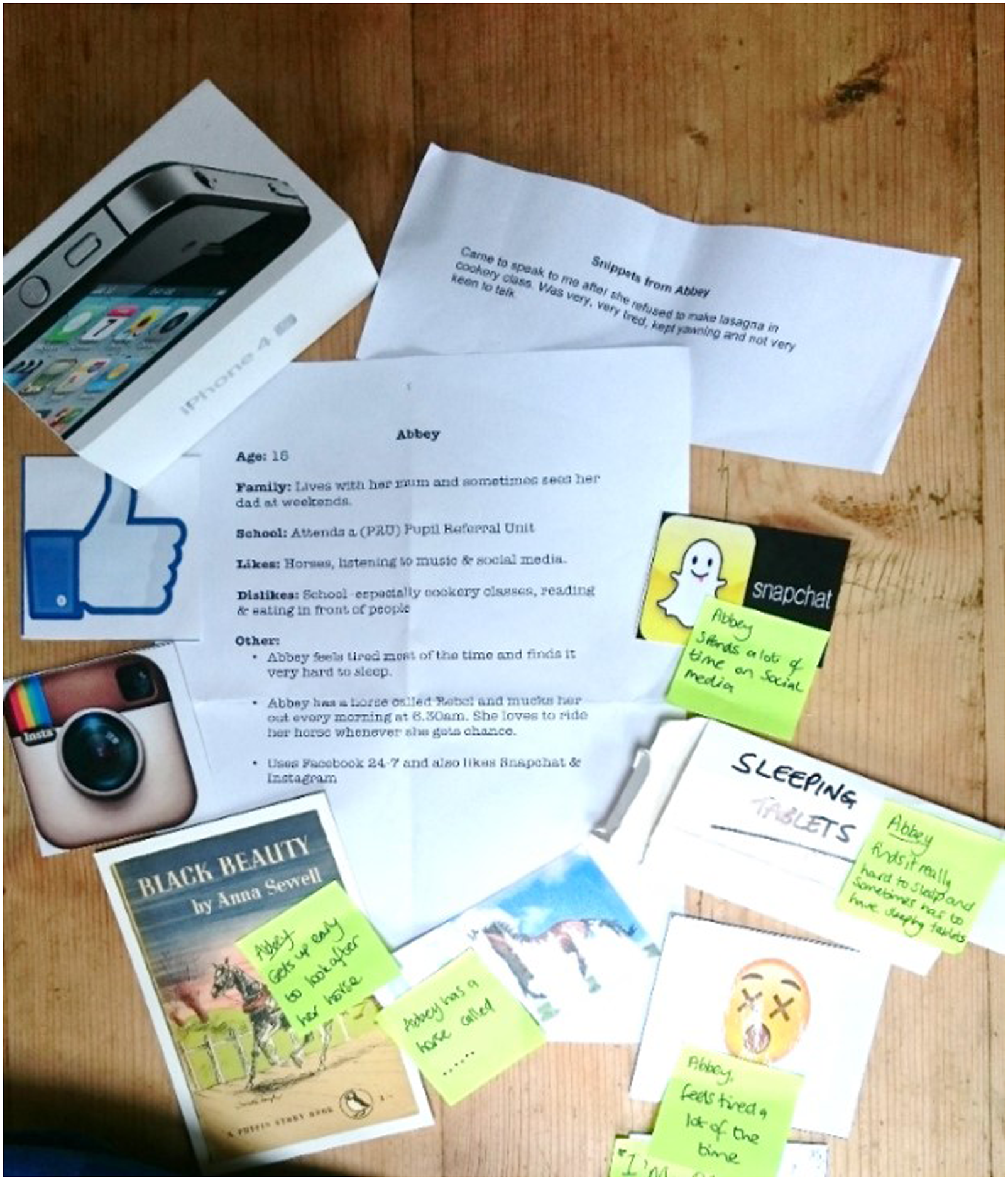
Cath found this reminiscent of Scene 1: she had again used her embodied knowledge and technical skill in facilitating groups to try to encourage engagement, but this was directive and desperate. Her first thought had been for the fellow academic who had put hours into creating these bags. YRs rejected the playful tékhnê displayed in the story bags, and the facilitation tékhnê Cath was trying to use. Through their silently communicated embodied knowledge (aisthêsis) that story bags are not a good approach to data analysis, YRs taught academics to diversify. Over the months that followed, ARs responded by sharing data to be analysed as words and larger meaning units, and then learning from YRs about how they might want to play with these. This included presenting complete interview transcripts and small chunks of transcripts which contained text that were considered potentially significant. Piles of small chunks on pieces of paper were then moved from one place to another. ARs and YRs worked in pairs, moving from analysis of their own stories to analysis of wider data. YRs identified elements in the data that they considered important and grouped them together. These groupings were used alongside predetermined themes (relationships, resources and ways of being), as the basis of NVivo analysis by ARs. The emerging framework of themes was then fed back to YRs using story dice and floor games that they cocreated. This helped identify whether themes (and illustrative data) remained coherent enough to enable further fictionalised storytelling (Satchwell et al., 2020). YRs contributed tékhnê and aisthêsis in terms of knowing how to appropriately play with data, and ARs contributed tékhnê in summarising content and use of data analysis software.
Photo 2 – Story Dice

Discussion
The findings from our reflective process are necessarily limited, as only two of the 18 strong intergenerational team engaged in these dialogues. Had young researchers taken part in this with us they would doubtless have indicated further ways in which they learned from each other or from academics. Their reflections are however captured in other papers (Dan et al., 2019; Satchwell, 2019) and here we have sought to challenge the greater orthodoxy: to highlight how academics learn from young researchers.
The contrasting studium and punctum identified by the first and second authors of this paper indicate that young researchers teach different things to different academics, according to who those academics are as well as the knowledge being mobilised in the moment. We found Aristotle’s conceptions of knowledge to be a useful heuristic device enabling us to identify diverse forms of knowledge that were being exchanged, but we recognise that this language may be inaccessible to some and what one of us understands as phrónêsis the other may describe as aisthêsis.
Our critical reflections indicate that more or less experienced academics learn from young researchers in ways that can increase our understanding of: • the different embodied knowledges (aisthêsis) and the technical competences (tékhnê) that different young people bring into the space of participatory research; • the need for transparency about facilitation (phrónêsis, aisthêsis or tékhnê) of cocreated spaces of shared learning, so that use of play and other methods can be agreed, rather than imposed; • the value and possibilities of young-researcher-led off-script peer interviewing (phrónêsis, aisthêsis or tékhnê); • how to mirror young researchers’ wisdom (phrónêsis or aisthêsis) about when to be in silent exchange in moments of interviewing; • how to embrace surviving difficult shared experiences as an opportunity to talk about difficult things (phrónêsis); • how to voice sensitive stories without exposing vulnerabilities and how to convey anonymised accounts as sociological fiction (phrónêsis, episteme and tékhnê); • how to play with data in creative and analytical ways to develop shared understandings (aisthêsis and tékhnê).
We also learned about how to learn these things, by being open and reflective in moments alongside YRs, by listening to what YRs communicated in words and actions, by stepping back to open out our vulnerabilities to each other, and by continuing to learn through our encounters throughout the multi-year study and the years that follow.
The moments of being-with in silence and breaking silence in our fieldwork we read as instruction on aisthêsis to stop interviewing and to start being together with wider groups of people for whom the boundaries of researcher, researched and research user merge. This finding is in contrast to Reich et al. (2015 cited in Montreuil et al., 2021), who suggest that involvement in data collection is an opportunity for children to learn about how to ask information gathering questions. In community participatory research contexts, as Peltier (2018) notes, it is almost inevitable that researchers and researched will know each other and this can increase the validity of our findings rather than undermining it. Some of this rich understanding comes from learning from young community members about how to learn in silence, and by sharing experiences, rather than by asking questions. The rich understandings that emerged from reflection on shared histories also provided insight into patterns of experience and breadth of data.
Burke et al. (2019) suggest that ‘the [academic] research team can only mitigate the risk of [unprofessional young people researching] by ensuring sufficient and ongoing training [including repeated mock interviews] and quality guides and tools in place to prompt peer researchers to ask follow-up questions’. We found that repeated mock interviews did not guarantee this. However, well-established relationships between ARs, YRs and participants in which ARs and YRs contributed tékhnê, aisthêsis and phrónêsis did promote caring, inclusive and safe fieldwork practice. Our conclusion is that there is need for ongoing reflection to create the conditions for learning from each other what to do in a given moment, to the extent of our capacities, and that YRs and ARs may express diverse forms of knowledge (at moments of preparing methods, engaging in fieldwork, sharing analysis and writing up findings) from which each of us can learn. Too much emphasis on academic models of research would train this out of young people, and remove academics’ opportunities to learn from them. ARs and YRs need time to repeatedly stop, watch and learn from young community researchers and each other to promote effective communication and data generation.
Conditions for phrónêsis become more likely, echoing Wagaman et al.’s (2018) and Larkins’ (2016) observations, when the entire group (YRs and ARs) participate in co-creating and maintaining norms for the group. This might require breaking away from binary divisions (young: old, academic: non-academic, researcher: researched, facilitator: trainee) to embrace collective spaces in which alternative phrónêsis may be possible. We therefore suggest caution is needed when tékhnê is being used by ARs, as it was in Scene 1 and Scene 5. As Montreuil et al. (2021) have noted, group facilitation is perhaps the most central ethical consideration of participatory research. In our practice, showing phrónêsis would have involved shared deliberation about what to do to achieve a shared ethically virtuous end, and the smooth functioning of the activities we have all agreed to and are participating in. Here the challenge for academic researchers is therefore to render more transparent the power and techniques of facilitation that could be used, letting go of the reins and being prepared to do the work that YRs ask us to do in support of their goals.
Some of the learning from our study counters the episteme (see Nind, 2011 for examples) that learning-disabled young people’s analysis of data beyond their own life is too challenging or risky. YRs showed us that reflecting on their personal data became a pathway into analysing data from other interviews and YRs also demonstrated skill in creating activities for data analysis. This is an important finding, about learning from YRs about how to do analysis, given that participatory analysis and interpretation are key steps in participatory research that are commonly overlooked or tokenistic (Montreuil et al., 2021).
We can also learn from the YRs’ request to include and analyse their own stories. We suggest that collaborative research requires that ARs also become subject to analysis, allowing the relationships between ourselves and others to become data accessible to the entire research team, not just ghosts that we call on or ignore when reassembling stories (Satchwell et al., 2020). Of course, social science academics are aware that our own lives affect how we interpret data (Killi, Moilanen and Larkins 2018), and very few of us consider that a fully grounded or bracketed approach to analysis is possible. But, in PAR, how many of us share our own stories and honestly reveal how these connect to the data? Future studies might usefully explore how we could do this in ways that are safe and provide resources for collaborative research.
Conclusions
We, Larkins and Satchwell, are two academics with differing backgrounds and disciplines. We did not recognise all of our own ontological and epistemological assumptions, our own expertise, safe spaces and areas of discomfort, until they were brought into the light through our application of Barthes’ concepts of studium and punctum. We would have benefited from using this deep shared reflection tool during as well as after the period of research. While time for contemplation becomes ever more scarce in the pressured environments inhabited by academics as well as community groups, without such reflection participatory research with children and young people risks falling into the same errors as other participatory activities: diluting its radical potential and attempting to make children conform to an established way of doing things (research as a tool for their education); co-opting them into neoliberal systems labouring to achieve other people’s aims (enhancing the success of grant applications or pathways to impact); or getting them used to disappointment (the fact that no matter what the truth is, systems and services do not always respond to research findings).
Given the extent of what academics can learn from children and young people about how to do research we suggest that it is useful to move away from training towards the notion of collaborative learning in participatory research with children and young people. The term collaborative learning emphasises that everyone in an intergenerational research team makes a unique contribution to orienting themselves and others to and through the field of study. It is hard to predict who in a team will contribute what knowledge to different research stages (facilitation of co-learning spaces, shaping inquiries, cocreating methods, identifying places of fieldwork, being together in field work in ways that allow thick understandings of voice to emerge, approaching analysis and developing findings). But if we acknowledge that there are diverse and valuable forms of knowledge that each team member might bring, and that the distinction between who knows what is not necessarily related to generation or academic status, there will be potential for greater transparency in our participatory research processes and richer understandings of the diverse lives and perspectives of participants in our studies.
Footnotes
Acknowledgments
The authors wish to thank the young researcher group UCan who cocreated and conducted the study on which this article is based.
Declaration of Conflicting Interests
The author(s) declared no potential conflicts of interest with respect to the research, authorship, and/or publication of this article.
Funding
The author(s) disclosed receipt of the following financial support for the research, authorship, and/or publication of this article: This work was supported by the Arts and Humanities Research Council, Grant No. AH/M001539/1, for project Stories to Connect: disadvantaged children creating ‘phygital’ community artefacts to share their life-narratives of resilience and transformation. Project website:  .
.