




Abstract
This paper introduces two methodological innovations designed to enhance the transparency, ethics, and creative rigor of youth-focused participatory research in mental health. First, we conceptualize ‘Invisible Ink’ as a metaphor for latent participant knowledge—insights rooted in lived experience that remain hidden without specific relational and analytic scaffolds. Second, we model ‘Backstage Cafés as emergent, informal third spaces where young people, researchers, and practitioners co-create trust, surface vulnerabilities, and negotiate power relations before stepping into formal research activities. Drawing on co-authored reflections from the UKRI-funded Attune and Create projects (n ≈ 200 participants, aged 10–24), we demonstrate how these tools operated across two iterative phases: (1) collaborative inquiry into ‘meaningful mess’—where uncertainty and vulnerability fuel creative exploration—and (2) management of ‘messy muddles’—complex ethical dilemmas and role ambiguities that arose in real time. Through a six-stage writing process combining surveys, interviews, collaborative coding, and a residential retreat, we illustrate how Invisible Ink and Backstage Cafés enabled genuine co-production of methodological insights, flattened traditional hierarchies, and sustained participant agency throughout data collection, analysis, and dissemination. Implications for qualitative and mixed-methods researchers include guidelines for integrating unstructured relational spaces, deliberately surfacing hidden contributions, and maintaining ethical reflexivity in long-term participatory endeavours. By foregrounding the dynamics of backstage processes, the behind-the-scenes activities that support the public facing participatory work, this paper advances participatory methodology beyond static frameworks toward a fluid, ethically accountable paradigm.
Keywords
Background
For Goffman, from whom the theatrical organising metaphor for this present collection is taken, the concepts of the ‘frontstage’ and ‘backstage’ are behavioural, referring to the ways in which individuals ‘perform’ everyday social interactions (1956). Manning (1989) refers to this as the ‘two - selves thesis’. Frontstage behaviour refers to that which is presented to others – the public persona conforming to cultural norms. Backstage behaviour is the private persona, often without the prevailing cultural expectations of behavioural standards and norms. Whist Goffman himself acknowledged the conceptual simplicity of the two personas (1959), they are a useful starting point and scaffolding for our emergent understanding of the processes and impact of our work. In this paper, we invert Goffman’s original perspective and use the structural and spatial affordances of the backstage metaphor to reveal, explore and understand the typically invisible and overlooked backstage processes in participatory research with adolescents and young people (10–24 years, hereafter young people).
Goffman also introduces the concept of Teams, referring to individuals who collaborate to stage a coherent show. These teams engage in collective impression management to maintain the frontstage presentation while coordinating backstage. This concept resonates strongly with our own experience, where the research team, including young people, academics, and professionals, functioned as a theatrical troupe (Team) to produce a powerful performance of participatory research. Youth participatory research can be defined and operationalised in multiple ways (Ozer et al., 2020). In our work it is an approach in which young people are intentionally and actively engaged as equal partners in all stages of the research. This means that youth lived experience was respected and valued as a body of knowledge within an interdisciplinary paradigm.
Whilst Goffman’s dramaturgical approach (1959) helps conceptualise the performance of individuals and groups, it does not sufficiently engage with a complex issue in participatory research – that of power (Foucault, 1998). Power in youth research can be defined in multiple ways (Spencer & Doull, 2015). In our work, as in most participatory research, power refers to the capacity or ability of individuals or groups to influence, control, or shape research. This includes the ability to affect decisions, direct resources, and determine whose voices and perspectives are prioritized or marginalized within the research context. Power asymmetry is often viewed as emanating from the traditional and entrenched hierarchies between adults and young people. This can have material effects as intersecting power dynamics and differing lived experiences profoundly shape both process and outcome (Bouchard, 2016). Nevertheless, the concepts of front stage and backstage remain pertinent to our reflections, particularly in making visible the layered and often hidden dimensions of collaborative work.
Project Context
Two highly participatory projects (Attune and Create) form the foundation of this paper. Both projects were set within the UK legislative and policy landscape, critically informed by The Healthy Child Programme (2023), Working Together to Safeguard Children (2004) and Transforming Children and Young Peoples Mental Health provision (2025). The projects were funded by the UK Research and Innovation funding council (2019–2026) on the Adolescence, Mental Health and the Developing Mind programme (MR/W002183/1 and MR/X0031). The Attune project aimed to understand the mental health impact and mechanisms of Adverse Childhood Experiences (ACEs) and to co-design arts and digital interventions (https://www.attuneproject.com). The Create project aimed to develop research methods to advance collaboration between researchers, young people and artists in youth mental health research, through the study of adolescent loneliness (https://create.leeds.ac.uk). Both projects sought to generate insight through an arts-based lens, creating equitable partnerships between an interdisciplinary group of researchers, artists, non-academic partners, mental health professionals and young people.
Participatory Practices Used in Attune and Create

Goffman’s metaphor (1956) provided the creative impulse for collaborative inquiry into our participatory processes. Our paper briefly sets out the range of participatory work on these projects before reporting our process for co-operative inquiry. We focus on the role of one participatory backstage process which was collectively felt to be highly influential in both projects, namely the Young Person’s Advisory Groups (YPAGs). YPAGs (also referred to as Youth Advisory Boards in other studies) are the most common form of youth participation in research (Hawke et al., 2018; Ozer et al., 2020; Sellars et al., 2021; Totzeck et al., 2024). However, their role is often presented simplistically as a backstage forum which can confidently and straightforwardly influence the front stage research ‘performance’. In this paper, we present how YPAGs themselves have generated several forms of backstage forums, which can be messy, muddled and sometimes murky, posing challenges to many assumptions about YPAGs as an uncomplicated participatory practice. We report four experiential themes which we collectively identified were going on ‘behind’ the YPAGs on Attune and Create. These were negotiated by two key ‘tools’ that the groups organically developed during project delivery: the ‘Backstage Café’ and ‘Ultraviolet Relational Light.’ We focus here on how the team used these tools, and the principles informing them, to move between the various ‘messes’ and ‘muddles’ that shaped their experience of both projects, to explore the new learning that has emerged in the process.
Participatory Research in Attune and Create
YPAGs in Attune and Create
YPAG Scaffolding

Our Collaborative Inquiry and Writing
The Six Stages of Our Inquiry and Writing Process for This Paper

To support genuine co-authorship, the writers’ retreat was a crucial activity aimed to balance the need to develop a collective understanding of insight and make decisions about what would be included in the paper with sensitivity to the levels of ‘readiness and comfort’ of all participants (Cahill & Dadvand, 2015). After the retreat, we collaboratively created task assignments and personal writing schedules. A subset of the group then refined the final draft of the paper for team review. Throughout the writing process, we sought to enact the very principles that our paper interrogates, namely the tensions between structure and spontaneity, the risks and possibilities of co-production and the movement between roles, spaces, and perspectives, demonstrating how participatory research must continually negotiate uncertainty, inclusion, and the diffusion of power.
Conceptualising Front Stage and Backstage
Backstage Dynamics: Tensions and Barriers
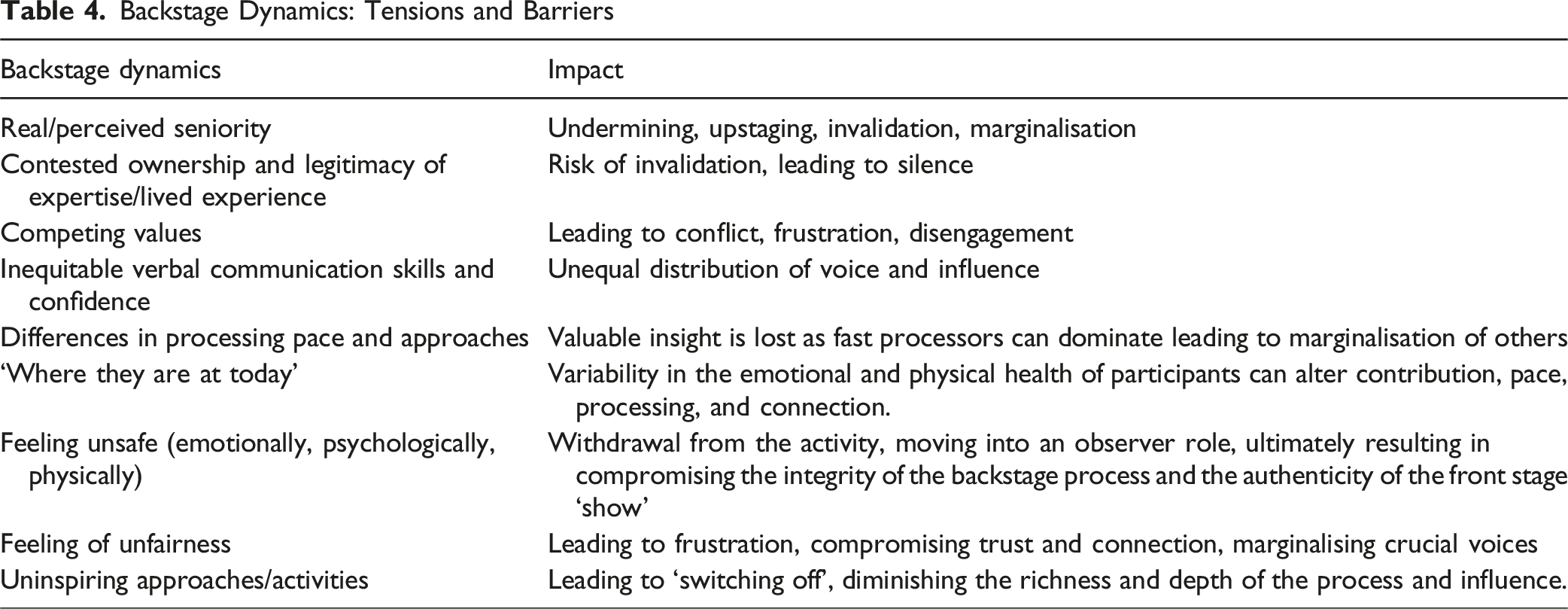
Conceptualising Mess and Muddle
Having conceptualised our use of key metaphors related to Goffman; we turn to their place in our reflections on the participatory work in our two projects. The troupe frequently emphasised the ‘messiness’ and ‘muddles’ of both backstage and frontstage participation. Here, we explain our orientation to these phenomena before surfacing the mess and muddles that relate specifically to the YPAGs in these projects.
Mess is typically understood as a situation that is disorganised, lacking clarity and with no immediately visible way through, not dissimilar to the backstage area early in the production phase of a show. Messiness was experienced at project start in Attune and Create, although it was perceived and tolerated differently by different people. For some, mess was tolerable, inevitable, and even welcome, suggesting a sense of permissiveness, opportunity, and openness. For others, it provoked anxiety and a desire for order, and if not resolved, could prompt them to leave the messy situation entirely. Yet in both projects, mess captured what the group perceived as the tremendous sense of potential and excitement they felt in shaping the research in truly exploratory and collaborative ways. The mess of collaboration was not seen as an obstacle to be overcome but an integral part of the creative and ethical negotiations required in this kind of research – in this way it was meaningful. Yet meaningfulness itself did not negate discomfort for some, and attention and care for individuals was needed. Critically, and as we shall discuss further below, if not carefully managed, ‘meaningful mess’ could quickly be experienced as what we collectively termed ‘messy muddles.’ In contrast to meaningful mess, messy muddles were not planned or anticipated. They were dilemmatic and tended to be experienced as a personal problem which came with an invisible emotional cost. Individuals’ experience of messy muddles felt to them as though they risked the authenticity of the frontstage performance. For the projects to work, the group needed to find ways to negotiate or move between muddle and mess (and sometimes back again) to put on its show.
Meaningful Mess and Messy Muddles in the Work of the YPAGs
Taking meaningful mess and messy muddles as our organising concepts, using an inductive approach, informed by collectively analysing and coding whiteboard content, interview data, and team field notes over multiple iterations towards consensus, we identified themes within each that characterised the YPAGs’ backstage processes. For meaningful mess, these were (1) vulnerability and (2) uncertainty. For messy muddles, themes were (3) ethical issues, and (4) roles, responsibilities, and power relations. Acknowledging the need to move between, and ultimately the value of, both meaningful mess and messy muddles in our projects foregrounded the importance of navigation through our research ‘theatre’ via open and inclusive negotiation, a process that was facilitated through two key tools: the ‘Backstage Café’ and ‘Ultraviolet Relational Light’. These tools helped to scaffold participation in the project, supporting what Barad defines as ‘intra-action’ (Barad, 2007), i.e., how agency is mutually constituted, or emerges through multiple interactions, offering a way to rethink how all the elements in the projects connect, collaborate, and individuate.
Tool 1: The Backstage Café as a Safe Third Space
The Backstage Café was conceptualised as a helpful, informal social sphere, organically created separately by young people, professionals, and researchers as a place to talk safely about the mess and muddles of the work, and how to find movement through them. The various café spaces that emerged were neither in the project nor outside of it. in the process of authoring this paper, we have identified that there was not a single event or activity in the project where these cafés did not play a role. Initially, it appeared that several different cafés were created. However, as collective ownership of the project developed over time it became easier to conceptualise these as a single café space with multiple booths. Some people might meet for regular catch-up chats over the course of the project, while others might have a fleeting encounter with someone else that they met by chance who was talking to another member of the ‘troupe.’
All Backstage Café encounters had a degree of influence on people, and subsequently the participatory elements of both projects. By creating a safe ‘third space' (Bhabha, 1994) beyond the frenetic activities of the backstage processes that directly supported the front stage show, the YPAG members, professionals and researchers could acknowledge the mess and muddles they were seeing or encountering and could be emotionally honest about their uncertainties and vulnerabilities. Flattening of power dynamics were experienced due to the informality of the café and the fact that people chose to go to the café for meaningful, relational contact and a joint purpose of navigating difficulties. The members of the YPAGs described the café space as a tool i.e., once the Cafe had organically emerged, young people intentionally sought it out to help with a problem (as one would a tool). The Cafe facilitated access to peer support and created a community for themselves (without adults) within the projects. In this co-constructed space, they felt able to share their own vulnerabilities on the projects, and find commonalities in ideas for, and from, their work on the project. In turn, this helped young people to develop more cohesive and defined responses to their participation. Often, they decided to bring their backstage café discussions, insights, and ideas to the YPAG and project delivery. In this way, young people employed the Cafe to claim and enact power in their participation, pointing to another dimension of the Cafe as a tool. Observation of the inclusivity of the Backstage Cafes was noted. It is possible that deeper analysis of the Cafes may have surfaced further complexities, but for our projects the process of emergence remained inclusive and collaborative. For the researchers and professional team members, a separate Backstage Café was similarly co-created and visited to negotiate complexities in the project, often related to power relationships and their influence on project decisions. They felt that, via Café discussions, in which they forged alliances and trusted relationships with colleagues over time, they were able to scaffold the project more effectively, and in doing so make the research more navigable and equitable for young people. In this way, the Cafe was also a tool for researchers.
Tool 2: ‘Ultraviolet (Relational) Light’ as Way of Understanding Latent Knowledge (Invisible Ink)
The idea of ‘Ultraviolet (Relational) Light’ served as a conceptual tool for understanding how to surface latent knowledge, referred to by our participants as ‘Invisible Ink’, that which is present but remains undetected until the right conditions reveal it. Ultraviolet light can cause materials to fluoresce or glow. This conceptual tool is particularly relevant in contexts where cognitive limitations, structural constraints, or interpretive biases obscure critical insights, making them imperceptible to the naked eye of conventional research practices (Rocca et al., 2017; Schrepp, 2005). Lived experience knowledge is not always immediately accessible or consciously recognised; some forms exist in a latent state requiring specific cognitive, analytical, or technical instruments, like the use of ultraviolet light, to surface it and engage with it. In spaces where power dynamics, entrenched hierarchies, or institutional structures dictate what can or should be visible. Without intentional use of reflexive dialogue, mutual recognition, and sustained engagement (the Light), this hidden, significant knowledge risks being undervalued or dismissed. The success of any collaborative or knowledge-generating process, therefore, does not solely depend on what is immediately observable, or observably valued, but on the extent to which the ultraviolet light can surface the invisible ink of embedded knowledge.
This is a further feature of our practices where the making visible of the invisible moves beyond Goffman’s traditional model to be more aligned with post-dramatic staging which emphasizes presence and experience over narrative (Lehmann, 2006).
Young people felt that, as they began participating in the YPAGs, backstage they experienced vulnerability, connected to whether their ‘invisible ink' (knowledge) would find a place for expression in the projects. Often the potential of this ‘invisible ink’ was revealed through interaction with the projects’ other key tool: the Backstage Café. In their Café encounters, some shared lived experience in the third person, some watched how other young people shared their experience and what response this elicited, whilst others decided to ‘take a leap’ and hope for the best. In the process, young people were able to test if their knowledge was valued, if their ‘invisible ink’ could become visible and so part of their contribution to the projects’ performance. What helped in this endeavour was repeat contact with the rest of the group, particularly the researchers and professionals, which young people felt built predictability about how their encounters would go, how their ‘ink’ could and would be ‘read’. These approaches appeared critical to the development of the Ultraviolet Relational Light tool.
In the next section, we present examples of the themes that emerged from our exploration of ‘meaningful mess’ and ‘messy muddles’.
Theme 1: Uncertainty as Meaningful Mess
Backstage, everyone is uncertain, particularly before the performance/project starts. Goffman (1956) suggests there will be different strategies to negotiate this anxiety with the team expected to work together to manage the presentation of the collective (and conceal anything that threatens cohesion). As participatory researchers, the team developed the proposals building in some uncertainty into the projects as a critical lever for collaborative discovery. In this sense, although uncertainty can appear disorganised and be tricky to tolerate, it was mostly purposeful and expected by the academics and crucially at funding stage accommodated. However, this was not always how it was experienced.
In the YPAGs, young people were initially generally uncertain about whether the project would be an enjoyable experience for them, would accommodate and welcome them (especially regarding diversity, disability and neurodivergence) and if they would be able to influence the project outcomes. Many were also uncertain as to whether they had truly grasped the aims and methods of the projects. Overall, their response to this uncertainty was an emotional but positive one: to fundamentally trust the projects as they had a ‘gut feeling’ that they were good for young people. They reported watching for signs that their trust was well placed. Key signs for them were: (i) the research team naming their own uncertainty and importance of learning together; (ii) noticing how the team was accommodating individual needs to support inclusion; (iii) continuity of offer for multiple project opportunities, which allowed young people to reflect on their own preferences and enact their agency; and (iv) creating certainty via the Backstage Café with other YPAG members, where they felt more helped by each other than by researchers or professionals to understand the projects’ aims. Notably, young people reported that they were comfortable with things not working well in the YPAG straight away and thus tolerated some uncertainty backstage.
Conversely for the research team and other professionals involved in the project, key uncertainties were whether the YPAGs would like and accept them, enjoy the work, be able to move at a required pace and tolerate missteps by the team, if the team could manage any safeguarding issues without disrupting relationships and work, as well as managing different discipline expectations of the young people and the process, all worries that are reported more broadly in the literature (Warraitch et al., 2024). Researchers and professionals were also unsure if they would be able to convey complex, sensitive material to the YPAG members in age-appropriate but non-patronising ways. Such concerns emerged from a genuine intention to counter adultism and empower the young people (Bettencourt, 2020). There were additional feelings of nervousness about getting the tone wrong and that the stakes were high and often resting on a few members of the research team, as a failed YPAG backstage could mean failure frontstage. A failed YPAG backstage might mean, for example that the young people felt invalidated. It might also mean that language and communication barriers caused young people to mask, performing to conform to what they perceived to be expectations of academic codes of practice.
The research team and professional staff navigated this uncertainty by, at the start, de-prioritising the project work to focus instead on relationship building, which included naming their own limitations and fallibility, and seeking permission from young people to get things wrong. Such attention to relationship building was crucial to the retention of young people (Shamrova & Cummings, 2017). Researcher and professional uncertainty led us towards helpful hypervigilance (or ‘sustained attention’ Ozer, 2017) in our YPAGs, watching what was happening in meetings and responding quickly to respect individual needs, as well as to repair failures or missed opportunities for inclusion. Such responsivity was essential for movement towards relational certainty. As more project opportunities became available, these were offered repeatedly to YPAG members to affirm a hope for a long-term working relationship with them. Via the Backstage Café, researchers reflected continuously on the reality of their experience of the YPAGs as sites of influence, as opposed to their potentially idealised role ‘on paper’, as they tousled with the tension of a genuine invitation for youth influence but without knowing if they could act on youth knowledge and preferences, and what it would mean for youth empowerment if they failed in this regard.
Uncertainties in YPAGs for young people and the researcher team and professional staff were emotive, stemming from relational newness and because the promise of power (via participatory processes) to influence both the live projects and future policies and practices could only be rendered true over time. Such orientations suggest the inevitability of biases and assumptions about participatory practices on both parts (Teixeira et al., 2021).
Theme 2: Vulnerability as Meaningful Mess
Both projects explored mental health, trauma and adverse childhood experiences. Reasons for participation were never purely functional nor transactional, but were often personal and emotional, driven by a desire for one’s lived experience to count for something and to bring good out of bad. Despite such convictions, these were, at times, brought into tension with unsettling vulnerabilities felt backstage by the young people, researchers, and professionals. We categorise vulnerability as meaningful mess, as it was felt to be uncomfortable and scary but necessary to advance relational contact and trust in the participatory work.
In the YPAGs, described as emotional spaces, many felt unsure of the consequences of sharing information about themselves, their lives, and their views. Some did not know if they would be included, left out or ignored by peers or researchers and other members of the group, a feeling especially keen for those with communication support needs. Regardless of the type of vulnerability, it felt deeply private and invisible to begin with, with young people unsure what to do with this feeling. Overtime, engagement with the Backstage Café and Ultraviolet Relational Light enabled the unseen, unheard, but felt, to be expressed, and in the process surface new knowledge about the value of vulnerability as a way of driving participatory learning, ultimately informing the project’s final performance (‘ACEs the Statistics', ‘Mental health and Change' and ‘Disrupting the Silence') (Films, 2025) The following case study describes one example of how meaning was made in this case purposively out of mess.
Case Study: One Young Person’s Account of Using the Projects’ ‘Tools’ to Make Meaning Out of Mess
This case study highlights the role of power, facilitation, and relational trust in making mess meaningful. Initially constrained by testimonial injustice (Fricker, 2007), this young person’s voice was overlooked despite structural inclusion (i.e., lacking in Relational Light). A shift occurred when a new youth worker joined the project and adopted a more engaged and responsive approach, using active listening, adaptive communication and emotional validation (Relational Light). From this new relationship emerged their own Backstage Café where the young person transitioned from passive observer to active participant. Participation is not merely about presence but is actively shaped by facilitation and interpersonal dynamics and effective facilitation that goes beyond procedural inclusion to actively challenge power imbalances and create environments where all contributions are recognised and valued. In our porject, this allowed critical latent knowledge/contribution to be shared making this young person’s ‘invisible ink' visible.
Surfacing her latent knowledge not only improved her experience of the project and facilitated her physical inclusion in YPAG discussions, but it also informed the ways in which the project team understood communication itself. Figure 1 shows the account this young person gave of her story using Widgit symbols, a visual communication tool that enhances accessibility and expression. This form of communication provided a new dimension to the ways in which visual arts played a role in this project. The full story spans 11 pages, with one example page shared here to illustrate the narrative. The remaining pages can be found in the supplemental materials. One young person’s experience of participating in Attune
The research team and professional staff also experienced vulnerability in relation to the YPAGs, especially given the present-day power of ‘cancel culture.’ They carefully chose who they would be emotionally open with by self-managing invitations to share lived experiences, not knowing what would be shared by young people in YPAGS and feeling responsible to minimise re-traumatisation that can come from hearing someone else’s story (young people referred to this as a ‘trauma-dumping’).
Like young people, the research team and professional staff navigated vulnerabilities by taking a risk and placing trust that good intentions and authenticity would buffer the impact of missteps. This often involved accepting accountability for their actions; saying sorry for missteps, mishearing, invalidating responses or not delivering on promises, highlighting that engaging in participatory work is not research as usual but requires self-reflection, flexibility, and humility (Israel et al., 2001). To this end, researchers and professional staff also acknowledged the value of the Backstage Café to manage their vulnerabilities.
In sum, meaningful mess provides the initial context within which (to return to, and continue to extend, Goffman’s metaphor) our theatre troupe worked as a team to surface, acknowledge, and negotiate, both collectively and individually, its vulnerabilities and uncertainties about participating in the projects. YPAGs rest on relational processes, and associated tensions; vulnerabilities and unknowns cannot be avoided purely by using any preordained guiding principles for participatory research. Instead, they must be actively used to help shape the work, a process that was further facilitated in our case by the Backstage Café and Ultraviolet Relational Light.
Theme 3: Messy Muddles in Participatory Ethics
We characterise muddles as issues emerging out of meaningful mess. These are backstage experiences that are dilemmatic and often felt personally and invisibly best described as moments when the sense of mess overwhelms that of meaning to become muddles. We identified a prevailing muddle in the work of our YPAGs around the ethics of participatory work. In our ethics muddles, for the researchers and professional staff, concerns often centred around safeguarding. A repeatedly encountered backstage dilemma related to the fear that our participatory practices might harm vulnerable young people. This is a common concern in participatory research (Wilson et al., 2020; Teixeira et al., 2021). We experienced tension creating and maintaining safe research spaces, as sometimes our protective agenda (to not ask) could exclude or silence the perspectives and experiences we most needed to hear about. Our dilemma was intense in Attune which focussed on multiple ACEs (Butcher et al., 2023; Pavarini et al., 2021) and our need to be trauma-informed (e.g., Alessi & Kahn, 2023; Zehntner et al., 2024).
Ethical dilemmas surfaced in our YPAGs. For researchers, despite applying our protocols and carefully scaffolding our participatory practices, there were times when the spontaneous discussions could be traumatising, a particularly difficult form of ‘muddle’ that could not be brushed aside. Such disclosures cannot be predicted nor shut down; what is helpful, even therapeutic to one person can lead to withdrawal by another. Such moments were experienced with some fear by researchers, who felt accountable for managing difficult conversations. Researchers navigated this ethical muddle in three ways. First, they were helped by young people themselves who pushed them (at the stage of writing the bid) to be courageous in this work and not to avoid difficult topics. This backstage direction was a source of constant anchoring. Second, the project drew upon the UK government vision; ‘Liberating the NHS: No Decision about Me Without Me’ (DoH, 2012), which, whilst NHS patient-focused, resonated with our work; patient (in our case young people) first, increasing patient (young people) voice and improving patient (young people) choice. Third, our art-based activities provided a way of creating safe engagement that collectivised and created distance from trauma by filtering it through an artistic process (Swanepoel & Conradie, 2023). We recognise, however, that there is a fiercely debated impulse in arts-based participatory work, in which the prioritisation of ‘safety’ over ‘risk’ can itself be seen to undermine any transformative potential that artmaking might have (Shaughnessy, 2005), to instead become a way of coopting participants into a set of activities that prioritise being involved in the process of art production rather than focussing on the value (be that defined in terms personal or social transformation) of the art produced (The May Group, 2025: 76–77).
Our projects adopted ‘No Participation Without Me about Me’ as a guiding principle from the preliminary stages of the project. By repeating this mantra and applying it to every stage of the research process, both projects actively reduced the risk of unintended silencing. Furthermore ethically-sound participatory research in this context is informed by UK safeguarding legislature (Working Together to Safeguard Children, 2004), policy frameworks (UK Policy Framework for Health and Social Care, 2023), ethical guidance (ERIC, 2013), and operationalised models designed to empower, be inclusive and accessible (Pavarini et al., 2021; Rowland et al., 2024). Yet none of this eliminates the tensions and decisions individuals must navigate ‘in the moment.’
Theme 4: Messy Muddles in Roles and Responsibilities
In participatory research, professional staff (arts practitioners/youth workers/project managers etc) play a crucial but often under-recognised role in facilitating engagement, safeguarding participants, and shaping research outputs. Unlike academic researchers, their contributions remain fluid, adaptive, and frequently invisible, potentially leading to a further messy muddle: misunderstandings regarding roles and responsibilities, which can also lead to tensions in the way power operates across the troupe. Goffman’s dramaturgical model clarifies these tensions. Leadership in Goffman’s model of dramatic theatre often involves navigation of both front and backstage spaces, smoothing transitions and maintaining morale while protecting the frontstage show. However, in participatory practices, where divisions between the frontstage and backstage are more blurred, leadership itself becomes participatory. Indeed, the ethical complexities of participatory youth research, shared vulnerabilities, uncertainties, and invisible labour, arguably require an emphasis on relational navigation, mutual accountability, and reflexive decision-making as shown in Figure 2. Messiness of participatory ethics
These complexities were experienced in several ways in our projects, in one example one of our professional staff perceived themselves to be or felt that they should/could be seen as equivalent to a youth member of a YPAG, rather than a facilitator who is distinct from the young people involved. They explained their own backstage uncertainty vis-à-vis their role and responsibilities: “Am I meant to be active here? Should I contribute, or step back? Where does my expertise intersect with young people’s voices?” This role ambiguity can impact the participatory process, affecting both the professional’s confidence and young people’s agency, and is an under-researched area in the literature (Williams et al., 2023).
Art practitioners influence participatory research yet often lack formal recognition as co-producers of knowledge. They often hold considerable ‘editorial power,’ for example the way they set up a workshop shapes the way young people present ‘their’ story. As one member of the troupe noted, “Creative choices are never neutral. The way we shape stories impacts how youth voices are heard and understood.” Decisions around framing, sequencing, and narrative structure influence how young people’s experiences are presented, yet this influence often remains unexamined (De Vecchi et al., 2016; Gubrium & Turner, 2011). Ignoring this aspect of participatory practice runs the risk of reproducing testimonial and hermeneutical injustice (Fricker, 2007), where certain contributions, while essential, are undervalued. This highlights the hidden power dynamics within participatory research, where practitioners shape representation but remain outside the formal research narrative. The risk here is the reifying of the artwork as a direct work of young people without valuing the influence of the practitioner in shaping the elicitation and framing of what we call ‘youth knowledge.’
Managing Mess and Muddle
The golden thread that holds participatory work together is relational trust, which determines whether backstage messes and muddles lead to generative collaboration or reinforce exclusionary hierarchies. All participants felt that if participatory projects are to function effectively, honouring the values and practices and potential of participatory research, participants—whether young people, practitioners, professionals or researchers—must commit to deep, sustained relational engagement. Such engagement requires an ethics of care to ensure that participation is genuine, reciprocal, and emotionally safe.
Cahill et al. (2007) describe participatory ethics as “embodied, engaged, and negotiated collectively” (p. 307). This was seen in our projects -the Backstage Café as a way for young people, researchers and practitioners to experience mutual support and trust, that in turn, enabled the research.
That said, power muddles in participatory research must be actively worked through via relational accountability, mutual investment in trust-building, and open and ongoing negotiation of roles and responsibilities. In Attune and Create through this focus we sought to move beyond surface level inclusion and create a research culture where power was genuinely shared across the group.
Discussion
Warraitch et al.’s (2024) recent review of the challenges in participatory health research with adolescents situates barriers at the level of organisational readiness, researcher preparedness to engage well with adolescents, and difficulties in working effectively and ethically with adolescents. This list mirrors wider reviews of participation in health research (Ocloo et al., 2021). Whilst helpful, our work seeks to move past a list of challenges to make visible the contrasting perspectives of young people and research teams in the key backstage processes of participatory work, using them as dynamic starting points for our discussion of the potential of youth-focussed participatory mental health research. A key recommendation that has been highlighted across multiple reviews is the need for more guiding resources and training for adolescent participatory research (e.g., Das et al., 2020). Within this agenda, there is a dominance of frameworks and guiding principles, but these can only take us so far and may even risk obfuscating the complex personal and relational processes invoked for all who have a stake in the participatory work (Wulf-Andersen et al., 2021). We argue that such training should consider the backstage processes for all age groups and roles in projects, to open the realities of the backstage uncertainty, vulnerability and emotional labour and the potential of both Backstage Cafes and Ultraviolet Relational Light to help. Training should also help everyone involved in participatory work in a project to identify and tolerate backstage nerves, vulnerability, and their dynamic relationship to the frontstage show.
Goffman’s metaphor of front and backstage has been helpful to us in our reflection on the participatory research in Attune and Create. We examined how participants experienced the backstage processes involved in this work (specifically the YPAGs) as a negotiation between ‘meaningful mess’ (uncertainty that could be marshalled through the projects’ use of creative practices to generate new learning) and ‘messy muddles’ (perceived as more dilemmatic moments).We also recognised the limitations of Goffman’s model of dramatic theatre for the realities of participatory practices where the distinctions between front and backstage are more nuanced due to the role of lived experience in participatory research and the interactions between the personal and the public face of the research. We align our approach with the post-dramatic paradigm associated with contemporary forms of theatre which is non illusionist and in which the barriers between audience and performer are more blurred. Ultimately, both meaningful mess and messy muddles proved necessary to the final production of the projects’ frontstage show (with some backstage processes visible). The continuous negotiation between uncertainty and structure, power, and vulnerability, engagement, and withdrawal, mess, and muddle, were not obstacles to participatory research but their very essence (Shaughnessy, 2012).
Two crucial tools surfaced as key to navigating mess and muddle in our work. The concept of ‘invisible ink’ emerged as a powerful way to conceptualise unseen contributions, latent knowledge, and hidden power structures within participatory research. Just as ultraviolet light reveals invisible ink, participatory research requires the right conditions—trust, facilitation, and relational scaffolding—to surface the knowledge of all participants. The ‘Backstage Café’ emerged both organically (but initially purposively in the case study example which led to engagement in the collective organic emergence of the youth troupe Backstage Cafe) as a space where invisible ink could be more readily made visible than in the project’s more formal spaces. It allowed participants to process their experiences, challenge hierarchies, and find clarity in the mess before stepping into the structured research. This fluid, unrecorded space reinforced the importance of reflexive dialogue—where young people and researchers alike could explore the tensions between visibility and invisibility, agency, and equity. Young people and researchers in this paper use the concept of tools loosely, to capture their usefulness to help us with certain issues or to deliver certain values.
Central to the way both tools functioned was the need for a sense of deep relational trust that bound our theatre troupe together, despite shifting roles, power dynamics, and uncertainties. Some participants initially remained invisible in discussions, feeling uncertain about their contributions, while others stepped forward only after finding validation through relational scaffolding. However, good relationships alone do not automatically ensure equity. The risk of hermeneutical injustice (Fricker, 2007)—where dominant discourses obscure participants’ understanding of their own experiences—remains a challenge in participatory work. Traditional academic structures privilege certainty, objectivity, and linearity, while participatory work thrives on mess, fluidity, and adaptation. The challenge is to acknowledge and embrace this complexity without reducing it to conventional, and we would argue inadequate, traditional research paradigms.
Recommendations for Future Participatory Research

Here we offer approaches based on our experiences that may be helpful for participatory research troupes (Table 5).
Conclusion
This paper explored how participatory arts-based research is shaped by both visible (frontstage) and invisible (backstage) dynamics. Using Goffman’s theatrical metaphor, we reframed participatory research as an evolving, wonderfully and meaningfully messy process which young people, researchers and professionals navigate with exceptional ingenuity and commitment to deliver powerful new research knowledge.
Rather than viewing uncertainty and emotional labour as barriers, we found them to be central to ethical and inclusive engagement. The metaphor-based tools of Ultraviolet Relational Light and Backstage Cafés revealed how deep knowledge and collaboration often emerge outside formal structures—through trust, reflection, and shared vulnerability.
Making invisible contributions visible requires intentional recognition, facilitation, and power-sharing. By embracing mess and muddle as part of the process, and centring relational trust, participatory research can challenge hierarchies and honour the agency and expertise of those it seeks to serve.
Supplemental Material
Supplemental Material - Backstage Participation: Mess and Muddle in Youth-Focused, Arts-Based Mental Health Research
Supplemental Material for Backstage Participation: Mess and Muddle in Youth-Focused, Arts-Based Mental Health Research by Syeda Sana Batool, Grace Bennett, Paul Cooke, Jack Hanrahan, Siobhan Hugh Jones, Srhya Lalh, Danelle Lee, Anna Mankee-Williams, Nina Piotrowska, Nicola Shaughnessy, Imogen Warren in International Journal of Qualitative Methods
Footnotes

Ethical Considerations
Ethics approval: REC Reference 23/WM/0105.
Consent to Participate
Written consent was secured for all youth participants.
Author Contributions
This paper is a co-produced by academic researchers, young people with lived experience of ACEs, and professional stakeholders. All authors contributed to the design, analysis, and writing. All authors have reviewed and approved the final manuscript.
Funding
The authors disclosed receipt of the following financial support for the research, authorship, and/or publication of this article: This work was funded by the UK Research Innovation (MRC/AHRC/ESRC) Adolescence, Mental Health, and the Developing Mind Programme; grant numbers MR/W002183/1 and MR/X0031.
Declaration of Conflicting Interests
The authors declared no potential conflicts of interest with respect to the research, authorship, and/or publication of this article.
Supplemental Material
Supplemental material for this article is available online.
References
Supplementary Material
Please find the following supplemental material available below.
For Open Access articles published under a Creative Commons License, all supplemental material carries the same license as the article it is associated with.
For non-Open Access articles published, all supplemental material carries a non-exclusive license, and permission requests for re-use of supplemental material or any part of supplemental material shall be sent directly to the copyright owner as specified in the copyright notice associated with the article.
