




Abstract
Understanding how different individuals experience and adapt everyday spaces is important for spatial design to become more inclusive. Unfortunately, in their work, spatial designers (e.g., architects) often refer to normative data about human behavior that exclude or stereotype those who fall outside the norm. There is a need for approaches capable of capturing human behavior within everyday contexts in greater depth. This paper introduces SpaceScript, a qualitative research method that combines theatre-based improvisation with real-time interaction to access the lived, embodied, and relational dimensions of spatial experience. It offers an agency-centered approach, enabling participants to co-create scenarios, adjust environmental elements, and explore comfort strategies through active, improvisational play. Grounded in participatory research, improvisational practice, and embodied inquiry, SpaceScript uses scaffolded, scenario-based exercises that prompt movement, adaptation, and reflection. Rather than relying on recall or fixed tasks, the method generates insights through active participation, revealing how comfort, accessibility, and social dynamics are shaped through memory, experimentation, and interaction. This paper details our development of SpaceScript and presents findings from applying it with older adults, a population often underserved and stereotyped in research and design. SpaceScript actively engaged participants in trial-and-error discovery, spatial problem-solving, and collaborative meaning-making. The method surfaced subtle dynamics, such as the contrast between perceived and actual comfort, the creative reinterpretation of spatial objects, and the ways participants constructed meaning through memory, experimentation, and dialogue. Beyond data collection, SpaceScript fostered social connection by offering participants a playful, collaborative space that encouraged interaction and reduced isolation. SpaceScript adds a participatory and embodied approach to qualitative spatial inquiry, one that captures not only how different people navigate space, but also how they construct meaning, solve problems, and engage socially through their environments.
Keywords
Introduction
Picture this: in a dimly lit room, Polly carefully navigates toward empty chairs, pausing where shadows deepen. From a traditional behavioral observation lens, we might have simply noted the difficulty of finding a seat in low lighting. But with SpaceScript, we did not just observe; we engaged. Together with Polly, we adjusted furniture, moved objects, and tested different spatial cues. She explained how textures and light patterns help her orient herself and build mental maps in daily life. These cues were essential landmarks that fostered her confidence and sense of control. That moment changed how we saw lighting. It was not just an environmental factor to mention in passing; it was a crucial part of Polly’s spatial experience. This realization reshaped how we designed the next exercises and rethought the workshop setup. Session by session, SpaceScript evolved into a dynamic tool, shaped by participants’ experiences and responses, revealing new layers of older adults’ engagement with space.
Researching age-inclusive design revealed that established methods for capturing socio-spatial behavior only offer limited insights. Post-occupancy evaluations, ergonomic evaluations, or observation-based behavioral data often capture movement and adaptation strategies but miss the motivation and emotional reasoning behind them. They are especially limited in understanding how unique populations, like older adults, navigate complex sensory, cognitive, and mobility conditions and engage with space in embodied and socially situated ways that unfold over time. To address this gap, it is necessary to devise a method that enables participants to engage actively, reflect on their actions, and iteratively test spatial experiences as they unfold.
In that effort, we developed SpaceScript: a qualitative method that uses improvisational, scenario-based exercises to explore how individuals relate to and shape their environments. It centers agency, movement, memory, and interaction as values co-constructed with participants through their active choices and reflections, rather than static outcomes observed from a distance. SpaceScript began by adapting improvisational theatre techniques inspired by Viola Spolin (1999) to foreground bodily, spontaneous interaction with space. These techniques were combined with selected principles from behavioral observation and participatory action research (PAR) to create exercises that support real-time reflection, collaborative environmental adaptation, and iterative learning. The method was refined with input from professional performing artists who were familiar with improvisation. Only after this conceptual groundwork and practical prototyping was the method applied in an empirical setting with older adults, whose experiences then guided further iteration and responsiveness.
In this paper, we introduce SpaceScript as an evidence-based, participatory method for exploring lived spatial experience and capturing diverse behavioral variables. Because participants co-create and reflect on their experiences, the method reveals behavioral cues, social dynamics, and meaning-making processes that otherwise remain hidden. The method thus offers applicable principles for researchers and practitioners seeking collaborative data that emerge through dialogue, experimentation, and embodiment.
Embodiment, in this context, refers to how spatial experiences are shaped through the moving, sensing, and interacting body, as understood in spatial research and architectural theory. Rather than treating space as a neutral backdrop, embodiment research emphasizes how people perceive, interpret, and adapt to their surroundings through physical presence, memory, and motor engagement. This responds to Pallasmaa’s (2012) work on sensory integration and corporeal presence in spatial understanding and draws on Böhme (2016) insights into atmosphere as the space’s general quality and feel which emerges from the interplay of bodily presence and spatial conditions. Embodiment is also seen as collaborative, where spatial meaning is co-created by space users through attentive movement and everyday practice (Ingold, 2002). This framework informs the participatory activities of SpaceScript, the types of data collected, and analytical methods equally, allowing researchers access to implicit indicators of embodiment through observable actions.
In the following sections, we outline SpaceScript’s theoretical grounding and development, describe its pilot application, and reflect on its methodological and ethical contributions.
Review of Established Methods in Spatial Research
The need for a methodological shift in spatial and behavioral research becomes clear when examining established approaches that study social behavior and comfort for design purposes. While spatial research has long relied on observational and ergonomic techniques, these often privilege executed behaviors over lived experience, overlooking how individuals actively interpret, adapt to, and shape their environments. This section identifies limitations in relevant spatial analysis methods and points to developments in participatory, performative, and embodied research as potential solutions.
Observational Methods
Observation-based tools such as behavioral mapping, time sampling, and event coding have long been used to study social interaction and spatial use (Altman, 1975; Ariza-Vega et al., 2019; Rebola et al., 2013). While widely used to study daily routines, social interaction, and movement patterns (Yu et al., 2021; Zhang et al., 2022), these methods often reduce behavior to visible action, offering limited access to the motivations or sensory dynamics behind spatial decisions. Supplementary interviews are frequently employed to address this gap (Groat & Wang, 2013), yet post hoc recall can be filtered through memory lapses, internalized stereotypes, or a desire to conform to expected narratives (Bell et al., 2019; Raphael, 1987).
More fundamentally, these methods often cast participants as passive subjects whose behaviors are interpreted by external observers. Without opportunities to test, reflect, or reconfigure their environment, participants are not positioned to articulate their reasoning or agency in situ (Cisek & Thura, 2022; Hammond et al., 2023). Furthermore, capturing the full range of behaviors, particularly rare or nuanced responses, through observation alone is time-intensive and may miss important edge cases. These limitations highlight the need for methods that engage participants as active contributors to the research process.
Ergonomic and Task-Oriented Embodiment
Embodied approaches such as ergonomic testing and bodystorming have extended spatial research by incorporating physical interaction and somatic feedback (Remijn, 2006; Schleicher et al., 2010). However, these methods often emphasize task performance, rather than the dynamic interplay between bodily comfort, emotional response, and social interaction. For instance, regardless of whether ergonomic testing uses digital simulations or life-size mockups, it tends to constrain user agency within preset variables. Even when improvisational bodystorming is introduced, the focus remains on immediate usability and is frequently framed around goal-directed behavior rather than open-ended exploration or meaning-making. Consequently, this approach struggles to capture how people adapt spatial behavior in real time and how they construct meaning through interaction, reflection, and social negotiation. It also tends to isolate individual performance from its broader context, missing the relational and iterative nature of spatial experience.
These limitations have prompted researchers to seek new methods that integrate movement, memory, and interpretation. However, many embodied design methods remain under-theorized within the qualitative tradition.
Participatory Approaches
Participatory design and co-creation frameworks have sought to center users’ voices in design processes, often through workshops, feedback sessions, and collaborative prototyping (Barreteau et al., 2010; Sanders & Stappers, 2008). In spatial research, these approaches have revealed important insights about preference, accessibility, and exclusion (Hammond et al., 2023; Piffero, 2009). However, in many cases, participatory activities are limited to post-use reflections or hypothetical planning scenarios, offering fewer opportunities to observe how spatial behavior unfolds in real time or to support embodied experimentation during the research process.
The open-ended nature of participatory design, while empowering, can make it difficult to structure the exchange to access feedback based on consistent parameters or to trace behavioral reasoning as it unfolds (Frauenberger et al., 2015). For instance, a participant may describe discomfort in a space, but without observing how that discomfort arises or is resolved in real time, it becomes difficult to translate such feedback into actionable design knowledge.
Embodied, Performative, and Co-Creative Methodologies
To address limitations of capturing nonverbal reasoning, spatial experience, and dynamic social interactions, we turned to embodied, performative, and participatory research methods for both theoretical grounding and methodological structure. These approaches offer tools to access knowledge that is not easily verbalized, positioning participants as active co-creators.
Participatory research, particularly in action research paradigms, provides a foundational orientation, emphasizing reciprocity, mutual learning, and ongoing participants’ involvement in defining problems, generating insights, and shaping outcomes (Weddle & Oliveira, 2024). Within this framework, co-creation refers to the collaborative production of knowledge through shared inquiry, where participants are not simply responding to research prompts but adapt and shape them based on their lived realities.
Performative methods, such as Popular Theatre (Conrad, 2004), and embodied approaches (Rieger et al., 2022) further extend this by engaging the sensory, affective, and physical dimensions of experience, treating movement, proximity, and posture as meaningful data.
Building on these foundations, SpaceScript integrates these approaches into a cyclical participant-driven framework that centers movement, spatial choice, and relational interaction. It emphasizes real-time action and reflection, aligning with principles of iterative learning and participant agency. Here, improvisation serves as a central mechanism, enabling participants to modify scenarios, introduce spontaneous behavior, and reconfigure spatial and social dynamics. This surfaces embodied knowledge, disrupts static assumptions, and allows novel insights to emerge.
By treating spatial adaptation and embodied action as legitimate modes of inquiry, SpaceScript provides a structured yet flexible method for participatory qualitative research. It contributes to ongoing efforts to center lived experience, challenge normative assumptions, and embrace the complexity of human-environment interaction.
Methodology
Here, we introduce SpaceScript as it was developed through iterative application in a pilot study that explored the socio-spatial interactions and preferences of older adults aged 70-85. While this study applied SpaceScript in collaboration with older adults, the principles presented here, such as participatory engagement, real-time adaptation, and embodied exploration, may be adapted to other populations in contexts where lived experience and behavioral complexity are central.
Development
The development of SpaceScript began through close collaboration with the second author, whose expertise in performing arts psychology and improvisational dramaturgy guided the initial framework. She introduced relevant improvisation literature emphasizing embodied exploration, spontaneity, and relational play, and helped translate performance practices into a structured, research-driven methodology. Together, we identified core dimensions such as agency, embodiment, and co-presence, aligning them with a scaffolded sequence of exercises designed to progressively build physical, social, and reflective engagement.
The method also draws on the lead author’s background in architecture, spatial design, and participatory research, as well as prior research on older adults’ comfort. This expertise informed the spatial framing of exercises, the user-centered scaffolding of activities, and the sensitivity to environmental cues that shaped participants’ interactions.
Once we had developed a rough sequence of exercises, I tested them with professional actors and dancers from the School of Creative and Performing Arts. These artists offered feedback on how the exercises might be interpreted in practice, what behavioral responses they would likely prompt, and how they could be accessible for people who have never tried improvisation. Their insights helped clarify instructions, refine prompts, and strengthen the progression of the activities.
While SpaceScript prioritizes participants’ agency and invites real-time feedback, it is important to distinguish between co-creation of experiential knowledge and co-design of the method itself. The core methodology, including the structure of improvisation exercises, scaffolding logic, and evaluation dimensions, was developed prior to participant involvement through interdisciplinary collaboration and prototyping. However, SpaceScript was intentionally designed to be responsive. During the sessions, participants contributed to how exercises were adapted, repeated, or sequenced based on their preferences, capacities, and suggestions, following the action research principles.
Participants and Participatory Engagement
Participants in the pilot study were 15 older adults (9 women, 5 men, and 1 non-binary) aged 70–85 with varied mobility, sensory, and cognitive capacities. Some described themselves as fully independent in movement, while others relied on various walking aids (e.g., walkers, canes, walking poles) to support their stability. Chronic pain and conditions such as osteoarthritis, spinal stenosis, and neuropathy were frequently mentioned, with some participants noting that prolonged standing or certain seating arrangements could cause discomfort. Several participants reported vision impairments and hearing difficulties. Additionally, a few participants shared experiencing cognitive conditions affecting recall and spatial visualization.
To establish trust and familiarity, we held an introductory session to ease them into the improvisational and participatory process. The session began with a discussion about what defines the surrounding environment, not just its physical features like walls and furniture but also the activities, interactions, and memories that shape it. This led to a conversation about acting as a way of communicating spatial possibilities, helping participants recognize how their movements and choices influence the environment. We then introduced participants to improvisation through simple, familiar actions, such as greeting someone or choosing to avoid interaction. As the sessions progressed, the scale and complexity of activities gradually expanded, with participants encouraged to reflect on their own lived experiences when embodying different roles.
Session pace and complexity were responsive to participant readiness. Exercises were repeated until participants felt confident enough to modify all aspects of the scene, from rearranging furniture in the room to modifying the rules governing their improvised interaction. Only then did the session progress to the next exercise, ensuring that each transition was rooted in participant readiness rather than external directives.
Environment Setup
The study sessions took place in a black-box theater with no fixed spatial references. The neutral setting supported open-ended interaction and reduced environmental bias. While the backdrop was minimal (black floors, curtains, and walls), participants were offered movable props: a variety of chairs, tables, rugs, lamps, and everyday objects (e.g., teacups, magazines, notebooks). Lighting and object placement were intentionally flexible and open to participant modification. Even the noise level in the room was dynamic, shaped by participants’ conversation levels. Participants could reposition chairs, reorient furniture, and alter spatial setups to meet comfort and social needs. The adaptability of the environment allowed real-time environmental testing and encouraged participants to actively co-create.
Improvisational Exercise Design
The progression of SpaceScript exercises followed a scaffolded structure, beginning with low-complexity tasks and progressing toward advanced, participant-driven scenarios. As illustrated in Figure 1, each exercise was carefully designed to balance physical, social, and cognitive engagement, while gradually increasing participants’ autonomy, by offering logical advancement from guided interaction to self-directed spatial exploration. Table 1 further outlines how each exercise built on the previous one and was evaluated across dimensions such as embodiment, agency, emotional engagement, co-presence, and spatial adaptation. A scaffolded set of exercises illustrating their progression and interconnections through the lenses of embodiment, agency, co-presence, and relational scaffolding Progression of Engagement Across Exercises

Exercises began with an initial phase of structured, low-stakes movement like “Space Walks”, where participants move freely in the neutral space without instructions beyond personal exploration. This foundational exercise focused on embodiment, revealing walking pace, posture, and spatial orientation habits. Once participants became familiar with the space, subtle social dimensions were introduced through the “Space Walks with Co-Presence” exercise, where participants made eye contact, exchanged greetings, or chose to avoid others. These social interactions allowed for the observation of co-presence, interpersonal spacing, and nonverbal negotiation.
Building on these foundations, exercises evolved to incorporate spatial and social modification. In “Space Sit-Downs,” participants selected and rearranged seats to reflect comfort, social familiarity, or imagined relationships. This phase invited experimentation with posture, proximity, and conversational dynamics, yielding insights into emotional engagement and spatial preference. The more advanced activities, like “Hinder the Design,” introduced dynamic spatial reconfiguration by prompting participants to create deliberately challenging scenarios. These included simulating worst-case situations, such as someone falling and being unable to get up, or encountering overwhelming crowding that makes it difficult to navigate. Participants assessed accessibility under pressure and adjusted layouts accordingly, revealing a broader range of movements, responses, and adaptive strategies.
This scaffolded logic is meant to ensure that participants progress from passive engagement to full environmental control. Exercises are not static templates but can be adapted based on group needs. However, SpaceScript’s key design elements include: (1) beginning with familiar movements, (2) layering social prompts gradually, (3) encouraging real-time spatial editing, and (4) ending with dynamic, unscripted navigation. Complexity can be adjusted by modifying instructions, introducing relational roles, or varying spatial constraints.
Exercise Instruction Protocol
To ensure clarity and comfort, I delivered instructions in a calm, conversational tone using accessible, non-technical language. As the primary facilitator, I always introduced exercises verbally, with physical demonstration if needed. I encouraged questions and clarified that participants could opt out or modify any task. Instructions were intentionally open-ended to allow for improvisation and participant-led adaptation. In many cases, participants were also invited to edit or reshape the exercise structure based on their comfort or interpretation.
For instance, in the “Sit-Downs Exercise,” I would begin with: “You’ll see a few chairs spread around the space. Please take a moment to choose a seat where you’d feel comfortable if you were meeting someone for a conversation. Think about whether you prefer to face the person, sit beside them, or leave some space between you. There’s no right answer here. Take your time, and you can always change your seat later if it no longer feels right. Once you’re seated, we’ll have a short conversation, and later you will switch chairs to test another setup.”
Instructions were followed by brief check-ins to ensure understanding, and I adjusted pacing based on participant engagement. If a participant asked for clarification or seemed hesitant, we would rephrase using their own examples (e.g., “Think of how you said you sit when you talk to a friend in a café”). This open, dialogic approach allowed participants to shape the exercise, promoting agency and minimizing performance pressure.
Data Collection
Collecting data in SpaceScript involves capturing not only what participants do, but also how they move, adapt, and negotiate space in real-time. This required a layered approach, combining audiovisual documentation, participant reflection, and live observation. The aim is to create a dynamic record of both physical and social behaviors, while exploring the reasoning and relational context behind participants’ decisions.
Video Recordings
To document spatial interaction comprehensively, sessions should be recorded from multiple angles. In our pilot, three cameras were used: a front-facing view to capture expressions and conversation, a side view for tracking group behavior and posture shifts, and an overhead camera to map navigation paths and furniture configurations. Audio was also recorded for transcription and analysis. Participants consented to the camera setup, and initial engagement with the cameras, during the introductory session, helped reduce self-consciousness, encouraging natural behavior.
Discussion Notes and Facilitation
After each set of related exercises, group reflections were conducted as open conversations, prompting participants to discuss spatial choices, comfort levels, and adaptations. These dialogues often led to spontaneous insights, deepening my in situ understanding of spatial behaviors. Facilitation was flexible rather than scripted, encouraging peer-to-peer exchange and reinforcing participants’ roles as co-creators. I used open prompts like “What influenced your movement here?”, “Did anything about the setup feel uncomfortable or familiar?”, “How did you decide where to sit?”, and “While sitting here, what was it like when you tried to tell a secret or when it got noisy around you?” Importantly, these conversations often shaped subsequent sessions, leading to changes in exercises and scenarios, furniture arrangements, and interaction modes. This iterative responsiveness ensured that a wider range of behavioral patterns was explored and that participants saw their suggestions meaningfully shaping the research process.
Observational Notes
I recorded real-time observations of spatial choices, movements, and adaptive action during sessions. While video recordings provided a broad reference, on-the-spot observations documented immediate, subtle, often unspoken interactions that recordings might miss.
I paid particular attention to how participants adapted to different spatial conditions, adjusting seating, changing walking patterns, or navigating the space in response to others’ movements. I also recorded momentary actions indicating hesitation, physical strain, or ease of movement, which helped reveal how the design and layout of space influenced accessibility and comfort.
These observations were later used to triangulate data, especially when reviewing footage or analyzing patterns of interaction. They’re also helpful for capturing the atmosphere of the session, something hard to reconstruct after the fact.
Supplementary Context
While surveys and physical measurements were not originally designed as part of SpaceScript, but rather as components of larger research, these instruments provided an additional layer of reasoning, providing context for interpreting participants’ behaviors during the sessions. Participant questionnaires were administered prior to the improvisation sessions to gather self-reported information about mobility, use of aids, sensory limitations, social personality, and spatial preferences. Sample questions included: “Do you normally use walking aids (e.g., cane, crutches, walker)?”, “Do you experience pain or discomfort while moving?”, “How would you describe your social character?”, and “At social events, where do you prefer to position yourself?”
Alongside personal surveys, bodily measurements further clarified the ergonomic and accessibility factors influencing participants’ choices. It would be useful to formalize the inclusion of these instruments in future applications.
Data Analysis
The data analysis process followed a hybrid thematic coding approach (Fereday & Muir-Cochrane, 2006), combining both deductive and inductive strategies. Initial codes were derived from pre-defined concepts embedded in the research design (e.g., spatial comfort, accessibility, emotional engagement, and interaction patterns). As the study progressed, inductive codes emerged from unanticipated participant behavior, dialogue, and environmental adaptations. This allowed for the emergence of new themes (e.g., unspoken navigation strategies, spontaneous problem-solving, or reinterpretation of objects).
Coding was managed by the lead author in NVivo, which supported both structured coding and flexible reorganization of emerging insights. All data were coded to density; that is, until behaviors, choices, engagements, and associated factors were categorized with no new patterns emerging.
Initial coding generated a wide range of nodes covering spatial features, interaction dynamics, and reflections on the process. For this paper, I focused on codes that highlighted how participants engaged with and adapted to the exercises, addressing the study’s central inquiry. I prioritized patterns that recurred across participants and sessions and persisted despite scenario changes, rather than scenario-specific remarks. These were then clustered into higher-order categories through repeated triangulation with video footage, field notes, and post-exercise reflections to develop the final themes.
Crucially, analysis was embedded within a cyclical process: exercises were refined between sessions, actively responding to emergent themes. This ‘perform, analyze, redesign’ loop not only deepened engagement with specific behaviors but also allowed participants’ spatial choices and reflections to shape the research trajectory, reinforcing the participatory and co-creative ethos of SpaceScript.
Although not strictly following the inductive paradigm of constructivist grounded theory, SpaceScript aligns with it through coding to density, exploring thematic relationships, and co-constructing meaning with participants (Charmaz, 2006). SpaceScript is also associated with arts-based and embodied research traditions (Barone & Eisner, 2011; Ellingson, 2017), which integrate movement, memory, and sensory feedback into qualitative interpretation.
To support the application of SpaceScript, Figure 2 provides a step-by-step framework, outlining its stages of development, facilitation, and analysis; highlighting core values; and showing how insights feed back into the process. SpaceScript framework: Stages, core values, and iterative feedback cycle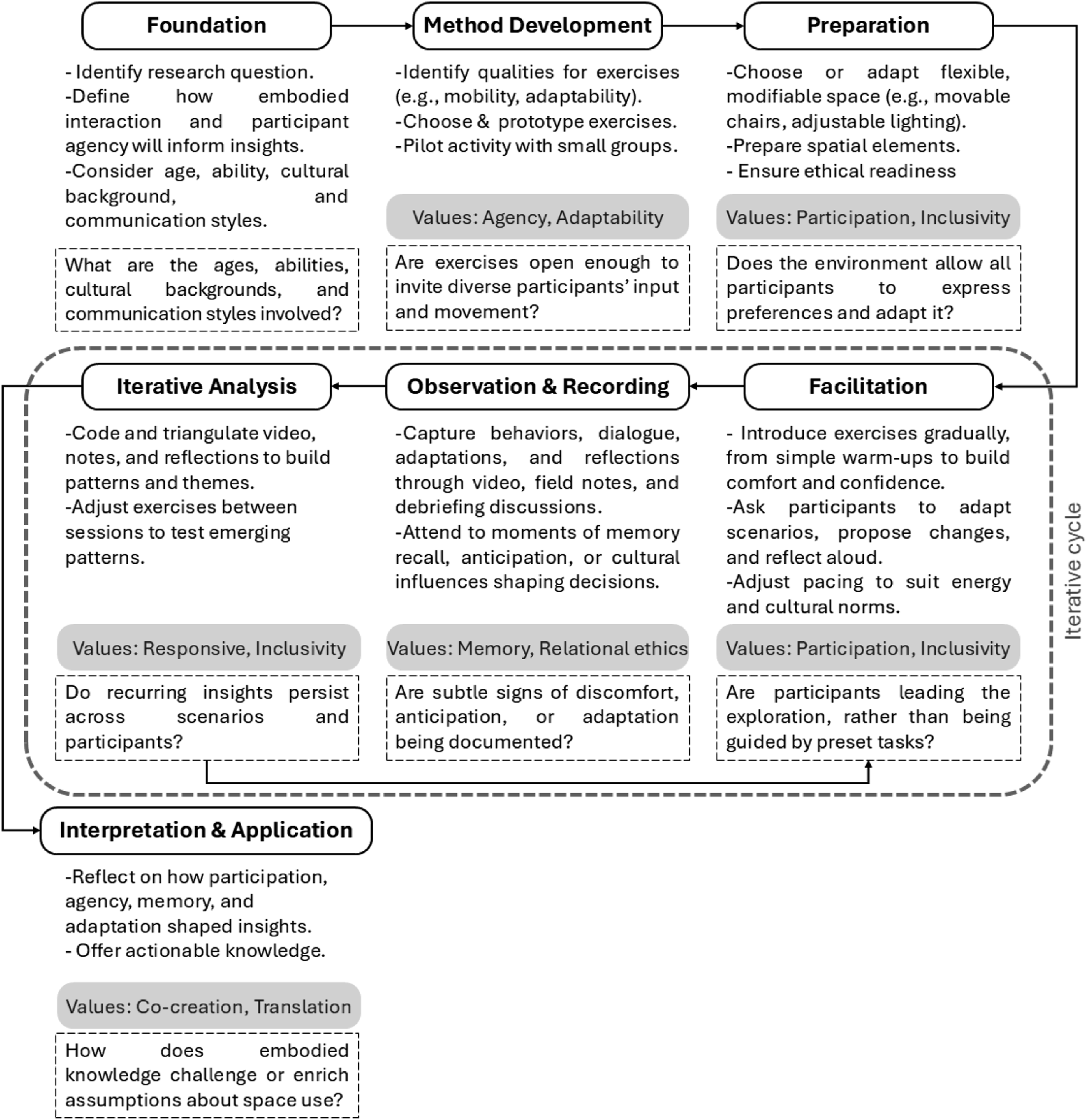
Ethical Considerations in SpaceScript
The ethical foundation of SpaceScript goes beyond the minimum obligation to “do no harm”, which emphasizes preventing physical, psychological, or emotional risks (Beauchamp & Childress, 2013; Guillemin & Gillam, 2004). While necessary, this standard is largely protective and does not ensure inclusion, autonomy, or dignity.
SpaceScript builds on this baseline by embedding values from Participatory Action Research (PAR) and relational ethics throughout its structure. In PAR, ethical practice involves collaboration, co-learning, and shared ownership (Blair & Minkler, 2009). Participants are treated as co-creators with agency to shape the process and outcomes, a particularly important principle for older adults whose spatial experiences are often overlooked. In SpaceScript, while participants do not shape the primary research questions or analytical methods, the method’s iterative design offers them meaningful pathways to actively adjust exercises, propose additional tasks, and influence the session’s structure, environment, and interaction styles. Feedback was continuously integrated, promoting responsiveness and inclusiveness. This contrasts with PAR limitations identified by Corrado et al. (2020), where older adults played marginal roles due to power imbalances or uneven participation. In SpaceScript sessions, all participants engaged in every exercise and had structured opportunities to reflect, suggest changes, and co-develop scenarios, making their expertise visible and promoting equal participation.
Relational ethics further grounded the method in attentiveness, trust, and responsiveness (Ellis, 2007; Hansen, 2024). As a facilitator, I prioritized participants’ emotional and physical comfort, integrated their feedback, and fostered reciprocal conversations where both researchers and participants shared reflections and experiences. Full transparency was maintained throughout, including open discussions about the research purpose, future stages, and how participants’ insights contributed to the larger project. When objectives were temporarily withheld to avoid biasing responses, they were disclosed afterward, with opportunities for participants to revise the task. This approach fostered a sense of co-ownership, where participants felt respected, valued, and genuinely involved in shaping the research.
Beyond formal consent and pseudonym use, participants had real-time control: they could pause, withdraw, change setups, or repeat exercises. By embedding ethics into both design and facilitation, SpaceScript aimed not only to protect participants, but also to affirm their expertise, foster co-agency, and create a space for meaningful, dignified engagement.
Pilot Study Findings and Discussion
Summary of Thematic Clusters and Representative Participant Quotes That Shaped Their Development

Discovering and Negotiating Comfort
This cluster shows how participants uncovered comfort through trial and error rather than abstract reporting. By testing, adjusting, and negotiating with their surroundings, they revealed subtle needs that are often overlooked when using conventional forms of observation.
The Trial-and-Error Discovery of Comfort
One of the clearest insights from SpaceScript was the gap between perceived and actual comfort, something unlikely to surface in static observation. Many participants began with confident assumptions about what seating would suit them, only to reconsider them after testing multiple options in real-time. Habit and visual familiarity often shaped their initial choices, but through iterative engagement, preferences shifted.
Participants frequently gravitated toward soft, cushioned chairs, assuming these would offer the most comfort. Yet over time, many found them harder to exit or presenting misfit with chosen tables, causing unexpected strain. Firmer chairs with armrests, initially dismissed as too rigid, became preferred by some for their stability and ease of movement.
For instance, Steve (74) selected a plush chair that looked inviting but gradually began fidgeting. “I feel short in this one,” he noted, as the sinking effect disrupted his posture. Larry (79) nodded in agreement, adding, “Yeah, you kind of sink into that one,” reinforcing the shared realization that initial perceptions of comfort could change once physically experienced.
Similarly, Molly (73) offered the cushioned armchairs to Heidi (76) and Zeke (79), assuming they needed more support. She chose a firm chair without armrests for herself but later commented, “This chair is better than we expected. I tried to give them the comfier chairs and ended up in this one, which didn’t turn out so bad, because it supports your back better.” Her realization reflected a broader pattern: comfort depended less on softness and more on posture, support, and usability over time.
These realizations emerged through active comparison, reflection, and iteration. Using SpaceScript, comfort was seen to be dynamic, shaped by posture, duration, and spatial fit, not something that could be predicted or assumed.
Comfort Discovery Without Spatial Recall
SpaceScript’s inclusivity was illustrated by the case of Larry (79), a participant who lives with aphantasia, which is a condition that prevents him from forming or recalling mental images. Unable to rely on memory to assess comfort, Larry approached each setup as a new, embodied experience, relying entirely on physical feedback. Over time, Larry refined his preferences by adjusting posture, trying new setups, and responding to how his body felt.
His process showed SpaceScript’s capacity to accommodate cognitive differences by rooting behavioral exploration in action rather than memory. While aphantasia is distinct from other conditions like dementia, Larry’s experience indicated SpaceScript’s broader potential to support populations who navigate space without visual recall.
Collaborative Problem-Solving and Adaptation
Here, participants addressed spatial challenges through real-time experimentation and dialogue. They rearranged furniture, modified routes, and tested strategies together, demonstrating agency and shared reasoning about how to adapt environments to diverse needs.
Reaching Adaptations Through Dialogue and Experimentation
SpaceScript revealed that adaptive strategies often emerged not through instinct but through discussion, negotiation, and collective problem-solving.
One interesting moment unfolded when Kate (82), Larry (79), and Dee (77) tackled the common dilemma of removing shoes indoors, a gesture tied to social etiquette but potentially unsafe on slick floors, especially for frail individuals. Kate (82) initially insisted, “I would ignore it and keep my shoes on for safety,” prioritizing function over etiquette. As the conversation deepened, Larry (79) suggested, “Actually, I have an idea. I would take off my socks too.” This unexpected pivot sparked a broader brainstorm, with the group eventually proposing always carrying specialized indoor slippers that offer both grip and social acceptability.
What began as a personal workaround evolved into a collectively imagined alternative, reflecting SpaceScript’s ability to surface solutions through lived dialogue. These solutions extended beyond the study’s original scope, offering practical strategies that participants found meaningful and applicable in their own lives.
Spatial Problem-Solving Through Environmental Scanning
SpaceScript also gave participants the opportunity to assess, test, and refine spatial choices through embodied trial and shared dialogue. Rather than defaulting to familiar arrangements, they engaged in active problem-solving shaped by evolving group needs.
For example, Steve (74) noted that turning his torso repeatedly during conversations was uncomfortable. His comment sparked a group reflection, where Dee (77) scanned the room, recalled past setups, and concluded that round tables eased that strain. This insight did not arise instantly; it unfolded through discussion, physical comparison, and accumulated spatial experience.
These moments show how participants did not just express preferences but discovered them through reflection and interaction. Environmental scanning and collective reasoning revealed both what was chosen and why those choices made sense in context.
Revealing Hidden Accessibility Barriers through Active Experimentation
SpaceScript revealed that many spatial barriers only become evident as they emerge through embodied social interaction. What appears accessible on paper may prove problematic in practice, especially over time and through subtle shifts in posture, effort, and endurance.
Dee (77) selected a chair without armrests beside a low table. As she leaned forward to speak with the others, the lack of elbow and arm support caused gradual strain. Reflecting on the experience, she observed that the physical tension started unnoticed and would have worsened had she remained seated longer. Larry (79) experienced similar discomfort with a backless chair. Assuming it would be manageable, he soon found himself slouching forward to use the table for support. The lack of a backrest created cumulative strain, prompting him to note that what felt acceptable at first quickly became uncomfortable. Ruben (78), eager for social connection, found that certain spatial orientations and enclosures led to feelings of isolation. Due to his hearing impairment, other participants’ voices became difficult to follow, making conversation confusing and inaccessible.
These moments highlight how accessibility is not just about initial usability but about sustained comfort during interaction. SpaceScript’s iterative, collaborative setup allowed such insights to surface, revealing barriers that static assessments often miss.
Reinterpretation and Meaning-Making
Participants reimagined the meaning and use of spatial elements, turning ordinary objects into cues for memory, social connection, or comfort. This highlights SpaceScript’s ability to reveal cultural and emotional dimensions within spatial experiences.
Unexpected Uses and Reinterpretations of Spatial Objects
Participants repeatedly reimagined objects in ways that diverged from their intended purpose. Chairs were not just for sitting, they became tools for balance, markers of territory, or support structures depending on need. These reinterpretations were not premeditated; they emerged through trial, discussion, and embodied engagement with space.
During one set of exercises, Kate (82), Dee (84), Larry (79), and Steve (70) began evaluating chair backs for their use as leaning supports while walking. Together, they identified three key criteria for stability: sufficient height, a graspable width, and overall sturdiness. These discussions developed new comfort metrics that offered a user-driven lens for evaluating chairs, one that traditional ergonomic tests might overlook. When chairs lacked armrests, Larry (79) proposed using tables, prompting the group to evaluate their height and solidity as alternate supports.
These moments illustrate how SpaceScript surfaces the fluid relationship between people and their environments, where participants continuously redefined elements to suit their needs.
Participants Co-Constructing Meaning through Memory and Narrative
SpaceScript revealed a more complex reality than what can be observed objectively. Participants did not simply respond to immediate discomfort; they often acted in anticipation, shaped by past experiences, both personal and witnessed.
Steve (74), for instance, routinely avoided sitting near restaurant kitchens because of years of coughing fits triggered by greasy air, rather than concerns about noise or traffic. Kate (82), a retired nurse, habitually scanned the floor ahead of her while walking, a movement that stemmed from decades of navigating clinical spaces with tripping hazards. Heidi (76) limited her shopping time, not from current fatigue, but from past frustration at the lack of seating. Larry (79) refused to keep rugs in his home, not because he had tripped on one himself, but because his mother’s fall on a rug had marked the beginning of her decline in independence. Polly (75) avoided places where people wore perfume, not due to an immediate reaction, but because of past experiences with chemical sensitivity. Doreen (71) and Samantha (79) steered clear of pet-friendly restaurants because of concerns about safety and hygiene rather than allergies.
Such insights surfaced because SpaceScript provided space for participants to share experiences, reflect, and act in real time.
Agency and Social Dimensions
This cluster highlights how participants’ sense of agency expanded through interaction. Social collaboration transformed individual adjustments into shared discoveries, showing that spatial agency is often relational.
Participants as Co-Designers
SpaceScript positioned participants as collaborators, empowering them to suggest changes, test variations, and refine exercises in real time. Their input often extended the research beyond its original scope.
A key example emerged from Dion (77) and Doreen (71), who, reflecting on earlier sessions, suggested experimenting with different levels of spatial enclosure. Their proposal stemmed from observations of other participants’ behaviors and prompted a deeper exploration of how open or closed seating arrangements influenced feelings of social intimacy and connection. These insights emerged directly from participant-led experimentation.
Soundscapes emerged as another layer of spatial experience. Larry (79) observed that music with lyrics disrupted conversation, noting, “You start hearing the song instead of the people.” This prompted discussion of how background noise influences social focus. In response, we introduced music into the space, and participants’ interactions shifted, revealing how subtle auditory changes could shape inclusivity and engagement.
Participants also pushed the method beyond the research setup. Larry suggested observing restaurants already catering to older adults, while Steve (74) proposed sharing findings through local media to influence design practices more broadly.
Temporal experience (how long one stays in space) also became part of the inquiry. Dion (77) reflected on how short visits required different comfort considerations than extended ones, prompting participants to re-evaluate what makes a seat “ideal” over time.
These moments highlight how SpaceScript collects data through a process of mutual discovery. Participants both enriched the research through actionable insight and helped reshape the process, reinforcing the value of lived experience in co-creating knowledge.
SpaceScript as a Social Encounter
Beyond its methodological aims, SpaceScript offered a social experience. The improvisational sessions created space for older adults to engage in meaningful conversations and build community. These benefits extended beyond the intended research goals.
For Ruben (78), who had been socially withdrawn, the sessions offered rare connection. “I never get to talk to other people about things that actually matter to me,” he shared. Kate (82) echoed this, valuing the chance to talk, reflect, and learn from others in a setting designed for engagement. Tahir (74), new to Canada, found in SpaceScript a bridge to reconnect with others in a new cultural context, saying, “I’m happy to meet everyone here and make new friends because all my friends are back home.”
Even participants who were already socially active like Samantha (79) expressed appreciation for the deeper level of conversation and interaction that the sessions fostered. Heidi (76), who often avoided social events due to accessibility concerns, like many participants, expressed a desire to return for future sessions, an indicator of both comfort and value.
This creates opportunities for research to foster meaningful social encounters and interactions.
Challenges and Refinements in SpaceScript
Developing and applying SpaceScript introduced distinct challenges that shaped its evolution. As an improvisational and participatory framework, it deviates from established methods that rely on structured tasks and passive observation, demanding a careful balance between providing enough structure to guide participants and maintaining the flexibility required for spontaneous, authentic engagement.
Early sessions revealed a tension between structured improvisation and natural behavior. While participants could engage in imagined scenarios, they were less responsive to prompts that felt irrelevant or imposed. They preferred conversations rooted in their own experiences, leading to a shift toward unscripted, participant-led scenarios. This transition highlighted the importance of gradual familiarization, scaffolding, and participant-led pacing.
The neutral black-box space supported behavioral openness but introduced limitations in simulating real-world constraints. Some participants noted the absence of spatial elements such as doors, corridors, or architectural bottlenecks that shape everyday navigation. Future iterations could aim to simulate such features while maintaining physical adaptability.
Recruitment also presented challenges. Skepticism toward improvisation, alongside logistical and physical barriers, limited participation from certain communities. More inclusive outreach, through partnerships with community organizations, will be essential for ensuring broader representation and trust in future research.
While these challenges spurred valuable refinements, they also highlight practical limitations that shaped the study’s outcomes and the range of strategies observed. Recruitment barriers constrained participant diversity; the neutral space limited realism; and initial discomfort with improvisation may have influenced engagement. Addressing these limitations requires multiple iterations across varied contexts and participant groups. SpaceScript is not a fixed method but a responsive process that captures overlooked variables, one that evolves through iteration, participant insight, and facilitator reflexivity.
Conclusion
SpaceScript contributes to spatial research by offering a structured yet flexible method for exploring how people inhabit and adapt to space. Grounded in embodied, real-time interaction, it moves beyond post-use accounts or passive observation by inviting participants to reflect on and adapt their actions and collaboratively generate new possibilities. This participatory process revealed not only how spatial behaviors occur, but also how they are shaped through dialogue, memory, and situational constraints.
Participants tested, revised, and discussed preferences in context. Through this iterative engagement, they uncovered misalignments between perceived and actual comfort, adapted to changing physical or social dynamics, and co-developed solutions grounded in personal meaning and lived experience. Many decisions emerged through discussion and shared experimentation. These insights were deeply informed by emotional associations, anticipatory reasoning, and embodied memory, highlighting that spatial behavior is as much about feeling, recollection, and negotiation as it is about function.
Based on these findings, SpaceScript may be useful when working across disciplines that require a deeper understanding of lived spatial experience to arrive at more inclusive solutions. In healthcare, it can help uncover how layout influences movement and care interactions involving different populations. In product or furniture design, it may support contextual, body-based usability testing with greater inclusivity. In architectural or public planning, the method reveals hidden barriers encountered by people for a range of reasons and the adaptive strategies they devise, both of which are difficult to detect through static assessments or verbal reports alone. To extend SpaceScript to other populations and settings, exercises can be tailored to match different capacities, cultural norms, and communication preferences, while upholding the core values of participation, agency, movement, memory, and relational ethics. With children, exercises could take the form of games with embedded challenges, rewards, and invitations to repurpose spatial elements. Utilizing drawing, modifiable objects, and imaginative play could be primary modes of expression, encouraging bodily experimentation and curiosity-driven interaction. With people with disabilities, facilitators may incorporate stronger sensory cues, fewer participants per session to avoid overstimulation, and design for multiple expression options (verbal, gestural, tactile). This helps capture subtle discomforts and preserve participant agency. For culturally diverse groups, SpaceScript should begin with reflective discussions on the relevance of spatial features and norms. Participants should be encouraged to identify missing or misaligned elements, and scenarios must be reviewed to ensure cultural respect and openness. In all adaptations, the facilitator’s role is to listen, adjust, and co-create with participants, ensuring the method remains grounded in lived experience and inclusive improvisation.
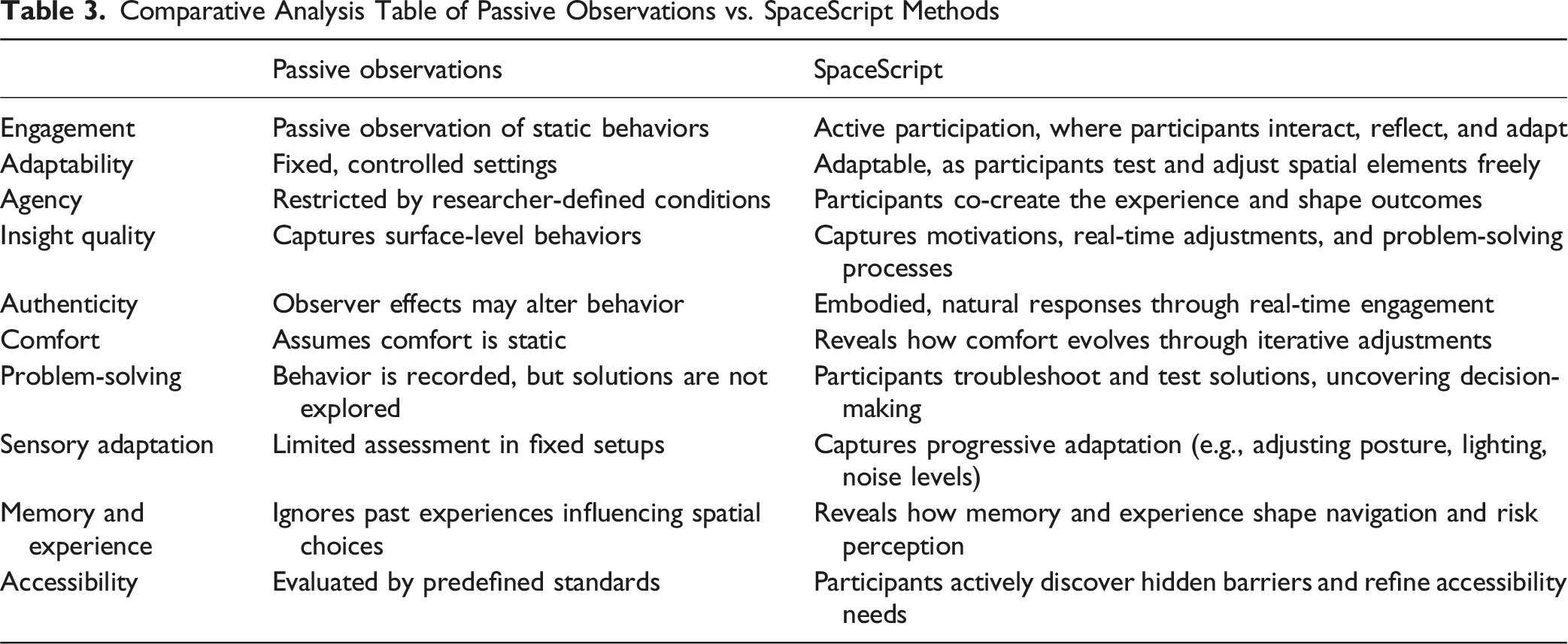
Comparative Analysis Table of Passive Observations vs. SpaceScript Methods
Footnotes
Author Note
Pil Hansen, General Editor, Routledge Book Series: Expanded Dramaturgy, Dramaturg (e.g., Vertical City, KAEJA, Invisible Practice, Su-Feh Lee).
Acknowledgements
The authors wish to thank the older adults who generously participated in this study, as well as the interdisciplinary colleagues and professional performers who provided feedback during the method’s development. We are also grateful to the Brenda Strafford Foundation for their support in participant recruitment, and to research facilitators Jonathan Tanone and Yiren Liu for their assistance in organizing the research space.

Ethical Considerations
Ethical approval for this research was granted by the University of Calgary Conjoint Faculties Research Ethics Board (REB24-0501).
Consent to Participate
All participants provided informed consent prior to participation, including permission to be video recorded and quoted anonymously in research outputs.
Funding
The authors received no financial support for the research, authorship, and/or publication of this article.
Declaration of conflicting interests
The authors declared no potential conflicts of interest with respect to the research, authorship, and/or publication of this article.
Data Availability Statement
The datasets generated and analyzed during the current study are not publicly available due to the nature of the data (video recordings of human participants) and ethical constraints.