




Abstract
Service-learning in Physical Activity integrates academic instruction with community engagement, promoting student learning and social commitment. Although the educational benefits for students are well established, faculty perspectives on their roles in these initiatives remain insufficiently examined. This study explores how university faculty conceptualize their participation in service-learning projects and the perceived impact on communities.
Methods
Employing an interpretative qualitative design, data were gathered through a 160-min narrative focus group with ten faculty members from seven Faculties of Education, complemented by individual interviews totaling 1,210 min. Participants reported between 3 and 6 years of experience, with several exceeding 6 years implementing service-learning in Spanish and Chilean universities. NVivo 15 software supported the thematic analysis of faculty narratives.
Results
Participants highlighted that service-learning effectiveness depends on horizontal communication, collaboration, and sustainable partnerships with community organizations. They emphasized that community impact should take precedence over academic learning as the main evaluative criterion. While acknowledging the transformative potential of service-learning, faculty identified persistent challenges, including institutional limitations and the absence of robust methods to assess social impact.
Conclusion
The findings emphasize the importance of deepening faculty engagement in service-learning, strengthening university–community alliances, and integrating long-term evaluation strategies. Reinforcing institutional support and establishing structured frameworks for impact assessment can optimize service-learning as a catalyst for meaningful social transformation.
Implications
The study reveals that faculty engagement with students and communities shapes how social impact is defined and assessed, informing educators’ understanding of community responsibility and sustained involvement beyond academic objectives.
Keywords
Background
At present, the experiential dimension of Service-Learning (SL) has achieved notable global recognition, having been adopted by numerous international universities (Granados Alós & Catalán-Gregori, 2025; Herold & Waring, 2018; Kenworthy & U’Ren, 2025). The Organization for Economic Co-operation and Development, through its project Innovative Learning Environments (OECD, 2018), identifies SL as a pedagogical approach that places students at the center of the learning process. This is the first of the seven principles to redesign learning environments in the face of the challenges of the 21st century (Rodríguez-Zurita et al., 2024). Furthermore, scholars concur that SL represents one of the most rapidly expanding innovations across primary, secondary, and higher education systems (Furco, 2019; Lin et al., 2025; Rivas-Valenzuela et al., 2025).
The experiential learning model proposed by Kolb (1984) has served as a principal theoretical framework for understanding the functioning of SL. Kolb conceptualizes learning as “the process by which knowledge is created through the transformation of experience” and knowledge itself as “a process of continuous creation and re-creation, not an independent entity to be acquired or transmitted” (Kolb, 1984, p. 38). Moreover, Kolb maintains that experiential learning more effectively accommodates diverse learning styles than conventional classroom-based instruction.
From this experiential standpoint, SL in higher education redefines the role of students, positioning them as active agents in their own learning (Bringle et al., 2011; Schank & Halberstadt, 2023). This transformation unfolds through pedagogically structured actions with explicit learning objectives and systematic opportunities for critical reflection (Juhász et al., 2021; Pinto & Costa-Ramalho, 2023), thereby consolidating knowledge, enabling evaluative insight, and fostering integrative and socially engaged learning (Choi et al., 2023). SL has further strengthened its relevance by aligning with the Sustainable Development Goals (Alvarez-Vanegas & Volante, 2024; Amiano et al., 2024), linking academic learning with community participation to cultivate key competencies such as ethical responsibility, civic engagement, and environmental awareness (Kaliappen, 2024; Uzorka et al., 2024).
Examining the evolution and global diffusion of Service-Learning (SL), it is noteworthy that the United States pioneered its adoption as an educational method that integrates community service within formal curricula, institutionalizing it in public education and incorporating it into multiple federal districts (Schulte, 2024). Subsequently, SL became embedded in the educational systems of Europe, Latin America, and Asia (Hong et al., 2024; Qi & Chen, 2025) with Argentina emerging as a regional leader. Spain has also demonstrated significant progress in this area (Blanco-Cano & García-Martín, 2021; Luna González et al., 2024), as have Germany, Ireland, Italy, the United Kingdom, South Africa, India, Japan, Singapore, Thailand, and several Oceanic nations (Franklin et al., 2023; Ma Hok Ka, 2024). The European Union has formally recognized SL as a mechanism for promoting education for active citizenship (Education and Youth Policy Analysis, 2017).
Within the field of Physical Activity (PA), multiple studies have examined SL as an educational strategy that integrates academic learning with community service in a reciprocal manner (Harpine, 2024; Rivas-Valenzuela et al., 2025). This pedagogical approach aligns with the core tenets of Kolb’s (1984) experiential learning model, providing structured time for reflection that enables students to derive meaning from their community engagement through critical analysis (Indrašienė et al., 2023). Consequently, SL enhances student motivation and engagement, particularly among individuals less responsive to traditional didactic approaches (Ochoa-Cervantes et al., 2024; Resch & Schrittesser, 2021).
Despite the broad consensus on SL’s transformative potential, its effects on faculty and communities remain insufficiently studied (Rivas-Valenzuela, 2024; Rivas-Valenzuela et al., 2022). Furco (2019) observes that 89% of SL research centers on students, while only 5% addresses faculty experiences and a mere 2% explores community outcomes - an imbalance that contradicts the model’s principle of shared transformation (Chiva-Bartoll & Fernández-Rio, 2021; Ochoa-Cervantes et al., 2024). Systematic reviews such as Hallinger and Narong (2024) confirm this asymmetry, showing that most scholarship privileges student perceptions (Bastarrica et al., 2023; López et al., 2023; Pong & Lam, 2023), leaving crucial dimensions such as teacher identity and social impact underrepresented (Kawai, 2021; Modić Stanke & Mikelić Preradović, 2024).
In PA education, this marginalization is particularly concerning. SL within these disciplines constitutes an embodied, relational, and community-based practice in which educators must navigate complex ethical and emotional terrains (Lobo-de-Diego et al., 2025). Limiting its assessment to student-centered metrics not only diminishes the epistemic and pedagogical contributions of faculty but also obscures the professional, ethical, and identity transformations they experience through these practices (Bringle & Clayton, 2020; Ochoa- Cervantes et al., 2024).
Methodology Considerations
This study is situated within a qualitative interpretive paradigm (see Duggleby Wenzel et al., 2025; Wiesner, 2022), grounded in a constructivist epistemology and guided by a hermeneutic-phenomenological orientation (see Creswell & Poth, 2018; Denzin & Lincoln, 2013). Consistent with Suddick et al. (2020) and Fuster (2019), the methodological design aligns with phenomenological research traditions in the social sciences and adopts interpretative perspectives advanced by Frechette et al. (2020), Suddick et al. (2020), and Laverty (2003). These approaches seek to describe and interpret the essence of lived experience, acknowledging its pedagogical relevance and interpretive depth. Moreover, this orientation encourages a self-reflective engagement through which individuals encounter meaningful experiences as they emerge into consciousness, thereby attaining deeper understanding of their pedagogical and existential significance (Fuster, 2019; Van Manen, 2017).
This methodological stance facilitated an in-depth exploration of the lived experiences of Physical Activity (PA) educators engaged in Service-Learning, illuminating how personal trajectories, contextual factors, and embodied participation contribute to shaping their professional identities and pedagogical knowledge.
Context and Participants
Attributes That Identify Each of the Participants in the Focus Group and Interviews

Participants implemented projects within courses of the Physical Activity (PA) degree that encompassed diverse subjects emphasizing initial teacher education, engagement with primary and secondary school contexts, and community-based PA programs. This diversity illustrates the broad applicability of Service-Learning (SL) in teacher education and its capacity to strengthen both academic formation and community involvement. The findings highlight the heterogeneous character of SL experiences and their curricular integration, contributing to a deeper understanding of how SL fosters professional development and social responsibility within higher education.
Techniques of Data Collection
The study employed the narrative focus group as its principal data generation method (Peterson, 2020; Trigueros-Cervantes et al., 2018). Focus groups, understood as structured discussions among informants on a shared topic (Kook et al., 2019; Kitzinger, 1994), constitute a robust methodological strategy for producing dialogical and co-constructed knowledge (de Souza et al., 2024). This approach facilitates the evaluation of experiences, the development of assessment instruments, and the enrichment of interpretive analysis (Tran et al., 2021).
Semi-structured interviews served as a complementary technique to deepen teachers’ narratives from a situated and interpretive perspective (Denzin & Lincoln, 2013; Scheibelhofer, 2023), recognizing participants as active contributors in the co-construction of meaning (Clandinin et al., 2025). An interpretive approach was adopted, privileging participants’ communicative agency and sensitivity to power relations in virtual contexts (Prior & Lachover, 2023).
The sessions, conducted via videoconference and transcribed verbatim, fostered reflective and emotionally resonant exchanges (Richard et al., 2021), from which rich meaning units emerged, characterized by affective intensity and experiential depth (Kook et al., 2019). The integration of these two techniques proved particularly suitable for examining SL processes, where identity, ethical reflection, and emotional labor are closely interwoven within pedagogical contexts marked by vulnerability and social commitment (Rivas-Valenzuela, 2024; Rivas-Valenzuela et al., 2025).
Analysis Strategies
The central category system derived from the qualitative analysis of the focus group was developed using NVivo 15 software (Figure 1). A mixed methodological approach combining categorical and content analysis was applied (Trigueros-Cervantes et al., 2018). The process began with an inductive categorization supported by NVivo Release 15, progressing from general to specific dimensions to identify emerging patterns and thematic structures (Allsop et al., 2022; Rivas-Valenzuela, 2024; Rivas-Valenzuela et al., 2025). Central category system derived from focus groups and interviews, analyzed using NVivo 15 qualitative data analysis software
Initially, all meaningful units corresponding to the research questions were identified, resulting in a comprehensive corpus of 4,670 references. From this dataset, nine analytical categories were developed, grounded in established conceptual frameworks. To further examine the social impact of Service-Learning (SL) in Physical Activity (PA) through participants’ perceptions and emotions, three additional categories - highlighted in red - were integrated: (1) Social and transformative impact of SL projects, (2) Relationship between entity and university, and (3) Relevance of SL for participants. This refined analysis produced a more specific corpus of 1,123 references.
Results and Discussion
The analysis began with a qualitative and inductive process, using a word cloud to identify the most frequent and meaningful terms. This initial step evolved into a cartographic representation that offered a holistic perspective on the research topic. Within the project map, the principal categories identified were: (1) Impact of university Service-Learning projects and (2) Relationship between entity and university. Complementary yet equally significant categories included (3) Relevance of university Service-Learning for participants and (4) Implementation issues in university Service-Learning projects. The map also encompassed (5) General structure, (6) Overall evaluation, (7) Teacher role, and (8) General evaluation, providing a coherent visual synthesis of the analytical framework (Figure 2). Map of the project through qualitative Nvivo software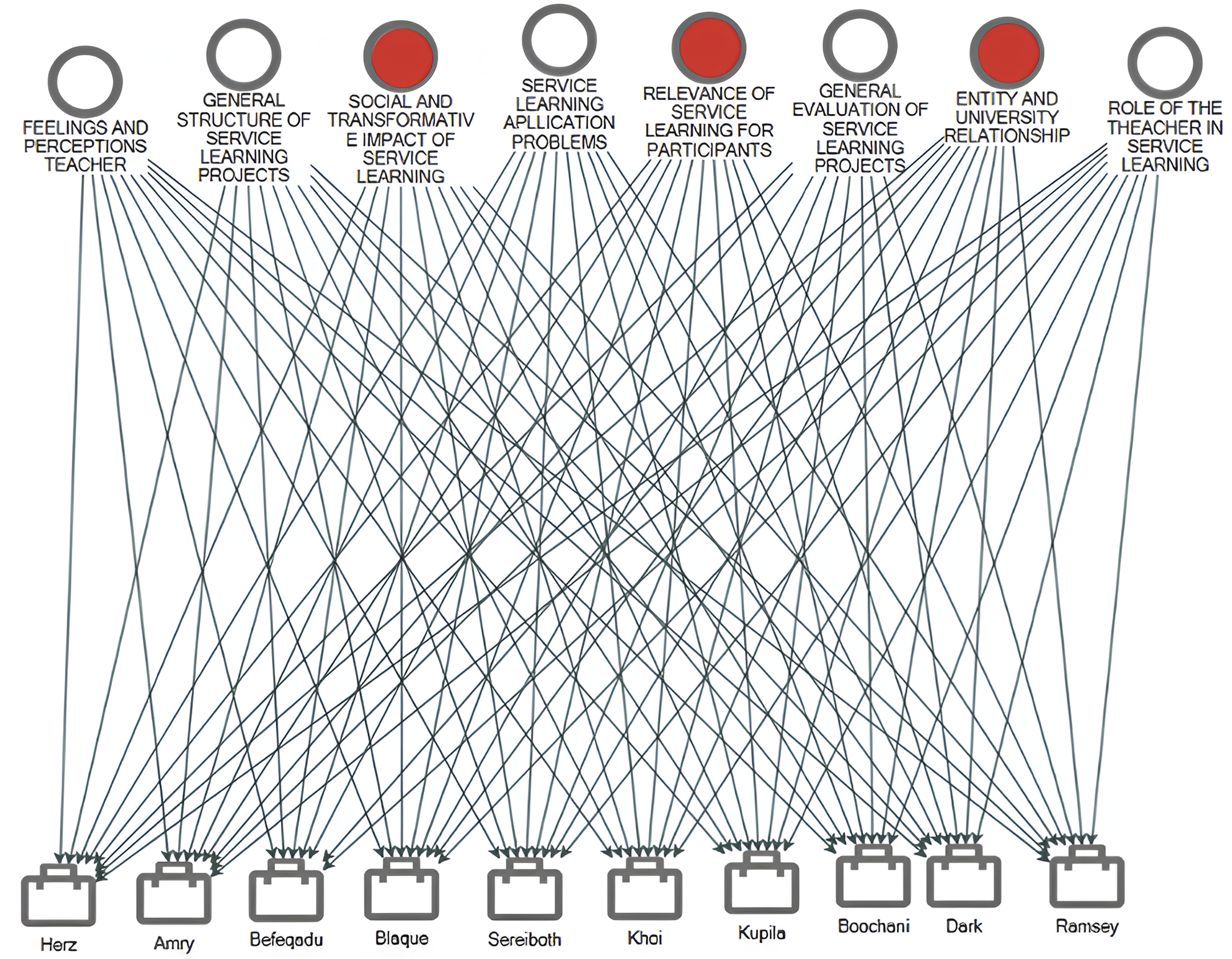
At the conclusion of the initial analytical phase, both the word cloud and the project map consistently reflected the core categories of the study, providing a coherent and symmetrical analytical framework. These visualizations established a structured foundation for examining participants’ perceptions within the expert focus group on SL in PA.
Teacher Perspectives on the Social Impact of Service-Learning
The expansion of SL across educational systems has extended beyond universities, becoming a widespread pedagogical practice that now reaches approximately 25% of primary and secondary schools in the United States. Since 2006, it has also been consolidated as a key form of social service (Franklin et al., 2023; Granados Alós & Catalán-Gregori, 2025; Hong et al., 2024; Kenworthy & U’Ren, 2025; Luna González et al., 2024; Ma Hok Ka, 2024; Qi & Chen, 2025). This diffusion is supported by several defining characteristics - curricular alignment with social needs, critical reflection based on experience, decision-making in complex educational contexts, and deeper comprehension of socio-political realities (Kawai, 2021; Modić Stanke & Mikelić Preradović, 2024). Moreover, the socio-emotional development fostered by university SL among participants constitutes a central aspect of its educational value (Blanco-Cano & García-Martín, 2021; Pong & Lam, 2023). Consequently, evaluating the social impact of SL projects in PA is of fundamental importance.
The challenge of assessing social impact emerges as a primary concern in the teachers’ discourse, as represented in Figure 3. Teacher perspectives on the social impact of SL in PA
This issue is linked to several critical factors, among which the excessive focus on curricular content is most salient. As reflected in the focus group discussions, Ramsey observed that «..there’s a lot of emphasis on making sure that, through Service-Learning as a methodology, students meet specific learning outcomes and competencies. But in that process, the whole idea of social impact seems to have been left behind..».
Equally problematic is the misconception that social transformation can be achieved merely through the selection of context. As Amry noted, students may have «..done projects in schools - mainly public ones - and in those environments, there’s tremendous diversity..». However, the mere choice of environment constitutes a superficial response that distracts from deeper, structural issues requiring systematic attention.
Following this line of analysis, a second interpretive approach was developed to examine teachers’ perspectives on the social impact of SL. As shown in Figure 3, while some categories exhibit balanced relationships, significant disparities appear among others - particularly “Social impact, importance of social impact by teachers” and “Social impact and social transformation.” These differences inform an initial hypothesis as to why the social impact of SL in PA remains under-evaluated. Teachers consistently recognize that measuring this impact is highly complex, as Herz explained: «..It’s very hard to tell whether people are really able, at some point, to apply what they learned in the project back into their own communities..».
However, when reflecting on their own roles and perspectives, faculty often assume that Service-Learning (SL) generates a meaningful impact, yet acknowledge the absence of formal protocols, documentation, or validated rubrics endorsed by universities or governmental bodies (Hallinger & Narong, 2024). As Khoi observed, «what usually fails, or what remains unresolved, is how to assess that impact - how to measure it - which we often do not know or simply do not have the time to do». Similarly, Ramsey added, «what we were saying before is that we do not evaluate social impact. We are aware that we do not do it». As the focus group progressed, these statements revealed how participants gradually articulated their perceptions of SL and reflected more openly on their pedagogical roles.
Befeqadu further illustrated this limitation, noting that: «..Honestly, there are very few studies that really look at the social impact. Most focus on what the students learn, and they rarely address the effect on the service itself. We tend to concentrate on learning, not on the impact - the footprint - left on the people who receive the service..».
At the same time, Sereiboth explained some of the practical reasons for this gap: «..in our case, we have two specific interventions in one course. We don’t set big goals for social transformation; we try to be realistic. In the end, what we aim for is a small, personal experience from a social perspective - something meaningful for the group we work with, and not much beyond that...».
These limitations are compounded by a further challenge - the absence of appropriate and reliable instruments to verify whether such changes occur. This leads to a paradoxical situation in which responsibility for evaluation often falls on students themselves: «..the students themselves make the decisions, since they are the ones who design the service. They also decide how to evaluate it, together with the people who receive it..», as Khoi reflected.
The Role of Teachers and the Social Impact on the Institutions
Introducing university students to contexts of social exclusion presents a considerable challenge for Physical Activity (PA) educators. It requires integrating experiential pedagogies with research-informed strategies to navigate and connect with organizations that often reflect complex social realities. These challenges intensify as the teaching and learning process becomes more demanding, calling for innovative educational approaches (Ochoa-Cervantes et al., 2024). In the focus group consultation presented in Figure 4, several intersections emerged between participants’ narratives and the codes related to their perspectives on their roles within SL projects. The role of teachers and the social impact of SL on the Institutions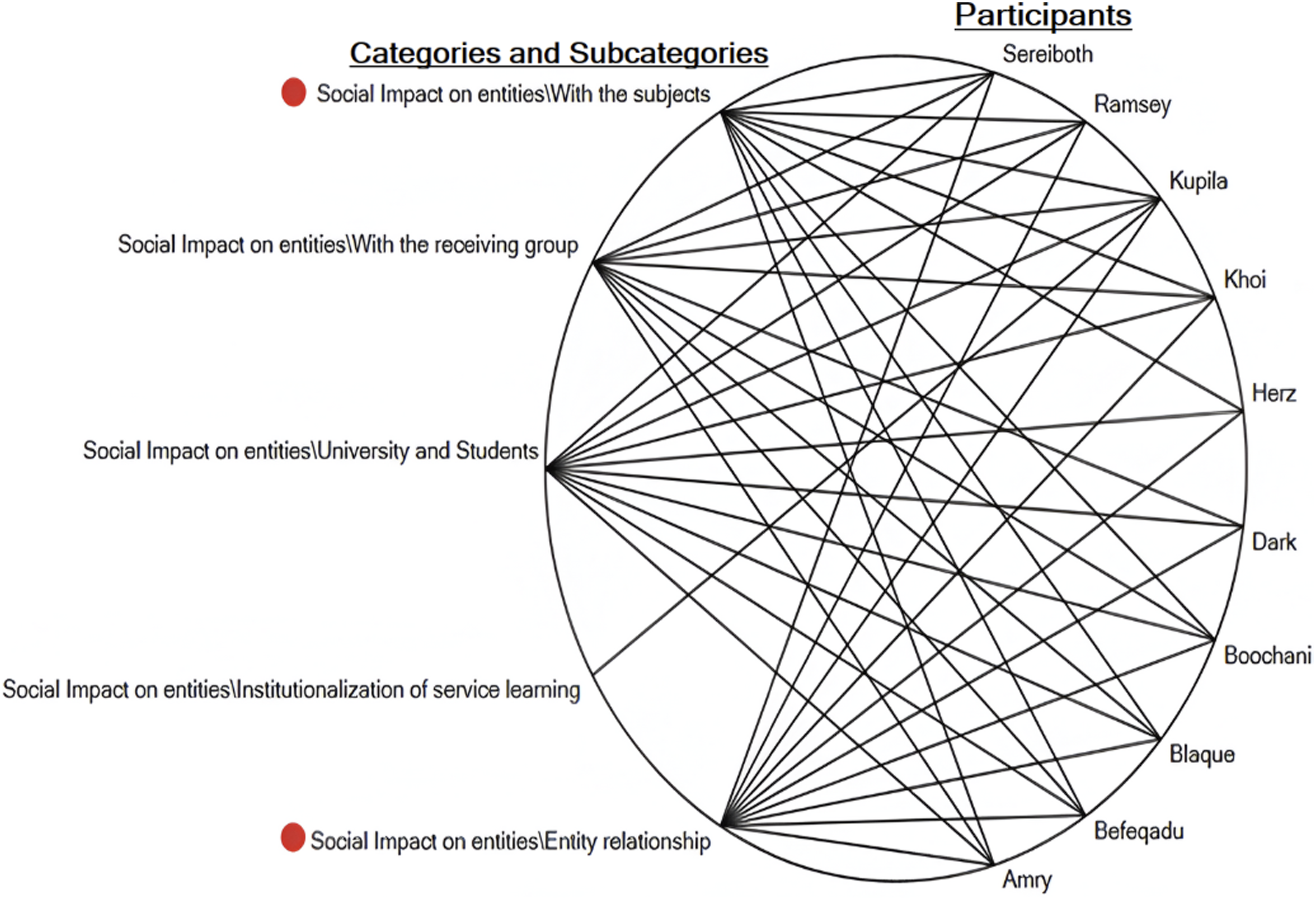
Boochani reflected, «It has been an exciting journey. I think my students learn more - and learn better - through direct contact with others and with themselves. I also find that I teach better this way.» Similarly, Dark elaborated, «For example, I have worked with people with functional diversity and with older adults, but honestly, where I have most clearly seen social impact - both collectively and culturally, especially among students - has been when working with migrants.»
Boochani also emphasized another key aspect of inclusion, stating, «I think it is very healthy that different kinds of people can enter our university. Sometimes it feels like an institution with too many walls, so it is refreshing to feel that it can truly be an open university.» In this regard, the faculty role appears substantially strengthened when educators’ perspectives are considered alongside those of other stakeholders, particularly when they work collectively to advance social inclusion through SL initiatives. As Boochani further explained, «..The fact that older people come in, people with different skin colors or different characteristics - I think it is healthy to see them enter our classrooms and share projects. That has been transformative for me, not only with the students I teach and with myself, but also with the people who are part of the university community..».
This testimony broadens the discussion on the transformative role of educators and the social implications of their involvement in SL. As Khoi observed, «It may be to a lesser extent, depending on the project or on the group, but there is always an impact when we respond to a need and that need is met.» Yet, faculty also acknowledge the persistent question of how to measure that impact and how to demonstrate the significance of their role. The focus often shifts from social transformation to student learning outcomes, supported by a range of evaluative tools that remain largely descriptive rather than analytical (Hallinger & Narong, 2024).
Expanding on this reflection, Khoi added, «There is another important impact - through SL, we connect with the community, and the community realizes that the university is present and engaged.» However, this perception can risk becoming a form of symbolic engagement, where the mere act of presence is mistaken for meaningful transformation. Without structured mechanisms of accountability and recognition, such impact quickly fades as institutional commitment to the methodology wanes.
Creating genuine social impact is a necessary precursor to transformation. Teachers often prioritize subtle, student-centered impacts - those that stimulate reflection and growth - over developing concrete tools to demonstrate, through evidence-based practice, the transformative potential of their interventions. Nonetheless, if relationships with partner organizations were more fluid, structured, and consistently managed, impact assessment could become more feasible, enabling projects to achieve deeper and more sustainable outcomes.
These narratives underscore a recurring theme among faculty: a clear awareness of their potential to influence institutional culture and community relations. While they recognize the university’s growing openness, they also highlight the persistent need for rigorous evaluative frameworks grounded in the lived experiences and methodological expertise of educators actively engaged in Service-Learning.
Perspectives to Evaluate the Social Impact of a Service Learning
In this final section, three heat maps were developed to visualize the intersection between the main subcategories and the focus group participants. Each map uses varying shades of blue to illustrate the intensity of discourse and the degree of alignment among participants regarding the study’s interpretive framework.
The first heat map (Figure 5) highlights the variation in how key elements appear across participants’ narratives. Notably, educators engaged in Service-Learning (SL) emphasized their roles within the structural stages of projects and the need to balance pedagogical and social objectives. Participants repeatedly affirmed that meaningful evaluation of social impact requires an equilibrium between curricular content and community service outcomes. Heat map. Relationship between project structure and perception of social impact on the SL
As Boochani expressed: «.I believe that the balance between learning and service is essential. Those two words - reciprocity and synergy - are absolutely necessary. In other words, I think balance is key, and maintaining it requires a constant dialogue about what we need and what you need..».
A related, though less dominant, pattern is evident in Ramsey’s reflections, which addressed the institutional and structural constraints that shape university SL projects. Ramsey noted the persistent «preoccupation of teachers with ensuring that students acquire specific content and competencies outlined in the curriculum.» Consequently, she added, «the whole mission of social impact tends to be forgotten.».
Participants also recognized the inherent complexity of evaluating social impact. As Herz explained, «It is very difficult to determine whether individuals are actually able to apply the knowledge or skills gained through the project within their own communities.» This challenge is compounded by the lack of effective systems for tracking change and verifying whether project structures are conducive to sustained impact. Blaque and Kupila elaborated, noting that some projects are designed with «..such rigid and closed phases that, while they can provide structure, they also limit flexibility and innovation..». Furthermore, participants identified an imbalance between academic learning (the methodological focus) and community engagement (the social focus). This imbalance hinders the kind of horizontal and sustained collaboration required to achieve meaningful social transformation - or even to establish the foundational conditions for its emergence in local contexts. Despite these challenges, there is consensus among educators that SL holds the potential to generate significant learning and social impact in vulnerable settings. Faculty and students alike reported that SL fosters profound socio-emotional engagement, reinforcing the importance of assessing how these experiences influence ethical reasoning and decision-making in complex contexts (Bringle & Clayton, 2020; Lobo-de-Diego et al., 2025; Rivas-Valenzuela, 2024; Rivas-Valenzuela et al., 2022).
The second heat map (Figure 6) further explores the relationships between the participating entities, universities, and stakeholders - specifically students and teachers - and their distinct role perspectives within university SL projects in PA. Heat map. Relationship between entity, university and teaching role
One of the principal challenges identified by participants is the absence of structured and regulated agreements that would allow institutions and community partners to collaborate consistently over time. Without such frameworks, projects tend to lose continuity and must often begin anew. As Blaque explained: «..We need to establish formal agreements within the institution, and I think everyone here understands that process. But sometimes it makes things complicated when we want to ask questions or make adjustments. It would really help to have more direct and friendly relationships. Having these agreements in place would make it much easier to navigate institutional barriers..».
From the standpoint of both the community partners and the university participants, there is broad agreement that SL initiatives suffer from a lack of sustained continuity. Dark observed, «Over time, I’ve realized that the type of group we work with really matters. It can make a big difference in the social impact - both for the students and for the people receiving the service.» The absence of longitudinal approaches in SL research further compounds this issue, as most studies remain cross-sectional. There is also a recognized need for stronger collaboration and communication among all actors involved, particularly between university faculty and representatives of community organizations (Hallinger & Narong, 2024).
Sereiboth highlighted this dynamic, noting that the university often pursues «a small, personal experience from a social perspective, within the recipient group, and not much more.» This perspective underscores a persistent emphasis on student learning over broader community transformation. While such experiences can reshape students’ conceptions of social responsibility and community engagement, they remain limited in scale and sustainability.
Finally, the third heat map (Figure 7) illustrates how participants gradually deconstructed their implicit theories during the focus group discussions, collaboratively constructing new interpretations of their practice and the evolving meaning of social impact (Rivas-Valenzuela, 2024). Relationship between positive perceptions and feelings regarding SL and its social impact
We have aimed to demonstrate how SL shapes faculty perceptions and emotions, contributing to their sense of generativity and professional evolution. This notion aligns with Erikson’s sociological and cultural framework (2004), which emphasizes transmitting cultural and ethical legacies to future generations. SL thus emerges as a key mechanism for fostering both technical and cultural generativity among educators (Kotre, 1984; McAdams & Logan, 2004).
Ramsey and Kupila captured this sentiment, noting that «the social dimension is essential in teacher education - not only for Physical Activity teachers. It is crucial to remain open to the community, to build networks, and to form connections as fundamental parts of this vision…».
Beyond these principal insights into faculty perspectives on SL’s social impact in Physical Activity, several additional considerations arise. One of the most salient is the need to differentiate clearly between volunteering and SL. When projects are reduced to the coordination of volunteer activities - sending students into communities without a structured learning framework - the pedagogical essence of SL is diluted. This conflation risks prioritizing moral or affective development over competency-based learning achieved through community collaboration.
Ramsey further emphasized this distinction, explaining, «Engaging in SL is different - we see its impact as deeper and more meaningful than what a group of volunteers could achieve.» In this sense, SL should be understood as a cooperative learning model in which educational objectives are co-defined with community stakeholders, rather than unilaterally determined by academic institutions. Through this dialogical process, the experience of alterity - the encounter with the other - becomes a catalyst for personal and professional transformation, reinforcing the continuous and reciprocal nature of learning and social change (López et al., 2023).
Conclusions
We examined the beliefs and implicit theories of university faculty regarding their roles in shaping the social impact of Service-Learning (SL) projects and their engagement with external partners. Drawing upon 466 coded references, the analysis explored how faculty conceptualize project impact and university–community relationships, employing an inductive category system and a comprehensive project map visualization. The research objectives were effectively met.
The findings indicate that faculty play a central role in ensuring the sustainable implementation of SL initiatives, emphasizing community service as a foundational component. SL functions as an experiential learning model that integrates teachers and students through reflective, written, and oral practices that enhance learning across multiple modalities and communication skills. Its ultimate aim is to promote equitable access to Physical Activity (PA) and align educational practices with democratic and inclusive values.
Considering the faculty perspective is vital to achieving balance between institutional priorities and student learning. This requires evaluating both academic performance and social impact rather than focusing exclusively on curricular outcomes. Furthermore, attention must be given to fostering value-based transformation among students. Equity within university–community relationships represents a key pathway toward empowering individuals in marginalized contexts, ensuring that collaboration extends beyond institutional interests to build sustained, reciprocal partnerships.
The results suggest that SL projects possess substantial potential to generate social impact; however, their success depends on ongoing reflection before, during, and after implementation, as well as coordinated teamwork and systematic evaluation to secure long-term sustainability. Overall, the study underscores the importance of deliberate design and execution in maximizing SL outcomes, with strong, enduring relationships between universities and community entities emerging as critical to achieving meaningful results.
Ultimately, this analysis provides insight into the practices and behaviors of university faculty engaged in SL within Spain and Chile. Given the contextual richness of these findings, SL research represents a promising and relevant field within education studies, inviting further exploration of its mechanisms and outcomes.
This study also highlights the necessity of institutional support for sustaining faculty participation in SL. To amplify the reach and impact of such programs, universities should implement structured policies that formally recognize and incentivize faculty engagement. Future research should prioritize longitudinal studies that assess the enduring social impact of SL, particularly within diverse educational and cultural settings.
Footnotes
Acknowledgments
We extend our sincere gratitude to the Ph.D. program in Educational Sciences for its support and academic guidance throughout this research. Special thanks to the Physical Education and Social Transformation Group at the University of Granada, whose insights and contributions have been invaluable in shaping our understanding of service-learning in higher education. Their commitment to educational innovation and social impact has greatly enriched this study.

Funding
The authors disclosed receipt of the following financial support for the research, authorship, and/or publication of this article: From the doctoral research conducted by the first author.
Declaration of Conflicting Interests
The authors declared no potential conflicts of interest with respect to the research, authorship, and/or publication of this article.