




Abstract
For decades, qualitative research methodologies have incorporated the voice of the participants in their designs and developments. Now, the increasing importance of social impact of the research worldwide has created a new scenario for qualitative researchers, in which the egalitarian dialogue could be one of the key elements. The traditional incorporation of participants into research process is not enough; we need to incorporate new components as the egalitarian dialogue in the research process to assure the social impact of the research. In this article, we first situate the concept of egalitarian dialogue and how it has been used in a great diversity of situation and areas, and second how when we use it, we can obtain both, a greater social impact, and an enrichment of the qualitative methodological research process. We based our work in a literature review in both, the main journals included in ISI Web of Science and Scopus, highlighting the journals on qualitative methodologies and revising Horizon 2020 and Seventh Framework Projects included in the CORDIS database. This literature review presents how different research groups and researchers have used egalitarian dialogue, mainly in the last decade, as an important element to reach social impact with their research.
Keywords
Introduction
Dialogue has been the cornerstone of advances within qualitative research since a diversity of theories and perspectives, as opposed to objectivism, based the interpretation of reality on the voice of the participants. Sometimes this dialogue has been with us through autobiographies and autoethnographies; on other occasions this dialogue has been produced with participants from different perspectives. Interpreting social reality based on dialogue instead of positivism meant entering a stage of war paradigm, where qualitative and quantitative positions were confronted (Denzin & Lincoln, 2003).
Qualitative inquiry prioritized, in the beginning, the interpretation of reality based on the direct opinions of the participants, trying not to intervene in the construction of that interpretation. This subjectivism can be explained by its opposition to the more objectivist stance. The transformative power of qualitative inquiry was in participants’ hands. Nowadays, “The qualitative researcher is not an objective, politically neutral observer who stands outside and above the study of the social world. But that doesn’t mean he or she is simply making things up!” (Denzin & Giardina, 2019, p.6).
The transformative power of qualitative inquiry and qualitative research methodologies today are in researchers’ and participants’ hands, with the landscape of working together to overcome social injustices in neoliberal times (Denzin & Giardina, 2017). Aiming at doing research that reduces social injustice oriented towards achieving social impact, in this article, we will take a closer look at how the concept of egalitarian dialogue is being used and how, when it is used, could have a direct and positive impact in the results of a research process.
The concept of egalitarian dialogue that we analyze in this article is defined by Flecha (2000) as one of the seven principles of dialogic learning. It is understood as a dialogue-oriented to a common understanding that breaks with the traditional differences between subject and object in research. The intersubjectivity between people participating in the dialogue becomes a key fact during the entire research process (Torras-Gómez et al., 2019).
Egalitarian dialogue implies a process in which the different forms of knowledge (system and lifeworld) are brought together. The dialogue is oriented to transform reality, bringing together academic knowledge and the people’s experiences, opinions, and reflections. Egalitarian dialogue ensures the usefulness of research and its objectivity through the direct participation of the people. It is understood that the participants do not have the academic background of the researchers since they are not experts in the problem under study. Therefore, their visions come from the lifeworld, their opinions, reflections, and experiences. Furthermore, that is why it is so important that the academics who are part of the research team bring their scientific background to the dialogue (system), breaking the methodologically relevant gap between the “subject” and “object” of the study. What is important is the force of the arguments and not the argument of the force; what counts are the best arguments regardless of who formulates them (Habermas, 1984).
Under conditions of equality, both the system world and subjects participate in the dialogue based on the contributions of the different forms of knowledge. Up to the present time, knowledge coming from the academic context has been recognized and privileged. In today’s knowledge society, it is essential to acknowledge learning from cooperative and practical contexts. The knowledge of all people can multiply the knowledge about a concrete situation from different points of view, valuing the arguments on which they are based and not the position or status from which they are issued.
On the other hand, the social impact ‘is the improvement of society and citizens concerning their own goals (like the United Nations Sustainable Development Goals)’ (Van den Besselaar et al., 2018, p. 43). In that way, the social impact of research could be understood as the benefits that citizens receive from research. Dissemination of research results is not considered social impact. We need the results to be published in journals of recognized scientific prestige (scientific impact) and then used by political decision-makers when applying new measures (political impact). When the results are transferred to the public, and it is found that social improvements have been achieved following objectives set by and for the public, such as those of sustainable development, we can say that research has had a social impact (Aiello, Donovan, Duque, Fabrizio, Flecha, Holm, Molina, Oliver & Reale, 2020).
The social impact could be evaluated before (ex-ante), during (in-itinere) and at the end (ex-post) of a research process. We are interested in the social impact obtained at the end of the project, when it could be established relations between the research process and the final results (in terms, for instance, on how the application of an egalitarian dialogue along the project impacted positively in the results).
In the following sections, we first present the methods section that includes how the literature review on egalitarian dialogue has been conducted in ISI Web of Science, Scopus and CORDIS. The first section deals with the relationship between egalitarian dialogue and social impact; the second section presents the main conceptual characteristics of egalitarian dialogue; the third section describes how egalitarian dialogue has been applied in practice and its relationship with the social impact achieved in the research projects. Finally, the article concludes with a practical example of how egalitarian dialogue was applied in a European Commission project—ChiPE—extracted from CORDIS.
Methods
This article is based on a narrative literature review in ISI Web of Science and Scopus databases under a narrative approach. The narrative literature review method has been used as a convenient approach for searching on topics on which there is not an extensive literature base, when the data is qualitative and not suitable for a systematic meta-analysis approach, for providing an overview of the topic addressed and recommendations for future research (Hall et al., 2021, p.2). Two researchers searched in December 2020 using the keywords “egalitarian dialogue” AND “social impact” without any limit of time. Most contributions, almost 90%, identified had been published in the last 10 years. These data show how the use of egalitarian dialogue has become much more critical in these years, where the need to carry out research-oriented towards social impact has become a vital issue. We intentionally used the term “egalitarian dialogue” in our search because it is a fundamental concept used in methodologies oriented towards social transformation, and this research has a great potential for obtaining social impact through the research process.
First, we searched by “egalitarian dialogue” identifying 46 articles in ISI web of Science and 57 in Scopus. Second, we searched combining “egalitarian dialogue” and “social impact” identifying five articles in Web of Science (WOS) and 13 in Scopus. The five articles identified in WOS were also contained in the 13 articles from Scopus. The articles were added to Mendeley reference management software. The Mendeley online version was selected for facilitating sharing, editing, and managing review references among the research team. First, we used Mendeley to identify duplicate articles, followed by a manual inspection screening titles and abstracts to remove duplicates. Second, two researchers analyzed the full text of the articles following the eligibility criteria of selecting papers that contributed with knowledge on: (1) how to implement the egalitarian dialogue in the methodological research, including in the organization, data collection techniques, and data analysis; (2) if it was used for researching about vulnerable groups or sensitive social issues; (3) the link between egalitarian dialogue and social impact; (4) how the egalitarian dialogue might enable social impact through the research process itself; (5) Other uses of the egalitarian dialogue that contribute to improving society, for instance in education.
Finally, a total of 39 articles that met the criteria were selected and reviewed by the authors. We did not restrict any country of publication or language although most articles were published in English (35) and a few in Spanish (4).
The search process is described above in Figure 1. Eligible papers were organized in Mendeley; they were also tabulated and used in the qualitative content analysis. The 13 articles containing both keywords (“egalitarian dialogue” and “social impact”) were exploited mainly for the third sub-section on the findings section. In turn, a search was carried out on CORDIS (European database containing research projects funded by the European Framework Programmes), also by keyword under “egalitarian dialogue,” to analyze research projects developed under H2020 and FP7
1
that have used egalitarian dialogue in their developments. The research projects analyzed applied qualitative techniques and orientations that use the dialogue but not the concept “egalitarian dialogue.” Only one of the projects used the concept, the Seventh Framework Programme project ChiPE: Children’s personal epistemologies: capitalizing children and families knowledge in schools towards effective learning and teaching. Analyzing this project reveals a previous one in which ChiPE was based, the Sixth Framework Programme project INCLUD-ED: strategies for inclusion and social cohesion in Europe from education. The evolution of both research projects is the clearest example of egalitarian dialogue to achieve social impact. Narrative literature review process scheme.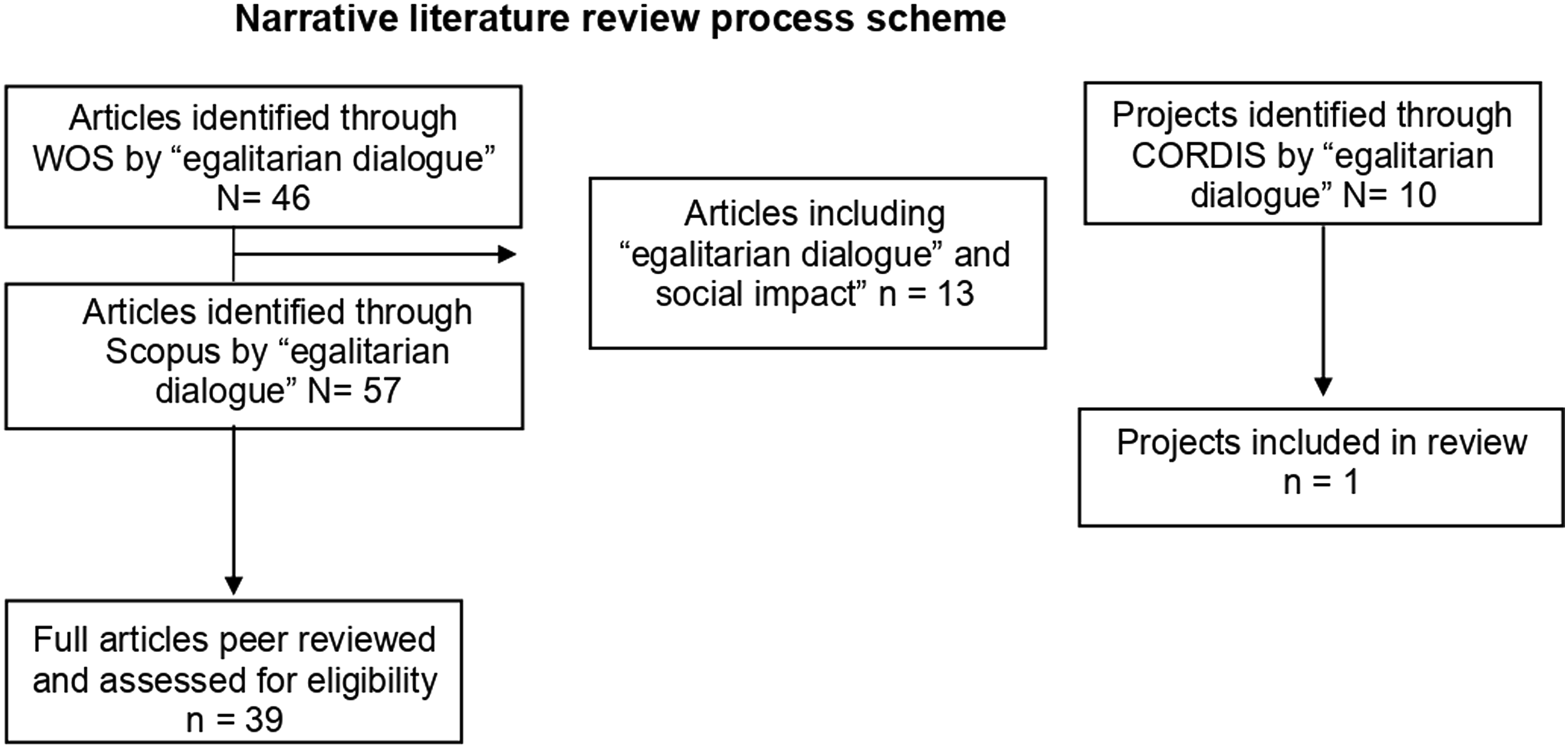
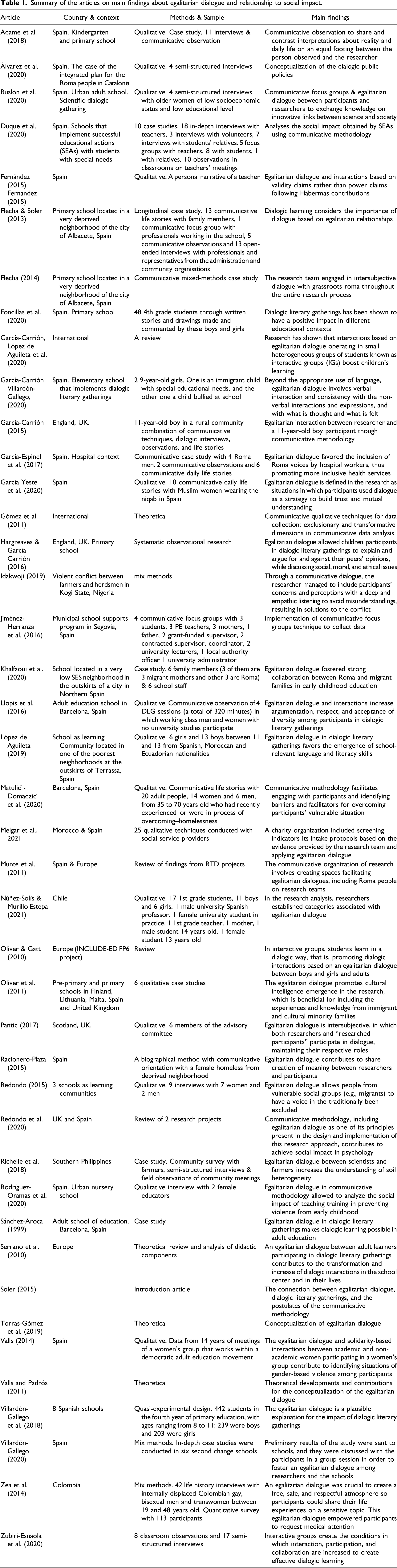
Summary of the articles on main findings about egalitarian dialogue and relationship to social impact.
Findings
After analyzing the 39 articles following the five criteria specified in the methodology section, we present the information in three main sections: the first one is on the relationship between egalitarian dialogue and social impact; the second is on the characteristics of this dialogue; the third explores how, if correctly developed, it is directly related to social impact.
The fourth section highlights one of the analyzed articles in the literature review, which explores the impact of dialogic literary gatherings on students’ relationships with a communicative approach (García-Carrion et al., 2020). This article, and the exploitation of documents extracted from the CORDIS website about the ChiPE project, exemplify how the use of egalitarian dialogue led to a high social impact in its results.
Egalitarian Dialogue and Social Impact
A new scenario is opening for qualitative research in the world due to the need to show social impact with the research results. The interpretation of reality by the participants through dialogue was the first stone in the concretion of participatory perspectives in research. However, dialogue in itself does not ensure the final social impact of research; we need to consider other elements that help to do so. The use of egalitarian dialogue (Flecha, 2000), which could be carried out under very different methodological perspectives, is one of these possible options since it allows results to be obtained that are oriented towards transformation and overcoming inequalities, which are totally linked to obtaining social impact.
We understand social impact as the improvements that research produces in the citizenry in response to social objectives. These improvements must be linked to social objectives where citizens have intervened to set priorities, such as the Sustainable Development Goals (SDGs). Competitive research funded by public bodies demands that the research carried out has this social impact. This fact directly impacts qualitative methodological processes that must be implemented to achieve this social impact, and at that point, the egalitarian dialogue could play a key role (Redondo, et al., 2020).
The articles analyzed apply the egalitarian dialogue in their methodological development. It is worth highlighting the article by Duque, et al. (2020), which analyses the social impact of successful educational actions applied to children with special educational needs. Under the auspices of the communicative methodology, egalitarian dialogue in this research was a determining factor in achieving social impact.
Similarly, the study carried out by Villardón-Gallego, et al. (2018), analyzed the effect of two concrete successful educational actions, based on egalitarian dialogue, on the development of “prosocial behaviour” in 4th-grade studies. As the author’s detail, egalitarian dialogue is a plausible explanation of the social impact achieved by these educational actions, but concrete studies must be carried out to corroborate this direct relationship.
The article by Álvarez, et al. (2020) provides an interesting contribution on dialogic public policies and the Roma community thinking in the relation of egalitarian dialogue and the social impact. The authors, introducing the concept of dialogic public policies, affirm that these types of policies have to be made using this egalitarian dialogue with the Roma people and scientific evidence to provide the best results. The link is established between the egalitarian dialogue and the best possible results obtained through the research process. They explain the importance of creating spaces of egalitarian dialogue, like those created to present the final results of the project Workalo: Creation of new occupational patterns for cultural minorities: The Gypsy Case in the European Parliament in 2004. By ensuring this egalitarian space in the research process, researchers, stakeholders, politicians, and Roma people engaged in debating and discussing the research results. Months later, one of the Members of the European Parliament who attended the meeting presented a motion to the European Parliament for the recognition of the Roma community that was unanimously approved. The same happened with a Member of the Spanish Parliament. He also attended that dialogic space since he presented a motion in the Spanish Parliament to recognize the Roma community and their culture in the history of Spain that was approved unanimously.
Matulic-Domadzic et al. (2020) analyze in their article the direct relation between the social impact of psychology on programs for homeless. They used egalitarian and intersubjective dialogue among researchers and “researched” people under the communicative methodology, highlighting also how both elements are consistent with the search social impact. As they argue, using the egalitarian dialogue they are looking for “the discovery of conditions for the social transformation of their realities through a common interpretation” (Matulicˇ-Domadzicˇ, et al., 2020, p.4). In this vein, egalitarian dialogue, and solidarity-based interactions between academic and non-academic women in FACEPA’s (Federation of Cultural and Educational Associations for Adults) women group has contributed to generate in-depth discussions that produce dialogic knowledge that accomplished social impact by contributing to the identification of situations of gender-based violence among participants (Valls, 2014).
In education, egalitarian dialogue has also been a facilitator for achieving social impact and improving educational outcomes. Egalitarian dialogue is one of the seven principles of Dialogic Learning, and it is present in “Successful Educational Actions” (SEAs) that promote educational success and social cohesion (Flecha & Soler, 2013) such as in Dialogic Literary Gatherings (DLG) (Foncillas, et al., 2020; Lopez de Aguileta, 2019; Sánchez Aroca, 1999). The egalitarian dynamics fostered in DLG increase argumentation and acceptance of diversity among participants (Llopis, et al., 2016). Regarding social impact, dialogic interactions in DLG motivate participants’ transformations and self-confidence (Racionero-Plaza, 2015). Serrano, et al. (2010) explain that the dialogic communicative interactions encouraged in DLG generate transformation among adult learners because they open spaces of egalitarian dialogues that generate egalitarian transformations impacting adult learners’ families and communities. Soler (2015) points to a strong connection between the egalitarian dialogue facilitated of in DLG and the postulates of the communicative methodology.
Interactive Groups are another “Successful Educational Action” in which dialogic interactions based on equal dialogue guide participation of students in heterogeneous groups encouraging inclusion, accelerating learning, promoting solidarity and success for all students, even in vulnerable contexts (García-Carrión, López de Aguileta, 2020; Zubiri-Esnaola et al., 2020; Oliver & Gatt, 2010). Núñez & Murillo (2021) use the communicative methodology to analyze the actions present in Interactive Groups, which facilitate an egalitarian dialogue. In their analysis, they established the following categories associated to dialogue “listening closely, listening attentively soliciting contributions or ideas, soliciting arguments, granting equal participants opportunities and accepting arguments by contributions” (Núñez & Murillo, et al., 2021, p.6). Moreover, Khalfaoui, et al. (2020) have shown, in a study with Roma and migrant families in early childhood education, that family participation and involvement in Learning communities that implement SEAs through egalitarian dialogue encourage trust and confidence relationships together with a strong commitment between families and school in the benefit of students’ best education.
Theoretical and Conceptual Components of The Egalitarian Dialogue
Pantic (2017) applies the communicative methodology in its research on teacher agency, where egalitarian dialogue is highlighted. She introduces a fundamental question, also highlighted in most of the articles analyzed, the ethical responsibility of the research staff in terms of presenting the accumulated scientific theory to the dialogue with the “researched” people. Without the need to possess academic knowledge, any participant can question the arguments provided by the research staff since the dialogue is established based on the best arguments and not on the power claims.
Gómez, et al. (2011) detail precisely the main characteristics of this egalitarian dialogue. Like Pantic, they highlight the involvement of research staff on equal positions, adding essential components that characterize this dialogue. They conceptualized egalitarian dialogue as an intersubjective one, in which both researchers and “researched participants” participate in dialogue, maintaining their respective roles. Researchers bring the accumulated scientific knowledge and the potential participants their feeling, emotions, personal thoughts (their life worlds) that they can link with the information provided by researchers.
The notion of egalitarian dialogue also implies addressing the dialogue to action (Freire, 1998), the capacity for language and action (Habermas, 1984), the universal ability to participate in a language-involve activity (Chomsky, 1985), and the “demonopolization of expert knowledge” (Beck, et al., 1994). All these imply breaking the traditional hierarchy between the person who has the scientific knowledge and the participants. The intersubjectivity is the basis on which a common interpretation of reality is produced, with a transformative orientation. The positive results of research depend on this transformative power in creating spaces of egalitarian dialogue where all participants share experiences, knowledge, academic background, and feelings. At the same time, the egalitarian dialogue is based on validity claims, rejecting pretensions of power (Habermas, 1984), recognizing the people’s critical consciousness of their situations and how they can change them through dialogue (Freire, 1998).
The spaces of egalitarian dialogue created in different research projects and reflected in the different analyzed articles are always directed to a final consensus with all participants. A great diversity of profiles is always promoted in these spaces, looking for a wide diversity of opinions, being inclusive in all interactions. However, this egalitarian dialogue needs not only good intentions by researchers and participants. It is essential to move from this ethics of intention to ethics of responsibility giving more importance to the consequences of the interactions (Gómez, et al., 2011).
When implementing egalitarian dialogue in qualitative research, coherence between what it is said, though, and expressed by researchers is essential. Consistency between communicative acts and expressions of feelings and beliefs enhances trusting and authentic interactions between researchers and participants (García-Carrión, López de Aguileta, 2020). Intersubjective dialogue in communicative methodology is a criterion of scientific rigor that entails an ethical responsibility and relies on people’s active implication and participation in the research through egalitarian dialogue for generating social and scientific knowledge. In this dialogic process, researchers bring the evidence and scientific knowledge to participants on the issue studied (Lopez de Aguileta, 2019). Participants, in turn, contribute with their experiences and interpretations of the knowledge provided. Egalitarian dialogue in Communicative Methodology has been also used as mean for analyzing social impact, for instance, for evaluating the impact of Dialogic Teacher Training for preventing violence from early childhood in a Learning Community in Spain (Rodríguez-Oramas, et al., 2020).
It is important to think about what happens when this dialogue does not happen, mainly if we research with vulnerable groups. Flecha (2014) enters into this critical question and analyses how the Roma community rejects researchers who do not work with their community in equality terms. If researchers cannot assure the participation of the Roma in the research process of assuring a positive impact in their community, they reject them. Participating through this egalitarian dialogue, together with other variables, ensures that the research results are close to the concrete reality and that the problems these communities face can be overcome (Flecha, 2014).
This idea regarding “why do the Roma not like exclusionary research” is directly quoted in the article by Munté, et al. (2011, p. 257) and later on in another relevant one by Garcia-Espinel, et al., (2017). The first one, centered in education, analyses how exclusionary research has negatively impacted in the Roma community because this research reinforces stereotypes against them. To overcome this situation, the authors propose to work with Roma people using egalitarian dialogue. Applying it in different spaces of dialogue, researchers changed their perceptions. “Egalitarian dialogue between researchers and people being researched can completely change the image established based on exclusionary perspectives which strengthen the stereotypes that exist about them” (Munté, et al., 2011, p. 259).
The second article centered on health is very important in overcoming situations of inequality of Roma community in their access to health services. The article presents a communicative case study around the death of an important Roma female leader in Spain. The egalitarian dialogue established between the workers at the hospital and the Roma relatives and friends was the main factor for allowing the Roma rituals regarding death respectfully. “In the same way that this dialogue has the potential to pave the way for implementing public policies based on scientific evidence, it empowered the participants so that their voices were heard by the employees at the hospital” (Garcia-Espinel, et al., 2017, p. 2197).
Oliver, et al. (2011) link egalitarian dialogue with the notion of cultural intelligence, highlighting the importance of incorporating a diversity of voices and experiences of participants, especially underrepresented groups and cultural minorities as the Roma community. They explain how applying this egalitarian and intersubjective dialogue makes the analysis of the social reality more rigorous and objective. The participants’ voices under these conditions enrich the final analysis, and the intersubjective dialogue between researchers and “researched” people is more objective than in other conditions.
In the same way, Redondo (2015), in her analysis on dialogic leadership, emphasizes how the egalitarian dialogue allows people from vulnerable groups to have a voice in spaces where they traditionally have been excluded. In this case, the participants in three different educational centers were empowered using this egalitarian dialogue and could act as leaders (dialogic leaders) for the whole community. These dialogic leaders are a clear example of how this dialogue transforms people’s lives and educational structures, impacting in participants, professionals and making this extensible to the community in which the centers are located.
One of the most remarkable articles also focused on education is the one by Valls and Padrós (2011). The research presented in this article was conducted using communicative methodology, assuring an egalitarian dialogue among all potential participants (researchers, people living or at risk of poverty, policy-makers, stakeholders, and representatives of NGOs).
Finally, Fernández’s (2015) article exemplifies a personal narrative of a teacher who spent 1 week in CREA (Community of Research on Excellence for All), in which research activities and functioning is based on egalitarian dialogue analyzed previously. The author explains how interactions with all personnel were based on this egalitarian dialogue in a great diversity of spaces and situations, independently from your position or if you are a newcomer in the group. Through all these interactions, new knowledge was constructed, and the author, as she explains, had the opportunity to transform themselves:
Since then, in a gentle process that has ended in the beautiful explosion of a week in CREA, I have fallen in love with education again, with its transformative power and its ability to change the world. I have found my place, I feel part of something bigger that helps me share a transformative struggle, which is real, which is already taking place in many classrooms and is well grounded in scientific excellence, with arguments that go beyond intuition from the egalitarian dialogue and love (Fernandez, 2015, p.946).
How Can Egalitarian Dialogue Be Applied To Achieve This Social Impact?
As we have seen, egalitarian dialogue has several components that can be very useful in achieving social impact. The mere fact of being part of our societies’ dialogical turn and responding to transforming features of reality gives it enormous potential. Most articles analyzed have applied communicative methodology in their methodological developments, but this does not imply that this egalitarian dialogue is exclusively articulated from this methodological orientation.
The notion of egalitarian dialogue and its practical implementation in methodological developments can be carried out from any qualitative research orientation that is approached critically to overcome difficulties. The principal objective of dialogism is to create an atmosphere of active listening and emphatic understanding to prevent misunderstanding and make a rapport in all the situations of dialogue. This approach enabled researchers to get to know the characters and their emotions.
Dialogism premises have been proven to help identify the security and socio-economic implications and causes of severe sociopolitical issues that are very sensitive and difficult to research, such as the violent conflict between farmers and herdsmen in Kogi State, Nigeria. Idakwoji’s (2019) research provides unique information and an in-depth understanding of this conflict. The mix-methods study included a qualitative study relying on respondents’ perceptions and applying Mead and Bakhtin’s dialogical interactive analysis approach. Through this approach, the researcher managed to know participants in the interviews, including their multiple emotions, concerns, and perceptions about the conflict, with a deep and empathic listening to avoid misunderstandings and foster a communicative dialogue (Idakwoji, 2019). Proposed solutions to the conflict emerge from the perceptions and understanding of those involved in dialogical interaction in research as a mean for change and peace.
Egalitarian dialogue has been used in a case study in the Southern Philippines in sustainable agriculture and food security. Researchers used an ethnopedological integral approach to dialogue with local farmers and built understanding on their vernacular perceptions and knowledge about agricultural soil (Richelle, et al., 2018). They conducted a community survey during two different stays at a local village. Through semi-structured interviews, local farmers participated in the study and assisted in community meetings with a local translator’s support. In the second stay, the research team provided feedback to participants and used the knowledge obtained from the local people to confront the geomorphopedological analysis that they previously conducted in the area (Richelle, et al., 2018). This study shows the benefits of including the local knowledge through an egalitarian dialogue for enriching agricultural science.
The egalitarian dialogue was a central element in the mix-methods research conducted on internally displaced Colombian gay, bisexual men, and transwomen (Zea, et al., 2014). The study relied on the communicative action to create a non-coercive and respectful atmosphere where participants could feel safe, confident, and free to dialogue and share their life experiences on sensitive issues like internal displacement, violence, and survival strategies without being judged or discriminated. According to researchers, egalitarian dialogue is enhanced when the elements above are present, and participants have permanent control over their narratives and can decide whether to deepen or disclose. As a result of the dialogic interactions, some participants felt empowered to request medical attention. The research team was diverse in gender, sexual orientation, nationality, immigration status, cultural backgrounds, and disciplines. This diversity was particularly beneficial for avoiding misunderstandings of cultural or languages expressions without limiting the understanding of participants’ narratives (Zea et al., 2014).
As we have seen in the analyzed articles, the egalitarian dialogue applied in the communicative methodology between researchers and participants is not only useful in generating knowledge and as a mean of interpretation of social reality, but it enables social impact through the qualitative research process itself. A qualitative study on young Moroccan girls sex trafficked in Morocco and Spain followed the communicative approach and used egalitarian dialogue in interviews with professionals. Researchers provided scientific knowledge on the topic and presented the preliminary findings that they were obtaining during fieldwork. Thanks to sharing evidence and engaging in dialogic interactions during the research, professionals contrasted evidence provided with their experiences. They started critically remembering possible cases of Moroccan girls sex trafficked that had gone unnoticed until that moment because it is a collective about which there is much invisibility and silence. As evidence of the social impact fostered by egalitarian dialogue between researchers and participants, a Moroccan charity organization decided to include screening indicators in their intake protocols to broaden the profiles of potential Moroccan victims. These indicators were based on the evidence provided by the research team in the interviews in which an egalitarian dialogue prevailed with a communicative orientation (Melgar et al., 2021).
The communicative methodology also incorporates a particular organization of research that reduces power interactions and power structures existing in society (Soler-Gallart, 2017). Throughout the organization of the communicative methodology, ensuring an egalitarian dialogue including all the voices contributes to reducing existing inequalities and disparity in society during the research process. Strategies present in the Communicative organization of research include creating an Advisory Committee, the constitution of multicultural research groups, forming functional working groups, or holding plenary meetings. A study conducted in Scotland applied the communicative methodology and formed an Advisory Committee composed with 12 members, including researchers and representatives of potential beneficiaries of the research. They met throughout the research process to discuss theoretical foundations, research tools, identify strategies for implementing fieldwork, analyze findings, and propose strategic ways to disseminate the research (Pantic, 2017).
The egalitarian dialogue in communicative methodology is implemented in the communicative data collection techniques. These are aimed at avoiding the instrumentalization of people and contributing to an intersubjective interpretation of reality on an equal footing, in which egalitarian dialogue is the means to reach a consensus on the interpretation of experiences based on argumentation. These techniques include the communicative observation (Adame & Márquez, 2018), communicative focus groups (Buslón, et al., 2020; Jiménez-Herranza, et al., 2016) and daily life stories. Communicative methodology approaches have also been applied in biographical methods favoring intersubjective interpretations between researchers and the “protagonists of the life stories” (Soler, 2015, p.840). This process, guided by an egalitarian dialogue, contributes to the shared creation of meaning by researcher and participant that identify and recreate the experience of the most biographically meaningful events. Evidence suggests that this communicative process can empower participants’ life meaning (Racionero-Plaza, 2015).
The intersubjective interpretation of results of the Communicative Methodology enables the identification of transformative and exclusionary elements of the issues studies. This fact is an essential step in the research process for achieving social impact. Under this approach, participants participate in the interpretation and discussion of findings through an egalitarian dialogue (Villardón-Gallego et al., 2020). The use of transformative and exclusionary dimensions of analysis in the Communicative Methodology allows for an in-depth analysis of social inequalities and the detection of new potential social problems by identifying barriers and difficulties. Thanks to the inter-subjective dialogue in the analysis process, inequalities emerge but also solutions and ways to overcome them based on a common interpretation of reality by both, researchers and participants.
Egalitarian dialogue itself has been proposed as transformative dimension of analysis in studies that follow a communicative approach. Garcia Yeste, et al. (2020) defined egalitarian dialogue in their study as “situations in which participants used dialogue as a strategy to build trust and mutual understanding” (Garcia Yeste et al., 2020, p.100). Focusing on egalitarian dialogue and following the communicative analysis of research, they found transformative interactions that overcome racism toward Muslim women that wear the niqab. Thus, the inter-subjective analysis of social reality through the exclusionary and transformative dimensions, and the specific analysis of egalitarian dialogue in people’s daily life interactions, glimpsed the possibilities of overcoming inequalities and social change that would otherwise go unnoticed.
The Practical Case of the ChiPE Project: Children’s Personal Epistemologies: Capitalizing On Children’s And Families’ Knowledge In Schools Towards Effective Teaching And Learning
Aiming at achieving social impact in qualitative research poses the challenge of finding strategies and methods to produce socially responsible and useful results. The concept of egalitarian dialogue was a relevant pathway towards impact in the EU-funded project Children’s personal epistemologies: capitalizing on children’s and families' knowledge in schools towards effective teaching and learning (ChiPE) focused on analyzing how dialogic learning environments may facilitate an inclusive epistemic climate in primary classrooms (García-Carrión, 2013). Despite the efforts of many researchers to advance knowledge towards inclusive classrooms, teacher discourse still prevails and hinders children’s opportunities to actively engage in their learning (García-Carrión, López de Aguileta, 2020). Aiming at tackling this challenge effectively to improve student learning, the ChiPE project deeply explored the implementation in the United Kingdom of two ‘Successful Educational Actions’ (SEAs) previously identified in the FP6 INCLUD-ED project.
The SEAs analyzed across Europe provide evidence of improving academic achievement, social inclusion, and community cohesion in many diverse schools. Drawing on these results, the ChiPE sought to determine whether two SEAs, Dialogic Literary Gatherings (DLG) and Interactive Groups (IG), would expand and extend those improvements in other contexts by creating dialogic learning environments and bringing family and community members into classrooms to support learning.
Consequently, the ChiPE project implemented these two SEAs in six schools in England for the first time in this country. The egalitarian dialogue was an instrumental tool for transforming primary classrooms in an inclusive space in this process. After observing, monitoring, collecting, and analyzing the data, results showed a dramatic and consistent shift from teacher to pupil talk in the DLGs, compared with typical teacher-dominated classroom interaction. According to Hargreaves and García-carrión (2016, p.15) “over 75% of the class joined in the dialogue, contributing over 80% of the talk, often in extended utterances which reveal reasoning and speculation.” These results reflected a clear shift in teacher-pupil talk and increased the opportunities for children to be included in the classroom discourse.
The introduction of the egalitarian dialogue in this project had a profound impact on children’s lives. Indeed, a narrative of a 11-year-old boy showed the importance of creating a space where egalitarian dialogue can occur between the researcher and the participants, even when they are small children. “I thought that it was very important to speak about the research and have our own ideas about it and… so then, they [researchers] can get our own perspective on what we think and what was going on and what is happening around us” (García-Carrión, 2015, p. 918, p. 918)
Indeed, research revealed that egalitarian dialogue enabled children to explain and argue for and against their peers’ opinions while discussing social, moral, and ethical issues (Hargreaves & García-carrión, 2016), thus increasing the likelihood of developments in their personal epistemologies.
The European Commission translated main ChiPE results to six languages reaching a wider audience. Indeed, the project reported positive outcomes in improving academic achievement, especially in economically deprived areas. As part of the social impact achieved, the EC highlighted the ChiPE results were socially beneficial since those helped meet the EU 2020 targets in terms of school attendance. 2
Conclusions
The review of articles in ISI Web of Science and Scopus and the review of European projects in CORDIS website on egalitarian dialogue and their relationship with social impact could allow us to conclude about the increasing use of the egalitarian dialogue to reach social impact. The notion of egalitarian dialogue used by the significant part of the articles, based on critical and dialogical theories of Habermas, Freire, and Flecha among others, has an enormous potential when we try to reach social impact, improving living conditions of the most vulnerable populations. The creation of egalitarian dialogue spaces in which all potential participants, through an intersubjective dialogue, break with the traditional differences between subjects and objects basing their interpretations on the force of the arguments and addressing their observations to transform difficulties into possibilities were joint in the great majority of the analyzed articles.
The application of the egalitarian dialogue in the different analyzed articles has been made specially through communicative methodology. The combination of dialogue and communicative methodology has made it possible to achieve social impact in the research studies presented in the different articles. The communicative organization, data collection techniques, and communicative data analysis presented in some analyzed articles are elements that, under the creation of spaces for egalitarian dialogue and ideal speaking situations, have helped to achieve social impact.
Through the ChiPE Project, we have observed a particular research project where the two “Successful Educational Actions” analyzed, in which egalitarian dialogue played a fundamental role, had a remarkable social impact on their results. This egalitarian dialogue between the students themselves and teachers created the ideal conditions for the positive results to be achieved in the end.
Footnotes
Declaration of Conflicting Interests
The author(s) declared no potential conflicts of interest with respect to the research, authorship, and/or publication of this article.
Funding
The author(s) received no financial support for the research, authorship, and/or publication of this article.
