




Abstract
This paper presents three cases of four innovative participatory and visual methods tailored for the novel practice of envisioning. Combining knowledge from the disciplines of Futures Studies and Participatory Research and arguing for the use of engaged, creative methods for data collection, it traces how principles of futures thinking and dynamic engagement merge into a practice of envisioning to address social change agendas. Each case includes details on new methods that evolved from traditional and creative data collection techniques. The formation of Photovoice Storyboards is explained as they build upon the method of photovoice or photo-journaling. BodyGlyphs are described as a method to capture the body as data, informed through embodied movement and play processes. The Gallery Walk, also informed by playfulness and participatory mapping, is discussed as a method to engage participants in co-design processes. The E-World Café is presented as the digital evolution of the established World Café method. Each case illustrates the practical application of a data collection method, where participants co-construct meanings for possible futures when addressing a defined social change agenda.
Introduction
The paper presents a discussion on innovative methods relevant to the practice of envisioning to address social change agendas. Envisioning is a novel conceptualization of doing research with people and groups united by a specific issue to conceive a shared program of action. It is specifically helpful for practice-based or qualitative researchers whose participatory research has a change orientation. The author proposes ‘Envisioning Research’ as a participatory methodological approach concerned with futures thinking—underscored by a ‘practice of envisioning’. Several authors have referred to vision-building processes in practice and research (Jørgensen, 2013; Miles & Keenan, 2002; Saritas, 2018; Padbury, 2020; Van der Helm, 2009) but these are still under-utilized in community-based and practice-based research and disciplines concerned with change agendas such as social work, education, counseling, criminal justice or public health.
The practice of envisioning has three foundational components: (1) anticipation, (2) aspiration, and (3) narratives. Envisioning involves anticipation through actively considering a preferred future tied to a defined social change agenda (e.g., what are options for addressing unsafe drug use in a community with a high level of drug overdose?). Groves et al. (2022) described anticipation as being prepared to plan and take action. This thinking about what might be and how it can be realized is coupled with elements of aspirational thinking, including “imagination, emotion, and cognition” (Groves et al., 2022, p. 63) that help surface narratives about a particular topic of concern. Narratives, as applied in the practice of envisioning, predominantly hold an epistemic function (Liveley et al., 2022), acting as tools that can help participants and researchers make sense of a constantly changing world. Narratives are used to understand commonalities and differences across a particular experience. In this sense, researchers using envisioning methods to acknowledge that stories are not “isomorphic” (Liveley et al., 2022, p. 227). Envisioning embraces the notion of “narratives as futures process” where they serve as a “sense-making tool” (Liveley et al., 2022, p. 226). Applied to the practice of envisioning, narratives as futures process involves participants exchanging their narratives in various forms (e.g., orally, textually, visually, etc.,) followed by dialogues to make sense of shared and divergent understandings of a situation that can be used to address the social change agenda. These three foundational components are gifted from the discipline of Future Studies, discussed later.
This paper positions the practice of envisioning as borrowing from, and potentially adding to, Future Studies and Participatory Research disciplines. The disciplines and their other informing concepts underpinning the practice of envisioning are first outlined before discussing three cases where four methods for envisioning (where all three components of anticipation, aspiration, and narratives were present) were applied. This paper encourages a shared vocabulary around the practice of envisioning, which comprises dynamic engagement with participants through innovative, change-oriented methods.
The Practice of Envisioning: Origins at the Intersections of Disciplines
The practice of envisioning is situated within the convergence of concepts derived from the disciplines of Futures Studies and Participatory Research. Futures thinking involves visioning, a learning process where developing capacities and values is crucial in tackling qualitative, human, and social challenges (Kristóf & Nováky, 2023). Van der Helm (2009, p. 98) described creating a vision as an “explicit preparatory step to get towards action.” Van der Helm (2009) stated that visions are concerned with “making claims about and for the future” (p. 98) and rely on assumptions around three main aspects: the future, the ideal, and the desire for deliberate change. Visions are distinct from worldviews because they make explicit or strong implicit claims about the future but refer to something that does not yet exist. For instance, this might resemble plans to provide access to youth-friendly healthcare, a strategy for developing a coalition of organizations engaged in child protection, or actions to enable digital transformation within an organization. Visions, as implied in the practice of envisioning, are not viewed as ideal or utopian but point toward “preferred” futures (Van der Helm, 2009, p. 99). Rather than aiming for the ideal, envisioning researchers, as proposed by the author, would encourage participants to envision a future better suited to their historical and contextual circumstances. It is vital to avoid conflating ideal futures with preferred futures. There are many possible futures, but only one preferred future that a group is aiming for when envisioning. The practice of envisioning assumes the possibility of choice; more futures are available, but if I had a choice, I would choose (or prefer) X.
Futures Studies or Futures Research, previously referred to as Futurology, has developed into an interdisciplinary field that explores potential, probable, and preferable futures, including the worldviews and myths that underlie them (Kristóf & Nováky, 2023; Minkkinen, 2020; World Futures Studies Federation, n.d). The discipline aims to understand what is likely to continue, change, and emerge among current trends, challenges, and technologies, encouraging proactive thinking and strategic planning to help society, organizations, and individuals effectively prepare for the future.
Foresight studies, an important domain of Futures Studies and often used interchangeably as an overall name for the discipline (Saritas et al., 2022; Öner, 2010), involves “systematic, participatory, future intelligence gathering and medium-to-long-term vision-building processes” (Miles & Keenan, 2002, p. XI, as cited in Saritas, 2018, p. 2) to inform present-day decisions and mobilize collaborative actions. The practice of foresight is not about predicting the future but rather a methodical approach to exploring possible futures with the aim of shaping them. It emphasizes understanding the dynamics that create the future, identifying trends, and recognizing emerging issues that could have significant impacts, enabling proactive rather than reactive strategies.
Futures Studies, and its domain of Foresight Studies, employs a variety of methods, from statistical analysis to scenario planning and simulations, as well as Delphi techniques (i.e., a method relying on the well-established questionnaire and polling forms of gathering data that entails rounds of questioning and summarizing feedback from the group of selected experts), trend analysis, and environmental scanning, to anticipate and influence the development of future events (Sardar, 2010; Öner, 2010). These tools facilitate a deeper understanding of possible future developments and their implications. The goal is to cultivate a strategic mindset that prioritizes long-term thinking and is open to innovative solutions and adaptive strategies. This mindset is seen as contributing to more resilient and adaptable planning and policymaking to help those who are participants or partners in research navigate complex, uncertain futures. Sartias (2018) noted that Futures and Foresight Studies methods were becoming increasingly participatory. These methods have links to the discipline of Participatory Research and can be assessed using its concept—the continuum of participation—to determine engagement level of those involved in the research process.
The continuum of participation involves the use of methods ranging from highly participatory from start to finish, including co-creating research agendas, to minimal input in decision-making processes by participants (Brown, 2022; Key et al., 2019). For example, Auemaneekul (2010) described the continuum moving from consultative on one end, through participatory involvement, to participatory action, where the former involves minimal community input through consultative processes and the latter has the community of interest driving change implementation. Others have described the same spectrum as a continuum of engagement (Vaughn & Jacquez, 2020). Regardless, the level of participation in research should be considered in relation to the goals and setting of the study.
The practice of envisioning builds on conceptualizations of participation in Futures Studies and aligns more with how participation is described in the discipline of Participatory Research. Participation in the practice of envisioning requires profound, interactive engagement either through co-creating or co-analyzing data or both, where the community of interest is deeply involved in envisioning preferred futures—sitting at the highly participatory end of the continuum. It is in this space that the discipline of Engaged Research is burgeoning (Fouché & Chubb, 2020) and where methodological approaches related to Envisioning Research should be located. Since the author’s first conceptualization of the practice of envisioning, it has borrowed and built on concepts. It has stepped further into what Lindström et al. (2022) termed collaborative future-making. Envisioning asserts the need for creative methods to translate the practical value of anticipatory futures thinking from the discipline of Futures Studies and Participatory Research into different, qualitative, engaged research contexts.
Informing Concepts for the Practice of Envisioning
Aside from the foundational components of anticipation, aspiration, and narratives, the practice of envisioning is informed by four key concepts significant to Futures Studies and Participatory Research: The Foresight Principle; consciousness-raising through dialogue; selection and sequencing; and use of creative, participatory methods enabling interactive engagement. The Foresight Principle, as defined by Richard Slaughter (1990), involves a conscious effort to expand awareness and clarify the dynamics of emerging situations. Slaughter (1990) suggested that foresight is not just a technical skill that can be learned or applied mechanically; it arises partly from our unconscious mind. This means that while foresight uses logical, rational thinking, it also depends on the less tangible, non-rational aspects of our experience—like values, ethics, and emotions. He also highlighted that effective foresight needs the correct social and institutional settings to really work well. It cannot rely solely on the narrow expertise of specialists or the strict application of scientific and technological methods. Instead, successful foresight should incorporate a broader, ethical perspective that considers the overall human context. Slaughter (1990) asserted that balancing these rational, social, and ethical elements is crucial but challenging and often lacks adequate support. When done right, this balance helps maintain social stability and adaptability.
Slaughter (2002) later argued for a shift in Futures Studies. He asserted that the discipline should concentrate more on strategic foresight because many of the existing methods were limited in what they could achieve in terms of establishing a vision and were unnecessarily complex. This approach was increasingly adopted over time, specifically in the 2010s and beyond (Kristóf & Nováky, 2023). Practitioners started to expand Futures Studies to include elements of strategic planning, which were not a significant part of traditional approaches in this field. This evolution reflected a move towards making Futures Studies more practical and focused on implementing findings. This is where the practice of envisioning's intersection with Participatory Research is most obvious.
The second key concept informing the practice of envisioning is Paulo Freire’s (1968) idea of conscientização or conscientization, referring to critical conscious-raising through dialogue about societal conditions. Conscientization promotes a deep understanding of the conflicts and disparities in social, political, and economic realms and encourages actions to resolve them. By engaging in iterative conversations with participants, dialoguing encourages the articulation of experiences and perspectives concerning the defined vision and can help uncover power dynamics and inequalities present in the group. As active contributors to the knowledge-creation process, participants engage in meaning-making through dialogue to gain collective awareness of common injustices, struggles, and successes. This can facilitate an orientation toward action development and, in some cases, action implementation. Reflection and action-orientated or anticipatory futures thinking are also catalyzed through dialogue. Both are essential to the practice of envisioning in order to foster a critical awareness that empowers individuals and communities to anticipate and shape their social and environmental futures.
The third concept informing the practice of envisioning is selection and sequencing. Selection refers to deliberately choosing a data collection method or methods tailored to the study’s aims. Sequencing, on the other hand, involves the thoughtful configuration of chosen methods in succession to augment the depth and breadth of collected data. Where multiple methods are used in the practice of envisioning to generate actions for addressing a defined social change agenda, sequencing is essential. Given that this paper reports singular methods where all phases of each study’s design are not specified, the significance and decision-making around the sequencing process are not further detailed.
In Foresight Studies, Popper (2008) asserted that the selection of methods is sometimes an inconsistent process dominated by the researcher or practitioner’s intuition and experience, as opposed to following a coordinated approach. He argued that the nature of methods themselves substantially influences the selection of method—whether qualitative, quantitative, or mixed—as their attributes affect their uptake based on assessed suitability for the specific goals of anticipatory futures thinking. As with the practice of envisioning, Popper (2008) stated that the selection of methods is context-dependent, influenced by the capabilities and strategic priorities of the group involved in futures thinking.
For Envisioning Research, once a group has convened around a particular topic concerned with action-orientated or anticipatory futures, selecting methods to enable deep engagement, promote dialogue, and uncover emergent insights is the next step. For the practice of envisioning, these should be creative, participatory methods (detailed later), which supports Popper’s (2008) and others’ (Miles et al., 2008) advocacy for a more balanced use of methods integrating increasingly participatory approaches that enhance the ability to harness foresight potential— a core objective within the practice of envisioning.
Creative participatory methods, particularly those informed by the creation or use of arts and play, can enhance research in many ways. They are deemed a necessary component and the fourth main concept in the practice of envisioning. Using storytelling (Moola et al., 2020), photography (Milasan, 2024), weaving and quilting (Ortega et al., 2023), video diaries (Buchwald et al., 2009) or drawing (Literat, 2013) for example, can make the data collection process more engaging for participants. Phillips et al. (2022) asserted that using methods to elicit multi-voice, embodied, affective, and aesthetic knowledge, such as with creative, arts-informed research, can sometimes make it challenging to develop clear-cut knowledge claims that may contribute to research and practice. However, the creative form can also motivate participants to share more robust explanations of their experiences and work together to make meaning from the data. Art and creative processes can also help participants and researchers alike tap into different emotional layers. They can capture complexities of the experiences shared about a particular phenomenon being researched and expand on what could be understood through words alone.
Building on this notion, expression in different forms can enhance access to information about a specific phenomenon where persons affected by the issue might have a range of literacy or communication barriers. Importantly, the process of creating can facilitate ownership, as it encourages participants to take control over how they represent their experiences and to what degree of depth they choose to share. Moreover, creating can be a therapeutic or cathartic experience for the research participant (Milasan, 2024).
Creative, arts-informed methods produce compelling displays of data (e.g., comic strips, museum displays, short films, infographics, interactive websites, etc.), making findings easier to communicate to broader audiences and extending epistemologies or ways of knowing (Enge et al., 2011). Creative data-gathering methods enrich the practice of envisioning, helping to articulate the actions and anticipatory futures thinking that arise through the process. While it is a valid concern and caution not to assume the “art-making ability” of participants (Moola et al., 2020, p. 5), the practice of envisioning does not prioritize the product of the creative process as data but the dialogues prompted through engagement in creative processes. Creative methods are not limited to arts-informed activities during collection. They can also refer to how participants co-construct knowledge from the data, the spaces for dynamic interactions between participants that can lead to new ideas about the future, and opportunities for participants to choose how their narratives are represented.
Taken together, the practice of envisioning is about coming to an idea for the future through appropriate methods for vision-building that involve dialoguing, co-production of knowledge, and determining actions in an interactive group process. Envisioning Research is potentially a burgeoning domain of Futures Studies and a new area of Participatory Research. Envisioning Research expands the scope of methods in Futures Studies from predominantly foresight methods (e.g., Delphi methods, environmental scans, applying scenarios) (Kristóf & Nováky, 2023) to include creative, arts-informed participatory activities for dialoguing and deeper engagement aimed at desirable actions. Envisioning Research serves to expand the focus of anticipatory futures thinking to populations that are defined as hard to reach, hidden, or vulnerable (Ellard-Gray et al., 2015), such as adolescents, migrants, sexual or ethnic minorities, people who are homeless, or persons with substance use disorders. The potential of applying envisioning data collection methods is illustrated through three cases.
Four Novel Methods for Envisioning Research: Three Cases
Envisioning research methods involve activities that support the concept of “studying with” (Priyadharshini, 2021), whereby the participants and researchers are engaged in inquiry together, developing actions to achieve the preferred future. Four methods for the practice of envisioning as applied to three different research contexts are presented: 1) Photovoice, Storyboards, 2) BodyGlyphs, 3) A Gallery Walk, and 4) E-World Cafés. The author outlines the contexts and purposes for which each method was applied and their evolution from existing participatory methods. In addition, the actions taken to raise critical consciousness about a defined social change agenda are discussed while briefly describing the outcomes of the separate studies.
Case 1 – Fostering Intergenerational Sex-Talk in Coast Kenya: Photovoice Storyboards
The Social Change Agenda and Study Context
Photovoice Storyboards were used in a research project where young people documented and shared their sexual learning and exposure journeys to prompt intergenerational conversations about how to promote sexual well-being and begin addressing sex-related harms in a Coast Kenyan community (Chubb, 2018). The study adopted a phased, community-based participatory action research (CBPAR) approach to address sex-related issues (e.g., coerced sex, transactional sex, or violation of sexual rights, etc.). The first phase, access and training, involved gaining permission, building relationships with community members, and training a local research team who were health outreach facilitators in a Kenyan community-based organization to assist with data collection, analysis, and implementation of sustained initiatives after the research was complete. The second phase, data collection, was with different groups, including young people through photovoice and adults in the community through focus groups, to understand the community’s specific sex-related challenges and the contexts of young people’s sexual learning and exposure. Phase three involved adapting the baraza (i.e., Swahili word for traditional open-air gatherings in Coast Kenya) and served as the critical consciousness-raising phase, in which young people’s Photovoice Storyboards of their sexual learning and exposure experiences were shared as a springboard for intergenerational dialogues to begin conceiving solutions to the sex-related challenges identified. The adaption of the traditional space where the sharing was done is discussed elsewhere (Chubb, 2018; Chubb et al., 2022) and is henceforth referred to as the sharing session. The final phase involved disseminating findings to discuss how the community might take ownership of any initiatives that could work to address sex-related harms young people were experiencing.
While details of all the participants for each phase of the research are detailed elsewhere (Chubb, 2018), 43 young people (23 females, 20 males) aged 10-21 participated in photovoice in phase two to document their experiences of sexual learning and exposure and worked with the research team to create the Photovoice Storyboards they wanted to be shared in phase three. All participation was voluntary, and several levels of ethical approval were obtained from the lead researcher’s host institution, as well as Kenya’s National Commission for Science, Technology, and Innovation, and the Chief of the Ward. Where participants were under 16, assent was also obtained. Photograph release forms were part of the consent/assent process, and young people worked with the researchers to anonymize any photos of faces or other identifiable elements in their photographs.
Description of Method: Photovoice Storyboards
Storyboards, initially used in the film industry for the pre-visualization of scenes, evolved into a powerful qualitative research method across numerous disciplines, including education, social work, and community development (Chubb et al., 2022; Simeon et al., 2010; Wikström, 2013). Storyboards facilitate the exploration of subjective experiences by inviting participants to express complex ideas and emotions visually and textually, enhancing the richness and depth of data collected. The process of creating storyboards typically involves participants drawing or writing responses to specific prompts, which can enhance the depth of perceptions and experiences participants choose to share (Ayob & Omidire, 2021). Storyboards are especially advantageous in studies with young people or populations where language may be a barrier, as they provide an alternative mode of expression (Ayob & Omidire, 2021).
The concept of Storyboarding, as described above, was adapted to include elements of photovoice as a first step. Photovoice is a method concerned with the democratization of knowledge production. Researchers invite participants to take photographs that represent their experiences or perspectives about a specific issue, taking the view that insiders—the participants—are the experts regarding issues in their community (Liebenberg, 2018). Through photovoice, participants take photos related to a defined topic, which are then discussed collectively to uncover deeper meanings. Through this process, participants critically examine a topic, identifying strengths and challenges, with the collective reflection aiming to raise awareness and drive social change.
Consciousness Raising Through Envisioning
Aspects of photovoice and collage as inquiry were used by Chubb (2018) to initiate intergenerational conversations on sexual wellbeing-related issues in a traditional space in Kenya. For photovoice, young people were given prompts inviting them to walk around their community and take photos of where they learn about sex in their daily lives (i.e., sexual learning) and any places or ways in which they might be exposed directly or indirectly to sex-related ideas (i.e., sexual exposure) in their communities. Each young person generated four to 12 photos and then participated in a 30–60-min interview to share why they took the photo and how it informed their sexual learning or exposure journey. A transcript was produced from the interview, and relevant details were matched to a hard copy of the associated photo. Each young person was invited to make changes to the information before the final Photovoice Storyboard was produced, in English and Swahili and comprised an enlarged version of their favorite photos or ones considered most representative of their learning or exposure to sex-related information along with descriptions of the chosen photos (See Figures 1–2)
1
. It was unanimously agreed that the photovoice storyboards would remain anonymous and that research team members would read the descriptions at the sharing session. First example of photovoice storyboards. Second example of photovoice storyboards.

The Photovoice Storyboards were springboards for reciprocal intergenerational sex-talk that did not require the verbal input of young people—simultaneously protecting their identity and encouraging their agency.
Guided by Photovoice Storyboards, the research team posed questions in the sharing session to envision solutions to sex-related issues such as sexual violence or unplanned teen pregnancies. Questions such as “How do these photographs change your understanding of sex-related issues in the community?” and “What can we (young people and adults) learn from sharing similar experiences of learning and exposure to sex-related ideas?” were intended to foster a space for creating new understanding and knowledge. Whereas “How do you see or want your future to look?” and “In what ways does this idea better your community?” focused on envisioning community-driven solutions. Conversations were recorded and thematically analyzed (Braun & Clarke, 2006) by a team of cross-cultural researchers, a process described in more detail by Chubb et al. (2022).
Outcomes
Through this dialogic process, community members became critically aware of the need to address sex-related challenges identified by the young people and expressed a shared commitment to change. It is a challenge for young people to access and act on their agency in spaces where cultural age-set rules are at play, but young people’s experiences helped inform and were part of this commitment to change. Results evidenced that the Photovoice Storyboards were key to inviting different generations of participants to share their experiences and ideas for addressing sex-related issues in the community. Significantly, participants identified a generational gap in sex-related terminologies and manners in which to communicate about sexual well-being and rights. The community decided age-based monthly mentorship sessions to develop the tools to talk about these topics were necessary.
Case 2 – Co-Designing an Arts, Culture, and Heritage Strategy in the Three Lakes District in New Zealand: BodyGlpyhs and the Gallery Walk
The Social Change Agenda and Study Context
BodyGlyphs and the Gallery Walk were two methods applied to envision ideas for an Arts, Culture, and Heritage Strategy during a day-long co-design workshop conducted by two facilitators with 32 participants who either worked for, or were affiliated with, 28 youth arts organizations in the Three Lakes District of New Zealand. The author was one of two people invited to facilitate the co-design workshop. As this was a facilitation-only role, institutional ethics approval was not required. However, the host organization managed ethical considerations, including a briefing about what participation in the workshop would mean, how data would be collected and used after the day, and obtained consent for the use of photographs (i.e., all participants signed a consent and photograph release form indicating voluntary participation). As one minor was featured in a photograph that a parent consented to, their faces were blurred from the image.
Description of Methods: BodyGlyphs and Gallery Walks
BodyGlyphs is a research method informed by playfulness and embodied processes. BodyGlyphs are embodied movements where an individual activates their body, mind, and emotions while employing their physical form to generate a visual representation in response to a query, concern, or concept. As a participatory method, BodyGlyphs can be used to prompt dialogue for envisioning (Chubb & O’Connor, 2023). Langham (2020) defined play through the element of fun. According to her, it is fun that draws people to engage, participate, share experiences, and be open with others. The idea of play and playfulness to engage people is attracting increased interest in studies using participatory methods. Perry (2018) highlighted that drama permitted the use of participants’ real bodies in research, which enhanced participants’ agency, leading to a more nuanced sharing and understanding of their lives.
Play and playfulness, like that informing BodyGlyphs, can ease stress, enhance learning, stimulate the mind, boost creativity, and connect people to one another and their environment (Gordon, 2014). Play encourages relationships and conversations among people of various ages and cultures, provides a safe space by encouraging participation, and helps modify the terms of conversation by diminishing the ability of stronger voices to dominate discussions or use personal experiences to persuade others (Calvo & Sclater, 2021; Hinthorne & Schneider, 2012; Langham, 2020). However, play for social change, or research-informed play (Gray & Kontos, 2018), must differ from ordinary play by eliciting conscious thinking while relating to real-life issues and concerns (Hinthorne & Schneider, 2012).
Embodiment can be one form to enact play, sometimes called serious play in research, where practice, such as the practice of envisioning, is processed through senses (i.e., auditory, visual, tactile, olfactory, etc.) (Kuepers, 2017). Embodiment constitutes the interplay between an individual’s physical presence and the multiple social, cultural, and historical contexts they inhabit or have moved through. It is a process that fundamentally involves gaining knowledge through bodily experiences – “learning through the body” (Spry, 2011, p. 33, as cited in Gray & Kontos, 2018). Embodied research combines a sense of vulnerability and aesthetic involvement with reflective and analytical interpretations inherent in artistic and interpretive decision-making. Thus, methods that involve embodied play are tools for ascertaining bodily representations in response to an issue that participants do not necessarily anticipate.
The Gallery Walk was a second method used during the same co-design workshop. The Gallery Walk is an envisioning method guided by research-informed play and the technique of participatory mapping. It can be used as an interactive envisioning practice to map existing and desired connections amongst participating groups. As a form of participatory mapping, the Gallery Walk is a research method that engages participants in creating maps that help express their personal and collective experiences, emotions, and perceptions often related to a specific space or place (Ralls & Pottinger, 2021). This can reveal a deeper understanding of community relationships and place attachment. It is a common method used in applied geography, community development, and action research (Amsden & VanWynsberghe, 2005; Suarez-Balcazar, 2020). Participants use various techniques, often highlighting significant locations and their experiences associated with these places (Ralls & Pottinger, 2021). Participatory mapping can take many forms, but the underpinning notion is to foster a collaborative environment where maps are the basis for discussion, helping to build an understanding of a context, scenario, or problem among participants. Participatory mapping facilitates analysis that supports the identification of actionable insights (Ralls & Pottinger, 2021). Thus, an important aspect of the Gallery Walk method is performing a connections analysis to map the existing and desired connections for each individual or organization participating. During a connections analysis, researchers and participants work together to note whom participants are already connected with and whom participants want to form a connection with them in the future. This is a practical form of analysis where participants can immediately use the knowledge gained through participation.
Consciousness Raising Through Envisioning
Participants were not pre-advised about the workshop activities, only the purpose of coming together. The facilitator-researchers used to prompt questions and invited participants to use their bodies to create playful responses to the question: What could the Youth Arts sector be in the future? As one facilitator moved around the room, inviting all participants to share their interpretation of a Bodyglyph and then asking those who created the BodyGlpyh to share what it represented for their vision of the strategy, a second facilitator made notes about what participants shared. At the end of the BodyGlyph session, the group sat in a circle for one of the facilitators to recap what was documented through the notes to confirm if the representations were accurate and to invite the group to add anything further. This iterative sharing process helped identify key recommendations for the strategy design.
The participants split into smaller groups to form separate representations of what they might choose to include. BodyGlyph #1 (see Figure 3) signified the critical role of young people in spearheading the strategy. Youth participants indicated that their heart-shaped framing symbolized their desire for love and joy to envelop their work (faces have been blurred to preserve anonymity). Additionally, it highlighted the significance of intergenerational relationships, representing the need for youth arts leaders of tomorrow to learn from today’s leaders. The glyph emphasized the importance of experience as a foundation, with adult leaders uplifting and walking alongside young individuals. It highlighted the essence of establishing connections and fostering collaboration in this pursuit.
2
BodyGlyph #1 – “Love is the Frame.”
As a second example, BodyGlyph #2 (see Figure 4) captured a sense of balance and harmony rooted in connection to the land. It drew attention to the apparent gap and desire to collaborate with Māori (Indigenous) experts in the youth arts domain. The glyph symbolized the participant’s aspirations to establish authentic connections to the place, and the need to foster a profound sense of belonging. It highlighted that the Arts, Culture, and Heritage Strategy should honor and integrate Indigenous perspectives, facilitating a more inclusive approach to youth arts. Five BodyGlyphs were created in total.
3
BodyGlyph #2. – “Ready to blossom”.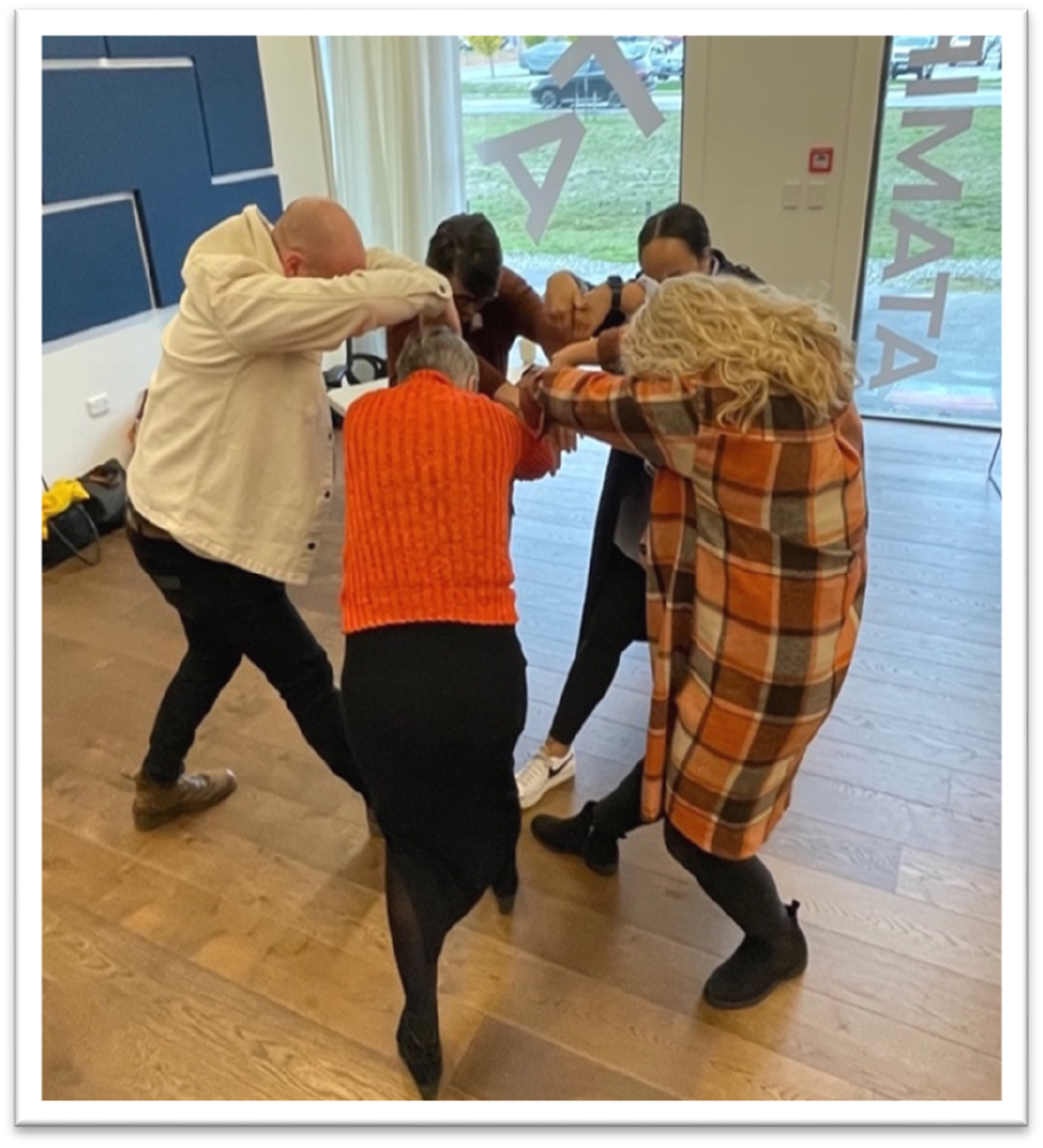
To practice envisioning during the Gallery Walk, participants were asked to write on a sheet of paper their organization’s unique contribution (i.e., their point of difference) to the youth arts sector in the Three Lakes District in New Zealand. Each group was asked to lay their paper on the floor, where everyone could walk around and see what connections were occurring in the sector— “a gallery walk.” While walking around and reading each other’s contributions, participants were asked to write their organization’s/practice name in a cloud on another organization/practice paper that they wanted to establish a future connection with, or to write the name of their organization/practice with an underline, to indicate there was already an existing connection (see Figure 5). Organization contributions to gallery Walk.4
Embodying Kogen’s (2024) assertion that participatory data analysis can bridge theory-building with practical implementation, both methods helped formulate a theory about potential partnerships and areas for collaboration within the youth arts sector. The participatory nature of the connections analysis enabled real-time mapping of commonly desired connections to uncover new areas or reasons for collaborations that would not have been reached had the participants relied on reading about each other’s organizational mission statements and website materials. Together, they envisioned a preferred future where organizations might be inclined to collaborate towards a shared goal. Similarly, the real-time feedback on the different interpretations of each BodyGlyphs revisited in the final circle of the session ensured participants drew conclusions about how both methods produced insights for designing a strategy. Their explanations were then prioritized in the researchers’ hybrid thematic analysis (Swain, 2018).
Outcomes
Using BodyGlyphs and the Galley Walk methods in the co-design workshop produced several important outcomes. A key takeaway was the recognition that youth voices must be central to the strategy’s development, with participants emphasizing the need for accessible and inclusive spaces where young people can creatively express themselves, along with the need for stronger collaboration between local arts organizations, individual artists, and youth-focused groups.
After the co-design workshop, one organization shared the findings from the Gallery Walk with different groups to spark ongoing discussions so that others not in the workshop could contribute to the strategy’s development. As a result, further meetings were established to continue the conversation, building on some of the ideas and themes from the workshop. Additionally, the driving organization created an e-book capturing the visual scribe’s work from subsequent meetings, showcasing the ongoing focus on youth and their role in shaping the future of arts and heritage in the region. To foster better collaboration in the sector, the driving organization also undertook a visual mapping project to identify all youth arts groups and organizations in the final presentation of the strategy. Their final product was the “Creativity, Culture, and Heritage Strategy” for the Queenstown Lakes District (Three Lakes Cultural Trust, 2024).
The Gallery Walk method enabled participating organizations to determine who they might reach out to for future partnerships while raising awareness of the services available in the sector. This method could be expanded to map issues and concerns about a phenomenon, place, or scenario. Both BodyGlyphs and the Gallery Walk as research-informed play processes help generate evidence and envision strategic actions that are useful for future facilitators seeking to create supportive environments for co-design processes and the practice of envisioning.
Case 3 – Defining Enablers Digital Transformation of Aotearoa’s Non-Profit Sector: E-World Café
The Social Change Agenda and Study Context
Kerrison (2023) adapted the World Café method, as used by Fouché and Light (2010), for online use to collect data on the difficulties that non-profit organizations in Aotearoa New Zealand encounter in adopting technology (i.e., digital transformation). Participants were primarily in leadership roles and came from a wide range of sectors, including education, health, and social services. Ethics approval was obtained from the researcher’s institution, and participation was voluntary. Kerrision’s (2023) utilized a two-phase data collection process. Initially, a semi-structured focus group was conducted and audio recorded. Data from this phase were inductively analyzed by identifying significant patterns, excerpts, and ideas, then organized into themes. These themes served as the basis for discussions focused in two subsequent World Cafés, one of which was adapted for online use (i.e., e-World Café) using the Zoom application. Zoom is a popular video conferencing platform that enables online meetings, virtual collaboration, webinars, and real-time messaging across devices globally (Zoom Video Communications, n.d) widely popularized during COVID-19 lockdowns.
Description of Method: E-World Café
The World Café is a qualitative data collection method rooted in the philosophy of Appreciative Inquiry (Fouché & Light, 2010). It is a participatory approach to data collection frequently employed in action-based research and community development, including organizational and strategic planning. The World Café supports large group discussions on specific topics (Löhr et al., 2020). A principal advantage of this method in research is that conversations develop across multiple rounds, enhancing group-wide exploration (Brown & Isaacs, 2005). Those who use the method emphasize constructive dialogue and collaborative learning among groups, prompting cross-pollination of ideas within a café-style setting that encourages open and non-threatening exchanges (Fouché & Light, 2010). This method contrasts with traditional research approaches, such as focus groups, typically involving a facilitator-driven discussion among a smaller group of participants. In comparison, the World Café facilitates larger, evolving conversations where participants can shift between tables, contributing to and building upon discussions.
Upon its development, this method represented an evolution from other data collection methods by its informal setting and structure, which align closely with values like inclusiveness, mutual respect, and the promotion of collaborative learning. Traditional methods of data collection often center on information transfer rather than an exchange, positioning the researcher as the expert, whereas the World Café encourages every participant to contribute and accounts for ideas that arise because of participant interactions, reflecting a shift towards democratizing knowledge creation (Dirkx, 2006; Lee & Garvin, 2003).
The World Café method involves several key stages: (1) Setting the context: Defining the purpose and scope of the discussion. (2) Creating hospitable space: Ensuring a welcoming environment that encourages relaxed and open dialogue. (3) Exploring questions that matter: Engaging participants in meaningful dialogue focused on significant, actionable questions. (4) Encouraging everyone’s contributions: Valuing diverse perspectives and ensuring all voices are heard. (5) Cross-pollinating ideas: Facilitating movement between tables to mix and broaden discussions on the different topics. (6) Listening for patterns and insights: Collectively identifying themes and deeper questions that emerge from discussions. (7) Sharing collective discoveries: Summarizing and acting on the knowledge and ideas generated during the café sessions.
The World Café method is particularly effective for envisioning change because it facilitates deep, insightful dialogue among participants. Adapting the World Café method for an online environment, the digital version aimed to preserve the atmosphere of its traditional counterpart despite inherent challenges (Brown & Isaacs, 2005; Löhr et al., 2020). Music greeted participants as they entered, and breakout rooms simulated the café’s tables to create a welcoming virtual space. The session opened with karakia (i.e., Māori prayers sayings to acknowledge the spiritual aspect of the event or activity), honoring tikanga Māori (culturally significant practices for engaging together used by Indigenous people of Aotearoa New Zealand), and dedicated time to whakawhanaungatanga (i.e., Māori of New Zealand use this concept of to describe relationship building), fostering formal and informal relationship-building. Although the online format precluded recording in breakout rooms due to software limitations with Zoom, the researcher audio-recorded and transcribed main session discussions.
Consciousness Raising Through Envisioning
The E-World Café, facilitated by Kerrison (2023), brought together 10 participants in a two-hour virtual session. It involved discussing themes relating to enablers of and challenges to digital transformation in the non-profit sector in New Zealand organizations. A special emphasis was placed on envisioning the enablers of digital transformation to produce a set of recommendations for the sector. Discussions were structured around themes identified by the researcher using Braun and Clarke’s (2019) Reflective Thematic Analysis (RTA) on data from previous research phases, with each of the four 20-min rounds focusing on different questions relating to a theme: (1) How can we improve digital capability in the non-profit sector? (2) What organizational and cultural changes are needed to enable digital transformation? (3) What system changes or levers are required in the technology landscape to make digital transformation more achievable? (4) What strategy and leadership enablers are necessary for digital transformation?
Participants added notes and summaries to a shared cloud document. They were also preserved for thorough analysis, allowing for the iterative development of a list of ideas about enablers to promote digital maturity within Aotearoa’s non-profit sector that combined both researcher and participant interpretations. This setup facilitated collaborative dialogue, with participants summarizing their discussions in subsequent group sharing sessions and agreeing on potential enablers of digital transformation. Kerrison (2023) then used Braun and Clarke’s (2019) RTA as an analytical framework to produce a set of findings that addressed the original question of the study.
Outcomes
These ideas culminated as a list of recommendations for non-profit organizations to initiate digital transformation processes for the future, including investing in ongoing digital upskilling for staff as a requisite for promoting digital maturity, developing an organizational culture that supports innovation and adaptability to implement digital transformation successfully, and, the need for sector-wide collaboration and advocacy as necessary steps to address shared digital challenges in the non-profit sector.
The E-World Café’s collaborative and conversational format invited participants to openly share challenges and ideas, reflecting on both personal and organizational barriers to digital transformation. The method encouraged participants to link their digital transformation efforts to broader social change goals, helping them see how strengthening digital maturity could directly influence their ability to create social impact in their communities.
Considerations for Applying Envisioning Methods
These envisioning methods (i.e., Photovoice Storyboards, BodyGlyphs, Gallery Walks, and E-World Cafés) fail to generate new scientific evidence independently. These methods are tools for envisioning that produce rich dialogues, visuals, or bodily representations. The researcher must then (either on their own or in collaboration with participants) follow structured analytical frameworks [e.g., hybrid thematic analysis (Swain, 2018) or narrative analysis (Riessman, 2005)] necessary for scientific validation, as was done in each of these studies. The choice of analysis technique depends on the study’s specific methodological framing and design, reflecting the commitment to maintaining scientific integrity while utilizing creative participatory methods. By applying rigorous analytical techniques to creative methods, the practice of envisioning within research can contribute to the broader research community’s understanding of how creative methods can inform scientifically sound strategies, practices, and policies.
Incorporating aspects of data retention and data protection into the practice of envisioning involves several ethical considerations, especially when dealing with permanent visual data such as photographs. This is particularly critical when participants are children, who may need to fully grasp the long-term implications of their consent as their personal and social contexts evolve. To address these challenges, researchers can implement a layered consent process, where participants (or their guardians, in the case of minors) can choose different levels of data usage. This could range from restricted use within the academic community to broader public dissemination. Such granularity allows for greater control over where and how the images are used, accommodating changes in the participant’s preferences and life circumstances.
Researchers should employ advanced anonymization techniques, other than pseudonyms, to obscure participants’ identities in photographs where feasible. This might involve modifying images to remove identifying features (as was done in the Kenyan and Three Lakes District cases by blurring faces and uniform details) or using visual representations that do not directly reveal the participant’s identity. Clear and accessible withdrawal protocols must be established, allowing participants to request the removal of their data from the study. While it is challenging to completely erase digital data once shared, researchers should commit to removing images from ongoing and future publications and make reasonable efforts to retract publicly available images when a withdrawal request is made.
As with the ability to access specific resources and certain privileges in other aspects of society, the ability to envision a preferred future is not equal. Groves et al. (2022, p. 64) asserted that all people have a place on the “continuum of anticipatory capability” and that those with higher capacity for anticipation can, therefore, think about multiple possible futures that might exist and, as a result, are also exposed to higher degrees of uncertainty. The authors argued that without a blueprint to achieve such futures, the only other option is “paralysis” (p.64). Thus, a certain degree of participant buy-in must already exist as they will eventually use the research outcomes to work toward the future they envision through the research process. Once this level of ownership is present, the practice of envisioning aims to overcome this paralytic imagining of a preferred future through consciousness-raising activities and accompanying dialogues. Together, this enables groups to co-construct meanings for what a possible future might be and conceive a plan or the requirements to work toward that future.
Conclusions
Envisioning research and its use of creative data collection methods are still in their infancy but hold potential for research underpinned by anticipatory thinking for addressing a social change agenda. Each method—Photovoice Storyboards, BodyGlyphs, the Gallery Walk, and the E-World Café—represents how the practice of envisioning can be enacted, focusing on iterative knowledge production and dynamic interactions between participants, and the participant with their environment. The methods allowed participants to engage deeply, co-create understanding, and actively shape ideas for preferred futures.
Envisioning methods add other inclusive, arts-based approaches to the suite of Participatory Research methods, that accommodate varied communication styles and promote genuine involvement in conversations for social change. To Futures Studies, these methods can bring an interactive, co-creative element to vision-building, encouraging participants not only to imagine futures but to collaboratively outline steps toward them using creative activities. This strengthens the field’s focus on collective anticipation for participant-driven outcomes. Further dialogues are encouraged to grow the vocabulary for the nature of Envisioning Methodologies, that is, how envisioning research studies are designed and practically applied.
Footnotes
Acknowledgements
Thank you to Professor Christa B. Fouché for the editorial role and as the critical friend who generously engaged with my envisioning conversations and methods as they developed. A special thanks to Badhoora Naseer, a Postdoctoral Research in the Centre of Community Research and Evaluation at the University of Auckland, who has separately completed a literature review on play processes for research that the author used in the initial theorizing of a knowledge base for Envisioning Research.
Declaration of Conflicting Interests
The author(s) declared no potential conflicts of interest with respect to the research, authorship, and/or publication of this article.
Funding
The author received no financial support for the research, authorship, and/or publication of this article. The research resported in the cases were funded seperately and acknowledged in their primary sources.
