




Abstract
Low levels of physical activity is a global public health challenge, and children are not taking part in recommended amounts of physical activity. To date, the majority of school-based physical activity interventions have not yielded increases in pupils’ physical activity levels, and it is suggested that this is partly due to traditional intervention approaches ignoring the role of individual school context. By context we mean the school setting, ethos, staff, and sociodemographic factors. Public health interventions must consider the context in which they are intervening to be sustainable and to capture complexity. Yet in this field, ethnographic approaches have been limited, especially when used in the development of an intervention. In this paper, we first describe how we conducted a rapid, multi-site team ethnography consecutively in three English primary schools over four months to inform the development of a flexible context-specific intervention to promote physical activity in primary schools. Data collection methods included collecting documentary data, observation, creative activities with pupils, semi-structured interviews with school staff and wider community members, informal conversation, and field notes. Second, we reflect on key learning from this work and its implications for others undertaking rapid ethnography to inform the development of public health interventions. These include practical considerations for the method, as well as illustrating how the approach provides different research insights, can contribute to the complex intervention agenda, and can support the development of more inclusive interventions. In doing so, we illustrate the value of ethnographic approaches in developing contextually-sensitive interventions that can address global public health challenges.
Keywords
Background
Children’s physical activity levels present a key contemporary public health challenge. Physical activity is important for children’s current and future mental and physical health and wellbeing, as well as the prevention of numerous health issues (Owen et al., 2010; Schuch & Stubbs, 2019; Skrede et al., 2019). Yet globally the majority of young people are not meeting recommended guidelines (Bull et al., 2020; UK Chief Medical Officers, 2019) of 1 hour of moderate-to-vigorous intensity physical activity (MVPA) per day (Aubert et al., 2021; Chaput et al., 2020; Guthold et al., 2020). Furthermore, children’s physical activity is socially patterned, with inequalities between genders, ethnicities, and socio-economic indicators (Love, Adams, Atkin, et al., 2019; Sport England, 2024). There is also evidence these inequalities have widened since the COVID-19 pandemic (Sport England, 2021; Walker et al., 2022, 2023b; Ziegeldorf et al., 2024).
School-based physical activity interventions have the potential to reach large numbers of children (Caldwell et al., 2022; Hills et al., 2015; Jago & Baranowski, 2004). However, with a small number of exceptions, such interventions have not yielded increases in child moderate-to-vigorous intensity physical activity (Borde et al., 2017; Jones et al., 2020; Love, Adams, & van Sluijs, 2019; Love et al., 2017; Love et al., 2018; Russ et al., 2015; van Sluijs et al., 2007). Most school-based interventions take a ‘one size fits all’ approach, where the same programme is applied across schools to maximise internal validity and are evaluated with a Randomised Control Trial (RCT) design. This approach assumes differences between schools’ social, cultural, economic, and environmental characteristics are independent from the intervention. We have suggested this standardisation of intervention could be a key factor in their limited success and especially when generalised beyond a trial (Jago et al., 2023b), and can lead to a lack of intervention sustainability (Herlitz et al., 2020).
Public health interventions must be well suited to the context in which they are intervening to be successful (Moore et al., 2021; O'Cathain et al., 2019). In intervention literature, context has been described as the set of characteristics and circumstances that surround the implementation and evaluation of an intervention (Pfadenhauer et al., 2017). In our work on physical activity in schools, context refers to the physical features of the school setting, the school ethos and culture, the skill sets and interests of the staff, the demographic profile of the pupils, and other organisational and systemic features that shape the school and its priorities (Jago et al., 2023b). Understanding the specific context in which a public health intervention is applied is essential to its sustainability and ability to capture complexity (Skivington et al., 2021). Qualitative methods can play a key role in integrating context into intervention development and evaluation – what we refer to as ‘context-specific’ or ‘context-sensitive’ – by providing an understanding of the system that is being intervened in, and the experiences of people within this (Herlitz et al., 2020; Moore et al., 2021; Morgan-Trimmer & Wood, 2016; Skivington et al., 2021).
As a methodology which foregrounds social and cultural context, ethnography can generate insights that can inform the development and evaluation of context-specific interventions. Ethnography has been described as “a rich and detailed methodology and, thus, well suited to the challenges of understanding how complex interventions work” (Morgan-Trimmer & Wood, 2016). An ethnographic approach requires immersion in a particular context or community (or ‘field’) over a period of time (McQuiston et al., 2012) in order to understand cultures, systems, and people’s sense-making. It usually combines observation, conversation, and the reading of documentary sources (Higginbottom et al., 2013; Morgan-Trimmer & Wood, 2016; Ybema et al., 2009) to create a rich description of a setting or culture. This methodology requires the researcher and research design having a degree of flexibility in the process and an ethnographic ‘sensibility’, whereby the researcher is attuned to people, language, settings, and meanings (Black et al., 2021; Butz & Besio, 2009; Ybema et al., 2009), and practices reflexivity.
With some exceptions from medical anthropology (Trundle & Phillips, 2024), traditional ethnography is rarely used in public health research. Its limited use may stem from perceived limitations of the method: its hallmark characteristic – extensive periods of immersion within the field – may conflict with health research timeframes; ethnography is rarely taught to students in the health/medical field, resulting in limited understanding of how to design and conduct ethnography; and ethnographic approaches have also been critiqued as lacking transparent, detailed, and consistent reporting of methods, in turn making interpreting findings challenging (Trundle & Phillips, 2023; Ward et al., 2021a). To address these practical challenges, ethnographic approaches have developed that draw on ethnography’s core principles, but do so within more bounded spaces, narrower remits, or shorter timeframes. These approaches are increasingly used in health research (Trundle & Phillips, 2024). ‘Applied’ or ‘focused’ ethnographies are guided by a defined research question and deal with a distinct problem in a specific context. Generally less time is spent in the field, but these can still be undertaken over several years (Bikker et al., 2017; Elias et al., 2020; Higginbottom et al., 2013; Rabin et al., 2023; Sobierajski et al., 2022; Wall, 2015). ‘Rapid’ ethnographies share these practical and focused boundaries but also emphasise a restricted time for data collection (Black et al., 2021). Furthermore, strands of ethnographic research now explore how to undertake this work across several sites (multi-sited ethnography) (Black et al., 2021; Falzon, 2016; Hannerz, 2003; Marcus, 1995; Van Duijn, 2020), and across a team of researchers (Bikker et al., 2017; Gray et al., 2019; Scales et al., 2008). Focused or rapid ethnographies have been used to evaluate public health interventions (Elias et al., 2020; Morgan-Trimmer & Wood, 2016; Rabin et al., 2023; Sobierajski et al., 2022), but less commonly to inform intervention development.
Traditional and Rapid Ethnography Design

The PASSPORT Study
The Physical Activity via a School-Specific PORTfolio (PASSPORT) study is developing and evaluating a school-context specific intervention to support school-based physical activity in Year 5 children (ages 9-10 years) in England (Jago et al., 2023b). Our goal is to create a flexible intervention for primary schools that could meet varying school needs and contexts. Schools will use a tool, co-designed with primary school staff, to assess their context and needs, and then select from a range of recommended activities to create a bespoke physical activity programme for their school.
As part of the formative work for the PASSPORT study, we conducted a rapid, multi-site team ethnography to inform the development of the PASSPORT intervention (House et al., 2024b). Other formative work that also informed the intervention and evaluation included a scoping review of school-based physical activity interventions (Jago et al., 2023a; Porter et al., 2024a), semi-structured interviews with school staff to understand aspects of school context that affect pupil physical activity and the feasibility and acceptability of the evaluation (House et al., 2025; Walker et al., 2023a, 2025b), a school survey to understand current physical activity provision across a broader number of schools (Porter et al., 2024a), and co-design workshops with school staff to design the intervention tool (House et al., 2024a).
Rapid ethnography foregrounds a real-world holistic view of the school system, which was necessary both to ensure the intervention we developed was useful and appropriate to the school setting, and to build into the intervention content. Findings from this study are reported elsewhere (Walker et al., 2025a). The aim of this paper is to provide a methodological case study of this under-used approach in the field of public health and specifically physical activity, and in the application of rapid ethnography to generate contextual understanding that informs the development of an intervention. In this paper we first provide a detailed case study to outline how we undertook this research. Second, we draw out key learning as we reflect on practical considerations for rapid ethnography, the benefits and challenges of the vast and varied data, and the value of the method in informing public health intervention development. In doing so, we illustrate the novelty and value of ethnographic approaches in creating contextually-sensitive and equitable interventions that can address public health challenges.
The PASSPORT Rapid Multi-Site Team Ethnography
We conducted a rapid, multi-site team ethnography in three Bristol (UK) primary schools, using a variety of methods with a range of participants over a four month period (March-July 2024). The aim of the rapid ethnography was to use case studies to understand and explore pupil physical activity in the primary school environment, and to consider the implications for promoting physical activity in primary schools.
Study Design
Our study design was informed by a range of methods literatures, including embedded research in health and education settings (Akintola et al., 2024; Holding et al., 2024; Rowley, 2014; Ward et al., 2021a, 2021b), organisational ethnography (Gaggiotti et al., 2016; Ybema et al., 2009), ethnography in education (Barley & Bath, 2013; Berg, 2010; Hammersley, 2006; Jachyra et al., 2015; Kirby, 2020; Mills & Morton, 2013b; Powell, 2021; Stan & Humberstone, 2011), multi-sited ethnography (Falzon, 2016; Hannerz, 2003; Marcus, 1995; Van Duijn, 2020), team ethnography (Bikker et al., 2017; Gray et al., 2019; Scales et al., 2008), feminist standpoint theory (Haraway, 1988; Harding, 1992), and creative approaches (Gallagher, 2008; Mannay, 2016).
The focus of this ethnography was informed by previous qualitative research (semi-structured interviews) with primary school staff in the PASSPORT study (House et al., 2025; Walker et al., 2025b) which identified aspects of the school environment that impact pupil physical activity. Insight from these interviews alone, however, was limited, and understanding these aspects of pupil physical activity within the broader school system and setting was required to better inform our intervention development. Therefore, data collection focused on broad systemic pressures that influence physical activity (e.g. school inspections); the role of senior leadership teams and decision-making regarding physical activity and Physical Education (PE); class teacher experiences and challenges; pupil engagement and motivation; and factors that might impact use of physical facilities. A study protocol was published on the Open Science Framework (House et al., 2024b).
School Sample
Three primary schools in Bristol, England, were recruited to this study. These schools had taken part in a previous study (Walker et al., 2023a) and were approached for recruitment because a relationship with key staff in these schools was established. The data from the previous study also provided an initial impression of the schools’ particular context, such as available facilities for physical activity and school prioritisation of physical activity, alongside descriptive data on school characteristics such as location and number of pupils (Bristol City Council, 2023), percentage of pupils on individual free school meals (Department for Education, 2023; Office for National Statistics, 2023), or ethnic diversity in the area (Office for National Statistics, 2021, 2024). The three schools presented a range of these characteristics, enabling a rich comparative data set.
Research Ethics
This study was performed in accordance with the Declaration of Helsinki and ethical approval was gained from the University of Bristol, Faculty of Health Science Research Ethics Committee (FREC Ref 16095). All study methods were performed in accordance with approved ethical guidelines and regulations throughout.
Participating schools signed a formal, but non-binding, school-study agreement. This was signed by the school Head, ensuring buy-in from senior leadership and signalling support for the study to the rest of the school. Schools agreed to inform the school community about the study and induct research staff to the site, including relevant school policies to adhere to. We gave participating schools a one-off payment of £500 to acknowledge the additional administration or disruption associated with study participation, and a tailored poster of ‘physical activity in your school’ (developed in consultation with staff and based on school data) once the research was complete.
We undertook several data collection methods which required different consent processes (outlined in Figure 1 and in the sections below). We sought permission from school staff for observations of their sessions in person or via email. Staff received a school-wide information sheet at the start of the study, but an additional information sheet was provided when requesting an observation. Staff gave verbal consent to the observation, both when it was arranged and again at the start of the observation. Parent and pupil information sheets were provided to families of pupils participating in a creative research activity. Parent consent was completed online and pupil assent was provided on paper at the start of the activity. Semi-structured interview participants received an information sheet and completed an online consent form, and £25 gift vouchers were provided for participants not on the school payroll. Rapid Ethnography Study Design
Data Collection Methods
We used complementary data collection methods, outlined below and in Figure 1. A team of three researchers collected the data. We appointed a lead researcher for each school to provide a clear point of contact for the school, but all researchers spent time in all schools to support cross-school comparison and consistency of data collection approaches. Data collection followed a planned but flexible order of work. This was designed to begin with simpler tasks and observations to build an understanding of physical activity in the school, then move into observations of the broader school system, as well as conversational methods informed by the observational and documentary data. Across this data collection, we positioned ourselves as learning partners with schools, learning from their day-to-day practices to make our intervention more useful and appropriate to primary schools, rather than external evaluators with a position of judgement or expertise on the school activities. Data collection was limited by time, with the end of the school year as a cut off point for the study. Progress in the data collection was assessed by following plans for the data collection which were informed by previous work with primary schools (e.g. to ensure we had observed all key activities identified in previous research), and through ongoing team reflection on the data. The workflow and time we spent in each phase is reflected in Figure 2. A summary of data collected in each school is included in Figure 3. Rapid Ethnography Workflow With Timeline Data Collection Overview

Documentary Data
We collected data on pupil demographics, physical activity programmes and funding, relevant school policies or strategy documents, active clubs, and photographs of the school grounds (Appendices A and B) to assist contextualisation and triangulation of all data.
Observation
80 observations were completed across the three schools. Observations focussed on key aspects of pupil physical activity and the school structures that shape it (Powell, 2021), including how, where, and when, pupils are active in the school day, and the factors that influence this (e.g. available facilities, competing priorities, staff expertise). We typically observed activities more than once to gain deeper insight and explore variation (e.g. break times in different weather conditions, or PE delivered by different staff). An observation guide focused researchers on the research questions (Appendix C) and a data collection template included descriptive details, researcher reflections, and points to follow up on, to support consistency across the team (Appendix D) (Hall et al., 2021). The role we navigated in each observation adapted to the approach and need of the member of staff leading the session. In some observations, for example, a staff meeting or core curriculum classroom lesson, we observed from the sidelines. In others, for example, practical PE sessions or clubs, staff members asked us to play an active role, expressing that we could be helpful or that watching from the sidelines would negatively impact the session dynamic. To remain unobtrusive, we took notes during the observations, completing the template as soon as possible after the observation.
Informal Conversations
Being on the ground in a school facilitated informal conversation with school staff and pupils, for example, in the playground or in the staff room. These conversations deepened our understanding of physical activity within the schools, built relationships, and guided our next steps in data collection.
Creative Research Activity with Year 5 Pupils
The inclusion of pupil perspectives was key and we chose creative methods to elicit richer, more reflexive conversations and data (Eckhoff, 2019; Ward & Shortt, 2020). We conducted four activities across the three schools with 22 pupil participants in total. We worked with class teachers to identify pupils with a range of engagement in PE and active clubs and ensure group diversity, particularly children from under-represented groups. Children collectively chose one of three creative research activity options (a mapping activity, a photo voice activity, and a drawing activity), enabling autonomy and ownership of the activity and providing time for relationship building between the researchers and the pupils (Barley & Bath, 2013). Each activity had a creative element, followed by a group discussion, facilitated by researchers. Discussions were largely pupil-led, reflecting on the creative work produced (e.g. photographs), with a loose topic guide to ensure all key areas were covered (Appendix E). Researchers made notes of the activity and small group discussions, and whole group discussions were recorded and transcribed. Visual material outputs (e.g. photographs) are also considered data. Post activity, researchers collectively completed a reflection form to capture initial insights and suggestions to guide further data collection (Appendix F).
Interviews
We conducted 26 semi-structured interviews across the three schools with school staff and the wider school community (e.g. school Governors, members of the Parent Teacher Association, or external providers of active clubs and PE). Participants were identified through their role in physical activity in the school or in key decision-making such as the Senior Leadership Team and other governance roles. The number of interview participants was informed by reflection on the data and our contextual knowledge of each school. The topic guide was semi-structured, with scope to ask tailored questions based on their role and our observations to date, but broadly explored their responsibilities and experiences related to pupil physical activity (Appendix G). This included facilitators and challenges, decision-making and processes, and their experience of school policies. Interviews typically took place in person at school and were recorded and transcribed. Researchers completed a post-interview reflection template to encourage reflection and support consistency across the team (Appendix H).
Field Notes
Researcher field notes supported all aspects of data collection, and were used for analytical memos (capturing initial thoughts and impressions (Phillippi & Lauderdale, 2018)), for personal reflections on undertaking the research (Bikker et al., 2017; Emerson et al., 2011; Mills & Morton, 2013a; Scales et al., 2008), and to identify next steps. Field notes were initially written in notebooks, then digitised and expanded post-data collection.
Team Reflexivity
To support data collection, the field team met in person weekly to discuss data collection across the schools, and put in place systems such as a shared document to capture key insights and ideas for next steps to build key learning across the team and sites into the data collection process. This regular team communication enabled us to explore any conflicts or differences in interpretation of our experiences in schools, and allowed us to reflect on our different positionalities as well as the unique school contexts, to better understand each others perspectives and interpretations. In these meetings we also explored the contesting data that was revealed across the different methods, within a school and across schools. Data analysis, therefore, began and overlapped with these reflexive practices (Scales et al., 2008).
Data Analysis
We used thematic analysis (Clarke & Braun, 2022; Guest et al., 2011) to support our analysis of the key learning from this data for the design of context-specific interventions (Walker et al., 2025a). We included observation forms, interview transcripts and reflection forms, creative activity transcripts and reflection forms, and field notes in this analysis, supported by NVivo (International QIP Ltd., 2022), and these were analysed together. Through the collective reflective processes built into the data collection, the field team familiarised themselves with the dataset. Two interview transcripts, two observations, one day of field notes from each researcher, and a photo-elicitation reflection document were independently coded by the field team members, who met to discuss their codes and interpretations. Two researchers then undertook coding of the whole dataset, inductively developing codes. In a dataset this large, the codebook was a practical tool to sort and organise the data, as well as enable deeper researcher reflection and nuance. The two researchers conducting the coding met weekly to discuss changes or additions to the codebook and interpretations of the data. For this analysis, themes were then developed by one researcher that explored the key learning from this study for designing context-specific physical activity interventions for English primary schools. All authors commented on the draft analysis, questioning interpretations and providing other perspectives.
Lessons Learned From the Approach
Lessons Learned and Implications
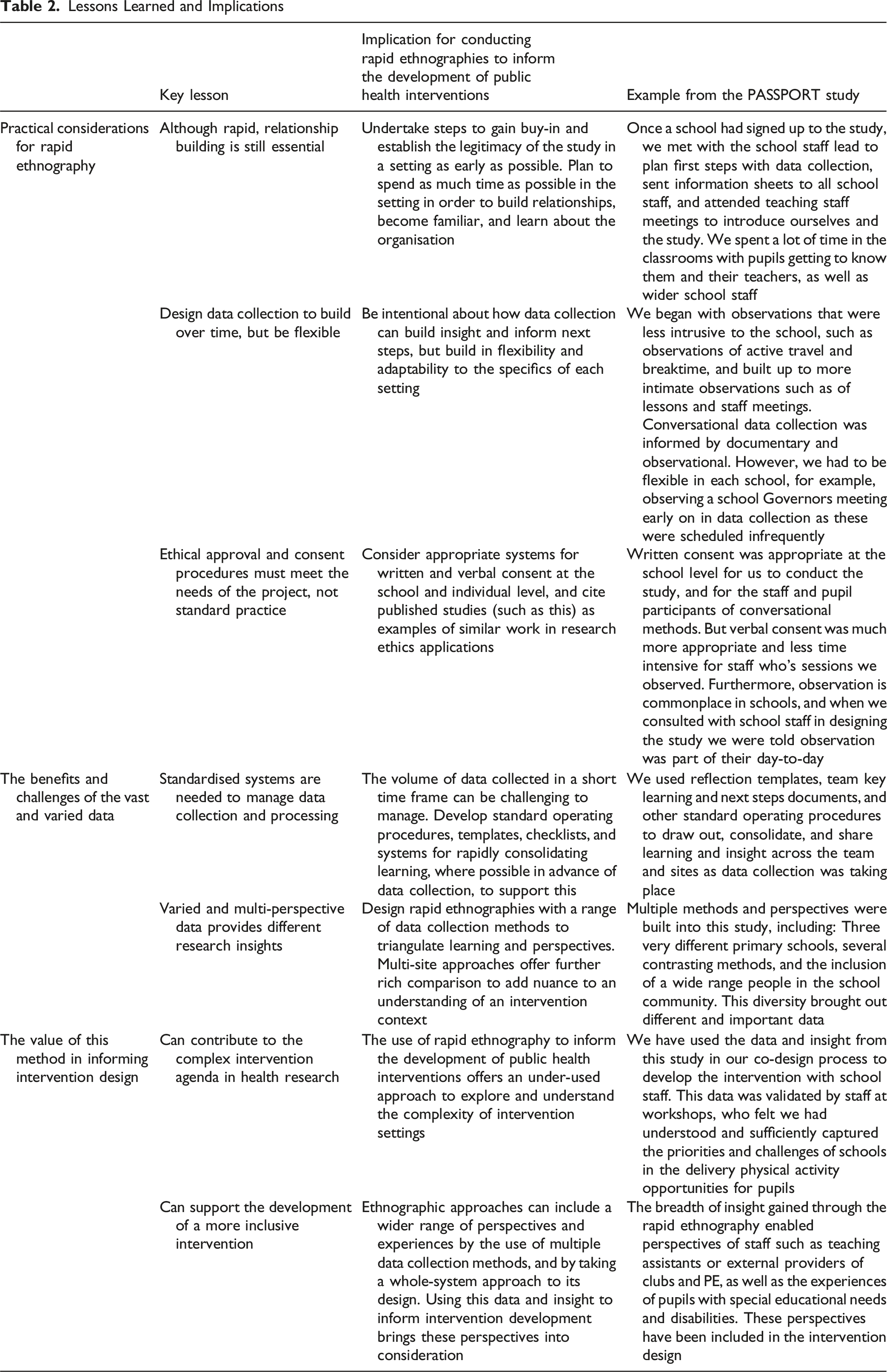
Practical Considerations for Rapid Ethnography
Although Rapid, Relationship Building is Still Essential
In undertaking rapid ethnography, building relationships and establishing the study within the setting is key to success. We did this through formal mechanisms, for example, signing the school-study agreement to set clear expectations for both parties, written communication of the study aims and plans to the whole school community, and attending staff meetings in person to introduce the team and the project before data collection began. These activities enabled us to be recognised and legitimised in school. Informal mechanisms were also key. Being present in the schools on a weekly basis built up rapport, trust, and familiarity between the researchers and school staff. Where possible we found opportunities to participate in the school community, such as helping out with school events, which facilitated our understanding of broader school priorities, current issues, and the school community.
Design Data Collection to Build Over Time, But Be Flexible
Key to this design was for insight to build over time and inform the next step in the data collection process as visualised in Figure 2. The collection of documentary data informed observations. The observations began with less burdensome and intimate activities, such as active travel and break times, and built up to classroom observations and staff and community meetings. Around the midpoint of the study we began our conversational data collection, creative activities with pupils and semi-structured interviews, which were informed by the preceding data collection. As outlined above, this deepening data collection was also dependent on relationship building, where trust and familiarity supported these later activities. However, data collection looked slightly different in each school, and we were flexible to their specific circumstances. This included structural differences such as staff roles or physical activity opportunities on offer, and school priorities each term that impacted what we could do and when. Therefore, while the data collection plan considered the building of insight, once data collection begins it is necessary to be responsive to the specific circumstances of the setting.
Ethical Approval and Consent Procedures Must Meet The Needs of The Project, Not Standard Practice
Within public health research rapid ethnography is relatively marginal, and understanding consent and ethical considerations can be a challenge for ethics committees. We used a combination of written and verbal consent as appropriate to each method used in the study, and this approach was supported by clear school-wide communication on the study in advance of data collection. Our study protocol may be of use as an example of consent processes for future research ethics applications employing rapid ethnography.
The Benefits and Challenges of the Vast and Varied Data
Standardised Systems are Needed to Manage Data Collection and Processing
Rapid multi-site team ethnography produces a large quantity of data, and it was challenging to capture and process in a timely manner. This was particularly so due to the multi-site and team elements of the study. The standardised systems and processes we put in place to support the work were essential (Bikker et al., 2017), and they evolved during data collection. We drew on learning from multi-sited and multi-team ethnographies (Bikker et al., 2017; Falzon, 2016; Gray et al., 2019; Hannerz, 2003; Marcus, 1995; Scales et al., 2008; Van Duijn, 2020), as well as guidance and frameworks on embedded or school-based research (Carnegie School of Education, 2020; Hall et al., 2021; Higginbottom et al., 2013; Jachyra et al., 2015; Ward et al., 2021b) to design systems and operating procedures to facilitate and support data collection and analysis. For example, data collection templates guided researchers to ensure they reflected on focus areas and to bring out key learning and initial impressions rapidly. These insights and next steps were then compiled so that learning could be applied across schools and researchers. The research team held an in-person meeting per week to monitor progress and reflect on learning and insights across the three sites. The digitising of field notes meant they could be shared amongst the team, key words, activities, and dates could be searched for, (Phillippi & Lauderdale, 2018), and they could then be incorporated into analysis.
Varied and Multi-Perspective Data Provides Different Research Insights
The strength of this approach is the varied and multi-perspective data that it generates, and this has provided novel and different research insights compared to other research designs, which we are bringing into our intervention development. The comparative aspect of conducting data collection in three settings enabled the difference of each school to come to the fore, supporting the argument for context-specific interventions that meet individual school need. This was especially so when comparing ‘like for like’ across the schools, such as the structure or experience of a particular staff role, or pupil engagement during a physical activity opportunity. Furthermore, central to this approach is the whole-school perspective it creates through the inclusion of a wide range of viewpoints and data in a given setting. These multiple perspectives drew out areas of contestation, contradiction, or convergence, giving nuance to the interpretation of school physical activity. Finally, a key feature of ethnographic approaches is the embodied experience of the researcher and how this deepens the interpretation of data. What we were told in interviews was not always what we saw in practice, for example, senior leadership describing the delivery of activities and seeing very different practices on the ground, or staff interpretation of an aspect of school being challenged by our comparative perspective across schools. In these cases, relying on interview data alone would have provided very different impressions of physical activity in those schools.
The Value of This Method in Informing Intervention Design
Can Contribute to the Complex Intervention Agenda in Health Research
There has been a recent turn in health intervention and evaluation research towards approaches that consider complexity (O'Cathain et al., 2019; Skivington et al., 2021). Most public health interventions take place in complex social settings such as schools, communities, work places, and organisations. The Medical Research Council (MRC) guidance on complex intervention development provides key principles and actions for consideration (O'Cathain et al., 2019), several of which are addressed in ethnographic approaches. These include seeing intervention development as a dynamic iterative process, involving stakeholders, understanding context, and paying attention to future implementation in the real world. This guidance also suggests that using different sources of evidence is valuable. Regarding the evaluation of complex interventions, MRC guidelines, updated in 2021 (Skivington et al., 2021), include how an intervention interacts with its context, the importance of understanding the system that surrounds a public health intervention, and the inclusion of diverse perspectives as core elements. The integration of multiple data sources and perspectives has also been recommended for epidemiological quantitative data (Lawlor et al., 2016). An ethnographic approach brings together evidence from a range of different sources which in turn strengthens confidence in findings.
Can Support The Development of a More Inclusive Intervention
This rapid ethnography enabled the inclusion of staff and school community perspectives and activities that are often overlooked or hard to reach in school-based research. The perspectives and experiences of school community members such as teaching assistants, school business managers, school Governors, members of the Parent Teacher Association, external providers of PE and physical activity, and pupils, were brought into this research alongside the more typical leadership roles such as Head teachers or PE leads. The inclusion of marginalised perspectives was not only in regards to roles, but also spaces and systems. Through observation of school activities that are not typically included in physical activity research, such as school Governor meetings, lunch halls, and support for pupils with special educational needs, we were able to better understand where and how physical activity was considered and prioritised in school governance and decision-making, as well as other spaces it was used to engage and support pupils. Furthermore, this study included three very different primary schools with high levels of ethnic diversity and disadvantage, as well as varying access to facilities and spaces for physical activity. These perspectives and experiences are included in the dataset and have fed into our intervention co-design process, strengthening the contextual sensitivity of the intervention development.
Conclusion
Public health interventions must be suitable for the context in which they are intervening. Physical inactivity is a global public health challenge, yet the majority of school-based physical activity interventions have limited success. We need to find ways to develop interventions that are flexible and adapt to context, and rapid ethnography is a practical and sensitive approach to support this. Rapid ethnography is a pragmatic and contextually sensitive methodology that can bring multiple data and perspectives together to inform the development of complex interventions. The focus of ethnographic approaches on understanding organisation and community cultures, experiences, and systems, through a range of data collection methods, creates rich and deep contextual insight. This paper uses the PASSPORT study as an example of how to undertake rapid multi-site team ethnography in primary schools to inform a context-specific school-based physical activity intervention. The key learning from this study provides useful guidance and insight for others undertaking a rapid ethnography and the value of this in informing complex intervention design.
Supplemental Material
Supplemental Material - The Value in Rapid, Multi-Site Team Ethnography for Understanding Context to Design Public Health Interventions: Learning From the PASSPORT Study
Supplemental Material for The Value in Rapid, Multi-Site Team Ethnography for Understanding Context to Design Public Health Interventions: Learning From the PASSPORT Study by Danielle House, Robert Walker, Simona Kent-Saisch, Lydia Emm-Collison, Ruth Salway, Alice Porter, Frank de Vocht, Michael Beets, Russell Jago, and Rebecca Langford in International Journal of Qualitative Methods.
Footnotes
Acknowledgements
We would like to express our gratitude and thanks to all the schools, members of staff, pupils, and school communities who participated in and supported the study.

Ethical Considerations
This study was performed in accordance with the Declaration of Helsinki and ethical approval was gained from the University of Bristol, Faculty of Health Science Research Ethics Committee (FREC Ref 16095). All study methods were performed in accordance with approved ethical guidelines and regulations throughout.
Consent to Participate
All participants provided informed consent.
Consent for Publication
Schools and participants provided consent for the publication of anonymised data.
Author Contributions
The rapid multi-site team ethnography study was conceived by DH, RJ, RW, RS, AP and SKS as part of the PASSPORT project. DH was the project manager. RJ is the project Principal Investigator. Study materials were developed by DH, RJ, RW, SKS, RS, and AP. Data were collected by RW, DH, SKS, and AP. The first draft of the paper was written by DH, RL, LEC, RJ, RS, AP, SKS, and RW. All authors reviewed the paper and made key intellectual contributions to content and reporting and approved the final manuscript (DH, RL, LEC, RJ, RW, RS, AP, SKS, MB, and FDV).
Funding
The authors disclosed receipt of the following financial support for the research, authorship, and/or publication of this article: This project is funded by UKRI REF EP/X023508/1. RJ is partly supported by the National Institute for Health and Care Research Bristol Biomedical Research Centre and the National Institute for Health and Care Research Applied Research Collaboration West (NIHR ARC West). AP is supported by the National Institute for Health and Care Research Bristol Biomedical Research Centre (Bristol BRC). FdV, is partly supported by the National Institute for Health and Care Research Applied Research Collaboration West (NIHR ARC West). The views expressed are those of the author(s) and not necessarily those of the funders including UKRI, NIHR or the Department of Health and Social Care.
Declaration of Conflicting Interests
The authors declared the following potential conflicts of interest with respect to the research, authorship, and/or publication of this article.
Data Availability Statement
Supplemental Material
Supplemental material for this article is available online.
References
Supplementary Material
Please find the following supplemental material available below.
For Open Access articles published under a Creative Commons License, all supplemental material carries the same license as the article it is associated with.
For non-Open Access articles published, all supplemental material carries a non-exclusive license, and permission requests for re-use of supplemental material or any part of supplemental material shall be sent directly to the copyright owner as specified in the copyright notice associated with the article.
