




Abstract
This article discusses the influence of the cultural context on the interview process. With literature demonstrating the role of spatial context on interviews, the article contends that similar consideration should be given to cultural contexts of research studies. Focusing on the cultural context where the interview takes place and the interactions during the interview can help researchers understand and analyze interview material. Interview forms such as conversation/interview bombing emerged from the interaction of cultural context with the interview process. This points to the need for qualitative researchers to explore how the cultural context shapes their research encounter. Such focus will expand the literature on the forms of interview emerging from the intersection of cultural context and interviewing as well as research on spatiality and interview.
Keywords
Introduction
Interview is a popular data collection technique used in education, science, health, and social research (Hawkins, 2018; O’ Reilly, 2012). Interviews vary and are widely used in qualitative research. Choosing among the three-common types of interviews (structured, semi-structured, and unstructured interviews) depends on the study purpose and design (Adhabi & Anozie, 2017; Edwards & Holland, 2013). With the common types of interviews, researchers engage in other forms of interviews such as focus group, in-depth interview, and ethnographic interviews (Anyan, 2013; Dworkin, 2012). For instance, focus groups are group interviews set up in a discussion format to facilitate interactions between participants, where the interviewer serves as moderator (Qu & Dumay, 2011). In-depth interviews are concerned with participants’ experiences and thoughts on a particular situation, idea or phenomenon, with interviewees as experts (Boyce & Neale, 2006; Lucas, 2014). And, ethnographic interviews are friendly and casual conversations into which the researcher gradually introduces new elements to help participants answer or provide more information (Spradley, 2016).
The popularity of interviews in qualitative research is explained by the interest in exploring complex phenomenon, capturing people’ experiences, understanding, and perspectives in specific contexts or situations. Though technology-mediated interviews such as email interviews (Meho, 2006), or skype interviews (Deakin & Wakefield, 2014) are transforming the way interviews are conducted, interviewing yields rich and meaningful data in any settings allowing participants to feel safe and comfortable (Dempsey et al., 2016). Moreover, literature shows that interviewers need interview skills and knowledge in the relevant topic areas to ask informed questions (Roer-Strier & Sands, 2015). Interestingly, qualitative researchers are increasingly examining the influence of the socio-spatial context on their research methods (Evans & Jones, 2011; Holton & Riley, 2014).
Traditionally, qualitative researchers have hinted to the connection between the spatial contexts and their research encounter by discussing the group understudy; yet, underexplored how spatial contexts and places of study shaped their research encounter (Anderson, 2004). Similarly, cultural contexts have been implicitly discussed by researchers in terms of going into the fields. However, with regard to how cultural contexts shape the research process, and particularly data collection techniques such as interviews explicit discussions are scarce. This article explores the intersection of cultural context and the interview process. The article starts with a brief review of related literature, followed with a background of the study used in this article, and the interview form emerging from the interaction of cultural context and interviewing.
Review of Related Literature
Research exploring the spatial contexts of the research encounter highlights the connection between “what people say and where they say it” (Evans & Jones, 2011, p. 851). Particular knowledges may be embodied within, and related to particular contexts (Holton & Riley, 2014). In addition, particular spaces may allow the researcher to observe peculiar spatial practices (Riley, 2010). Indeed, interview sites and circumstances are situated in social spaces, and create “microgeographies” of social interactions and meanings (Elwood & Martin, 2000; Hein et al., 2008).
The interest in the intersection of space, place, and context with interview has seen the emergence of innovative approaches such as mobile interviews and place-based interviews (Holton & Riley, 2014; Wiederhold, 2015). However, a common characteristic of these innovative approaches is the use of “movement as a part of the research approach itself, so that…the researcher is mobile and thus either follows the subject through space, or makes the subject mobile for the purpose of the research” (Hein et al., 2008, p. 1269). With a focus on mobility as opposed to the traditional sedentary approach to interviews, these emerging forms of interviews show the relevance of spatial contexts. Places, spaces, and contexts have meanings, and inform the actions and narrative of the interviewees. The intersection of place, space, or context participate in the construction of knowledge. However, less discussed in this growing literature expanding traditional conceptions of interviews, are the forms of interviews emerging from the intersection of cultural context and the interview process.
These emerging forms of interview build on ethnographic techniques, which take into account context, participants’ understanding of their experiences, and culture that is “the acquired knowledge that people use to interpret experience and generate social behavior” (Spradley, 2016, p. 5). For instance, ethnographic interviews seek to get people to discuss what they know (Skinner, 2012). Participants draw on their contextual understandings; assumptions; and meanings they assign to their experiences without relying on the researcher’s view, assumptions, language, or classification of things (Spradley, 2016). Interviews in qualitative research often move away from traditional paradigm (i.e. positivism), toward new paradigms such as interpretive, constructionist, feminist, critical, and postmodern philosophies.
Ethnographic interviews align mainly with new paradigms (e.g., interpretative, constructivist, or feminist) philosophy as they purpose to understand the world, or participants’ experiences through their own lenses and words, and not through the language or lenses of the researcher (Wolgemuth et al., 2020). Though paradigm-driven approach to qualitative interviews help researchers design research that allows them to use interviews informed by their assumptions about knowledge creation, interviews driven by research approach paradigms limit the ability to “capture the complexity represented in the field of qualitative [research interview practices]” (Roulston, 2010, p. 51). The limitation engendered by paradigm-driven approach to interviews prompted researchers such as Hammersley (2014) to invite researchers to challenge the paradigm-driven approach that does not allow for any flexibility. Indeed, the paradigm-driven approach requires researchers to specify the theoretical framework and stay within its limits when conducting any inquiry (Hammersley, 2014). For this reason, Wolgemuth et al. (2015) call for a “participant-responsive, epistemologically informed flexibility in which qualitative interview researchers experiment with methods, while seeking to maximize participant benefits and grapple with the theoretical implications of methods decisions” (p. 369).
The practice and approach to qualitative interviews necessitates more flexibility that paradigms appeared to limit (Koro-Ljungberg et al., 2009; Wolgemuth et al., 2020). Drawing on this call for flexibility in research design; and on the growing literature on the interplay of space, context, and place, I explore: the encounter of cultural context with the process of interviewing to highlight the situatedness of interview forms using the author’s research.
Study Background
The selection of interview sites is often conceived as a simple research design issue for qualitative researchers (Edwards & Holland, 2013). However, for research conducted in international and different cultural contexts, it is a complex issue in the research design process. In the following sections, I discuss instances in my research experience to illustrate the nexus of cultural context with interviewing in understanding and defining forms of interviews. My research study explored literacy practices of players of the board game Songo (Bayeck, 2019).
This cross-cultural study was conducted in Yaoundé, Cameroon and New York City, United States, using semi-structured interviews and other data collection techniques such as video recordings and observations. The gaming group in Yaoundé consisted of players from various ethnic groups in Cameroon; while in New York City players were all American citizens. Yet, New York City players were mainly from Antigua in the Caribbean, with only one participant originally from Ghana, west Africa. In both settings, the game was played outside, in public spaces where participants met to play, and known by people living around as gaming spaces. A total of 16 players were selected for interviews on both sites, based on their availability. Interviews in Yaoundé as well as New York City were conducted in each gaming space. Yet, in this article, I discuss a phenomenon that occurred during the interview process in Yaoundé, Cameroon.
Songo (Figure 1) is a board game played in Cameroon, Gabon, and Equatorial Guinea, with geographical distribution of its variance across the African continent (Bayeck, 2019). In the literature, Songo is assigned to the family of board games known as Mancala or “sowing” games (de Voogt, 2005; Meka Obam, 2008). Mancala refers to board games played with seeds/stones dropped in holes on the board in a clockwise or counter-clockwise direction (de Voogt, 2005). Songo is played by two players on a board with two rows, and 14 holes, with 70 seeds distributed equally between players (Bayeck, 2019; Mbarga Owona, 2004). Though played with seeds, using the term Mancala as an umbrella for all African board games, instead of the game name, is likely to dismiss the peculiarity of each of these African board games. The term Mancala ignores the creativity and ingenuity of the communities that designed these games. For this reason, I choose to use Songo, the name given by the players and designers of this game, and move away from the generic term Mancala.
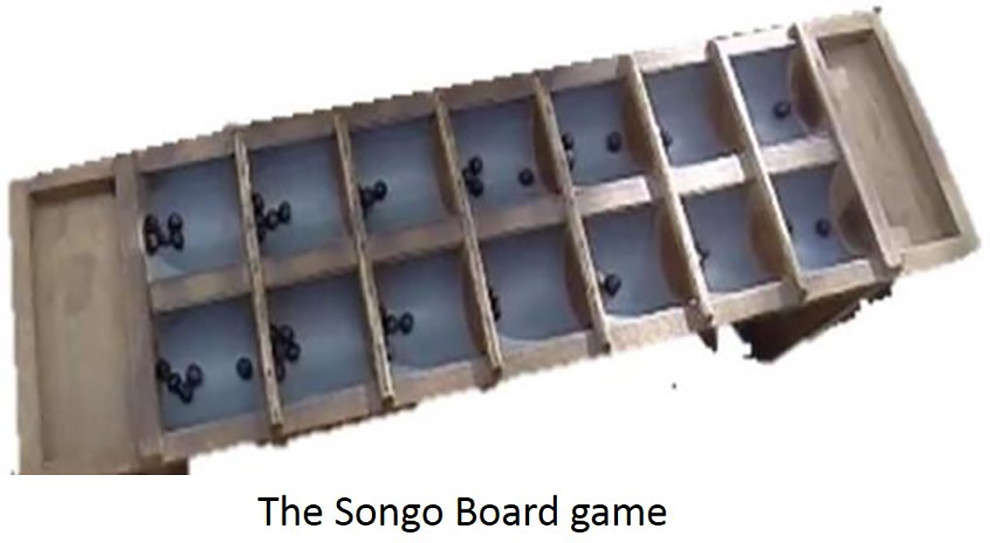
Songo board game from the author.
In this study, I explored what people learned, how they learned, and the practices they engaged in during Songo gameplay (Bayeck, 2019). Literature on Songo had mainly focused on the mathematical potential (Mbarga Owona, 2004; Njock, 1985), and on the social significance of the game (Meka Obam, 2008). Investigating literacies and learning in Songo board gameplay was therefore important to situate the game in the field of game studies. In the design of my study, I planned to conduct face-to-face interview with each participant on both gameplay sites. Yet, in Yaoundé, Cameroon, the one-on-one interviews encountered the cultural context that informed the interview process, from which emerged a new form of interview.
Intersection of Cultural Context and Interviewing
As previously stated, various forms of interviews are available for researchers to collect data in qualitative studies (Edwards & Holland, 2013). Interview forms are selected and designed by researchers, as part of the research design process, based on factors such as study purpose, time assigned to collect data, and research approach. Hence, interview forms are always chosen before the research encounter, or prior to field research. This implies no consideration of the context, especially the cultural context in which the interview will take place. Yet, ways of interacting in a particular cultural context are likely to shape interviews. Researchers interact with participants and experience power shift at different moments of the data collection process (Roer-Strier & Sands, 2015).
Cameroon is a bilingual country located in West/Central Africa, where English and French are the official languages. In addition to these official languages, the country has more than 250 local languages (Achimbe, 2014; Nkwain, 2014), whose interactions with official languages, and other local languages has created other languages 1 (Atindogbé & Bélinga b’Eno, 2014; Biloa, 2012). Based on Hosftede’s (2001) classification of countries, Cameroon has a collectivist culture. This implies that individuals are integrated into groups, and let the group interest prevail over their own interests (Hofstede, 2001; Van Hoom, 2015). However, Hofstede’s (2001) classification has been contested given its homogenization of a society. For example, Hofstede associates culture to nation and does not consider the dynamic nature of culture (Signorini, Wiesemes, & Murphy, 2009). Moreover, in a nation, many kinds of culture—nationality, history, or knowledge—interact and are expressed by individuals in complex ways (Viberg & Grönlund, 2013). Nevertheless, Hofstede’s (2001) classification of culture contains elements (e.g., individualism and collectivism) that have been shown to play a role in people’s behavior in other contexts (Viberg & Grönlund, 2013). Though these categories may not reflect the culture of an entire nation, they may give hints into people’s way of interacting. Therefore, Hofstede’s classification was used in this article as an indicator of the tendency/orientation/values participants’ ways of interacting were likely to reflect.
Bronx, New York City (NYC) was the other context where I collected data. NYC is a multiethnic, multilingual, and multicultural city. Still, using Hofstede’s (2001) as a means to highlight the behavior or value people in some settings tend to emphasize, NYC culture can be described as individualistic. In this culture, the emphasis is placed on the individual, and activities or practices that value individual development or assertation are nurtured and encouraged (Conroy, 2016).
During the data collection process, the planned face-to-face interview with each selected participant went as planned. Each participant was interviewed, and provided responses to my questions. Though participants were interviewed on the gameplay site, the presence of other players did not influence my interviews with the selected participants. Indeed, participants did not allow any unsolicited intervention from any other player. For instance, during my interview with one of the players, Delva, another player tried to participate and was rebuffed as shown in the excerpt below.
Excerpt 1
we normally play the best of six in other words, on the sixth game whoever first reaches six games, wins six games but sometimes, your opponent, you just have the advantage you just have this particular mode on that day when you can just win six straight games and you leave the opponent really aching. But the objective is to play six games, win six games
ok, got you so now. So it can be six to zero or it can be what?
yes, six to zero
yes, six to zero. See this guy here he let me down so many times he usually played one of the best. I nearly died when he gave up, when it was in Poland (pointing at Adman)
[to Nicky] you talk too much. Don’t answer the question
[to Researcher] go ahead Becky
[to Nicky] one at the time
[to Nicky] don’t (with his finger directed toward Nicky as a way to asked him to not say more)
For players in NYC, participation in this one-on-one interview meant individually responding to the questions asked by the researcher, which aligned with my expectations of the semi-structured interviews I proposed in my research design. Participants understood that I was interested in the experiences of the interviewee and as such no other players should add to this conversation. This explains Delva’s reaction at Nicky’s single attempt to add to the conversation “you talk too much. Don’t answer the question,” and Adman’s advice to Nicky “one at the time.” Nicky’s attempt to join the conversation was the only occurrence throughout my data collection that a player tried to intervene in my interview with a selected participant. However, in Yaoundé, Cameroon, the planned interview with each player turned into what I termed “conversation/interview bombing,” with participants who spontaneously joined the interview with the selected interviewee. In this article, I call these participants “self-selected, improvised interviewees, or interview bomber.”
Conversation/Interview Bombing
Conversation/interview bombing draws from the concept of photobombing. Photobombing is a term used to describe the action of disrupting someone’s picture/photo by appearing in it when one is not supposed to (Fletcher & Greenhill, 2010; Ibrahim, 2017). At the core of photobombing is the idea of disruption, interruption, but also participation in a scene without prior invitation. Interestingly, the concept of participation in a scene without prior invitation aligns with what occurred during my interviews with participants in Yaoundé, Cameroon.
Access to the gaming group in Yaoundé was enabled by an informant respected by the gaming group. My informant introduced me and my research to the leader of this gaming group. This introduction gave me access to players, as the group leader took upon himself to in turn introduce me and my research to the members of the gaming community. This process followed the cultural way visitors or newcomers are presented and brought into a community in Cameroon. Once my research was explained to participants, the leader asked players to support me in my research endeavor. Following the leader’s introduction and explanation, almost in unison, players said “tu es la bienvenue, tu es libre de venir ici quand tu veux [you are welcome; you are free to come here when you want].” The gaming group leader then said, “tu es libre de venir et de faire tes interviews [you are free to come and conduct your interviews].” This process of gaining access and obtaining verbal consent to conduct my research was culturally appropriate. Being introduced by the group leader implies acceptance and consent from all group members to conduct my data collection (Author, 2019; Nkwain, 2014). In other words, I no longer needed to explain my study or obtain verbal consent from every participant. For this gaming community, it was assumed that every player was a participant in this study, and had given his verbal consent. Players took upon themselves to explain the purpose of my research to participants absent on the day of my introduction to the gaming community. In addition, participants helped me identify and schedule interviews with specific players.
Interestingly, the planned face-to-face interview with each participant turned into what could appear to be a focus group, given the interactions among participants (Stewart & Shamdasani, 2014). Nevertheless, this apparent group interview was not designed, nor set up on a topic determined by the researcher (Qu & Dumay, 2011; Stewart & Shamdasani, 2014). During each interview, two or three other players joined the interview with the selected participant. They answered questions, complemented, and added to the knowledge shared by the selected interviewee. The single interview became an interaction between the group of participants and the interviewer, which reflected the cultural context. This form of interview enabled by the cultural context is what I termed “conversation/interview bombing.” Hence, conversation/interview bombing refers to face-to-face interview with a participant that turns into an interaction with other self-selected/improvised interviewee who participate in the interview without the researcher’s prior invitation. Conversation/interview bombing is informed by a culturally-situated way of interacting, sharing, and creating knowledge. It allows the researcher to attend to the cultural context and interactions that enhance/expand the researcher understanding of the phenomenon under investigation, and maximizes benefits for participants. The excerpt below illustrates an instance of interview bombing that occurred during my interview with Vince. The other participants Bouli and Pierro joined the interview and contributed to this co- construction of knowledge. The interviews were conducted in French, and translation is italicized in brackets.
Excerpt 2
pourquoi est-ce qu’il n’y a pas de femmes qui jouent, qui soient même spectatrices
[why don’t we have women who play, who are even spectators]
c’est déjà une culture, donc une culture
[it is already a culture, so a culture]
c’est parce que les femmes n’apprennent pas, c’est un jeu d’apprentissage, moi je suis un Bamiléké, 2 je joue au Songo, est ce que chez les Bami 3 il y a le Songo?
[it is because women do not learn, it is a game of apprenticeship; I myself, I am a Bamiléké, I play Songo, is there Songo among Bami?]
Non
[no]
Voilà, et je suis arrivé et j’ai regardé comment on joue; le problème c’est de regarder comment on joue et que si tu veux apprendre tu commences aussi à voir comment on bouffe les pions; qu’est-ce que, comment le mécanisme du jeu se passe; tu apprends aussi c’est un truc qui est mathématique
[there you go, I came and watched how it is played; the problem is to watch how they play and if you want to learn you also start to see how they capture seeds; what is, how the game is played, the mechanism of the game; you also learn; it is something that is mathematical]
je vous direz donc la petite histoire, ce Monsieur vient ‘apprendre à jouer
[I will then tell you the little story, this man just learned how to play]
Voilà
[there you go]
pour son âge, il vient d’apprendre à jouer
[for his age, he just learned how to play]
voilà
[there you go]
il ne connaissait pas jouer
[he didn’t know how to play]
il a un potentiel d’apprentissage très élevé parce qu’il commence déjà à battre ceux qui ont peut-être plus de 15 ans d’expérience
[he has a very high learning potential because he is already beating those who may be have more than 15 years of experience]
qui jouent depuis longtemps
[who have been playing for long]
qui ont peut-être 15 ans de jeu
[who may be have 15 years in the game]
oui, je les fouette
[yes, I beat them]
As the excerpt above shows, Bouli and Pierro (self-selected/improvised interviewees/interview bombers as I called them) participated in the interview, building on each other to provide more information about the game, and how learning to play the game occurs. The self-selected/improvised interviewees/interview bombers jumped into the interview, without prior invitation, yet, in a way that is culturally appropriate when passing knowledge. It is important to mention that in other cultural contexts, as in the case of NYC discussed above, interview bombing may be seen as negative. However, in a cultural context that values helping/assisting others, and emphasis communal practices, interview bombing is an accepted and expected practice. Indeed, it is common in Cameroon for individuals to address questions not directly address to them or participate in conversation without a formal invitation (Author, 2019). As shown in the excerpt, such participation in the interview is not intended to suppress information; but rather to complement the answers, provide a complete picture of the event or situation. In other words, the interview bomber participates to help the researcher understand the concept/phenomenon understudy from participants’ view by collaborating with the selected participant to provide a complete picture of the situation or event. This collaboration between the selected participant and the interview bomber (s) helps the researcher in building a full understanding of the phenomenon under investigation. Therefore, interview bombing refers to any intervention by a self-selected/improvised interviewee/interview bomber that complements the answers provided by the selected interviewee, and includes collaboration between the selected interviewee and the interview bomber/self-selected interviewee. These characteristics are critical given that in the cultural context of Cameroon, values, knowledge, and information transmission is perceived as a collective responsibility, a communal effort (Author, 2019; Nsamenang, 1992). This collective mindset and communal practices in everyday activity explain players’ tendency to intervene in the interview and answer questions not initially addressed to them (Author, 2019).
While this form of interview may raise concerns about the informed consent; and the ability of the interview bomber to withdraw from the study, it also highlights the need to push for flexible research designs when initiating qualitative research inquiries. For instance, flexible approach to research design may allow the researchers to obtain the interview bomber consent during the course of the interview or even after the interview. Interestingly, in this study, verbal consent was obtained from all members of the Songo gaming group in Yaoundé, even though all were not selected to participate in the interviews. Understanding how people create knowledge and interact in this context was critical to discern the constructive participation of the interview bomber(s). As previously stated, interview bomber (s) did not attempt to direct or control what was being said. Interview bomber(s) participation was collaborative in nature, a collaboration with the selected interviewee, which allowed the researcher to gain more understanding of the phenomenon under investigation.
As in any qualitative interview, power relations existing between the research and participants, are also present in conversation/interview bombing. Indeed, the interview bomber participation in the interview placed the bomber in a position of expert. Yet, this position was negotiated with the selected interviewee, allowing the bomber and the selected interviewee to jointly embody the role of experts. In fieldwork, the researcher’s power is negotiated with participants (Merriam et al., 2001). As a female in a male-gaming environment—Songo is played by men only in Yaoundé- I was automatically not an expert with regards to the game, and an outsider in this gaming environment. This power dynamic was reflected in conversation/interview bombing as the bomber and the selected interviewee assumed the position of experts. They subtly negotiated their power by determining for instance when to join, how to join, and the information to share. Yet, the power of my position as a researcher at the university, one who grew up in Cameroon and could culturally identify with players, carried weight in the interview process.
Doing this research was important to participants, and players referred to me as “ma fille[my daughter],” reference which, in this cultural context, indicated my adoption and acceptance into this gaming community. With this address term, players were establishing a kinship relationship with me, I was the daughter, a member of the family, learning about Songo. Indeed, “ma fille[my daughter]” is an address term inspired and shaped by local languages, values, and culture, which is used to reduce the distance between people, and in this case, between participants and the researcher (Author, 2019; Nkwain, 2014). The term created a family-like relation in each interaction with interviewees (Author, 2019). Interestingly, being called “ma fille[my daughter]” also captured the power dynamic that existed between participants and the researcher. “Ma fille” gave me access to every player, the right to ask and have any questions answered, while reminding me of my child-like status, that is, non-expert. Players’ participation in the interviews was situated in the ways of interacting or sharing knowledge common in Cameroon. I was both an outsider and insider, and the interaction of my gender, education, and cultural background facilitated access to participants. Furthermore, the power dynamic was shaped by the embedded cultural ways of interacting, my gender, and my educational background.
Conversation/interview bombing differs from other forms of interview involving multiple participants at once because a) the participation of other participants is not planned but rather spontaneous; b) participation in the interview can be initiated by the self-selected/improvised interviewee/interview bomber or by the selected interview; c) involves collaboration between the selected interviewee and the interview bomber(s); and d) reflects knowledge building as participation complements and/or improves knowledge about the phenomenon under study from participants’ perspective.
Conversation/interview bombing emerges from the intersection of the cultural context and the interview process. Indeed, the cultural way of living, thinking, and doing things in Yaoundé, Cameroon shaped the interview to the extent where the selected participant also invited/called other players into the interview as evidenced in this excerpt of my interview with Caulet.
Excerpt 3
pourquoi tu ne peux enseigner aux jeunes à jouer?
[why can’t you teach young people how to play]
c’est dur eeeh 4 ; il va te demander que je gagne quoi là; c’est le système, eeeh Mani; je lui dis qu’ après notre génération les qui vont jouer même encore au Songo; les jeunes ils ne veulent pas apprendre, eeeh
[it is hard eeeh; he will ask you what do I gain there; it is the system, eeeh, Man; I am telling her that after our generation who will even play Songo again; young people do not want to learn, eeeh]
les jeunes-là ne veulent pas apprendre
[young people do not want to learn]
ça risque finir eeeh
[it may disappear eeeh]
non en fait il faut, il faut déjà cette envie, il faut déjà qu’ils aient cette envie de vouloir
[no in fact there needs, the desire needs to already be there; they need to have that desire to]
euhmm 5
nous on a grandi dedans, quand je dis c’est notre jeunesse là-dedans,
[we grew up in it, when I say our youth was in it]
quand on apprenait on nous tirait
[when we were learning they were dragging us]
on nous tirait; on nous forçait même
[they were dragging us; they were even forcing us]
et on jouait
[and we played]
quand Papa Mbah disait venez jouez, on a appris la même année
[when Papa Mbah said come play, we learned the same year
oui, mais, mais je le tape
[yes, but, but I beat him]
c’est pas ça le plus important, tu me tapes, je te tapes
[that is not the most important, you beat me, I beat you]
Mani participated in the interview on this invitation from Caulet:
…c’est le système, eeeh Mani; je lui dis qu’après notre génération les qui vont jouer même encore au Songo; les jeunes ils ne veulent pas apprendre, eeeh […eeeh, Man; I am telling her that after our generation who will even play Songo again; young people do not want to learn, eeeh]
Attention to culturally-situated ways of sharing information showed that the cultural context shaped the interview form. The intersection of cultural context and interviewing in the research encounter contributed to the emergence of a new form of interview. Conversation/interview bombing is situated in the cultural context where it occurred.
Conclusion
With the growing interest in the influence of spatial contexts on research encounters, it becomes critical for researchers to pay attention to cultural contexts. Building on Evans and Jones’ (2011) argument, I contend that “what people say and [the cultural context] where they say it [shapes how they say]” (p. 851). The focus on the cultural context is critical to avoid misunderstanding and misinterpretation of practices or phenomenon happening in specific cultural contexts. Moreover, exploring the intersection of cultural contexts with the research encounter would create awareness among researchers and allow them to identify phenomena peculiar to a cultural context. Attention to the interplay of the cultural context and research encounter could expand boundaries of research design, and reshape interview practices, enabling researchers to engage in culturally-responsive interview practices that enrich the data. Inherent to group interviews is the difficulty for the researcher to determine which response to include—whose story to tell—and whether answers from other participants should be integrated in the interview (Merriam et al., 2001). However, conversation/interview bombing follows specific criteria, among which collaboration and co-construction of knowledge, which facilitate the integration and interpretation of all responses. This integration is important for researchers who may encounter this form of interview in two different cultural settings, or just in one setting. Therefore, researchers encountering conversation/interview bombing should discuss it in their reporting of the data. The form of interview discussed in this article encourages researchers to be reflexive as they engage in fieldwork.
Researchers should interrogate how their research design and assumptions are challenged by the cultural context in which their study is conducted. Conversation/interview bombing calls for researchers to become aware of their own influence on the language used in describing interviews, to sensitivity, and understanding of the cultural context. For instance, in this research, conversation/interview bombing could have been assimilated to a different form of interview discussed in the literature; and the interview bomber’s contribution ignored. Developing an understanding of the ways of being, interacting, and creating knowledge of the context where research is conducted is essential for researchers. Furthermore, I contend that interview bombing emphasizes the need for qualitative researchers to explicitly consider/adopt a context-driven paradigm when conducting research. Paradigm-driven approach to research limits the researcher (Hammersley, 2014; Roulston, 2010). However, context-driven paradigm is different even from Wolgemuth et al.’s (2015) participant response because the former encourages researchers to be informed by the values and/or cultural practices of the study setting during data collection. The explicit adoption of context-driven/informed paradigm will a) provide more flexibility to researchers; b) help researchers to develop a better understanding of participants and the phenomenon under investigation; and c) expand the field of qualitative research.
Footnotes
Declaration of Conflicting Interests
The author(s) declared no potential conflicts of interest with respect to the research, authorship, and/or publication of this article.
Funding
The author(s) received financial support for the research from the Pennsylvania State University Africana Research Center and the Comparative International Education Summer funding. No funding was received for authorship and/or publication of this article.
