




Abstract
Previous studies have identified both physical and psychosocial forms of stress among newly married women due to inadequate water, sanitation, and hygiene (WASH) access. However, methodologies used to identify stress have relied on surveys and interviews, which have limitations for eliciting situated information regarding stress. Prior public health studies indicate that, together with other qualitative methods, audio diaries provide rich data sets of participants’ everyday practices, and their interactions with their physical and social environment. In this research, our interdisciplinary team collaborated to explore the feasibility of making audio diary recordings from prompts in a rural, Indian context where many women are illiterate. Three pregnant women living in rural Karnataka (India) were trained on the prompts and audio recorders, and were asked to make audio entries over two weeks. Midterm and exit interviews were used to ascertain women’s thoughts and experiences making audio diary entries. Each woman successfully recorded, on average, 27 minutes per week, demonstrating the feasibility of audio diaries in rural India. While the recruitment and training process was labor intensive and required follow-up visits, trust-building between participants and researchers over time facilitated discussions about the contextual and experiential details of making recordings that will improve data collection through this method. We concluded that when used with other qualitative methods, audio diaries offer a unique opportunity to collect participants’ practices, feelings, reflections, and interactions with their physical and social environment in real time.
Keywords
Introduction
Maternal psychosocial stress is considered a primary cause of negative perinatal outcomes. Evidence in women in high income countries implicates domestic violence (Valladares et al., 2019), maternal age and body mass index (BMI) (Bleker et al., 2017), and relative deprivation from living in a more disadvantaged socioeconomic environment (Nkansah-Amankra et al., 2010) as sources of maternal stress and adverse health outcomes. However, evidence characterizing psychosocial stress and its role in these health outcomes in low- and middle-income countries (LMICs), like India, is limited. For example, poverty can mean that a household does not have access to basic water and toilet facilities inside the home. Physical stress and injury from fetching water and psychosocial stress from fear and harassment during defecation, urination, and bathing in the public domain are leading stressors for women in India (Baker et al., 2018; Caruso et al., 2017; Hulland et al., 2015; Kulkarni et al., 2017; Sahoo et al., 2015). Therefore, if physical and psychosocial stress related to lack of access to safe water and sanitation increases pre-term births and low birth weight, then reducing stress from these conditions could reduce both outcomes. There is a critical need to better understand the contextual and temporal experiences of stress related to meeting water and sanitation needs among pregnant women in LMICs like India, and the social and personal factors that women employ to reduce physical and psychosocial stress.
In order to generate new information about sources of water, sanitation, and hygiene-related physical and psychosocial stress (WASH PPS) among pregnant women in India and the ways that women offset that stress, we introduced the use of audio diaries as a novel method to gather data on women’s WASH-related experiences. Previous methodologies for studying maternal stress and women’s WASH PPS have relied on surveys and interviews, which have limitations for eliciting situated information regarding stress. Interviews after an event, for example, are more likely to capture a participant’s mental state and introspective interpretation and/or cultural contextualization of a stressful experience, rather than the immediate impact of an experience on the mind and body. Interviews rarely happen at the time or place of a stressful experience, so the immediacy of the experience is lost, moreover, the stability of self-reported experiences varies over time (Schraedley et al., 2002; Walentynowicz et al., 2018). Stress research needs a process-oriented approach that captures ongoing interactions between individuals and their environment (Crozier & Cassel, 2016). Prior public health studies indicate that, together with other qualitative methods, audio diaries provide rich data sets of participants’ everyday practices, and their interactions with their physical and social environment (Crozier & Cassell, 2016; Williamson et al., 2012).
In this article, we discuss a feasibility study exploring the implementation of audio diaries in a rural Indian context among an illiterate population. Most audio diary studies happen outside the field of public health (e.g., Williamson et al., 2015) and nearly always in urban areas of high-income countries (e.g., Hewitt, 2017). We seek to contribute to this body of work by detailing the use of audio diaries in a LMIC and a rural context, where illiteracy impedes the wide use of written diaries. Through a small feasibility study conducted by an interdisciplinary team, we tested the feasibility of data collection through this novel qualitative method, focusing on the ability of participants to record their responses to impersonal prompts.
In this article, we first explain (a) what audio diaries are and how they compare to written diaries; (b) how they have been used in different populations and geographies; and (c) what previous research has found regarding audio diaries’ advantages, disadvantages, and ethical challenges. Second, we discuss the audio diary methodology that we developed for our field area. Third, we detail our findings as they pertain to the feasibility of using audio diaries in a rural Indian context where the female population has low levels of educational attainment. Fourth, we conclude with a description of the potential for audio diaries to elicit unique information about WASH PPS (and other forms of stress) among rural, illiterate Indian women as well as other “hidden” behaviors among marginalized populations. We also discuss the limitations of the audio diary methodology, including time and attention to detail.
Using Audio Diaries in Public Health Research
The use of diaries as a qualitative form of data collection has a long history (Alaszewki, 2006), and they have been used successfully across a wide variety of research. Diary-keeping can encourage a more conscious awareness of everyday practices (Spowart & Nairn, 2014), capture events in a longitudinal fashion over a time period where the researcher cannot be present, and bring to light sensitive information not likely to be shared in a survey or interview format. However, written diaries as a method entail a suite of difficulties, including: selection bias against participants who are illiterate or uncomfortable writing; onerous in their time commitment (Fitt, 2018) leading to high attrition rates; formulaic list-like entries (Crozier & Cassell, 2016); exclusive of the sight-impaired (Koopman-Boyden & Richardson, 2013); and participant hesitancy regarding writing ability (Harvey, 2011).
The use of audio diaries offers a way to overcome some of these negatives. Like written diaries, audio diaries entail asking a limited number of participants to keep a daily diary using a voice recorder over a number of days. Because they are quicker than written diaries, participants find them less burdensome and time-consuming (Hislop et al., 2005), and for these reasons, they are perhaps more informative. Participants find speaking an easier form of communication than writing (Williamson, 2012), which may encourage participation and depth (Markham & Couldry, 2007). In addition, audio diaries allow for situated data collection. When context is significant for the problem under scrutiny, the timing, immediacy, informality, and spontaneity that audio diaries offer can make them ideal. With current technology, audio recorders and smartphones are highly mobile, user-friendly, and may increase their situational usage by participants, producing distinctive, embodied accounts in context.
Audio diaries are ideal for recording emotions, critical events, and reflections on everyday experiences (Cottingham, 2018), and can provide new insights into the hidden aspects of health histories (Bernays et al., 2014). They can enable individuals to speak about highly sensitive topics regarding their health and their experiences of health. Because stress levels and stressors can change rapidly due to circumstances, the longitudinal use of audio diaries can include multiple contexts and sources of stress unavailable to a researcher or team (Crozier & Cassell, 2016), including temporal variations in social support and personal coping strategies. Participants are able to speak of relationship dynamics as events and behaviors unfold around them (Williamson et al., 2012), instead of merely listing relationships in response to a survey question. Audio diaries have been shown to raise participants’ awareness of their surroundings and circumstances. For example, in the work of Williamson et al. (2015), the research team learned through audio diaries not only the circumstances and stresses that women faced while breastfeeding, but also the relationship that women had with those around them (e.g., husbands) and the tensions and discussions surrounding the activity of breastfeeding.
Audio diaries can bring to light unique contexts and unforeseen circumstances (Crozier & Cassell, 2016) making them an ideal companion for developing interview and survey questions in an iterative manner. Additionally, they can be open ended and relatively unstructured, giving fewer constraints on responses that may lead to unique data, complexity, contradictions and “messiness” of human life (Williamson et al., 2012). Diaries may also minimize researcher influence associated with interviews and surveys, although participants remain aware that eventually the researcher will be listening to responses. To their advantage, this feature has enabled participants to establish a relationship with the researcher in ways that assisted with data collection. On the other hand, the method has stopped participants from sharing their recordings because they were too personal (Bernays et al., 2019). Unlike one-on-one interviews, audio diaries can lead to participants sharing socially unacceptable scripts that are important to their everyday experiences. However, social desirability bias may mean that those keeping diaries are altering their behavior in order to report specific behaviors to researchers (Breakwell, 2012; Williamson, 2012).
Although audio diaries have not been used extensively in public health, they have been used successfully in studies focused on highly sensitive topics. Audio diaries may encourage personal revelations on taboo subjects because the participant has control over what s/he chooses to reveal and to hide, questions to be answered or ignored, and the timing of recordings (Williamson et al., 2012). In the case of HIV in adolescents in Uganda (Bernays et al., 2019), researchers learned of the immense pressure on the participants to keep their diagnosis a secret, and the loss of social support because of the necessity of silence as familial relationships changed. Bernays et al. (2019) used this method together with a Randomized Controlled Trial (RCT)—a rare combination in public health studies—and they found highly useful data with which to supplement the RCT. For example, participants had the most difficulty keeping their diagnosis private on the weekends, when privacy was hardest to find. Therefore, the trial intervention delivered treatment for 5 days during the week, so participants experienced “normal life” during the two-day rest on weekends (Bernays et al., 2019). Similarly, in the case of persons living with HIV in conditions of scarce access to treatment in Serbia (Bernays et al., 2014), audio diaries uncovered the hidden script of despair that lay behind public narratives of “hope” that respondents knew they were supposed to have internalized, but admitted, when making their recordings, that they were despondent.
Audio Diaries: Limitations and Ethics
Limitations to the audio diary method include low completion rates, dependence on participants for quantity (Fitt, 2018) and quality (Gibson et al., 2013) of entries, and the inability to probe at the time of recording. Quality of recordings depends on the interest of the participant, but Williamson et al. (2015) suggest that a minimum length could be requested. As with other qualitative methods, there will inevitably be missing data—both in the entry content itself and in the number of days recorded. Although audio diaries have the advantage of being quicker than journal entries for participants (Fitt, 2018), audio diaries’ data analysis is labor intensive. It can be easy for participants to produce a large amount of data, so a small sample is the norm. After collection, audio diaries are analyzed similarly to other qualitative data collection methods (e.g., iterative thematic coding; grounded theory development; use of prior theories). Research using audio diaries to inform later qualitative methods must draw on a small sample to enable timely transcription, translation, and iterative, independent coding before the next stage of data collection (Crozier & Cassell, 2016).
Although making audio diaries has been described as “cathartic” by participants (Crozier & Cassell, 2016), participants may (also) experience emotional distress during recording, something that the researcher cannot know until the recording is listened to (Bernays et al., 2014). Revelations of gender-based violence or non-recent sexual abuse may emerge, so current knowledge of national laws and medical ethics regarding reporting are essential, and must be followed (See Silverio et al., 2020 on tensions regarding ethical reporting of illegal or illicit behaviors). One way to minimize harm is to emphasize repeatedly that participants have access to the research team at any time (and/or providing access to a counseling service; Bernays et al., 2014), and to use face-to-face interactions with researchers over the audio diary recording period to support participants and/or refer them according to their wishes (which may change over time; Silverio et al., 2020). Another is to emphasize to participants that they have the right to stop recording at any point (i.e., during an entry or during the requested recording period). While audio diaries enable participants the choice of what to answer or avoid, to retain or to delete, the problem of audio diary privacy at home or at one’s institution raises concerns for participant well-being. In a study with HIV-positive children, Bernays et al. (2019) recruited 12 adolescents to record diaries from 15 original participants, but none agreed to record in second phase due to the difficulty of keeping the diaries private. The audio diary attracted unwanted attention, rendering the method ethically impossible (Bernays et al., 2019) due to participants’ fear of a privacy breach and associated backlash. The ethical considerations surrounding the audio diary method require extraordinary care when developing implementation protocols.
Study Site and Implementation
The present feasibility study was carried out in Koppal, Karnataka, which is one of the least developed districts in the Kalyana Karnataka region of this south Indian state (Government of Karnataka, 2020). The district consists a population of 1.4 million and has a sex ratio of 982 females per 1,000 males (Government of India, 2011). The overall literacy rate of the district is 68.1% (male 67.0% and female 49.3%), putting the gap between male-female literacy at 7% higher than the state (14%). As per the 2015–16 Economic Survey of Karnataka (Government of Karnataka, 2016), Koppal district ranks 25th (among 30 districts) in the Gender Inequality Index (GII). The GII measures women’s opportunity to participate in decision making and quality of life due to the high rates of poverty, unemployment, and illiteracy. For example, about 20% of girls in the district dropout of school while transitioning to secondary education; 50% are anemic; 36% marry before the age of 18; and 33% deliver a child before the age of 20 (International Institution for Population Sciences, 2020). With regards to WASH access, open defecation still prevails in the district despite a national toilet-building campaign and declaration that the district is “open defecation free.” Access to improved sanitation in the district is 58% compared to the state average of 75% (International Institution for Population Sciences, 2020).
This feasibility study was embedded in an on-going project implemented by Karnataka Health Promotion Trust (KHPT), but no identifiable information was obtained and the data recorded by women was not analyzed and reported as a research product. We solely assessed whether recorders were used and to what extent; therefore, no formal institutional review board (IRB) approval was necessary. However, participants and their immediate family members were briefed on the recorders, the prompts, and the duration of the study. They were informed that the objective of the study was to determine: (a) whether women could successfully use the recorders; and (b) what forms of prompts were the easiest to understand and recall. Participants verbally agreed to try to make recordings over the duration of the study.
Implementation Processes
Since we were conducting a feasibility study of the use of audio diaries to document WASH PPS during pregnancy, we wanted to recruit a relatively small sample of three to five women who represented the same demographic profile of the women that we intend to include in future research. The parameters for selection were thus: living in the catchment area of the local implementing partner; being in the second or third trimester of pregnancy; living in a home that did not have a toilet; and agreeing to participate. Previous research using audio diaries had, on average, enrollment rates of 58% (Bernays et al., 2014; Cottingham et al., 2018; Gibson, 2018; Williamson et al., 2015), so we expected that due to the novelty of the approach for our study population, we would need to screen perhaps three to four times as many women to get the necessary number of participants.
Study Implementation Timeline and Activities.

Audio Diary Prompts for Weeks 1 and 2

We selected a simple, battery-operated, handheld recording device by Sony that was easily available in India, so that training would not need to be extensive and women could use them without difficulty (see Williamson et al., 2015). Their low cost made it a minor matter if they broke or were stolen. Participants were individually trained on the use of the recorders and then asked to demonstrate its operations in the presence of the team. They were oriented to written and pictorial prompts at their homes (again, in the presence of senior family members) and then asked to repeat the prompts as they understood them to check for comprehension. Initially, prompts were given in written (in Kannada), recorded (on the device in Kannada), and pictorial form (see Figure 1) because many women in the study were not fully literate. If a woman were literate, she could simply read and respond to the prompts. If she were not, the pictorial prompts were designed to illustrate the written words. Women were also encouraged to ask for help from someone literate if they preferred to have the prompts read to them instead of trying to read them themselves. Select audio diary prompts in written and pictorial form used during Week 2. (English translation added).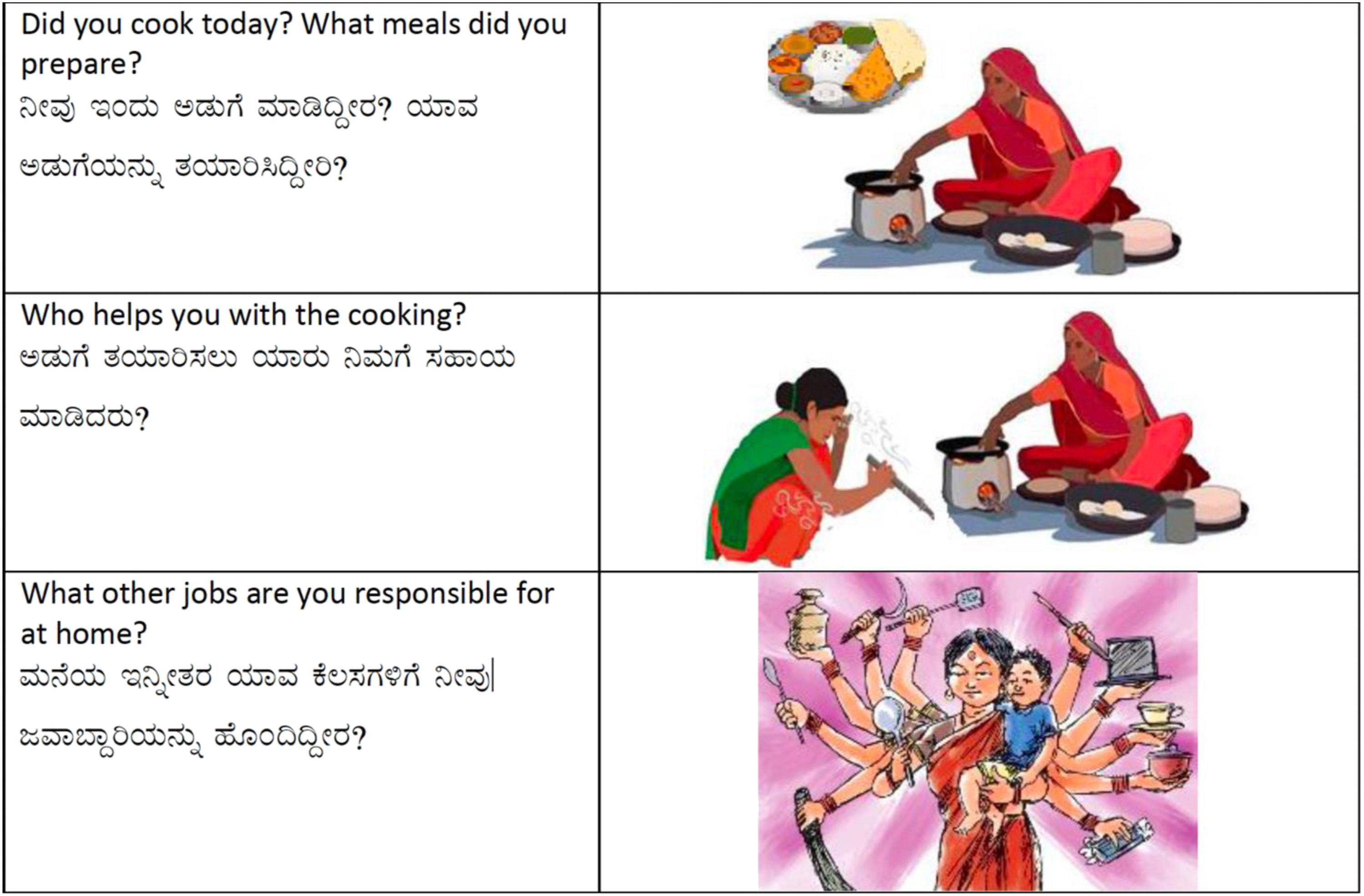
Midterm and exit interview questions.

Preliminary Findings
Number and duration of recordings per participant.

At the midterm of data collection, the team visited the households of all three women to collect week 1 audio diaries, explain the week 2 prompts, and ask women about their experiences recording the audio diaries. After our experiences with training women on the prompts in week 1, we modified our procedure in week 2 to address difficulties women were having with the written and/or recorded prompts, by adding pictorial prompts to written text. The pictorial prompts were reported as being more effective than written prompts. We also encouraged women to expand on their responses and record for longer periods of time, in an effort to improve the content of the audio diaries, which in week 1 were between 1–2 minutes long. The week 1 questions, it must be stated, did not require long answers, although women were encouraged to speak as much as they wished.
Only two of the three participants were at home when the team visited after one week. One of these women had to be brought home from her agricultural work in the interview team’s car. The third participant was away from the village but had left her recorder there, so the team downloaded her week 1 audio diary and arranged, over the phone, to meet her at home in a couple of days, which they did. While not as time consuming as initial recruiting and orientation, considerable time at midterm was spent locating the participants, orienting women to the new prompts, and discussing with them their experiences making audio diaries. Women were specifically encouraged to speak for longer in their entries, given the brevity of their responses in week 1. All three women recorded for more days and for more minutes than week 1, including one of the participants confronting high hurdles to recording.
The three participants fully understood the use of the recorder, and all three women said they found it interesting to speak to the recorder like it was a mobile phone, and that is why they agreed to participate. One participant indicated that she was happy to have been singled out to participate, and spent time telling her neighbors and friends about making recordings. However, during exit interviews none of the three women, when asked if they would like to keep the recorders longer, said that they would like to. Participants said that the machine did not do anything but record, like play music, for example; its only function was to record their diary entries, which occasionally felt like a burden due to the demands for their labor at home and in the fields.
Beyond time constraints and work burden, the team heard at midterm some of the domestic difficulties women faced in general, and how they spilled over into their ability to make audio diaries. Family dynamics influenced women’s logistical ability to record. One of the study participants was recruited at her natal home, and the team noticed that she was distinctly more comfortable speaking at her natal home than the other two participants, who lived with their in-laws. This corresponds with a body of research regarding the very different expectations and freedoms impacting women where she is a daughter, and where she is a daughter-in-law (Allendorf, 2012, 2013). Nevertheless, in the course of answering questions about daily routines, women did talk in their audio diaries about their feelings and daily experiences, for example, an expression about fear of going alone to defecate.
For the other two participants, conflict with family members hindered audio diary duration and content. One woman reported in her exit interview that she was depressed due to household tension, and saw “no need of telling” about conflicts with her father-in-law on the recorder, so she stopped recording after fighting with him during week 2. She also said that only when her husband took their young child was she able to record; all her recordings were in the evenings, presumably when they were out of the house. The remaining participant spoke freely when alone with the team, and briefly explained the household struggles that caused her to be severely upset and to keep her feelings hidden. She stated that she could not speak freely to the recorder because of the presence of her sister-in-law.
Audio Diaries’ Feasibility With Rural Women of Low Educational Attainment
We learned in this small study that the audio diary methodology is feasible to use in a low-resource setting among a low-literacy population; however, appropriate time and care must be invested to explain the procedures, including the use of technology and the prompts. Individuals took different lengths of time to learn how to use the recorder, but its simplicity meant that technology was not a barrier to audio diary recordings. After one week, it became clear that a joint form of pictorial prompt and written text in the local language helped women best understand what was being asked of them. Training on the prompts was time intensive, and perhaps more time spent on refining and explaining prompts would elicit more detailed answers. Given that our prompts asked women rather mundane questions about everyday experiences, it is notable that women did speak about their experiences making recordings in ways that revealed their feelings about them. Support and encouragement from the field team over the two weeks of recording were key to the trust-building (Ashworth et al., 2021) that elicited important reflections and women’s continuing participation.
Having time and resources to recruit, explain, orient, and revisit participants and their families were critical. We had an enrollment rate of 20%, indicating a future need to screen approximately five women to enroll one. During the agricultural season, when the study took place, many women were working in their fields at some distance from their village, so the season of the year might be a consideration for future work. Even in our small sample, the team had to make an extra effort to locate and meet two of the participants over the two-week period in order to collect the audio diaries. Women working at a distance from their residence may also have led to more difficulty recruiting according to the selection process.
All three women made more and longer recordings in the second week than the first, which may be an indicator of growing comfort with the technology, prompts, and/or audio diary format. Domestic conflicts were disruptive to women’s ability to make recordings, even though they were interested in doing so. It is noteworthy that women who related—during their midterm and exit interviews—that they withheld their feelings from their audio diaries were those experiencing the most domestic stress. This result suggests diaries get lower quality data from women distracted by other forms of domestic stress; however, the woman recruited while staying at her natal home recorded the least number of minutes and less detail than the other two. (As noted above, this same participant spoke more comfortably than the other two during the midterm and exit interviews.) Other forms of domestic stress are likely exacerbating WASH PPS, so it is important that our future use of audio diaries strategize how to maximize data collection from all women, and include in-person interviews that establish rapport with participants.
The participants spoke of a number of barriers to their making of audio diary entries, including: confidentiality; interruptions; ability to concentrate; and agricultural and household work. All women expressed fear of their recordings containing personal information that someone might use against them, for example, a neighbor or a household member. Password-protected voice recorders, similar to those participants used, are available and we plan to use them for this reason should they go missing or get stolen. A lack of privacy from a small child or sister-in-law were problems for participants, and in the first instance, she solved the problem with the help of her husband. In the second, the team suggested that she go to a friend’s house if that would allow her to speak more comfortably, and she agreed. It must be taken into consideration that women have difficulty responding to impersonal prompts might perhaps have greater difficulty making recordings regarding sensitive subjects or living in precarious conditions.
Beyond practical suggestions to arrangements, the implementation team did not try to solve family problems, but based on exit interviews it appears that more time needs to be given to orienting surrounding neighbors, family members, and agricultural work supervisors in the same way that participants are oriented. While we were not informed by women that their participation exacerbated household conflicts, it might be fruitful to give recorders to other household members as a means to redirect attention from the pregnant women making recordings, and these recordings might provide information regarding within-household disparities. In addition, just as women required midterm support, perhaps this midterm support should be extended to persons she works with and lives with.
Discussions during midterm visits contained deeply personal stories of stress, although, notably, participants did not express that they found recording audio diaries themselves stressful. For example, one participant expressed extreme distress over tensions with her in-laws and the level of caregiving she was expected to provide. While follow-up visits (midterm and exit) were time and labor intensive, the depth of women’s conversations with the field team generated extremely useful data, as participants shared detailed information about their lives and stressors when discussing the details of making recordings and reflecting on their experiences. As with all stress research and other research on sensitive topics that make audio diaries ideal for data collection, ethical considerations are paramount. The location where this feasibility study took place has established support services should the need arise in our future work (e.g., the presence of local health care workers and 24-hour access to social support by phone through KHPT staff).
Participants were more open during the exit interview than in their audio diary entries, perhaps because three weeks was the time necessary to establish trust (Ashworth et al., 2021) or because the field team strengthened participants’ ability to carefully examine their own situation. However, it is important to remember that the audio diary prompts focused on ordinary activities with little attention to emotion, while the interviews specifically asked women to reflect on their experience of making audio diaries, eliciting some of the reasons (e.g., lack of privacy to record) that interfered with their ability or desire to record. This feasibility study demonstrates that even when asking impersonal questions, audio diaries can bridge the public-private divide between investigators and participants, including those related to domestic conflict and stressful experiences, through trust-building over the course of the recording period, and through the integration of local health care workers throughout the process (Ashworth et al., 2021).
Conclusion
Audio diaries hold the promise for collecting important information about daily sources of stress, including our future WASH PPS study, that other qualitative methods may not be able to extract. Even in answering simple questions about ordinary life, our participants’ expressed information about their experiences and problems. When combined with midterm and exit interviews, the social context of each participant’s experiences became evident. These interviews could be used to probe into any extenuating circumstances through questions related to ability to make audio diaries, as we did here. In this feasibility study of audio diaries with rural Indian women with limited formal education, we learned that women successfully used voice recorders to respond to pictorial prompts about their everyday behaviors and feelings. We believe that asking women to respond to more specific, more intimate prompts about their daily experiences will lead to more detailed information in audio diaries. Based on this feasibility study, we know that participants confided in field staff regarding domestic conflicts and stressors when talking about their ability to make audio diary entries. Taken together, we gained insights into three women’s everyday stressors, feelings, and coping strategies.
Our research contributes to existing literature by demonstrating that the audio diary methodology is feasible for use in a low-resource setting among a low-literacy population. However, considerable time must be invested to recruit and enroll participants, given our 20% recruitment rate. A lengthy period is also required to explain and familiarize recruits, family members, work associates, and neighbors with the procedures, the use of the recorder, and the prompts. These activities did, however, assist in the development of trust between field staff, participants, and their families. Additional time is needed for audio diary collection in situ and orienting participants to a new set of weekly prompts. This intensive time commitment to data collection, together with the duration of analyzing audio diary entries, may prove a barrier to their extensive use. Limitations such as participants’ fears of exposure of personal material, interruptions that prevented them from making entries, and domestic conflict must be addressed to obtain good data, but more importantly, for ethical reasons, privacy and confidentiality must be paramount. Nevertheless, we are encouraged that audio diaries will increase our insights into WASH-related physical and psychosocial stress that impacts maternal and child health. The role of psychosocial stress from water and sanitation deprivation in maternal health in LMICs remains unclear, largely because its relatedness to and relative importance in context of other sources of stress mechanisms remains unclear. Audio diaries show promise for successfully eliciting such data, paving the way toward new insights on the impacts of stress.
Footnotes
Acknowledgments
The authors would like to thank the participants of this study and their families for giving generously of their time. We would also like to thank Mr. Pundalik Barmegowda, Ms. Umadevi Madinal and Ms. Sharada Hiremath from KHPT Koppal office for their contribution in field work for data collection. We also would like to acknowledge the support received from the administration and finance teams at KHPT and St. John’s Medical College, Bengaluru.
Declaration of Conflicting Interests
The authors declare no potential conflicts of interest with respect to the research, authorship, and/or publication of this article.
Funding
The authors received financial support for the authorship and publication of this article from Texas A&M University.
