




Abstract
This study demonstrates the possibility of co-creation that invites participants into the artistic process itself, fostering shared ownership of knowledge production and enabling new forms of storytelling that bridge artistic expression and lived experience. We explore the affordances of co-creating illustrated stories by centering the previously unshared stories of families forcibly displaced by war and systemic violence. We engaged in workshops to co-create visual stories which integrate their pre- and post-migration experiences with schooling, especially in the context of mathematics learning. The co-created illustration reflects the participants’ desired ways of depicting gender and race, with nuanced depictions of their emotional journey, holding both the struggles and moments of joy. Extending art-based methods further, we discuss how the co-created stories could convey the participants’ embodied experiences and their everyday acts of exercising agency to address power and inequity.
The co-creation of art represents a shift from traditional art toward a more dialogical and social approach, reframing “audiences” as active agents in the artistic decision-making process (Walmsley, 2020). In this article, we examine the possibility of co-creation between artists/researchers and families who have experienced forced displacement due to war and other forms of systemic violence. Within arts-based research, artists/researchers integrate diverse genres of art making with social science methods to facilitate a practice that meaningfully combines the arts, pedagogy, and research (Burnard et al., 2022; Cahnmann-Taylor & Siegesmund, 2018). We further the methodological discourse by exploring the possibilities of co-creating art with forcibly displaced communities. According to the United Nations High Commissioner for Refugees (UNHCR, 2007), forced displacement refers to a situation in which individuals are compelled to flee due to persecution, conflict, repression, natural or human-made disasters, human rights violations, ecological degradation, or other life-threatening circumstances. Through a collaborative process of co-creating visual stories, we aimed to offer participants an opportunity to share their school-related experiences and stories, which might otherwise remain unheard. There tends to be a lack of participation by historically marginalized groups directly in the process of co-creating art, which is crucial for amplifying their voices and bringing their experiences into learning discourse.
We selected mathematics as a disciplinary context for this research due to its central role in school curricula and its rigid disciplinary boundaries, which we aimed to challenge by integrating art as a transformative and inclusive medium. Our study explores how schooling norms, particularly those surrounding mathematics, are revealed and challenged through the co-creation of visual stories. For instance, Kayumova et al. (2018) presented a combination of text and graphics, created by the researchers themselves, to highlight inequalities and normative practices in science classrooms. Such practices particularly impact historically marginalized communities and influence how knowledge is constructed. By engaging forcibly displaced families in the co-creation of visual stories that highlight their voices, we aim to foster inclusivity and mobilize knowledge within the field of mathematics education. Arts-based methods offer a powerful means of integrating the cultural and historical knowledge of these communities into educational discourse.
Arts-based methods incorporate the arts in all aspects of the research process (e.g., data collection, data analysis, and data representation) and enhance social inquiry through the generative power of the arts, transcending the limitations of verbal and textual communication (Cahnmann-Taylor & Siegesmund, 2018; Chilton, 2013). Arts-based methods position iterative, creative, and artistic practice at the core of inquiry, enabling researchers to “explore, describe, evoke, provoke, or unsettle” (Leavy, 2017, p. 191) phenomena of interest and to represent emergent themes and understandings (Leggo & Irwin, 2013). Both artists/researchers and participants play significant roles in this generative process, collaboratively creating and shaping diverse forms of art (Cahnmann-Taylor & Siegesmund, 2018).
Arts-based methods have the potential to integrate the arts into academia, extending beyond education to encompass various fields and disciplines (Woo, 2017). By transcending disciplinary boundaries, arts-based methods invite and incorporate the everyday experiences of people, fostering inclusivity by engaging learners from diverse cultural and social backgrounds (Harasym et al., 2024; Khanolainen & Semenova, 2020; Nzinga, 2023). Learning extends beyond classrooms and libraries; it also occurs in lived spaces and through the arts (Woo, 2017). As such, arts-based methods connect researchers and communities. Particularly in collaborations between artists and individuals from minoritized groups, artistic creation can illuminate otherwise overlooked experiences (Khanolainen & Semenova, 2020). Because arts-based methods go beyond verbal and textual communication, when applied pedagogically, they have the power to invite diverse modalities of expression and emotions into scholarly discourse on learning and inclusivity (Grumet, 2017; Harasym et al., 2024). These methods also facilitate diverse dialogues, offering a shared language beyond words, among parents, teachers, researchers, and children alike (Grumet, 2017).
This interplay between lived experience and art is reflected in other methodologies that similarly prioritize community-based and narrative approaches. For instance, Germinaro and Nickson (2024) utilized Black Spatial Storylines to explore the connections between Black Geographies, hip-hop, and storytelling in education. Through autoethnographic narratives, they demonstrated how Black soundscapes and narratives reshape educational praxis, honoring diverse Black experiences and fostering liberatory, place-based pedagogies. Similarly, Burke (2023) adopted a community-responsive methodology inspired by Dewey’s Laboratory School to design and adapt science clubs and theaters for low-income communities. These studies underscore the power of responsive, place-based, and inquiry-driven mobilization of arts, which can transcend traditional boundaries between home and schools and between various disciplines.
Collaboration and iteration are central to arts-based methods (Woo, 2017). The integration of arts encourages transdisciplinary collaboration, fostering dynamic spaces for dialogue and reflection that disrupt conventional knowledge production (Leggo & Irwin, 2013). Moving beyond representation, co-creation invites participants into the artistic process itself, fostering shared ownership of knowledge production and enabling new forms of storytelling that bridge artistic expression and lived experience.
Bridging Co-Design and Co-Creation: Empowering Voices Through Co-Creation of Visual Stories
Govier (2009) characterizes co-creation as a “collaborative journey” in which artists and audiences collectively intend to create something new with purpose (p. 3). This process is not a solitary endeavour, but rather a shared journey of discovery, innovation, and artistic expression. Co-creation of art attempts to shift its emphasis from the final artistic product to embrace the emergent, dialogic, and collective process that involves participants as active agents. Through these collaborations and dialogues, the arts can unite artists and participants in a shared aesthetic journey of creating art (Govier, 2009). One of the main arguments around co-creation of art appears to be a shift from traditional methods of art creation that overemphasize the final product. In the process of co-creation of art, new forms of knowledge can be generated through inviting and engaging participants in sharing their everyday experiences and knowledge with others through dialogues and artistic encounters (Chilton, 2013).
The concept of co-creation can be linked to co-designing, a topic that has been explored in the field of learning sciences (Gutiérrez et al., 2019; Ishimaru et al., 2018; Mawasi et al., 2023; Vossoughi et al., 2023). These studies explore the core principles of the co-design approach by creating a collaborative environment where diverse skills, experiences, and voices can emerge, be transformed, and be acknowledged. Bang and Vossoughi (2016) maintain that participatory approaches within the co-design process can foster the creation of new forms of knowledge among a wide range of participants. Co-design also shifts power dynamics by involving participants as active contributors in the co-creation of their own stories (Dadkhahfard & Takeuchi, 2025; Mawasi et al., 2023; Pierroux et al., 2022). By creating new ways for a variety of individuals to share their experiences and amplify their voices in the process of co-creation of art, not only through words but also through artistic mediums, hierarchical power structures can be challenged. Placing participants at the heart of the co-creation of art can empower participants by centering their voices and experiences as well as by repositioning them from passive observers of art into active, agentive contributors (Kumpulainen et al., 2013). In this context, collaboration in the process of co-creation of art can create transformative and emergent spaces that not only amplify the voices of the participants but also invite their unique and often unheard experiences and stories, potentially leading to a redistribution of power dynamics between participants and the artist/researcher. Art should not be considered solely for its technical excellence, but also for its transformational capacity to effect change; this transformative influence can manifest in numerous ways through the collective engagement of individuals in the participatory process of co-creation (Harasym et al., 2024). Our approach to the co-creation of visual stories integrates elements from both co-design approaches and co-creation processes in artistic practices. This study employed the co-creation of visual stories as a way to listen to participants’ experiences in school by involving them as active agents directly in the process of illustrating and depicting these experiences and stories in visual form.
Intersectionality and Marginalized Experiences in STEM Education
Intersectionality, introduced by Crenshaw (1991), provides a critical framework for understanding how overlapping social categories such as race, gender, and class create unique forms of marginalization. This framework emphasizes the interconnectedness of these categories in shaping social inequalities (Collins, 2015). Intersectionality offers a lens that enables a comprehensive understanding of societal issues by considering the interlocking social and historical contexts of oppression. The lens of intersectionality has been applied in the context of STEM education to explore how multiple identities intersect to influence experiences, opportunities, and barriers (Avraamidou, 2019; Leyva, 2016, 2017). Leyva (2017) argued that gender is not an isolated concept, but rather a social construct that intertwines with other social categories, such as race, class, and ethnicity. Studies on gender in mathematics education should consider the social context and the relational aspects of identity. Avraamidou (2019) also utilized the lens of intersectionality to explore the challenges, obstacles, and conflicts faced by a young Muslim woman during her journey in physics. The study emphasized how her multiple identities intersected and how this intersection both restricted and supported her participation in science.
In this study, we focus on Afghan girls who were forcibly displaced and were navigating intersecting systems of oppression: race, gender, nationality, and displacement, compounded by systemic barriers and societal stereotypes. This research employs co-creation of visual arts to shed light on the complex bodily experiences of these girls in the context of mathematics education. By engaging them in reflective, dialogical art-making, the study seeks to amplify their voices regarding aspects of their identities and in-school experiences. Viewed through the lens of intersectionality, this complex interplay of race, gender, nationality, and other social categories among Afghan refugee/forced migrant families, along with their bodily experiences in the school and mathematics classroom, forms a complex phenomenon that should not be simplified or analyzed in isolation. Their race, gender, and nationality, among other factors, intersect to shape their bodily experience.
Research Design
Positionality Statements
Shima Dadkhahfard: I came to this research as an Iranian artist and researcher with academic training in both graphic and industrial design, holding undergraduate degrees in each and a graduate degree in industrial design. Over the past 15 years, I have worked as a professional illustrator and have published 13 children’s picture books, including storybooks and math-themed titles. My connection to this research also stems from a deep cultural and linguistic bond with Afghan communities. As an Iranian, I share a common history and language with Afghans, most notably, Farsi. Dari is an eastern dialect of Farsi, and the two are mutually intelligible. This shared language facilitated clear and meaningful communication throughout all workshops and interactions.
Miwa A. Takeuchi: My works are oriented toward the goal of re-imagining mathematics and STEM learning, with a focus on linguistic diversity, historicity, and power. To foster transdisciplinary experiences, I keenly observe and listen to learners’ embodied and emplaced experiences that have been historically subjugated or hidden. In the process, I discipline myself to use my racialized, gendered, queer, and linguistically minoritized experiences as a “guide to listen” (instead of reinforcing assumptions). The conceptualization of co-creating the visually illustrated story with the participants, especially with young people who have the experience of forced displacement, stemmed from my hope to engage in dialogues with young people and their families, as well as school teachers, to envisage liberating pedagogy.
Setting
The study involved six forcibly displaced Afghan families, including 12 parents and their school-aged children. Three families were classified as refugees, while the other three had immigrated to Canada after being displaced by war and other systemic violence. All families had arrived in Canada within the past two to three years (at the time of recruitment) and brought prior educational experiences with them. The child participants ranged from grades 5 to 12 and came from families navigating recent migration.
We engaged in six workshops for co-creating visual stories, with each family participating in at least one workshop during the 2022-2023 year. These workshops (each lasting 90 to 120 min) were held either virtually through Zoom or in a private room at a university library. Given the post-pandemic circumstances, some participants preferred to join via Zoom. Before the workshops began, consent forms were collected, and all data and forms were securely stored in accordance with institutional ethics policies. These workshops provided a platform for the families to share their experiences and stories, contributing valuable insights to the study. During the workshops, if any participant appeared distressed while sharing their experiences, they were reassured that their comfort was more important. They were reminded that we could take a break or even stop the session if they felt uneasy. Prioritizing participants’ autonomy in how they engaged with the workshop (including stopping the session) was crucial for listening to and connecting with participants’ stories and experiences ethically and with care (Blanchet-Cohen et al., 2017; Ellis et al., 2007).
Process of Co-Creating Visual Stories
Our methodology centers on the co-creation of visual stories, which is a dialogic, social, collaborative, and iterative process (Figure 1). One of our central aims of the workshops was to explore how the process of co-creating visual stories evokes conversations on equity and learning through illustration-mediated workshops with participants. In particular, we encouraged participants to share their bodily experiences and stories related to the school context through visual forms of communication. Both authors participated in the design of workshops, and Dadkhahfard led the workshops by utilizing her professional background as an illustrator and her language proficiency as a speaker of the Persian language (Farsi), which has both commonalities and differences with the participants’ first language (Dari). Dadkhahfard translated all workshop conversations from Farsi/Dari to English to ensure that participants’ insights were accessible for analysis. Another fluent researcher verified the translations to maintain authenticity and clarity for a broader audience. Illustration-mediated workshops were part of the co-creation process wherein participants actively engaged in sharing stories and experiences in the form of drawings, thus becoming active contributors to the co-creation of visual stories. We explain this process as follows. Process of Co-Creating Visual Stories
At the beginning of each workshop, before the participants started drawing based on their own stories, we introduced them to a digitally illustrated story (Figure 2) to closely examine both its story and artistic elements. This illustrated story was based on ethnographic research conducted by Takeuchi (2018) and depicted the issues of race, power, embodiment, and home-school learning disconnection for mathematics learning. The process of visually illustrating the story was iterative, aiming to surface issues such as depicting race and gender (Dadkhahfard & Takeuchi, 2022, 2025). Unpacking this illustrated story with participants evoked conversations about learning and equity, especially around race, gender, and embodiment in the school context. We presented this digitally illustrated story as a source of inspiration, allowing participants to share their own experiences and narratives. Illustrated Storybook Shared With Participants (Available at the Website: https://illustratestem.com/)
Subsequently, during the workshops, participants, inspired by the illustrated story, narrated their own stories while illustrating their experiences in the context of school. As participants engaged in drawings, Dadkhahfard highlighted how she used artistic elements such as color, size, shape, line, texture, and composition. Once the participants completed their drawings, they were invited to verbally share stories based on their drawings. This was an opportunity for them to provide context that may have been overlooked in their drawings. We have engaged in conversations both on the stories and the artistic elements utilized by the participants. While participants shared their stories either visually or verbally, Dadkhahfard also engaged in visually sketching those stories in the form of visual field notes (Figure 3) to interpret verbally shared stories with illustrations. Visual Field Notes
Various types of data were gathered during the workshops. Throughout the various stages of the workshops, data were gathered through methods such as observations with visual field notes (Phillippi & Lauderdale, 2017), audio/video recordings (totalling 670 min of recorded data), and participants’ drawings at different stages of completion. Visual field notes taken during the workshops captured contextual information illustrating participants’ embodied stories expressed during the workshops (e.g., Figure 3). Gol Noor at School in Her Homeland
One of the profound elements of co-creation is the collectively created visual stories illustrated between Dadkhahfard and participants. Following the workshops, visual analysis of the drawings (Albers, 2013; Albers et al., 2009) was conducted using the Procreate
1
graphic application on an iPad Pro (Figure 4) while we reviewed the video-recorded data gathered during the workshops. Visual discourse analysis offers opportunities to analyze visuals and how their elements are organized to convey meanings within visuals and the contexts in which visual arts as a language are created (Albers, 2013; Albers et al., 2009). The focus of analysis was on racialized and gendered bodily experiences that were represented and communicated in participants’ drawings and storying of these drawings. Visual discourse analysis offered insight into the experiences, beliefs, and thoughts of the participants that are often not expressed or represented verbally. Visual Analysis of Participants’ Drawings
Drawing from the knowledge gained from visual analysis, shared stories, and drawings by participants, along with the visual field notes, we collectively engaged in an iterative process of transforming and rendering these data into digital illustrations among ourselves and with the participants. Dadkhahfard integrated her illustrations, based on our interpretations of the participants’ shared stories, into the initial draft of the digital illustrations. Together with participants who expressed interest, we engaged in an iterative cycle of creating a story that depicts shared experiences of forcible displacement, gendered and racialized experiences with mathematics, and navigating a school in a country they immigrated to. In the process of designing the digital illustrations, each phase was reviewed and refined with participants. We received feedback and valuable insights from the participants to modify the illustrations, and we collaboratively worked on finalizing the digital illustrations. This process helped the digitally illustrated story to be not a mere representation, but rather a collective creation of shared stories.
Co-Created Visual Stories
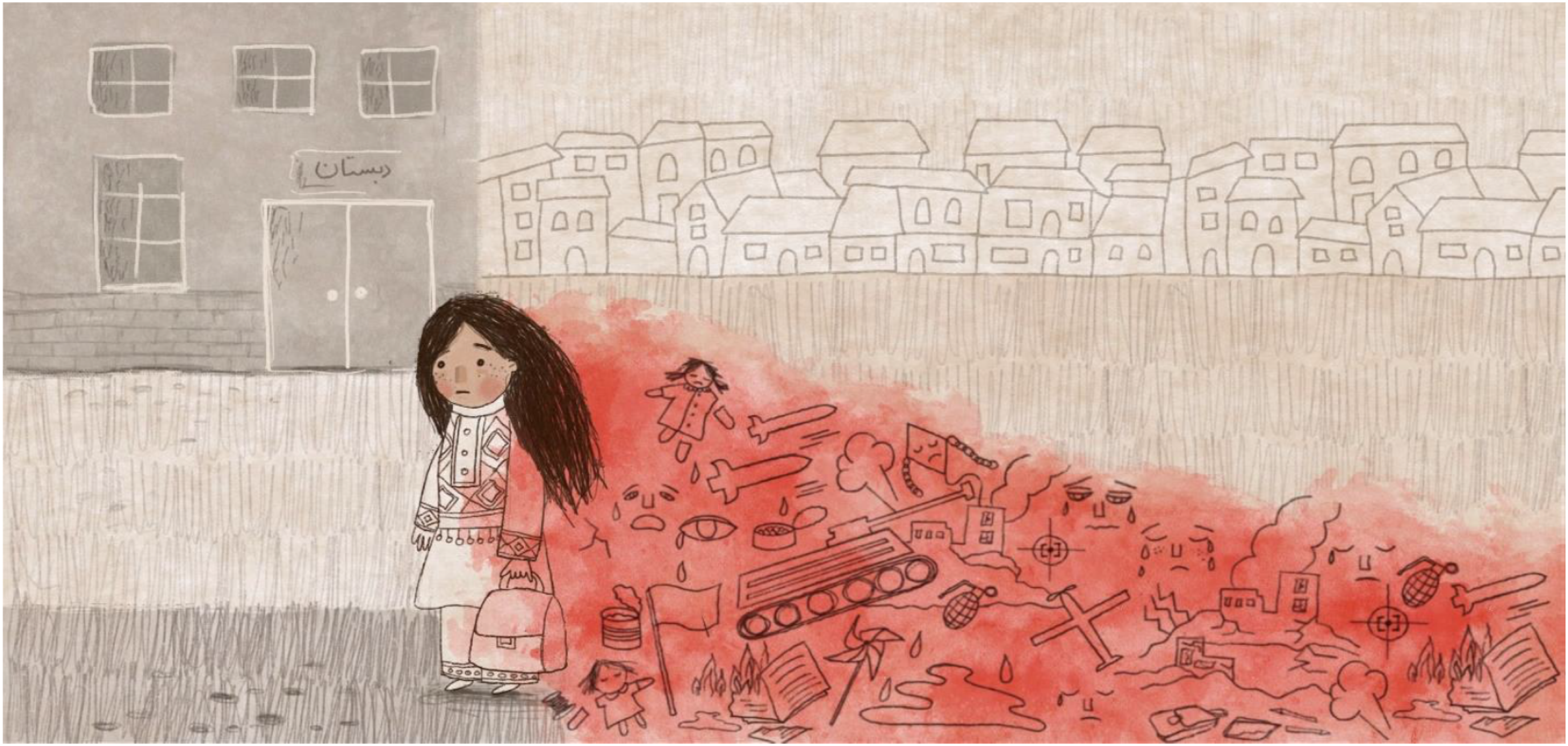
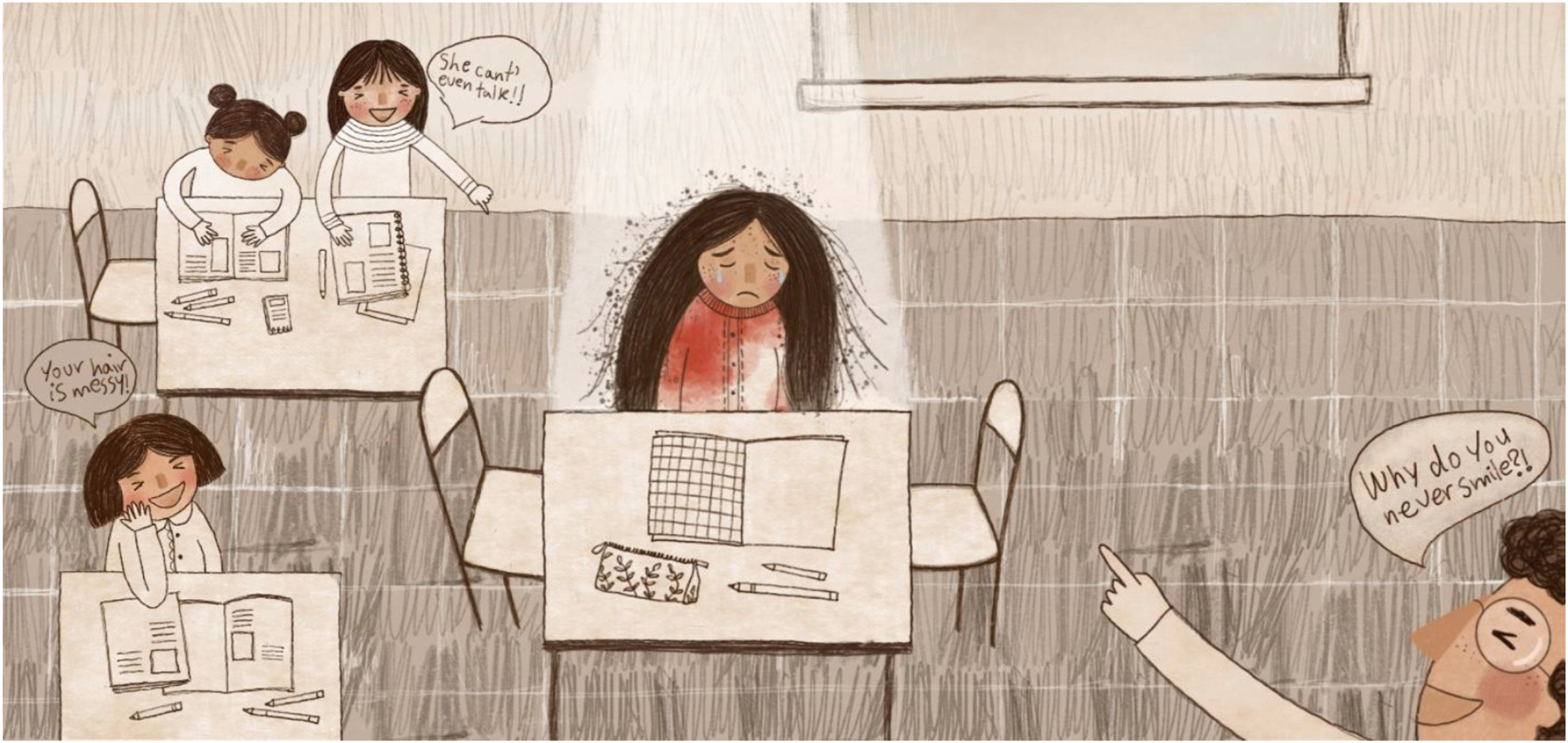
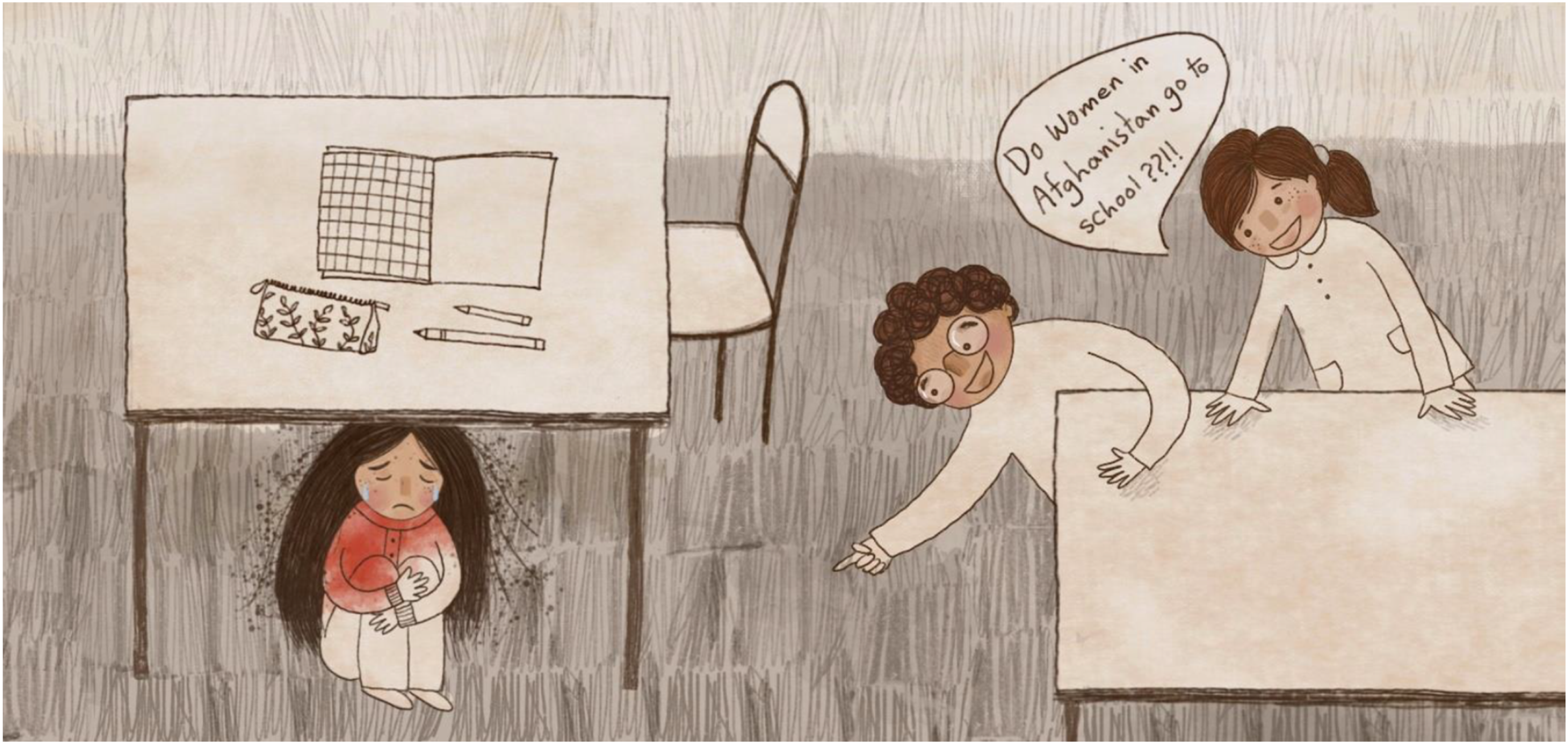
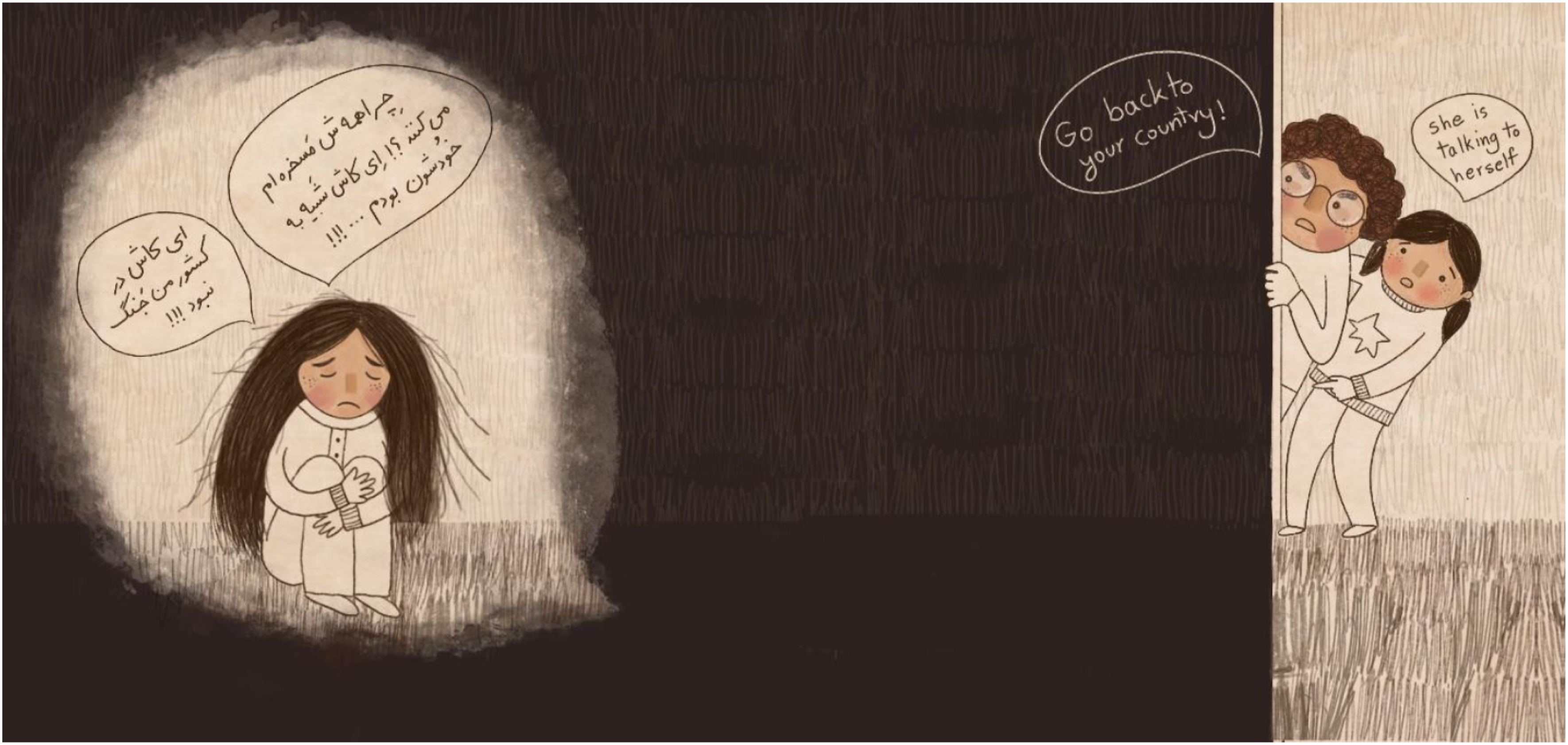
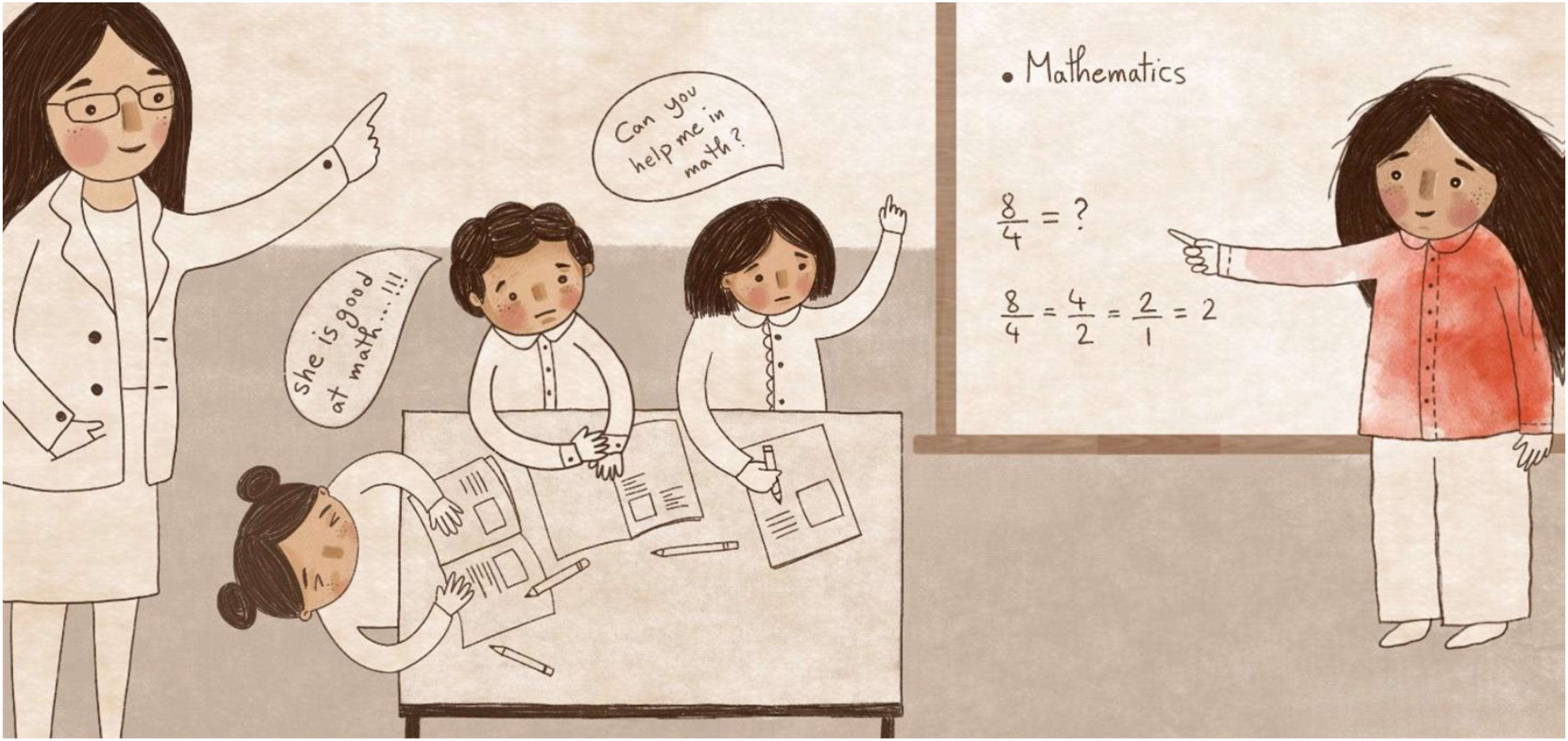
The co-creation of visual stories occurred in two main ways—through the initial workshops and through the iterative process of co-illustration through subsequent workshops. Saman, Yara, and Soha (all assigned pseudonyms) participated in the subsequent workshops to collaboratively design and finalize the digital illustrations. Together, we created the story of Gol Noor (a pseudonym chosen by the participants). It is an imagined story of a refugee girl, Gol Noor, who came to Canada from Afghanistan when she was a Grade 3 student (Figure 5). This is an imagined story yet deeply reflects participants’ lived experiences. The story’s synopsis is as follows. Gol Noor used to go to school in her own country, Afghanistan (Figure 6). Following the war, Gol Noor and her family had to flee from their country, and they sought refuge in Canada (Figure 7). Gol Noor had to repeat Grade 3 in Canada. In her own country, she had an interest in her studies and enjoyed attending school. In contrast to her previous experiences related to education, Gol Noor’s journey to her new school in Canada took a different turn as she became a target of bullying due to her physical appearance, her English accent, and her identity as a refugee girl (see Figures 8–10). Navigating this situation (Figures 11 and 12), Gol Noor resorts to the joy of re-appreciating the wonder of mathematical knowledge rooted in her cultural practice (Figure 13). Her knowledge and experiences started to get acknowledged and recognized in the mathematics classroom (Figure 14). This co-created story is made available online to share with the public (https://illustratestem.com/). Gol Noor in the House in Her Homeland With a Traditional Costume The Departure of Gol Noor From Her Homeland Verbal Bullying at School due to Her Gendered and Racialized Body Verbal Bullying at School due to Her Gendered and Racialized Body Gol Noor’s Body After Being Bullied Gool Noor’s Lonely Body After Being Bullied Slapping the Student Who Bullied Her Gol Noor Re-Appreciating the Wonder of Mathematics Knowledge Rooted in Her Cultural Practice Acknowledging Gol Noor’s Knowledge and Expertise in the Mathematics Classroom


Complexity in Depicting Race
Illustrating race and nationality is complex, as assigning flattened color can risk misrepresenting race as skin color (Dadkhahfard & Takeuchi, 2022). To represent the complexity of race beyond skin color, we focused on the lived experience of the participants, focusing on their bodily experiences of being racialized and gendered in school settings. Based on the feedback from participants and their shared racialized and gendered experiences, we repeatedly discussed how we can represent a protagonist that Saman, Yara, and Soha can see as themselves. Because participants’ narratives focused a lot on embodied experiences, we tried to illustrate bodily expressions that mirror the participants’ narratives. Upon unveiling the initial version of the illustrations to the participants, they expressed great excitement about the character. For instance, Yara was so excited and said, “I love her, she is so similar to me, it seems that it is me.” Based on the feedback, we further integrated elements that help Gol Noor to be seen as one of the community members in participants’ eyes. For example, Saman, Yara, and Soha recommended including the traditional clothes that girls typically wear in Afghanistan (see Figures 5 and 7). The depiction of traditional clothes reminded Soha of her memories back home: “We used to wear our traditional clothes on special occasions.”
Unflattening Emotional Journey
The participants also suggested adding frames that highlight the character’s life and her happiness, along with the struggles. For example, Soha said, “I want the viewer to know that I was happy in our home, in our country.” Her suggestion was reflected in the depiction of Gol Noor before the war forced her to leave her homeland (Figure 5). Soha also mentioned her initial hope and happiness to go to the school in Canada, “I was so happy and positive to go to school here and make new friends.” Soha also described herself as someone who always enjoyed school and said, “In Afghanistan, I loved school and studying.” Soha emphasized the importance of nuanced depictions of their emotional journey, holding both the struggles and moments of joy and happiness. In this context, she also named stereotypes imposed at the school: “At school some of my peers were whispering and talking about Afghanistan and the war there, and they said she is from Afghanistan; it is dangerous to talk to her.” Emotions are not neutral but can be politically mobilized to suppress or empower historically marginalized groups (Vea, 2020). Participants’ voice to depict the multitude of emotions was rooted in their desire to be seen on their terms, instead of through flattened stereotypes.
Depiction of the Teacher
Saman, Yara, and Soha suggested depicting a teacher in the illustrated story to invite readers to consider the significant roles a teacher can play in their education journey. As Avraamidou (2019) discussed, the intersection of social constructs such as race, gender, and ethnicity can affect the ways in which minoritized groups can be recognized and involved in the field of STEM. The participants’ drawings and associated sharing depicted how the intersection of race and gender influences their school experience. For example, on the drawing Saman depicted (Figure 4), she said, “he [teacher] got surprised and asked me to solve other math problems while he was watching me. Then, I solved them.” The White male teacher was doubtful about Saman’s ability to solve an advanced mathematics equation on her own. In her drawing, Saman used different colors to represent and distinguish racial identities. Saman further explained her drawing: “One time I asked a complicated question to him …The teacher was surprised and asked where I found this question, it is so advanced.” Saman added, “He didn’t predict a girl of color could be that much advanced in mathematics.” Saman’s experience is similar to what Schuster and Martiny (2016) observed in their research: scientific competence of women of color tends to be questioned due to their deviation from the stereotypical STEM profile.
Other interactions with a teacher were more affirmative, and the participants emphasized depicting both authoritative and affirmative roles that teachers can play. Soha explained, “In math class, I was at the center not because of my race or country or gender or as an Afghan girl, but because I was really good at it, and I always solved the math problems very fast … The teacher encouraged me, and it made me feel better.” In the co-created story, we decided not to make the teacher’s role monolithic to evoke dialogue. One of the key considerations was to challenge stereotype perpetuated through teacher-student interactions. Incorporating the participants’ stories and drawings, co-created visual story aimed at depicting images that could actively broaden who can be competent in mathematics, which ultimately question race-, gender-, class-, and language-based exclusion perpetuated in the discipline of mathematics (Joseph et al., 2019; Leyva, 2016; Nasir, 2002; Sengupta-Irving & Vossoughi, 2019; Takeuchi & Aquino Ishihara, 2021).
Discussion
This study offers a unique perspective on the use of co-creating visual stories as a methodology to uncover and share the experiences of forcibly displaced families, particularly within school settings where participants negotiate power, stereotypes, and marginalization. By placing participants at the center of visually depicting their experiences, we were able to reveal how race, gender, and forced displacement shape their experiences within the school. We view this methodological innovation within arts-based research as a tool for promoting equity, diversity, and inclusive practices in education. Because this research employed an arts-based method, a substantial portion of the findings was conveyed through visual storytelling. To ensure public access and support knowledge dissemination, all digital illustrations were published on the website https://illustratestem.com/. These illustrations serve both as educational resources and as references for scholars and researchers exploring methodological approaches. By centering co-creation as a methodological tool, this work highlights its role in advancing arts-based research and expanding the concept of “knowledge mobilization.” The co-creation of visual stories as an arts-based approach offers a valuable opportunity to explore how collaboration between researchers and participants can deepen understanding of participants’ experiences and stories (Halverson & Sawyer, 2022). The methodology of co-creating visual stories positions participants as collaborators and protagonists in the storytelling process, rather than as passive subjects. Our participants not only shared their experiences but also actively shaped how their stories were visually represented. By engaging participants in the creation of visual stories, the study empowers them to visually express complex identities and stories that might not emerge through qualitative methods relying solely on verbal or textual communication. However, one challenge in the study was the distress some participants experienced when recalling their forced migration. This led us to limit direct questioning and prioritize their well-being and autonomy in sharing. Another challenge was that while offering more time or techniques might encourage deeper expression, it does not guarantee a more complete representation, as each artist’s style and choices are inherently unique.
By involving participants directly in both the creation and refinement of the story, our study shows that co-creation is a collaborative journey, creating a narrative that participants can identify with and feel represented by. This collaborative approach emphasizes that knowledge production is not a one-sided process, but a shared journey that values participants’ voices. The creation of Gol Noor, an imagined yet representative figure, illustrates how visual storytelling can serve as a medium for exploring the complexities of race, gender, and cultural displacement. Gol Noor’s character serves as a mirror for the participants, allowing them to see aspects of their own identities and challenges within her story. The iterative feedback from participants, including details such as traditional clothing and emotional experience, underscores the importance of culturally and personally relevant representation. This inclusion aims to challenge the flattening of complex identities often found in educational narratives and mainstream picture books (Sousanis, 2015). By integrating text, imagery, and artistic expression, the co-creation of a visual story as an arts-based method not only amplifies marginalized voices within school settings but also provides a critical framework for resisting dominant narratives and promoting equitable knowledge production. By sharing the co-created story publicly through the website, we aim to foster ongoing dialogues with teachers, teacher educators, and students. For example, the co-created story highlighted the dual role teachers can play as both gatekeepers and supporters. Some participants shared experiences of feeling empowered by teachers who recognized their abilities in subjects like mathematics, while others felt their capabilities were underestimated due to stereotypes related to race and gender. This duality, depicted in Gol Noor’s story, invites reflection on how educators can be instrumental in either reinforcing or challenging biases. By representing the teacher’s role as nuanced, the research challenges the monolithic portrayal of authority figures and invites conversations toward a more equitable approach to student-teacher interactions.
The findings highlight the potential of co-creation of visual stories to influence educational practices by promoting more inclusive representations in pedagogical tools. Integrating narratives like Gol Noor’s in STEM education could help interrogate stereotypes that restrict certain groups from being seen as capable in fields like mathematics and science (Joseph et al., 2019; Leavy, 2016). The educational impacts of employing co-creation of visual stories on learning and identity, especially in the fields of mathematics and science, warrant further exploration. Building on arts-based methods, this project positioned co-created visual storytelling as both a research method and a form of knowledge exchange. Through collaboration with forcibly displaced communities, we explored how artistic co-creation can shift power dynamics in knowledge production, particularly in mathematics education. Integrating co-design principles with arts-based research, our work challenges normative schooling practices and demonstrates the transformative potential of visual storytelling in fostering inclusivity and social change.
Footnotes
Acknowledgements
We appreciate all the families who participated in this study – thank you so much for gifting your stories to us and to the world.

Funding
The authors disclosed receipt of the following financial support for the research, authorship, and/or publication of this article: Our work was financially supported by the Social Sciences and Humanities Research Council Insight Grant (435-2020-0134, PI: Miwa A. Takeuchi). Any opinions, findings, and conclusions expressed herein are our own and do not necessarily reflect the views of the funding agency.
Declaration of Conflicting Interests
The authors declared no potential conflicts of interest with respect to the research, authorship, and/or publication of this article.