




Abstract
Qualitative research has increasingly been utilising visual methods such as drawing to collect richer insights from participants of all ages and backgrounds. This article demonstrates the methodological potential of a structured arts based workshop that included a data walk, a drawing session, and a reflective peace wall. We reflect on the suitability and value of this approach to support young people’s learning about peace, to collect insights on what peace means to them, and how they envision their contribution to a peaceful world. This project was done with 12–18-year-old students in three schools in Glasgow, Scotland. We found that a structured approach allowed students to understand and express what positive peace means and to see themselves as agents of change. Three key methodological insights are offered: ways the approach addresses a crisis of praxis in peace education research, how research methods can gain congruence with democratic concepts in of peace education, and normative validity established through the voice of young people. This article contributes to the literature on arts based and creative methodologies and offers a novel model of peace education research inclusive of multiple ways of knowing and more democratic methods.
Keywords
The aim of this article is to demonstrate the methodological potential of a structured arts based workshop to engage young people in reflective and creative learning about socially important issues such as peace. Previous studies discovered that children understand and can conceptualise war better than peace, and peace tends to be described simply as absence of war, or negative peace, at the neglect of positive and just peace elements (Hakvoort, 1996; Lourenco, 1996; Oppenheimer & Kuipers, 2003). Covell et al. (1994) posit that “because exemplars of peace are encountered less frequently than are instances of war,” there is a “less-developed understanding of war than peace across ages” (p. 720). In particular, Walker et al. (2003) explain, in western countries, “adults are less likely to identify examples of peace for children than they are to identify examples of war” (p. 197) and news coverage, films, history texts, and video games focus on wars and not on peace. Peace, therefore, is largely viewed as “a passive state, rather than as an active process,” as McLernon and Cairns (2001) point out, drawing on previous literature (in particular, by Alvik, 1968). Covell et al. (1994) also found that youth lack motivation and self-efficacy to effect peace as they believe that conflict, violence, and war are inevitable. This poses concerns for the state of peace in the world as well as for peace education. Youth may not know how they can contribute to peacebuilding or believe actions they take can prompt meaningful change.
In this regard, we agree with Walker et al. (2003) who assert that knowing how children and youth “conceptualise peace can assist the professionals working with them to find ways to help [them] identify positive, nonviolent actions they can take in response to war” (p. 191). However, how to engage children and youth in peacebuilding work remains an acute concern in peace research and practice. In particular, as Cremin (2016) acknowledges, there are crises of legitimation as research rarely aligns with peace values, of representation as research lacks reflexivity, and of praxis as research has limited if any impact on participants. This article responds to these concerns by proposing a structured arts based workshop as a transformative approach in line with peace values with the potential to democratise knowledge production and prioritise participant benefits. It does so by centring youth voices and experiences as important and valuable sources of knowledge, understanding, and social action.
This arts based research approach thus has three objectives. First, it can support research that makes an impact on the lives of participants through teaching students about positive and just peace and the importance of community and individual action in peacebuilding. Second, it can be used for research purposes to explore what images of peace youth (and people of other ages) create through drawing/painting and what commitments they can make to sustain peace. Third, it can support young people’s learning about and reflection on peace, building and sustaining peace, and their role in these processes. Our approach consisted of three steps: (1) a peace walk to allow students to learn more about peace, conflict, and peacebuilding; (2) drawing to express their conceptualisations of peace; and (3) a reflective peace wall to explore youth’s contribution to and conceptualizations of peacebuilding.
We chose a creative approach for the workshop and drawing as the main activity as they offer a host of benefits when working with youth. First, this approach allows researchers to create a safe space for participants to express themselves, to support participants in making meaning of their experiences, to enhance their agency in the research process, and thus make knowledge production more impactful (Akesson et al., 2014; Bliesemann de Guevara et al., 2022; Clacherty, 2021; Huss et al., 2015; Liebenberg et al., 2020). Second, drawing, as other arts based media, “may provide insights into [young people’s] feelings and thoughts about the world” (Barraza, 1999, p. 49). Specifically, drawing helps to “surface unspoken thoughts and feelings” (Kearney & Hyle, 2004, p. 362), allows participants to share their thoughts, experiences, and feelings in a more “expressive, empowering, and personally relevant manner” (Literat, 2013, p. 84), and self-define themselves (Huss et al., 2015). In particular, visuals such as drawings allow us to capture interpretations and meanings that can be overlooked in traditional methods (Rose, 2014). Third, many young people enjoy drawing “without showing any sign of tension” (Barraza, 1999, p. 49) and use drawing to express themselves and explore and make meaning of their world (Podobnik et al., 2021). Especially as drawing is a “low-threshold approach to visual expression and the production of visual research material” that does not require complex skills or a wide range of materials (Martikainen & Hakoköngäs, 2023, p. 982). Fourth, creative approaches can help to strengthen participants’ sense of agency for taking action to contribute to building a peaceful and just community, society, and the world (Liebenberg et al., 2020; Moletsane et al., 2007) and increase their awareness of their belonging to the broader humanity (Harris, 2007).
There is a growing number of studies that invite children and youth to draw/paint in response to a particular issue. However, they primarily have focused on environmental education and children’s relationship with and perception of the natural environment (Barraza, 1999; Bowker, 2007; Kalvaitis & Monhardt, 2012), assessment of children’s comprehension of studied material (Shepardson et al., 2009), children’s experiences and expectations of schooling (Dockett & Perry, 2005; Einarsdottir et al., 2009), and their conceptualisations of happiness and fear (Maagerø & Sunde, 2016). Some studies have used art with children and youth who experienced war as well as refugee and immigrant children to help them express and rediscover themselves and their sense of resilience, belonging, and morality as well as address their emotional and behavioural problems (Kollontai, 2010; Rousseau et al., 2005; Rowe et al., 2017).
Several studies have relied on drawing as data collection to analyse how children and youth view peace and war. These include asking children to draw peace and war in England and Northern Ireland (6–7-year-olds) (McLernon & Cairns, 2001), in the United States after the Yugoslavia-NATO conflict (3–12-year-olds) (Walker et al., 2003), and in Iraq (4–12-year-olds) (Jabbar & Betawi, 2019). While in the first two of these studies children included a significantly higher number of objects in war drawings than peace drawings, in the third study, along with images of absence of war, children described peace as religious practices and inner peace.
In contrast, our research showed that young people (12–18 years old) in Scotland used multiple positive peace elements in their drawings (Authors, forthcoming). One potential explanation for a more nuanced depiction of positive peace may be that our project was done with older children who had more exposure to discussions of and learning about positive peace. Another explanation is the approach we developed to support youth in learning about and expressing their views and conceptualisations through drawings. In this article, we demonstrate our approach and reflect on its effectiveness and what can be improved to collect more in-depth and nuanced insights from young people.
Procedure
The Site
The study was done in the city of Glasgow in Scotland, one of the four nations of the United Kingdom (UK). Although overall the country has a high score of positive peace, in recent years grievances between groups, exclusion by socio-economic group, rule of law, freedom of the press, and level of trust in governments have been deteriorating (Institute for Economics & Peace, 2022). Many young people across the UK experience marginalisation and violence in schools (Ogunnusi, 2006). Additionally, Glasgow is ranked as the least peaceful city in the UK and the most violent in Scotland due to gang and knife crime, extreme health inequalities (Coid et al., 2021; Institute for Economics & Peace, 2013), sectarianism that leads to violence (McBride, 2022), and marginalisation and exclusion of youth (particularly young men) in deprived areas of Glasgow (Deuchar, 2010). At the same time, in Scotland, the voting age is 16, and the role of the formal education sector is to educate politically literate and civically engaged young people. This is primarily done through the Curriculum for Excellence (Education Scotland, 2019) that serves students ages three to eighteen and a commitment supported by professional teaching standards to both uphold and promote children’s rights as articulated in the United Nations Convention on the Rights of the Child (UNCRC) (Education Scotland, 2023).
Objectives and Research Questions
Drawing on the aforementioned prior research which emphasised that children and youth find it hard to conceptualise peace and may feel overwhelmed when faced with the world’s challenges and complexities, our aims were to work with youth in one of the least peaceful cities in the UK – Glasgow – to: (1) support their learning about peace and conflict, (2) understand how they conceptualise peace, and (3) explore reflections on and commitments to peacebuilding they can make based on this knowledge. We thus asked the following research questions: 1. How do young people express their understanding of ‘peace’? 2. What kind of contributions to peace young people would like to make? 3. Are there any differences and similarities in conceptualisations and contributions of youth of different socio-economic and geographic backgrounds?
Participants
Participants.

aIdentified as a UNICEF Rights Respecting School.
Data Collection
Data collection took place after we received ethical approval from the Ethics Committee of the College of Social Sciences at the University of Glasgow and signed consent forms from student participants and their parents/guardians. We conducted four arts based workshops to achieve our objectives, answer the research questions, and give voice to a local youth perspective. The workshop order and process were replicated for each group. Each workshop consisted of three activities (peace walk, drawing, peace wall) and lasted 2 hours. The first two workshops occurred at a university research centre where students from St Jean-Baptist and Cooper High School jointly participated in a community research-engagement event. Local schools were invited through a university level communications and school leaders selected students to participate in the event; students voluntarily agreed to be included. The third and fourth workshops occurred at Minch Academy at the request of school leadership who were desiring further opportunities for learning about positive peace as a rights-respecting school.
We adopted a constructivist approach (Dewey, 1938; Vygotsky, 1978) to this study as we saw young people as active participants engaged in an arts based research approach (Barone & Eisner, 2012; Topolovčan, 2016). We did not expect them to have a correct answer to the question we posed; rather, we saw them as coming from very different and unique circumstances and having differing prior knowledge, experiences, and interests (Bowker, 2007). As such, we opened a space where they could rely on their prior and new knowledge and experiences to construct and express their understanding of peace. This approach emphasised ways of knowing that go beyond language, so participants could construct meaning without the limit of what can be portrayed in words alone (Hickman, 2008). The youth were assured that there was no correct answer. Data was therefore created pertaining to perceptions and experiences to gain insights and understanding in a way with the potential to impact the lives of the participants.
Phase One – Data Walk
First, to focus attention and provide contextual information, students participated in a peace data walk. A ‘data walk’, also known as a carousel learning strategy, is an interactive learning technique used to activate prior knowledge on a topic and share ideas (Owen & Thomas, 2019). In small groups or pairs, pupils engaged with eleven posters about peace and conflict located on the walls of the room. We asked them to spend some time with each poster, then complete a short reflection form; they were provided with a template to write down their reflections and key discussion points (see Appendix 1).
They posters depicted global, regional, national, and then local issues related to peace and justice (see Appendix 2). The poster topics included: (1) What is peace?, (2) Global Peace Index – Negative Peace, (3) Global Peace Index – Positive Peace, (4) United Kingdom Peace Index, (5) What is Conflict?, (6) Violent/Armed Conflict, (7) Causes of Armed Conflict, (8) The Cost of Armed Conflict, (9) The Power of Peace, (10) Peace-building – Official Processes, (11) Peace-building – Community Focus. The topics were selected by the researchers to provide a comprehensive, yet easy-to-grasp, information to students that explains a wide range of definitions of peace, violence, and conflict; causes and costs of conflicts; how peace can make communities thrive; how peaceful Scotland and the UK are; and how peacebuilding is done at various levels. The researchers stayed in the room where the posters were placed to answer student’s questions. This activity prepared students for a subsequent drawing session.
Phase Two – Drawing
Graphic Organiser to Brainstorm Ideas for Drawing.

Phase Three – Peace Wall
The final activity was a reflective ‘peace wall’ which invited participants to express conceptualisations and contributions exploring what it means for local young people to be peacemakers. In the centre of the wall, we placed the following quote to inspire young people, which we borrowed from learning resources produced by Nal’ibali (n/d) in South Africa: We all have a special quality, a unique ability to help change our planet – and the way we live on it – for the better. So find your inner superpower and share it with the world!
The reflection wall included cards with eight (8) prompts: • Peace is… • I take a stand for… • I believe… • I imagine the world… • Justice is… • I will… • I am inspired by… • Respect is…
These prompts were intended to spark personal reflection on how each of us may contribute to more peaceful coexistence, otherwise considered positive peace (Harris, 2004). Each participant was asked to complete at least one prompt with their views, opinions, and commitments. We saw this method as an empowering approach that can help enhance participants’ agency; participants can define their world in their own words and identify what action they can take to contribute to building a more peaceful and just community. This segment of the workshop was modelled after a visitor engagement tool from the Canadian Museum of Human Rights (https://humanrights.ca/). We contacted the museum’s Activity Manager for Program Delivery who shared the prompts used in the final gallery titled “Inspiring Change”, where participants are asked to join the conversation by finding an “imagine” card and writing their own message. In this way, the aim of data creation in this phase was not only to capture qualitative data, but also to promote participants’ voices and potential for action. Ideas about peace have the potential to become real through action, imagination, and commitment. Figure 1 shows what a peace wall looked like after one of the workshops. Completed peace wall example.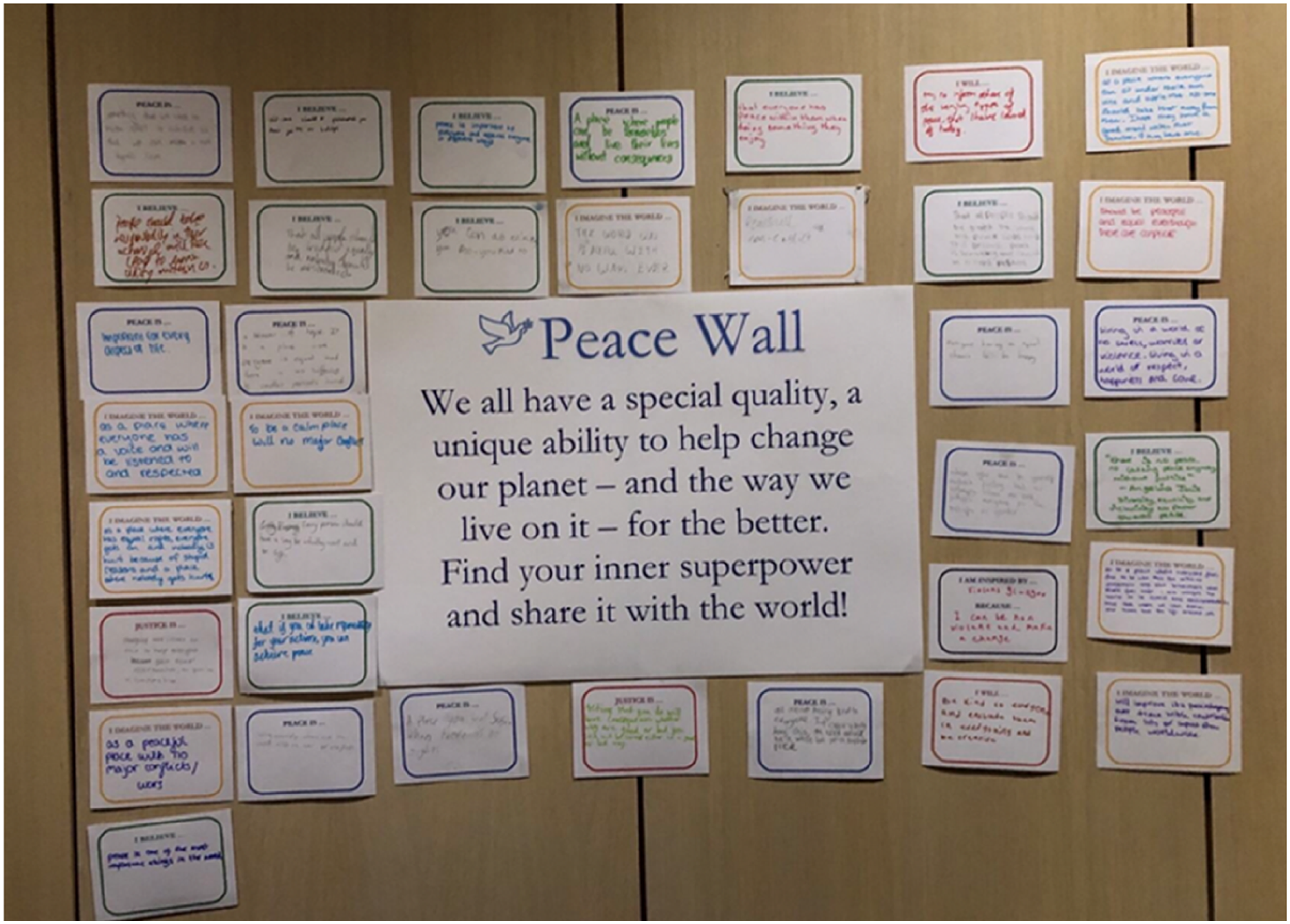
Data Analysis
The data analysis took place in two stages: analysis of the drawings and analysis of the prompts from the peace wall. In stage one, we analysed the drawings. All drawings were converted to electronic jpeg files. To analyse them, we adapted three approaches to the analysis of visual data: • Child-centred Personal Meaning Mapping (PMM) methodology (Bowker, 2007), • Visual content analytic procedures (VCAP) (Kalvaitis & Monhardt, 2012), and • Visual art coding scheme (VACS) (DiBartolomeo et al., 2015).
Elements for the Analysis Based on the Three Methods: PMM, VCAP, VACS.

Elements of Visual Analysis.

We recorded the element of ‘mastery’ if a young person included at least one element of positive peace. For this part, we used nine elements of positive peace to guide coding of the drawings that were developed by Standish and Joyce (2016, p. 70) and include:
• Peace zone – safe spaces where violence is absent
• Peace bond – positive relationships characterised by kindness and empathy
• Social justice – presence of fairness and/or equality
• Eco mind – harmonious living between humanity and nature
• Link mind – perception of interconnectivity and/or interdependence
• Gender mind – awareness of gender as an important facet to understanding
• Resilience – ability to absorb personal, social, or environmental calamity
• Wellbeing – health, wellness, and taking responsibility for self and/or others
• Prevention – knowing ways to stop violence before it starts
Example of Analysis of a Drawing.
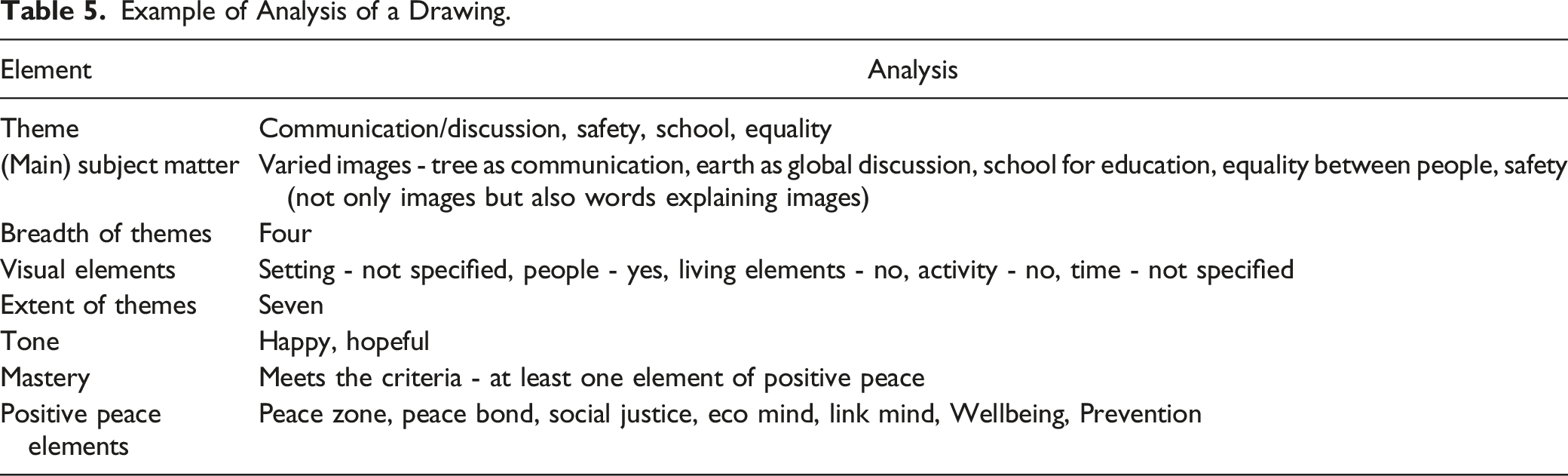

Example of a drawing (17-year-old).
Number of Positive Peace Elements.

Themes and Sub-themes From the Peace Wall.

To give an example of the analysis, we offer the following peace wall prompt response: I imagine the world to be a place where everyone feels free to be who they are without judgement and also somewhere where people feel safe. I also imagine the world to be diverse and environmentally safe and where we can care about our home and the life around us. (GA34)
Themes and Sub-themes Identified in a Prompt From the Peace Wall.

Discussion
This article offers a template outline, rich description, and reflection on the methodology we utilised to engage young people in Glasgow in conceptualisations of positive peace. We find three key contributions this arts based approach brings to a discussion of methodological insights: ways the approach addresses crises of legitimation, representation, and praxis in peace education research, how research methods align with democratic concepts foundational in peace education, and the normative validity gained through the voice of young people.
Cremin (2016) presented crises of legitimation, representation, and praxis in peace education research which arts based and reflective methods of this project respond. This project demonstrated a methodology in the field of peace education research that better ensures congruence with peace values, demonstrates reflexivity, and offers an opportunity to learn and a chance for taking action (Cremin, 2016, p. 12). The approach described in this project answers the call to rethink how data is captured and analysed in a field of study where sensitivity to process and outcomes is paramount. Instead of ruminating about questions of validity and reliability, the arts based format challenges researchers, as Ellis and Bochner (2000) contended, to embrace a renewed appreciation for personal experiences and to focus on assets within diversity and difference instead of pursuing similarity. Ellis and Bochner (2000) further challenged us in developing a methodology to consider ways to bring honesty and a sense of emotional reliability through a format that considers possible new ways of living in peace (p. 746).
Fundamentally, qualitative research is about how individuals make meaning (Merriam & Tisdell, 2016), and people do not express meaning only through their words and actions but also through creative expression. Traditional methods of data collection through words alone (e.g., interviews, surveys, and focus groups) are not considered as accessible to young people as they rely on fitting communication of ideas into adult ways of understanding (Walker et al., 2003, p. 192). These methods do not always allow youth to convey meaning and understanding as well as non-linguistic and visual language, thus an arts based approach has the potential to collect more in-depth and nuanced insights from young people. As Barone and Eisner (2012) noted, arts based research removes limits of discursive communication so meaning can be conveyed that could otherwise be inexpressible (p. 1). To this end, we chose an arts based approach because these creative processes can grant access to participants’ insights, feelings, and thoughts (Barraza, 1999).
The ways in which research is conducted, analysed, and communicated can contribute to, or limit, diverse forms of knowledge and diverse perspectives. We posit the arts based approach gains traction on different ways of knowing. In Reimagining our Futures Together: A New Social Contract for Education (UNESCO, 2021), a provocation was put forward for a new educational research agenda, one that considers students as “knowers” and acknowledges that “students are also important sources of knowledge and understanding about their own educational experiences, aspirations, achievements, and reflections” (p. 125). An arts based approach enabled researchers to act as facilitators and co-learners rather than experts, thus allowing participants to bring forward their own conceptualisations of peace in context. This addressed Cremin’s (2016) concern as an opportunity for alignment with peace values by bringing a greater congruence to the power dynamics of research, which can become imbalanced between researchers and participants.
The arts based method also addresses the observation that peace education research could better prioritize benefits to participants through their participation. As Cremin (2016) put forward, peace education research often fails to have an impact on the lives of those involved. As one objective of the approach was teaching participants about positive peace, the workshop format incorporated high-yield instructional strategies of effective learning experiences (e.g., templates, graphic organizers, small groups) (Marzano, 2017). The processes of the arts based workshop were thus designed not only to gather qualitative data from pupils, but also as an opportunity for learning, personal reflection, and to inspire commitment to change. This makes our approach critical in orientation as the results, “are meant to effect change in people by raising consciousness about the issues under study” (Merriam & Tisdell, 2016, p. 69). This research thus followed tenants of what Toews and Zehr (2003) titled ‘transformative enquiry’, a methodology aimed towards social action rather than only knowledge generation. This recognises that young people’s conceptualisations of peace are personal, inter-relational, and constructed. An invitation to reflect and share their voices addresses a perceived lack of impact.
We find this commitment to benefitting participants through chosen methods also aligns with the UNCRC (UNICEF, n.d). Article 12 contends that young people have the right to express their views, feelings, and wishes in matters which affect them and to have their views considered and taken seriously. Sadly, youth are often portrayed as passive, lazy, self-obsessed, and disinterested. As researchers, we are prone to neglect barriers that prevent young peoples’ constructive engagement with global challenges and their potential to make a change. This project created a platform to share views with their peers, therefore creating a space for young people to set their own framings of peace and their own commitments for action. The approach enhanced youth engagement, participation, and decision-making, ultimately making small advances towards the larger aim of building and sustaining a more just, peaceful, and resilient society through research. Valuing people and their voices is considered an essential feature of Scottish education, one that was upheld in this project through listening to youth voices (Scottish Government, 2023). In doing so, we have made an attempt to democratise knowledge production.
The unfortunate reality remains that youth are experiencing worsening violence in schools, conflict between groups, and increased inequality through social segregation of schools, even though the United Kingdom (UK) maintains a high score of positive peace ranking 18 in the world (Institute for Economics & Peace, 2022). This emphasises the important voice young people must have in peace education research, where methods have not always enabled young people to share their experiences or ways of knowing. The arts based approach thus demonstrates a democratisation of knowledge production that teaches what peace education might mean in post-modern times, recognising there are potentially ‘many peaces’ to represent. It could be argued that education for positive peace needs to work through young people to be effective; without their active participation there really is no education taking place.
A further key contribution of this arts based approach is representation of what young people value related to peace education, otherwise conceptualised as normative validity (Biesta, 2020). While empirical design methods in social research most often speak to construct validity, content validity, internal validity, or external validity (Kidder & Judd, 1986), through an arts based approach we bring forward attention to normative validity, the alternative consideration of whether what is being studied actually represents what is valued. As Biesta (2013) noted, often in educational research what can easily be measured is valued which tends to leave out more challenging aspects of research in contemporary education. In a research environment where empirical evidence and a “what works” approach prevails, finding out what young people value about peace is difficult; youth are considered a vulnerable population and a time-intensive arts based, qualitative data collection approach is often not preferred, especially given the ‘pseudo-security of numbers’ (Biesta, 2020, p. 102). An asset of the arts based approach is capturing what a group of young people identify as desirable and what ought to be. The themes and sub-themes that emerged from the reflective peace wall (see Table 7) begin to formulate normative validity of positive peace for these young people in Glasgow at this particular point in time. The project uncovered meaning of the phenomenon of positive peace for those involved, a key aim of qualitative research (Merriam & Tisdell, 2016).
Limitations and Future Research
This project engaged with a small group of youth participants from three schools in Glasgow, representing two areas of the city, (a wealthy area and a disadvantaged and marginalised area). A larger sample size from other parts of the city, including areas that are even more deprived and less safe compared to the areas some of our participants came from, could have yielded different results. Future research may move to those areas to seek other perspectives on how young people understand peace, what they envision as peaceful society, and what their commitments to peace are.
We could not understand the handwriting of some of our participants which prevented us from analysing their written notes taken during the peace data walk. Neither did we make notes of their conversations during drawing. Future research may consider including analysis of written notes and conversation and decisions of participants during the art creation. This can be done through interviews in particular as they will allow to dive deeper into particular elements each participant included, ask follow-up questions during the reflection and drawing phases, and make inquiries about any unclear words in participants’ writing.
Due to exploration of alternative data collection methods and the desire to capture participants’ voices through non - linguistic modes, we did not conduct individual interviews or group discussions with youth participants. However, in future work we see interviews, group discussions, or even participatory analysis as important steps to consider as they could help us develop a more in - depth and nuanced understanding of the drawings. In particular, as Kearney and Hyle (2004) note, drawings are “a catalyst for unstructured interviews” that offer participants an “opportunity to frame their own experiences, unencumbered by our biases” (p. 362). In combination, they have a potential to offer rich and in-depth insights. This combination would also align with Freirean critical pedagogy that views dialogue as a key to emancipation, equality, and collaboratively deepening understanding about and transforming the world (Freire, 1970).
Conclusion
This project exemplifies a greater synergism between research methods and aspirations towards positive peace. An arts based approach helped capture what young people value and exemplified how we might go about identifying it. This project thus contributes to the body of literature on creative and arts based methods as well as how to actively engage young people while also building and strengthening their topical knowledge.
Supplemental Material
Supplemental Material - Engaging Young People in Peace Education Research: Using an Arts Based Approach to Gain Congruence through Democratic Methods
Supplemental Material for Engaging Young People in Peace Education Research: Using an Arts Based Approach to Gain Congruence through Democratic Methods by Sarah K. Anderson and Yulia Nesterova in International Journal of Qualitative Methods.
Footnotes
Declaration of Conflicting Interests
The author(s) declared no potential conflicts of interest with respect to the research, authorship, and/or publication of this article.
Funding
The author(s) disclosed receipt of the following financial support for the research, authorship, and/or publication of this article: This work was supported by the Open Access funding was provided by the University of Glasgow.

Supplemental Material
Supplemental material for this article is available online.
References
Supplementary Material
Please find the following supplemental material available below.
For Open Access articles published under a Creative Commons License, all supplemental material carries the same license as the article it is associated with.
For non-Open Access articles published, all supplemental material carries a non-exclusive license, and permission requests for re-use of supplemental material or any part of supplemental material shall be sent directly to the copyright owner as specified in the copyright notice associated with the article.
