




Abstract
Visual methodology is a process that enables empowerment and collaboration and challenges power dynamics in research studies, including those involving vulnerable populations. Across interdisciplinary fields, visual methods are known to capture processes of reflection, such as photovoice in criminology, photo-elicitation in sociology, portraiture in education, and photo novella in other social sciences. These fields move research toward participatory reflexive methods. However, less research documents how visual methodologies promote healing by encouraging participants in studies to engage in vulnerability within and beyond the research. Drawing on a decolonial feminist approach and a decade of research on Latina women’s experiences with violence, I explain how visual methods can be effectively utilized with vulnerable groups. I describe the ways that visual methods expand on healing-centered research and praxis, particularly in studies of criminalized women. These methods promote healing through Reflexive Vulnerability which includes methodological practices of (1) nonlinear reflection (2) creation of safe spaces and (3) reciprocity. It complicates the objective nature of detachment in scientific research, and brings forth the interconnection of science and spirituality. Through this process, emotions of nostalgia, shame, guilt, sadness and hope reveal the importance of centering emotions in vulnerable research studies. This vulnerability opens up possibilities for healing from state, interpersonal, and intergenerational violence.
“Stories go in circles. They don’t go in straight lines. It helps if you listen in circles because there are stories inside and between stories, and finding your way through them is as easy and as hard as finding your way home. Part of finding is getting lost, and when you are lost, you start to open up and listen” (Tafoya, 1995; 12)
Introduction
Telling stories and bearing witness to other people’s stories have been historical methods of resistance, healing, and safeguarding knowledge and cultures (Carranza, 2021). To employ a healing-centered method of storytelling, one must get lost in the process of unlearning and learning (Palagana et al., 2017), while engaging with vulnerability and pain (Saraswati, 2023). This occurred when I interviewed Guadalupe, and a year later she tragically passed away. In 2018, I wrote: “…I spoke to her about re-interviewing her for my doctoral study, and she agreed. Tragically, this never happened, as Guadalupe was shot and experienced an untimely death at the hands of her partner. Guadalupe’s story and images remind us that a researcher can only capture and create meaning about a specific time and place (Maldonado, 2018: 243).
Guadalupe’s passing was one of four tragic losses I experienced within a single year, all involving friends who were mothers. This pain underscored an early lesson for my research journey, finding myself grappling with personal vulnerability—a realization that vulnerable contexts were the foundation of my work. This context was also a microcosm of colonial structures where criminalized women, and their children could be taken away through death, prison, overdose, or psychosis. While much scholarship offers rich assessment of research with vulnerable populations (Benzon & Blerk, 2017; Rouf, 2004), and ethical considerations (Van Damme, 2019), less work shows how vulnerability as a space and practice requires reciprocal relationship-building, where healing possibilities coexists with violence and grief.
In honor of what grief and my study participants’ stories have taught me over the past decade, I center vulnerability, love, and healing as major component of the research process with criminalized women. Photo-elicitation’s storytelling through images enabled me to bridge the gap between vulnerability and the ‘glimpse of healing’ I observed in my research. While reflexivity reveals multiple layers of consciousness (Dowling, 2006), vulnerability serves as the context in which harm is produced and felt. Luna (2009:128) argues that viewing vulnerability as layered allows for a more nuanced analysis of research contexts, as each layer reflects aspects of a participant’s specific circumstances, where there “might be different vulnerabilities, different layers operating”. I argue, vulnerability is both personal and structural. The personal can serve as a gateway to engage with pain and make social meaning, but the structural is also the place where wounds produce vulnerable populations. For this reason, I conceptualize the methodological tool of reflexive vulnerability (RV) as a form of epistemic disobedience (Mignolo, 2007) where emotions are at the core of scientific inquiry. As McKiitrick (2021) notes, disobedient methods are guided by curiosity; this idea is echoed in her chapter “my heart makes my head swim” in which she argues that scientifically creative projects help us address scientific racism and engage in the physiological work of liberation. Thus, reflexive vulnerability is a concept, a story, a method, and process that encompass the role of uncovering consciousness through emotion.
To challenge Western rationality and its detachment from the embodied role of emotions in scientific inquiry, I build on epistemic disobedience to develop a methodological tool that bridges emotion as both embodied and conceptual. The nurturance required to be vulnerable in research spaces demands an integration of spirituality, science, and emotion in knowledge production. Peck (2003), in his work on spiritual growth says that methodology and measurement has become a scientific idol where forces that cannot be measured are excluded as intangible. Because healing and vulnerability are not often captured, and because the logic of coloniality –ongoing structures of colonial power– affects all processes of knowledge production (Mignolo, 2007), researchers may lose sight of the healing by vulnerable populations. In order to challenge this, I must acknowledge my own role as a researcher and a lifelong community member of Southern California. My studies on violence and resistance with mothers has been deeply shaped by personal experiences of interpersonal violence, addictions, and grief. While I carry certain privileges as an “educated mother” for instance, I also exist within a body politic of violence, one that has left me in states of psychosis. Writing this is itself an act of vulnerability, as I attempt to make sense of the violence I have witnessed, survived, and what has been mirrored to me through others’ stories. As a woman and writer, who has also found spaces of healing, joy, and pleasure, I offer this work not as a claim to the “right” way to do research, but as a reflection on what it means to be wounded and healing in the face of crisis.
I turn to feminist scholarship that has long challenged the binaries separating emotion from reason, body from mind, and self from society (Lara, 2002). Feminist scholars call for moving beyond binary oppositions, such as rationality vs. non-rationality and objectivity vs. subjectivity, to account for the affective and relational dynamics embedded in research, including emotions like guilt and shame (Bondi, 2005; Chodorow, 1999; Hochschild, 1983). Building from the sociology of emotions, I understand emotions as embodied and socially situated, emerging through cultural, relational, and lived engagements (Williams & Bendelow, 1997). Studies highlight the importance of understanding human experience as shaped by both the body and social environment, while also recognizing the key role of our nervous system in how we feel and respond (Andrade, 2019; Damasio, 2005). As Ahmed (2004: 30) writes, emotions move between bodies, mediating the “psychic and the social, the individual and the collective” revealing reflexive vulnerability as a “contact zone of impressions” within the research process.
Utilizing a method that partially captured the complexities of the lives of criminalized women invites me to ask: what is the healing potential of visual methodologies with vulnerable research participants? This question motivated my use of visual methods and created pathways to conduct collaborative research. As illustrated in Guadalupe’s story, the passage of a year profoundly transformed the realities she, her family, and her community experienced. She was shot and killed around the corner from where my parents live—where I grew up—and that space, too, has been reshaped by the vulnerability we all experienced through her death. This transformation highlights the vulnerability shared by both researcher and participant, embodying what Johnson-Hanks (2002) terms a vital conjuncture—an ‘experiential knot’ where potential futures are contested, and elements of life history are neither stable nor coherent but instead shaped by dynamic relationships that vary in timing and pace. For this reason, the intentionality behind researchers’ choice of method in vulnerable situations is crucial for fostering a relational process rooted in an ‘ethic of interconnectedness,’ ultimately working toward social change.
This paper contributes to ongoing conversations about ethical and emotional research by foregrounding the role of emotion in research with vulnerable populations. I draw from decolonial feminist methodologies to develop reflective tools and outline their specific contributions through the concept of Reflexive Vulnerability—a framework for qualitative research that centers (1) the creation of safe spaces, (2) nonlinear reflection, and (3) reciprocity. Drawing on findings from my own research, I illustrate how these components make visible complex emotional experiences such as nostalgia, shame, guilt, sadness, and hope.
Visual Method Background
Participatory photography and visual methods have existed in various research settings under different names: portraiture in Education (Chapman, 2005), photovoice in Criminology (Fitzgibbon & Stengel, 2017), and photo elicitation in Sociology (Clark-Ibañez, 2004). Studies in different fields have engaged with this method. For example, anthropologists investigating culture of proletariat mothers in Peru (Bunster, 1978), sociologists investigating inner city children’s social life in Los Angeles (Clark Ibañez 2004Clark-Ibañez, 2004), public health scholars examining immigrant health outcomes in Canada (Haque and Eng 2009), criminologists shedding light to mass incarceration in the U.S. (Brown, 2014), and broadly social scientists and humanities scholars who engage with community based participatory action research, pedagogy and other fields (Dmello and Kras 2021; Glaw et al., 2017). Evaluations of visual methodologies have found that they enhance the richness of data and strengthen the relationship between researcher and participant (Pain, 2012). As healing research methodologies, they include reflexivity, emotion, and intersectionality, through frameworks like liberation psychology (Lee et al., 2021), grounded in ethical principles such as respect, responsibility, and reciprocity. Others draw on healing justice, a global and emergent political framework that addresses intergenerational harm where healing is understood as “a means rather than an end” (Shaw et al., 2022, p. 36). Despite the widespread use of visual methods globally and the central role of testimonio in shaping the meaning-making process through cultural intuition, history and memory (Delgado Bernal 1998), we know surprisingly little about how to effectively engage with vulnerable contexts as qualitative researchers.
Decolonial Feminist Approach
Academics were instruments of capitalism and enablers of exploitative colonialism, making them complicit in nation-building projects rooted in white supremacy (Cesaire, 1950). Unlearning and redefining how we create, generate, and value knowledge is essential to decolonizing research (Udah, 2024). Because decolonization is a ‘history-making movement which gives form and substance’ (Fanon, 1963, p. 2), then the methods utilized to respond to dehumanization must be part of archiving vulnerability as a form of history. The process of self-reflection embedded within testimonio, and visual methodology offers opportunities to center the emotional aspects of data collection, not just symbolically (Tuck and Yang 2012) but actively challenging the patriarchal settler colonial structures. The responsibility to be self-reflective is an ever-evolving tool, one that invites us to “embody practices of decolonization not only in research but as an overarching life praxis” (Fortier, 2017). A dimension of this process “calls upon the act of listening as a symbol for healing wounds of colonialism” (Barreiros & Moreira, 2020) where vulnerability becomes an act of resistance. And if the act of listening is an act of love, a love-centered hooksian approach then commits love as an active choice that is embedded within research (Washington, 2024; hooks 1984).
A decolonial feminist method is not abstract; it is active, constantly uncovering experience through reflexive vulnerability. As Saleh-Hanna, 2023:10 notes, “time does not heal all wounds. What happens with time, what we are able to abolish and remove in our time – within our lifetimes – will begin the healing we so desperately need. Freedom. Decolonization. Indigenization. Balance. Ma’at.” Therefore, what scholars do with the time offered in spaces of interdependent vulnerability becomes a doorway to the glimpse of healing we bear witness to.
Contributions of Reflexive Vulnerability

The Methodological Process
IRB Approval
Methodological Summary

Recruitment
The studies were based in Southern California (SoCal), primarily Los Angeles and the Inland Empire. Participants in the studies included biological and other mothers, including those who identified as having non-binary gender. As a researcher, I had the gift of proximity (Miller, 2021) in that I too am a Latina mother from SoCal who has experienced criminalization. Thus, I was able to easily recruit participants soon after sharing information about my research via a recruitment flyer distributed to members of my social network. I employed purposive sampling and snowball sampling (Sherraden and Barrera 1995). When interested mothers saw the flyer, they contacted me by email, phone or text and we scheduled a time to meet. Meetings typically occurred in their home, in a public coffee shop, or an organization.
Before Conducting an Interview
Before each interview, I provided participants with a consent form, obtained verbal or written consent, accommodated preferences for non-audio-recorded interviews by taking memo notes, transcribed audio recordings using Otter and Trint on my personal computer, ensured transcripts in Spanish and English were reviewed with my research team, and assigned pseudonyms to protect participants’ identities with files securely stored under those names. For my first two studies I did not realize the emotional labor it would take to conduct these types of interviews and did not have the tools or experience to emotionally prepare myself prior to the conversations with mothers. After completing my second study, due to personal traumas, I engaged in three years of healing work and trainings to better prepare for further research. In the later studies, I often meditated or engaged in physical activity prior to an interview. This practice allowed me to prepare for the stories I would hear and participate in reflexive vulnerability.
Interview Process through an ‘Ethics of Care’
The entire interview process was guided by what Collins (2000) suggests: “talking with the heart taps the ethic of caring” (262). Participants were supported through a process grounded in care, creativity, and agency. They selected the photographs they wished to share and signed consent forms specifying whether and how their images could be used in publications. This approach created a non-threatening space for expression (Wang, 2024) allowing participants to engage on their own terms. Requests to obscure identifying features (e.g., gang signs) were honored, and pseudonyms were used throughout. Anonymity in visual data was offered through options such as angled or partially framed photographs; however, all participants opted to have their images shared as taken, often to reclaim and contextualize their stories. Visual images can capture moments in life and specific events, and testimonios can contextualize details of experiences that the photos may not convey. Thus, while the mothers had conversations about the photos in the interviews, I also probed with open-ended questions from an interview protocol on childhood, violence, family, and interactions with institutions that brought forth a photo-elicitation testimonio.
To minimize retraumatization, I did not explicitly ask mothers to recount traumatic events. When trauma surfaced organically, my questions invited a caring, non-invasive approach to vulnerability, using the photographs as an anchor for reflection and storytelling. This approach was guided by an ethics of care, which emphasizes relational accountability, embodiment, and context-specific actions over abstract ethical rules (Groenhout, 2004; Wang, 2024). I developed relationships with women across time and space, meaning that some I had known since growing up in Los Angeles, while others I met during the course of my research across Southern California. Many of the women did not know each other, except when they were referred through shared networks such as rehabilitation centers, where bonds had already formed through collective experiences of incarceration or addiction. While some participants I had known for years, others I met only once during the interview process. Even in brief encounters, a shared emotional understanding, particularly around family separation created the conditions for connection. The temporal elements of this research were not defined by how long it took to build trust, but rather by the quality of relational connection at each point. I recognize that trust often requires time, but my experience challenges the notion that extended duration is the only, or even the primary measure of depth in qualitative research. In visual storytelling, time and space become blurred, narratives unfold in nonlinear ways, and shared vulnerability can collapse temporal distance. Participants’ wellbeing remained central throughout the process. I followed up after interviews and encouraged the use of self-identified support systems (e.g., therapy, church, community). At the end of the interviews, I offered to assist the participants in breathwork with essential oils. We held hands and hugged after crying and laughing through the interviews. We held space for each other as long as we needed.
In the interviews some mothers began by talking about the oldest photos and ended talking about the most recent ones. Others chose random orders as I probed about their life. For example, if they were talking about an incident that occurred in their childhood, and there was a memory triggered in that moment, they would share another photo to that related to that experience. The photos included children, family, significant locations (e.g., neighborhoods, car shows, prisons, parks), artwork (e.g., drawings by children or incarcerated individuals), legal documents, and books (e.g., poetry, the Bible). Most photos were sent via text, and I photographed physical copies to maintain an electronic record under pseudonyms. Participants also signed a separate photo consent form for use in research outputs.
Bearing Witness to Vulnerability
The photographs triggered painful memories, such as of deaths, and beautiful memories, such as of regaining child custody. I saw mothers reminisce about their trauma associated with rape and drug use and worry about their children and court dates. I saw them laugh about the present and hope for the future. As women who experience “feminine emotional distress” or the various emotions connected to suffering in the context of oppression, they are able to alter their lives as social subjects but also those around them (Rosas, 2009). Sharing photographs and intimate parts of themselves, sorrows of loss, the transformations, the drug relapse, the paranoia, all of it, form part of the vulnerable context.
Reflexive Vulnerability
As an insider researcher who understood child removal, domestic violence, drug addiction, psychotic states, and death, from personal experiences and not simply theoretical, but real in the consequences they produced; over the process of un/learning I began to center vulnerability as a methodological instrument. I therefore, bridge the practice of vulnerability to make reflexivity reach beyond inward reflections, and into the interconnectedness of data collection. Reflexive vulnerability is a process in which deep emotional reflection becomes a methodological pathway to understand, complicate, and be part of the vulnerable contexts. This practice is boundless, occurs organically, is led by emotional-spiritual experience, and informs meaning making processes of social suffering and transformation. Reflexive vulnerability is not transactional, but rather insightful of people’s inner and outer worlds that helps us understand larger patterns of violence, inequality, and healing.
Reflexive vulnerability includes practices of (1) nonlinear reflection (2) safe spaces and (3) reciprocity. Figure 1 illustrates the conceptual model through a series of concentric, interrelated circles. Each circle represents a key dimension of the methodological and epistemological process. The outer circle reflects time, a recognition that healing, reflection, and testimonios unfold over time, including across multiple encounters and stages of research. The second circle represents the nonlinearity of reflection and storytelling, emphasizing that emotional insight and reflexive understanding do not follow a linear path, but emerge through layered and repeated processes. The third circle signals the spaces created methodologically, both literal and relational, that enable participants and researchers to engage in vulnerability. The fourth circle focuses on the reciprocal interactions and material outcomes of these processes, such as co-constructed meaning, emotional shifts, or visual/narrative outputs. At the center is vulnerable healing and spirituality, the inner circle that holds the possibility of transformation through embodied connection, spiritual reflection, and collective meaning-making. These layers are not hierarchical or mutually exclusive; rather, they are interdependent and coexist to make ethical and relational research possible. Drawing from a women of color tradition, spirituality and healing are vital components of this process, particularly for participants whose survival and resistance are shaped by faith, ritual, or collective care. Scholars such as Anzaldúa (2015) and Collins (2000) have emphasized the transformative power of spiritual knowledge, arguing that spirituality can open up spaces for resistance and build ‘alternative epistemologies’. While this model emerged through visual methodologies, it is not limited to them. RV can be applied across qualitative methods and scientific studies that are committed to emotional, relational, and ethical accountability. The following sections offer the how to engage with reflexive vulnerability practically, in the research process. Dimensions of Reflexive Vulnerability
Creating Safe Spaces
Researchers note that creative methods in research such as writing, poetry and arts can serve as an emotional safety valve (Mazza, 2009) where unconscious thoughts and difficult feelings create a bridge between what happens on the inside of a person, to echo collective life (Sinding et al., 2014). But how do we create this emotional safety valve? If in the heart, four valves open and close to help blood flow, then for the emotional safety valve in this context, what helps the safety flow? For the heart, the valves are the essential mechanism helping blood flow smoothly, if it doesn’t then the heart cannot pump blood to the body. For people, if we don’t focus on the emotional safety valve, the social-emotional experience can be narrow and or closed to feel okay to share, make meaning, and experience healing.
Giving the space to let mothers share the photographs and visuals that they wanted to share was one of the first steps in creating a safe space. Not dictating what they could or could not share gave the space the flexibility of moving in the direction they wanted to. Below I list what “safe spaces” in the emotional safety valve of photo-elicitation testimonios entail. 1) A safe space in research is a physical space in which stories can be shared without judgement, without fears or threats of any kind but also a space in which participant can share. For the most part this occurs in the home, for those whose homes carry triggers it may be a public space, or organization. 2) A spiritual space that acknowledges the pains embedded within the storytelling process and the forces they call for support. This space acknowledges that participants carry spiritual wisdom of their own, and we are not here to disregard if they lean on God or not, but only make meaning. 3) A mental space that gives room for mothers to contextualize and reflect on their story in the way they choose to, at that moment of their life. This space brings opportunity to let the story flow at the capacity that they can share stories. Sometimes the mental capacity allows for brief storytelling about an image or experience, others offer extensive engagement, all are okay. 4) An emotional space that honors the grief, laughter, tears, and rage shared during the process. This is where vulnerability becomes center. 5) A humble space, that allows for researcher to listen carefully without interrupting the flow of the points of the story that are important to the people. Here, researchers become listeners, researcher is not at the center, we are just those who have the privilege to document. Creating a safe space moves into a compassionate state, where the only intention of that moment is to make others feel seen and heard without an attempt to intellectualize anything but simply listen to understand. 6) A familial space where mothers and their families and children feel comfortable to open up to you, to feel like a familial sense of safety. For many who came from violent homes where safety wasn’t provided, this familial space is meant to recreate meanings of connection.
Audre, Native American Latina mother of two from South Central Los Angeles, approached me at an organization and said “Hey! I heard you’re writing a book about homegirls in CPS.” I said yes. She said, “I want to share my story with you.” We met the next day, and she shared with me photos on her phone. Even before the recorder went on, Audre started sharing about her life. She pointed to a photo of her son (Figure 2) and said, “You see this right here? I’m still grieving. So what I tell you right now is how I feel today because a year ago, I would not be able to talk.” She explained that she was unhoused at the time of her son’s birth. A week after the birth, the shelter in which she resided shut down due to health conditions and Audre and her sons were transferred to a new shelter. After they moved, when her son was three months old, he died in his sleep. The cause of death was originally said to be sudden infant death syndrome, but later Audre was told it was Rhinovirus. She said, “I mean, we were homeless for two years. My (other) kid, my three-year-old now, he was with me throughout the whole time. We had the case open and they did drug test us and stuff like that. So it was, I think, more of a tragedy at the end because I had my second son while I was in the shelter and he passed away.” When she started sharing that her son’s death was related to being in a shelter that did not meet the health conditions for people to live in, she emotionally broke down. I broke down too. The strong tone with which she started the interview disappeared and was replaced by tears. I listened as the tears flowed. Audre contextualized her son’s death and her CPS cases as stemming from her smoking marijuana to address stomach issues that suppressed her appetite. Although her CPS cases were not open long, she questioned why the system would think that her marijuana smoking was more damaging than her shelter housing. Audre’s Deceased Son
Throughout the interview and sharing of pictures and videos, Audre commented that the “wound is still fresh”. The mental, emotional, spiritual space she was in when her son passed away became a focal point of her story. The images she shared related to the grief and healing she experienced, and the community and family pictures she shared were connected to her future aspirations about teaching other people about the process of grief. She offered a glimpse of healing when she talked about everything as a process with her husband, family, and community: “But my healing, I can say that I’m still processing it, it’ll take time. That wound is still fresh for sure.”
The spaces in Audre’s story were connected to safety: “is it safe to share that I am still grieving?” “is it safe to go back to visit the place where my son is buried?” “is it safe to share that I wanted to die after he died?” and “is it safe to share that I needed help?” These questions that came up for Audre indirectly connected to the space the interview created for her to share. As I listened carefully, Audre shared more deeply.
There are questions researchers can ask after listening in an interview and when writing results: is it safe for me the researcher to share this information? What meaning does this bring and through what lens? Often, when we choose methods, they inform how safe we will feel to write about it, for some scholars, it’s because this work is very sacred; so not everything in one’s dataset should be shared. For other scholars it’s a safety concern to share stories from vulnerable groups – for example, sharing info about gang members may jeopardize some people’s lives. Regardless, social scientists who do research with vulnerable people must think about safety in all processes of research study, not solely for “institutional protection” but more deeply, for the social meaning we make from being able to develop safe spaces in our work. It is also important to acknowledge the risks involved in navigating safety (physical, emotional, and ethical) throughout the research process. Safety is not guaranteed by the setting alone, but requires the application of situated ethical practice (Shaw, 2020).
Nonlinear Reflection
Ethnographers have described the importance of understanding methodology through a nonlinear dynamic system (Agar, 2004). This system considers how initial study conditions can shift, researchers form part of the data, and representations are intersubjective. When conducting qualitative research, there is no ‘one way’ of storytelling. Some study participants like to reflect on life chronologically, in the order of events that became “turning points,” whether positive or negative, for them. Other participants like to go from the present to the past. And still other people tell stories that are like scattered puzzle pieces, going back and forth in time.
I often work with grieving mothers who have lost their loved ones in various ways: mothers who lost custody of their children through CPS, migrant mothers who have left children behind in Central America, formerly incarcerated mothers who lost time with their kids, and gang-affiliated mothers who have lost their partners to prison and death. In my studies these mothers reflect on the past and these nonlinear reflections involve nostalgia. Saunders-Hasting (2019), who examines the relations between violence, nostalgia, and insecurity in Guatemala, notes that engaging with nostalgia ethnographically involves more than simply extracting it from the data to uncover the “true” story or an untainted past. It also involves a nuanced exploration of the layers through which nostalgic stories address the past, the present, and processes of change. In a similar way, my research documents the shifting understandings of grieving mothers, and facilitate the mothers’ emotional capacity to be vulnerable and share their stories through photographs. Nostalgia forms part of the reflexive vulnerability applied in qualitative research, where researchers hold space to the nonlinearity of the testimonios.
Shame and Guilt
In my studies Latina mothers who have used drugs acknowledge their shame and guilt through their photographs. Alicia, Guatemalan mother of Carlitos, shared in her interview that she was two weeks away from regaining custody of her son. Then, she shared about her migration from Guatemala, and ended her story with details about her childhood. Her discussion of her photographs evoked feelings of guilt and shame in her.
Alicia shared a photograph (not shown here), describing how her hair was short, and she had acne because she shaved her head when she was going through her drug crisis. She said, “I put the car on fire and shaved my head. I didn’t even know what I did when I woke up at the psych ward.” Although she felt shame and guilt for her drug use while mothering, she compared the way she was accountable for her actions today to the way she was accountable in the past. She acknowledged that as a person with an addictive disorder, the urge to use drugs comes and goes, but at the same time, the opportunity to be next to her son now brings her a glimpse of healing, something she does not take for granted. In Figure 3, she shared that all the “little things” matter to her, like taking her son to the park and hiking often. Being able to be present for her son in spite of her thoughts of relapsing and her ongoing recovery. She explained, while revealing nostalgic emotion, that when there is a possibility of losing oneself (mentally) and one’s children (to the state), a few hours at the park with one’s child are much more than a pleasant outing. For a criminalized mother, connecting to land and children provides hope for becoming a better mother and healing from the past. Alicia Hiking With Her Son
Criminalized mothers contend with shame and guilt. In a research interview they reflect on the shame imposed by the state, the shame they felt about their own behaviors while in crisis, and the guilt they felt for what they put their children through. The nostalgic feelings expressed in the interview reveal not only places mothers “wish they could be” but also places they wish they’d never been to – for example, for Alicia, rehabilitation and psychiatric facilities. The non-linear reflection allows women to be vulnerable and express these emotions. Photos hold the space in the memories of mothers, in their bodies and spirits to understand that shame and guilt is not all they have; their photos tell a story of all they have been and are yet to become.
Sadness, Connection, and Hope
The formerly incarcerated mothers in my studies teach us about the nonlinear reflection that happens in storytelling through photographs. Take as another example Genesis, a mother of four children who served eight years in prison. I arrived to the halfway house where Genesis was living on a Tuesday morning. Genesis had already informed the house staff that a researcher would come to conduct an interview. I signed the necessary paperwork to enable the interview. Genesis saw me and grabbed her backpack with photographs. She said “I have a lot I want to share; so I am just going to grab them all.” We walked to Farmer Boys restaurant to have lunch and talk. Genesis had been released from prison for three months. She often reminded me that the photographs were for her like gold, all that kept her sane while she was inside. Her “property” went with her everywhere, and every time she received new pictures from her children, she placed them in her personal archive.
When we started the interview, Genesis pulled her photos from her backpack and began describing her them (Figure 4, taken with permission by me). She said, “Look. These are my beautiful daughters. They were 8 and 10 here. My son was 10 here; he’s 17 now.” She would flash through the photographs as she was flashing through memories in places she had not physically been. “My daughters started using makeup here, they told me over the phone. Then now they have little boyfriends that I don’t like.” I asked about her relationship with her children before and during incarceration, as compared to today. Genesis responded that it was difficult because she did her prison term in Texas; so, she seldom got any visits from anyone. This made the photographs a tool of both sadness and connection. Genesis’s Photos Shared During Interview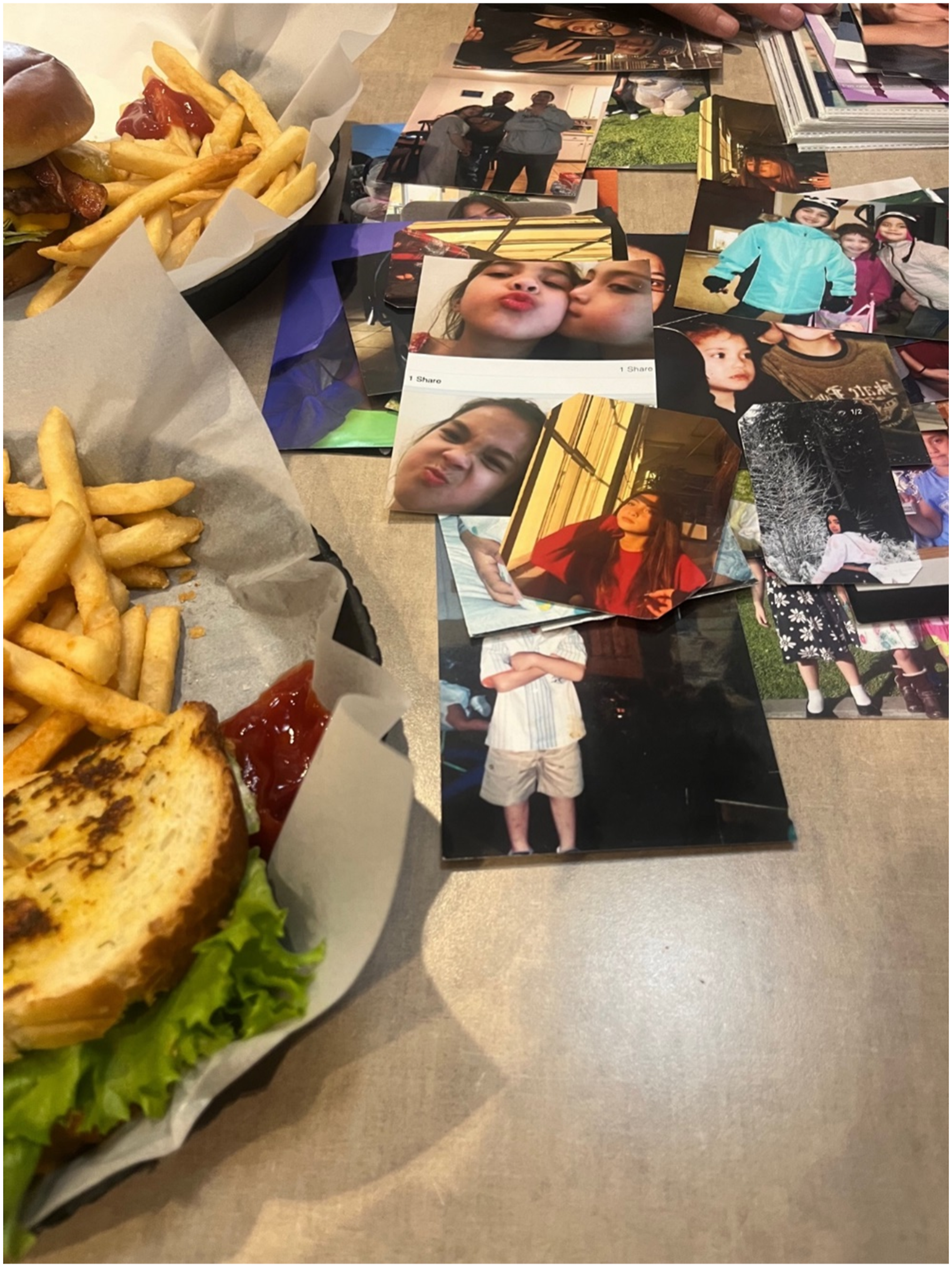
When formerly incarcerated mothers utilize photographs to tell their story, they talk about their feelings of sadness, sometimes even depression or previous depression states. But photographs in women’s lives and in the research interviews were a method of connection, a method of hope to reunite with loved ones again. Critical moments where she wanted to be there, all she could hold onto where photographs that kept her connected. The nonlinear reflection here allowed her to apply this reflexive vulnerability in ways she accepted that her relationship with her daughters was not the best. Her photographs though, bring meaning to the sadness and hope she carries.
Reciprocity
Reciprocity in research, particularly within insider-outsider dynamics, carries both challenges and transformative potential. It builds capacity for relationship-building through transformative praxis (Thambinathan & Kinsella, 2021) where communities resource the researcher just as the researcher supports them. While scholars have noted the tensions inherent in reciprocity, strong relationships often shape the research itself (Carranza, 2024). Lagunas (2019) describes how the question of being a “good researcher” can take a back seat to meeting the immediate needs of one’s community. Others have emphasized reciprocity as a vital social process in community mental health (Maiter et al., 2008) and a core aspect of healing in many cultures (Kleinman, 1995). As a mother participating in health research, I often found myself moving between roles, witnessing and sharing in the struggles of other mothers, while also carving pathways to healing within and beyond the research space. The point is not to praise “academic service” or argue that research can be “non-extractive.” Rather, it is to state that reciprocity in the research process can deepen human connections and learning about social conditions. In vulnerable research contexts, reciprocity becomes the way that connection is built, not just through the research process, but as a mechanism to disrupt power dynamics and produce material outcomes for vulnerable groups.
On a Tuesday afternoon, I completed an interview with Sarita, a migrant Guatemalan mother who lost her two children to adoption. Sarita walked me out of her home and said, “You have a huge responsibility now. With our stories you will be able to do something more. You are going against a corrupt system and that is not easy, but you have a purpose, and God will bless your work.” I responded, Thank you. I will do my best to raise awareness. It will take me time, but for now, if you need anything, please reach out.
This exchange stuck with me. I stayed in the car for 20 minutes, meditating on Sarita’s comment and everything I heard during her interview during which we cried a lot. I had to pause and reflect on what I should do after hearing her story of the adoption of her children. These moments reminded me to question how vulnerability in research can create a disruptive space where emotions drive reciprocal relationships and a deeper sense of being.
My reciprocal relationship with Sarita began with the types of visual images Sarita shared with me. Many of them were legal documents from her CPS case: the documents she provided to the court, court transcripts, medical records, and more. They were in English, though Sarita primarily spoke Spanish. Due to the language barrier, Sarita expressed hopelessness because through the CPS case processing, she was uninformed of many decisions. Reviewing the documents together in the interview evoked in Sarita feelings of nostalgia and hope; she felt relief knowing that there was an opportunity to reunite with her children after they turned 18. Figure 5 shows the documents Sarita shared with me. At the bottom of the image is an award given to one of her children, which Sarita described as evidence of how well her children were doing prior to their removal by CPS. By showing the legal paperwork and the awards to her children, Sarita discussed both the injustices she experienced and the pre-removal relationship she had with her children. I offered my own interpretation of the legal paperwork to help her understand the court order terminating her parental rights. Personally, I found the court transcripts disturbing because they revealed that Sarita’s voice was minimized in the removal proceedings. My feelings of injustice allowed me to connect with Sarita as a mother first, and as a researcher second. Documents Shared During Interview
While my role as a researcher is not to intervene or act as an expert in the field of child welfare—in this case, regarding adoption laws—my engagement in reflexive vulnerability enabled me to listen to stories, facilitated by visual images, and provide practical assistance in the form of translation of documents to Spanish and interpretation of legal paperwork. As an English speaker with some knowledge of legal terminology, I felt responsible for and capable of helping Sarita. Through this interview, I learned reciprocity in research extends beyond actions taken after the data collection, like reporting back. It also encompasses actions during data collection and for that matter, throughout the entire research process.
Oftentimes, when I shared research progress or findings with my research participants, they would reply, “You got it. I trust you. Just bring me a copy of the book when it’s done.” Reporting back to research participants wasn’t as important to participants as I thought it would be. They found value in what we collectively created during our interview. I do want to acknowledge that researchers cannot always be there for participants in ways we/they would us like to, especially with material outcomes. However, there are micro-healing moments that can live with us forever, micro healing that can be learned, felt, remembered. This is not to say that a more personal story tells a more authentic story (Dowling, 2006) because we develop blind spots from our connections. But rather, I want to argue that reciprocity as a practice and intersubjective process, can be a resource and be part of what helps us navigate vulnerable research contexts with people feeling vulnerable due to loss and violence. There is no one way to dictate what is reciprocal, it just means to be–reflexive, vulnerable, and accountable to the work that we do and the people that we work with.
Conclusion
In order to get a “glimpse of healing” from mothers in vulnerable contexts who experienced criminalization, violence, grief and loss, reflexive vulnerability described the process in which vulnerable research could be conducted by (1) creating safe spaces (2) nonlinear reflections and (3) reciprocity. Building on decolonial feminist methodologies, this concept helps uncover the emotional pathways in qualitative research. Reflexive vulnerability is here to offer insights on how to center emotions and lived experience as ways to live within vulnerable contexts, and redirect ideological categories that do not separate “us from them.” This contributes to the ongoing research of healing potential of visual methodologies by sharing specific lessons, reflections, and strategies that support the ethical tools of vulnerable research.
In this redirection—and in the midst of ongoing war, genocide, and displacement—how might reflexive vulnerability, as a decolonial practice, help us carry collective feelings of fear into deeper understanding of the specific conditions shaping the lives of vulnerable populations? As Pillow (2003: 209) writes, if our work touches even one soul, relieving them of pain, it has made a difference. The question then becomes: how can a decolonial application of reflexivity do both—produce knowledge and remain accountable to the vulnerable conditions we and our participants inhabit? How might reflexive vulnerability offer a way to trace the emotional trajectories of ongoing colonialism while opening space for healing and transformation? If reflexive vulnerability offers anything, I hope it encourages a research practice rooted in authenticity and liberation—not so the academy can assimilate our “other ways of knowing,” but so our imaginations become the groundwork for collective, micro acts of healing. It challenges us to tell stories that are not linear or easily resolved, but constantly shifting, like the lives they reflect. When I interviewed Guadalupe, I thought I would hear her story again. I never did. Death and grief, too, become part of our analytical frameworks, reminding us that decolonial practice is not only theoretical, but an urgent and lived reality we must return to, again and again.
Footnotes
Author note
Researcher moved since this research was conducted. New affiliation is: University of Utah, Department of Sociology and Criminology.
Acknowledgments
I would like to express my deepest gratitude to all the mothers who shared their stories with me, demonstrating incredible courage and vulnerability in their journeys toward healing. I also wish to thank my mentors for teaching me the value of employing methods that open up new ways of understanding and being. Lastly, I would like to thank all the foundations, universities, and institutes for believing in my work and funding it.

Ethical Considerations
This study received ethical approval from multiple institutions (1) the University of California, Santa Barbara IRB (approval # 35-22-0338) on March 20, 2023, (2) the University of California, Riverside IRB (approval #17-179) on December 6, 2017, (3) the University of California, Santa Barbara IRB (Approval # 31-22-0197) on April 8, 2022 and (4) the University of California, Los Angeles IRB (Approval #15-00160) on October 19, 2015.
Consent to Participate
All participants provided written or verbal informed consent prior to enrollment in the study.
Consent for Publication
Informed consent for publication was provided by all the participants.
Funding
The authors disclosed receipt of the following financial support for the research, authorship, and/or publication of this article: This work was supported by the Programa De Investigacion en Migracion y Salud, UC Global Health Institute Womens Health, Gender and Empowerment Grant, UC Santa Barbara Chicano Studies Institute Dissertation Grant, Global Latinidades Center, Institutional Courage Grant, American Sociological Association Doctoral Dissertation Improvement NSF Grant, 20231203.
Declaration of Conflicting Interests
The authors declared no potential conflicts of interest with respect to the research, authorship, and/or publication of this article.
Data Availability Statement
Author is willing to share research data in a relevant public data repository (approved by IRB as well).