




Abstract
This article explores what it means to engage youth in meaningful dissemination of research findings. To do so, the authors (a group of academic researchers and youth collaborators, aged 14–18) consider their experience working together on the Spaces & Places research project, a participatory visual methods research program that took place in Eskasoni, a Mi’kmaq community in rural Nova Scotia, Canada. Over the course of the project, we developed a strong sense of relational accountability. Reflecting on our experiences, we believe that this is central to the development of a dissemination process that is meaningful and engaging. To reflect on youth perspectives and experiences of the project’s dissemination process, we use a participatory action research technique—the Socratic Wheel—to explore six factors that contribute to a meaningful dissemination process: The degree to which the project is relationship building, strengthening, rewarding, able to reach our intended audience, provides opportunities moving forward, balances structure with flexibility, and allows youth to have a sense of ownership over their work.
What is already known?
We know that meaningful engagement of youth in research will result in valuable and applicable findings. We know that young people have a lot to contribute to research regarding their lived experiences. We also know that researchers need to work on ways to engage youth in a way that is enjoyable and beneficial to the youth themselves and is not tokenistic by establishing accountable relationships between participants, researchers, and community partners.
What this paper adds?
This manuscript contributes to our understanding of youth engagement in research, especially in more collectivist and Indigenous communities. This article considers what factors contribute to a meaningful and engaging research project including the dissemination process.
The Spaces & Places (S&P) Eskasoni Project brought together a community of researchers, youth, and community service providers with the common goal of exploring the ways that young people experience their community and the impact of these experiences on their well-being. Informed by community development and critical theory, decolonizing, and Indigenous methodologies, this project aimed to create a space for youth-led knowledge generation, interpretation, and dissemination to affect change on a personal and a community level. Those of us involved in the project understand that research cannot be “worthy or ethical if it does not help to improve the reality of the research participant” (Wilson, 2008, p. 37). Further, unless Aboriginal peoples (across the lifespan) are treated and recognized as full partners in the research projects that concern their communities, the maximum benefit of these projects will not be achieved (National Collaborating Centre for Aboriginal Health [NCCAH], 2013). Consequently, our experiences in working toward this goal have raised questions regarding how various youths, across cultures and contexts, are meaningfully engaged in research processes that simultaneously support and empower youth (providing resources and skills) and respect youth agency (by not being prescriptive and/or patronizing). While we as the youth and academic authors of this article cannot answer this question in ways that speak across heterogeneous populations, we can share some of our own experiences. Consequently, as youth participants to the process, we have engaged in a reflective process of our engagement in this project. Together with other team members, our goal is to better understand how the approaches used in the project facilitated or hindered youth engagement. Additionally, we hope to better illuminate how we as youth perceive the ways in which we were in fact engaged in relation to how we would have liked to be engaged. In doing so, we hope to contribute to the larger conversation of youth-engaged research.
Our starting point is relational accountability (Wilson, 2008). Put simply, we believe that to meaningfully and ethically engage youth in research, we need to critically consider the dynamics of our relationships (established through this work) and who holds responsibility for various project components in these relationships. Drawing on this argument, we—youth participants/coresearchers together with the site researcher (also a community service provider), project manager, and project Principle Investigator (PI)—will reflect on our relational experiences in this project and how these experiences facilitated our engagement in the research process and the subsequent cocreation of knowledge, with particular focus on the dissemination of findings and mobilization of knowledge. We found that it is the establishment and ongoing nourishment of relationships between researchers, participants, and community service providers, which are key to developing a dissemination strategy that is meaningful for youth. This nourishment of relationships includes the acknowledgment and respect that we are accountable to these relationships as well as those that shape our lives outside of the research project, with our families, communities, and culture.
In this article, we as youth researchers and academic partners hope to expand upon a relational accountability approach to research and illustrate our own processes in the S&P study. We will begin by reviewing the literature that explains in more detail our understanding of relational accountability to help establish a theoretical framework for our reflections. We will then explain who we are and what we did in more detail. Finally, we will reflect upon our experiences in the research and dissemination process of S&P through the use of a participatory action research (PAR) technique, “the Socratic Wheel,” to (1) assess the extent to which we were meaningfully engaged in disseminating research findings from the project and (2) understand what we as First Nations youth and non-Indigenous researchers have learned from one another and respected members of our community and what this working relationship has allowed us to accomplish. Thoughtful consideration of our research and dissemination process was essential for the academic researchers in order to determine the effectiveness of our efforts and tangible impact of our work with community partners and youth collaborators, beyond what was required by our funders.
As our primary intent is to contribute to future research and dissemination processes involving youth, we will not focus on project findings but rather on the process of what we did with them and what this process has meant to us as collaborators. In doing so, however, we recognize the heterogeneity among Indigenous communities and the augmented complexity of defining or using potentially homogenizing terminology such as “Indigenous,” “Aboriginal,” “First Nations,” “Inuit,” and “Metis” particularly in light of both cultural differences, but also contextual variation created through locality (rural/urban) differences, and site-specific experiences of intergenerational trauma, cultural genocide and continuing racism, socioeconomic marginalization and macroaggressions situated in social and institutional structures. It is also important to recognize the legacy of non-Indigenous researchers who, for generations, have entered communities without respect for local knowledge or the desire to engage in a mutually beneficial process that would ensure their work would be relevant and beneficial to the community (NCCAH, 2013).
Before starting, we would like to outline our respective roles: While our discussion of the literature brings in aspects of insider and outsider researchers, our emphasis in this article is to share our reflections—as youth members of the team—on the process, or components, of meaningful youth engagement. As such, the role of the academic coauthors is to facilitate the sharing of our thoughts and reflections by means of an academic article, rather than to reflect on their actions of “boundary crossing” (Giroux, 1992) age and cultural differences. As with many other aspects of this project, because of this partnership we as youth gain from the dissemination of an academic article (in addition to previous dissemination of findings to community and service providers), focused on process, through skills development (see also our discussion later in this article on Strengthening Capacity).
Relational Accountability and Youth Engagement
There is much literature that asks academic researchers to think carefully about how young people are engaged in research. Within this literature, there are numerous calls for greater engagement of children and youth (Alderson, 2000; Gallacher & Gallagher, 2008), where research is conducted with participants—often as coresearchers—rather than on participants, as subjects (Bagnoli & Clark, 2010; Grover, 2004; Holland, Renold, Ross, & Hillman, 2010). Alongside this literature, reflecting the complexity of such engagement across various and often complex environments, is a call to ensure that how youths are engaged is carefully considered (James, 2007; Komulainen, 2007; Spyrou, 2011). Authors such as Delgado (2015) and Morrow and Richards (1996), for example, caution against including young people in ways that are overly mechanized and tokenistic, ways that albeit unintentionally, may serve to disrespect the knowledge of young participants and perhaps even be harmful. For example, superficial engagement in research activities may mean that researchers do not provide youth with necessary research information and training. This is especially so when recognition of youth agency (i.e., the fact that youth do have the capacity to conduct research) results in an uncritical consideration of youth research skills (i.e., the acquisition of skills through training, irrespective of capacity or talent). In this way, youths as researchers may be unable to reflect critically on the taken-for-granted in their lives and/or the ways in which their experiences are situated against a larger historical and contemporary socioeconomic and political backdrop. Such projects can result in superficial findings that may be unable to make significant contributions to either the body of knowledge regarding youth or the social change to positively impact their lives. Similarly, a lack of appropriate support resources (as determined by participating youth, the local research site and the specific project) can result in dissemination products that fail to convey necessary information. Such projects may be ineffective at best or contribute to youth disempowerment and continued marginalization at worst (Cannella & Lincoln, 2009). Consequently, many researchers are confronted by the question of how to “meaningfully” engage youth in research: Where their participation is both substantive (as opposed to tokenistic) and responded to respectfully, resulting in both advances to the knowledge base and benefits to youth participants themselves.
We find that Wilson’s (2008) discussion of relational accountability provides a useful framework from which to understand how we interacted within S&P and how these interactions impacted the ways in which youth members of the research team could engage with the research and in the dissemination of the project’s findings. Wilson’s (2008) text, along with others (see, e.g., Chilisa, 2012; Kovach, 2009; Tuhiwai Smith, 2012), elucidates the essential ways in which Indigenous research methods differ from other methods that are rooted in dominant, so-called Western theory. Wilson’s text illustrates how “we cannot remove ourselves from our world in order to examine it” (p. 14); if we are asking youth to examine their lived experience, we must engage them where they are at and as a part of the communities they navigate day to day. While other authors have also discussed the implications of the “biologically situated researcher” (Denzin & Lincoln, 1998, p. 23), Wilson’s consideration of his own positioning as an Indigenous researcher further an Indigenous research paradigm, which demonstrates critically the use of Indigenous approaches in Indigenous communities as well as highlights the ways in which non-Indigenous researchers (such as the PI and project manager) cannot help but bring their dominant world views with them when crossing borders (Giroux, 1992) and entering an Indigenous community. Importantly, Wilson (2008) emphasizes the complexities and danger in “outsiders” conducting research with Indigenous communities, where inevitably comparisons are made between the culture of “studied” and the “studier” (p. 17). These concerns that reflected in various Indigenous research ethics frameworks.
In Canada, the OCAP principles, for example, call for ownership, control, access, and possession of Indigenous data (Schnarch, 2004) by the Indigenous communities from which such data came. A detailed reading of these guidelines highlights the interrelated nature of these four principles and the ways in which they serve to respect and retain ownership of knowledge by Indigenous peoples and communities (see also Liebenberg, Wood, & Wall, in press). It is in this interaction of stewardship and ownership that how outside researchers engage with community members comes to the fore. Building on these concepts, Wilson argues that in order to ensure that any comparisons that are made are integrated in ways that highlight strengths located within community and do not further existing stereotypes, it is critical to establish relational accountability with participants. In the case of our study, this also meant ensuring relational accountability with service providers (see Liebenberg, Sylliboy, Davis-Ward, & Vincent, 2017), all the while positioning youth participants as coresearchers and experts on their own lives throughout the project, especially during the interpretation of data and sharing findings.
Returning to the caution of how to meaningfully engage youth, we can draw again on Wilson’s discussion to unpack ways of achieving this in Indigenous communities. Weber-Pilwax (2001) outlines the three R’s of Indigenous research and learning: respect, reciprocity, and responsibility. Drawing on these three R’s, Wilson (2008) emphasizes that obligations are fulfilled by understanding and claiming particular roles within a relationship, where the researcher remains the researcher, but works respectfully with the experts (i.e., research participants or research collaborators) to interpret and share knowledge owned by the community. It is only in this way that the knowledge developed through the research process can be respectfully honored. This is an extension of the argument put forward by many others, most notably Fals-Borda (1995) who urged researchers to move away from research approaches (including dissemination) that are exclusionary. These critics ask that academic researchers use research methods in ways that are accessible to participants and their communities and share findings using nonacademic language ensuring that these too are accessible to all. Indeed, this call is also emerging with a focus on policy and practice implementation (see, e.g., Bammer, Michaux, & Sanson, 2010; Leadbeater, Banister, & Marshall, 2011). Wilson’s (2008) argument expands on this, however, demonstrating how it is through our relationships that this “decolonizing” of the research process is achieved; and more specific to Indigenous communities, it is through our collective relationship with the community that this is achieved. Put simply, it is by acknowledging and owning our respective roles that truly respectful and reciprocal relationships are established within research teams and principles that may be useful in a variety of settings, both Indigenous and non-Indigenous.
When establishing relationships with the youth participants, researchers must be respectful of and accountable to the network of existing relationships in which participants are enmeshed prior to the study. This includes relationships with others directly involved in the project such as other participants and service providers, as well as those that are not physically present (Wilson, 2008). Relational accountability holds researchers responsible to participants as well as participants’ communities. This sense of responsibility directs researchers to empower youth while acknowledging where youths are at and acknowledging the supports that are, or are not, available to youths within their community. In reality, this may result in a balancing act that asks of researchers to navigate tensions between youth’s lived realities and contextual constraints, especially in instances where researchers are working with youth who within their communities are marginalized and/or stigmatized. Adding to this complexity is the recognition of the value of communities in developing the strengths of young people (see, e.g., Dawes & Donald, 2000; Elliott et al., 2006; Kirmayer, Simpson, & Cargo, 2003; Lalonde, 2005; Masten, 2014; Seccombe, 2002; Wyman, 2003). As Wilson (2008, p. 79) writes, “forming and strengthening these connections give power to and help the knot between to grow larger and stronger.” Consquently, researchers are challenged to find where these connections exist, and which of these connections will facilitate the continued growth of supporting relationships accountable to the needs of young people, especially as they delve into the research and dissemination process. In summary, relationships established during the research process ought to contribute to the strength and cohesiveness of the community and the network of preexisting relationships in which the research takes place, in addition to empowering youth.
Given the argument that for research to be ethical and inclusive relational accountability must be established and nurtured among all those involved in the research (Kovach, 2009; Tuhiwai Smith, 2012; Wilson, 2008), three practical implications arise. First is the issue of where to find existing and positive community or contextual relationships that will support youth and the research process. This issue is addressed elsewhere in this edition (see Liebenberg et al., 2017), but in short asks for slow and careful consideration of who in the community are champions for those youth with whom researchers hope to work. Second, we need to be aware of and embrace the various forms of expertise and skills that everyone brings to the team. Researchers have “how-to” knowledge regarding research approaches, while youths have “experience” knowledge regarding youth. Using their “experience” knowledge, young people are often best positioned to understand which of the various “how-to” options will work best in their community or context. Additionally, community partners have expertise in existing relational networks, including which youth hold what knowledge. This is of particular value to participant selection. Community partners can then be critical to assessing relevance of the study to the community and relevance of research methods to youth (see Liebenberg & Hutt-MacLeod, 2017; Liebenberg et al., 2017). Second, the positioning of everyone on the team and how their skills can contribute to the research activities and who is best positioned to hold responsibility for individual activities should be considered throughout the research process, including analysis and dissemination. For a methodology to meet the criteria of relational accountability, it “needs to be based on a community context (be relational) and has to demonstrate respect, reciprocity, and responsibility (be accountable as it is put into action)” (Wilson, 2008, p. 99). This relational accountability must be maintained throughout the project including what is disseminated and how.
Spaces & Places
S&P is a multisite, community-based, participatory action study. The aim of the project is to explore what spaces are available to Indigenous youths in their communities that establish a sense of belonging and connection to culture. The overall goal of the project is to identify the ways in which communities can build better civic and cultural engagement with youth, thereby supporting positive life outcomes. Since 2012, the study has taken place in three Indigenous communities in Atlantic Canada: two communities in Labrador—Hopedale, a remote predominantly Inuit community located on the North coast of Labrador, and Port Hope Simpson, a remote predominantly Metis and Southern Inuit community on the southeastern coast of Labrador as well as in our community Eskasoni on Cape Breton Island, in Nova Scotia. In each of these three sites, the study has been a partnership between the PI and the community-based mental health service providers; all of whom use community development models of service provision. Between the three sites, the project has engaged 25 Indigenous youth aged between 12 and 18 (www.youthspacesandplaces.org).
Our community
Eskasoni is a band government of the Mi’kmaq located alongside the Bras d’Or Lake on Eastern Cape Breton Island, a rural region of the Canadian province of Cape Breton, only accessible by road. Our community has a population of about 3,752 on reserve and 660 off reserve or living on other reserves and is the largest Mi’kmaq community in Atlantic Canada. We are proud of where we come from, our culture, and our close-knit community.
Who we are
While dominant research ethics approaches would caution the researcher to maintain the anonymity of research participants such as ourselves, the relational accountability that we have established by positioning ourselves as participants and coresearchers requires that the researcher name those individuals who wish to be named and acknowledge us for our contributions to the research project (Wilson, 2008) and in this instance, as coauthors. Over the course of this project, we as the youth participants/coresearchers have dedicated our time, energy, knowledge, and experience to this project and for this must be acknowledged.
Our team is made up of 8 young people (3 girls and 5 boys), from Eskasoni, together with staff from Eskasoni Mental Health Services (EMHS; represented by Mallery Denny), the PI (Linda Liebenberg), the project manager (Jenny Reich), and student researchers from Dalhousie university. We identify as Indigenous Mi’kmaq youth; our connection to our culture (through language, activities, and historical knowledge) is a source of strength and pride for us. This project has been particularly valuable for us in that it has provided us with the opportunity to share our appreciation of culture with our community; letting them know that their efforts to retain our culture, and to share it with us, is important to our well-being. We have also been very excited to share our culture and our community’s ownership of culture with others.
At the start of the project, we ranged in age from 14 to 18. We were connected to the research project by trusted community service providers from EMHS. We had existing relationships with these EMHS staff through EMHS community development and/or recreational programing (see Liebenberg & Hutt-MacLeod, 2017). We were offered the opportunity to participate in the study because we stood out to the staff at EMHS as young people who had something important to say about growing up well in our community. The project started in June 2014 and despite the project’s official end in June 2015, we have remained connected to the project and the researchers; we continue to meet and explore how we can continue to share our findings today more than a year after the project’s completion. Over the course of the project, we have demonstrated leadership, creativity and shared our strong sense of humor and fun.
As will be discussed farther on, the establishment of strong relationships between everyone involved in the S&P project was an essential component of the project. These relationships were embedded in the existing connections between EMHS and the academic team members and further developed by means of the help and tireless efforts of EMHS staff. It was the existing relational accountability that these individuals as service providers and members of the community had with youth and the academic researchers, which allowed for the connections developed between the academic team members and the youths who participated in the study (see also Liebenberg et al., 2017). Once the EMHS staff had fostered these initial connections, the academic members of research team could work to build relationships with youth and their families to make their own connections and extend the network of accountability. Viewing these relationships as core components of a network, or a complex interwoven web, and navigating this network with respect and the consultation of, or facilitation by, community members (e.g., EMHS and school staff) were essential. This approach allowed the research to be conducted in a way that was culturally appropriate and aligned both the research aims (see Liebenberg et al., in press) and with the holistic, community-based philosophy of EMHS (Liebenberg & Hutt-MacLeod, 2017).
What we did
The research methods used throughout the project were primarily participatory visual method techniques (see Liebenberg et al., in press, for a detailed discussion of how methods were selected and why) that allowed us to reflect on various aspects of our lives and our interactions with our community (Liebenberg, Ungar, & Theron, 2014). Between June 2014 and June 2015, we participated in two rounds of data gathering. In both phases, we photographed spaces and places in our community that made us feel safe and gave us a sense of belonging, or conversely did not, over a period of 7 days. Then, we engaged in one-on-one photo-elicitation interviews (Liebenberg, 2009) with academic members of the research team. We also conducted “day-in-the-life” filming sessions (Gillen & Cameron, 2010), where two researchers (one academic team member and one EMHS team member during the first round of filming and two academic team members during the second round of filming), working each as a camera person and note taker, followed us each around for as close to a full day as possible trying to record a day in our lives on film. This was followed again by one-on-one interviews based on a half-hour compilation of our “day-in-the-life” footage edited by academic and EMHS members of the research team. Between the first and second rounds of data collection, we spent a weekend participating in a data analysis workshop where we shared clips of our videos and photos that we took, that we wanted to share with the rest of the group, and participating in various activities such as body mapping, community mapping, and using thematic analysis (Braun & Clarke, 2006; Guest, MacQueen, & Namey, 2012) to generate codes and analyze the data collaboratively with staff members from EMHS and the academic research team. Throughout this project, we were actively involved in the production of data. As such, our findings are the result of our participation as knowledge makers and sharers as opposed to simply our involvement as research subjects (NCCAH, 2013).
What we found
Over the course of the data analysis weekend, we looked at the data we had collected and the spaces and places in our community we identified as those that contributed to or detracted from our sense of safety and well-being. With this in mind, we considered the question “What does it mean to ‘do-well’ as a young person in our community?.” In other words, what resources and structures do we have in our community and ourselves that help us to develop as happy and healthy young adults? We found that youths in our community need family and other informal relational supports, access to and engagement with their culture, strong personal aspects such as self-esteem, and finally holistic education (Liebenberg et al., 2015). We believe that our data support other research that demonstrates how the cultural and geographic landscape of the community is key to doing well (Fleming & Ledogar, 2008; Kirmayer, Fletcher, & Watt, 2009; Ledogar & Fleming, 2008; McGuire, 2010). For example, we think integrating cultural components into community resources like our park “Goat Island” allow us to engage with our culture, community, and the environment that surrounds us. The opportunity to reflect on some of the taken-for-granted aspects of our day-to-day lives has reinforced for us, our connection to our culture, and the important resource this is for our own outcomes in life.
Dissemination process: How we shared these findings
Once we established our key findings, we began the process of disseminating our findings. Working from the understanding that strengthening community, strengthens young people, it has been important to the S&P team that we share our findings back to the community, letting them know what supports we need and what we have to offer, bolstering connections, and looking for ways to reinforce links in our community.
In one weekend, we designed a mural representing our findings and painted it on the 60-foot long wall of the mental health crisis center (see www.youthspacesandplaces.org). We were invited by the Director of EMHS to share the findings in this way. This invitation validated the importance of our expertise and the ways in which we could contribute to the community, and it was an important space to share findings focused on mental health outcomes of youth with relevant service providers. Additionally, we feel this invitation provided a good opportunity for each of us to lead the dissemination project with assistance from the rest of the team, to contribute to the design and development of a dissemination product. This mural now serves as a backdrop to a community healing garden and picnic space developed by other youth in our community and as a reminder for caregivers and service providers of what we need to thrive (Liebenberg et al., 2015). In addition to the mural, we created posters and postcards (mobile dissemination products) that have been distributed around our community and to local leadership. We can also continue to distribute these resources as we see appropriate. In June 2015, we presented at the international “Pathways to Resilience III: Beyond Nature vs. Nurture” conference with academics and practitioners as the key audience. Here, we participated in a preconference workshop called “Understanding Meaningful Engagement of Youth in Research and Evaluation” representing youth voices in discussions about engaging youth meaningfully in research. Later in the week, we presented to the larger conference audience on our experience with S&P. Our posters were also on display throughout the event and a photobook of the entire project that was presented as gifts to the keynote speakers. Additionally, we created a series of videos and manuals about our research journey and dissemination process, specifically for researchers, that can be found online [www.youthspacesandplaces.org]. Because it isn’t always possible for us to attend conferences, we have created a conference poster that researchers and service providers can take with them when they attend various conferences and, in this way, continue to share our project findings. For all these dissemination projects, we have taken the lead on the content and design, with the support of the rest of the team. While we have lead on these aspects, decisions around how to disseminate have often come from academic and service provider team members. This has been useful because these team members often have insights into options (like conference presentations) that we may not have thought of. However, by having predominant control of the design process, we have also been able to participate in these activities in ways each of us are comfortable with.
Beyond the project, we have also been inspired by the research and our findings to engage more with our community by participating in service and arts projects in both our community and farther afield. The project may be officially complete but we hope to continue to share our findings and research experience by staying connected, organizing community activities, and brainstorming with the rest of the research team. This article is one of these continued collaborative efforts!
Method
To answer the question “What does it mean to meaningfully engage youth in the dissemination of research findings?” Jenny and Linda suggested we use a PAR tool called the “Socratic Wheel.” They recommended the tool as they believed this would provide us with a fun yet meaningful means of eliciting reflection on our experiences. A PAR method was used because these approaches are well aligned with the community-development-led theories that guided the original study’s design and offer a complementary framework to Indigenous and decolonizing methodologies (Liebenberg et al., in press; McGuire, 2010; Wilson, 2008). Specifically, PAR approaches mirror requirements from Indigenous communities to conduct research and in ways that honor and respect Indigenous culture and knowledge (see, e.g., Castleden, Sloan Morgan, & Lamb, 2012), in ways that assert the legitimacy of Indigenous ways of knowing (Chilisa, 2012; Kovach, 2009; Liebenberg et al., in press; Tuhiwai Smith, 2012).
The Socratic Wheel is used to assess and rate an issue (such as engagement in dissemination) on multiple criteria. The wheel can also be used as an assessment of past or desired changes in the various criteria (Chevalier & Buckles, 2013). Briefly, the criteria are positioned at equal points on the wheel. The group selects a point on the related rating scale (that runs from the center of the wheel to the criteria itself). This initial rating ordinarily reflects baseline or current experiences. A second rating can then be added reflecting current, post activity, or anticipated experiences. In our reflection in the S&P research experiences, six of the eight research participants elected to reflect on our experiences. We worked as a group, positioning our experiences of and future expectations for the project visually. We then used this graphic (see Figure 1) to discuss the relational accountability of the project in more detail. This group discussion was facilitated by Jenny and Linda. We modified the exercise slightly for our purposes and to accommodate our time constraints. While we had intended to determine our initial and expected rating scores by consensus, we decided to use the mathematical average instead. In this way, disagreement within the group was better accounted for and we could explore this disagreement in our discussion to gain better understanding of the significance of meaningful engagement on an individual level and what causes these differences in experience. Also, our “expectation” scores are based on where we would like to see the factors score positioned; as we learned during the exercise, a higher score is not necessarily indicative of higher satisfaction with a factor (see also Figure 1). In determining these scores, we engaged in extensive discussion about our experiences. Our reflections that emerged through these discussions are included with the scores for each factor below.
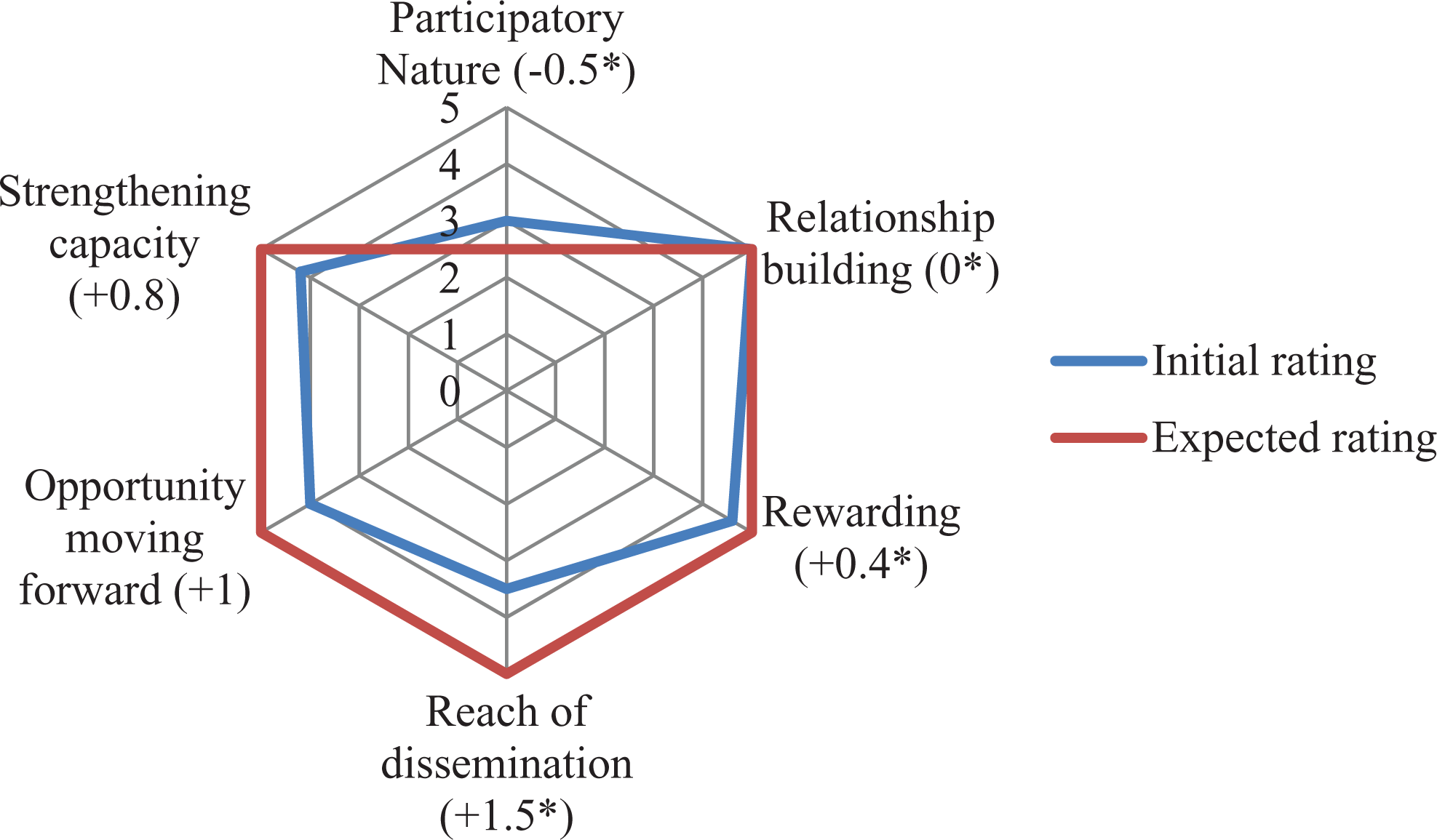
Meaningfulness of dissemination process spaces & places Eskasoni. *Magnitude in expected change.
The six factors we used to measure the how meaningful the dissemination process has been for us as youth participants are opportunities for relationship building, opportunities to strengthen our capacity, rewarding experiences, reach of our dissemination efforts, opportunities for each of us moving forward, and the participatory nature of the project. These factors were determined by Jenny based on her recollection of previous discussions with participants about their experience of the S&P project. We were invited to offer feedback and revision of factors; however, all parties agreed these particular factors were adequate measures of how meaningful the dissemination process of the project was in their experience. During our meeting to reflect on our experiences, Jenny and Linda took detailed notes of the process and out discussions. We engaged in this reflective process one year after the official “end” of the project.
Our experience in using this approach suggests that this tool could be useful for teams to use at the start of PAR projects to determine expectations and responsibilities. Teams could, for example, only enter information regarding how youth envision or expect their contribution to be. At the end of the project, actual experiences could be added together with expectations of how project momentum could impact future activities.
Ethics approval for this component of our work was included in the original project, as provided by the host academic institution (REB File #: 2013-3084) and the ethics board that oversees research with Mi’kmaq communities in the province (no approval number provided). This reflective work forms a component of the dissemination.
Findings
Relationship building
Relationship building was the strongest factor on our Socratic Wheel, scoring a 5 for both experience and expectation. These scores reflect our satisfaction with the relationships between ourselves as a group of youth, ourselves and the participating EMHS staff, and ourselves and the academic team members.
Research can be invasive, especially considering the day-in-the-life filming that we all participated in. Trust is essential to allowing a stranger to follow you around and observe you in personal spaces such as your home. We unanimously agree that trust has been established between everyone involved in the research. The other members of the research team (i.e., EMHS staff and academics) helped create this trust through their use of time and food; the time we spent together and the meals we shared helped us build these relationships through the opportunity to share and spend time together. Importantly, this time was not focused on the research but on connecting and enjoying one another’s company. Because of this, our overall experience of the research project—and the dissemination activities in particular—was positive. Both the project and our relationships became very meaningful to us all.
In our discussion of this factor, we have explored how these relationships were strengthened throughout the project but especially during the dissemination process. Activities such as painting the mural on the crisis center as well as traveling to the conference in Halifax and presenting together were particularly effective for building what we anticipate will be lasting relationships. These opportunities challenged us to think creatively and speak confidently in front of large groups of strangers about our personal lived experience and our research experience. Our accomplishments were only possible when we supported one another and used our individual skills and talents collectively. It is the nature of these relationships that has kept us engaged in the project for the past two years and motivates us to stay involved by attending meetings and planning for the future of the project despite its official end. This experience underscores the centrality of relational accountability to the meaningful engagement of youth throughout the research process but especially in the dissemination process.
Strengthening capacity
Over the course of the research and dissemination of findings, we as participants/coresearchers were challenged by the various activities and given an opportunity to learn new skills including research techniques, public speaking, and professional presentation. We were also able to practice and build upon our existing skills and strengths, for example, drawing and painting, writing, engagement, and community service. These experiences echo what Wilson (2008, p. 69) said of his own research work: “All of us were research participants, rather than me being the researcher and them my subjects. We all learned and grew as a result of exploring our relationship with this topic.” Two aspects are crucial to these learning opportunities. First, because we led on content and design, we were able to participate in ways each of us were comfortable with, and work on aspects that were of interest to each of us (both in terms of content and activities). Second, the nonyouth members of the research team were always there supporting us, encouraging us, and ensuring that we had the resources we needed to succeed. While drawing on our own strengths, and being supported by the team, meant that the experience was rewarding for us, it has also contributed to the project’s success.
What may be helpful for researchers to realize is that youth may not be interested in all the opportunities to develop skills that come along or may choose to participate selectively in some activities. Writing this article is a good example. As we mentioned at the start, we are gaining skills through this process. Specifically, we have had the opportunity to think about the fact that activities and processes have important “how” questions attached to them. This helps us think about our own plans and intentions as we move forward. However, because of our own priorities and existing demands on our time, we have left the actual writing of this article to Jenny and Linda. So, while we as the youth researchers have directed the content, and gained from the process that generated that content, we are not necessarily gaining skills in academic writing; largely because right now, this is not a priority or necessity for us.
Our initial rating score of our experiences is 4.18 because we experienced capacity strengthening as a direct result of our engagement in the research and dissemination process. While, for some of us, this high level of capacity development is true, for others, the rating was scored lower because we did not feel our skills were built upon to the same degree as others or did not feel as challenged. For example, some of us felt comfortable and had experience with public speaking and engaging our community and did not feel our capacity was strengthened to the same degree as other participants. In terms of expectations, we rated this factor at 5. We all expect the score to increase with our continued engagement in the project and the anticipated opportunities to practice developing skills and building a wider web of connections in the local community and abroad through this engagement. What this will look like will be determined by how we move forward and the skills we as youth identify as those we would like to learn and/ or bolster.
Rewarding
This factor examined how rewarding participation in the dissemination process was for us. Facilitated by Jenny and Linda, we explored the questions “was the project worthwhile?” and “did we get something out of the project?” Based on our experiences, we gave the factor a score of 4.6. The project has been rewarding; it has contributed to our learning and skill development and has improved our general understanding of the social world we move in. This is because the project was designed to position us as experts, providing us with the reflective research skills needed to do this research work, to draw on our lived experience and reflect on our social webs. Of course, the success of this approach has also depended on the trusting and respectful relationships that have been established between all members of the research team (including the EMHS staff and the academics). This project design has also meant that our social webs have been expanded by the creation of a community of coresearchers and friends. Additionally, participation has given us insight into the world of academic social research. In these ways, the project has made a significant positive contribution to our development as young adults. Seeing the findings of the project on the mural wall and sharing our experience at an international conference were certainly rewarding experiences.
However, we gave this factor an expectation score of 5 (+0.4 increase) because we believe that by moving forward, by continuing with the project, the experience will continue to develop our skills and broaden out networks. We anticipate that the project will continue to be rewarding as we move forward and continue to share and learn as well as celebrate the individual successes that may stem from the project. Here, we are reminded that “the nature of the research that we do as Indigenous people must carry over into the rest of our lives. It is not possible for us to compartmentalize the relationships that we are building apart from the other relationships that make us who we are” (Wilson, 2008, p. 91).
Reach of dissemination
Reach of dissemination, or where we have been able to share our findings and the audiences we have been able to reach through our activities, was given a lower experience rating score of 3.5. We believe that not everyone who may benefit from hearing about these findings or who have the power to make positive contributions to the community based on these findings has been reached yet. While we were able to share our findings with other community agencies through the use of posters, postcards, videos, and slide shows, with the EMHS staff and the broader community through the mural on the crisis center, as well as an international audience of practitioners and academics at the “Pathways to Resilience III: Beyond Nature vs. Nurture” conference, there are other dissemination activities that we have not yet done. For example, we have not hosted a launch for our mural in order to share our findings with the broader community. Similarly, we could host a round table discussion with community leaders (such as The Band Council) and the media to share findings and discuss how the information could be used to further develop resources for youth (see also the Public Science Project, http://publicscienceproject.org/). Continuing to look for opportunities to share our findings with stakeholders—more specifically with community leaders, our families, and peers—is important to strengthen our project and validate our findings. A broader range of dissemination products and more opportunities to present findings to local leaders and the academic community will help extend the reach of this study’s findings. We are optimistic about achieving this and our expected rating score of 5 because of the strong relationships in the team and our own growing capacity as a group of youth. And of course, doing these things will be rewarding, further encouraging us to engage with these plans.
Opportunity moving forward
For us, opportunity moving forward meant having more opportunity to share our research findings and build connections with other youth and researchers. It also meant being credited for our work on the project and using our participation and accomplishments on our resumes and personal CVs as we apply for jobs and postsecondary opportunities. Based on our experience so far, we rated this factor as 4. For us, the project and the opportunities it provided did not end with the data collection and analysis, but have continued and provide even more opportunity through the ongoing dissemination process. We are excited by the opportunity to remain engaged in the project and to engage with research and other projects in our community. The project has already inspired us individually to engage with local community development opportunities as well as pursue international development opportunities. Part of being able to move forward in these ways stems from our enjoyment of the project activities (i.e., we know they can be fun and rewarding). But it also stems from our skill development and the way our experiences on the S&P project have added to our sense of personal agency and self-efficacy: We know that we can do these things. These experiences also provide practical resources for moving forward. For example, we can add this project and what we have done on it to our resumes, supporting our opportunities moving forward as we apply for jobs and pursue our education. To this end, we have asked the academic members of the team for certificates of participation and “transcripts” describing our involvement and what we have done, so that we can add these to our personal academic portfolios.
Our expectations are rated as 5 because we would like to take action, to share our findings by creating and looking for more opportunities to share our work. We could, for example, invite more young people to join our group, to learn from what we have found and offer fresh ideas and new perspectives.
Participatory nature
The final factor we explored was how meaningful the participatory aspect of the S&P project was. This aspect related to our sense of control regarding how the research was conducted and how the project findings were disseminated. Based on our experience, we gave this a score of 3. Importantly, though, this was 0.5 higher than our expectation score of 2.5. While we do not feel like we determined precisely what happened during the research or what all the dissemination projects would be, having a structure and clear goals allowed us space to determine what these products would look like without feeling overwhelmed or overburdened. So, for example, at the start of the project, the EMHS director asked whether we would present our findings in a mural on the outside wall of the crisis center. While this approach was somewhat predetermined, the findings and the ways in which they are presented were determined by us. Similarly, once the mural was complete, Linda suggested making posters and postcards and presenting at a conference. Again, what has been presented and how was determined by us with the input of EMHS and research staff.
The −0.5 difference between our experiences and expectations reflects our preference for equal control of research and dissemination activities, where all groups (i.e., youth, staff and academics) can combine their skills in a way that shares the findings in a way that is both efficient and effective. In discussion with the academic team members, we believe that it is the role of the researcher to provide the platform from which the youth voices will be heard. It is important that this platform supports the hearing of these voices by an audience and that this platform ensures that findings will translate into meaningful consideration and tangible change as a result of everyone’s efforts. We all have to assume our respective roles and responsibilities in the larger process, based on the resources and skills and interests we bring with us.
Discussion
Since the completion of the project, the academic team members have been spending a lot of time in thinking about our project and more broadly what it means to engage youth in the dissemination of research findings and how researchers can ensure this experience is meaningful. It was with these questions that we were approached by Jenny and Linda to discuss our experiences and hopes for our future engagement and the engagement of other youth in projects like S&P. At this time they also proposed that we coauthor this article. The researchers recognized that our voices were essential in reflecting on this process and that sharing this experience must be a collaborative undertaking. Once we had agreed that we would like to be involved in the authorship of this article, we got to work and discussed our experience of the dissemination process for S&P and why, more generally, this is a critical stage of the research project to engage youth in ways that are meaningful. We talked about our experiences as youth participants sharing the findings from the S&P project so far, what we want other researchers working with young people to know, and where we want to go from here.
We as the youth coresearchers agree that the most important thing academic researchers have to understand is the importance of building trust with youth when you want to learn about their lives and experiences in their communities. In other words, establishing relational accountability contributes to meaningful rather than tokenistic engagement (Delgado, 2015; Morrow & Richardson, 1996). Specifically, research processes embedded in these active engagements increase validity of results due to the combined efforts of academic researcher knowledge of research rigor with youth expertise in lived experience. This is achieved through the positioning of youth participants as coresearchers and equal contributors to knowledge generation as opposed to subjects (Bagnoli & Clark, 2010; Grover, 2004; Holland et al., 2010). While never a concern raised by the youth, one challenge (and possible limitation of the study’s process) faced by the academic researchers was inconsistency in research assistants and academic support staff. While this does not appear to have been an issue, this variability merits conversation as it may have affected the research team’s relational accountability with the site community and within the research team.
Presentation of findings that are built on valid results has provided us as youth confidence in sharing the research findings; these are not our opinions, but findings based on an in-depth interrogation of our collective experiences situated against our community’s history. Additionally, the ways in which we are sharing these findings are physically supported by the rest of the research team. This support in the dissemination process has allowed us to disseminate robust findings, as well as engage in meaningful ways that are empowering as opposed to superficial and disempowering or that contribute to further marginalization (Canella & Lincoln, 2009). This collaboration means we are creating products (including conference presentations) that are taken seriously by audiences. As a result of the relationships that were cultivated throughout the project, we were able to balance rigor with flexibility, without compromising the validity of our data, reflecting a strength of our process. Over the course of the project the methodology was adapted in response to changing participant and community needs. Our strong relationships and close communication allowed us to make quick decisions and collectively think on our feet because the research team was willing to meet us where we were at with respect for our ongoing lived experiences.
We were happy to participate in the project and excited to learn how many people were interested to learn about Eskasoni and Mi’kmaq culture and what can be learned from our community. The project was also a great opportunity for us to learn more about Eskasoni and Mi’kmaq culture from one another. A highlight of the dissemination for many of us was getting to share with others how proud we are of our community. In particular, all that there is to do here, the formal and informal supports available, and how much talent and passion is possessed by ourselves and our peers. We found that being positioned as coresearchers within respectful and accountable relationships was empowering but also instilled a sense of responsibility to represent our community through our findings in a way that was respectful and focused on our community’s strengths and challenged existing stereotypes (Wilson, 2008).
We have found that the dissemination of research findings was most meaningful when the research and findings highlight the strengths of the community, the talents of local youth, the beauty of the landscape, and richness of the culture. In this way, our experiences reflect Wilson’s (2008, p. 16) conclusion that the dominant scientific approach to research with Indigenous communities “focuses on problems, and often imposes outside solutions, rather than appreciating and expanding upon the resources available within Indigenous communities.” We sought to challenge the tendency in Western research paradigms to research “the negative” thus “giving more power to disharmony” (p. 109). We recognize that “focus on alienation or lack of relationships does nothing to form relations but rather can tear them apart” (p. 109). We challenge this by focusing our dissemination efforts on identifying and building strong relationships among one another and our community. Practically speaking, over the course of the project, this also meant acknowledging and respecting the capacity and limitations of the youth participants, academic researchers, and community service providers. For example, when collaborating with service providers, it is important for academic researchers to be cognizant of their roles in the community and the primary responsibility of service providers to their clients. This means respecting their time and energy and allowing them to determine where they are and are not able to contribute. Finally, we recognize that what we have proposed in this article with regard to approaches to meaningfully engaging youth may not have relevance to all Indigenous youths and their communities. Simultaneously, we hope that some of what we have discussed may resonate with some non-Indigenous youths and their communities.
As we move forward, we hope to prioritize sharing our findings with our families, friends, and local community. While participating in international conferences and sharing our experience in academic articles like this one are important, we do not feel like we had the kind of opportunity we would like to share our findings and experience with our closer networks of support and relationship. While this is certainly a limitation of this work, we do feel supported by the research team and excited for opportunities like a launch for the mural we painted and opportunities to engage on a local level despite the projects official completion.
Conclusion
The Final Question: Why Are You Here Today?
Before we concluded our meeting and left the youth center to enjoy the warm and bright July evening, Jenny asked us one last question: “Why did you come here this afternoon?” One of us (a young woman) replied, “Because you asked me too”. Another of us (a young man) joked, “Because I knew there would be pizza”. The room broke out in laughter before everyone else began to chime in: “Because I wanted to see everyone, and get out of the house.” “Because I missed you guys.” “Its fun…and I missed [everyone].” “We don’t often get together like this, it’s great to see everyone in the group.” Everyone’s answers affirmed what the academic team members had begun to suspect throughout the dissemination process of S&P Eskasoni. It is a combination of factors that makes the dissemination of research findings meaningful and engaging for youth coresearchers. As youth, we wish to share our research findings in ways that are rewarding, strengthen our capacity, are able to reach our intended audience, provide opportunity moving forward, and have a structure but are participatory and allow us to have a sense of ownership over our work. Most importantly, we wish to participate in dissemination projects that both bolster existing connections and build new relationships. Establishing strong connections between youth, academics, and community service providers generates a strong sense of relational accountability. It is this relational accountability that allows all participating project members to contribute to the project in the way that best suits their needs and capitalizes on their strengths. Learning is reciprocal, and we are all held responsible to one another. While various research contexts present great variation in the challenges that researchers face, taking time to develop and maintain respectful relationships with youth coresearchers and their champions can help researchers find effective ways through some of these contextual challenges. As we move forward, we will continue to navigate our relationships with the project and with each other. Meaningful relationships in research (like anywhere) can be fulfilling and, as we have found, are necessary. But they can also be messy and challenging in and of themselves. We are still learning what it means to nourish these relationships as the project has officially wrapped up. Despite the heat of the day and the long list of commitments we were juggling, the tone of our meeting was set right from the start, by the continuing warmth and support of the group. One of us compared the group to a family where everyone jokes and teases, but most importantly supports one another and finds joy in the achievements and accomplishments of the group, and the achievements and accomplishments of individual members of the group. In “Research is Ceremony,” Wilson quotes a friend who says “If research doesn’t change you as a person, then you aren’t doing it right” (p. 83). We cannot say that all we did was right, but we do know we were all changed.
Footnotes
Acknowledgments
We would like to thank all the staff at Eskasoni Mental Health Services for all of their support on the Spaces & Places project
Declaration of Conflicting Interests
The author(s) declared no potential conflict of interest with respect to the research, authorship, and/or publication of this article.
Funding
The author(s) disclosed receipt of the following financial support for the research, authorship, and/or publication of this article: This article is funded by Atlantic Aboriginal Health Research Program and the Social Sciences and Humanities Research Council of Canada (Grant Numbers 611-2014-0346 and 890-2011-0023).
References
Supplementary Material
Please find the following supplemental material available below.
For Open Access articles published under a Creative Commons License, all supplemental material carries the same license as the article it is associated with.
For non-Open Access articles published, all supplemental material carries a non-exclusive license, and permission requests for re-use of supplemental material or any part of supplemental material shall be sent directly to the copyright owner as specified in the copyright notice associated with the article.
