




Abstract
As qualitative research continues to adapt to technological advancements, the evaluation of data quality and quantity in online versus face-to-face focus groups becomes increasingly important. The purpose of this systematic review was to explore how the format of a focus group (online or in-person) influences the quality and quantity of data collected. Adhering to PRISMA guidelines, the review analyzes a total of 45 cross-sectional studies published between 2000 and 2023, providing both quantitative and qualitative comparisons across various metrics, including word count, idea expression, participant interaction, and statements of agreement or disagreement. Word count was generally higher in face-to-face focus groups, suggesting a tendency for more extensive verbal expression. However, the total number of ideas expressed did not significantly differ between the two modalities. Qualitatively, 62.5% of studies reported more detailed responses in face-to-face focus groups, while asynchronous online focus groups were found to elicit more expansive responses in some instances. In terms of the characteristics of focus groups, synchronous formats were more common for online focus groups, with the duration of sessions varying widely across the two modalities. These results suggest that although online and face-to-face focus groups exhibit distinct characteristics, they are similarly effective in yielding data of comparable quality, especially in terms of idea generation. Accordingly, combining the two formats within a single study is likely to maintain data integrity. Overall, the findings from this review offer valuable insights for researchers and practitioners across diverse disciplines and should help them to strategically design their focus group studies so as to align with specific research objectives and contexts.
Introduction
In an era marked by rapid technological advancements and an ever-evolving digital landscape, researchers face a critical choice in their approach to data collection: opting for traditional face-to-face methodologies or embracing online methods (Davies et al., 2020; Żadkowska et al., 2022). The transition from traditional to online data collection has been propelled by factors such as convenience, cost-effectiveness, and broader accessibility (Khan & MacEachen, 2022; Opara et al., 2023). However, it is essential to assess the strengths and limitations of each approach to facilitate informed research practices, create robust data collection strategies, and explore the option of merging data collected from both formats.
In the field of qualitative research, focus groups represent a cornerstone method that, by fostering interactive and dynamic discussions, can elicit rich, nuanced insights into a wide variety of topics (Akyildiz & Ahmed, 2021; Kitzinger, 1995). The use of face-to-face group interviews within the social sciences can be traced back to the early 20th century. Morgan (1996) notes that group interviews were first conducted and described by Bogardus (1926), and later by Merton and Kendall (1946) to study propaganda and its effectiveness on troops. Many decades later, the face-to-face approach to focus groups became complemented by the use of online platforms (Halliday, Mill, Johnson, & Lee, 2021; Stewart & Williams, 2005), most notably during the period of COVID-19 (Hensen et al., 2021; Lobe et al., 2020), and this brought both opportunities and challenges for qualitative researchers.
The goal of both face-to-face and online focus groups is to explore participants’ experiences and perceptions (Fusch et al., 2022; Marques et al., 2021; Van der Voort et al., 2023), facilitating interactions within a homogenous group (Busetto et al., 2020; Plummer-D’Amato, 2008) under the guidance of a moderator. Discussions in these groups are structured around predetermined questions or topics, the key difference being the mode of communication: by definition, face-to-face focus groups are conducted in-person (Kitzinger, 1995; Morgan, 1996), whereas online focus groups rely on tools such as chatrooms, videoconferencing, email, instant messaging, forums or audio-recording. Additionally, online focus groups may be either synchronous (i.e., text-based, audio-based, video-based) or asynchronous (i.e., text-based) (Lobe, 2017).
Synchronous online focus groups resemble the face-to-face approach, as discussions happen in real-time with a moderator facilitating group discussions among participants who are simultaneously connected to the platform being used (Jones et al., 2022; Willemsen et al., 2022). Van der Voort et al. (2023) and Lobe and Morgan (2021) indicate a growing prevalence of video-based synchronous online focus groups. However, text-based synchronous online focus groups remain pertinent in contemporary research, as evidenced by various studies. For instance, Colom (2022) utilized WhatsApp to study young activists in Western Kenya, while Neo et al. (2022) explored Singapore residents’ perspective on COVID-19 using the same platform. Additionally, Chen and Neo (2019) investigated the feasibility of WhatsApp for data collection, and Aligato et al. (2021) employed Facebook Messenger to research healthcare workers and caretakers of small children in the Philippines.
By contrast, asynchronous online focus groups do not require the simultaneous online presence of participants and moderators. This format allows for a flexible response time, whereby participants can engage within set deadlines, extending the research duration over several days. They are mostly text-based, making particularly essential to consider the timeframe, interview guide, and focus group setup (LaForge et al., 2022). LaForge et al. (2022) outlined the importance of timing, noting that the hours for posting questions and immediate logoffs by participants after replying can affect the opportunity for further probing. They emphasized the need to decide whether the discussion items should remain fixed throughout the session, highlighting that preparing the interview guide and configuring the platform could require several hours.
Regardless of the format, recruiting participants for focus groups remains a challenge, prompting researchers to employ incentives to stimulate engagement (Adler et al., 2019; Fusch et al., 2022). Furthermore, whichever approach to focus groups is used, a critical element in the data collection process is saturation, defined as the point at which new data cease to provide novel insights (Hennink, Kaiser, & Weber, 2019; Low, 2019; Ofusu et al., 2023; Ritter et al., 2023). However, the best strategy for achieving data saturation remains a subject of debate, with proposed methods including establishing a specific sample size or number of groups, or basing the decision on thematic saturation (Hennink & Kaiser, 2021; Sebele-Mpofu, 2020).
Importantly, the face-to-face, synchronous online focus groups and asynchronous approaches to focus groups may yield both similarities and differences in terms of data quality and quantity. These encompass metrics such as word counts, the generation of ideas, participant interaction, number of on-topic/off-topic statements, and expressions of agreement or disagreement. Evaluating these dimensions can shed light on both the shared characteristics and disparities inherent to face-to-face, synchronous and asynchronous online focus groups modalities.
Some research suggests that face-to-face and online focus groups are broadly comparable in terms of total word count in audio-visual (Namey et al., 2020), in synchronous online-text the nature of the ideas generated (Campbell et al., 2001), levels of interaction (Gadalla et al., 2016), and patterns of agreement and disagreement (Reid & Reid, 2005). However, Reid and Reid (2005) found that face-to-face groups tend to yield higher word counts, attributing this to the time-consuming nature of typing in asynchronous online focus groups, even with extended time allowances. Contrasting findings have also emerged with regard to idea generation, with some studies concluding that face-to-face groups foster more prolific ideation than asynchronous online focus groups (Nicholas et al., 2010; Tenniglo et al., 2017), while others contend that online groups generate a larger set of ideas in both audio-based synchronous (Dwyer et al., 2022) and asynchronous groups (Schweitzer et al., 2012). Patterns of participant interaction may also differ. Keemink et al. (2022) assert that face-to-face focus groups offer a more socially engaging interaction, whereas synchronous online groups with video feeds may impede communication. However, both Keemink et al. (2022) and Stewart and Shamdasani (2017) counterbalance this by claiming that synchronous online groups allow for unhindered interaction owing to an informal atmosphere. Perdok et al. (2016) observed heightened discussion and interaction in face-to-face as compared with asynchronous online focus groups, whereas Stehr et al. (2023) reported greater group interaction in video-based synchronous online groups. Discerning the relevance of participants’ comments adds another layer to these differentials. Campbell et al. (2001) posited that text-based synchronous online focus groups, despite yielding shorter responses, often delivered more relevant insights. Conversely, Underhill and Olmsted (2003) text-based synchronous online focus groups reported greater relevance to the topic of discussion in face-to-face groups. Regarding the dynamics of agreement and disagreement among participants, online focus groups show a proclivity for more disagreements, attributable to the online disinhibition effect. This disinhibition effect further extends to the disclosure of sensitive information in online focus groups especially in text-based synchronous online focus groups (Underhill & Olmsted, 2003). Overall, these findings underscore the multifaceted nature of face-to-face and online synchronous (text, audio, video) and asynchronous (text-based) focus groups, each of which has distinct merits and aspects that require consideration.
Consequently, the purpose of this systematic review was to examine empirical studies that have conducted and report data for both face-to-face and online focus groups so as to assess their equivalence in terms of the quantity and quality of the information obtained. Specifically, we aim to analyze and synthesize the existing body of research to ascertain whether the mode of conducting a focus group (i.e., face-to-face, synchronous online, and asynchronous online) the richness and depth of information collected. The ultimate goal is to provide valuable insights for researchers and practitioners in various fields.
Method
This systematic review was conducted in accordance with the guidelines set out in the Preferred Reporting Items for Systematic Reviews and Meta-Analyses (PRISMA) statement (Page et al., 2021). The Sample, Phenomenon of Interest, Design, Evaluation, and Research type (SPIDER) framework was adopted to assist in formulating the review question (Cooke et al., 2012). The review question was: ‘What are the differences in metrics such as word count, idea expression, participant interaction, and statements of agreement or disagreement between face-to-face and online focus groups, as observed in studies utilizing both modalities?’
Eligibility Criteria
According to the SPIDER mnemonic and research question (see Table S1 of the Supplementary material), the review was limited to empirical studies that conducted and report quantitative or qualitative data for both face-to-face and online focus groups, thus allowing comparative analysis of the two methods. In addition, articles had to have been published in peer-reviewed journals and be written in English. Conference presentations, theses or dissertations, theoretical articles or reviews, research reports, and other documents such as books, book sections, commentaries, and corrections or errata were excluded.
Search Strategy
On May 17, 2023, we conducted an electronic search with no limits on year of publication from the following databases: APA PsycArticles (via APA PsycNet), APA PsycInfo (via APA PsycNet), CINAHL Complete (Cumulative Index to Nursing and Allied Health Literature via EBSCOhost), ERIC (Educational Resources Information Center via ProQuest), MEDLINE (via Web of Science), Scopus, and Web of Science. The search string employed was as follows: “focus group*” AND (conventional OR traditional OR “face to face” OR “in person”) AND (online OR Internet OR virtual OR web OR “computer mediated”). The complete syntax for application of this full string to the seven databases is shown in the Table S2 of the Supplementary material. Additional records were subsequently identified through a hand search of the reference lists of articles identified as eligible after reading the full text, as well as of the reference lists of literature reviews on the topic of focus groups (systematic reviews, scoping reviews, integrative reviews).
Study Selection and Screening
After removing duplicates and applying the inclusion and exclusion criteria, the titles and abstracts of a random selection of 20% of all identified articles were first screened independently by two researchers to determine study eligibility. This screening process exhibited high inter-rater reliability (Cohen’s kappa = .99). The titles and abstracts of the remaining 80% of articles were then reviewed by one of the two researchers, who selected those eligible for inclusion. In a second stage, two researchers independently reviewed the full text of all articles that met the inclusion criteria from the first stage. Articles that compared qualitative and/or quantitative data from both face-to-face and online focus groups were included. Any disagreements that arose were resolved through discussion, with arbitration by a third researcher where necessary. Finally, the reference lists of included articles and literature reviews were manually searched to identify any additional records that met the criteria for inclusion. A comprehensive flowchart detailing the process of article inclusion is shown in Figure 1. A total of 45 articles were selected for systematic review. Flow chart showing the process through which articles were selected for the systematic review (based on PRISMA 2020).
Data Extraction
Data extraction was performed using a researcher-designed coding book, encompassing article identification data (i.e., author(s), title, year of publication), method variables, and outcome variables. The method variables covered aspects such as country, broad field of research (i.e., health, business, education, social science, agriculture), sampling and recruitment methods, sociodemographic characteristics of the sample, and variables related to focus group implementation. These included whether it was conducted synchronously (i.e., text-based, audio-based, video-based), or asynchronously (i.e., text-based), the platform(s) used for interaction between participants in online groups, the number of focus groups conducted, the size of focus groups (mean number of participants per group), the duration of focus groups, and any incentives offered. The outcome variables covered qualitative or quantitative aspects such as the mean number of words per focus group and per participant, the mean number of ideas per focus group and per participant, the total number of interactions in focus groups, the total number of on-topic/off-topic statements, the total number of expressions of agreement or disagreement, and any sensitive information disclosed during the focus groups.
The data extraction process was conducted independently by two researchers, who achieved a high level of agreement with each other (Cohen’s kappa = .98). Any discrepancies were resolved through discussion and consensus. In cases where agreement could not be reached, two additional researchers were consulted for further input and resolution.
Data Analysis
In order to provide a comprehensive overview of the studies examined, we performed descriptive analyses of quantitative variables, calculating frequencies, percentages, means, and standard deviations, to examine variables related to the characteristics of focus groups. Finally, a comparison of outcome variables between face-to-face focus groups and both synchronous and asynchronous online focus groups was conducted using the non-parametric Mann–Whitney U test. Due to the scarcity of available data, the two online focus groups modalities were combined in some analyses. All analyses were performed using R 4.2.1 (R Core Team, 2022).
Results
A total of 45 publications were selected for systematic review, all of which were cross-sectional studies that conducted a comparative analysis of face-to-face and online focus groups. Of these, 20 articles reported quantitative results for a range of variables, enabling us to conduct a quantitative comparison of metrics such as word count, idea expression, interactions, on-topic/off-topic statements, and expressions of agreement or disagreement. The remaining 25 articles provided qualitative information regarding the comparison of face-to-face and online focus groups across these variables. The selected articles were published between 2000 and 2023.
In six articles (13.3%), the authors applied and compared more than one online focus group strategy. For example, Underhill and Olmsted (2003) describe two approaches to online focus groups: one was a computer-mediated condition in which participants were in the same room and could see and hear each other while typing, although communication was only via text using their computer; the other was an internet-simulated condition in which participants were isolated from one another and all communication was via text. In the study by Abrams et al. (2015), some online focus groups were text only via computer, while others used an audiovisual format. In these cases, the data were coded separately for each online focus group strategy and compared with face-to-face focus groups. Overall, these data imply a total of 54 different comparisons.
General Description of Studies
The largest proportion of studies were carried out in the USA (37.8%, n = 17), followed by the Netherlands (11.1%, n = 5), Australia, and the UK (8.9%, n = 4 in each case). In terms of the broad field of study, it is noteworthy that 48.9% of articles (n = 22) were centered on health-related topics, followed by 26.7% (n = 12) related to social sciences, 15.6% (n = 7) in the domain of business, 6.7% (n = 3) in the field of education, and lastly, 2.2% (one article) in the agricultural sector. Participant recruitment strategies were reported in 75.6% of articles (n = 34), with the most common being email contact (23.5%, n = 8), the distribution of flyers (23.5%, n = 8), and the use of social networks (20.6%, n = 7). Six articles employed different participant recruitment methods for face-to-face and online focus groups. For face-to-face groups, researchers used in-person invitations, engaged with associations, support groups or other non-governmental organizations, or advertised in local newspapers. For online focus groups, recruitment methods included the use of email, social networks, and advertisements in both online and offline newspapers, forums, and bulletin boards, among other strategies.
Of the 43 articles that detailed the sampling method, this was most commonly purposive sampling (67.4%, n = 29), followed by convenience sampling (25.6%, n = 11), snowball sampling (2.3%, n = 1), and stratified sampling (2.3%, n = 1). One article (2.3%) used different non-probabilistic sampling techniques in online and face-to-face focus groups (respectively, convenience sampling and purposive sampling).
Only six (13.3%) of the articles analyzed explicitly referred to the use of a saturation strategy for concluding data collection or for evaluating its quality. These articles had predefined (prior to conducting the focus groups) a specific percentage of total themes or a set number of focus groups that would be required to achieve saturation. For instance, Namey et al. (2020) reported that more than 85% of themes emerged across each of the focus group strategies used (face-to-face, video-based, text-based) indicating the attainment of thematic saturation based on sample size selection. Similarly, Namey et al. (2022) established that data collection would continue until reaching 80–90% saturation, which they achieved by conducting six focus groups for each strategy. Additionally, external reviewers validated the coding consensus and identified no new themes or sub-themes, thereby corroborating the saturation of data. Other studies indicated that saturation was achieved after conducting four face-to-face focus groups (Richard et al., 2018) or five online focus groups (Buckle et al., 2021), although both these studies omitted to mention the saturation criterion for the alternative focus group format. Finally, in two articles it was assumed that thematic saturation was reached since no new themes were identified in the last focus group.
Both genders were represented in most of the focus group studies analyzed. Six articles (13.3%) included an online focus group composed solely of men or women, and five (11.1%) a face-to-face group of these characteristics. Regarding age, participants in online focus groups were slightly younger (mean = 37.7 years, SD = 17.6 vs. mean = 40.3, SD = 18.6 in face-to-face groups), with the target population most commonly consisting of students (15.6%, n = 7, for both online and face-to-face groups), professionals (13.3%, n = 6 for online; 15.6%, n = 7 for face-to-face), the general population (11.1%, n = 5 for both online and face-to-face groups), adult patients (11.1%, n = 5 for both online and face-to-face groups), LGBTIQA+ (8.9%, n = 4 for both online and face-to-face groups), and pediatric patients (8.9%, n = 4 for online groups; 6.7%, n = 6 for face-to-face).
Lastly, less than half of the articles analyzed mentioned using incentives to encourage participation and enrollment in the study (33.3%, n = 15 in online focus groups, and 28.9%, n = 13 in face-to-face groups). Among these articles, the most commonly employed incentives were gift vouchers (46.7%, n = 7 in online focus groups; 46.2%, n = 6 in face-to-face groups) and monetary rewards (26.7%, n = 4 in online focus groups; 30.8%, n = 4 in face-to-face groups).
Characteristics of Focus Groups
Here we considered variables related to the format of online focus groups (synchronous or asynchronous), the communication platform(s) used for participant interaction in online focus groups, the number and size of focus groups, and the duration of group sessions. Given that these variables could vary across different types of online focus groups (i.e., synchronous and asynchronous), we analyzed the results considering the 54 coded comparisons.
Regarding the format of online focus groups, 57.4% (n = 31) were synchronous, 37% (n = 20) were asynchronous, 3.7% (n = 2) used both synchronous and asynchronous strategies with the same group, and 1.9% (n = 1) did not specify the type of online group. A variety of communication mediums were used to allow interaction among participants in online focus groups, including text-based, video-based, and audio-based. During synchronous online focus group sessions, all three of these mediums were used. Text-based was the most common, being employed in 64.5% of studies (n = 20), followed by video-based (25.8%, n = 8) and audio-based (6.5%, n = 2); one study (3.2%) did not specify the communication medium used. By contrast, asynchronous online focus groups exclusively used text-based (100%, all 20 studies), as did the two online focus groups that combined synchronous and asynchronous sessions (100%, n = 2). Regarding face-to-face focus groups, audio recording was primarily used (71.4%, n = 30), followed by a combination of audio and video recording (28.6% n = 12).
Characteristics of Focus Group Studies Comparing Face-To-Face Groups With Synchronous and Asynchronous Online Groups.

Note. n refers to the number of studies.
a: text-based n = 19; video-based n = 7; audio-based n = 2; not mentioned n = 1,
b: text-based n = 17; video-based n = 6; audio-based n = 2; not mentioned n = 1,
c: text-based n = 16; video-based n = 5; audio-based n = 2; not mentioned n = 1
d: text-based n = 15; video-based n = 4; audio-based n = 2; not mentioned n = 1.
Comparison of Outcome Variables Between Online and Face-To-Face Focus Groups
As outcome variables we considered the mean number of words and ideas, the number of interactions between participants, the number of on-topic/off-topic statements, and the number of agree/disagree statements. Because these variables may vary across synchronous and asynchronous online focus groups, some of the analyses were conducted separately, excluding those cases where both synchronous and asynchronous strategies were employed within the same group.
Differences Between Synchronous and Asynchronous Online Focus Groups and Face-To-Face Focus Groups in the Total Mean Word Count and Total Mean Number of Ideas Generated.

Note. n refers to the number of studies; TMW = Total mean number of words per focus group; TMW-P = Total mean number of words per participant; Ideas = Total mean number of ideas per focus group; Ideas-P = Total mean number of ideas per participant.
a: text-based n = 9; video-based n = 4; audio-based n = 1.
b: text-based n = 6; video-based n = 3; audio-based n = 1.
c: text-based n = 6; video-based n = 2; audio-based n = 2.
d: text-based n = 4; video-based n = 2; audio-based n = 2.
For a deeper analysis, Table 2 shows comparisons for the number of words and ideas of synchronous online focus groups and face-to-face focus groups, and asynchronous online focus groups and face-to-face focus groups. The total number of words per participant was significantly higher in face-to-face compared with synchronous online focus groups. However, the overall number of ideas and the number of ideas per participant were similar across the different focus group formats.
Differences Between Online and Face-To-Face Focus Groups in the Number of Interactions and the Number of Different Kinds of Statement.
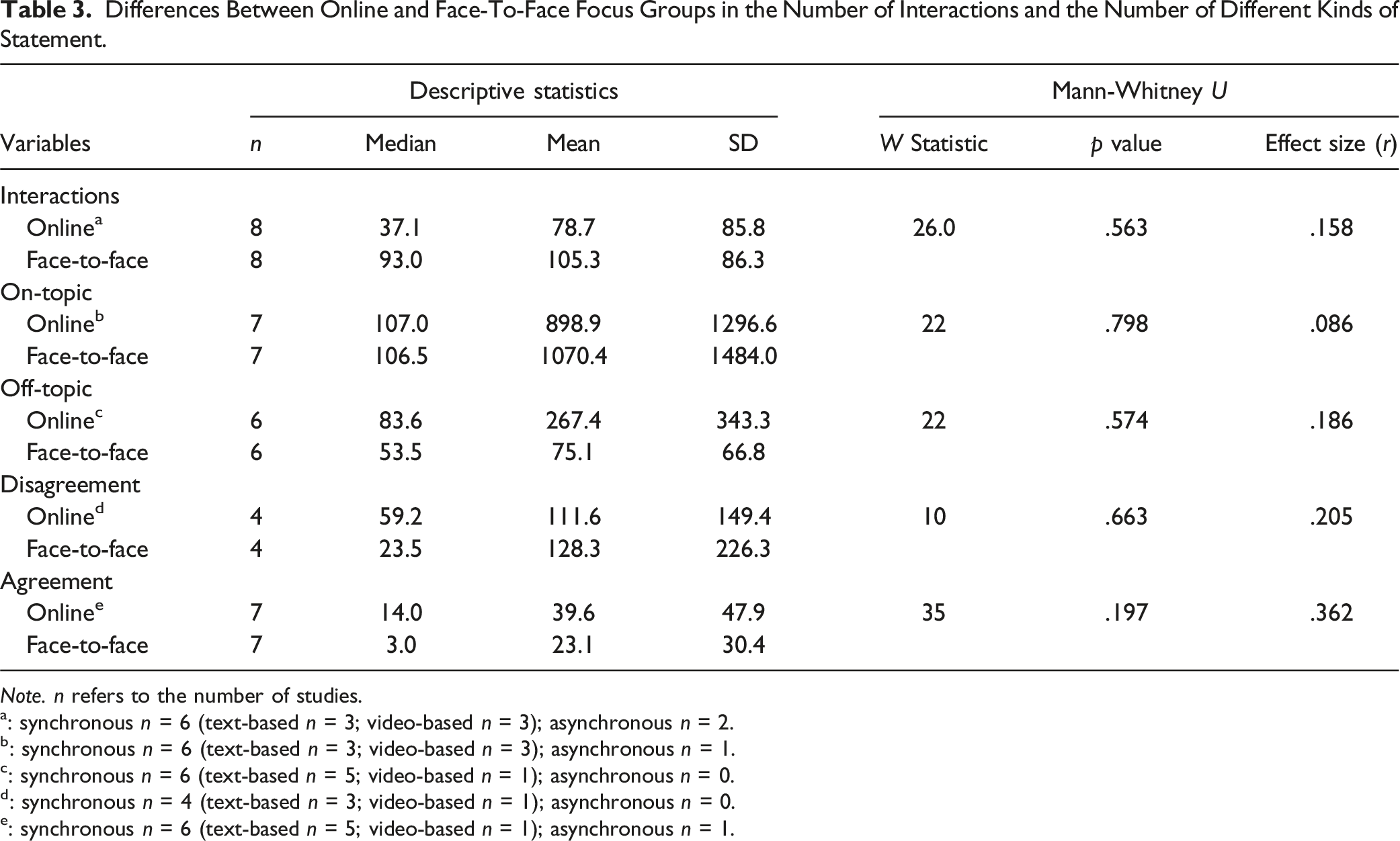
Note. n refers to the number of studies.
a: synchronous n = 6 (text-based n = 3; video-based n = 3); asynchronous n = 2.
b: synchronous n = 6 (text-based n = 3; video-based n = 3); asynchronous n = 1.
c: synchronous n = 6 (text-based n = 5; video-based n = 1); asynchronous n = 0.
d: synchronous n = 4 (text-based n = 3; video-based n = 1); asynchronous n = 0.
e: synchronous n = 6 (text-based n = 5; video-based n = 1); asynchronous n = 1.
When analyzing the qualitative data provided in the articles regarding differences between online and face-to-face focus groups in outcome variables, the pattern of results was similar to that observed in our quantitative analysis. Of the eight studies that reported results related to the use of words, 62.5% concluded that face-to-face focus groups tended to exhibit greater verbal expression and more detailed responses, resulting in higher word counts, as opposed to shorter responses in online focus groups. Among the 13 studies that compared the production of ideas between the two formats, 76.9% (n = 10) found that it was similar. Regarding the level of interaction among participants, just over half of the 24 studies that examined this aspect (54.2%, n = 13) reported lower levels of interaction in online focus groups, while 25% (n = 6) found that interaction levels were similar. Furthermore, those studies that examined who was involved in the interaction (16.7%; n = 4) concluded that participation was more evenly distributed in online focus groups, whereas face-to-face groups were often dominated by a few individuals. This finding contrasts with the qualitative insights from 11 studies focusing on participation relevance. Of these, 72.7% (n = 8) found that online focus groups encouraged more direct and topic-focused participation, leading to discussions of greater relevance.
Although the relevance of this qualitative data is notable, it is important to consider that the information for all the aforementioned variables was primarily reported in the papers’ discussion sections, often without specifying the methods used to reach their conclusions. For instance, regarding the level of interaction among participants, Hinkes and Christoph-Schulz (2019) pointed out in the discussion section that dominant participants were less problematic in online focus groups, while Gabes et al. (2021) indicated that asynchronous focus groups might lack sufficient responsiveness due to delayed participant interaction. However, in neither case was the method to obtain this evidence indicated.
Discussion
This systematic review has analyzed empirical studies that conducted and report data for face-to-face and online focus groups, thus enabling us to assess similarities and differences between the two formats in terms of the quantity and quality of the information obtained.
Over a third of the studies reviewed were conducted in the USA, followed by countries such as the Netherlands, Australia, and the UK. This suggests that research of this kind is most likely to be carried out in technologically advanced societies, where widespread Internet access facilitates the implementation of online focus groups. Consistent with previous findings (Chai et al., 2021; Jones et al., 2022; Rana et al., 2023), purposive sampling was the most common approach used to recruit participants. Notably, however, there was limited reporting of the strategies employed to achieve data saturation, which is a critical aspect of methodological rigor. Saunders et al. (2018) and Sebele-Mpofu (2020) describe four distinct approaches to this question, namely theoretical saturation, inductive thematic saturation, a priori thematic saturation, and data saturation. This variety of approaches is consistent with what we observed here, insofar as among the studies that did report the strategy used to achieve saturation, there was considerable heterogeneity in the approach adopted.
Regarding the demographic characteristics of participants, those engaged in online focus groups tended to be slightly younger than their counterparts in face-to-face groups. This may reflect a certain digital divide between younger and older generations, which, it has been argued, became highlighted during the COVID-19 pandemic, an event that precipitated a surge in online activities, particularly among the younger demographic (Martins Van Jaarsveld, 2020). It is also the case that younger people are increasingly reliant on digital platforms for education and career-related pursuits. Interestingly, however, research suggests that the pandemic also led to changes in the use of digital platforms among older adults. Nimrod (2020) reports a significant increase in Internet use among older adults in Israel following the onset of the pandemic, with platforms such as Zoom, Skype, and WhatsApp gaining in prominence. This phenomenon is not limited to Israel, however, with similar findings being reported by Haase et al. (2021) in Canada, and by Elimelech et al. (2022) in a cross-cultural survey of older adults in Spain and France. This surge in the use of digital platforms among older adults would appear to pave the way for their increasing inclusion in studies employing online focus groups.
In both face-to-face and online focus groups, incentives can play a crucial role in motivating and retaining participants. The present review found no differences between the two formats in the frequency with which incentives are used, although it should be noted that only around a third of the studies reviewed made explicit mention of whether this was the case. The most commonly used incentives were gift vouchers or monetary rewards, reflecting the general consensus over their effectiveness as motivational tools (Adler et al., 2019). At all events, researchers should be mindful that incentives may have a notable impact on data collection dynamics. As highlighted by Abdelazeem et al. (2022), the provision of incentives is associated with a greater likelihood of participant consent and an elevated response rate. However, this heightened responsiveness may have implications for data quality, as participants may be more predisposed to participate in a study when incentivized (Bidonde et al., 2023).
The number of focus groups conducted in studies using synchronous online focus groups was comparable to those that conducted face-to-face, with equal groups in each modality. Similarly, the number of participants per group showed no significant difference between the synchronous online and face-to-face groups. This comparability enables researchers to adopt an online format when face-to-face meetings are infeasible. Both formats typically feature a smaller number of participants to facilitate more meaningful interactions (de Souza et al., 2024). Kite and Phongsavan (2017) further advocated for fewer participants in synchronous online focus groups to cover more topics. Additionally, if participant visibility is important to researchers, video-based synchronous online focus groups can be particularly effective in mirroring the dynamics of face-to-face focus groups. In contrast, asynchronous focus groups typically involve fewer groups but include a larger number of participants. The advantage of these asynchronous online focus groups is that they allow researchers to obtain more reflective responses from participants (Colom, 2022). For those who aim for spontaneity and speed of response, the synchronous online modality mimics the face-to-face focus groups and therefore offers an advantageous platform for real-time interaction and immediate feedback.
In the quantitative analysis of outcome variables, we observed significant differences between face-to-face and online focus groups in the total mean word count per participant, including when the comparison was limited to face-to-face versus synchronous online groups. However, the total mean word count per group did not differ significantly across the two formats (online vs. face-to-face). When analyzing the qualitative data reported by the studies reviewed, we found that face-to-face focus groups tended to yield lengthier verbal contributions, resulting in higher overall word counts. Although Jones et al. (2022) and Willemsen et al. (2022) highlight similarities between synchronous online focus groups and face-to-face groups, the results of this review suggest that the latter still tend to generate a greater volume of words by comparison. The higher word counts observed in face-to-face focus groups may be attributed to the in-person interaction with the moderator, which inevitably becomes less dynamic in online focus groups (Lobe et al., 2020). In online focus groups, particularly asynchronous ones, the reduced presence of non-verbal cues, such as body language, may pose challenges in perceiving subtle expressions that often contribute to increased disclosure and, consequently, the generation of higher-quality data (Thunberg & Arnell, 2022). It should be noted, however, that one of the studies included in the present review concluded that asynchronous online focus groups can foster participation and may yield more on-topic responses (Synnot et al., 2014). This could be because the asynchronous nature of the group allows participants to take their time in articulating and expressing their thoughts. Whatever the case, it highlights the importance of considering the issue of participant engagement in both synchronous and asynchronous online focus groups.
Analysis of the total number of ideas per group and per participant revealed no significant differences between face-to-face and online focus groups, suggesting that the two modalities are equally effective in generating and eliciting ideas. In this respect, researchers can be reassured that the choice of either the face-to-face or online approach to focus groups will not in itself compromise data quality.
While the quantitative data provided by the studies reviewed here in relation to participant interaction revealed no significant differences between face-to-face and online focus groups, the qualitative data offer a somewhat different picture. Specifically, half of the studies reported lower levels of interaction overall among participants in online focus groups compared with their counterparts in face-to-face groups. However, some authors note that face-to-face focus groups can be dominated by a few individuals, with other participants assuming more reserved roles (Hinkes & Christoph-Schulz, 2019). Conversely, the evidence suggests that participation is more evenly distributed in online focus groups (Barratt, 2010; Gadalla et al., 2016; Schneider et al., 2002). These findings underscore the importance of considering the dynamics of participant interaction when deciding on which modality of focus group is best suited to a given study and the outcomes being sought, insofar as the quality and pattern of interactions may impact data collection.
The quantitative analysis revealed no significant differences in the frequency of on-topic versus off-topic statements between face-to-face and online focus groups. Once again, however, the qualitative data offered a more nuanced view, indicating that participants in online focus groups are more likely to remain focused on the topic at hand, thereby enhancing overall relevance (Campbell et al., 2001; Synnot et al., 2014). A similar pattern of results was observed in relation to statements of agreement and disagreement: while no differences were observed in the quantitative data, the qualitative analysis revealed instances of discord among participants in online focus groups, particularly where individuals challenge the comments of others. In this regard, Walston and Lissitz (2000) found that participants in online focus groups were more inclined to present conflicting viewpoints, a process facilitated by the online setting. This phenomenon may be explained by the online disinhibition effect, suggesting a distinct dynamic in digital interactions.
This systematic review is not without limitations. Given that the aim of this systematic review was to examine similarities and differences in the quantity and quality of the information obtained through face-to-face and online focus groups, a limitation that needs to be acknowledged is the paucity of studies directly comparing these two modalities. Specifically, variables such as interactions, on-topic, and levels of agreement have not been extensively compared across these two modalities. Further comparative research is therefore needed to add to knowledge about the respective strengths and limitations of the two approaches. Also, it is important to note that combining text-based and video-based online focus groups into a single category, due to the scarcity of studies, despite their distinct differences, may introduce heterogeneity. Another limitation of our study is the restriction to English-language publications. While this approach allows us to capture the most widely disseminated research, it may exclude relevant studies published in other languages. Finally, we acknowledge as a limitation that our review does not include a detailed quality assessment for each included study. However, it is worth considering that the diverse contexts, disciplines, and methodologies of the studies would make a uniform quality assessment particularly challenging and could potentially introduce bias.
Conclusions
Despite the aforementioned limitations, the findings of this systematic review have numerous implications. The tendency for higher word counts and more detailed responses in face-to-face focus groups suggests that this setting may be more conducive to in-depth discussions. However, asynchronous online focus groups can yield expansive responses, which is crucial for topics requiring thoughtful reflection. Given that the two formats appear to generate similar numbers of ideas (both per group and per participant), they may safely be combined within a single study without compromising data quality. It should be noted, however, that participant involvement tends to be more evenly distributed in online focus groups, a format that may also be advantageous in terms of encouraging more tangential discussions. A further aspect to consider here is that online focus groups can often provide a cost-effective and logistically simpler alternative to face-to-face groups, especially in times of travel restrictions (such as occurred during the COVID-19 pandemic) or when seeking to recruit geographically dispersed participants. Overall, the results of the present review may serve as a guide to researchers and practitioners in selecting the focus group modality that is best suited to their specific context and goals.
Supplemental Material
Supplemental Material - Information Retrieval in Face-To-Face and Online Focus Groups. A Systematic Review
Supplemental Material for Information Retrieval in Face-To-Face and Online Focus Groups. A Systematic Review by C. A. Chai, M. Barrios, J. Gómez-Benito, A. I. Berrío, and G. Guilera in International Journal of Qualitative Methods
Footnotes
Declaration of Conflicting Interests
The author(s) declared no potential conflicts of interest with respect to the research, authorship, and/or publication of this article.
Funding
The author(s) disclosed receipt of the following financial support for the research, authorship, and/or publication of this article: This work was supported by the Agency for Management of University and Research Grants (AGAUR) of the Government of Catalonia, grant number 2021SGR01071 and the Pre-doctoral Researchers of the University of Barcelona (APIF).

Data Availability Statement
The data that support the findings of this study are available from the corresponding author upon reasonable request.
Supplemental Material
Supplemental material for this article is available online.
References
Supplementary Material
Please find the following supplemental material available below.
For Open Access articles published under a Creative Commons License, all supplemental material carries the same license as the article it is associated with.
For non-Open Access articles published, all supplemental material carries a non-exclusive license, and permission requests for re-use of supplemental material or any part of supplemental material shall be sent directly to the copyright owner as specified in the copyright notice associated with the article.
