




Abstract
In the wake of the Covid-19 pandemic, many research projects were forced to adapt their design and conduct interviews online. This paper discusses the benefits and challenges of using online focus groups with participants representing different generations and cultural and social backgrounds. Based on the researchers’ experiences and field notes from a three-country comparative project, aiming at analysing the extent to which previous experience of state surveillance impacted attitudes to commercial monitoring and tracking of online behaviour among two generational cohorts, the paper identifies seven aspects where the move from offline to online interviewing interfered with the original research design. The paper suggests that most of these interferences resulted in a need to adjust the methodology to better fit the online setting. We reflect critically upon the issues of technological preconditions and digital skills, recruitment, group size, degrees of previous acquaintance, the role of the interviewer, participants’ household status and media environment, and ethical considerations concerning privacy and data management. Based on these methodological insights, we conclude that future online focus group research would benefit from using smaller groups and adjusted moderation, flexibility in interviewing tools and channels, and new, online-specific ethical considerations when planning, executing, and analysing interviews. The paper advocates the complementarity between in-person and online focus groups as two modalities of data collection and argues for the normalization of hybrid methods.
Introduction
One of the implications of the Covid-19 pandemic has been the difficulties in conducting qualitative empirical research (Kopecka-Piech & Łódzki, 2022), not least research that involves face-to-face interaction with media users. 1 During the so-called social distancing phase of the pandemic, interviews have been necessary to conduct online. Online interviews have, of course, been conducted already before the pandemic, for a variety of reasons, and indeed have their benefits, but the pandemic also made those interviews that built on co-presence necessary to be done online. While there are many useful handbooks and methods articles published on online methods (e.g., Hine, 2005; Hunsinger et al., 2019; Markham and Baym, 2009), some of which are also directly addressing problems that have arisen during the pandemic (e.g., Garcia Garcia & Barclay, 2020; Lupton, 2021), their focus is often on methods suitable for online execution, and less on the implications for methods less fitted to online settings, such as the focus group interview.
Focus group interviews have, since they were introduced in the 1940s by Robert Merton (Merton & Kendall, 1946; Merton et al., 1956; for historical overview, see Morgan, 2022), been used for their interaction dynamics, where partakers in the discussion focus on one question or theme and discuss it thoroughly. The dynamics of the interaction between co-present informants has proven extremely useful for prompting or sensitizing informants about latent attitudes deeply buried in routinised everyday behaviour, the tacit knowledge directing everyday practice, and similar phenomena. But they are also efficient for prompting identity positions, such as generational identities, nostalgia or memory patterns (see, e.g., Bolin, 2011).
The increasing adoption of online methods has led to the inevitable comparison of the use and utility of face-to-face and online focus groups (e.g., Archibald et al., 2019; Davies, 2020; Jones et al., 2022; see also Neo et al., 2022, regarding asynchronous text-based focus group discussions on WhattsApp). Reviews of comparative literature highlight mixed results regarding mainly the depth of data production and the interaction and cohesion between participants. While some research does not find significant differences between both modalities of data collection methods (Woodyatt et al., 2016), other studies stress the superficiality of answers lacking contextual detail produced in the online setting and a question-answer behaviour in detriment of a spontaneous conversational mode between participants (Stewart & Shamdasani, 2017). Difficulties in establishing a presence behind the computer screen are also observed as a potential factor compromising the quality of data. All these concerns are linked to the role of the moderator. The need to adopt a distinct attitude when conducting online focus groups is one of the most consensual dimensions across the literature comparing both data collection methods. Studies emphasize the need for a more structured intervention by the moderator, while stressing the necessity to be careful not to influence replies or morph the discussion into a question-and-answer session. The advantages regarding logistical concerns are another consensual aspect in the literature: online focus groups can be time saving and cost effective (Willemsen et al., 2022). They offer an opportunity for reducing the amount of researcher and participant travel to and from focus group locations. If online focus groups provide a practical and convenient communication space for both participants and researchers, they also favour the inclusion of geographically dispersed participants and offer an opportunity to study hard to reach populations. In turn, researchers need to evaluate whether online qualitative data collection methods may hinder participation from under-served groups, individuals without access to technology, with scant digital skills or lack of confidence in use.
This paper aims to contribute to the advancement of qualitative online audience research methodology with a specific focus on focus groups. In the following sections we will discuss some methodological, ethical, and empirical challenges that arose due to forced changes in research methodology of a three-country comparative project, involving both a quantitative survey and qualitative interviews. The paper focuses specifically on the benefits and challenges of conducting focus group interviews online and discusses wider implications for future audience and internet research. We shed light on the challenges in engaging different generations in online interviewing and suggest moving beyond looking at online focus groups as a modality by default or substitution to face-to-face focus groups, and advocating the complementarity between both approaches.
The Empirical Point of Departure: A Three-Country Comparative Project
The larger project aims to understand whether experiences of authoritarianism affect media users’ attitudes towards corporate and state surveillance. In order to study this, we chose countries with different historical backgrounds in terms of surveillance regimes: Estonia (subsumed by the totalitarian surveillance apparatus during the occupation by the Soviet Union 1940–1991), Portugal (authoritarian regime in 1926–1974), and Sweden (a liberal democracy with a welfare state legacy) as a reference point.
We employed a mixed-method approach, combining a quantitative survey with qualitative focus group interviews. For the online survey conducted in Autumn 2020, we sampled participants (N = 3221) from two generational cohorts: one born in 1946–1953, having had their formative years during the authoritarian regime in Portugal or the Soviet time in Estonia (or in liberal democracy in Sweden), and the second born in 1988–1995, with their formative years in post-totalitarian/post-authoritarian Estonia or Portugal (see Kalmus et al., 2022). In each country, we planned to conduct six face-to-face focus group interviews (FGs) with people from the same cohorts in Spring 2021. Among both cohorts, we aimed at composing three gender-balanced groups with different profiles: one with higher education; one with mixed education, living in a small city or countryside; and one with secondary education.
The focus group interviews were planned and conducted by the three authors/project researchers in each country (with the extra help of a professional research consultant from the market research company Uuringupartner in the case of Estonia). The interviews were structured in the same way, and around the same focal topics as the survey, in order to provide for comparability in the joint analysis. All three researchers have between 20 to 30 years of experience of conducting qualitative interviews, including focus group interviews, and one had practiced interviewing both in face-to-face and online settings.
Through colleagues who had already experienced the move of focus groups interviews from offline to online settings some of the challenges reported below were anticipated. Our colleagues (Bengtsson and Johansson, forthcoming) had, however, focussed on youth and young adults, which differed from our dual focus on both younger and older interviewees.
Methodological Implications of the Pandemic
The pandemic forced us to conduct the focus group interviews online. We chose the videoconferencing tool Zoom, which allows conducting synchronous focus groups, is relatively easy to use, and guarantees high quality recording. Zoom has the advantage over other video-conferencing tools (e.g., Skype) in that it does not require the installation of apps or other kinds of software, but can be run on browsers such as Chrome, Firefox or Safari. This minimizes the technological barriers to participation, and reduces the efforts and time to be spent on technical instructions to the interviewees. Zoom was used for all focus group interviews, while some of the individual interviews used other technologies and means, including WhatsApp (five interviews), Messenger (one interview) and face-to-face (two interviews), depending on the participants’ preferences and the affordances of the pandemic. In this article, we, however, concentrate on the focus groups, and thus leave the technological differences aside (furthermore, we did not notice any decisive differences between technologies when used for individual interviews).
Online interviewing had, indeed, some advantages: it was easier to recruit people irrespective of their geographical location, and to find common times for interviews, as has been identified in previous research (e.g., Wahl-Jørgensen, 2021). Online focus group interviews have also proven a useful tool in other situations. As an example, if anonymized, online focus group interviews have been proven successful for discussing sensitive topics among people with severe health problems, such as patients undergoing cancer treatment (e.g., Wettergren et al., 2021), or that are difficult to reach because of the lockdown during the Covid-19 pandemic (Melis et al., 2022). For the purposes of our research, however, they introduced new challenges that we will examine next. When we were forced to move the originally planned face-to-face interviews online, we took notes from the fieldwork and held research seminars in the project team to identify points for methodological reflection. Some of these (such as optimal group size, and the need to restrict the length of the interviews) were partly anticipated through our discussion with colleagues while others emerged during our focus groups. In the next sections we will critically examine seven main points, grouped under two main topics, to pinpoint the degrees to which focus group interviews can be used effectively in online settings.
Technological Preconditions and Recruitment
Online interviewing, firstly, presupposes some basic technological arrangements, such as a stable internet connection and access to a device with audio and video capabilities. In our case we assumed this to be a minor problem since we wanted to interview informants that were active online. Besides technological preconditions for doing the interviews, a basic level of digital literacy was paramount to navigate video conferencing software. All younger participants were familiar with Zoom for professional and sociability reasons, and the focus groups with the younger cohort were conducted according to the initial schedule in all countries. Since most participants in the older cohort were retired, many lacked experiences of video conferencing software. Zoom was a new and challenging environment for them-even for those who were used to computers during their vocational life. Although we recruited participants among internet users, several of the elderly participants had technological difficulties with our chosen technology. Some were unable to connect and could thus not be interviewed. Hence, instead of the one-size-fits-all strategy designed previously, a more agile approach was required.
In all countries, some of the elderly informants with basic or secondary levels of education felt uncomfortable with the group interview in the online setting, which led us to complement the sample with individual interviews. This methodological decision, while prolonging the data collection, provided flexibility in choosing the interview mode and channel appropriate for each participant. In Portugal, five participants with scant digital skills preferred WhatsApp, since they had gotten familiar with this specific tool during the pandemic to interact with relatives and friends. In Estonia, Zoom, Messenger and face-to-face contact were used alternately to conduct five individual interviews, based on the preferences of the interviewees. In Sweden, individual interviews had to be used to compensate for the number of no-shows in the focus groups. These were all made on Zoom, although not entirely without difficulty for the older interviewees. While researchers had to adapt to different demands at the same time, making the whole process more time-consuming, this strategy guaranteed access to a more diversified set of media users.
The second point of examination related to the recruitment, initially conducted by the three researchers within their extended social networks. Respondents were compensated for their interviews by a gift card of 300 SEK/20 EUR in Estonia and Portugal. An email with a reminder was sent out 3-4 days before the interview with the zoom link and the telephone number to the interviewer, and a reminder was also sent with the link on the morning of the interview. Telephone interactions were also made to secure participation. Interviews were scheduled to after lunch or late afternoons/early evenings.
The Numbers of Focus Group and Individual Interviews by Countries and Socio-Demographic Groups.


Notes: Group A: Higher education, different occupations; Group B: Secondary education, living in a small city or countryside, different occupations; Group C: Secondary education, different occupations. Mini-group means a group of two interviewees. White background: focus groups conducted as planned; Light grey background: focus groups conducted partly as planned; Dark grey background: focus groups substituted with individual interviews.
In Estonia, the researcher’s personal network was not sufficient for recruiting all participants, and an experienced professional from the research company Uuringupartner was hired to achieve the planned sample size. The company used a recruitment questionnaire on their Facebook page, encouraged recruited participants to recruit their acquaintances, and employed personal networks to complement the sample. Due to unexpected technical problems, the group “Old C” had to be split into two “mini-groups” each consisting of two participants (the second mini-group was re-scheduled to take place after the technical problems had been solved). In the group “Old B”, the potential participants were strongly reluctant to online group discussions; thus, the focus group had to be replaced with five individual interviews conducted by using the most convenient channels for the participants (Zoom—with two participants, Messenger—with one participant, and face-to-face—with two participants).
In Portugal, the researcher’s personal network was sufficient for recruiting all participants according to the planned sample size. No difficulties were found with the younger cohort and with “Old A”, but resistance was found among potential participants for groups “Old B” and “Old C”. These interviewees were not comfortable in participating in a group discussion with other people unknown to them. In addition, five of these potential participants did not know the videoconferencing tool Zoom and were not willing to learn how to use it when help was provided. Instead, they all suggested WhatsApp, a direct messaging app that they were familiar with, to conduct the interviews. Hence, these focus groups were substituted with eight individual interviews (Zoom—with three participants, and WhatsApp—five participants).
While it was easier to approach interviewees in remote places, and compose non-geographically defined groups, the fact that interviewees did not know each other proved to be a hindrance, and some respondents hesitated to take part in group discussions with strangers. This was especially prevalent in Portugal. One might also wonder if that would not be the case if face-to-face focus groups were conducted instead or if the fieldwork was held in a time other than the Covid-19 pandemic. 2 Table 1 shows the distribution of focus groups across the countries and socio-demographic profiles, and the extent to which we had to add individual interviews when it was difficult to engage respondents in group settings.
Table 1 demonstrates that for the younger generational cohort, the videoconferencing tool was not an obstacle. Only in Sweden, we had to complement a focus group interview in the category Young B, where there were two no-shows among the recruited members who had agreed to take part. Among the Old A group, those with higher education, Zoom did not pose any problems in any country. These were interviewees that were used to online tools for meetings and had no problems in joining the conversations. For the Old Group B, however, online interviewing posed problems, since they were unaccustomed with the technology. As Table 1 shows, we did in fact not succeed in recruiting one single focus group among this generational segment. However, by varying and complementing modalities of data collection methods, we were able to adapt to our informants’ technological skills, experiences and preferences and, thus, guaranteed access to all targeted groups.
Conducting Online Focus Groups and Interviews
Third, online video conferencing tools restrict the group size, and constrain people to talk in strict turns, hindering natural dialogical conversation. The fact that people do not share the same physical space, sometimes severely hampers the dialogue that one wishes to have in a focus group. If natural dialogical conversation is more spontaneous and reactive, our experience also showed that waiting for one’s turn to answer opened room for more self-reflexive responses. The turn taking mode invited some of our participants to consider what others were saying while giving them time to elaborate on their experiences and practices, thus, moving from a reactive to a more thoughtful mode. If some of our discussions were less vivid, that did not, however, compromise the quality of the data.
To enhance group interaction, and based on recommendations from colleagues, we decided to reduce the group size to a maximum of five participants, which resulted in most groups consisting of only 3-4 people. 3 However, if the interviewees were not acquainted before, it took some time to “break the ice”, which, in combination with the shortened session time, made, on some occasions, the interviews less informative. Bad internet connection sometimes interfered with some participants’ ability to partake or interrupted the conversation. Such small groups also become vulnerable for dropouts and might reduce them to “mini-groups” of two people, which is not ideal for keeping the discussion dynamic and ongoing. Online interviews also needed to be shorter than face-to-face interviews since it is more difficult to uphold concentration among participants, and a balance had to be struck between creating a calm atmosphere and time efficiency. The online setting also modulated attention by challenging mainly young participants to stay engaged in the conversation as they were more likely to multitask or being abrupted by incoming notifications.
Fourth, the difficulties in “breaking ice” and providing a friendly atmosphere can also be related to the degree to which informants were acquainted before the interview. We found it easier to have informants who had some type of social relation before the interview, compared to groups consisting of total strangers. While this was not always possible to attain, in some cases, the “ice-breaking phase” became longer than usual, which somewhat restricted the time for the interview questions.
Fifth, this also meant that the relation to the interviewer is more important in online settings, compared to face-to-face interviews. Partly, this was due to the changed role of the moderator, where in face-to-face interviews the moderator functions as one who makes prompts to initiate discussion, but in the online setting becomes the focal point. As a crucial part of online focus groups, moderation is the backbone to assure a space for everyone to participate. In the online setting, the moderator needs to combat the need to distribute questions in turn to each participant by taking a more active role in managing the group, promoting dialogue points, and maintaining the ongoing discussion. In our experience, guaranteeing interpersonal exchanges was not always easy, but while some participants addressed only the moderator, many also talked with each other directly. However, on some occasions it was impossible to provoke discussions among the participants despite the efforts of the moderator. This led to veritable Q/A sessions, where each interviewee responded in turn to the prompt or the question by the interviewer/moderator. Hence, the moderator needed to be more involved in structuring the discussion process, while being also apart from it.
In our previous research we have found that the right prompt can trigger an active discussion and set the conditions for a lively interaction dynamic among focus groups, where minimal interference on part of the moderator is required. In a study of media memories among different generations in Sweden and Estonia, the prompting question “Can you tell us about your earliest media memories?” proved to be a good opening and triggered lively discussion among the participants (Bolin, 2011: 68; Bolin, 2017: 30).
Figure 1 illustrates the difference between the ideal focus group dynamic (on the right), and the Q/A mode we sometimes ended up in (on the left). But, in general, our focus group dynamic lied in between the two models. Non-dialogical and dialogical models of focus group interaction. I = interviewee; M = moderator. Figures drawn by authors.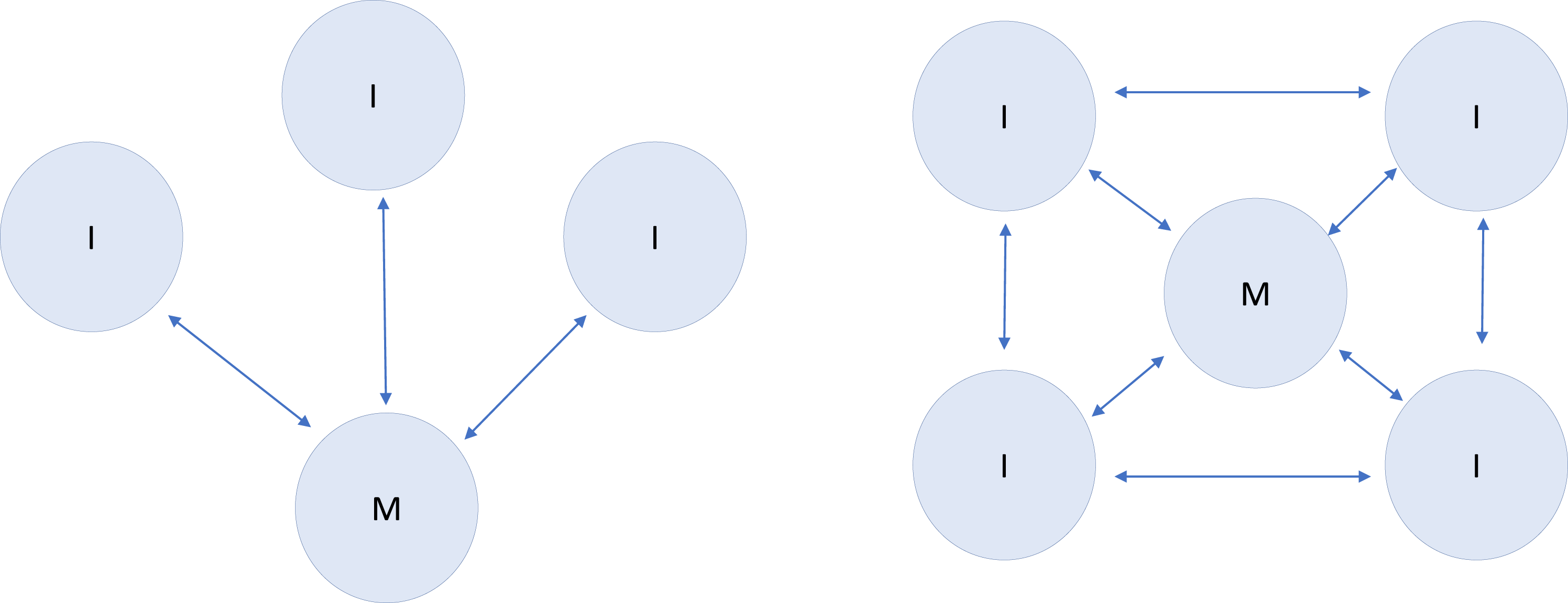
Sixth, we found that the interviewees’ household status and media environment were much more important in online settings. Normally, focus group interviews are conducted in neutral settings where people are called to a university, a conference site, or some other institutional setting. In online focus groups, participants are mostly in their private homes. On the positive side, the inter need not to travel to a certain place to take part in a focus group discussion allowed us to secure the inclusion of informants from more remote places and with physical disabilities. As a challenge, we encountered new types of privacy concerns as ethics-related implications. Zoom interviews made the researcher, other interviewees and sometimes, inevitably, household members enter participants’ private space (see also Neo et al., 2022). All interviewees were informed about the aims of the research, the benefits and risks involved, and their rights in the recruitment process and before the interview. They provided their verbal consent to participation and recording and could volunteer to using cameras during the online group conversation. A few participants switched off their camera after the introductory remarks. Younger interviewees tended to be better equipped and more skilled in protecting their privacy, e.g., by using filters to blur the home background, or participating via a mobile device from their car, garage or sauna to isolate themselves from household members. The majority, however, participated from their living rooms (older participants) or bedrooms (younger participants). Securing the informants’ privacy vis-à-vis household members was sometimes beyond the researcher’s control as they could not know whether participants were always alone in the room. Older participants, often working from a stationary computer, had less opportunities to change the setting of the interview.
Seventh and last, there are also questions related to the sharing of data online, especially concerning GDPR. As our project conducted interviews in three languages, and as researchers, each of us do not master each other’s languages, we needed to translate the interviews into our common working language English. There are several translation applications available, and after testing four software programs, we decided to use DeepL. However, since the freemium version of DeepL runs translation online, we had to anonymize all our interview transcripts beforehand manually and carefully to preserve anonymity in compliance with GDPR. However, this procedure does not differ substantially from the code of conduct of handling personal data when conducting in-person focus groups.
Our experience confirms that focus groups, with their merits and limitations, is a type of data collection that cannot be transferred directly from in-person situations to online settings without acknowledging the specific interactional structure of the latter. Researchers need to consider the size of the groups and the duration of the discussions as well as the communicative dynamics and the role of the moderator. Critical reflexivity of these issues also matters because they affect the ways in which questions are raised, interpretations are made and how the group dynamics evolve.
Discussion
Online focus groups may have the potential to function as a restrictive and exclusionary device, but as online settings have their own limitations and barriers, so have in-person focus groups. For instance, conducting online focus groups may be beneficial to overcome constraints related to the geographical location and physical disabilities of participants, and research funding. They may also help diminishing problems related to the complexity of data collection that in-person focus groups require from researchers. However, although online focus groups have proven useful in some, very specific settings, our analysis revealed significant differences between the two generational cohorts. Although we encountered some cultural differences between the three countries, our main methodological lessons, and suggestions for further audience research, centre on the need to consider the many subtle facets of inter-generational differences when planning online interviewing.
As we witnessed, not all barriers were rooted in access to technology and connectivity. Levels of digital skills and self-confidence in use also played a decisive role in older participants’ possibilities and willingness for taking part in online research. Considering the various aspects of the “gray digital divide” (Huxhold et al., 2020), there is a need to reflect on the ways in which age and online methods intersect.
As a contribution to methodological development within qualitative research, the study provided the following insights into challenges in engaging different generations in online interviewing: 1. As is already established in previous research, group size and communication dynamics need to be adjusted to the online setting, and to our experience, smaller groups of maximum five participants will be beneficial for smooth turn-taking among participants. 2. Participants’ digital skills, familiarity with the medium, and educational and vocational background are crucial factors, and we can advise researchers to be flexible in choosing interviewing tools in order to build trust in technology and in the interviewer and overcome insecurities among participants. 3. In onine interviewing platforms, there is a need for additional ethical considerations when planning, executing, analysing and, if the research design so requires, sharing the interviews between researchers in order to secure participants’ privacy and confidentiality.
The fact that methods books and articles pay little attention to focus groups might be that such types of group interviews introduce many challenges when conducted online, as we detailed in the paper. However, our aim was to move beyond looking at online focus groups as a procedure by default or substitution. Better knowledge of the pros and cons of online and offline focus group interviews can contribute to better methodological choices in the future, which might include considering that the proclivities of one modality may match the vulnerabilities of the other. We even wish to suggest that combining both modalities may elicit a wider range of responses. Both procedures combined expand the possibility of accessing diversified practices, experiences, and points of view—that is, more socio-cultural contexts and positions. The mapping of multiple regards and tensions between conflicting perspectives invites more nuance and complexity into research. Hence, by advocating the complementarity between both modalities of data collection methods—in-person and online focus groups—we argue for the normalization of hybrid methods.
Naturally, we have not exhausted the topic of the relation between online and offline interviewing, and we acknowledge the limitations posed by the small amount of focus groups we conducted under these specific circumstances. Our conclusions are also limited by the specific topics of our interviews—online state and commercial surveillance. For some informants, these are sensitive and complicated matters (which can explain why some did not want to take part in group discussions online). Less sensitive topics might have produced other reactions from the interviewees. We thus would welcome a further discussion of the limitations and opportunities of hybrid use of online and offline interviewing.
Conclusion
This paper has offered a reflexive account of the use of online focus groups in a study of how experiences of authoritarianism affect media users’ attitudes towards corporate and state surveillance. The critical discussion has advanced our understanding of the challenges and implications of this online method, having in mind that procedures of data collection are an important issue as they may impact on the knowledge produced. We have analysed the ways in which the move from offline to online interviewing has interfered with the process of conducting focus group interviews. We conclude that most of these interferences resulted in a need to adjust the methodology to better fit the online setting, and reflect critically upon the issues of technological preconditions and digital skills, recruitment, group size, degrees of previous acquaintance, the role of the interviewer, participants’ household status and media environment, and ethical considerations concerning privacy and data management. Furthermore, we suggest that future online focus group research would benefit from using smaller groups and adjusted moderation, flexibility in interviewing tools and channels, and new, online-specific ethical considerations when planning, executing, and analysing interviews. We also argue for the possibility of mixing online and offline formats.
Footnotes
Declaration of Conflicting Interests
The author(s) declared no potential conflicts of interest with respect to the research, authorship, and/or publication of this article.
Funding
The author(s) disclosed receipt of the following financial support for the research, authorship, and/or publication of this article: This work was supported by Riksbankens Jubileumsfond (P19-0822:1).
