




Abstract
Arts-based research can provide pivotal avenues for researchers and participants to explore experiences that are difficult to put into words. Arts-based methods offer important opportunities for participants to develop reflexive understanding through material interaction with art and mark-making supplies. While sensorial and embodied experiences are entangled with arts-based methods, there is little methodological and theoretical work that puts arts-based research methods into conversation with sensory ethnography. This methods paper provides a detailed, critical reflection on the development and implementation of the sensorial arts-based exercise, Beneath the Surface, for research that examines solid-organ transplant recipients’ embodied experiences through a crip/feminist/materialist framework. Adapted from art therapy practices, Beneath the Surface generated a novel context for the articulation of embodied experience, creating space for the expression of sensations and feelings that fall outside the dominant cultural narratives of transplant, such as the “gift of life” or a “second chance,” that demand absolute gratitude. Beneath the Surface contributes to theoretical discussions surrounding embodiment, inscription, and interiority. The exercise also demands attention to ethical deliberations, highlighting the critical importance of developing trauma-informed research protocols and addressing the historically fraught relationship between critical disability studies and art therapy.
Keywords
Introduction
Sensory ethnography positions embodied experiences as important sources of knowledge (Culhane, 2016; Pink, 2015). As a growing theoretical and methodological framework, sensory ethnography challenges the Cartesian dualism between body and mind that locates knowledge in the mind, shifting how fieldwork is conducted. While literature surrounding sensory ethnographic field practices has been more robust in relation to theoretical considerations, it is less oriented to the actual making/doing that facilitates the expression of embodied knowledge
(Nakamura, 2013; Stoller, 1997; for exceptions, see Elliott & Culhane, 2016; Pink, 2015). These practices of making/doing are especially formative as modes of knowledge production, given that understandings, bodies, and aesthetic judgments are enacted in ways that enable insights to emerge through sensual and tacit means, not only through cognitive awareness (Burri, 2021).
We aim to bridge this gap between sensory ethnographic methods and arts-based research, offering a detailed reflection on our arts-based sensory interview exercise, Beneath the Surface. This arts-based research practice is part of the interview protocol for a multimodal interdisciplinary study titled Frictions of Futurity and Cure in Transplant Medicine (“Frictions”). The authors, as part of the larger Frictions team, are a group of social scientists, mental health practitioners, and artists whose collaboration explores the generative and underlining tensions, ambiguities, challenges, and provocations that surround psychosocial well-being within the field of solid-organ transplantation. We developed this exercise from sensory and arts-based research methods to respond to the challenge of eliciting embodied experience in biomedical settings that socialize patients and practitioners to privilege Cartesian logic that locates knowledge in the mind. Our exercise emerged in conversation with growing attention to visual and performative methodologies in health and public health research. These methodologies provide critical opportunities to explore “beyond the dominant biomedical paradigm” and challenge and complicate entrenched discourses on solid-organ transplantation experiences (Guillemin & Drew, 2010, p. 179). Our research asks, How can a focus on arts-based sensory knowledge generate different ways of knowing solid-organ transplant experiences? In this paper, we first synthesize the turns to sensory ethnography and arts-based methods before recounting the process of developing the Beneath the Surface exercise and its relevance to the Frictions project. We then discuss how critical disability studies and new materialist approaches to embodiment further complicate the phenomenological and theoretical underpinnings upon which much sensory ethnography is premised. Finally, we explore the challenges we have encountered with this approach, namely, how we work to differentiate the ethnographic exercise Beneath the Surface from an art therapy session. We contend that this arts-based interview exercise provides an important intersection for arts-based, sensory, and imaginative methods in ethnography that are informed by a convergence of crip/feminist/materialist theorizing.
Embodied Sensing
The growing attention, or turn, in a range of humanities and social science disciplines to bodied and sensory experience is not without debate. In anthropology, although invesitigations sensory experience share a critique of the outsized attention to sight in participant observation, contention arises over the utility of phenomenological approaches (Ingold, 2011; Pink, 2010) compared to those that seek to identify culturally specific sensory systems and their hierarchical arrangements (Classen, 2012; Howes, 2010; Howes & Classen, 2014; le Breton, 2017). Sensory ethnography in the field of visual anthropology highlights the synesthetic quality of sensory engagement wherein images might conjure smells and textures (Nakamura, 2013). Multisensory experiential approaches in visual ethnography are additionally attuned to affects and emotions, experienced somatically or otherwise. Despite divisions and contentions concerning sensory ethnography’s theoretical and methodological foundations, a mutual understanding that “sensory information rarely acts alone” (Nakamura, 2013, p. 1334) emerges. The community of sensory information is material and embodied—and “characterized by uncertainty” as a form of knowing that is inextricably tied to not knowing in full (Culhane, 2016, p. 15).
Such attunements to uncertainty and embodiment are particularly important to ethnographic research in biomedical settings. Biomedical institutions and discourses shape the narrative practices of both health practitioners and patients (Berkhout & Stern, 2021; DelVicchio-Good & Good, 2000). Medical anthropologists and medical humanities scholars characterize biomedicine as engendering “epistemological narrowing” (Squier, 2007) that limits the scope of valued forms of knowledge and flattens embodied experiences into data points (Canguilhem, 2015[1978]; Jain, 2013). Biomedical frameworks have historically demanded forms of communication that privilege the quantitative and the material-visible (Canguilhem, 2015[1978]; Foucault, 1994) to demonstrate mastery of biomedical knowledge (Good, 1993). Biomedical discourse is thus simultaneously concrete in its empirical attention and abstracting in its homogenization of patient bodies and dehumanization of human suffering (Kleinman, 1997, p. 96). As a result, biomedical frameworks narrow the scope of communicable experience, “render[ing] unspeakable certain aspects of distress and suffering” (Berkhout & Stern, 2019, ii).
Challenges of representing multisensory and affective experience extend beyond the bounds of biomedicine. The question of representation is persistent in sensory methods, whose advocates stress the inadequacy of academic writing to express the nuances and textures of embodied and affective experience. Michel Serres expands this critique beyond academic writing and describes it instead in terms of an “addiction to language” (Serres, 2008, p. 92). Indeed, sensory and imaginative ethnography are premised on the position that not all experience or knowledge “may be expressible in words” (Culhane, 2016, p. 52). The growing interest in multimodal methods and representation endeavors to remediate this conundrum. Here, artistic methods become tools not only for communicating ethnographic evidence but for collecting it as well. Artistic expression, like sensory experience, cannot always easily, readily, or accurately be melded into a verbal telling. Verbal communication often requires a coherent narrative with a problem, climax, and resolution. Conversely, artistic modes are non-linear (Berkhout & Stern, 2019) and often embrace contradictions and nuances that are smoothed over in verbal telling (Hogan & Pink, 2010). Art thus becomes an important source of eliciting sensory experience and a way of conveying those ethnographic findings.
These responses to the challenge of representation in sensory ethnography inform our approach to eliciting sensory experience in biomedical spaces. Biomedical institutions do not typically value forms of knowledge that fail to adhere to narrative conventions of linearity, coherence, and articulation (Good, 1993; Jain, 2013; Squier, 2007; Street, 2014). This can foreclose opportunities to explore understanding that sits outside of reductionist frames. Given that sensory ethnography also identifies the challenges of verbalizing and communicating sensory experience, arts-based methods also intervene here, engendering modes of communication, evidence, and storytelling that subvert narrative conventions (Bagnoli, 2009; McNiff, 2011; Potash, 2019).
Critical Thinking on Arts-Based Methods
Arts-based methods likewise provide unique avenues into dialogue. These methods centre the subjective experiences of participants and position participants as “knowers” themselves (Gubrium et al., 2014, p. 1612). As a result, arts-based methods have the potential to create more equitable power dynamics between researcher and participant (Shaw, 2016). Much like sensory methods, arts-based methods interrupt the taken-for-granted temporalities of verbal interviews. Artmaking methods might unfold in silence, providing different temporal possibilities for reflection and different ways of sitting with silence.
However, the opportunities that arts-based methods offer also require critical attention to contextualization and reflexivity. Contextualization requires multiple sensitivities. First, the products of visual and performative methodologies must be contextualized within the research frame—presenting the works without such explanations risks their misappropriation and misapprehension (Brady & Brown, 2013). Contextualization also emerges as important to how visual data are used. Guillemin and Drew (2010), writing on using photovoice and photo elicitation with individuals experiencing postnatal depression, emphasize the necessity of participant commentary as part of the visual story. Brady and Brown (2013), likewise, write that providing a wider context is essential to ensuring that participants’ creations are legible within the epistemological commitments of a given research project. Here, critical attention to context cautions against instrumentalizing visual and performative research methods and uncritically applying methods from one project to another. Instrumentalization risks foreclosing the very opportunities for emergence and immanence that contribute to these methods’ value, replac ing immanence with rigid guidelines that inhibit the co-production of knowledge (Lewin & Shaw, 2021). Context, here, is not so much a bounded concept to be stirred in, but rather an ongoing process of analyzing and interpreting in collaboration with the participant. In this way, context is also a call to effect a reflexive practice and to build a reflexive ethic into the research process and reporting.
Reflexivity raises important issues of how arts-based research methods are being framed and how researcher/s shape the focus of research encounters. Shaw (2016) explains that although arts-based methods are often framed as enabling stories and opening up space for new expressions, researchers must also be aware of the barriers such methods present. We understand this call to examine barriers as part of a broader invitation to explore frictions within our research—to pay attention to the dynamic tensions that create and close different opportunities for expression. Recognition of barriers complicates narratives of visual and performance methods as inherently positive and instead asks how the researchers’ focus also engenders a particular world of possibilities.
Developing the Beneath the Surface Exercise
The Frictions team developed the Beneath the Surface exercise as part of a broader project that is dedicated to developing nuanced understandings of experiences of solid-organ transplantation (e.g., kidney, heart, liver, and lung transplant). The Frictions project brings together researchers from psychiatry, critical disability studies, science and technology studies (STS) and medical anthropology, alongside artists with lived experience of organ failure and transplant. We aim to address central challenges in transplant medicine, including organ procurement and challenges in waitlisting (of and for) potential recipients; accessing psychosocial supports; and the experience and sequelae of graft failure. This interdisciplinary team draws theoretical inspiration from crip theory and feminist STS. These lenses raise important questions surrounding the embodied experiences of organ failure and transplant, the ways certain lives and bodies are prioritized and valued, how discourses and imaginaries of cure and futurity are embedded in transplant medicine, and what unintended consequences these disciplinary matrices might entail for transplant recipients, donors, families, and clinical team members.
Frankel, at the time of publication, is the project’s PhD candidate research assistant studying medical anthropology and feminist STS. Frankel was the first point contact for this stream of research participants and facilitated interviews with Stern, an art therapist, a practicing artist and a medical educator in health, arts and humanities. Berkhout and Stern have worked together clinically, in arts-based trauma therapy and a research capacity, modifying artistic making practices informed by trauma-informed care for research settings. Fritsch, a critical disability studies and STS scholar, is Co-PI on the Frictions project with Berkhout. Together, with the guidance of Stern, we collaboratively developed the interview protocol described below.
The generative connections between arts-based research and sensory ethnographic methods (Hogan & Pink, 2010) inspired the Frictions project team to develop an interview protocol that integrated these two approaches. In Berkhout and Stern’s prior work bringing arts-based therapy approaches into qualitative research methods, their workshops utilized making practices to explore unspeakability in lived experience of first-episode psychosis (Berkhout and Stern, 2021). Building from these earlier workshops, the Frictions interviews consisted of the following practices: First, we started with an introductory “scribbling in” exercise consisting of a free-flowing movement of the hand with whatever mark-making materials are available (e.g., pens, pencils, markers, paints). This exercise makes space for forms of engagement and expression that might fall outside of discursive narrative conventions—and the norms of biomedical discourse that often have a narrow vision of valuable data (Squier, 2007). Second, we used double-sided prompts to invite multiple ways of engaging with whatever materials are available (e.g., “this is what I show/this is what I hide). Finally, we adopted a witnessing practice or “noticing back,” whereby close visual engagement with the works reflected on elements of form (e.g., shape, texture, colour, composition), as well as the emotional impression left by the pieces. This moved the engagement with each piece out of a representational/interpretive space and focused on affective and sensory connection.
With these tools from this prior context, the Frictions team began to explore what making practice might fit best with the questions and problematics of the study. Initially, our interest in embodied experience made whole-body mapping an attractive option for building an arts-based interview (de Jager et al., 2016). Whole body mapping is often conducted as a group exercise wherein participants lie on large pieces of paper spread across the floor. Another participant then will trace the outline of the first’s body. Once participants’ bodies have been outlined, they are encouraged to fill in their forms with the colours, images, and patterns that speak to their experience (Dew et al., 2020). Chernelle Lambert, Favero, and Pauwels use whole-body mapping to elicit life stories from research participants living with HIV, finding that this exercise “explores the body as a vehicle in which we exist in the world” (Lambert et al., 2022, 175), effectively grounding the exercise in phenomenological orientations to body and world.
However, whole-body mapping posed three challenges for the Frictions project. First, the exercise requires a large, dedicated space that was not available at our research site. Second, whole-body mapping also requires participants to be able-bodied, as they must be able to lower themselves onto the floor and get back up. This is not feasible for many individuals who live with overlapping forms of medical complexity, especially those who are recent transplant recipients or those experiencing complications. Further, an exercise that presumes non-disabled bodies contradicts the Frictions project’s crip and critical disability studies commitments. Third, the team was concerned about the associations that outlines of bodies could generate. On the one hand, the whole-body outline risked encouraging the kinds of literal, representative thinking that we were trying to move away from with this exercise. For example, the whole-body map might prompt the participant to focus on the site of the transplant within the body and ignore other sensorial and embodied experiences. On the other hand, we were concerned that an outline of a body too closely resembled the chalk outlines of dead bodies in television crime dramas. Because transplantation is fraught with close proximities to death, it was of the utmost importance that our research methods were trauma-informed and therefore free from associations with death and how it is sensationalized in popular media.
We explored substituting the whole-body outline for the outline of a hand. Here, each finger would stand in for one of the five senses. Tracing a hand satisfied our concern about the scale of the materials required for the exercise, as someone in a hospital bed would be able to do it. Further, we would also be able to conduct the hand tracing exercise via online video interviews. However, where body mapping presumed a non-disabled body, hand mapping presumed a five-fingered hand. The challenge of direct representation also remained pressing.
At this juncture, Stern contributed her expertise in art psychotherapy to the conversation, suggesting that we use the exercise Beneath the Surface that she developed in her earlier trauma therapy work. This exercise asks participants to create a cast of their hand and forearm with kitchen aluminum foil. Participants choose how to position their hand and, after making the cast, have the opportunity to transform the cast by bending, cutting, tearing, flattening, and marking it. Finally, the cast is fixed to a board or paper (the size of a legal pad), on which participants might further draw, write, and scribble.
Taking a cue from Anna Harris’s team-based sensory ethnographic work (Harris et al., 2019), our team engaged in a trial run of the activity that was conducted over Zoom. This enabled us to assess if the practice was feasible through a virtual setting since not all participants would be able to engage with in-person interviews (at the time of writing, seven were ultimately in-person and sixteen were virtual), and it was an opportunity to assess our prompts and instructions for clarity. Frankel and Stern first asked Frictions team members to choose a medical experience and reflect on the different sensory memories associated with that experience, moving gradually through sounds, scents, tastes, textures, and sights. With these sensory memories awakened, Stern guided members through the making of the cast: choosing how to position one’s hand, whether with an open palm, a closed fist, or any position that speaks to the feelings of the medical experience. Once the hand and forearm were covered in foil, Stern prompted everyone to remove their cast, examine it, and ask, what more does it need or call for? A first step can be to change the shape of the cast itself. One of our team members began to trace the creases forming on the foil and as the foil began to fall apart and mapped the different creases onto a piece of paper. Another slid a pen quickly over the surface of the excess foil around the forearm of her cast, creating curls that mimicked how the cast’s fingers turned in toward the palm. Participants are then invited to make marks on and around the cast. Here, one team member bisected the paper with two different colours of tempera paint across which the cast lay. Another team member found she needed to add another cast: in the transformation and mark-making process, she realized that she was often reaching for others. These modifications arise without recourse to verbal associations. They come about from one’s physical response to the material qualities of the media. The body of the foil cast elicits amendments and additions from the participant, which are applied materially, further refining the cast’s expression in an ongoing, wordless conversation.
Foil is a generative material to work with. It is easy to find, inexpensive, and highly malleable. As the examples above show, the foil sometimes speaks back. It can nod to what isn’t there and what should be. It can move in unexpected ways that deepen and expand participant reflections. At the same time, foil can also be frustrating. One team member who is also a professional artist found working with foil exasperating as the foil would not move as he wanted. While foil is malleable, it is also obstinate and fragile. As will be discussed below, these qualities of foil are important to how this exercise is trauma-informed. That is, it is an exercise that asks participants to recall difficult experiences but endeavors to do so in a way that does not retraumatize participants. The foil, in speaking back and refusing to be disciplined, enables participants to differentiate the cast from their own bodyminds, making the cast an external container for embodied experience.
After determining that Beneath the Surface was feasible for interviews conducted online, we integrated the exercise into our research protocol. Frankel and Stern conducted this exercise as part of the second of three interviews. The first interview within the larger study focuses on participants’ transplant journeys, their experiences with medical teams, what kinds of care and attention were most meaningful, and what might have been absent. The second interview begins with the scribble-in exercise. Frankel then draws the participant’s attention to sensory experiences that arose in the first interview and verbally explores those further with the participant. Although the interview protocol asks about each sense individually, we have found that prompts for sounds might elicit textures and haptic qualities of transplant experiences, or a question about smells might recall tastes, sounds, or images. Frankel or Stern then guides participants through the cast-making process and its subsequent transformation. This usually takes about 10–15 minutes, which is often silent, although sometimes the participant will talk through what they are doing to and with the cast. When the participant’s action slows, Frankel or Stern will then ask if the cast feels done.
We then engage in a dialogue of “noticing back.” Here, we do not make any normative or aesthetic judgments on the cast. Instead, we will make observations about what we see or find striking. Noticing back is not an evaluation but rather a form of witnessing that can encourage further exploration of experience but does not require it.
The majority of these interviews have been conducted online. Creating an online-accessible exercise was vital. While some participants lived within walking distance of the hospital where we conducted research, others were hours away by car. Furthermore, transplant recipients take immunosuppressive medications to prevent graft rejection. Online interviews provided participants with the space to act according to their comfort levels in accessing public transportation or entering hospital spaces for in-person interviews. While we would provide participants at in-person interviews with paints, markers, yarn, pencils, foil, and other supplies, we found the exercise just as evocative when participants gathered pens and highlighters for online interviews. As a result, the online option in combination with the exercise design has ensured that participation is accessible and that the exercise’s structure does not preclude participation based on wellness or dis/ability.
Surface and Depth
Surface and depth are often associated with dichotomies of the superficial and the profound, the plain and the mysterious, and the unreliable and the true. The Beneath the Surface exercise plays with these binary oppositions, simultaneously confounding and underscoring them. The exercise provides nonverbal opportunities for communication. Participants are provided with prompts and materials to convey experiences that might resist articulation. This is especially important in the case of trauma, which theorists have long associated with un-integration or dissociation from one’s life story (van der Kolk & van der Hart, 1991). While much twentieth-century literature on trauma advances narrative solutions to post-traumatic difficulties (Tuval-Mashiach et al., 2004), more recently, academic and public-facing work has highlighted trauma’s stickiness within the body as particular images, scents, or sounds can trigger traumatic recall (Pillen, 2016; van der Kolk, 2015). Here, the triggered person re-experiences elements of the traumatic event itself and misses the buffering quality of memory. Memories, by contrast, change over time and might be retold in different but truthful ways (Brison, 2023). The traumatic memory stays defiantly unaltered. The relationship between trauma and sensory triggers makes the construction of a trauma-informed interview especially important.
The cast intervenes in important ways here. The cast serves as a container for participants’ experiences of transplantation. Although the cast is formed from the participant’s hand and forearm, the act of removing it and subsequently transforming it, both reinforce the foil’s separateness from the participant and allow the participant to enact control. In this way, the depths of participants’ transplantation experiences are not only brought to the surface of the foil but are reconstructed as the foil’s surface. The surface is not superficial, plain, or unreliable. Rather, it becomes a testament to the profound, mysterious, and idiosyncratic dimensions of transplant experience.
These dimensions can often go unarticulated. Discourses of transplantation as a cure, the “gift of life,” and a second chance, tend to foreclose opportunities to express the trials and challenges of transplantation. Not only does transplantation require rigorous adherence to biomedical and pharmaceutical regimes post-transplant but often also entails complications, including rejection and graft failure (Silverstein, 2023). We found that the Beneath the Surface exercise—because it circumvents the constrictions of narrative generally, and transplantation narratives specifically—provides important opportunities for complaint. Here, the pains and distressing sensations of participants’ transplant journeys find more robust articulation than in oral interviews where any mention of difficulty is often and immediately followed by caveats of gratitude. Gratitude still surfaces in this exercise but emerges alongside expressions of frustration, difficulty, and suffering. The cast exercise engenders opportunities for holding multiplicities that need not cancel out one another. Further, multiple contrasting experiences need not be ordered sequentially or separately by narrative structures.
The Friction team’s methodological and theoretical commitment to sensory ethnography further complicates the idioms of surface and depth. Sensory ethnography draws from phenomenological insights—namely, that experiences of the body are central to human experience and the relationship between body and surrounding environments (Merleau-Ponty, 2013 [1945]). This idea contrasts with the language of inscription that accompanies Foucauldian understandings of the role of discourse in the production of subjects and subjectivities. For Foucault, the body is “totally imprinted by history” (quoted in Crossley, 1996, p. 101). Although corporeal feminist movements suggest that phenomenology and inscription are irreconcilable, Crossley (1996) finds that Merleau-Ponty and Foucault were writing against notions of bodies as closed and as defined by interior qualities such as the soul. Thus, neither Merleau-Ponty’s attention to the habits formed through ways of being in the world nor Foucault’s focus on the ways in which bodies are disciplined through space and discourse, is concerned with interiors.
This raises the question of what theoretical approaches to body and senses are generative for thinking with both surfaces and depths. Matthew Wolf-Meyers describes senses as mediating and translating exterior stimuli into bodily interiors, making them important sites for understanding bodies’ relationships with their environment (Wolf-Meyers, 2020). His new materialist approach to the senses, wherein bodies are formed through intra-rather than inter-relationality, draws from Karen Barad’s work. Barad argues that bodies (and nonhuman entities) come into being with other bodies. That is, contrary to centuries of Western metaphysics that posit that entities have their own determinate properties, intra-action “recognizes that distinct agencies do not precede but rather emerge through intra-action” (Barad, 2007, p. 33). This lens positions bodies as “radically open” (Barad, 2012, p. 214). Fritsch builds on this idea of matter as “a dynamic and shifting entanglement of relations that in each specific enactment reconfigures the world” (2015, p. 52) in her article “Desiring Disability Differently.” Here, embodiment is not only a matter of phenomenology but rather a material, “intracorporeal practice” (Fritsch, 2015, p. 55). This approach to embodiment attunes itself to the agential movements of matter and the material-discursive configurations that are constantly in the process of producing bodies. In the context of sensory ethnography, this framework raises important questions about how insides and outsides are produced and what boundary-making practices are employed to maintain these distinctions.
Such maintenance is highly charged in the context of solid-organ transplantation, which requires the opening up of bodies not only for the nominal transplant surgery but also for routine bloodwork, draining ascites, repairing wiring, or addressing complications. Openness is not inherently desirable (Roberts, 2017). But in transplant, distinctions between inside and outside become further complicated. Jean-Luc Nancy examines these complications in terms of intruders and strangers. Reflecting on his own heart transplant, Nancy configures the viruses and bacterial infections that he experienced throughout his life as intruders—rather than the donor heart—because these viral and bacteria lie dormant and newly threatening in his post-transplant immunosuppressed state. He writes, “What a strange me!...Not because they opened me up, gaping, to change the heart. But because this gaping cannot be sealed back up...I am closed open” (Nancy, 2008, pp. 176–8). The reconfiguring of surface and depth that the Beneath the Surface activity engenders intimately converses with the troubling of bodily boundaries that new materialisms and transplantation signal.
Frictions
Three frictions have emerged in our work and reflections on the Beneath the Surface exercise. Anna Tsing articulates friction as a defining feature of global interaction—what propels Enlightenment universals across the globe and prevents them from being “fully successful and the same everywhere” (2004, p. 10). The frictions we identify here refer to the generative tensions and contradictions we have encountered, where friction serves as “a reminder of the importance of interaction” (Tsing, 2004, p. 6) and intra-action (Barad, 2007).
First, Beneath the Surface presents ethical frictions. Among the potiential benefits of research participation identified in our ethics protocol, we note that participants might benefit from and enjoy sharing their experiences. Indeed, one participant, after carefully removing the delicately molded cast from her arm, immediately crushed it then gingerly opened it and began to smooth it out. She explained that she wanted to be like the foil and that she needed the foil to see this need. Another participant noticed her anger with her transplant experience—she softened her anger by covering the cast with pastel pink tissue paper, saying, “I needed that.” (Image 1)
Arts-based methods developed concurrently in qualitative research and art therapy circles in the 1970s (Leavy, 2015). That similar methods are shared across therapeutic and research domains raises critical questions about how to differentiate therapeutic practice from research. Sensory and imaginative ethnographic investigations that mobilize arts-based methods complicate these questions as sensory and imaginative ethnography are deeply attuned to affective intensities. This knot of methods and domains prompted the authors to reflexively question how these methods weave in and out of the domain of therapy. Stern and Frankel—art psychotherapist and researcher, respectively—discussed this question before and after each interview. They have found that the process of noticing back at the end of the scribble-in and cast-making process is key to differentiating an art therapy session from an arts-based interview. Noticing back does not entail asking participants how they feel or what a particular colour or flourish means to them. That is, the subject of conversation is the work that is created, not the creator. As Stern explains, the arts-based exercises provide opportunities for the interviewers to act in the capacity of “professional strangers,” to witness what takes place. For example, in one interview conducted with a transplant recipient and their partner, Frankel observed that both recipient and partner had placed a white pipe cleaner around the wrists of their respective casts, making the subject of the observation the casts rather than a direct comment on shared experience. The participant’s response was material rather than verbal, as the partner pushed the casts end-to-end, took one end of each pipe cleaner, and twisted them together. She exclaimed, “Okay, that’s what was missing…that security of being tied together.” Foil cast torn into two pieces during the interview.
Witnessing is an important form of care that spans the domains of therapy and qualitative research. Ethnographers and anthropologists have made important interventions in professional ethics of care in the context of ethnographic writing (Garcia, 2010; Kleinman, 1997; Moran-Thomas, 2019), but less is written on ethics of care in the interview process. One of the primary ethical obligations of anthropologists, as articulated by the American Anthropological Association (2024), is to do no harm. When working with populations who have experienced trauma, interviews that can trigger participants become problematic. Anthropologists are not necessarily trained in how to work with such interlocutors, although anthropologists with backgrounds in social work, psychotherapy, and psychiatry are among the exceptions. The Frictions research team addresses this issue through co-facilitated interviews. As some interviews are conducted online, we also ensure that we have the address and phone number of the participant, and whether online or in person, the name and phone number of a friend or family member we call if the participant becomes distressed. We also begin each interview by explaining that the arts-based process can bring up a lot of emotions. This practice allows participants to determine how much they want to share or protect themselves from difficult feelings, thus engendering an important sense of control. Finally, we are always careful as we steer the interview toward its conclusion to end on a note that facilitates containment and closure (rather than exposure)—and even to make these route adjustments throughout the interview. This move reflects therapeutic, pedagogical, and scholarly practices that acknowledge how scholarly work can reproduce the same violence it studies (Hartman, 2008). Here, we may call the participant’s attention to sources of joy and capacity expressed earlier in the interview or the first interview.
The second friction we encountered has to do with the articulation of prompts. Prompts, whether questions or arts-based invitations, provide important opportunities for steering the research. They create a focus (Shaw, 2016) and a container within which to operate. A container, here, is not so much a constraint as it is the outline of a sandbox in which to play and explore—or leave. What makes the Beneath the Surface activity unique is the addition of the aluminum foil that acts as a material prompt. The foil’s capacity to speak back, to bend and wrinkle in appealing and frustrating ways, provides constant feedback about how experiences are—and can be—expressed. The material of the foil also has limits. The ways in which participants probe and confound those limits, however, are instructive. One participant, immediately after removing the foil cast from her arm, asked, “Can I break it?” Other participants asked, “Can I stand it up?” And they placed an empty paper towel roll inside the cast’s forearm to support it.
The third friction stems from the project’s theoretical grounding in critical disability studies and crip theory. Art therapy and disability have a historically troubled relationship. The arts-based activities that now comprise arts-based research methods were part and parcel of experiences of medical institutionalization, engendering an ongoing connection between the artworks of people with disabilities and pathology (Gorman, 2011; Yi & Moon, 2020). This connection is further entrenched by the discrimination against disabled artists in gallery spaces (Gorman, 2011; Reid et al., 2019). In addition, arts-based exercises often elicit discomfort from participants who say they have neither experience nor skill in artmaking. The expectation of producing fine art is one reason why Stern prefers the term “mark-making supplies” to “art supplies.” The exercise’s aim is not to create a work of art that evidences a pathology. Instead, participants use mark-making materials as non-verbal media for expression and knowing (Bagnoli, 2009; McNiff, 2011). Approaching the cast as a material mode of knowledge-making and sharing distances this practice from its pathologizing predecessors. But this distance is not complete. The Frictions project has also dedicated funding for artists in residence, prioritizing disabled artists and artists who are transplant recipients. Working to create space for artists with disabilities to produce and share their work is not intended to ameliorate or erase this friction between art therapy and disability, but rather to respond to it in a way that reflects our project’s grounding in critical disability studies and crip theory. (Image 2) Foil cast affixed to participant’s refrigerator.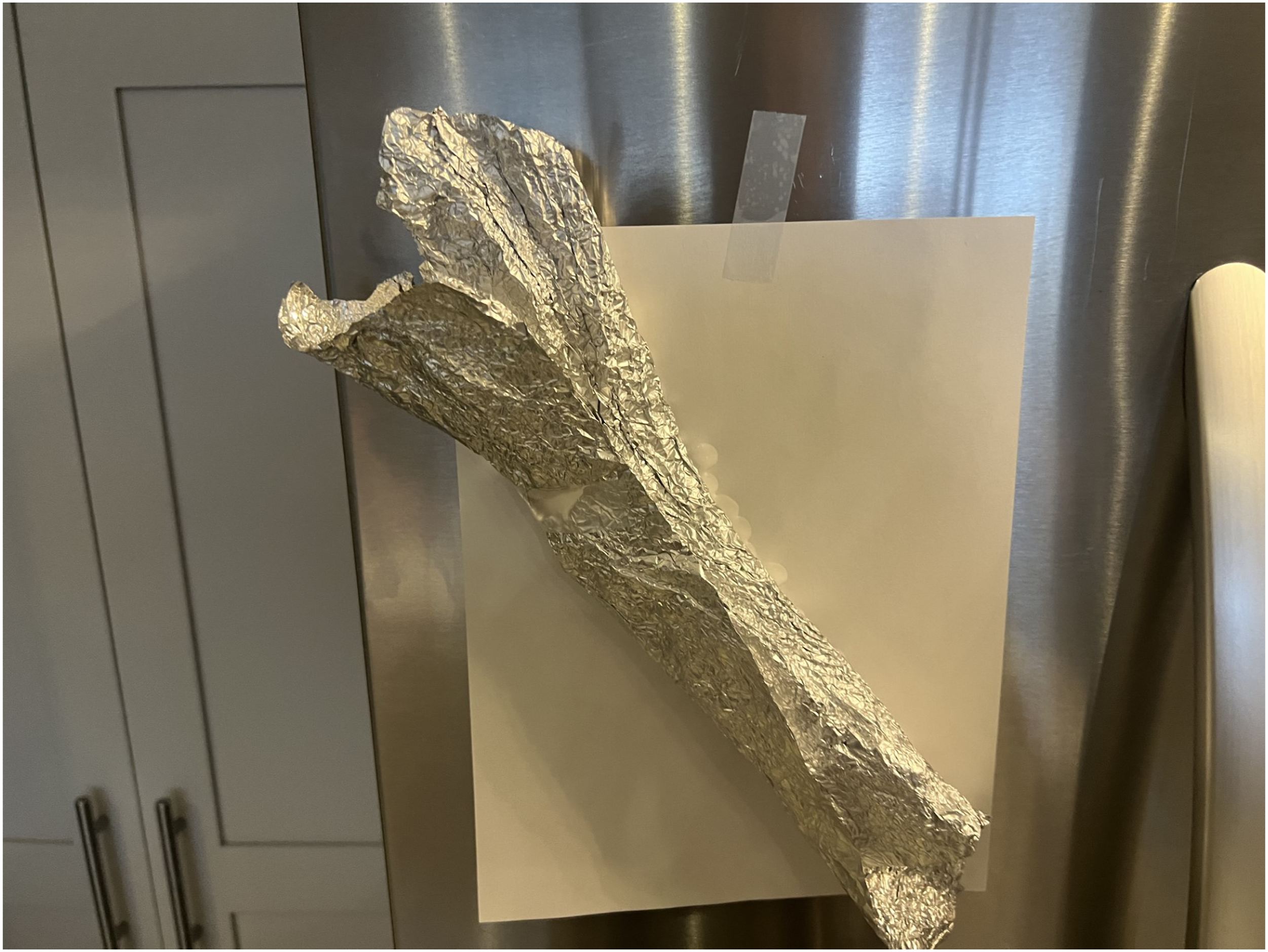
Conclusion
Arts-based research methods provide pivotal ways to make difficult, traumatic, and otherwise incommunicable experiences sharable. In health research, arts-based methods create space for participants to speak back to dominant biomedical paradigms. The Frictions project’s goal to know transplant differently necessitated the use of arts-based methods. Sensory ethnography complements the interventions that arts-based methods enable: our methodological attention to participants’ sensory experiences provided insights into material and embodied dimensions of transplant experiences. Many of these experiences fall outside of biomedical domains and are therefore vital to examining and addressing the delivery of psychosocial supports.
The process of developing the Beneath the Surface exercise foregrounded the need to ensure that the exercise was accessible, doable online, and trauma-informed. Here, accessibility meant creating an exercise that could be done in person, from a hospital bed, or from home. Our attunement to accessibility concerns also drew our attention to historical and contemporary tensions between art therapy and disability arts. The Frictions research protocol offers two important interventions here. First, we created artist-in-residence opportunities within the project, prioritizing artists with transplant experience. Second, Beneath the Surface is as much about the final product of the cast as it is about using the cast itself as a prompt and medium that opens up different ways of knowing and sharing. As a material prompt, the cast spoke back to participants. Working with and through aluminum foil in this way made it less an object to be analyzed and more so a material that facilitates the sharing of embodied knowledge. Finally, it was essential that the exercise be trauma-informed. Our participant population experiences high rates of post-traumatic stress. Asking participants to remove the cast from their arms and transform it made space for participants to enact agency over the cast, which became a container for those experiences. Critically, Frankel and Stern conducted interviews together, along with pre- and post-briefs. This practice exposed the porous boundaries between therapy and research—especially as qualitative research often cites catharsis as one of the benefits participants may experience. Through our reflexive practices, we worked to identify how we could construct these boundaries to ensure that the Beneath the Surface exercise continued to be trauma-informed without purporting to be a therapeutic intervention.
Throughout our study, participants’ foil casts have found many homes. Some participants are eager to keep them and to do the exercise again on their own or with family members. In subsequent online interviews and photos participants have sent, the casts appear affixed to the refrigerator or standing atop a bookshelf. One participant described it as a memento of the state of his arms, which six months after his-liver transplant, were still “so thin.” He looked forward to comparing the size of his arm to the size of the cast as he worked toward gaining weight as part of his recovery. The material of the cast exceeds its frame as a research medium. It becomes part of the materiality of desired futures and testaments to past journeys, each enfolding the other. Beneath the Surface enables often ephemeral insights and experiences to be materialized in such a way that they can be cherished and torn up in equal measure.
Footnotes
Acknowledgments
We are indebted to the Frictions research participants for generously sharing their experiences of solid-organ transplantation. We thank Chloe Wong-Mersereau and Brad Necyk for their role in shaping the Beneath the Surface exercise, and the reviewers for their generative comments.
Declaration of Conflicting Interests
The author(s) declared no potential conflicts of interest with respect to the research, authorship, and/or publication of this article.
Funding
The author(s) disclosed receipt of the following financial support for the research, authorship, and/or publication of this article: This research is supported by a New Frontiers in Research Fund (NFRFE-2019-00448).
