




Abstract
On the Move is a practice-oriented research project with children at asylum centers. The children are a diverse group with different backgrounds, languages and resources. They are in especially vulnerable life situations: They may have traumatic experiences from war/flight/migration/asylum systems in their past. They may also be affected by their parents’ traumas. Their uncertain future affects their daily lives in the asylum centers. The children may be marked by a history of relational loss, and might again lose family, friends or care staff when they move. The children comprise a diverse range of backgrounds, cultures, languages, resources, and challenges. Past traumas, their history of relational loss, and uncertainty about the future cast shadows over the children’s lives. Due to their situation, the children also can be difficult to reach, follow, and support. On the Move had a unique opportunity to research with children living in asylum centers. The project is a collaboration between researchers, children, and professionals at Red Cross Asylum centers in Denmark. It examines how participation in a long-term, holistic and playful movement intervention can support children’s connectedness. It is inspired by a hermeneutic phenomenological research approach, practitioner research and Arts-Based Research. The purpose of this article is to contribute to knowledge about the ethical and methodological possibilities and challenges that may arise when conducting research with children in vulnerable situations. The article focuses on exploring ethical dilemmas and illuminating research methodological processes, and thus does not aim to highlight findings or analyses from the research project. The article demonstrates how ethical foundations and multi-dimensional methods inspired by crystallization can create opportunities to illuminate children’s participation in a playful, holistic movement intervention. Insights from this can inspire and inform qualitative research with children in various vulnerable situations.
Introduction
On the Move was developed through a co-creative partnership between Red Cross Asylum and University of Copenhagen, Department of Nutrition, Exercise and Sports. The project is anchored in the research field of Embodiment, Learning and Social Change, which focuses on pedagogical, psychological, and practice-based research in sport and movement settings and educational contexts. The research field is based at the University of Copenhagen. The On the Move project was developed in close collaboration between practice, project development days, and research. Children at the asylum centers, teachers and researchers have together been co-developers of the project. On the Move was carried out over three years, with an estimated number of 350-400 children participating. The project was anchored in Red Cross Asylum, and On the Move movement activities are still being used there. (Illustration 1). Maise Johansen and Anni Lamhauge
A literature review preceding On the Move showed that sports can reduce stress, strengthen social communities of refugees/migrants/asylum seekers, and create positive experiences and inclusion. The studies also showed that sports can be a meeting place which can create joy and provide a break from the worries of life as a refugee, create a sense of belonging and integration, and lead to positive development for the target group (Doidge et al., 2020; Koopmans & Doidge, 2022; Lewis, 2015; Luguetti et al., 2022; Mcdonald et al., 2019; Middleton et al., 2022; Nesse et al., 2023; Spaaij, 2012, 2014; Stone, 2018; Whitley et al., 2016).
A study done by Ley & Barrio (2010) presents a critical perspective. Their article highlights how sports can have negative consequences, such as exclusion, for people in post-conflict areas and refugees. Therefore, it recommends that sports activities with the target group should be inclusive, based on local circumstances, sustainable efforts, reflections on the participants, and creative approaches. Further, sports activities should be combined with various other activities such as movement and games, and take place in collaboration with stakeholders such as schools and organizations. The study also recommends establishing holistically oriented movement projects (Ley & Barrio, 2010).
TeamUp (2021) is a research project based on a movement-based psychosocial intervention with children at asylum centers in the Netherlands (Bleile et al., 2021). The study shows that the intervention had an effect on the children’s psychosocial situation, but that the project faced challenges with participation, regulation, and handling of the children’s energy and challenges. The study does recommend more movement-based interventions, as these can be suitable for a multicultural group of children at asylum centers (Bleile et al., 2021).
On the Move can contribute with knowledge about movement with children in a group, though from a different perspective than TeamUp’s measurable motor movement intervention and many sports-based studies. On the Move is an intervention with a playful, creative approach to movement that is grounded in a holistic understanding of the body and movement (Winther, 2017, 2024). The research project’s literature review showed that there is little research on children at asylum centers participating in long-term holistic, playful movement interventions. Shorter pilot research projects (under three months) with families at asylum centers in Denmark show that holistic, playful movement activities may have the potential to create joy in movement and enhance attachment processes between children and adults (Baumgarten et al., 2022; Lamhauge et al., 2024). These studies recommend longer-term holistic movement interventions with children and families at asylum centers.
Children in asylum systems may be characterized as a group of children who may be facing essential social, physical, and psychological challenges (Bleile et al., 2021; Ekblad, 1993; Moldendauer, 2017; Røde Kors, 2019, 2023; Vitus & Nielsen, 2011/2017). Experiences of war, conflict zones, flight, migration, and/or the uncertainty within asylum systems can mark children’s life situations (Bleile et al., 2021; Johansen & Winther, 2024; in prep; Røde Kors, 2019, 2023). Children with refugee backgrounds may also be affected by their parents’ physical and psychological conditions, traumas, and stressful experiences (Dalgaard et al., 2015).
Children in asylum centers are characterized as a group of children in a vulnerable situation. Vulnerable populations can be defined as individuals at “higher risks of harm or wrong” (Bracken-Roche et al., 2017, p. 1; O’Brien et al., 2021). Vulnerable populations can also be defined as being “at risk for poor physical, psychological, and/or social health” (Aday, 1994, p. 487). Aday also states that “Relative risk reflects the differential vulnerability of different groups to poor health” (Aday, 1994, p. 487). Agergaard & Lenneis (2024) highlight a need for more studies with ethical and methodological reflections on vulnerable groups within the fields of movement, sports, and health. Nordentoft & Kappel (2011) indicate that it is crucial to uncover dilemmas in research with vulnerable groups, as it often involves a “messy” research process. Vulnerable groups are also often under-investigated due to challenges in reaching, engaging, and safely including them in research (O’Brien et al., 2021). One overarching condition in asylum area research is that migrants, refugees, and asylum seekers are estimated to be one of the world’s most hard-to-reach populations due to their temporality in residences, diffusion among communities, and access to social networks (James, 2023; Shaghaghi et al., 2011). A lengthy approval process is also mentioned as a significant challenge in a research project with asylum seekers in the UK (James, 2023).
Another dilemma in research with vulnerable groups is whether and how the group should participate in the research (Aldridge, 2014). Within child research, several studies indicate a critical shift towards researching with children rather than on them (Moore et al., 2008; Morrow & Richards, 1996; Ponizovsky-Bergelson et al., 2019; Qvortrup, 2002). This involves recognizing the children’s right to express themselves. Research indicates that this shift requires ethical and methodological reflections on how to bring forth children’s own voices (Moore et al., 2008; Morrow & Richards, 1996; Ponizovsky-Bergelson et al., 2019; Qvortrup, 2002). Additionally, these children’s voices may be under-represented and challenging to highlight (Moola et al., 2015). A critical reflection suggests that qualitative studies focusing on giving voice, particularly with children, can have good intentions but may lack reflective considerations (Facca et al., 2020). Research with children in vulnerable situations shows that it is challenging and requires methods to be adapted to children’s life situations (Nomakhwezi Mayaba & Wood, 2015).
The intended contribution of the research project On the Move is to gain knowledge about a long-term holistic, playful movement intervention with children in asylum centers. It can also contribute with knowledge on how to conduct research with a group of children in vulnerable situations, highlighting ethical and methodological possibilities and challenges. This article aims to convey this based on groups of children at asylum centers.
The article will first briefly present On the Move and thereafter the research project’s theoretical, methodological and ethical foundations. This is followed by two sections a) Reaching and meeting children living in asylum centers, and b) Methods for researching with children living at asylum centers.
On the Move
On the Move focuses on researching with children while developing a considered and adapted project. The research project is inspired by co-creation research in which children and movement teachers are involved as co-developers (Philips et al., 2022).
The project investigates children living at asylum centers who participated in a long-term (3-year) holistic, playful movement intervention. Children aged 6 to 15 participated twice weekly in the movement intervention at the Red Cross Asylum centers’ 1 school and after school program (Johansen & Winther, 2024, in prep.). In the intervention, all children in the asylum centers had the opportunity to participate throughout the 3-year project period, estimated to include 350-400 children. The children’s length of participation varied: from the entire period, to joining midway, to leaving the asylum centers during the period. The project’s data is based on children who participated from approximately 3 months to 3 years in the program (Johansen & Winther, 2024, in prep.).
The movement intervention is based on a holistic view of body and movement (Merleau-Ponty, 1962/2002; Sheets-Johnstone, 2012), and was developed, planned, and implemented based on practice-oriented holistic movement psychological theory. This focuses on physical, psychological, emotional, social, cultural and spiritual movement processes (Winther, 2017, 2024), allowing teachers and researchers to see and be aware of resources, opportunities, and vulnerabilities within the group of children (Winther, 2017, 2024). The movement pedagogical practice has been specifically tailored to this group of children who have various languages and cultural backgrounds-;, hence a focus on the language of the body. This entails a playful approach emphasizing creative and co-creating movement processes. The movement intervention is structured around thematic movement programs of 8 weeks duration (Johansen & Winther, 2024, in prep.). These programs integrate elements from multicultural games, world dances, martial arts, inclusive ball games, and outdoor activities (Johansen & Winther, 2024, in prep.). Within this context, an unpredictable, multidimensional, playful, and experiential movement universe unfolded. An example of a movement game used and further developed in On the Move is the old game Kis Pus 2 . The game begins with participants standing in a circle, in pairs on a mat. One pair performs a movement together, and another pair mirrors the movement. Then they make eye contact and switch places. Multicultural music plays in the background 3 (On the Move, 2024).
Repetition is significant for children in asylum centers due to their experiences with frequent changes in residences and relationships (Johansen & Vestergaard-Andersen, 2016). Therefore, each movement session follows a certain structure: (Illustration 2). The structure of the movement intervention created by Maise Johansen and Anni Lamhauge (Johansen & Winther, 2024; On the Move, 2024)
The structure also gives possibilities for including themes and movement activities brought in by the children and teachers during the process (Johansen & Winther, 2024, in prep.). This approach ensures that children and teachers can co-develop the movement intervention and that it can be adapted to the children’s perspectives. During project development days, researchers and teachers collaboratively developed playful movement activities as the movement interventions (Johansen & Winther, 2024, in prep.). Additionally, the children were involved each week in inventing and further developing the movement practice and playful activities. The structure and playful activities that were developed are compiled in the booklet On the Move, 2024.
Theoretical, Methodological and Ethical Foundations
Merleau-Ponty’s (1962/2002) phenomenological understanding of the body broadly inspires the theoretical framework of the research project. Merleau-Ponty focuses on the lived body as the subject of perception. It is the body that guides and carries our experiences, and thus human intentionality is also bodily. According to Merleau-Ponty, this also applies to human perception: recognition of the world occurs through the senses. For Merleau-Ponty, the body is in continual and dynamic interaction with the world. The body is thus seen as subjective and intersubjective, being both lived and experienced (Merleau-Ponty, 1962/2002). Inspiration from Merleau-Ponty’s understanding of the body and movement can also be seen in the project’s drawing on Maxine Sheets-Johnstone’s (2002) work. Sheets-Johnstone sees “movement as our common heritage and mother tongue” (Sheets-Johnstone, 2002, p. 37). She regards movement and the kinesthetic body as what binds us together. And that “corporal-kinetic” is our commonality and comes before language; our spoken language is therefore “post-kinetic” (Sheets-Johnstone, 2002, p. 37). We find ourselves and encounter others through movement (Sheets-Johnstone, 2002). This understanding of movement is relevant for the research project On the Move, which highlights a group of children with various cultural and linguistic backgrounds; all of them can have movement as a common ground.
Inspiration From Hermeneutic-Phenomenological Research
The research project is inspired by a hermeneutic-phenomenological approach, which emphasizes both describing and interpreting phenomena of the lifeworld (van Manen, 2016). This approach involves phenomenological reflection to produce rich, detailed descriptions of lived experiences, aiming to understand their essential meanings (van Manen, 2016). Since the project focuses on illuminating how participation in a long-term, holistic, playful movement intervention supports children’s connectedness, and thereby addresses lived phenomena, this approach was chosen. It is used to describe, illuminate, and understand the lived phenomena that emerged in the multidimensional movement universe that opened in the intervention. The hermeneutic-phenomenological research approach has also inspired the processes of coding, analysis, and writing in the research project. It is inspired by vanManen’s understanding that “interpretative phenomenological research and theorizing cannot be separated from the textual practice of writing” (van Manen, 2016). The hermeneutic-phenomenological approach is also applied in the methods section.
Practitioner Research
The project is inspired by practitioner research, in which research and practice-based interventions are conducted simultaneously (Jarvis, 1999). Therefore, the researchers have continuously participated in the movement intervention, acting simultaneously as researchers and practitioners (co-teachers) (Johansen & Winther, 2024, in prep.). The practitioner research approach was chosen because the research project is so closely linked to practice: the research aims to shed light on the child group in the movement intervention. Practitioner research gives the potential for a close link between theory and practice (Dadds & Hart, 2001). However, this research project is distinct from a variation of practitioner research that involves, for example, nurses researching their own practice with the intention of improving it (Jarvis, 1999). The researchers are not employed as teachers at Red Cross Asylum. Still, the researchers are deeply rooted in practice as they have many years of practical experience with holistic movement practices in various groups. Through co-creative research and previous projects, the researchers are both co-developers of the movement intervention and co-teachers when participating in the movement intervention. Subsequently, the researcher writes down practice narratives. As part of the co-creative project, the researchers reflect on their knowledge with the teachers.
Inspiration from practitioner research entails a dual perspective, meaning that the researchers move between subjective bodily involvement and analytical reflection (Winther, 2015). Therefore, the researchers must be very aware of the challenges in navigating this movement in methodological, writing, and analysis processes (Winther, 2015). Practitioner research also involves a dual role: the researchers must move between being a practitioner (co-teacher) and simultaneously viewing the practice in a nuanced, focused, and analytical perspective (Winther, 2015). The dual role entails both opportunities and challenges. The researcher’s role is not only participation, but subsequently writing down practice narratives, necessitating awareness of both roles (Winther, 2015). This provides the researchers with a deep insight into the children’s movement processes, also when they are challenged. It also offers an opportunity for responding when the researchers assume the role of a practitioner (co-teacher). Here it is crucial that the researchers navigate cautiously, ensuring that such involvement happens in close collaboration with and respect for the children and their teachers. Below is a practitioner researcher’s description of the dual role: Illustration 3. Practitioner Researcher’s Description combined with an Arts-Based illustration by Maise Johansen and Anni Lamhauge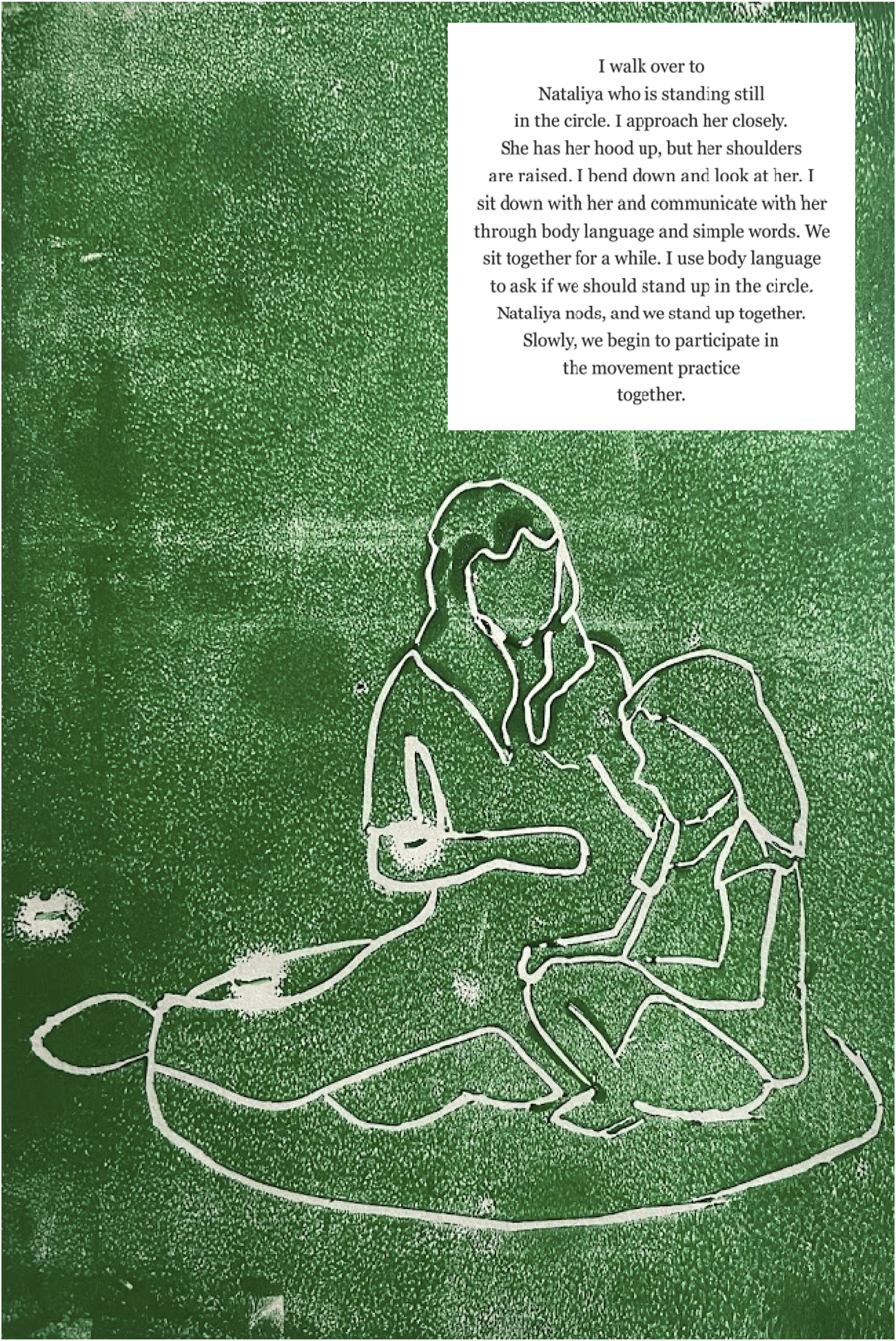
The above narrative shows that researchers 4 have a role as co-teacher in taking care of a child. Moreover, the children’s vulnerable situation can also challenge vulnerabilities in researchers, since the dual role can open them up to being influenced by the children’s circumstances. This can occur in various parts of the research process, both when researchers assume the practitioner role of co-teacher, when writing down and analyzing data, reading the children’s narratives, or conducting interviews with children, teachers and psychologists, as well as when reading literature from the asylum field. Therefore, the researchers in this project also addressed their own vulnerabilities in interactions with the child group, for example by participating in supervision. Teachers could receive supervision through the Red Cross Asylum where they are employed. The researchers received supervision from Helle Winther, who is an internationally certified dance- and movement psychotherapist and supervisor.
Ethical Foundation
In phenomenological ethics, the situation and encounter with the Other (here, the children in asylum centers) is central, as we inevitably hold a part of the children’s lives in our hands. This creates an ethical obligation to care for the children (Brinkmann, 2020; Løgstrup, 1991). Ethics in qualitative research, as here when researchers are close to children in vulnerable life situations, involves dilemmas about meeting the children and whether aspects of the children’s lives can be conveyed publicly (Brinkmann, 2020). At the same time, such research has an ethical potential to enable the voices of people in vulnerable situations to be heard (Brinkmann, 2020). Within social philosophical ethics, it can be seen as the raison d’être of research to help individuals and communities flourish (Brinkmann, 2020; Christians, 2005). The On the Move research project is inspired by both formal ethical codes and rules (Brinkmann, 2020; Kelly & Alli, 2004; Palmer, 2016), and situational and relational ethics (Ellis, 2007), which can be closely linked to the ethics of care (Christians, 2005; Noddings, 1984). Taking care of has been the basis for researching with children in asylum centers, as they are in particularly vulnerable situations. Acting ethically in research contexts can involve following ethical rules, situational and relational ethics, and being considerate throughout all research phases. The concept of giving back is also relevant, understood in this project as the research being beneficial to the participants (Kirsch, 1999; Swartz, 2011). In interaction, these frameworks aim to enable researchers to carefully hold a part of the children’s lives in their hands. However, this does not exclude the possibility of ethical dilemmas arising in any stage of the research. In a subsequent section, the first theme will also discuss ethical processes and dilemmas in the project.
The following sections illuminate a) Reaching and meeting children in asylum centers, and b) Methods for researching with children in asylum centers. These sections explore possibilities, dilemmas, and challenges in conjunction with literature in the fields.
Reaching and Meeting Children in Asylum Centers
Reaching Children
In On the Move, the researchers, through many years of collaboration with Red Cross Asylum and the University of Copenhagen, had created a unique opportunity to research with children in a movement project. However, the research project was still limited and affected by the temporality of the children’s stay.
The researchers and teachers do not know how long the children will stay at the asylum center and hence participate in the project. Children may arrive and leave from one day to the next; they may be deported, granted asylum, go underground, be sent to another center, or disappear from the center in other ways. The children’s participation in On the Move can also fluctuate due to their parents’ situation or changes in their asylum cases beyond the project’s scope. This creates limitations in analysis possibilities. However, the research project shows that with a flexible, adapted, and long-term research project, it is possible to obtain saturated, meaningful scenic descriptions and interviews with both the children and the teacher teams about movement processes.
Approval Processes and Collaboration
Reaching children is also associated with formal ethics (Brinkmann, 2020; Kelli & Alli, 2004). Formally, the University of Copenhagen and Red Cross Asylum have a cooperation agreement concerning ethical principles, rules for research, and informed consent (Palmer, 2016; University of Copenhagen, 2021a). This includes pseudo-anonymized 5 and data protection rules. Drafting the cooperation agreement and information and consent forms for participants has been an extensive process, as the cooperation agreement includes legal issues regarding data responsibility between the University of Copenhagen and Red Cross Asylum. Consent forms were prepared following GDPR guidelines and parental consent legislation.
A crucial limitation in the approval process is to what extent the informants understand the project (James, 2023). When children participate, as in On the Move, parents or guardians must give consent according to Danish law. The parents gave informed consent for their children to participate in On the Move through Red Cross Asylum. Parents gave specific additional consent for children who appear with recognizable faces in publicly shown videos and photographs. The process required translating consent forms and employing interpreters in more than 20 different languages, including English, Dari, Arabic, Farsi, Pashto, Sorani, Spanish, Turkish, Russian, and others. The Red Cross Asylum staff have also individually approached families to ensure they understood what the project entailed. Despite the formal ethical rules, it still may be unclear as to whether the parents understand the content of their consent. In On the Move, Red Cross Asylum has been a crucial partner due to their extensive experience in informing people living at asylum centers. Parents have also had the opportunity to contact the On the Move teachers, whom they know from school and after school programs at the Red Cross Asylum locations, throughout the project period. Research with children who have asylum status thus involves temporal and organizational challenges in obtaining approvals. A potential method for reaching the child group can be to establish long-term cooperation with the community, organization, or state entity. Cooperation also requires reflections on roles and premises, not elaborated in this article; see the research dissertation (Johansen, in prep.).
Limited Knowledge of Backgrounds
In the cooperation agreement, the researchers’ knowledge is limited; they do not have access to information about the children’s asylum cases. This can be seen as a challenge in meeting the children and analyzing the children’s participation processes. Simultaneously, it can be seen as an opportunity to meet the children openly, when they know the researchers do not have knowledge of or can influence their asylum case. In theory, the children can be “free,” without having to think about their asylum case in the research project. However, the project still needed to be based on a fundamental awareness of meeting the children with particular care, recognizing that they have multidimensional resources, traumas and vulnerabilities due to their vulnerable situation (Johansen & Winther, 2024, in prep.).
Meeting the Group of Children
As previously mentioned, children living at asylum centers may have many social, psychological, physical, and mental resources and challenges due to their situation (Johansen & Winther, 2024, in prep.). Situational and relational ethics are therefore particularly relevant (Brinkman, 2020; Christians, 2005; Ellis, 2007). The children’s parents gave consent for their participation in the On the Move movement intervention. However, such participation also involves a relational and situational meeting with the children in each movement session, when the children’s consent and situation must be considered. The researchers in On the Move were therefore in continuous dialogue with the teachers to ensure that children’s safety and well-being were the highest priority. The children’s well-being in the movement intervention had also been ensured through teachers employed by Red Cross Asylum, who use asylum pedagogical approaches, including knowledge about traumas. Additionally, the project has a fundamental premise of the “pedagogical back door”: children can “take breaks” from the movement and research activities before, during, and after sessions, and are invited back in, according to their situation. Researchers and teachers have also been aware that if children need support beyond what the teachers can provide, they can be referred to the asylum centers’ psychologists (Johansen & Winther, 2024, in prep). The movement intervention has also been carefully adapted to the children’s situations. The movement interventions and ongoing interaction can thus provide the opportunity for each child in the group, in spite of multidimensional vulnerabilities, to participate according to their situation on that day.
Methods in Researching with Children in Asylum Centers
The research project examines children’s participation in the movement intervention using multiple research methods.
Along with a hermeneutic-phenomenological approach and practitioner research, Arts-Based Research (ABR) also provided inspiration to gain insights into the children’s processes, express the findings, and give the children a voice of their own. ABR is an approach that can be used in research involving experiences, processes, and expressions. It is a field that unfolds between research and art (Leavy, 2018; Winther & Berg, 2021; Wright, 2010). This is particularly relevant, as children in asylum centers often face challenges with spoken and written language. Simultaneously, ABR-inspired methods were chosen to create, process, and convey the project visually, providing sensory-rich depth and nuances (Leavy, 2018). ABR methods are not part of the main methods and thematic coding, as they were not used throughout the entire research project. The specific ABR methods used will be elaborated after the four main methods.
The four main methods are: 1) Researchers’ scenic descriptions, 2) Children’s experience descriptions, 3) Child-friendly-multimodal-interviews with children, and 4) Interviews with psychologists and teachers. The research methods are illustrated in the crystallization Figure 1 below: On the Move’s Research Methods Crystal, Created by Maise Johansen and Anni Lamhauge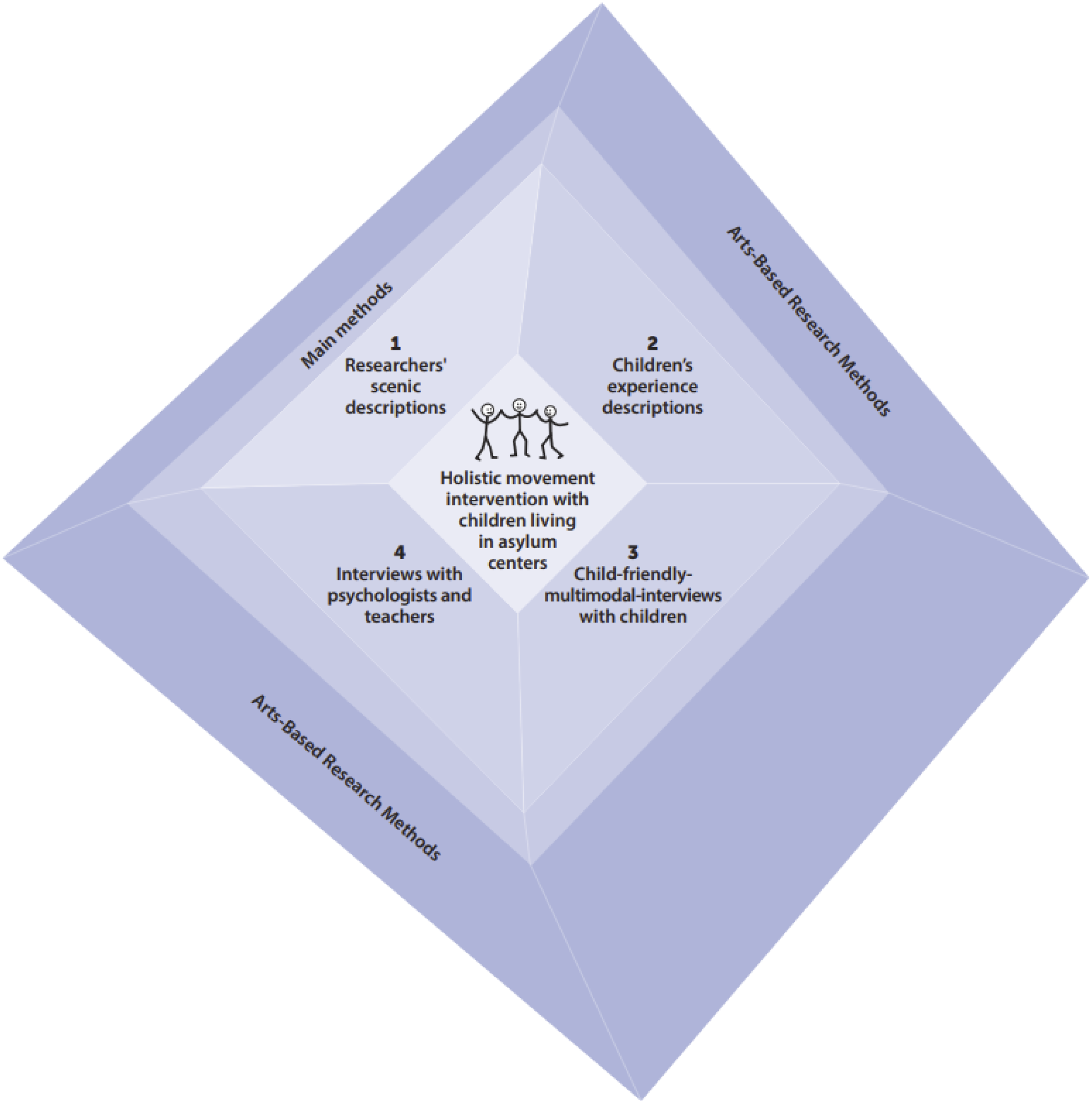
The research project is inspired by crystallization (Ellingson, 2009; Richardson, 2000): “… the crystal, which combines symmetry and substance with an infinite variety of shapes, substances, transmutations, multidimensionalities, and angles of approach.” (Richardson & St. Pierre, 2018, p. 822). In the concept of crystallization, multiple types of data and a range of theoretical frameworks illuminate the subject (Tracy, 2010). The methods in the On the Move research project were chosen because they can illuminate the children’s participation in the holistic, playful movement intervention in a sensory-rich and in-depth manner. The methods do not aim to create a valid singular truth, but rather to open up a deep, complex understanding of the subject (Tracy, 2010).
“Nothing reveals itself unless there is someone it reveals itself to!” (Rønholt, 2006) This sentence illustrates that a central idea in the hermeneutic-phenomenological approach is to illuminate lifeworld phenomena through sense-based descriptions (Rønholt, 2006; van Manen, 1990, 2016). Voices from interviews, written words in experiences descriptions, drawings, or other artistic expressions can also shed light on individuals’ lifeworlds. The thematic coding and analysis process is also inspired by vanManen’s hermeneutic-phenomenological approach (van Manen, 2016).
Thematic Coding and Analysis Process
Thematic coding, according to vanManen, focuses on first bringing the essence of a phenomenon to light, and then analyzing and interpreting the data through theories, concepts, and other descriptions (van Manen, 2016). The research project data obtained by the four main methods includes approximately 180 scenic descriptions and child experience descriptions, 43 child-friendly multimodal interviews with children, and 21 semi-structured interviews with psychologists and teachers 6 (Johansen & Winther, 2024, in prep.). The coding and analysis process in the research project consisted of three specific operations: 1) transcribing interviews and rewriting the researchers’ scenic descriptions and the children’s experience descriptions, 2) thematic coding of interview transcriptions and descriptions, and of the children’s experience descriptions, and 3) analyzing themes using theories, concepts, and other descriptions (Johansen & Winther, 2024, in prep.).
The On the Move research project has attempted to bring forth scenic descriptions and lived experience descriptions, voices, words, and expressions of children living in asylum centers through multidimensional methods and the coding and analysis approach. Researchers organize, process, select, and interpret this data. Thus, what is brought forward will be a re-presentation of the children’s descriptions, voices, words, and artistic expressions (Hastrup, 2020).
The methods used in the research project are elaborated below: 1) Researchers’ scenic descriptions, 2) Children’s experience descriptions, 3) Child-friendly multimodal interviews with the children, 4) Interviews with psychologists and teachers, 5) Arts-Based Research methods, and 6) Crystallization of methods (Johansen & Winther, 2024, in prep.).
Researchers’ Scenic Descriptions (Main Method 1)
Phenomenologically inspired narratives have been used for over a decade in a wide array of studies to capture bodily experiences (Allen-Collinson, 2016; Sparkes, 2002; van Manen, 1990, 2016). One specific method is practice narratives, focusing on meaningful moments and occurrences perceived by the body through sensing and reflection (Winther, 2015). In On the Move, researchers’ practice narratives are mainly scenic descriptions, which can be understood as written film clips (Winther, 2015). From their written field notes, the researchers select significant moments to “zoom in on” (Winther, 2015). Such scenic descriptions by the researchers are a central part of the research project. Below is an example: Illustration 4. Scenic Description of the Movement Practice (Johansen & Winther, 2024, in prep.) and illustration by Maise Johansen and Anni Lamhauge
The above scenic description captures a significant moment in the children’s group during the movement intervention. The small yet significant moment is registered in the researcher’s mind and subsequently reconstructed and written in a literary form (Winther, 2015). The data is saturated with scenic descriptions that create sensory-rich, nuanced narratives about the children’s participation in the movement intervention; these may illuminate the children’s movement processes. Inevitably, the researchers’ dual role and dual perspective will influence the writing, coding, and selection of these descriptions. As mentioned, the scenic descriptions are the researchers’ written practice narratives; the research project also gathered the children’s own practice narratives in the form of their drawing their lived experience descriptions.
Children’s Experience Descriptions (Main Method 2)
Children in the research project were involved in writing lived experience descriptions. These are a form of practice narrative that captures significant sensory-rich moments written from a first-person perspective (present tense and first-person narration) (van Manen, 2016; Winther, 2015). The process of creating the children’s experience descriptions allowed their written words to emerge. Due to the children’s diverse linguistic backgrounds, the method was developed in collaboration between children and researchers to consist of drawn experience descriptions with a few written words. Below is a mood illustration of the method with examples of the children’s experience descriptions: (Illustration 5) Illustration of the Process and Examples of Children’s Experience Descriptions by Maise Johansen
Words/sentences like “Very wow,” “We can jump,” “We dance together” from the children’s lived experience descriptions give insights into their experiences of the movement intervention. The written words are included in the thematic coding. The drawings themselves are not included in main methods coding but can be used for visual dissemination of the project. Besides practice narratives, the children’s experiences are also illuminated through child-friendlymultimodalinterviews, elaborated in the next section.
Child-Friendly-Multimodal-Interviews With Children (Main Method 3)
Interviews with the children have focused on understanding and describing their participation in the intervention and their situation as asylum children. Such interviews were conducted in three rounds during the project period. Some children participated in all three rounds, while others participated in fewer rounds due to their temporality. All interviews in the research project were based on a semi-structured interview guide with themes, open questions, and follow-up questions (Kvale & Brinkmann, 2015). The possibilities and limitations of the semi-structured interview are elaborated under Interviews with teachers and psychologists (Main Method 4). Interviews with the children were also inspired by the Child-friendly-multimodal-interviews.
Child-friendly multimodal interviews were chosen as a method in order to give the children a possibility to talk about their experiences. Qualitative interviews are a common approach in childhood research for investigating children’s experiences, although interviewing children is a challenging and complex discipline (Clark, 2010; Einarsdóttir, 2007; Ponizovsky-Bergelson et al., 2019). The power relationship between children and adults may challenge the interview data (Ailwood, 2010; Clark, 2010; Einarsdóttir, 2007; Ponizovsky-Bergelson et al., 2019). (The power relationship will be elaborated on in a later section.) Additionally, there are many considerations, such as the role of the interviewer or capturing children’s attention (Ailwood, 2010; Ponizovsky-Bergelson et al., 2019). Therefore, “child-friendly” interviews with elements such as drawing can be beneficial (Ailwood, 2010; Groundwater-Smith et al., 2015; Sahimi & Said, 2012). Drawing can help children in vulnerable positions express themselves and start talking about experiences that are hard to articulate (Søndergaard & Reventlow, 2019). It can allow children to bring forth their own narratives (Einarsdóttir, 2007; Ponizovsky-Bergelson et al., 2019). Using multiple modalities/multimodal interviewing may help children discuss their felt senses, especially regarding movement experiences (Svendler Nielsen, 2009, 2012). In On the Move, interviews with the children followed a semi-structured interview guide. The interview itself was adapted with inspiration from child-friendly and multimodalinterview approaches (Groundwater-Smith et al., 2015; Svendler Nielsen, 2012). Child-friendly multimodal interviews have shown potential for this child group. The children were also invited to move around the room, stand up, and demonstrate with their bodies while answering questions. They could also draw, and were invited to take breaks and have a friend present in order to feel secure. Feeling secure and respected is crucial for children living in asylum centers, as they may carry traumatic experiences with them, and the adapted interview methods provided them an opportunity to participate. Additionally, the children were specifically informed that the interviews were about the movement intervention and not about their asylum case, to minimize confusing this interview with the authorities’ inquiries. Below is an example - an excerpt from a children’s interview and an illustration: (Illustration 6). Excerpt from a children’s interview (Johansen & Winther, 2024, in prep.) and graphic illustration by Maise Johansen and Anni Lamhauge
Child-friendlymultimodalinterviews with the child group presented several challenges. First, some children were challenged academically and linguistically due to their past. Others expressed that they could not remember what they had done with their bodies, even though the interview occurred right after a movement session.
Interviews With Teachers and Psychologists (Main Method 4)
As with interviews with the children, those with the teachers focused on understanding and describing the children’s movement processes in the movement intervention and life situations. Teacher interviews were also conducted in three rounds during the project period. Psychologist interviews were conducted only with a focus on understanding and describing the children’s situation at the asylum center, because psychologists did not participate in the intervention. The interviews did not address the children’s individual asylum cases (cf. the ethical section on research). Interviews in the research project On the Move were, as mentioned, based on a semi-structured interview guide with themes, open questions, and follow-up questions (Kvale & Brinkmann, 2015). The semi-structured interview format is useful as it includes this variety (Kvale & Brinkmann, 2015). One limitation is that it can be difficult to compare interviews when open questions are asked. However, in this research project the aim is not to compare interviews, but rather to gain in-depth insights into the children’s participation processes in the movement intervention.
Power Relationships in Interviews
The research project’s interview data may be influenced by the asymmetrical power relationship in all interview situations, especially those with children (Kvale & Brinkmann, 2015). For example, children will often accept all questions and frequently try to answer them as expected (Kvale & Brinkmann, 2015). Here there has been a focus on clarity about roles and the framework, content, and significance of the interview in relation to ethical rules and considerations. There were still challenges in the interview situation, as it takes time and care to explain to the children, teachers, and psychologists what the interviews concerned and how they would be used. It was especially important that the children not confuse the research interview with an official interview about their asylum case. Additionally, it was important that the researchers had no set expectations regarding answers, even though they had also participated in the movement intervention. Therefore, the researchers guided the children and teachers to talk about participation in the movement intervention with focus on embodied movement experiences in a lively and nuanced way, rather than asking them to evaluate the activities. In this situation, the researchers also used their bodies to show what the interview was about. Another focus was on creating a sense of security for the children, teachers, and psychologists during the interview situation. Creating a sense of security was inspired partially from practitioner research. The children and teachers were familiar with the researchers, as they were co-teachers in the movement intervention.
Overall, the four main methods have illuminated possibilities and challenges in research processes with children in asylum centers. ABR methods contributed to illuminating the child group’s participation in the research project, as elaborated below.
Arts-Based Research Methods
Using ABR approaches entails research data being created, processed, and disseminated through artistic methods such as visual art, music, drama, dance, and photography (Leavy, 2018; Winther & Berg, 2021; Wright, 2010). ABR can create knowledge about lived experiences, as Wright (2010, p. 2) expresses it: “… arts draw upon a variety of modalities, such as speech, image, sound, movement and gesture, to create multimodal forms of meaning.” ABR can also be used to encourage children to participate, as “… art provides young people with authentic meaning-making experiences that engage their minds, hearts and bodies” (Wright, 2010, p. 2). Several ABR methods were included in the research project, such as poems, drawings, visual art, and graphic illustrations. In particular, the creation of body portraits allowed the children to express their experiences in the movement intervention.
Children’s Expression of Their Movement Experiences through Body Portraits
Based on visual art, children’s movement experiences were expressed, presented and investigated. The idea of body portraits was developed in collaboration between the children’s group, researchers, a visual artist, and teachers. The process involved the children first participating in a movement session. Then the children put the movements on paper: they choose a movement from the session (statue position) and lie down in that position on a large piece of paper, while their partner draws the outline of their body on the paper. Then the children are asked about different parts of the body, resulting in words, short sentences, and/or a color they want to paint in that area. Then they paint their own body portrait (see the illustration below). (Illustration 7). Body Portrait Process with Pictures by Maise Johansen and Nille Beck
As seen in the photo collage above, the body portrait activity gave the children an opportunity to express their movement experiences. Body portraits also became performative portraits that can be used for dissemination. The body portrait process was designed carefully, considering the children’s situations and possible traumas, consistent with On the Move’s overall approach. Besides body portraits, On the Move also used graphic illustrations, video, and photographs for dissemination.
Illustrations, Video, and Photographs
The illustrations in this article are used to visually illuminate the project’s holistic, playful movement interventions, and to show the practitioners’ dual role, the context of a scenic description, and an example of an interview situation. Researchers in collaboration with the artists [a] created the illustrations. This entailed the researchers making a hand-drawn sketch based on the research process or data. The sketch was then turned into an illustration, either a drawn illustration or a linocut print, in collaboration with the artists. One example is the illustration on the cover, where interwoven lines show how the research project takes place in asylum centers; traumatic experiences from the past, concerns in the present, and uncertainties about the future are all present. Another example is of the practitioner’s dual role, illustrated by a linocut print with accompanying text.
Video is another method in child and movement research that can illuminate children’s movement processes (Svendler Nielsen, 2009). Video was not used as a research method here because many of the children would not participate or move freely if there was a video camera present. As mentioned, children in asylum centers have ongoing asylum cases, and therefore not all children and parents want to be publicly visible through videos and photos. However, photographs and video were chosen for the dissemination aspect of the project. The dissemination video ([University of Copenhagen], 2021b) was created with the intention of minimizing “disturbance” to the children’s free movement space. Therefore, a selected asylum center and a group of children who felt comfortable with a video session were chosen. Due to ethical considerations, the video journalist and the researchers participated in the movement intervention at various asylum centers without filming in order to determine which children have a parental consent to dissemination video and felt comfortable with the video journalist’s presence and being filmed. Therefore, only a few children are shown in the video. The video also shows only “positive” moments. This was a deliberate choice to ensure that children, their families, or family members who may be elsewhere in the world are not revealed. The dissemination video process with the children was time-consuming. The approval and editing process required care to ensure that children who should not be publicly visible were either blurred or cut out, adhering to formal ethical rules and protecting the child group. The dissemination video is additionally limited to being a short representation of only part of the project. During the project period, the children also recorded their own videos in a movement intervention session, intending to contribute to the project’s development. However, these videos were not shown, stored, or used publicly due to GDPR regulations.
Overall, the ABR methods provided an opportunity for the children’s group to express themselves in other ways than spoken language. This is a valuable potential for this target group, who with many transitions, languages, and cultural meetings in their lives often find it challenging to express themselves through speaking. ABR methods can also create opportunities to illustrate the children’s resources and vulnerabilities in movement processes through visual narratives. However, it was possible to use ABR methods only in some centers, as these are relatively comprehensive and costly.
The themes have illuminated ethical and methodological possibilities and challenges in the On the Move research project with children in vulnerable situations. Below follows a summary of how the methods crystallize.
Crystallization of Methods
Crystals grow, change, and are altered, but they are not amorphous. Crystals are prisms that reflect externalities and refract within themselves, creating different colors, patterns, and arrays casting off in different directions. What we see depends on our angle of repose… (Richardson & St. Pierre, 2018, p. 822).
This article demonstrates how several methods may combine perspectives, thus illuminating the child group with its various dimensions, patterns, boundaries, and nuances. The researchers’ scenic descriptions can convey the children’s movement processes as well as resources and vulnerabilities expressed through body language. These descriptions can thus offer insights into bodily-rooted and nonverbal movement processes among children at asylum centers. However, the scenic descriptions are from the researchers’ perspectives. Through the children’s lived experience descriptions, their own written words/sentences can emerge as nuances in the illuminating crystal. These are, however, limited to being concise written words and sentences. Here, child-friendlymultimodalinterviews may allow children to give more words to their experiences through the researcher’s opening and follow-up questions, combined with bodily demonstrations and drawing opportunities. These again can create new reflections in the crystal. Interviews with teachers and psychologists can crystallize the understanding of general vulnerabilities of the children’s group at an asylum center, while still complying with all ethical rules in that situation. Data from interviews with children and teachers can also be coded in conjunction with the researchers’ scenic descriptions, providing multidimensional depth with both practice narrative and interview data.
ABR methods may be compared to lightly transparent lines and edges in the crystal, giving the children’s group an opportunity to express their experiences aesthetically beyond conversation and writing. ABR-inspired illustrations also offer nuances and depths in the understanding of descriptions and interview excerpts. Photographs and video dissemination create the possibility of visually showing how participation in a holistic, playful movement intervention can take place. ABR methods can, in various performative interactions with the main methods (such as graphic illustrations), create sensual and visual understanding. All methods, as highlighted in the sections here, also carry limitations concerning the target group.
Discussion
The research project’s foundation in body phenomenology, hermeneutic phenomenology, practitioner research, and ABR approaches, along with the qualitative methods 7 used, lead to several limitations. Due to its epistemological and methodological foundation, the research project is characterized by subjectivity, context dependence, and time-consuming and labor-intensive research processes. Furthermore, it is influenced by ethical and methodological limitations related to the conditions of asylum research, particularly concerning reaching and meeting children in vulnerable situations at asylum centers in Denmark. Therefore, the research project cannot provide definitive and evidence-based truth. However, this is not its intention. Rather it seeks to have implications and to inspire how a holistic, playful movement intervention can be significant for children in asylum centers and other children in vulnerable situations. Furthermore, the research project may also contribute knowledge about the many ethical and methodological dilemmas, possibilities, and limitations in research with children in vulnerable situations. This is also while being aware that research and movement projects in other contexts may have different perspectives that need to be considered.
Another point is how research projects can portray a target group in a nuanced manner, or whether such portrayal contributes to reproducing understandings of vulnerability (Katz et al., 2019). The On the Move research project can portray how the children’s participation in the movement intervention is affected by their situation, based on literature on children at asylum centers and research data. The data is based on interviews: how children, teachers, and psychologists perceive their life situation and how it also affects their participation in the movement intervention. The research project seeks to show both the multidimensional resources and vulnerabilities of the child group. It portrays the child group as having limitations and challenges from its diverse nature, including various social, psychological, physical, cultural, and linguistic backgrounds. Another challenge is also the wide age range: the children were from 6 to 15 years old, making it difficult to portray a 6-year-old as compared to a 15-year-old due to their differences in development. Still, the long-term research project has created opportunities for in-depth data, allowing for a nuanced portrait of the child group. It is an inescapable condition that such research cannot capture all nuances. Thus it may be criticized for inadequately portraying a child group in a vulnerable situation, or for reproducing understandings of the group. Another point is whether the chosen methods for describing this child group in vulnerable situations are sufficient, as Katz et al. (2019) question the use of the term “vulnerable groups.” One might also question whether the research process has become too “messy,” which Nordentoft & Kappel (2011) identify as a challenge in research with vulnerable groups. It can also be debated whether the children’s voices, words, and expressions have been reflected and nuanced sufficiently through the research choices and processing. The participants’ voices and descriptions in the research project On the Move can only be understood within the limitations of how these have been processed (by coding and analysis). Likewise, limitations apply too regarding the ethics of the research project. Have the ethical rules, the relational/situational ethics, and the ethics of care been sufficiently followed, or has the research process had “blind spots”?
Nevertheless, movement interventions and research with children in vulnerable situations are important. Bleile et al. (2021) point out that children at asylum centers need support through movement-based interventions. Moreover, as O’Brien et al. (2021) and Moola et al. (2015) highlight, vulnerable groups are often under-investigated in research because it is so challenging to conduct research with them. Discussions should lead to cautious, tailored interventions, reflections, and care for child groups in particularly vulnerable situations.
Conclusion
The article has described ethical and methodological possibilities and challenges in conducting research with children in vulnerable positions. It sheds light on a practice-oriented research project, On the Move, with children living in asylum centers.
Inspiration from practitioner research includes methodological awareness of dual roles and dual perspectives. This can provide in-depth insights into the child group’s participation in movement interventions, even when the children are challenged. It also offers the opportunity for taking care of the participants. However, the practitioner’s role requires caution and respect for the children as well as the teachers. At the same time, inspiration from practitioner research means that researchers must relate to being affected by the children’s situation; this may challenge the researchers’ own vulnerabilities.
The article demonstrates that the research project faced several challenges in reaching and meeting children in asylum centers. Particularly, it required long-term comprehensive collaboration agreements, approval, and consent processes. Furthermore, the temporality of the children’s participation is a constraint, and researchers have limited knowledge of the individual children’s asylum cases. In meeting the children, specially adapted approaches and knowledge about the group in general were required. At the same time, the article illustrates that adhering to ethical formal rules, relational/situational ethics, and the ethics of care has enabled prioritizing the children’s safety and well-being.
The article demonstrates that On the Move’s methods have created an opportunity for the researchers to employ sensory-rich descriptions, interviews with teachers and psychologists, and children’s lived experience descriptions and voices from child-friendlymultimodalinterviews. However, the interview method was challenged by some children’s linguistic preconditions and their difficulty in recalling experiences. Power relationships influence all interviews. The inspiration from a practitioner research approach may help the children understand that the interview is about participating in the movement intervention. This is crucial for this child group, as an interview situation may otherwise be mistaken for an asylum case interview with the authorities.
Arts-based research (ABR) methods can provide the child group with another way to express themselves beyond spoken and written language. This is particularly relevant for children in asylum centers, as their spoken and written language is often limited due to their many transitions, languages, and cultural encounters. The body portrait process particularly allowed the children to express their experiences with movement interventions. ABR methods thus give an opportunity to convey the children’s participation in the movement intervention through visual narratives. Graphic illustrations have been used to disseminate the research project and this article.
The research project’s theoretical framework and methods have limitations characterized by subjectivity, context dependence, and time- and labor-intensive research processes. The research project has several implications. It can show how various qualitative methods may be crystallized by combining them and various perspectives when exploring and illuminating how participation in a long-term holistic, playful movement intervention can support children’s connectedness. The project’s knowledge may thereby have implications, inspiring holistic and playful movement interventions, projects and research with children in other vulnerable situations worldwide. Such interventions must consider the specific contexts, including ethical, methodological, pedagogical, and psychological considerations related to the location and target group. Reflections on this project may contribute to essential discussions of methods and ethics when conducting qualitative research with children in vulnerable situations. Qualitative research with children in asylum centers requires an ethical and methodologically cautious design tailored to the target group. This includes the importance of giving space for descriptions, movement experiences and expressions, as children across cultures, languages, and backgrounds continuously express themselves through their bodies, voices, movements, and artistic processes.
The article’s perspective suggests that On the Move’s approaches and methods may be developed further and have implications for practice-oriented research projects and movement projects with other children from various cultures and backgrounds in national, regional, international and global contexts. Most of all, one hopes that children in various life situations are given the opportunity to move within playful universes. (Illustration 8). Arts-Based illustration by Maise Johansen, Anni and Katarina Lamhauge
Footnotes
Acknowledgement section
We would like to thank the participants and collaborators for their time, helpfulness, and openness.

Ethical Approval
This study has received ethical approved from the Faculty of Science at the University of Copenhagen. No other ethical approval is required in Denmark for this study.
Informed Consent
Participants have given verbal and written consent to the Red Cross Asylum in an informed consent statement that has been developed in collaboration with and approved by the legal departments at the University of Copenhagen and the Red Cross Asylum as agreed in the collaboration contract between the two organizations (Document ID: 20B8E3FA-2A38-4ACE-9A94-3C7C348B22C6).
Funding
This work was supported by the Novo Nordisk Foundation with grant number NNF20SH00062727.
Declaration of Conflicting Interests
The author(s) declared no potential conflicts of interest with respect to the research, authorship, and/or publication of this article.