




Abstract
This article introduces a culturally grounded methodological framework for community art therapy research in Caribbean communities. Integrating arts-based research, community-based participatory research (CBPR), and radical reflexivity, the framework was developed through ongoing fieldwork and co-designed interventions with local collaborators. It addresses methodological challenges at the intersection of structural vulnerability, cultural relevance, and emotional accountability in postcolonial contexts. Community art therapy is positioned as both intervention and epistemology, emphasizing visual journaling, positionality work, and creative co-authorship. Art is treated as a valid form of embodied, relational, and affective knowledge, resonating with Caribbean expressive traditions. The framework demonstrates flexibility in the face of climate-related crises and prioritizes ethical engagement through sustained community partnerships, iterative feedback loops, and culturally responsive analysis. This paper contributes to qualitative methods by advancing a model of research that centers care, creativity, and cultural humility. It offers scholars and practitioners an adaptable approach to knowledge production in contexts where conventional methodologies may fall short. By embedding reflexivity and co-authorship into every phase of the research process, the article expands how rigor, ethics, and relevance are conceptualized in participatory and arts-based inquiry.
Keywords
Introduction
The Caribbean, one of the world’s most disaster-prone regions, faces recurring environmental shocks, including floods, earthquakes, volcanic activity, and an annual average of six major hurricanes (Otto et al., 2018; United Nations Office for the Coordination of Humanitarian Affairs, 2020). These climate-related events compound structural inequalities and long-standing economic vulnerabilities, particularly given the region’s composition of developing nations and territories with limited infrastructural resilience (United Nations Industrial Development Organization, 2023; World Bank, 2023). In response, regional agencies, such as the Caribbean Disaster Emergency Management Agency (CDEMA, 2021), have called for resilience-building strategies grounded in data-driven, evidence-based approaches.
Recent shifts in disaster response frameworks reveal an expanded understanding of resilience that extends beyond infrastructure to include psychological well-being and social cohesion. This shift reflects a growing recognition that community-based approaches are not ancillary but central to long-term recovery (Donald, 2020; Hofman et al., 2021). Innovations, such as geospatial mapping of housing vulnerability (Tingzon et al., 2024) and the integration of psychosocial supports into emergency planning, signal a heightened awareness of the emotional toll that disasters exact on both individuals and communities (Campbell & Greaves, 2022). Concurrently, grassroots initiatives rooted in storytelling and music are mobilizing cultural knowledge to engage youth in climate adaptation (Plummer et al., 2022).
These developments point to an urgent need for research and programming that center communities as agents of resilience. Economic precarity renders the region highly susceptible to external shocks (Pereira & Steenge, 2021), and while governments have introduced infrastructural risk reduction strategies (World Bank, 2023), the social fabric of families and communities continues to provide critical emotional and material support. Multigenerational studies emphasize the role of kinship networks, faith practices, and oral traditions in cultivating psychological resilience across generations (Donald & Brock, 2023; Donald et al., 2024).
Given the Caribbean’s collectivist values and expressive cultural traditions, community-based interventions are especially well-suited to support trauma recovery and foster long-term adaptation. Community Art Therapy, an emerging practice that integrates creativity, cultural responsiveness, and psychological care through visual arts within local environments, offers a promising avenue for participatory resilience-building. Goldstein Nolan (2024) emphasizes the importance of co-created spaces that honor local ways of knowing and provide safe environments for processing difficult experiences. In culturally rich contexts where healing is often symbolic and relational, artmaking serves as a powerful medium for both emotional care and social critique (Abrons et al., 2019).
Yet despite its potential, community art therapy remains underutilized as a methodological and clinical practice in the Caribbean. Globally, scholars have explored this approach using ethnography (Kim & Park, 2021), case studies (Vick & Sexton-Radek, 2008), and mixed methods (Goodman-Casanova et al., 2023), highlighting its capacity to promote emotional expression, social connection, and empowerment, particularly among marginalized populations. Participatory action research aligns closely with these aims, emphasizing co-construction and shared authority (Feen-Calligan et al., 2018), while arts-based research (ABR) further expands the methodological repertoire by treating artistic expression as a valid and affectively resonant form of knowledge (Golden et al., 2024).
This article responds to the call for innovative qualitative methodologies by advancing a culturally grounded, process-oriented framework for community art therapy research in the Caribbean. Developed through longitudinal engagement in disaster-affected communities, the framework foregrounds cultural specificity, emotional accountability, and participatory knowledge production. By conceptualizing art not only as intervention but also as epistemology, this approach offers a transformative model for ethical inquiry in settings shaped by trauma, resilience, and collective meaning-making.
Methodological Framework
The research approach to community art therapy makes a methodological contribution to qualitative inquiry by integrating community-based participatory research (CBPR), arts-based research (ABR), and radical reflexivity into a cohesive and culturally responsive framework. Developed over years of collaboration with Caribbean communities, this framework emerged in response to community-defined needs and priorities, guiding both the therapeutic and research components of community art therapy. Through iterative, trust-based engagement, participants emphasized the importance of methodologies that acknowledge their multifaceted realities, emotional, cultural, and social, while also integrating local strengths and resilience resources. In doing so, this approach addresses persistent gaps in trauma-informed research, particularly the lack of attention to emotional accountability, cultural responsiveness, and collaborative meaning-making (Goldstein Nolan, 2024; Tolmos et al., 2024).
Qualitative and arts-based methods are especially well-suited for research in spaces where trauma, identity, and cultural expression are deeply interconnected. Community art therapy offers a participatory, multimodal approach that resonates with longstanding Caribbean traditions of storytelling, music, visual symbolism, and spiritual practice (Donald & Brock, 2023; Plummer et al., 2022). These modalities offer culturally grounded alternatives to dominant Western research and therapeutic frameworks, enabling participants to access and articulate experiences that may be difficult to verbalize or fully express through linear or conventional interviews (Bhui et al., 2022; Golden et al., 2024).
Central to this methodological approach is the recognition of art as a legitimate and generative form of knowledge production, one that is intuitive, embodied, affective, and relational (Gerber, 2022; Leavy, 2020). Community members engaged in artmaking not merely as a therapeutic activity but as a reflective practice, through which they constructed meaning from their lived experiences of trauma, resilience, and collective care. The arts-based elements of this research were designed not to extract data, but to foster healing, dialogue, and co-authorship.
The fieldwork unfolded amid overlapping crises, including the COVID-19 pandemic and post-hurricane recovery efforts. These conditions required a methodology capable of adapting to disruption, emotional volatility, and logistical uncertainty. Consistent with trauma-informed research principles and the work of Kumar and Cavallaro (2017), the community art therapy projects embraced methodological elasticity through iterative design, continuous dialogue, and an embedded ethics of care. Adjustments to programming and research timelines were not seen as interruptions but as necessary adaptations that honored the well-being of all participants.
At the heart of this framework lies radical reflexivity (Smith & Luke, 2021), a stance that moves beyond self-reflection to engage in a sustained, creative, and vulnerable relationship with the research process. Unlike traditional forms of reflexivity, which may emphasize the researcher’s individual positionality in abstract terms, radical reflexivity calls for an ongoing, relational interrogation of one’s entanglement with the field, participants, and knowledge production. This includes embracing ambiguity, cultivating emotional honesty, and valuing the “messiness” of research as a space for insight rather than error. It also encourages the use of creative and expressive methods, such as poetic inquiry and visual journaling, to surface and hold complexity (Smith & Luke, 2021).
As a Caribbean-born, U.S.-based art therapist, I inhabited a dual positionality that afforded both cultural proximity and structural distance. This insider-outsider dynamic shaped every phase of the research, from the development of arts-based activities to the interpretation of findings and demanded continuous reflexive engagement. Practices such as visual memoing, positionality journaling, and co-reflection with community collaborators were embedded throughout each project to maintain alignment between intention, process, and ethical practice.
While this research is grounded in core CBPR principles, shared decision-making, co-learning, capacity-building, and equitable partnership (Israel et al., 2013; Wallerstein et al., 2017), it also extends them in two important ways. First, it commits to sustaining relationships beyond the project timeline, resisting the episodic nature of many academic-community partnerships. Second, it treats art as central to epistemology, not as a supplementary tool. Visual and creative data are understood as primary sites of meaning-making, where participants shape not only the content but also the form of knowledge shared.
This methodological framework models a relational, restorative, and decolonial approach to research. It challenges top-down methodologies logics and embraces co-authorship, cultural specificity, and emotional resonance as vital dimensions of scholarly rigor. By privileging local knowledge systems, centering participant voice, and integrating creative praxis, it offers a scalable, ethically grounded methodology for research in postcolonial and crisis-affected contexts, one that reimagines what counts as valid knowledge in both academic and therapeutic spaces.
Research Design and Implementation
This section details how the methodological framework was implemented during the research process. Emphasizing relationship-building, shared authorship, and cultural responsiveness, the implementation of community art therapy interventions in the Caribbean relies on processual sensitivity and place-based ethics. The research process was anchored in an ongoing commitment to mutual trust, flexible engagement, and reflexive practice.
Community Entry and Trust Building
In the Caribbean context, community entry is not a discrete step, but a continuous, relational process grounded in cultural immersion. Reflecting CBPR principles (Israel et al., 2013), this approach emphasizes humility, reciprocity, and long-term presence. Collectivist values and dense relational networks necessitated a trust-centered ethic well before formal research activities commenced.
Entry into communities occurred through informal conversations, volunteer work, and consistent participation in local events, demonstrating services rather than extraction. These acts created openings for collaboration, supported by community gatekeepers, such as spiritual leaders and mental health professionals. These cultural brokers guided ethical and contextual navigation and fostering culturally appropriate engagement. Consent was conceptualized as dialogic, evolving, and responsive to shifts in context, especially in regions impacted by climate-related disasters. Ongoing check-ins were essential to reaffirm consent, especially following local or national crises that may have altered participants’ capacity or willingness to engage. Ongoing contact between research cycles via in-person visits and virtual check-ins has reinforced the project’s long-term commitment to collective well-being (Goldstein Nolan, 2024).
Participant Recruitment
Participant recruitment was not a discrete task, but an extension of the relationships cultivated through community engagement. Grounded in principles of mutual benefit and cultural responsiveness, recruitment processes emerged organically from within the community itself. Rather than imposing standardized inclusion criteria, the selection of participants was guided by trusted community members who identified individuals and families whose experiences and needs aligned with the goals of the intervention (Perez et al., 2022). This relational, strengths-based approach honored local knowledge and leadership as central to ethical engagement.
In communities where rapport had already been established, recruitment drew from long-standing relationships, shared values, and continued presence. In newer contexts, the foundation for trust was built gradually through volunteering, offering pro bono mental health support, and engaging in everyday community life. These acts of service fostered credibility and allowed space for the research invitation to emerge in ways that felt organic and respectful.
Art therapy graduate students were included as co-learners in community art therapy programs and occasionally in the research process. Their presence added a layer of reflexivity to the project, as their inquiries and observations often illuminated assumptions within intervention. Engaging alongside community members also helped students recognize the significance of relational depth in ethical recruitment and reinforced the value of humility in cross-cultural research settings.
Intervention Co-Design
Community art therapy interventions were co-designed in collaboration with community leaders and participants, grounded in locally identified needs such as adolescent resilience, family healing, and collective grief. While I initially prepared materials and drafted session outlines, these plans were not fixed; they evolved through iterative cycles of feedback, reflection, and revision with community stakeholders. This process honored shared authorship and ensured the interventions remained responsive to the context.
One such example emerged in a children’s program requested by a coalition of neighboring communities, which included participants ranging in age from 9 to 15. From a clinical perspective, this broad age span raised developmental concerns. However, out of respect for community perspectives on childhood, I temporarily set aside professional assumptions and allowed the program to proceed as envisioned. As the sessions unfolded, community collaborators began to note distinctions in how younger children and adolescents engaged. This led to a mutual recognition of the benefits of developmentally tailored approaches. Together, we introduced modifications that better supported the needs of each age group, marking a pivotal moment of shared learning and respectful negotiation.
The timing and setting of the sessions further reinforced the program’s cultural alignment. Held during my summer travel season, activities took place in familiar, accessible venues such as churches, riversides, and community centers. These spaces fostered a sense of safety, belonging, and cultural resonance. At the same time, they presented important ethical considerations, particularly around privacy and confidentiality (Wilkins, 2018). Flexibility remained essential throughout the program. Session plans and pacing were adapted based on ongoing participant feedback and, at times, restructured in response to environmental disruptions such as storms or other climate-related events.
Beyond participation, community members were actively involved in shaping the physical environment of the interventions. As shown in Figure 1, art therapy students and members of a community collaborated to paint and prepare a new structure that served as the primary space for the children’s art therapy program. This act of co-creation transformed the space into a visual and symbolic expression of shared ownership. Following the end of each day of the summer program, parents took it upon themselves to maintain the space, an organic gesture that underscored the community’s sustained investment. Today, the structure continues to serve as a site for community events and gatherings, with support from a local non-profit organization. This ongoing use speaks to the durability and relevance of the intervention beyond the research timeline, reinforcing the value of community-rooted design and shared stewardship. Constructing Space for Community Programs
Positionality in Practice
My positionality as a Caribbean-born, U.S.-based clinician and academic situated me within a complex and shifting intersection of cultural proximity and critical distance. This dual standpoint afforded certain relational advantages, such as shared cultural touchpoints and linguistic familiarity, while simultaneously demanding ongoing reflexive attention to issues of power, privilege, and representation. Navigating these insider–outsider dynamics required sustained ethical reflexivity and methodological transparency throughout the research process.
To engage with these tensions, I adopted a radical reflexivity framework (Smith & Luke, 2021), integrating reflective practices such as visual journaling, memo writing, and affective processing into the research design and implementation. These tools served both epistemological and ethical functions: they facilitated attentiveness to the emotional dimensions of cross-cultural fieldwork and helped maintain accountability to the communities I engaged.
Field encounters, particularly those situated in hurricane-displaced areas, often gave rise to emotional intensities I could not ignore. Rather than suppress or detach from these affective responses, I turned to arts-based methods as a means of processing and interpreting such moments. One drawing, created after visiting a family experiencing acute material hardship, centered on their feet, a symbolic focus that emerged from my internal struggle with witnessing both vulnerability and resilience (Figure 2). This image served not only as personal forms of self-care but also as visual memos rendering the emotional and ethical dimensions of the encounter visible within the research process. Observation of Potential Participants’ Resources. Note. Art Materials: Colored Pencil
These reflexive practices were not supplementary or optional, they were central to the ethical grounding of the project. By engaging feedback loops, encouraging cultural dialogue, and centering participant interpretation, the research upheld a collaborative ethic rooted in humility, emotional accountability, and co-creation. In this way, community art therapy functioned not only as an intervention, but also as a methodological and epistemological lens shaping how knowledge was generated, held, and shared.
Analysis and Rigor
To ensure methodological rigor in community art therapy projects, research design and analysis were guided by Lincoln and Guba’s trustworthiness criteria: credibility, transferability, dependability, and confirmability (Lincoln & Guba, 1985; Israel et al., 2013; Wallerstein et al., 2017). Each project utilized a collaborative, arts-based methodology that prioritized cultural meaning-making, emotional resonance, and ethical co-production of knowledge which are approaches I think aligns with Lincoln and Guba’s criteria and are rooted in Caribbean expressive traditions.
Credibility was strengthened through a multi-layered, participatory analytic process. Data sources included participants’ artwork, transcribed discussions, researcher-created visual reflections, field notes, and observational memos. Initial inductive coding and thematic clustering evolved into collaborative sense-making activities with community members and art therapy students. Member checking, through follow-up conversations, email exchanges, and community presentations, enabled participants to confirm or clarify interpretations, reinforcing authenticity and interpretive co-authorship (Goldstein Nolan, 2024; Israel et al., 2013).
Visual and multimodal data were treated as stand-alone cultural texts, not merely illustrative of verbal narratives. Recurring motifs (e.g., water, domestic spaces, flora) were interpreted through a culturally responsive lens in relation to oral traditions, and socio-environmental realities (Donald & Brock, 2023; Dorchin, 2017). Art therapy students engaged in reflective visual analysis, producing their own artworks to explore emerging themes, allowing for intuitive and emotional insight alongside traditional coding. This multi-perspective, arts-based approach elevates symbolic and experiential knowledge forms (Bhui et al., 2022; Golden et al., 2024).
Artmaking also functioned as an analytical tool. I created a collage using different colors of construction paper to explore preliminary themes (Figure 3), visually mapping emotional and conceptual connections. This embodied form of analysis supports dependability by making the analytic process transparent and replicable through documented visual reflections (Smith & Luke, 2021). Student coders followed similar practices, producing reflective artworks to process and represent findings. Reflective Art About the Coding Process. Note. Art Materials; Construction Paper, Glue, Scissors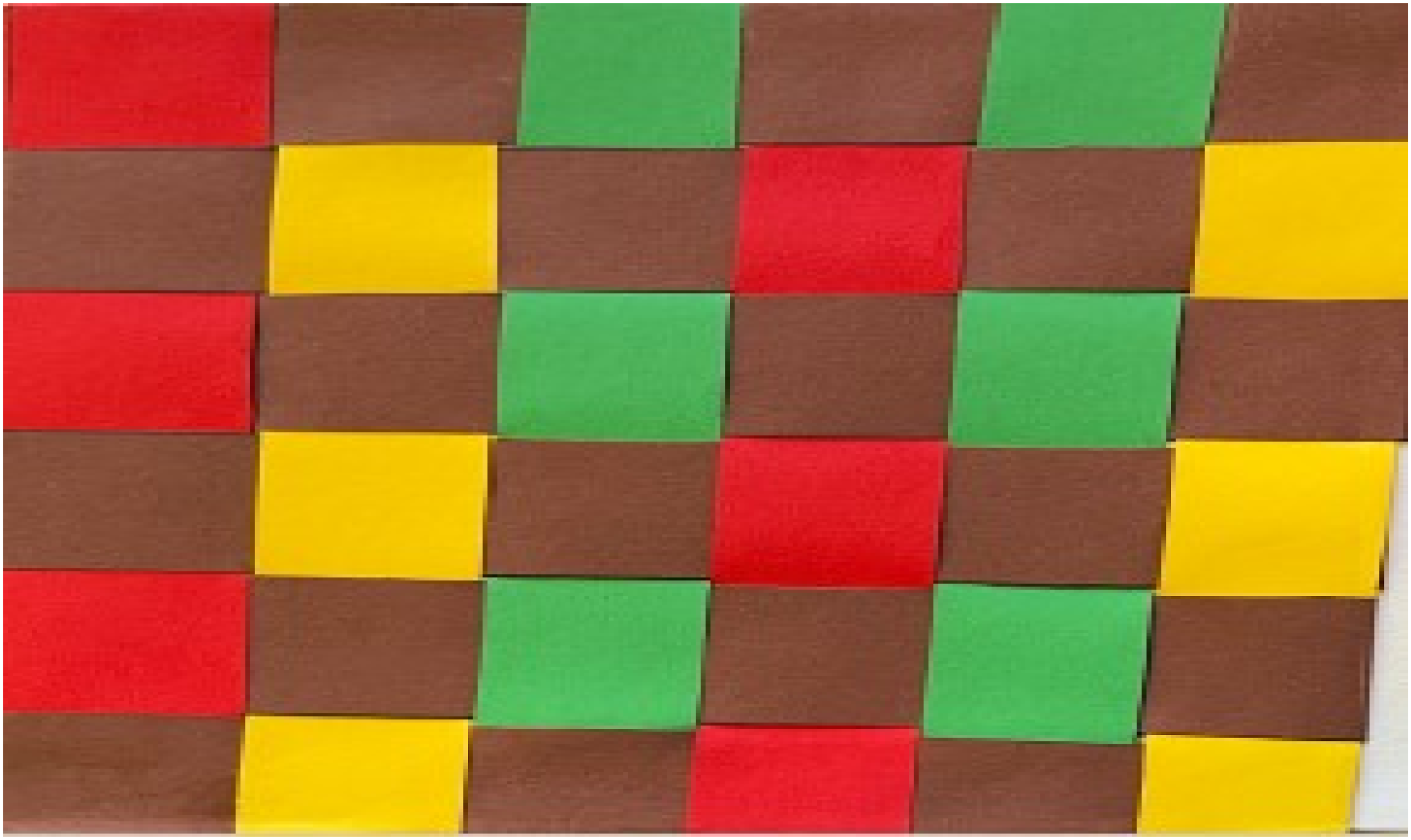
Dependability was further enhanced through peer debriefs. Art therapy students involved in the field, or the analysis process were engaged as peers rather than assistants. These discussions served as analytic checkpoints, challenged assumptions, and offered alternative interpretations (Tolmos et al., 2024). An evolving audit trail, comprising written notes and reflective art, tracked shifts in analytic decisions, contributing to a transparent and reflexive process.
Transferability was addressed through thick descriptions of the cultural context, including communal Caribbean life, local expressive forms, and spatial settings (e.g., riversides, churches, beaches). Music, especially songs requested during community art therapy sessions, was integrated into the analytic process. I also played music during coding sessions to maintain emotional continuity and cultural resonance. This honored the role of sound in Caribbean storytelling, the performing arts, and healing as resilience resources (Campbell & Greaves, 2022; Plummer et al., 2022).
Confirmability was upheld through sustained reflexive practice. A personal and collective archive of analytic decisions, visual memos, and researcher reflections was maintained. Community participants were invited to guide how their creative work was shared, ensuring dissemination aligned with their values and perspectives (Smith, 2012; Wilkins, 2018). This co-authorship in interpretation and representation reinforced ethical integrity and minimized researcher bias.
Ethical Considerations
Ethical engagement in Caribbean community art therapy research requires the navigation of unique tensions between collectivist cultural norms and research ethics historically grounded in Western individualism and privacy. Research settings such as beaches, churches, and community centers foster openness and shared experience but challenge dominant academic standards of confidentiality. The participants were informed of the communal nature of these spaces and invited to make informed decisions about how their voices and creative outputs would be shared.
Informed by decolonial research ethics (Smith, 2012), I strive for each community art therapy project to resist imposing external frameworks and instead centers community participation in shaping ethical protocols. Community members determined the appropriate venues for interventions and offered culturally grounded feedback on proposed methods. This includes considerations of access, mobility, and intergenerational inclusion. In alignment with relational accountability, a principle rooted in indigenous and decolonial scholarship (Smith, 2012; Wilson, 2008), ethical decision-making is understood as a relational and ongoing process rather than a fixed set of rules. This approach requires continual negotiation with participants and leaders, recognizing that knowledge production is embedded in relationships and responsibility to others.
Visual methods introduce additional layers of ethical complexity, particularly when they intersect with culturally grounded understandings of space, expression, and confidentiality. In community art therapy, artworks were treated with deep respect and recognized as powerful forms of personal and cultural expression. Consent for their use and display was carefully negotiated, with participants given the choice to retain, withdraw, or co-curate the representation of their pieces. One example is the reflective artwork shown in Figure 4, created during a riverside interview with a spiritual leader. The natural environment, chosen by the participant, held deep cultural significance and served as both a site of knowledge-sharing and a meaningful co-actor in the research process. While this setting evoked a sense of serenity for me and inspired artistic reflection, it also raised tensions with Western research norms that prioritize confidentiality and private spaces. The leader’s choice underscored how Indigenous methodologies center the interconnectedness of people, land, and knowledge systems, challenging conventional definitions of appropriate research settings. As such, the interpretation of visual materials and the research process required not only technical sensitivity but also a commitment to cultural relevance. Observation of the Environment During Data Collection. Note. Art Materials; Graphite Pencils
Researcher Positionality and Reflexivity
Engaging in community art therapy research in the Caribbean requires more than disciplinary expertise; it demands a commitment to dynamic processes and a willingness to co-create knowledge within unpredictable environments. This role extends beyond clinical or academic analysis; it is a relational, creative, and ethical commitment to communities that navigate intersecting adversities.
Researchers in such contexts must balance two responsibilities: producing rigorous qualitative scholarship while remaining accountable to community partners. This requires a methodological stance rooted in reflexivity, flexibility, and cultural responsiveness. Following Hurricane Beryl in 2024, art therapy students and I assisted in neighboring communities, offering crisis intervention and needs assessments. These experiences prompted structured debriefings, emotional processing, and ethical reflection which reinforced the affective labor of trauma-informed research and the importance of supportive supervision (Dinah, 2024; Goldstein Nolan, 2024). In community art therapy, and by extension, community work and research, I have navigated multiple identities, as a researcher, therapist, community member, and diaspora ally, while remaining attuned to power dynamics, community needs, and the emotional labor inherent in trauma-informed work.
Community art therapy research resists rigid protocols. In disaster-prone regions, art therapy sessions may be disrupted by hurricanes, displaced populations, or changing leadership styles. Adaptability is not just a strength but also a methodological necessity. As Tolmos et al. (2024) contend, scholars embedded in adversity-impacted communities must adopt relational, emergent strategies grounded in mutual care. This is particularly relevant in Caribbean cultures, where healing is inherently communal.
Emotional labor is intrinsic to this work. Bearing witness to trauma, grief, and resilience, while supporting community members and students, requires thoughtful co-navigation of the affective terrain. After Hurricane Beryl in 2024, for example, art therapy students needed structured debriefings and reflective spaces. Supervision and peer support became central to the methodology, reinforcing emotional containment and ethical practice.
The work is supported by creativity. Reflective artmaking has supported my own meaning-making, ethical discernment, and emotional resilience. Art functions as both a data and an analytic process. Cultural forms, such as poetry and music, were also integrated throughout recruitment, facilitation, and analysis which honors Caribbean epistemologies and expanded the definition of research data.
Ultimately, this role demands redefinition of expertise. The researcher becomes not an authority but a co-learner and facilitator. Community members possess vital knowledge of healing, resilience, and collective care. Methodologically, this requires listening, adapting, and sharing power allowing art therapy to function not only as an intervention, but also as epistemology.
Limitations
The paper offers a rich, culturally responsive framework for community art therapy in Caribbean contexts, it is not without limitations. First, the study’s findings are contextually grounded and may not be applicable to other postcolonial or disaster-affected regions. While transferability is supported through thick description, the interventions remain specific to cultural, spiritual, and geographical dynamics.
My dual positionality, as a Caribbean-born and U.S.-based researcher, also presented both strengths and complexities. Though this insider–outsider stance allowed for relational depth, it also introduced interpretive tensions that may have shaped data collection and analysis in ways that are not fully transparent.
Third, the longitudinal and adaptive nature of the work, while methodologically appropriate, makes replication challenging. The research design prioritized flexibility, which, while necessary in crisis contexts, complicates the establishment of clear procedural benchmarks.
Lastly, visual and arts-based data present unique analytic and ethical challenges, particularly in balancing cultural relevance with confidentiality. Despite careful negotiation of consent, the public nature of creative expression in communal settings may have influenced participants’ choices around disclosure.
Conclusion
This study advances qualitative inquiry by positioning community art therapy as both intervention and epistemology within disaster-affected Caribbean communities. Integrating community-based participatory research, arts-based methods, and radical reflexivity, the framework facilitates trauma-informed, culturally embedded, and ethically grounded research practice. Key contributions include the use of visual data as analytic material, reflexive co-authorship, and relational ethics suited to postcolonial contexts. By embracing methodological elasticity, co-designed interventions, and positionality transparency, this approach reimagines qualitative rigor through care, creativity, and collaboration. It offers a model for scholars seeking responsive, decolonial methods in settings where conventional research paradigms fall short.
Footnotes

Funding
The author disclosed receipt of the following financial support for the research, authorship, and/or publication of this article: This work was partially supported by the Florida State University (First Year Assistant Professor grant program).
Declaration of Conflicting Interests
The author declared no potential conflicts of interest with respect to the research, authorship, and/or publication of this article.