




Abstract
As researchers in communication sciences and related disciplines continue to embrace qualitative research methodologies, there will be a corresponding need for innovative methods and strategies for data collection and generation, reflexivity and knowledge translation to make qualitative research methods more inclusive. Historically, those who communicate differently from the status quo have been excluded from or spoken for in qualitative research. The resulting omission of these perspectives in the literature constitutes a critical research-to-practice gap as clinicians seek to deliver client-focused communication care. Arts-Based Research (ABR) offers researchers a means of augmenting potentially linguistically and cognitively demanding verbal interviews while inviting participants to share a window into their daily lives with researchers and knowledge users. Additionally, ABR offers participants alternative forms of expression and creates avenues for researcher reflexivity and participant-researcher reflexive dialogue. To illustrate how ABR can enhance communication research, we present reflections on a study that incorporated multi-media artistic materials in a reflexive arts-based collective case study design. Working with young people experiencing post-concussion communication changes, we used arts-based materials collected and created by participants to support and enhance data collection. These materials were analyzed as part of each case, across cases, and played a central role in sharing our findings. Additionally, arts-based materials facilitated participant-researcher reflexive dialogue and researcher reflexivity. The goals of this paper are to: 1) provide a brief overview of ABR as a method for researchers interested in communication; 2) discuss four ways to incorporate ABR in the research process; 3) provide a case example illustrating different types of creative works to illustrate the four ways ABR can enhance communication research; and 4) discuss benefits, considerations and implications of using ABR to support inclusive research design.
Keywords
Introduction
Rose: This picture was one that I had taken, I think it was right before Christmas break…I thought it really represented the experience, because a lot of times…even if I was in the middle of a conversation and surrounded by people, I just felt a little bit odd having to take in all the information and not being able to pick up all the stuff that’s going on. You just…feel a little bit removed from it all…
Interviewer: I like the way you took the picture…the room is surrounded with darkness on the side as well. I think it really captured that feeling.
Rose: Yeah! That’s what I was like, that’s exactly how I felt a lot of times, and I still sometimes do…
Excerpt from an interview with a youth participant experiencing communication changes post-concussion describing her submitted photograph (see Figure 1).
In this digital age, visual and creative works quickly and impactfully communicate messages to a broad audience. Researchers are beginning to harness the transformative and translational power of the arts. Arts-based research (ABR) methods invite the audience to expand their understandings of the human experience by considering alternative perspectives and challenging pre-existing beliefs (Lapum, 2018). ABR also has the potential to break down barriers to communication and expression by offering participants alternative, accessible, and inclusive ways to share perspectives and experiences. This fills the need for accessible and inclusive methods to study communication and the experiences of those who communicate in ways that are different from the status quo. Photograph: “Off to the side,” by Rose.
New methods are required as researchers interested in communication embrace the utility of qualitative research paradigms in exploring phenomena and experiences out of reach in quantitative paradigms. ABR methods may be relevant to communication-focused researchers from a variety of health-related fields (i.e., communication sciences including speech-language pathology/therapy and audiology, nursing, medicine, occupational therapy, psychology, and health professional education) and social sciences and humanities fields (i.e., linguistics, sociology, anthropology and disability studies).
As researchers interested in communication embrace the utility of qualitative research paradigms in exploring phenomena and experiences out of reach in quantitative paradigms, methods that mitigate the verbal, linguistic and cognitive demands of the “typical” interview are required. Individuals who communicate differently have traditionally been excluded from qualitative research in communication sciences and related fields, with researchers citing logistical concerns with conventional interview-style data collection methods (Teachman et al., 2014). ABR offers researchers a means to include and support participants experiencing communication differences in qualitative research.
This paper explores the potential applications of ABR in communication sciences in three parts. In Part 1, we introduce arts-based research, discussing its application to data collection, analysis, researcher reflexivity and participant-researcher reflexive dialogue, and the translation of study findings. In Part 2, we illustrate the various applications of ABR in communication research using a reflexive arts-based collective case study investigating how youth navigate post-concussion communication changes as an example. In Part 3, we conclude with a discussion of the possibilities offered by ABR methods and present considerations for researchers planning to employ ABR methods in communication science research to improve the accessibility and inclusion of those who communicate differently in their qualitative research designs.
Part 1: Applications of Arts-Based Research Methods in Communication Sciences Research
Background
Historically, the field of communication sciences and disorders (CSD) has focused primarily on studies of measurement, assessment and treatment efficacy (St. Pierre & St. Pierre, 2018). In CSD, clinically relevant, contextualized information and perspectives of those experiencing communication differences have often been excluded from the predominantly positivist research guiding clinical practice. For over two decades, there have been calls within and beyond the field of CSD to conduct research with instead of on participants (Charlton, 1998) to better represent those who are often spoken for in the literature, including young people (Mah et al., 2020; Phelan & Kinsella, 2011, 2013), those living with illness or disability (Gibson et al., 2017; Smith et al., 2017), and individuals experiencing communication differences or difficulties (Lloyd et al., 2006; McCormack et al., 2022; Teachman et al., 2014). Qualitative research methodologies offer a means for inquiring about the experience of living with communication differences and including those who communicate differently in research by providing participants with alternative forms of expression during data collection.
With the researcher acting as an instrument of data collection and analysis, qualitative research methodologies explore complex and nuanced processes, understandings and meanings. A staple of qualitative data collection, interviews often rely on participants’ expressive and receptive communication systems (Teachman et al., 2014), posing methodological challenges for researchers depending on language to transmit and construct meaning with participants (Lloyd et al., 2006). ABR can provide another avenue for data collection and meaning-making, particularly for those who communicate differently or experience difficulty using various language systems (spoken or signed). Therefore, ABR can improve representation and equity while reducing researcher-participant power imbalances during the research process. As such, ABR methods may have the potential to extend beyond traditional participant-researcher engagement toward more participatory approaches, such as engaging those with communication differences as co-researchers.
Researchers may shy away from adapting their methods to include individuals with communication differences, instead opting to interview clinicians who work with the clinical population of interest or using family members or caregivers as a proxy (Glavind & Mogensen, 2022; Lloyd et al., 2006). Presumptions that individuals with expressive language impairments will not be able to provide sufficient data during interviews for meaningful analysis and the belief that language comprehension or cognitive difficulties will result in poor or reduced credibility may deter CSD researchers from gathering interview data with these participants (Lloyd et al., 2006). Concerns regarding obtaining informed consent, potential power imbalances (Proctor, 2001) and the potential for researchers to introduce bias by “speaking for” participants (Goodley, 1996) are also cited as reasons for excluding those with more significant cognitive and communication differences from qualitative research. Sampling bias may occur when researchers screen communication and cognitive skills and select those with only mild communication impairments. Potential participants experiencing more significant communication difficulties may opt out of qualitative research for actual or perceived logistical constraints (Lloyd et al., 2006).
Many of these concerns arise when researchers approach the work from a positivist epistemological stance (Lloyd et al., 2006) that seeks measurable, concrete and objective data free from bias or other confounding factors. However, conducting research from a constructionist philosophy of knowledge generation allows researchers to embrace the uncertainty, complexity and uniqueness of participants’ realities while learning and reflecting on culturally shared meanings (Crotty, 1998). Kovarsky (2014) writes, “communication disorders, as well as our helping practices, are cultural constructions” (p. 59). Approaching research questions from a constructionist paradigm that acknowledges and values multiple perspectives and the multifaceted and subjective nature of reality allows the researcher (and the reader) to deepen their understanding of the phenomena or experiences under investigation. ABR methods have the potential to expand the nature, scope and reach of communication research, contributing to advancing knowledge in communication and health-related disciplines. Additionally, ABR methods can be used to ask diverse and complex social research questions, prioritize and respect viewpoints of underrepresented individuals, and collect and collaboratively generate data in imaginative ways.
Defining Arts-Based Research
Embracing alternative paradigms in communication sciences calls for innovative data collection methods. Customizable and adaptable, ABR methods offer researchers practical tools for meeting this need for improved inclusion and representation of participants who communicate in diverse ways. Lapum (2018) defines ABR as “an approach to research that integrates arts media into one or more phases of the research process” (p. 527). ABR is epistemologically congruent with (constructionist) qualitative research paradigms that accept and seek participants’ multiple realities instead of seeking to identify unbiased and absolute truths or realities (Crotty, 1998). ABR seeks to raise more questions than it answers and may be used to disrupt the status quo (Kangasjarvi et al., 2020).
ABR may draw on a range of art forms, including visual, literary or performative works (West et al., 2022). The creators of the art may be the researcher (Mcniff, 2007), participants (Othenin-Girard, 2015) or both (Pranee & Rumbold, 2008). Examples of performative ABR, at times referred to as Performative Social Science (PSS) (Jones, 2022), include dance (Peers et al., 2014), music (Ellis, 2020), comedy and drama (Ward et al., 2020), and film (Jones, 2012). Examples of literary ABR include novels, short stories, and poetry (Ward et al., 2020). Researchers have incorporated visual art such as photographs (Lorenz, 2010), drawings (Skukauskaite et al., 2022), and self-portraits (Bagnoli, 2009) in their work. Additionally, researchers may employ ABR for one or more of the following purposes: 1) eliciting interview responses (Phelan & Kinsella, 2011; 2) contributing original data to the analysis and generating “different ways of knowing” (Boydell & Gladstone, 2012, p. 1); 3) translating study findings to broader audiences within and beyond academia (Lapum, 2018); and 4) facilitating participant and researcher reflexivity (Skukauskaite et al., 2022). Examples of these applications are provided in Part 2.
ABR methods are well-suited for researchers applying a sociocultural lens to their inquiries. All forms of art communicate a message and are shaped by the culture and circumstances of the artist and the audience (Barone & Eisner, 2012). Pioneers of ABR in education research, Barone and Eisner (2012) write, Arts based research is an effort to extend beyond the limiting constraints of discursive communication in order to express meanings that otherwise would be ineffable. Indeed, an examination of the forms of communication employed in the culture at large reveals a level of diversity of forms that is enough to dazzle the eye, delight the ear, and tempt the tongue. (p. 2)
Barone and Eisner’s (2012) assertion that ABR creates possibilities for the expression of “meanings that otherwise would be ineffable” (p. 2) holds particular weight for communication scholars, knowing that those who communicate differently tend to be excluded from providing first-hand accounts of their experiences because of their communication differences (Teachman et al., 2014).
Applying ABR to communication sciences challenges researchers to expand how we conceptualize communication and bring into focus and value different forms of expression. Alternative forms of data collection in qualitative communication research are emerging. For example, Mactavish, Mahon, and Lutfiyya (2000) incorporated the arts in their qualitative study with individuals with intellectual disability, using collages of images constructed to reflect main themes from earlier interviews to support participant’s receptive and expressive communication in follow-up or “verification meetings” to enhance the credibility of the collected data. Researchers interested in learning about the experiences of people living with aphasia have used participant-captured photos to act as an alternative form of expressive communication and a means of guiding subsequent interviews, a technique referred to as photovoice (Ulmer et al., 2017). Similarly, Teachman et al. (2014) used photo-elicitation techniques as part of their data collection strategy when gathering data with young people who use augmentative and alternative communication. Othenin-Girard (2015) used poetry, photographs, drawings and metaphor as a method of inquiry during a personal narrative study of the author’s first-hand experiences of aphasia, verbal dyspraxia and foreign accent syndrome after a stroke. Beyond the previously reported applications of ABR methods in qualitative research, the inclusion of ABR methods when working with individuals who communicate differently provides participants or co-researchers with alternative modes of expression, allowing them to share their experiences their way.
Part 2: Case Example: A Reflexive Arts-Based Collective Case Study With Youth Navigating Post-Concussion Communication Changes
In this example, we draw on a reflexive arts-based collective case study conducted with five Canadian youth (16–25 years) to illustrate how ABR can enhance qualitative CSD inquiries. This instrumental case study aimed to learn first-hand how youth navigate post-concussion communication changes in their daily routines and activities. Research Ethics Board approval was granted from the University of Alberta’s Health Research Ethics Board (No: Pro00103888) and Dalhousie University Health Sciences Research Ethics Board (REB#: 2021-5585). Informed written consent was obtained for study participation and collecting and disseminating participant generated arts-based materials.
Rationale for Employing Arts-Based Research Methods
In qualitative research, meaningful coherence is an established marker of a project’s quality. Tracy (2010) writes, “studies that are meaningfully coherent eloquently interconnect their research design, data collection, and analysis with their theoretical framework and situational goals” (p. 848). Our rationale for weaving arts-based research methods into the study design and execution hinged upon our desire to demonstrate meaningful coherence among the a) research paradigm, b) methodology, c) theoretical framework, and d) research question while e) responding to the cognitive and communication strengths and needs of our participants.
Research Paradigm
Gergen (2020) describes a social constructionist philosophy of knowledge as one where “acknowledged are the multiple perspectives, values, and ways of life created by the peoples of the world, and the rich potentials of sharing” (p. 7). Informed by a constructionist paradigm, we embraced multiple participant realities and set out to co-create meanings through researcher and participant dialogue and reflection. We purposefully integrated ABR methods to pursue different ways of gathering knowledge while providing participants with alternative forms of expression, which challenged the traditional norms of the conventional “research interview.”
Methodology
Case Study Data Collection Summary.

After the first meeting, participants shared their realities and experiences creatively and personally by collecting and creating arts-based materials that reflected their experiences of post-concussion communication changes. During the second meeting, participants described what they submitted and why to the interviewer. The inclusion of ABR methods allowed participants to express their experiences in multiple ways and create shared meanings while referring to and reflecting on their participant generated materials (PGMs).
We found that ABR enhanced the richness of the data collected and contributed additional data sources for each case. To add to the maximum variation (Flyvbjerg, 2006) among the cases in the collective case study and increase participant autonomy in the data generation process, we provided open-ended instructions to the participants, allowing them to submit creative works or materials of their choosing that reflected their experience of communication changes following a concussion. Instructions included a list of examples (e.g., photographs, video/audio recorded materials, literary works, calendar/journal entries and artwork) providing participants with a starting point if needed. Giving participants control of the process by offering them the option to choose the creative medium and the message they wanted to express disrupted the power dynamics that can exist in “typical” participant-researcher interactions.
Theoretical Framework
Ecocultural theory provided the theoretical framework for the study, focusing the inquiry on how youth experiencing post-concussion communication changes navigated and adapted to these changes in the context of their daily routines (Weisner, 2010). Ecocultural theory combines ecological and cultural perspectives, providing a framework for exploring the role of sociocultural factors in how individuals and families adapt their daily routines in response to a condition (Bernheimer et al., 1990). From an ecocultural perspective, all individuals belong to ecological niches and seek to fulfill culturally driven roles in their environments. Concussions and associated communication changes can disrupt a young person’s daily routines. Applying an ecocultural lens to the study of post-concussion communication difficulties offers a unique opportunity to explore how youth navigate their environmental and cultural systems and how families, concussion care providers and community members can change and adapt these systems to support young people during their concussion recoveries better.
Activity settings served as a unit of analysis during the study, allowing us to ask questions about 1) people present, 2) task demands, 3) scripts for conduct, 4) motivations, feelings and purposes, and 5) cultural goals, values and beliefs (Gallimore et al., 1993; Weisner, 2002). This ecocultural perspective is congruent with ABR because arts-based materials, the people who create them and the values ascribed to them during their interpretations are rooted in environmental and cultural systems. Banks and Zeitlyn (2015) write that “images exist materially in the world” and that these representations are relevant to both “human social relations” and are “historically and socially embedded” (p. 166).
Research Question and Approach to Data Analysis
We chose to include ABR in the study design, believing it was essential to deepen our understanding of participant experiences, what Yates (2010) refers to as “windows to identity,” (p. 283) while also broadening our knowledge of the sociocultural factors involved in the experience of post-concussion communication changes, which is conceptualized as “windows to the world” (Yates, 2010, p. 283). ABR creates opportunities for researchers and knowledge users to learn about aspects of the research question that are important to participants, and this insider’s perspective may allow the reader to vicariously experience the events and emotional responses conveyed by the participants. Specifically, we asked: 1) How do youth respond to the effects of post-concussion communication changes in daily life, including (a) daily routines, (b) identity, (c) relationships, and (d) participation in school/work and community activities? and 2) What communication and concussion values, beliefs, and assumptions do youth navigate and (re)produce as they adapt to post-concussion communication changes in their daily lives?
The collection and discussion of arts-based PGMs enhanced the interview data generated during meetings with participants and served as additional data sources to be analyzed within and across cases. Reflexive thematic analysis (Braun & Clarke, 2021) was used to generate complex and multifaceted themes representing the patterns of meaning identified in the data set.
Inclusive Design Considerations
The First Author’s in-clinic experiences as a speech-language pathologist guided the research team’s decision to employ ABR methods to study how people navigate communication changes after a concussion. Unprompted, as alternative means of expression and making sense of their communication changes and recovery, clients shared drawings, journal entries, diagrams and calendar entries during clinical interactions. Based on our observations of the creative and intuitive strategies employed spontaneously by individuals during their concussion recoveries, we were confident that ABR would resonate with study participants. Using ABR during data collection has been noted to facilitate rapport building and may contribute to efforts made to reduce power imbalances that are inherent in the researcher-participant relationship while providing a strategy for building rapport during the interview process, particularly when interviewing children or youth (Phelan & Kinsella, 2011). We intentionally avoided prescriptive language in the data collection instructions to give the participants the autonomy to decide what and how much of their daily life they wanted to share with researchers. In this way, ABR also promotes participant engagement by making data collection and the subsequent interview process interactive and dynamic. We structured the data collection timeline so participants had sufficient time to gather their materials before Meeting 2. From the data collected and the responses provided during the interviews, it was evident that the act of gathering materials encouraged participants to think deeply about the topic as they reflected on their experiences. Additionally, ABR methods facilitated participant-researcher reflexive dialogue and researcher reflexivity. Tied to the sincerity and trustworthiness of qualitative work (Finlay, 2002; Tracy, 2010), reflexivity refers to the intentional and ongoing process of identifying and critically reflecting on how personal experiences, values and assumptions situated in societal, historical, cultural, political, and geographical contexts, influence our actions, how we interpret and respond to the actions of others, and what we imagine as possible (Bourdieu & Wacquant, 1992; Lumsden, 2019).
A scoping review of ABR in qualitative health research found that authors may not provide a rationale for selecting a particular creative medium (Boydell et al., 2012). We deliberately used open-ended instructions so that participants would have the freedom to submit materials they felt best represented their experiences for four reasons. First, as described above, in the First Author’s clinical practice, people spontaneously generated different types of creative works during their recoveries that supported their cognitive and communication difficulties and played to their strengths. Second, aware that some researchers have reported on participant-led changes to more prescriptive ABR data collection procedures (see Vigurs & Kara, 2017), we took a novel approach to data generation by allowing participants to select their preferred creative modalities to increase flexibility, autonomy, and participant engagement with the process. Third, allowing participants to determine their preferred media would grant us access to a broader variety of materials, meeting a feature of case study research and maximizing variation among cases (Flyvbjerg, 2006). Fourth, the act of generating materials is a form of communication in and of itself. By using arts-based techniques, participants could express themselves using different modalities, beyond what a “typical interview” structure may allow. ABR affirms and values alternative forms of expression and communication.
A practical reason for including ABR in the case study design was the potential benefit of the arts-based materials providing receptive and expressive communication augmentation during interviews. Gube (2022) writes, “visual tools like these techniques act as referential anchors through which participants communicate their experiences to others” (p. 119). The submitted materials are concrete representations of complex concepts and emotions. Participants in our study submitted a range of arts-based PGMs, including poetry, drawings, found images, hand-written letters and custom spreadsheets, each providing a window into their daily lives and experiences of concussion and communication changes. Materials were submitted electronically, and the interviewer (First Author) imported the images into a slideshow to facilitate co-viewing during the interview process. Collecting the materials before the meeting allowed participants time to reflect on their experiences and made these experiences easier to recall and refer to by serving as a tangible representation of their intended message. Participants experiencing slowed linguistic or cognitive processing benefited from additional time to prepare for the interview before Meeting 2. Those experiencing memory difficulties used the materials to assist with recalling stories or information they wanted to share. Borrowing from the technique of supported communication (Wilson & Kim, 2019) and adapting the strategy for virtual data collection, the interviewer took note of participants’ descriptions of their materials on the shared slide in real time. Sharing visuals and notes during the discussion allowed participants to see what the researcher heard them say and then add to or clarify their message. When asked about this data collection strategy, Gladys, a 21-year-old participant, said, “I thought the PowerPoint we did last time was really, really good, just to stay organized…I’m a very visual person, so that was really helpful for me just to stay on track.”
Case Examples of Arts-Based Participant Generated Materials
Summary of Arts-Based Participant Generated Materials.

Visual PGMs: Photography, Images and Artwork
All participants submitted images as part of their PGMs. Four of the five participants submitted photographs of their environments, referred to as autophotography (Glaw et al., 2017), and one participant submitted images found online that reflected her experiences. Participants submitted photographs of people, including friends (with informed consent) and self-portraits, places (e.g., study spaces, dorm rooms), activities (e.g., sleeping, studying, ice-climbing), and objects (e.g., crafts made while passing the time during acute concussion recovery, a map used to structure communication-skill practice and a bottle of medication taken for concussion-related pain).
Lily submitted a photograph of a stack of books with bookmarks marking her progress with each (Figure 2). Using this photograph as a starting point, Lily explained, “I wanted to talk about these books, because this is something that I feel communication wise has really been interrupted with the concussion, it’s just my ability to read, when reading is one of my favorite things to do.” Slide co-created during Meeting 2, photograph: “Books…I’m reading,” by Lily.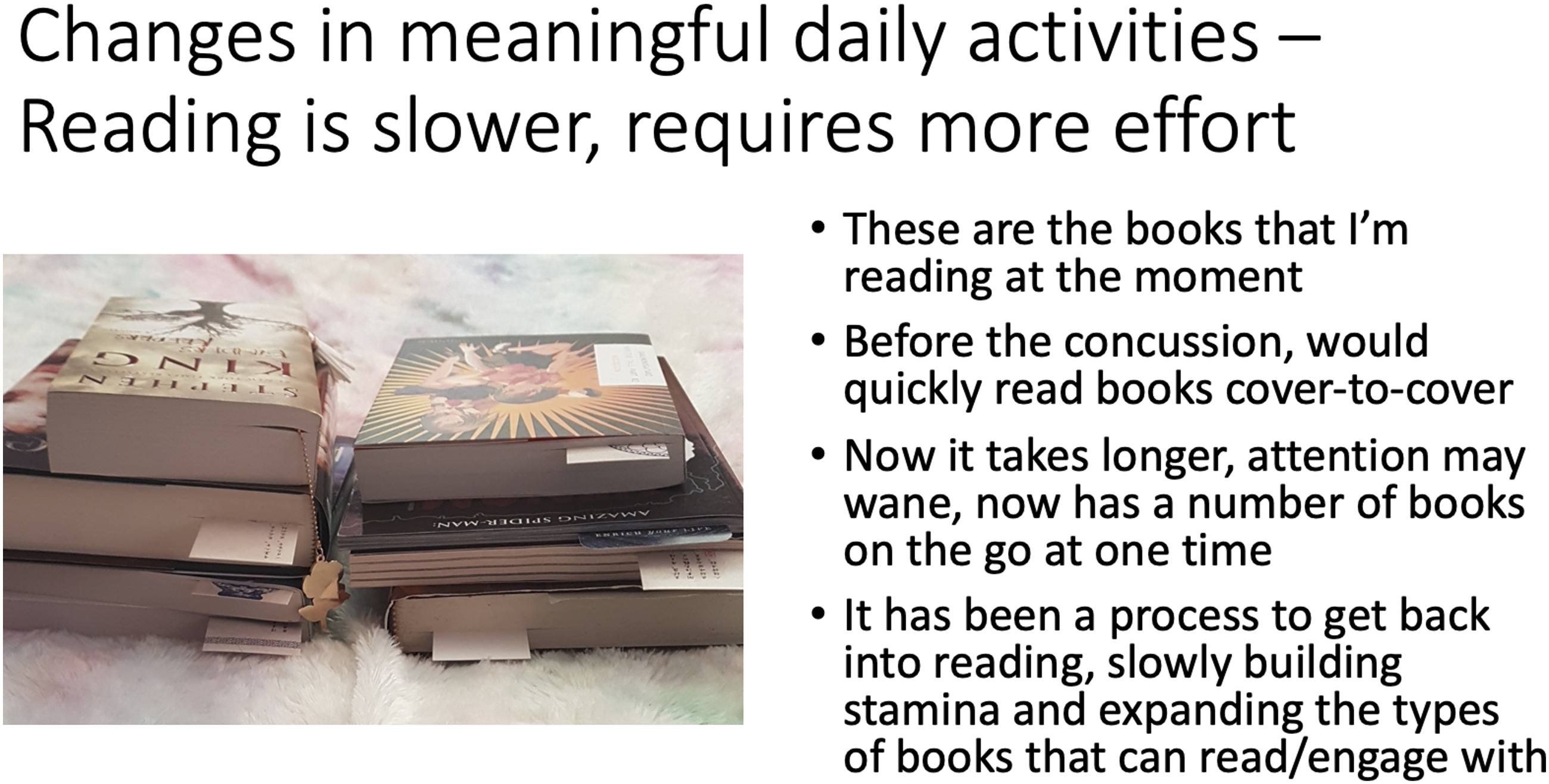
The first PGM discussed during Liz’s interview was an image of two paper birds (Figure 3). Liz explained that in the early days of her concussion recovery, she could only “sit in silence and read or craft or colour.” While she enjoyed making crafts, Liz shared that before her accident, she “would never have really made time for that unless it was also a social thing.” Energized by spending time with others, Liz liked engaging with people during her time off from work. Liz continued, explaining how the concussion interfered with her participation in meaningful daily activities, “in those first couple of days, I was…confined geographically because I wasn’t supposed to do any stairs. Yeah, so I was in the basement, in the darkness, making paper birds.” Photograph: “Paper birds,” by Liz.
Images provided participants with a tangible, visual representation of the picture in their mind’s eye to share with the researchers and created opportunities to think and explore concepts through metaphors. Two years post-concussion, 21-year-old Gladys submitted an image of a rainy day on a soccer field. During her interview, she explained that she searched for this image because everything felt dark and dreary after she sustained a concussion while playing soccer despite the sunny conditions she encountered on the day of her injury. When asked what search terms she used to find images, Gladys replied: “I think it was ‘communication’ and ‘depression’…and then the other one was just, like ‘rainy day soccer field’…it was just like mostly scrolling and finding what I wanted after I searched those.”
Motivated to practice his communication skills to improve his ability to participate in conversations in the workplace and with peers, 16-year-old TJ submitted a map to the study. He explained that the map not only gave him ideas of things to speak about but also helped support his memory while talking, saying, “it was just a picture but it helped me with my own writing because it would be something that I would recognize like the lake…[I] don’t want to look so stupid. I don’t want to look so confused.” The experiences of “confusion” are also discussed in the context of TJ’s notebook sketches. To work on his communication skills, TJ would visit the library to study and sign out books. The sketches in Figure 4 illuminate his inner dialogue while struggling to remain focused, interested and less confused. I was just trying to get myself out of boredom. You know? I spent most of the days during that period bored. Doing nothing, just sitting at home, looking at the ceiling, looking at the floor, looking at the walls, looking at the same old TV every f*cking day. It was so boring to the point that…I had to do something, you know. – TJ Notebook sketches: “Boring” and “confusion,” by TJ.
Twenty-one-year-old participant, Lily, submitted several drawings made during the acute phase of her concussion recovery, nearly two years before joining the study. As she introduced her artwork, she explained that her drawing, inspired by a character from a Japanese graphic novel, was “another thing that with the concussion has kind of gotten messed up.” Lily noted that drawing is “a form of communication too because drawing is an expression of yourself.” Lily used the submitted drawings to not only demonstrate and explain how the mechanics of her drawing had been affected by the changes in hand-eye coordination and hand tremors she experienced after the concussion but also reflect on how the concussion and associated communication changes affected her mental health. When asked to describe what drew her to the character represented in her drawing (Figure 5), Lily said, “it’s the look on her face…being in the darkness and seeing nothing but her eyes…I related to that because it…spoke to the isolation I felt at the time…the way that my mental health [was] deteriorating.” Analyzing her drawing further, she said, The darkness of the picture…represents that very early month of…me having to just sit in a dark room the whole time by myself…I was just an observer at the time…I just sat at home and watched as things passed by. I didn’t really get to, like, comment on how I felt, but I got to witness it all. – Lily Drawing: “I was just an observer,” by Lily.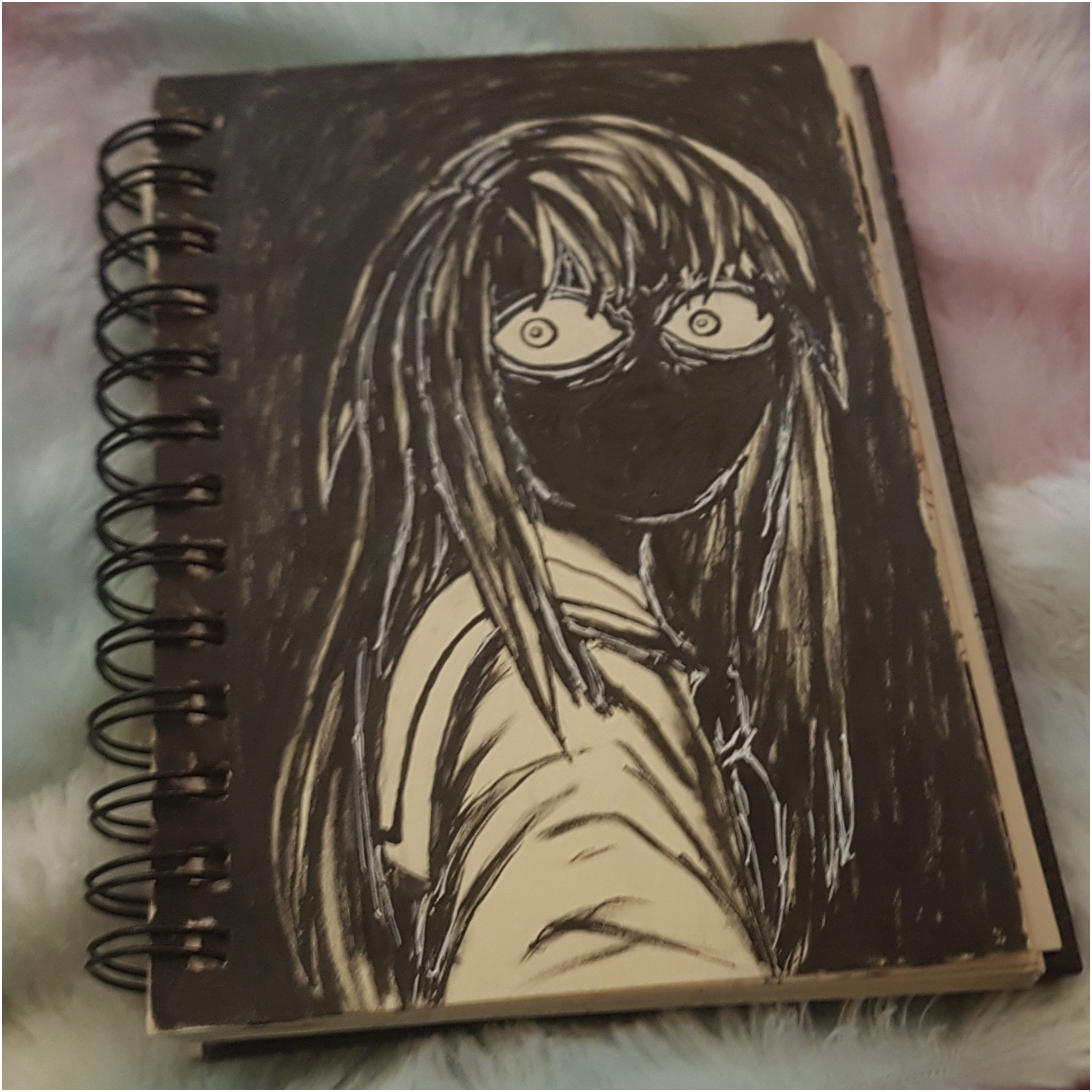
When asked to reflect on the experience of seeing the image and recalling her feelings from that time, Lily said, It takes me back to that moment, but I also try to look at it as a positive thing because…I don’t feel that as much. I feel like I have a voice. Participating in things like this, it gives me a voice and it allows me to express how my concussion makes me feel. And I’ve also grown a lot from that point, so I look back on that drawing and I see it as something positive. – Lily.
Literary PGMs: Poetry, Handwritten Letters, and Journal Entries
With the freedom to choose what types of creative works to submit to the study, Gladys contributed a pair of poems, the first from the acute phase of her injury (Figure 6) and the second (Figure 7), when asked to gather or create PGMs. So [this is] a poem I wrote…since we talked about doing that material, just kind of reflecting back…I used to write poetry a lot…it was actually really nice…I wanted to contrast that [poem] with the other one I wrote because that one I did right when I was concussed. – Gladys Poem: “Inside,” by Gladys. Poem: “Untitled,” by Gladys.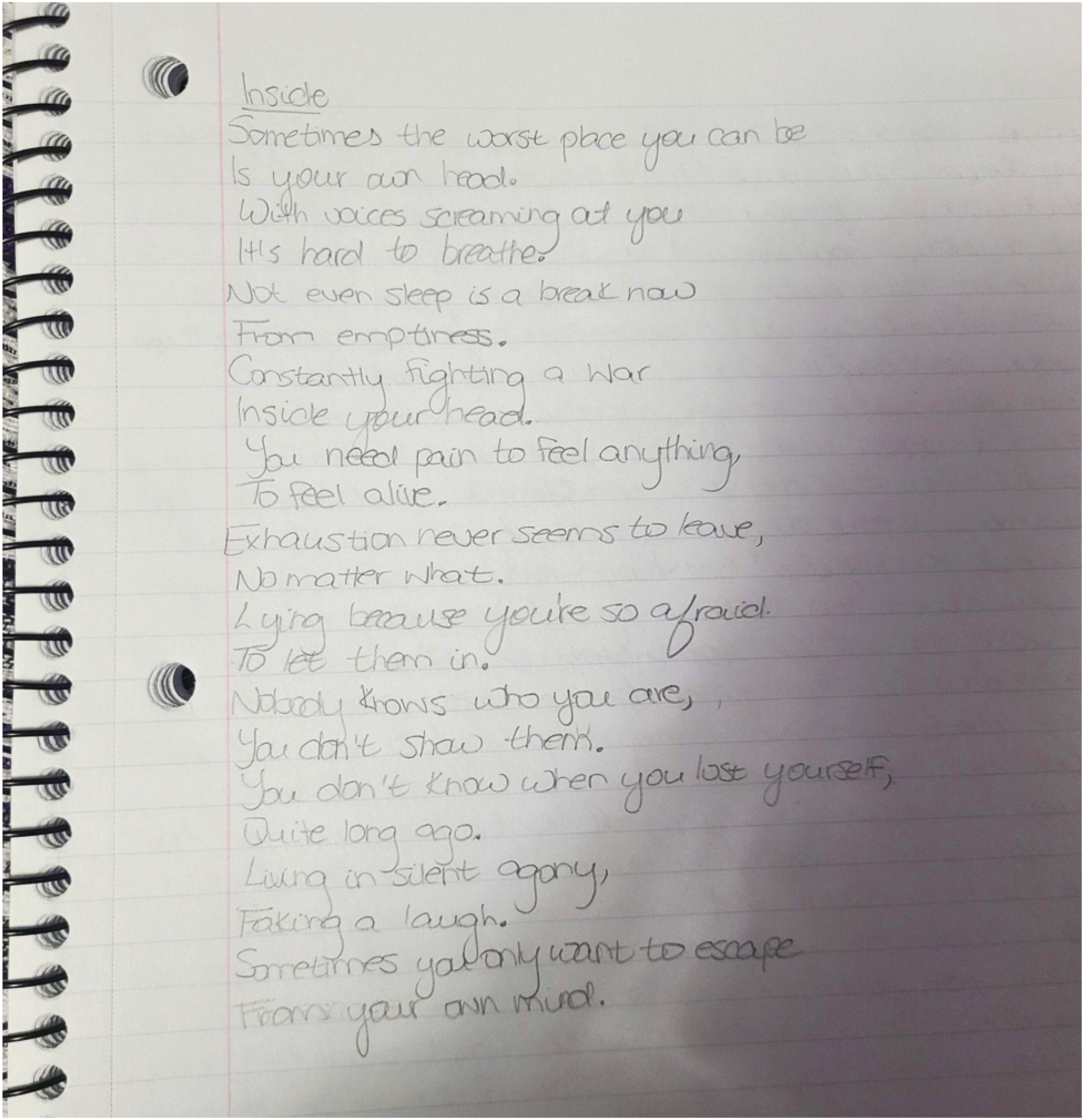
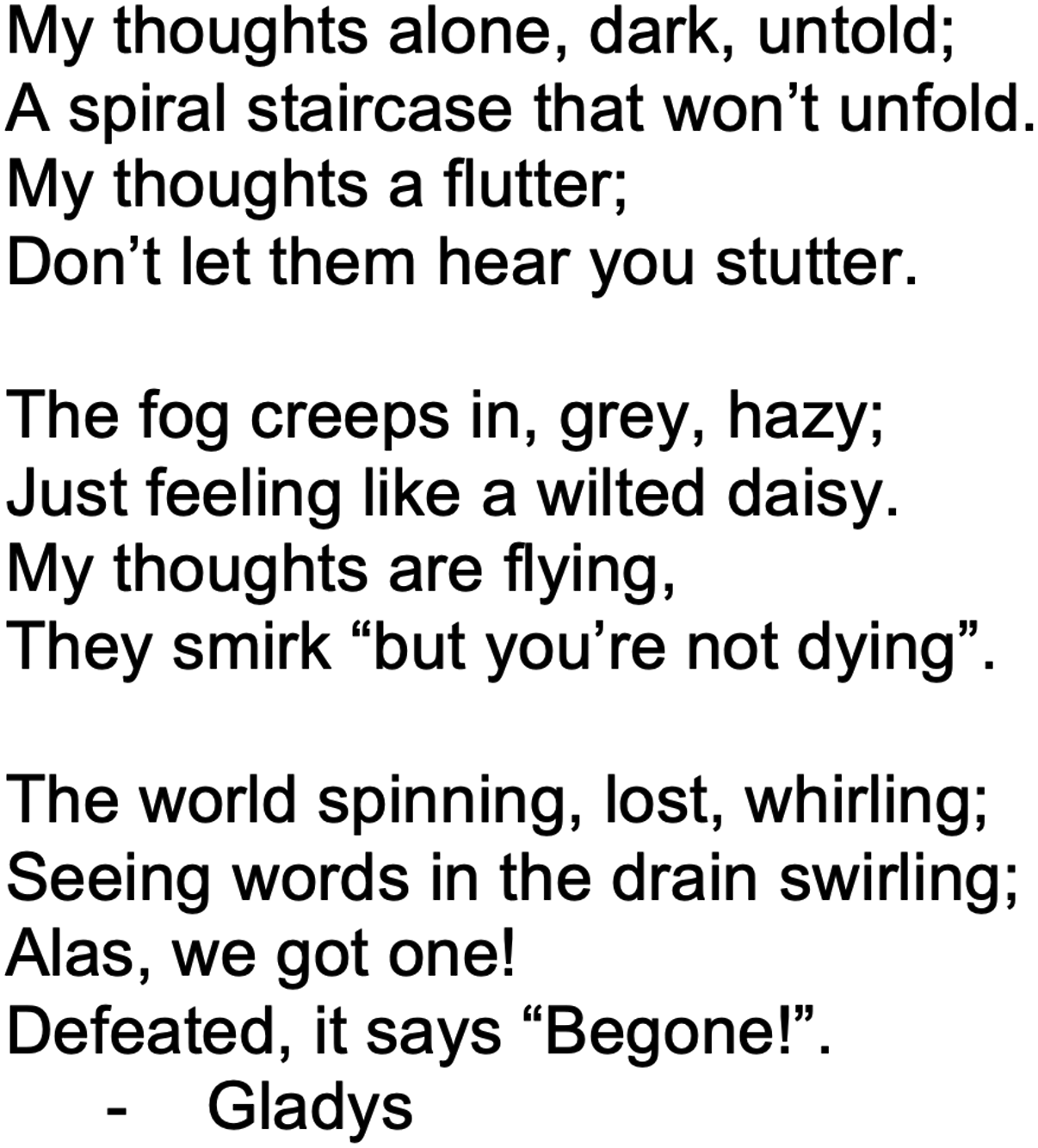
Gladys shared insights into how communication can affect a young person that the research team could not have anticipated. Gladys explained how, during her concussion recovery, the writing process “took a really long time,” commenting, “I remember being so frustrated with trying to get my emotions down on paper…writing was a big way for me to get my thoughts out and not being able to do that was really hard for me.” The poetry provided a starting point for Gladys to discuss the emotional impact of the communication changes she experienced, “not [being] able to say what you want, or, like, think what you want, or just, like, having all these, like, brain blocks was really hard for me, and I think, especially in writing it was really challenging.”
Analyzing and reflecting on the cognitive and communication skills needed to write poetry and how those skills were affected by her concussion, Gladys explained, “this one [“Inside”] …is pretty much exactly how I felt. Especially, like, just different, like the world spinning, and not being able to pick words” and she recalled thinking, “I can’t even think of a word I want to use, never mind think of another word to rhyme with that [word].” Reflecting on differences she experienced in the writing process from the acute concussion recovery phase to the resolution of concussion symptoms, Gladys said of the second poem, “it was really easy for me to put [my experiences] into words and have a rhyme scheme and have an intonation scheme and… [I could] think of the words I wanted to use really easily.” She continued, I think this [“Untitled” poem] took me maybe like 20 minutes to write. It didn’t take very long and I was really happy with it…contrasting that with the other one, it took me probably...seven days to write the other one, and I remember I had so many eraser bits everywhere. – Gladys.
Gladys highlights the relationship between communication and identity and the common experience of feeling like an outsider or an observer when navigating post-concussion communication changes, commenting, “when I looked at it [it was] like, wow, it’s like another person. [The person I am] now is like an outside person looking in, but at the same time, then I was like an outside person looking in as well.”
Gladys introduced elements of performative ABR, submitting song lyrics to the study. Gladys described how her musical preferences changed during her concussion recovery: “I’ve been a rock fan, but I did not listen to a lot of rock because it was too hard on my head.” Gladys discussed how the melody and lyrics resonated with her emotional state, There’s a group of three songs I listened to, over and over again, just because they were familiar and [had] a melody I could easily follow…Some of the lyrics…really resonated…you’re trying to break out of this funk and you just can’t…there’s still something holding you back and you just can’t quite put your finger on it…It made me feel like it’s okay to not be okay…if a band is writing about it, it must be okay. – Gladys.
A surprising contribution to the study was a hand-written letter submitted by Liz. She explained how she limited texting, video calls and face-to-face conversations with others to help manage her concussion symptoms. Instead, she began writing letters to friends and family to tell them about her accident. Liz explained that letter writing helped to counteract the monotony of spending her days alone in the basement, “I was really looking for other things that I could do so, eventually, I tried writing a letter.” In her letters, she would write, I’m staying off my phone, so I’m writing people letters instead. I read, write and colour all day, every day…I have a sensitivity to noise…I would tell them…you can text me and I will read the message I just might not respond right away or in length. – Liz.
Liz and Rose took a pragmatic approach to managing their concussion symptoms and communication changes. Liz tracked her symptoms daily in a notebook to help her adjust her daily routines to minimize symptoms (Figure 8). She explained, “I just started keeping track of the days that I worked or any day where I did something that caused me to have a major headache.” Referring to an entry written after a trial day at work, she said, “it says only increase in symptoms after conversing with customers.” She recalled, I learned that small talk is very difficult…you already feel drained…it is the end of a hard work day you’re just tired and then you have to go have a conversation with somebody…it’s very difficult to make yourself…happy and seem interested in…[the] conversation…that’s when I really realized - talking was hard. – Liz. Symptom journal excerpt: “Conversation makes me tired,” by Liz.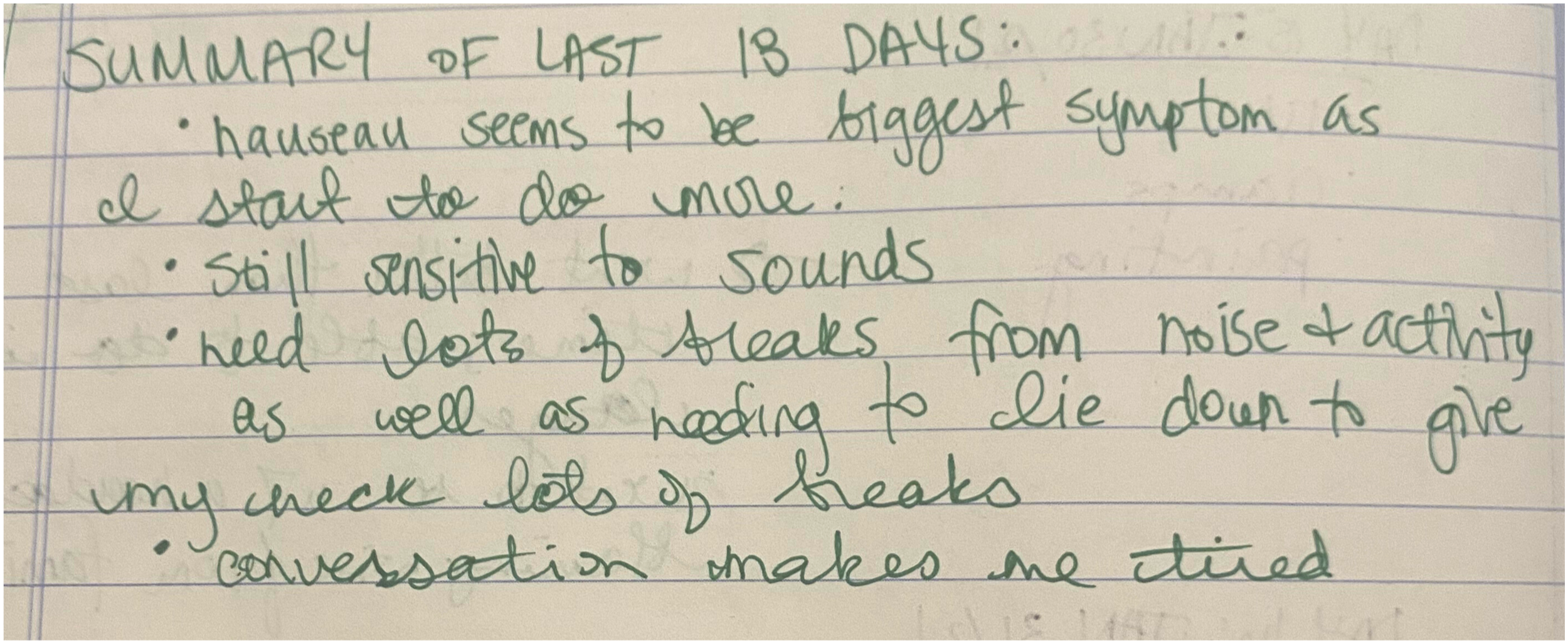
Rose, a university student at the time of her concussion, developed a due-date tracker in a customized interactive spreadsheet she programmed to assist with allocating study time, alerting her to upcoming assignments, and tracking completed tasks. One of the challenging aspects of adjusting to communication changes and concussion symptoms is the extra time needed to complete daily tasks, particularly academic tasks that rely on cognitive and communication skills. Acting as a metaphorical “second brain,” the due-date tracker supplemented the cognitive and communication skills needed to complete her responsibilities as a student. Rose remarked, “due dates and just knowing when things were due and when to do things…I didn’t realize how much my brain was doing…now that I write it out I’m like okay like there [were] a lot of things I was juggling.”
Part 3: Contributions and Considerations: Arts-Based Research and Communication
It’s kind of vulnerable, you’re showing part of your life and you’re like, this is how I feel about this picture, and this is how I feel about my experience…pictures are a lot different than talking about it because you’re like, this is a look into my life…I didn’t have a lot of physical representations of the time, just because so much of it was just going on in [my] head…it was really interesting…it also gave me a chance to reflect and like look back…if I had to show someone what it was like, these are some of the things [I could show them]. – Rose
Translation of Study Findings
ABR products can embody and express aspects of human experiences inaccessible through other qualitative research methods (Eisner, 1981). ABR methods granted our research team and, by extension, our intended audience of 1) young people and families navigating similar circumstances, 2) health care and educational professionals, and 3) those in broader public and academic circles, a look into the daily lives of youth experiencing communication changes. Applying arts-based methods to research makes abstract concepts and emotions more concrete through symbolism and metaphor while embracing pluralism, which “conveys and represents multiple intersubjective realities emergent from the ambiguity of chaos and not knowing” (Gerber & Coffman, 2017, p. 594). The arts-based materials that participants created during different stages of their concussion recoveries provided rich data about their past and current perspectives. This ability to “transcend temporality and allow us to experience and represent the past and present with vibrancy and simultaneity” (Gerber & Coffman, 2017, p. 594) is another feature of ABR that contributes to its translational power.
Practical Considerations
Collecting, creating and describing what the PGMs meant to them facilitated participant-researcher reflexive dialogue. Through the use of ABR, participants were deeply engaged with the topic, demonstrating the active process of critically reflecting on and making sense of their experiences of communication changes after a concussion during the interviews. ABR methods made tangible aspects of these experiences that are invisible and typically hidden. The depth and breadth of data collected and generated with the five youth participants in the case study extend beyond what could have been gathered through interviews or observations. Allocating time for participants to gather materials and consider personally relevant topics and stories was an intentional design decision. ABR materials helped participants experiencing cognitive and communication difficulties express their experiences and tell their stories with greater depth as the support provided by the visual or literary materials reduced memory and expressive communication demands during interviews. Arts-based PGMs increased the youths’ autonomy during the interview process by guiding the conversation to topics personally relevant (Phelan & Kinsella, 2011, 2013).
Ethical Considerations
ABR studies often employ innovative and novel research approaches; consequently, research ethics boards may not be fully equipped to guide the procedures used in these studies. Furthermore, ABR’s organic and spontaneous nature calls for researchers to be responsive to ethical moments as they unfold during data collection and analysis and mindful of future ramifications of sharing personal materials and case details in publications (Phelan & Kinsella, 2013).
One ethical consideration our research team encountered and navigated was the tension that exists between our desire and obligation as researchers to preserve participant anonymity while representing their experiences and voices authentically (Clark, 2020). Before submitting the PGMs, participants provided informed consent and specified where the materials could be shared (i.e., presentations, journal articles, book chapters) and how they wished to be credited for their artistic contributions (i.e., pseudonym, real first name, full name). As manuscripts were prepared for publication, the research team engaged in nuanced discussions regarding which materials to include in publications and how to represent them.
For example, one participant had contributed an image of the tattoo she commissioned during her recovery with the text “do it afraid”. The image was of her body, from the neck down, with the tattoo visible. Given the personal and intimate nature of this type of body art, the image of the tattoo was powerful. For this reason, we included the image in a draft manuscript. However, through individual reflexivity and reflexive dialogue between researchers, we reflected on whether the image revealed more personal and identifiable information about the participant than they may have intended to share publicly. Two considerations were instrumental in our deliberations: 1) a tattoo is unique and recognizable, particularly when it is clear where it is located on the body, and 2) the participant included an image of her body without her face, assumingly to maintain anonymity. Following our discussion, we decided to include the image as data and describe the image without including the image in published manuscripts.
Ongoing reflexive dialogue is essential to authentically reflect participants’ stories while maintaining privacy and anonymity. When using ABR methods, researchers must frequently question the purpose of gathering and sharing participant generated materials by asking, “What purpose does this creative work serve?” “How does including or publicly (re)presenting the creative work answer the research question/study aims?” and “What are the potential harms of making this information available?” In our case, we considered whether the image was needed to tell the story of the data or if a description of the tattoo would suffice. In this case, we determined that a written summary of the image and quote tattooed was equally powerful. If circumstances were different, and the image expressed something words could not do justice, we would have consulted with the participant before submitting the paper for publication to ensure they were comfortable sharing the picture in this way. We continue to reflect on our experiences, learn from the research process and evolving viewpoints in the field, and acknowledge that today’s decisions may not reflect future values or practices.
Another consideration is the role of arts-based materials in facilitating the discussion of challenging, personal or stigmatized topics during interviews. While contributing to the richness of our understandings of the phenomena of interest, researchers must be aware of the many ethical considerations that may arise when this uncensored access is granted. As Rose stated, there is a vulnerability in sharing artistic representations of personal experiences. It is recommended that arts-based researchers tread carefully and operate with sensitivity and reflexivity to represent the participants and the data accurately while avoiding objectifying the participants and their communities (Sinding et al., 2007). Researchers are discouraged from using creative works for “shock-value” and encouraged to use participant materials purposefully, with appropriate context, to mitigate the risk of misrepresentation (Sinding et al., 2007).
Researcher reflexivity is critically important to ensure what is made public during the translation of ABR study findings is relevant to the research question and does not pose current or future harm to study participants or those associated with them through the shared materials or quotations. Personal artifacts and stories are made permanent and open to interpretation once published. However, it behooves researchers to remind their readers that arts-based data are simply snapshots in time, reflecting what we have interpreted as participants’ experiences at that moment. Experiences and reflections on past experiences are dynamic. Personal narratives will be told and retold, shaped by new perspectives and the passage of time. Similarly, researcher decisions about data interpretation and dissemination are shaped by the sociocultural context and are therefore expected to change over time, calling for ongoing researcher reflexivity.
Implications
Given the traditional interview’s reliance on expressive and receptive language systems to share and build meaning, qualitative research often excludes those experiencing communication differences or changes. With growing calls to include those who communicate differently in qualitative research, ABR methods offer improved accessibility and inclusivity during data collection by providing participants with alternative forms of expression during data generation and may scaffold or augment interview responses. Additionally, by intentionally crafting open-ended and flexible instructions for generating creative materials, participants have the autonomy to dictate how they engage in the research process, including the creative media they decide to use and the experiences they choose to explore and share. These features of ABR have the potential to disrupt power dynamics present in participant-researcher interactions and improve participant engagement.
Conclusions
Research paradigms in communication sciences are shifting to include the experiences and perspectives of individuals experiencing communication difficulties. ABR offers communication researchers a means for increasing the accessibility of qualitative research methods to improve the inclusion of those who communicate differently in their study designs. ABR methods can provide viable alternatives to traditional and exclusionary qualitative research methods by reducing cognitive and communication task demands during interviews, allowing for multi-modal communication of ideas and facilitating deeper participant-researcher engagement and reflexivity. Showcasing arts-based participant generated materials in academic and non-academic settings creates new opportunities for the translation of research findings, increasing the impact of the work. When researchers apply arts-based methods with clear purpose and ethical practice, ABR has the potential to support inclusive research to further enrich our understanding of topics in the field and open doors to novel lines of qualitative inquiry.
Footnotes
Acknowledgments
We express our deepest gratitude to the youth participants for sharing their experiences and artistic works to help others understand what it feels like to navigate communication changes after a concussion. We thank the members of the research team who provided transcription support for the study.
Declaration of Conflicting Interests
The author(s) declared no potential conflicts of interest with respect to the research, authorship, and/or publication of this article.
Funding
The authors disclosed receipt of the following financial support for the research, authorship, and/or publication of this article: Jessica A Harasym was supported by the Social Sciences and Humanities Research Council of Canada [752-2021-2339] and the Women and Children’s Health Research Institute (Grant Application ID: 3195). This research was supported by a Faculty of Rehabilitation Medicine Thesis Operating Grant from the University of Alberta and a Faculty of Health Research Development Grant from Dalhousie University.
