




Abstract
Many issues and challenges face research design and research teams that want to become more inclusive, especially in large-scale research projects involving many stakeholders. This article explores an approach called Design-Based Research (DBR). DBR has been widely used in education for several years; it emphasizes collaboration with the community and takes the context of participants into consideration. DBR is transposable to other disciplines and is intended to be inclusive of the diverse stakeholders involved in a research project. For instance, in an ongoing research project about unconscious bias and inclusive behaviors, it takes into account all stakeholders’ needs and involves them in all stages of the research, which is taking place in a real-world context rather than a laboratory. The aim of this article is to better understand how the DBR methodology enables the inclusion of historically marginalized groups and how it is applied in the field. This exploratory article will present an example of an ongoing research project using the DBR methodology to show how this approach can be more inclusive than experimental approaches. This exploration reveals the positive impact of DBR in implementing solutions that can help reduce inequalities and power relationships. It also reveals the complexity of conducting qualitative research in a social laboratory. In particular, it takes into account the specificity of each historically marginalized group, from an intersectional perspective, the difficulty of operating within a process where not everything is determined in advance, and the need for a researcher specializing in DBR. It is important to allow sufficient time and financial resources at each stage to recognize the involvement of community organizations. The tools and knowledge generated by this type of research project will be useful for other organizations and future research.
Introduction
In qualitative research, it is often necessary for researchers to involve participants or partners in their projects. Indeed, participatory research encourages participants’ involvement at all stages of the research process, breaking down barriers between academia and the communities targeted by the research (Maltais & Bourgeois, 2021). Since the goal of research projects is to respect scientific criteria but also to contribute to the advancement of knowledge, it is not adequate to say that participants will be informed of the results or to publish only popularized texts on the findings.
Qualitative participatory research is frequently criticized because stakeholders from practice settings are often poorly involved, or solutions to improve a problem are poorly adapted to their realities. Decolonized and feminist methodologies in particular aim to challenge traditional research methods and show that research does not sufficiently take into account the contexts, the personal experiences, the knowledge and the participation of people representing historically marginalized groups (Celis, 2022). The lack of participation by historically marginalized groups (mainly women, racialized, Indigenous, disabled and members of the LGBTQ2S+ community) prevents researchers from acquiring knowledge that is only accessible within these groups and contributes to perpetuating inequalities and power relationships from an intersectional perspective (Courcy et al., 2019). Decolonized methods respond to the numerous critiques of studies carried out without the participation of historically marginalized groups, which put forward inaccurate interpretations of their societies and the results of which can be simplistic and reduced to stereotypes or distorted reasoning due to the researcher’s lack of knowledge of the context (Maltais & Bourgeois, 2021). For example, the use of traditional research methods in studies conducted with Indigenous communities has been criticized because these methods should be adapted to the social and cultural context of each community participating in the research. Dominant research models, such as the hypothetico-deductive model, risk dismissing Indigenous knowledge transmitted through the oral tradition, which is only accessible within the community from which it comes (Maltais & Bourgeois, 2021; Smith, 2021). Decolonized methodologies are not just about data collection: they address the entire research process by creating partnerships with participating communities and involving them in all stages of the research, from design to implementation and dissemination of results (Fine & Torre, 2019).
Thus, in this effort to decolonize scientific knowledge, embed research in the contexts of historically marginalized groups, and bring science closer to social spaces (Charron & Auclair, 2016), the principles of equity, diversity, and inclusion (EDI) must be taken into account at all stages of a research project. In addition to encouraging the participation of people from various underrepresented groups, inclusion refers to the implementation of practices that enable all members of society to be and feel valued, supported and respected, with particular attention to underrepresented groups within the research community and in the research itself (Fines-Neuschild, 2022). Inclusion is therefore rooted in social psychological theories and approaches and is addressed at the individual level as a sense of belonging and a perception of being a stakeholder in different processes (Adamson et al., 2021; Ferdman & Deane, 2014; Jansen et al., 2014; Nishii, 2013). Research has also shown that a balance between individual uniqueness and belonging within a work group is important in the search for inclusion (Chung et al., 2020; Mor Barak, 2015; Shore et al., 2018).
Despite the need to conduct participatory research inclusively, it is still challenging to achieve this in practice and at each stage of the research process. To our knowledge, there is a need for more scholarly articles that will provide a better understanding, through concrete examples, of how a methodological approach to research actually enables historically marginalized groups to be included, and how it is applied in the field. The aim of this article is to respond to this challenge by presenting our experience with a research project that proposes a methodology that establishes a dynamic of community collaboration and co-construction of knowledge: the Design-Based Research (DBR) methodology. This article is structured to provide coherent answers to the following questions: What is the DBR methodology? How can it be applied concretely in a research project? How does this experience contribute to the inclusion of historically marginalized groups and to the advancement of knowledge about inclusive qualitative research? To this end, the DBR methodology will be introduced, its characteristics described, and guidance given on how researchers can operationalize this methodology. This article provides a more detailed explanation of how this methodology can be inclusive at every stage of research in an ongoing study of unconscious bias and inclusive behaviors. Finally, we discuss the main lessons learned from this experience and how it can enrich our knowledge of inclusive qualitative research methods.
What is the Design-Based Research Methodology?
First known by the term “design experiments”, the DBR methodological approach emerged in the early 1990s with the work of Brown (1992) and Collins (1992). The aim of this approach is to design innovative solutions (tools, interventions, resources, devices, etc.) and test them in a real-life context. Collins (1992) argues that the DBR approach “cannot be an analytic science, such as physics or psychology, but rather a design science, such as aeronautics or artificial intelligence. For example, in aeronautics the goal is to elucidate how different designs contribute to lift, drag, and maneuverability” (p. 4). This methodological approach is in some ways a response to the limitations of predictive research methodologies such as experimental, quasi-experimental or predictive research and the randomized controlled trials used in health science (McKenney & Reeves, 2018; Reeves, 2006) (Figure 1). For this reason, “DBR has gained much attention over the past two decades due to an increasing frustration over the lack of the relevant and sustainable impact of findings of traditional research on actual practice” (Oh & Huang, 2018, p. 262). According to Brown (1992), a classroom is synergistic and many aspects of it cannot be considered independently but demand a systemic approach that takes the context and stakeholders into account. Although it is mainly used in education, it is reasonable to think that DBR can be applied to other contexts, such as social science research and management science. For example, just like a classroom, an organization is called upon to co-construct, collaborate, and interact with its stakeholders. Individuals develop in an ecosystem that includes inequalities, equity challenges, and changing beliefs and practices. Considering all stakeholders is therefore consistent with the inclusion of all groups during the research process. Predictive research versus Design-Based Research (Reeves, 2006, p. 59).
Unlike experimental research, the DBR approach aims to conduct research in situ to take into account the context in which it is conducted (Brown, 1992). Olson (2004) goes further, arguing that although double-blind experiments are feasible in medicine, they are impossible in education. In medicine, it is possible not to inform a sample of the nature of the treatment, but in education and the social sciences in general, participants know what the research is about and can change their beliefs, if only for reasons of social desirability. In this case, there is no consideration of EDI unless these populations are directly targeted, but it is not clear that this happens from an inclusion perspective.
A central element of DBR is the connection between theory and practice (Anderson & Shattuck, 2012). A theoretical framework or conceptual model is used to provide a relevant analytical grid for interpreting the results (McKenney & Reeves, 2018). Thus, the benefits of research that adopts a DBR methodological approach are twofold: the advancement of knowledge at the theoretical level and the benefits of design principles in the field (Anderson & Shattuck, 2012; Oh & Reeves, 2010).
In the case of experimental or even action research, stakeholders are not actively involved except, in most cases, as participants during the data collection. It is true that there is nothing new about considering stakeholders in participatory research, but DBR contributes to the advancement of knowledge at the theoretical, scientific and practical levels. In practice, this contribution takes the form of artifacts (training, tools, resources, etc.) that can be reused in the field. In this kind of research, stakeholders are considered from the outset and are also part of the research objectives. Regarding the involvement of stakeholders in engineering education, Minichiello and Caldwell (2021) argue, “To ensure the change is both positive and effective, DBR is conducted with educational practitioners and stakeholders from within the context of interest, as well as in collaboration researchers from other disciplines (Cobb et al., 2003)” (p. 32).
To operationalize DBR, we propose an approach with iterative cycles (Figure 2) inspired by the work of McKenney and Reeves (2018), The Design-Based Research Collective (2003), Plomp and Nieveen (2009), and Bannan (2009). The approach starts with a design phase, which involves creating a solution for a complex problem that is developed in collaboration with stakeholders. This phase is preceded by analysis and exploration of the context in collaboration with the stakeholders, including a literature review to scientifically validate the relevance of the research. The second phase aims to implement the solution in a real-life context or test it with the public for whom it is intended. Finally, the third phase consists in the evaluation of the solution. This is a scientific process and the evaluation entails collecting data. The DBR methodological approach does not specify the type of data to be collected, but it must be consistent with the research objectives. According to Zheng (2015), DBR is essentially qualitative, but iterations of the solution can also be evaluated using quantitative methods. Mixed methods approaches are in fact common (Ryu, 2020). The results are then used as inputs for the next iteration. There is no prescribed number of iterations, but we do not consider a single iteration to constitute DBR research; on the other hand, a large number of iterations can add to the complexity of the research project and will inevitably take longer. Iterative cycles of Design-Based Research.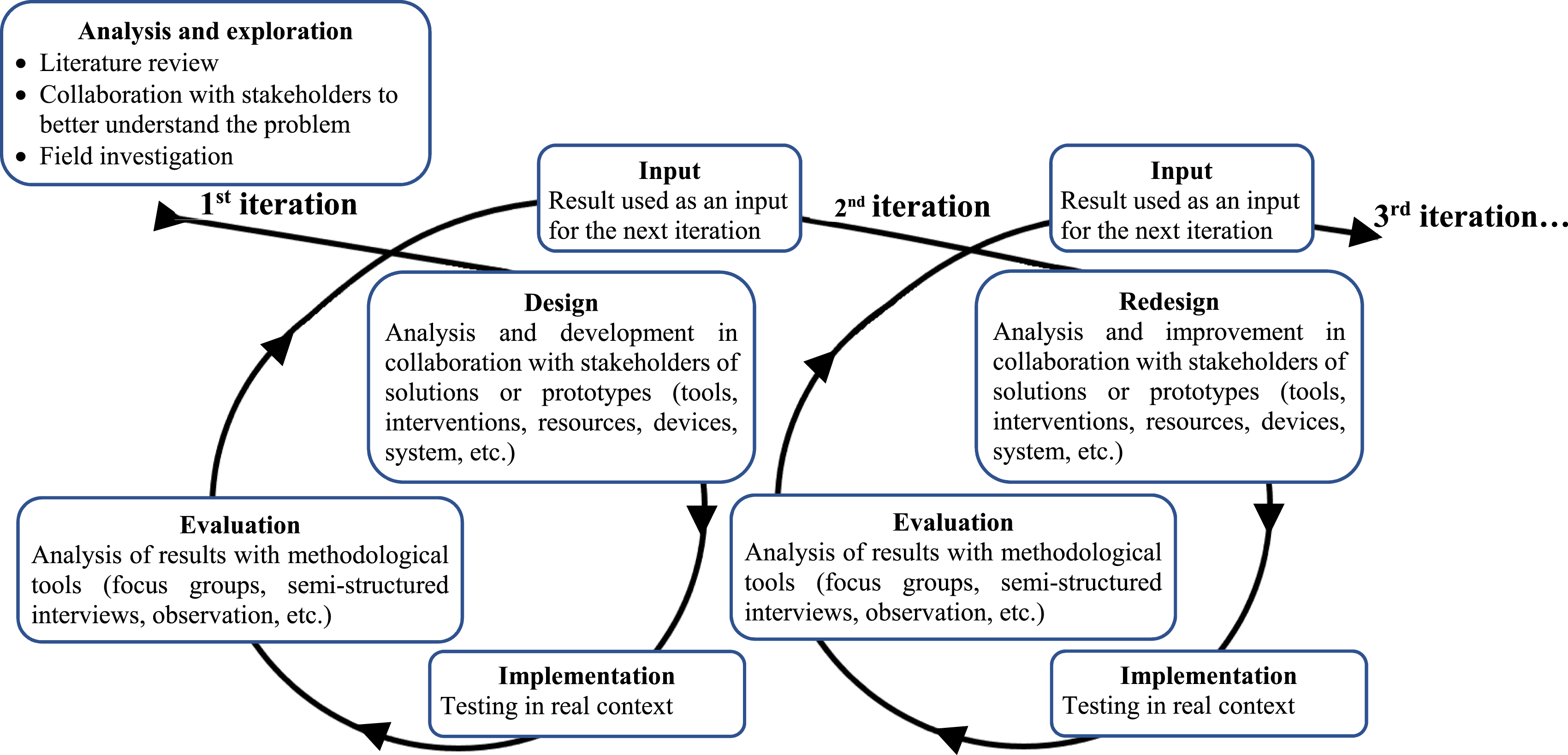
The DBR methodology is similar to other qualitative methods such as institutional ethnographic research and action research. Just like the DBR methodology, institutional ethnography allows researchers to report on the experiences, knowledge and practices of people in an organizational context and to produce knowledge by giving voice to groups whose voices have been marginalized in order to consider their experiences (Smith & Griffith, 2022). These methods also make it possible to avoid reproducing the power relations and social relationships in the organization (Lacharité et al., 2017). Both practitioners and researchers often have trouble differentiating between action research and DBR – likely because they share many epistemological, ontological and methodological underpinnings and a common meta-paradigm: pragmatism (Cole et al., 2005). These methodological approaches assign an important role to researchers, as they are involved in multiple stages of the research (Barab & Squire, 2004). As in anthropological and qualitative research, the same precautions regarding the researcher’s credibility and trust apply (Anderson & Shattuck, 2012).
Despite their similarities and the fact that researchers often have difficulty distinguishing between them (Anderson & Shattuck, 2012), action research and institutional ethnographic research differ from DBR mainly in their theoretical contributions. DBR contributes to theoretical developments related to solving a problem with stakeholders. The purpose of the DBR approach is to design and evaluate practical solutions that are appropriate for the specific environment (Goldkuhl, 2012; Hevner et al., 2010). For example, in the case of the research project presented in this article, organizations were looking for solutions to make people more aware of their unconscious biases and encourage them to adopt more inclusive behaviors.
How can DBR be Applied Concretely in a Research Project? Example of an Ongoing Research Project on Unconscious Bias and Inclusive Behaviors
To better understand how DBR can be operationalized and what is inclusive about it compared to other types of research, we describe an ongoing project. The research focuses on unconscious bias and inclusive behaviors. The choice of DBR for this research on inclusion was perfectly appropriate because inclusion is rooted in communities and exercised by them. In addition to allowing theorization about unconscious biases and inclusive behaviors, DBR makes it possible to generate a dynamic of collaboration with all stakeholders, allowing the development and experimentation of practices that evolve as the research takes place.
Context and Objectives of the Research Project
Although progress has been made in the fight against discrimination in organizations across all sectors, many inequalities persist against historically and socially marginalized groups based on national or ethnic origin, skin color, religion, age, gender, sexual orientation, gender identity or expression, marital status, family situation, ability, social class, and immigrant status, among other things. For example, in Quebec, only .3% of employees of public agencies are Indigenous people, about 10% are members of visible ethnic minorities, and 1% are people with disabilities (CDPDJ, 2020). In Canada, the representation of women on the board of the Toronto Stock Exchange hovers at around 20% (Bédard & Brière, 2018), and only 6% of board members are racialized people (lesaffaires.com, 2020). This breakdown suggests that the literature on inequality needs to be further explored.
One explanation for these inequalities is based on the concept of systemic discrimination against already marginalized groups, which represents the sum of the disproportionate effects of exclusion. This results from the combined impact of prejudicial and stereotypical attitudes, which are often unconscious, and policies and practices that are generally adopted without regard to the characteristics of members of groups targeted by the prohibition of discrimination (CDPDJ, 2020). These attitudes and stereotypes, defined as unconscious bias, affect our understanding, actions, and decisions unconsciously, involuntarily, or without intentional control; they need to be addressed in organizations to eradicate various forms of discrimination (Bellack, 2015; Blair, 2002; Dovidio et al., 2008; Kang & Lane, 2010; Kirwan Institute, 2017). Therefore, this research project seeks to answer the question: How can organizations, through mutual learning with various historically marginalized groups, raise awareness of employees’ unconscious biases and support them in developing inclusive behaviors that reduce discrimination related to different systems of oppression?
This project’s research question leads to several objectives: (1) identify types of unconscious bias and employee behaviors using theoretical frameworks, tools, training, and experiments specifically developed by experts from marginalized groups; (2) based on the knowledge of marginalized groups, develop a coaching model for organizations to strengthen their capacity to support employees in adopting inclusive behaviors, including supportive inclusive organizational practices; and (3) in partnership with marginalized groups and on a longitudinal basis, develop an approach with indicators to assess the changes brought about by the adoption of inclusive behaviors and practices in organizations.
Stakeholders Involved and Project Governance
This research involves collaboration and the co-construction of knowledge with historically marginalized groups represented in seven community-based organizations that specialize in these realities, a dozen research centers that include professors and students from various disciplines, and three major partner organizations from the municipal, health, and education sectors. These three partner organizations, which are committed to inclusion, constitute a social laboratory where research is conducted with people in their workplaces.
Project governance is based on a diversified, participatory and inclusive management approach. Work is done in teams, and management methods are designed to meet the needs of people in different work teams, while emphasizing the uniqueness of each individual. A collective approach is favored: everyone is involved in decision-making at every stage. The implementation of the project is based on a structure that allows us to work on each specific project dimension with the help of an expert team of co-researchers made up of representatives of local organizations, professors and students. Scientific and management committees also involve the three partner organizations in the consultation and decision-making process. Activities for each stage of the research will be carried out in an inclusive working environment, using diverse working methods.
Application of the DBR Methodology in a Research Project
The DBR approach is appropriate for involving all groups at all stages of this research project on unconscious bias and inclusive behaviors. A collective approach is applied, in which all people participate in all stages, based on inclusive behaviors.
As mentioned above, project management is designed to be diversified, participatory and inclusive. The management methods applied in the project seek to meet teams’ needs while recognizing individual uniqueness.
The example in Figure 3 shows the six iterations that are planned as part of the research project. The approach is incremental: each iteration serves as input for the next. For example, if a stakeholder group mentions that the interventions are not adapted or do not meet the needs of their community, the research team can adjust elements to better meet those needs while maintaining a rigorous scientific approach. Application a DBR methodology in a research project.
The first iteration will test the reliability and validity of the research questionnaire developed from the theoretical framework. The questionnaire will help people to become aware of and reflect on their unconscious bias and inclusive behaviors. The design of this questionnaire, which is called a digital compass, aims to better understand participants’ unconscious biases and inclusive behaviors. The compass allows real-time analysis of responses and suggests individual resources based on the scores obtained. After analyzing the results, adjustments will be made and we will be able to administer a questionnaire whose metrological qualities have been validated. The use of this questionnaire will enable the development of an educational digital compass to assess unconscious bias and inclusive behaviors. Once bias and inclusive behaviors have been identified, the second iteration will allow participants to better understand their bias and identify training and support needs. To this end, experiential training is developed that is adapted to the partners’ context and needs. The third iteration will define support mechanisms for adopting inclusive behaviors. Based on support needs, experiential training activities and discussions on the experimentation method for the development of inclusive behaviors will be carried out in accordance with the elements of the theoretical framework.
The fourth iteration will allow us to experiment and better understand the changes in inclusive behaviors, inclusive leadership and organizational practices based on the support model designed in the third iteration. Different mechanisms will be implemented for each group, accompanied by co-researchers who will document the experiments. These will be supported by participant observation tools specifically designed for the project. Feedback activities with participants on the experimental activities and adaptation of the coaching model are also planned.
The fifth iteration will identify observable changes. Participants will be asked to complete the questionnaire again. This post-test will be used to conduct a paired sample t test to assess whether the interventions were significant. When participants complete the questionnaire a second time, they will also be asked feedback questions to help them adjust the resources suggested in the digital compass. Specific questions on inclusive organizational practices and inclusive leadership will also be formulated for selected managers. This will allow for feedback on the coaching model, changes observed, and validation of indicators and tools for assessing change. Finally, in the sixth iteration, we will consolidate the tools developed and share the lessons learned from the prototype. This stage will prepare the way for extending the approach to other partner departments or divisions, as well as to other organizations wishing to adopt a similar methodology.
Because DBR allows it, the procedure for the first iteration resulted from design work with the stakeholders. The design process of the digital compass is therefore inclusive because it made it possible to work with the various historically marginalized groups to design the questionnaire, develop the resources, and ensure that the information collected is useful for partners. The training design process took place during several working meetings in order to co-construct and experiment with original content using inclusive pedagogical methods and delivered by a diverse training team.
Discussion and Conclusion
This article seeks to answer to the following question: How does this experiment contribute to the inclusion of historically marginalized groups and the advancement of knowledge about inclusive qualitative research? The primary objective of this article was to better understand how the DBR methodological approach enables historically marginalized groups to be included, and how it is applied in the field in a research project about unconscious bias and inclusive behaviors. This exploratory article presents an ongoing experiment based on the DBR methodology to show how this approach can be more inclusive than experimental approaches that traditionally do not involve participants in the different stages of research. Some key lessons learned from this experience contribute to the advancement of knowledge about inclusive qualitative research and the capacity for qualitative research methodology to be inclusive.
One of the spinoffs of the DBR methodology is that it allows for solutions that can help reduce inequalities and power relationships. It is important for qualitative research, such as DBR, to be part of a decolonial epistemology that emphasizes social justice. This approach is based on standpoint theory (Hartsock, 2019), which considers the multiple lived experiences of participants, including those of historically marginalized groups, and promotes a creative process of co-construction of knowledge (Falquet, 2021). This perspective allows actors to question the researchers’ positioning to avoid renewing power relations that could have an impact on the knowledge produced by the research (Larochelle-Audet, 2019). Vakil et al. (2016) mention that constructs related to race and power are rarely considered in research design, unless they are the specific topic. Thus, considering the whole context in DBR-type research has the potential to improve equity among historically marginalized groups. A feature of the DBR methodology is its collaboration and co-construction of knowledge and practices. Stakeholders develop solutions, tools and resources through collaboration and co-construction with the participants concerned, and the resulting artifacts are therefore well adapted to the communities’ needs. Thus, adaptation to different contexts is another element that makes the methodological approach inclusive, as iterative evaluations provide knowledge that serves as input for subsequent iterations. Additionally, involving all stakeholders in designing solutions that will be useful to historically marginalized groups and collaborating at all stages of the research project also help to reduce power relationships. This approach responds to researchers who point to the lack of participation by historically marginalized groups, the exclusion of knowledge accessible only within these groups and the perpetuation of inequalities and power relationships from an intersectional perspective (Charron & Auclair, 2016; Courcy et al., 2019).
The lessons learned in this experiment include the complexity of carrying out qualitative research in the context of social laboratory and theorization. As presented in Figure 3, inclusion of all groups is characterized by stakeholder participation and ownership of the project. This is important to ensure that everyone is properly aligned with the project goals. It also ensures that stakeholders have a common understanding and feel involved in the project. Stakeholder involvement in the DBR methodology revolves around the idea of a social laboratory, as it creates a collaborative space and brings together stakeholders with a common goal, namely finding solutions for a problem.
One of the remaining challenges in this social laboratory, as highlighted by studies showing the importance of the balance between individual singularity and belonging to a work group (Chung et al., 2020; Mor Barak, 2015; Shore et al., 2018), is to work from an intersectional perspective, while respecting the specificity of each individual and each historically marginalized group. For example, in the training development phase, highlighting the different realities of each group proved to be a major challenge. Another challenge is the complexity of operating in a process where not everything is determined in advance, considering each iteration. This requires a great deal of flexibility on the part of research partner organizations, which usually need to know about a project in detail before planning their participation. In this context, the presence of researchers specializing in the DBR methodology to ensure adaptation by team members and consistency in the iterations is essential for the success of the research process.
Another lesson learned relates to project progress. The project so far has highlighted the need to allow sufficient time for each stage and to ensure that all stakeholders are properly involved. Projects using a DBR methodology typically take several years to complete, but research funding sometimes has a limited duration. Operationally, the DBR methodology is complex to implement, especially when numerous partners are involved, and when the budgets involved are substantial. Financial resources are important as the participation of community-based organizations representing the realities of historically marginalized groups must be recognized and must not be done on a volunteer basis, as is often the case in projects involving such groups.
Finally, according to Oh and Huang (2018), a more inclusive research approach can help reduce the gap between research and practice, as all the groups involved in the project can be represented. Thus, DBR has favorable characteristics for the inclusion of different groups in a research project. The example presented in this article shows that working with all stakeholders to meet their needs requires a dual intent for the research, namely to contribute at both the theoretical and practical levels.
In terms of practice, it is important for the tools and knowledge generated by this type of research project to be useful and used by other people and organizations in different sectors of activity. In the case of the project presented here, the digital compass developed is already accessible to a wider audience and training will also be available shortly once it has been tested in the research project.
At the theoretical level, it is relevant to encourage inclusion in other qualitative research projects by using a DBR methodology. This would overcome some limitations of the project presented in this article because the project is presently under way. The project team is very sensitive to the issue of inclusion because it is one of the themes of the research project. At the end of this research, and as an avenue for future research, it would be relevant to carry out a postmortem analysis of the entire process. This could be done by using collection tools allowing the various stakeholders, and especially historically marginalized groups, to express in more detail the strengths and weaknesses in this participatory and inclusive approach to research using the DBR methodology.
Footnotes
Declaration of Conflicting Interests
The author(s) declared no potential conflicts of interest with respect to the research, authorship, and/or publication of this article.
Funding
The author(s) disclosed receipt of the following financial support for the research, authorship, and/or publication of this article: The authors received support for the research from Social Sciences and Humanities Research Council (Race, Gender and Diversity Initiative).
